


9,99 €
Mehr erfahren.
- Herausgeber: The History Press
- Kategorie: Sachliteratur, Reportagen, Biografien
- Sprache: Englisch
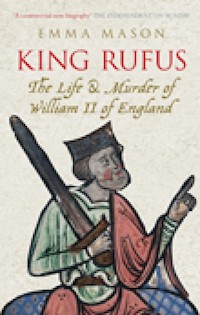
The future William II was born in the late 1050s the third son of William the Conqueror. The younger William, - nicknamed Rufus because of his ruddy cheeks - at first had no great expectations of succeeding to the throne. This biography tells the story of William Rufus, King of England from 1087-1100 and reveals the truth behind his death.
Das E-Book können Sie in Legimi-Apps oder einer beliebigen App lesen, die das folgende Format unterstützen:
Veröffentlichungsjahr: 2008
Ähnliche



















In Memoriam
Victoria Chandler
1950–1999
Contents
Title
Dedication
Preface
1 Introducing the Red King
2 The Third Son
3 Securing the Throne: 1087–1088
4 Brothers at War
5 The Northern Frontier
6 Challenges to Royal Authority
7 Conflicts
8 Triumph; Tragedy; Epilogue
Map
Annotated Select Bibliography
List of Illustrations
About the Author
Copyright
Preface
The reign of William II has had a compelling fascination for me since I gave my very first lecture in English history on this topic when I joined the teaching staff of Birkbeck University of London. While preparing that presentation, I was struck by the contrast between the positive achievements of the reign and the negative light in which William was viewed by most historians who were active down to the late 1960s. Ideas voiced in that lecture were developed in a paper delivered to a staff-student seminar for members of the Birkbeck Faculty of Arts. The interest generated then encouraged me to develop these ideas still further in my first article on the subject, ‘William Rufus: myth and reality’, which evoked wider discussion. Some years later, I published a second article on the subject, ‘William Rufus and the Historians’, examining the treatment of the king by writers over successive generations. I concluded with a brief outline of why, in the light of international political tensions of the time, it seemed probable that the king’s death was not accidental. The preparation of a further paper, ‘William Rufus and the Benedictine Order’, convinced me that in some important respects the monastic writers of the twelfth century conveyed a misleading impression of the king’s dealings with the religious houses.
When my work on William II reached this stage, Jonathan Reeve of Tempus invited me to write a book on the subject, a biography rather than a thematic ‘reign of...’. Plenty of information about the king is found in the work of those who wrote within a few decades of his death, but this was all slanted in one direction or another. In drawing on these accounts, my book could readily have been subtitled ‘A Study in Spin’. Writers in the ancient world already practised spin, and its use continued down the centuries. In the early twelfth century, monastic historians used negative spin with gusto as they attacked a ruler who siphoned off clerical wealth to fund his military projects. Positive spin, on the other hand, is found in the depiction of William II in Geoffrei Gaimar’s Estoire des Engleis. This writer used to be regarded as a mere entertainer, but recent studies of him and of his source of information when writing of this reign indicate that his positive depiction of William and his court circle should be taken seriously.
The further back in time a historical subject existed, the sparser and more problematic the sources become, so that detection and deduction increasingly come into play. No one can claim to be truly comprehensive when writing on a subject so far back in time as William II. Those readers who enjoy detective stories will find plenty of conflicting sources here from which to draw their own conclusions. The ultimate challenge comes in deciding what did happen in the New Forest on 2 August 1100. Did the abbot of Gloucester, the old woman and the huntsmen know something which was covered up by the establishment of the next reign? And who were those who transmitted the name of Raoul d’Equesnes so discreetly down the generations until responsibility for the king’s death was no longer a politically sensitive issue?
Among the many people who have given me specialist advice during the preparation of this work, I am particularly grateful to three who generously allowed me to see work of their own in advance of its publication: Val Wall, in respect of her paper on the Venoiz family, ancestors of Constance Fitz Gilbert, the patron of Geoffrei Gaimar; Ian Short, translator of Gaimar’s L’Estoire des Engleis; and Neil Strevett, in respect of his University of Glasgow PhD thesis, ‘The Anglo-Norman Aristocracy Under Divided Lordship 1087–1106’ (2005).
Others who have been particularly helpful include Alison Finlay, who responded to repeated calls on her expertise in Old Norse; John Hayward, who resourcefully found many of the illustrations; and Richard Mortimer, Keeper of the Muniments of Westminster Abbey, who enthusiastically collaborated in the hunt for the real find-spot of the sculptured capital depicting William II and the monks. Janet Barnes and Penny Wallis both provided additional illustrations.
My ideas on the reign of William II have developed during conversations with many of the participants in the annual Battle Conference on Anglo-Norman Studies. Individuals both there and elsewhere have, over several years, kindly given me items of bibliography or clarified points of detail. Those to whom my thanks are due include Bill Aird, David Bates, Martin Biddle, David Crouch, Katherine Edwards, John Gillingham, Roy Hart, Chris Lewis, Sharon Lieberman, Mark Philpott, Rosemary Power, Susan Reynolds, Richard Sharpe, Matthew Strickland, Naomi Sykes, Kath Thompson and Ann Williams. Jane Dobson expertly and energetically word-processed the text to publication standard.
The dedication is to the memory of a kind friend, a brave woman and a dedicated medieval historian.
CHAPTER ONE
Introducing the Red King
William II (1087–1100) was formally styled throughout his reign as William, King of the English (sometimes adding ‘by the grace of God’), William, King of England or, in a formal record, as King William the younger.1 Down to the 1130s, chroniclers working in England used one or another of these styles, and the nickname of Rufus (‘the Red’ in Latin) was virtually unknown to them.2 If, as seems likely, this nickname stemmed from some feature in William’s appearance, his French-speaking family probably knew him as Guillaume le ros or le rossel.3
Red hair perhaps still recurred in the Conqueror’s family, due to its Viking ancestry, but writers working in England in the twelfth century are agreed that William, as an adult, had fair hair, variously described as ‘rather yellow’, or ‘blond’.4 They differ, though, over whether he had a red beard,5 or a ruddy complexion.6 Youthful red hair can fade to golden brown in an adult. This perhaps happened in William’s case, while his beard retained its original colouring. Equally, though, he may have inherited the very fair north-European skin type of those whose face quickly turns red after eating and drinking or after exposure to strong sunlight or wind.
William’s nickname is first used, in its Latin form, by writers working in French-speaking lands. Guibert, Abbot of Nogent-sous-Coucy, writing between 1114 and 1124, stated that the king was nicknamed Rufus because he was red: (‘qui Rufus, quod et erat, cognominabatur’).7 A few years later, another monastic writer, Orderic Vitalis, based in the Norman abbey of Saint-Evroul, began to record William’s nickname in the successive books of his Ecclesiastical History, a work which, despite its title, is largely taken up with the secular politics of the day. More than half of all his references to the king accord him one or another of his formal styles, most often King William, but occasionally William the younger.8 Orderic often referred to the king as William Rufus, though, and occasionally as William Rufus, King of the English.9 As his work progressed, Orderic sometimes abridged this to King Rufus, the equivalent of ‘The Red King’.10 Geoffrei Gaimar, working in England in the later 1130s and writing in French, stated that William was known as the Rus Rei (the Red King).11 This nickname was probably already circulating in England when Geoffrei wrote, since he is not known to have had any direct contact with Orderic. The king’s nickname continued to be used by writers later in the twelfth century, both in its French and Latin forms. Wace, writing for the court of Henry II, called William Guillelme le Ros (William the Red, or William Rufus) or else Li Reis Ros (the Red King).12 Towards the end of Henry II’s reign, Walter Map, another writer in court circles, used the formal Latin styles of Willelmus secundus rex Anglie (William II, King of England), King William, or William Ruffus.13 Even in the highest social circles many men had nicknames, usually derived from some feature in their appearance. Being called William the Red carried with it dashing and exuberant overtones, on a par with another nickname, Longsword, which one writer ascribed to him.14 A tenth-century ancestor of his had been the first William Longsword, a man around whom there was some effort to promote a religious cult.15 This alternative nickname, sanctioned by family tradition, may have been the original one by which the future king was known.16 Clearly, though, the red feature in his appearance was so conspicuous that he quickly became known as Rufus. In his own time, and for generations afterwards, being known as William the Red or the Red King carried no derogatory overtones, but in the nineteenth century the writer E.A. Freeman, in particular, used the nickname to heighten his vilification of William II.17
William of Malmesbury described the king as stockily built, with a ruddy complexion; his ‘rather yellow’ hair centrally parted; his eyes of indeterminate colour, containing bright specks; physically very strong, despite his moderate height, and with rather a paunch. He was not an accomplished speaker, and when he fell into a temper he had a marked stammer.18 William of Malmesbury was probably born about 1095 or 1096, so he is unlikely to have seen the king, but he may have spoken to older informants who had met him. It has been observed, though, that this description of William II includes features which the Roman writer Suetonius ascribed variously to the Emperors Augustus (stocky), Claudius (stammering when angry), and Titus (exceptionally strong in proportion to his height).19 William II may have resembled, more or less, the description of him by William of Malmesbury, but this cannot be verified. His portrayal on his coinage reflects the image of himself as king that he wanted to project, rather than his actual appearance, while two thirteenth-century miniature ‘portraits’ of him reflect how an artist of that period thought a king should look. In his depiction on a capital which was retrieved from the precincts of the palace of Westminster, he is shown with short, curly hair (the sculptor depicted none of the figures with straight hair) and a short, neat beard. Given the context, and the possibility that the sculptor had seen him, this may have been an attempt at a likeness, and was at any rate an image of himself that the king wanted to project.20
Objective accounts of the reign written by those close to the centre are non-existent. The Canterbury monk Eadmer, biographer of Archbishop Anselm (1093–1109), also wrote the Historia Novorum (History of Recent Events) – essentially, in his view, a prolonged conflict between those exercising royal and ecclesiastical power. Eadmer’s hero Anselm is depicted in a prolonged confrontation with King William, who is depicted in a uniformly bad light. Reading between the lines of Eadmer’s narrative, and of those of other monastic writers, we gain a distinct impression that the king intentionally shocked his clerical opponents by making sensational remarks from time to time, and that earnest bystanders gained a frisson from these, then drew on them to provide good copy for their tendentious accounts of the reign.21
Both of Eadmer’s major works, his Vita Anselmi (Life of St Anselm) and his Historia Novorum, rely largely on notes which he took when travelling in the company of the archbishop, from soon after Anselm’s election to Canterbury. These narratives have the strengths and limitations of lively eyewitness reporting, selectively presented to give only the archbishop’s viewpoint in his confrontations with King William. Eadmer began writing the Vita Anselmi during the 1090s, but around 1100 the archbishop discovered what he was doing. He asked to see the work and then corrected various points, suppressed some, changed the order of others and approved the rest. A few days later, though, he told Eadmer to destroy the manuscript. The order was obeyed literally, but not in the spirit. Eadmer secretly made a copy, and resumed work on it after Anselm’s death. Consequently, the work is very full when it covers the dealings of King William with the archbishop but, since note-taking was subsequently debarred, there is far less on Anselm’s dealings with the king’s brother and successor, Henry I.22 This imbalance inadvertently reinforced King Henry’s own claims to be altogether a better king towards his subjects (including the clerics) than William had been. What is more, the detailed version of the archbishop’s dealings with King William was that which, thanks to Anselm’s revision of the text, he himself wanted to be recorded for posterity. The Vita Anselmi is a valuable work in many respects, but it is not an objective depiction of William II.
Eadmer was compiling material for his Historia Novorum at the same time as he was working on his biography of Archbishop Anselm. Between 1094 and 1100, he made careful notes of the key debates and discussions in which the archbishop was involved. He included in this second work lively eyewitness accounts of both royal and ecclesiastical councils which he attended as a member of Anselm’s entourage, but he was not an impartial observer. He had a real talent for vivid description, and his reporting of the disputes between King William and Archbishop Anselm probably covers these confrontations fairly accurately, as seen from the archbishop’s viewpoint. On the other hand, Eadmer rarely records anything about the king’s policies apart from those which had implications for the archbishop, and of which he himself had direct knowledge. He omits from his work a great deal that could be said in favour of William, but includes discreditable rumours about the king. Between 1109 and 1115 Eadmer drew on these notes to write up his Historia Novorum. He did further work on it from 1119, but without making any extensive revisions.23 The disparaging spin that Eadmer put on his account of the arguments between King William and Archbishop Anselm stems from the fact that the archbishop distanced himself from worldly concerns, while the king’s overriding interest was in the funding and attainment of his military objectives.24
In one area, though, Anselm did have practical aims. At Canterbury he succeeded to a long line of predecessors who aspired to exercise a quasi-imperial ecclesiastical authority throughout the British Isles, and he did all in his power to succeed in this.25 Yet his aim could be realised only with the support of successful military campaigns. These in turn required financial and military support from the greater landholders – including the archbishop – a point which Anselm ignored. Whether the archbishop was totally oblivious to practical considerations is questionable. It has been argued that he was, in a real sense, a revolutionary, determined to shift the balance of power in the realm away from royal authority towards that of the ecclesiastical hierarchy, headed, of course, by himself. Acting in line with the precepts that successive Popes asserted with increasing vigour from the mid-eleventh century, it has been claimed that, during the later years of William II and the early years of Henry I, Anselm attempted to impose a series of reforms on the Church in England which were designed to further his aspirations to be acknowledged not only as the primate of the whole of Britain but also as co-ruler of the kingdom of England.26 Anselm’s supporters regard this case against him as being too sweeping, but even with more limited objectives, his disregard of his reasonable obligations towards the king put him on a collision course with William. Eadmer needed to justify his hero, and the best form of defence was to attack William as the oppressor of an unworldly prelate.
A more comprehensive account of the reign is contained in the Anglo-Saxon Chronicle. During the tenth century, and for much of the eleventh, this work was kept up at several monastic centres, whose writers all had their own perspectives on national events, but after the trauma of the Norman Conquest there was no longer much enthusiasm for maintaining a work written in English for an English audience. After 1079 there is, for all practical purposes, only one extant version, which is generally known as the E-text. From the middle of the eleventh century this version was kept at St Augustine’s abbey in Canterbury, but then either the author-manuscript or a copy of it was sent to Peterborough, perhaps shortly after 1116. Neither the manuscript actually sent there nor any earlier version of it survives, but at Peterborough itself a copy was made covering events down to 1121, and inserting passages relating events of particular relevance to Peterborough.27
Superficially, the Anglo-Saxon Chronicle consisted of a series of annals in which each year’s events were written up just after they had occurred. Increasingly, though, from the early years of the eleventh century, hindsight crept in, and literary passages were inserted to heighten the drama of the narrative. The coverage of the reign of William Rufus in the E-text is in the form of annals, but in their surviving form they date from 1121 or later, when the manuscript was reworked at Peterborough. Most of the annals for the reign are quite long, and the writer commented on events in some detail. Naturally, this text emphasised those policies of the king which had a major impact on monastic interests. When covering the later years of the reign, the writer repeatedly criticised the heavy taxes that were levied.28 Summing up the king’s reign, he criticised William’s policy of leaving bishoprics and abbacies vacant after the deaths of their incumbents, so as to profit from the revenues of their extensive estates. The chronicler wrote that the king acted forcefully and fiercely towards both his subjects and his neighbours, and was ‘very terrible’. The advice of his wicked counsellors and his own avarice led him to harass the nation by constantly demanding military service and levying punitive taxation. Because of these persistent malpractices, William was hated by ‘nearly all’ his people. God’s judgement on him was demonstrated by the fact that the king was cut off in the middle of his wrongdoing, without time for repentance or for making any reparation.29
The Anglo-Saxon Chronicle provided the basic source material used by several twelfth-century writers, although some of them drew on versions now lost, which differed to some extent from the E-text.30 One of these men was John, a monk of Worcester Cathedral priory, who wrote the Latin chronicle which bears his name. Essentially, John echoed the verdict of the Anglo-Saxon Chronicle on the king, but in a modified form. He wrote that William’s dramatic death demonstrated God’s vengeance for the demolition of churches, and the uprooting of those who had worshipped in them, when William the Conqueror created the New Forest. There was much injustice in the reign of William II, and the verdict of judges was swayed by the offering of bribes. The chief agent responsible for exacting the punitive taxation and for the retention of church benefices was the king’s minister, Ranulf Flambard.31 An informal network existed among the major chroniclers of the earlier twelfth century, and inevitably information was transmitted from one writer to another. John did gain access to a manuscript of Eadmer’s Historia Novorum, but made little use of it when narrating the reign of William II.32
Two further monastic writers, William of Malmesbury and Orderic Vitalis, deployed their literary talents to the full when they narrated the reign of William Rufus. William of Malmesbury covered the reign in two of his works, the Gesta Regum Anglorum (History of the English Kings) and the Gesta Pontificum Anglorum (History of the English Bishops). The Gesta Regum was begun with the encouragement of Queen Edith Matilda, the first wife of King Henry I.33 Through her mother, Queen Margaret of Scotland, she was descended from the pre-Conquest kings of England, and the work accordingly charted the secular politics of the land from the coming of the Anglo-Saxons down to the twenty-eighth regnal year of King Henry I.34 The queen died in 1118, long before the work was finished, but copies were dedicated to King David of Scotland (her brother); to her daughter the Empress Matilda; and to Earl Robert of Gloucester, the eldest bastard son of King Henry I.35 Naturally, this courtly audience expected William of Malmesbury to write favourably of the successive royal subjects of his work, a consideration which placed him under some constraint when it came to discussing William Rufus. Given the king’s appropriation of clerical wealth, a policy continued by Henry I despite his renunciation of this at his accession, the chronicler was obliged to omit a good deal of the criticism that he felt about King William and instead to comment favourably on him, as far as possible.
Much of the information on the reign that William of Malmesbury did include is also found in the Ecclesiastical History of Orderic Vitalis, in particular, and also in the Anglo-Saxon Chronicle, Eadmer’s Historia Novorum and in the Chronicle of John of Worcester. William seems to have obtained almost all of his material independently of any of them, sometimes from verbal sources, but he criticised the same features in the king’s character and rule as did the other writers. When William wrote his Gesta Pontificum for a clerical audience, he was free to give full vent to his criticisms.36 The Gesta Regum is transmitted in four versions, all essentially originating with William of Malmesbury himself. Two drafts were written over a period of years, down to about 1126. One of these drafts was transmitted much as it stood, but the other was substantially revised by about 1135, after which one manuscript copy of this revised version was amended still further.37 Comparison of the texts that transmit these varying versions shows that over the intervening decade William of Malmesbury toned down some of his initial criticisms of William Rufus.38
Around the time that William of Malmesbury was modifying his criticisms, another monastic writer was composing his own account of the reign. Orderic Vitalis, born in England in 1075, of a French father and an English mother, entered the Norman monastery of Saint-Evroul ten years later, and was based there for the rest of his life.39 In his massive Ecclesiastical History – a work which, despite its title, has a great deal to say about secular politics – he covered the reign of William Rufus in Book VIII. This was probably written between 1133 and 1135, with some additions made a year or so later.40 While on a visit to England, he saw Eadmer’s Vita Anselmi and also the Chronicle of John of Worcester, but generally he relied very little on written sources while covering events in England and Normandy between 1083 and 1095 – the last years of William the Conqueror and most of the reign of William II. For this period Orderic seems to have relied very largely on oral sources and on his own memory.41 He did not move in court circles, but probably gained information from some of the eminent men who called at Saint-Evroul in the course of their travels.42
Besides writing several decades after the end of William’s reign, and largely without the benefit of relevant written sources, Orderic interwove his account with imaginary speeches which he put into the mouths of his protagonists.43 In comparison with the speeches reported by Eadmer, which at times may represent his recollections of confrontations which he himself witnessed, those included by Orderic are not verbatim reporting. He introduces direct speech into his narrative in order to dramatise a point of view, or else to sum up a discussion. At times he merges into one confrontation a whole series of discussions which in reality may have been far more low-key. The ideas being debated, too, were sometimes closer to those of the 1130s, when Orderic produced much of his work, than to the 1090s.44 The king could be made to appear politically incorrect by the standards of generations as yet unborn. Orderic, and also William of Malmesbury, used speeches to indicate that the king’s policies changed sharply after the first few years of his reign, and that these changes were decidedly for the worse, from a monastic standpoint.45 In common with both Eadmer and William of Malmesbury, Orderic indicates that the king often spoke brusquely, in a staccato and even a stuttering way, which was probably correct. Yet, while he was impatient of clerical attempts to criticise or restrain his actions, he was utterly fearless in warfare and in the hunting field, and he respected the newly emerging code of chivalry.46 Despite Orderic’s criticisms of the king, he acknowledged William’s skills in warfare.47 These were also admired by other writers. William of Malmesbury wrote that, from a military point of view, the king could be compared with Alexander the Great, and might almost seem to be a reincarnation of Julius Caesar.48
The secular achievements of William II were also acknowledged by Suger, abbot of the French royal abbey of Saint-Denis. His assessment of the king was made from a different standpoint to that of the English monastic writers, none of whom showed any understanding of the constraints of government, and in particular of the need for the steady cash flow that enabled it to function. Monasteries, above almost every other interest group in society, appreciated stable government, but monastic writers showed a marked resentment of the taxation of their wealth, which funded the defence of the Anglo-Norman frontiers. Eadmer, John of Worcester, William of Malmesbury and Orderic Vitalis were all monks from boyhood onwards. With the probable exception of John, they all travelled widely at times, but almost entirely within a monastic orbit. Their interests were scholarly, and three of them never held high office. The exception was Eadmer, but his six-month tenure of the bishopric of St Andrews served only to demonstrate his complete failure to adjust to the requirements of his new position in public life, a post which he relinquished abruptly.49 Suger, in contrast, governed an exceptionally prestigious abbey for many years (1122–51), while also acting, for most of this time, as a royal counsellor. In this capacity he was chiefly employed to negotiate both with the Anglo-Norman monarchy, the enemy of his own Capetian sovereigns, and also with the papacy. Suger’s appraisal of William Rufus is found in his Life of Louis the Fat, a text on which he worked over many years, compiling material during Louis’s reign, repeatedly revising the work and making interpolations. It was eventually completed a few years after King Louis died in 1137.50 Suger was born c.1081. By the time that Rufus died, in 1100, he was a young adult, still completing his education.51 Despite his natural bias towards French interests, he described William Rufus as ‘the very great king of England, the son of the even greater King William who conquered England...’. Suger noted the pride of William Rufus, his undaunted valour, his energy, his wisdom, his military skill and his eagerness for glory and fame.52 King William was clearly depicted as a worthy and formidable opponent of Suger’s own monarch. This positive image was not absorbed into English historiography, though. The predominant image of the king, transmitted from one generation to another, was essentially that projected by Eadmer and those who drew on his work.
An English secular clerical writer, Henry, Archdeacon of Huntingdon, was a contemporary of these monastic historians. He was born c.1088, the son of Nicholas, Archdeacon of Huntingdon, and his English wife.53 From 1100, or perhaps slightly earlier, Henry was at Lincoln, where he received his higher education. The bishop at this time was Robert Bloet, formerly chancellor to William Rufus. The bishop himself continued to visit London frequently, but it is not known whether Henry ever saw William II.54 The circumstantial indications in his writing that he attended the royal court date from the reign of Henry I onwards.55
Henry of Huntingdon is chiefly remembered for his Historia Anglorum (History of the English People), a work which Robert Bloet’s successor, Alexander, Bishop of Lincoln (1123–48), asked him to write. This request was probably made soon after the bishop’s election, and most of the text was completed by c.1130. Henry then did further work on it down to 1154 or slightly later, in order to include contemporary events. In this later period, he also made some revisions to its earlier books, or sections.56 Eventually, the Historia existed in six different versions, copies of the basic text with variations made by Henry himself.57 Henry intended that his work should appeal not only to Bishop Alexander, but also to a wider audience. He stated that he wrote ‘for the many – I mean the less well-educated’. He therefore used simple language, adopted a strong storyline and included plenty of dramatic incident.58 The protagonists in his narrative came over well, thanks to his rhetorical skill and his detailed assessment of character.59 The Historia Anglorum briskly covered English history from the coming of the English until Henry’s own later years. Thanks, probably, to his maternal ancestry, he could read English, and he drew heavily on the Anglo-Saxon Chronicle, supplemented by a range of Latin works.60 When his narrative reached the reign of William Rufus, he announced that, although he had relied on older works and on handed-down stories up to this point, he would now deal with what he had personally seen or heard, or what he had heard from people who did witness particular events.61 This is misleading, since he continued to draw on written sources, and chiefly on the Anglo-Saxon Chronicle, down to 1133. Henry’s statement, therefore, really indicates that his own birth occurred about the same time as William II became king. The account of this reign essentially reflects the monastic perspective of the Anglo-Saxon Chronicle, augmented to a limited extent by some Norman annals, and a short section of memorable sayings of the king, although these may draw on classical sources.62
Robert Bloet was royal chancellor by January 1091, relinquishing the office when he was consecrated bishop of Lincoln in February 1094.63 Any anecdotes of life at court in this period which he may have relayed later to the chapter at Lincoln found no place in the Historia Anglorum. If Henry of Huntingdon did hear any such stories, he perhaps thought them unsuited to the general tone of his work. William of Malmesbury reported Bloet’s abilities as an administrator in secular business, contrasting this with his ignorance of Church matters and his lack of gravitas.64 The former chancellor’s perspective on the reign would surely have differed from Henry’s chief sources, and may be reflected in his brief reference to Rufus as ‘the great King William’,65 praise which contrasts sharply with the monastically derived criticisms of him found elsewhere in the Historia Anglorum.
Secular views of William II would have differed considerably from those of the monastic writers, but laymen did not write history – or much else for that matter – in the generations after his death. King Alfred (871-99) had encouraged literacy among the upper classes. Towards the end of the tenth century, Ealdorman Æthelweard even wrote a Chronicle, in Latin. His choice of language probably reflected the fact that the work was intended for his cousin Matilda, abbess of Essen in Germany.66 By Æthelweard’s time, the English language was increasingly used to convey written information. Other lay authors are unknown, but the wealthier lay people, including King Harold II, his mother, sister and sister-in-law, all owned books, and presumably read them.67 In the post-Conquest era, too, many people in aristocratic circles could probably read, even if they could not write, but they gained their knowledge of the past very largely from secular clerics, who would declaim their works before a select audience.68 There was no clearly defined line between history and literature in these circles, but there was an enthusiastic audience for works which combined these two genres.69
Writing his Estoire des Engleis (History of the English) in the later 1130s, Geoffrei Gaimar worked in the French language, the medium for popular literature in this period. The earlier part of the Estoire was in effect a rhyming paraphrase of a text of the Anglo-Saxon Chronicle, with a little romanticising reinterpretation of events. As the narrative progressed beyond the Norman Conquest, though, the chivalric ethos came to predominate. When the work reached the reign of William Rufus, Geoffrei produced a brilliant portrait of a king who combined military skills with a chivalric, courteous approach to life, who was good-humoured and generous, and whose joking – the very quality which Eadmer deplored – was shown to be a strategy to defuse tense situations at court. Even though Geoffrei omitted some aspects of the reign on which the Latin chroniclers focused, notably the appropriation of monastic wealth, there is no reason to sideline his glowing pen-portrait of William II as fictional, since he may well have drawn on the recollections of older contemporaries who had known the king. Yet Geoffrei Gaimar’s depiction of William II did not enter mainstream historiography. Writers in subsequent generations would discount any text written in French, the language of romance literature, and instead would use as source material only ‘serious’ works, written in Latin and with a strong monastic bias. The pen-portrait of William in the Estoire des Engleis was, in effect, forgotten. Writers working in the wake of the Reformation would gladly have used it, but did not know of it. The text was rediscovered and printed only in the middle of the nineteenth century. Even then, the monastic portrait of William II was too deeply entrenched to be revised by the leading historians of the day, or by those in succeeding generations.70
A generation or so after Geoffrei Gaimar finished his Estoire des Engleis, another verse-history (in French) was being composed by Wace. This writer was born in Jersey, educated in France, and then based in the Norman city of Caen, occasionally commuting for short periods to Bayeux, where King Henry II granted him a prebend in the cathedral. When Wace began his long history of the dukes of Normandy, the Roman de Rou (The Romance of Rollo), he was already an experienced writer, who claimed to have composed many vernacular works.71 Part III of the Roman de Rou, the section which covers the reign of William Rufus, was written at some point between the mid-1160s and the mid-1170s.72 The work drew both on written sources and on oral ones, including informants at Bayeux. When Wace did not know something, he said so, although, like other writers of the period, he invented the speeches that he put into the mouths of his characters.73 The substantial section on William Rufus depicts the king in much the same way as does Geoffrei Gaimar, even though Wace did not draw on this earlier writer. William, as portrayed by Wace, is chivalrous, an energetic and able war leader, and given to joking.74 This presentation of William II did not enter mainstream historiography. Like Geoffrei’s Estoire, the Roman de Rou would be regarded as popular entertainment since it was written in French, rather than in the more ‘serious’ Latin. Even as a work of entertainment it was not popular, judging by the fact that out of the eight manuscripts which survive, only four (including a fragment) are earlier than the seventeenth century.75
The depiction of King William in the romance works of Gaimar and Wace had no impact on Walter Map, a well-educated cleric whose De Nugis Curialium (Courtiers’ Trifles) was largely drafted in 1181 and 1182, with some slightly later additions.76 This Latin work, largely designed for a courtly audience, describes William as ‘the worst of kings... a monster hateful to God’ – the man who drove Anselm from Canterbury, depopulated the New Forest and uprooted thirty-six of its churches.77 Map’s work was seemingly designed as a collection of exempla – stories with a moral. Where their sources can be traced or deduced, he is often shown to have garbled them, whether accidentally or else to make a telling point, as with his lurid anecdote about events leading up to the death of William Rufus.78 Walter Map’s work did not circulate in his own time, and its one surviving manuscript dates only from the fourteenth century.79 Gerald of Wales, writing his De Principis Instructione early in the thirteenth century, introduced William as a dramatic figure who foreshadowed many of the features of Henry II and Richard I, in order to demonstrate that their tyranny was in the tradition of the kings of England.80
Later medieval chroniclers, when they discussed King William at all, largely transmitted the old monastic anecdotes with their hostile bias.81 Following the Reformation, though, the historians of the later sixteenth and seventeenth centuries depicted William II more favourably, with emphasis on the wars and political issues of his reign. In sharp contrast to the monastic historians, most of these writers put a favourable interpretation on his personality. His opposition to papal claims was particularly admired.82 Yet, although these historians were aware of the bias in the monastic chronicles, they rarely discounted it entirely. Consequently, the depiction of the king that first appeared in the works of the earlier twelfth-century chroniclers continued to be transmitted. It was revived in the later nineteenth century, and given a sharp injection of Victorian notions of morality.83
William Stubbs published a particularly hostile tirade against William II in his The Constitutional History of England.84 This in turn influenced E.A. Freeman when he wrote his massive biography of the king. His own comments on the chroniclers whom he cited indicate, though, that he had mixed feelings about his subject. Freeman considered that many of the worst acts of the reign were committed by the king’s followers, rather than by William himself, but he still followed the chroniclers in accusing the king of sexual depravity and irreligion.85 Freeman popularised the term ‘the Red King’, but also conceded that William had the qualities of a knight and a gentleman.86 Yet it was the generally hostile tone of Freeman’s work that was taken up by succeeding generations of historians down to the mid-1950s, despite a major challenge issued by V.H. Galbraith in 1944. In a published lecture, he criticised the reliance that had been placed on chroniclers who actively misrepresented the king. Galbraith pointed out that, as successive chroniclers repeated particular anecdotes, these were increasingly fictionalised. Moreover, historians often misinterpreted the assumptions on which statements had been made initially. By the time Stubbs and his contemporaries were at work, their own prejudices led them to gloss events even further, in effect reimposing medieval values.87
Yet even after Galbraith’s warning, other historians writing as late as the mid-1950s made, at best, some tentative moderation of the chroniclers’ views. Usually they would cautiously approve of one or another of the king’s policies but add that, in other respects, nothing could be said on his behalf. In subsequent decades, though, the balance began to tip in William’s favour.88 In 1967, Christopher Brooke published a vivid reappraisal in his The Saxon and Norman Kings;89 a provocative article on Archbishop Anselm by Sally N. Vaughn followed in 1975;90 and my own initial reappraisal of the reign of William II followed in 1977.91 Frank Barlow published his full-scale biography of the king in 1983, depicting him more favourably than he had done in an earlier work in 1955.92 In 1983, too, Michael Clanchy, in a major political history of medieval England, observed that, while monastic chroniclers had regarded Rufus from one perspective, secular contemporaries of the king would have viewed him in a contrasting light.93 Later in the 1980s, Marjorie Chibnall reached a verdict on the king which was generally favourable to him.94 At the end of the decade, Pauline Stafford observed that the attacks on the government of William Rufus were really made against long-term developments in monarchical rule which had evolved over the previous two centuries. The king was made a convenient scapegoat for these, at a time when royal policies were increasingly bearing down on ecclesiastical interests. Simultaneously, the emergence of the Gregorian reform movement encouraged churchmen to see themselves imbued with a ‘holiness’ which distinguished them from the laity. Consequently, it was much more difficult for William Rufus to establish a working relationship with Anselm than for his predecessors to work with their own archbishops. By the late eleventh century, royal power faced a challenge which did not exist in earlier times.95 My second reappraisal of the reign, in 1991, reinforced my earlier perception of its positive qualities.96 Since then, recent work by Ian Short, translator of Estoire des Engleis, and by John Gillingham, commenting on that text, has demonstrated that Geoffrei’s depiction of the king must be taken seriously.97
David Crouch published in 2002 what might be termed a revision of the revisionists. He saw William as remorseless, cruel and calculating on some occasions, but facile, ironic and humorous at other times. Crouch did, though, give William credit for a political vision and military skill which matched, and perhaps exceeded, those of his father. He suggested that disillusionment with human nature and a sense of personal insecurity led the king to maintain an atmosphere of terror at his court, so that he might even be likened to Nero, a verdict which is largely drawn from William’s treatment of the conspirators in 1095.98 In fact, their fate may owe little to the paranoia that Crouch implies, but much to William’s realisation that his generous treatment of the rebels in 1088 had not brought long-term stability.
No fully rounded assessment of any medieval person is possible, given the inevitable bias, imbalance and limitations of the available sources. In addition to those already discussed, there is the added hazard in the chronicles of the Anglo-Norman period that their writers drew on anecdotes which they found in Classical Latin works. When two chroniclers independently include the same episode relating to William Rufus, this in itself does not prove that the story is true, since further investigation may show that both writers drew on the same classical text.99 There are major obstacles to reaching any full understanding of the thought-world and social conditioning of the time. It is as unrealistic to empathise with the king as it is to condemn him for his reactions to the difficulties he faced. Eleventh-century political life was harsh. Amiable and altruistic non-entities – if any such existed – caused more problems than they could hope to solve. William Rufus met problems and dangers head-on. While his rapid response to a crisis could be extreme, as in 1095, in the climate of the day this was often the only means by which effective rule could be imposed.100
The historical importance of the reign of William II has often been overlooked by historians unduly biased by the medieval chroniclers. In several respects, though, the reign witnessed important developments which established an agenda followed by the king’s successors. Most significant for political and economic life in England over the new few centuries was his effort to gain control of as much as possible of the continental lands which had been held by his father, a process which combined diplomacy, military operations and financial inducements to his older brother Robert, who mortgaged the duchy of Normandy to him in order to go on crusade.101 The king’s sudden death before Robert’s return leaves William’s intentions towards the duchy an open question, but his objective of reconstituting the Anglo-Norman realm was taken up by his younger brother Henry and their successors. Consequently, for centuries to come, the need to maintain armies on the continent had major consequences for England. William the Conqueror evidently regarded the defence of his continental lands as his main priority, but, while these clearly mattered to William Rufus, he also took energetic measures to ensure the security of the frontiers of England and to extend them as far as possible, another objective which had long-term consequences.
The expense of repeated expeditions, whether in Britain or on the continent, and in particular the need to hire large numbers of mercenary troops, resulted in a demand for a steady flow of taxation. The means by which this was raised affected other areas of life in England. Intermittently, throughout succeeding centuries, the demands on the populace for heavy taxation to finance the war effort led to a reaction which at times endangered the stability of the monarchy itself. In the reign of William II, revenues were drawn to a large extent from the wealth of ecclesiastical landholders, both bishops and abbots, chiefly by the expedient of holding sees and abbacies vacant for years at a time. Crown revenues derived from Church lands were not a new phenomenon in this reign, though. Tenth-century kings frequently appropriated the estates of minster-churches which had succumbed to the Danish inroads of preceding generations. If churchmen in the late Anglo-Saxon era wanted to take control of these lands, then they had, in effect, to buy them back.102 What was seen as an unwelcome innovation in William II’s reign was the practice of holding the greater benefices vacant, coupled with the growing rigour with which Church lands were assessed for fiscal purposes. Henry I addressed clerical grievances in his Coronation Charter of 1100, undertaking not to appropriate revenues from vacant bishoprics and abbacies.103 Clerical wealth, though, remained all too tempting a source of revenue, and was tapped by one expedient or another for centuries to come by successive kings determined to finance their continental wars.
William II is remembered for his disagreements with some of his senior prelates, as the papal reform movement grew in strength. Yet he was not the first king of England to experience a challenge to his authority from that quarter. King Edward (1042–1066) was alerted to the threat to his prerogative when papal reforming synods were held, from 1049 onwards, and when his own nominee to the bishopric of London was rejected by Archbishop Robert, who claimed to have papal authority for his action.104 William the Conqueror had largely good formal relations with the papacy, although he maintained firm control over his prelates, both during his earlier years in Normandy and later as king of England. He also put some limitations on direct contact between the papal curia and individual prelates in his lands. There could be no open dispute about this, since his goodwill was essential to the Pope, in view of ongoing tensions between the papacy and the western Emperor, and the challenge presented by an antipope.105
William II’s adroit dealings with the papacy were to have long-term significance for future rulers. His reign largely coincided with the pontificate of Urban II (1088–99) but also with the anti-pontificate of Clement III (1080–1100), a genuine reformer who had the support of a substantial number of cardinals. William naturally postponed declaring for either man while there remained real uncertainty about which was the true Pope. After Urban II emerged triumphant in 1095, William acknowledged him, but obtained significant concessions in return, the most important of which was that papal legates would only be admitted into the kingdom of England with the king’s permission.106 This prevented their activities from undermining royal authority (as had happened in the western empire), and was to have long-term consequences for Church-State relations. Attempts by Archbishop Anselm and the bishops of Durham and Norwich to take a stand on clerical rights which had the potential to weaken the royal prerogative were unsuccessful.
Major developments in the workings of the royal administration, and in the administration of justice, are usually ascribed to the reign of Henry I. In fact, though, much of the groundwork for these originated in the reign of William II, when the office of local justiciar clearly developed out of tentative precedents in his father’s reign. The shire courts, too, increasingly administered royal justice, and itinerant justices were also commissioned, anticipating the better-known eyres of Henry I’s time. In some of William’s writs there can be traced the origins of the judicial processes of writ of right, praecipe, novel disseisin and nisi feceris. It now became regular practice to impose a staggering fine on those who disregarded orders conveyed by writ. The imposition of effective royal justice throughout the land was essential if England was to be a unified kingdom. These legal developments, combined with others in financial administration, paved the way for the work of the exchequer in the twelfth century, and perhaps even initiated it.
Royal government was largely carried out by a team of administrators. In some important respects, their collective activities anticipated the scope of those delegated to the justiciar in the twelfth century.107 One of their major initiatives, almost certainly masterminded by Ranulf Flambard, was the compilation of Domesday Book as a work of reference for the convenience of the royal government, a project which utilised the returns of the Survey authorised in 1085 and carried out in 1086. By establishing the facts, both about the extent of the king’s lands and about those of his subjects, his administrative team established a sound basis on which to proceed with their work in his name. The Inquest carried out at the end of the previous reign, which provided the evidence so comprehensively recorded, was essentially a continuation of late Anglo-Saxon practice.108 In a real sense, Domesday Book itself, therefore, is one manifestation of a wider process taking place in the last decades of the eleventh century, the merging of English and Norman-French practices and traditions.
William II, as his father’s designated heir, succeeded to the well-established rights of the pre-Conquest kings, men whose vigorous rule was at times arbitrary and verging on the tyrannical. Already in these earlier reigns the mechanisms of coinage, law and royal dues did not require the king’s continual presence to function effectively, and a long tradition of the documentation of land tenure, royal rights and dues made it possible to exact from the king’s subjects the funds needed to implement his policies.109 The chroniclers who deplored the policies of William II lacked the historical perspective to perceive that they were criticising the growing efficiency of a government which in many respects was utilising and updating well-established procedures. In the middling and lower levels of government at national and especially at local level, many of the men who implemented these policies were themselves Englishmen, accustomed to traditional practices but capable of moving with the times both politically and administratively.110
While it would be an exaggeration to say that it was a case of ‘the more things change, the more they stay the same’, a man such as Wulfstan, Bishop of Worcester (1062–95), whose adult years extended from the latter part of Cnut’s reign to the middle of that of William II, would have considered that, in many essentials, national and regional government in the latter reign was conducted in a traditional manner.111
NOTES
1Regesta Regum Anglo-Normannorum 1066–1154: I. Regesta Willelmi Conquestoris et Willelmi Rufi 1066-1100, ed. H.W.C. Davis with R.J. Whitwell (Clarendon Press, Oxford, 1913), p.131, nos XLVIII, XLIX, LI; p.137; LXXIV. The Anglo-Saxon Chronicle, revised translation ed. D. Whitelock with D.C. Douglas and S.I. Tucker (Eyre and Spottiswoode, London, 1961), sub. an. 1091, 1092, 1093, 1094, 1095, 1096, 1097, 1098, 1099, 1100.
2 F. Barlow, William Rufus (Methuen, London, 1983), p.12.
3 Barlow, William Rufus, p.11.
4 William of Malmesbury, Gesta Regum Anglorum. The History of the English Kings, I, ed. and transl. R.A.B. Mynors; completed by R.M. Thomson and M. Winterbottom (Clarendon Press, Oxford, 1998), cap. 321, pp.566-7. L’Estoire des Engleis by Geoffrei Gaimar, ed. A. Bell, Anglo-Norman Text Society XIV-XVI (Basil Blackwell, Oxford, 1960), line 6240.
5L’Estoire des Engleis, line 6240.
6 William of Malmesbury, Gesta Regum Anglorum, I, cap. 321, pp.566-7.
7 Guibert of Nogent, De Vita sua libri tres, I, xxiii; J.P. Migne, Patrologia Latina, CLVI (1880), p.887, col. 1.
8The Ecclesiastical History of Orderic Vitalis, ed. and transl. Marjorie Chibnall, 6 vols (Clarendon Press, Oxford, 1969–80), III, 228-9; IV, 54-5 (William junior, transl. as William Rufus), 130-1; V, 202-3.
9Ibid., III, p.94-5, in a passage written in the late 1120s (ibid., p.xiv); IV, pp.50-1, 236-7, 250-1; V, pp.222-3, 280-1.
10Ibid., IV, pp.126-7, 148-9, 170-1, 186-7, 272-3; V, pp.244-5, 246-7, 300-1.
11L’Estoire des Engleis, line 6242.
12 Wace, The Roman de Rou, ed. A.J. Holden; transl. G.S. Burgess; notes by G.S. Burgess and E. Van Houts (Société Jersiaise, St Helier, 2002), lines 9349, 9365, 9374, 9388, 9621, 9666, 9699, 9723, 9726, 9831, 9963.
13 Walter Map, De Nugis Curialium. Courtiers’ Trifles, ed. and transl. M.R. James; revised by C.N.L. Brooke and R.A.B. Mynors (Clarendon Press, Oxford, 1983), pp.436-7, 464-5, 470-1.
14 Hermann, De Miraculis Sancti Eadmundi, in Memorials of St Edmund’s Abbey, ed. T. Arnold, 3 vols (Rolls Series, London, 1890-6), I, pp.77, 145.
15The Gesta Normannorum Ducumof William of Jumièges, Orderic Vitalis and Robert of Torigni, ed. and transl. E.M.C. Van Houts, 2 vols (Clarendon Press, Oxford, 1992-5), I, pp.xxviii-xxix, 86-9, 92-5; Wace, The Roman de Rou, lines 2015-16. On his rule, see D. Bates, Normandy before 1066 (Longman, Harlow, 1982), pp.9-10, 12, 19, 164.
16 Descendants of the first William Longsword continued to be given both his name and nickname in later generations: The Beauchamp Cartulary Charters 1100-1268, ed. E. Mason (Pipe Roll Society, new series XLIII, London, 1980), (a) no. 178; (b) nos 59, 360.
17 E.A. Freeman, The Reign of William Rufus and the Accession of Henry the First, 2 vols (Clarendon Press, Oxford, 1882), I, pp.144-59.
18 William of Malmesbury, Gesta Regum Anglorum, I, cap. 321, pp.566-7.
19Ibid., II, pp.xxxvii-xxxviii; p.284.
20 The successive coin-types of the reign are discussed in chapter three. One of the thirteenth-century depictions of the king, reproduced on the cover of this volume, is in British Library MS Cotton Claud. B. VI, folio 124. The other, an illustration of him enthroned, holding a model of Westminster Hall in his right hand, and a sceptre in his left hand, is in British Library, MS Royal 14. C.VII, folio 8v. The sculpture is discussed below, in the context of Westminster Hall.
21 E. Mason, ‘William Rufus: myth and reality’, Journal of Medieval History, 3 (1977), pp.1-20, at pp.2, 4-5.
22 Eadmer, The Life of St Anselm, Archbishop of Canterbury, ed. and transl. R.W. Southern (Nelson’s Medieval Texts, 1962; reprinted Clarendon Press, Oxford, 1972), pp.ix-x, 149-51.
23 R.W. Southern, Saint Anselm and his Biographer. A Study of Monastic Life and Thought 1059-c.1130 (Cambridge University Press, Cambridge, 1966), pp.298-304.
24Ibid., pp.123, 145.
25Ibid., pp.127-30
26 S.N. Vaughn, ‘St Anselm of Canterbury: the philosopher-saint as politician’, Journal of Medieval History, 1 (1975), pp.279-305.
27The Anglo-Saxon Chronicle, ed. and transl. D. Whitelock with D.C. Douglas and S.I. Tucker (London, 1961), pp.xi-xvii.
28Ibid., sub. an. 1096, 1097, 1098, 1100.
29Ibid., sub. an. 1100.
30Ibid., xviii-xxi.
31The Chronicle of John of Worcester, III, ed. and transl. P. McGurk (Clarendon Press, Oxford, 1998), pp.92-5.
32Ibid., III, xxvi-xxvii.
33 William of Malmesbury, Gesta Regum Anglorum, I, pp.2-9.
34Ibid., I, pp.798-9.
35Ibid., I, pp.2-13.
36Ibid., II, General Introduction and Commentary, by R.M. Thomson with M. Winterbottom (Clarendon Press, Oxford, 1999), pp.267, 269.
37Ibid., I, pp.xxii-xxiii.
38Ibid., II, p.276.
39The Ecclesiastical History of Orderic Vitalis, I, pp.2, 5-6.
40Ibid., IV, p.xix.
41Ibid., IV, pp.xx-xxii.
42Ibid., I, pp.86-7.
43Ibid., IV, pp.xix-xx.
44Ibid., I, pp.80-81, 83.
45Ibid., I, p.83 and n.4.
46Ibid., I, p.83 and n.5.
47Ibid., IV, pp.178-9.
48 William of Malmesbury, Gesta Regum Anglorum, I, pp.550-51, cap. 309; pp.566-7, cap. 320. Eadmer, Historia Novorum in Anglia, ed. M. Rule (Rolls Series, London, 1884), pp.281-6.
49 Southern, Saint Anselm and his Biographer, p.236.
50 L. Grant, Abbot Suger of St-Denis. Church and State in early twelfth-century France (Addison Wesley Longman Limited, Harlow, 1998), pp.33, 38.
51Ibid., pp.77-80.
52 Suger, Vie de Louis VI le Gros, ed. and transl. H. Waquet (Société d’édition ‘Les Belles Lettres’, Paris, 1929), pp.6-7.
53 Henry, Archdeacon of Huntingdon, Historia Anglorum. The History of the English People, ed. and transl. D. Greenway (Clarendon Press, Oxford, 1996), pp.xxvi-xxvii.
54Ibid., pp.xxix-xxx.
55Ibid., pp.lii-liv.
56Ibid., pp.lvii, lxi.
57Ibid., p.lxvi.
58Ibid., p.lviii.
59Ibid., pp.xxxvii, xxxix.
60Ibid., pp.xxix, lxxxv-cvii.
61Ibid., pp.lxxxv, 412-13.
62Ibid., pp.lxxxi; 446 n.126.
63Ibid., p.586 n.4.
64 William of Malmesbury, The Deeds of the Bishops of England (Gesta Pontificum Anglorum), transl. D. Preest (The Boydell Press, Woodbridge, 2002), p.212.
65 Henry, Archdeacon of Huntingdon, Historia Anglorum, pp.596-7.
66The Chronicle of Æthelweard, ed. and transl. A. Campbell (Thomas Nelson and Sons Ltd, Edinburgh and London, 1962), pp.1-2.
67 E. Mason, The House of Godwine. The History of a Dynasty (Hambledon and London, London and New York, 2004), pp.104, 182-4. On the extent of lay literacy in late Anglo-Saxon England, see J. Campbell, ‘Observations on English Government from the Tenth to the Twelfth Century’, reprinted in his Essays in Anglo-Saxon History (The Hambledon Press, London and Ronceverte, 1986), pp.155-70, at p.158; and ‘Some Agents and Agencies of the Late Anglo-Saxon State’, reprinted in his The Anglo-Saxon State (Hambledon and London, London, 2000), pp.201-25, at pp.219-20. For a minimalist assessment of lay literacy, see C.P. Wormald, ‘The Uses of Literacy in Anglo-Saxon England and its Neighbours’, Transactions of the Royal Historical Society, fifth series XXVII (1977), pp.95-114, at p.113.
68 M.T. Clanchy, From Memory to Written Record: England 1066-1307, 2nd edn (Blackwell, Oxford, 1993), p.53.
69 I. Short, ‘Patrons and Polyglots: French Literature in Twelfth-Century England’, Anglo-Norman Studies, XIV (1992), pp.229-49.
70 J. Gillingham, ‘Kingship, Chivalry and Love. Political and cultural values in the earliest history written in French: Geffrey Gaimar’s Estoire des Engleis’, reprinted in his The English in the Twelfth Century. Imperialism, National Identity and Political Values (The Boydell Press, Woodbridge, 2000), pp.233-58, esp. pp.241-3, 255-7.
71 Wace, The Roman de Rou, p.xv.
72Ibid., p.xxvii.
73Ibid., pp.xxxvi-xxxviii. See also P. Damian-Grint, ‘Truth, Trust and Evidence in the Anglo-Norman Estoire’, Anglo-Norman Studies XVIII (1996), pp.63-78, at p.70, 76.
74 Wace, The Roman de Rou, lines 9365-70, 9567-72, 9699-9702, 9805-9872, 9889-9976.
75Ibid., pp.xxv; E. Albu, The Normans in their Histories: Propaganda, Myth and Subversion (The Boydell Press, Woodbridge, 2001), p.219.
76 Walter Map, De Nugis Curialium, pp.xxix-xxx.
77Ibid., pp.464-7.
78Ibid., pp.xxxiii, xxxv-xxxvi, 465-71.
79Ibid., pp.xlv-xlvii. Map’s literary fame in his own day stemmed from his abilities as a raconteur, or story-teller; ibid., pp.xxii-xxiii.
80 R. Bartlett, Gerald of Wales 1146-1223 (Clarendon Press, Oxford, 1982), p.93.
81 T. Callahan, jnr., ‘The making of a monster: the historical image of William Rufus’, Journal of Medieval History 7 (1981), pp.175-85, at p.181.
82Ibid., pp.182-3.
83Ibid., pp.183-4.
84 W. Stubbs, The Constitutional History of England, 3 vols, fifth edition (Oxford 1891-5), I, pp.320-28.
85 Freeman, The Reign of William Rufus, I, pp.146-7.
86Ibid., pp. 147, 169.
87 V.H. Galbraith, ‘Good Kings and Bad Kings in Medieval English History’, reprinted in his Kings and Chroniclers. Essays in English Medieval History (The Hambledon Press, London, 1982), II, pp.119-32, at pp.124-5, 127.
88 E. Mason, ‘William Rufus and the Historians’, Medieval History, 1:1 (January 1991), pp.6-22, at pp.9-10.
89 C.N.L. Brooke, The Saxon and Norman Kings (Batsford, 1963; reprinted Fontana, London, 1967), pp.158-74.
90 Vaughn, ‘St Anselm of Canterbury. The philosopher-saint as politician’, pp.279-305.
91 Mason, ‘William Rufus: myth and reality’, 1-20.
92 Barlow, William Rufus; F. Barlow, The Feudal Kingdom of England (London, 1955). The positive achievements of the reign are noted, but their summary concludes: ‘He was a buffoon with a purpose, a jester who accepted his father’s mantle but spread it in extravagant caprice.’ (p.170).
93 M.T. Clanchy, England and its Rulers 1066-1272, (1983; 2nd edn Blackwell, Oxford, 1998), pp.42-4.
94 M. Chibnall, Anglo-Norman England 1066-1166 (Basil Blackwell, Oxford 1986, reprinted 1987), pp.58-9, 64.
95 P. Stafford, Unification and Conquest. A Political and Social History of England in the Tenth and Eleventh Centuries (Edward Arnold, London, 1989), pp.106, 144-5, 185, 199-200.




