


Erhalten Sie Zugang zu diesem und mehr als 300000 Büchern ab EUR 5,99 monatlich.
- Herausgeber: Biteback Publishing
- Kategorie: Sachliteratur, Reportagen, Biografien
- Sprache: Englisch
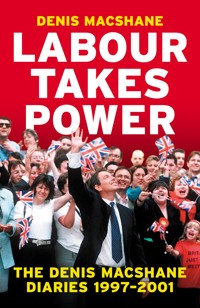
With the strong possibility of Labour forming our next government, it is fascinating to consider the last time the party stood on the verge of power, back in 1997. At that time, future Europe Minister Denis MacShane had a ringside seat that he would occupy for the next decade or so, living through Cool Britannia, the Good Friday Agreement, Peter Mandelson's multiple resignations, Princess Diana's death and Tony Blair's seeming invincibility. New Labour may be remembered as an unstoppable force, but MacShane's diaries reveal that while, outwardly, all seemed to be going well, the personal rivalries, slights and petty jealousies between the party's big beasts meant that it was never far from disaster. MacShane was a regular in Downing Street from the moment of Labour's election victory, and his candid, intimate diaries show figures such as Tony Blair, Gordon Brown, Robin Cook, Peter Mandelson, Clare Short and Alastair Campbell in a light in which they've never been seen before, detailing the personalities as much as the politics of Labour's most successful stint in government.
Sie lesen das E-Book in den Legimi-Apps auf:
Seitenzahl: 671
Veröffentlichungsjahr: 2023
Das E-Book (TTS) können Sie hören im Abo „Legimi Premium” in Legimi-Apps auf:
Ähnliche



















i
“The adventure and challenge of taking over government after decades in opposition is revealed in Denis MacShane’s diaries. He vividly captures the inside details of the tensions and words uttered as Labour set about rebuilding Britain. Labour Takes Power is an important guide for the new Labour generation in the Commons preparing for power under even more challenging circumstances.”
David Blunkett, former Home Secretary
“Denis MacShane breezed in from Europe after fifteen years’ exile working with social and social democratic parties on the Continent to be elected an MP in 1994. His inside story of the first Blair government reveals deep tensions over policy and progressive politics. As Labour looks to once again form a government, this book is essential reading on what entering power meant for Labour MPs in 1997.”
Polly Toynbee, Guardian columnist and former BBC social affairs editor
“The 1997 Labour government brought in many significant reforms – more than some of our young people realise – including the abolition of hereditary peers, a Parliament for Scotland, assemblies for Northern Ireland and Wales, an elected mayor for London, the abolition of all Tory homophobic laws, a national minimum wage, a win-win relationship with Europe, the Human Rights Act and the ending of massacres in the Balkans and the death squads of the Serb strongman Slobodan Milošević. Denis MacShane was an active backbencher and commentator during this time and his diaries reveal details, anger and passions which bring to life those early Blair years in a way which history books often fail to manage.”
Baroness Helena Kennedy of the Shaws KC
ii“The diaries of Tony Blair’s former Europe Minister Denis MacShane are a compulsively readable chronicle of the first New Labour government. There’s high drama, low gossip and parliamentary mischief, but what also emerges is a serious politician who spoke up passionately for Europe at a time when many of his colleagues hoped the issue would simply go away if they ignored it.”
Francis Wheen, former deputy editor of Private Eye
“Much has been written about New Labour, but first-hand, contemporaneous accounts of the Blair government are always invaluable. Denis MacShane’s book is one such, and his insider’s take will provide historians and political scientists alike with a fresh perspective on a period that Labour’s potential return to government has arguably made more relevant than ever.”
Tim Bale, professor of politics, Queen Mary University of London
iii
Contents
Preface
I have been writing books, articles and speeches for myself and many others ever since I was a student journalist. I honed my writing skills as a parliamentary candidate for Labour in 1974 and then as the youngest ever president of the National Union of Journalists (NUJ) four years later. Between 1979, when I was blacklisted by all media employers and had to go to work in politics across the Channel, and my return as the MP for Rotherham in 1994, I wrote endless words under my own name and for others, working to promote social justice and to end communist rule in Europe, apartheid rule in South Africa and different forms of autocratic rule in Latin America and Asia.
As I wrote political biographies or accounts of the historical origins of the Cold War and the left, I sifted through thousands of documents, letters and memoirs. If by chance in some archive I came across the contemporaneous letters, diaries or interviews of one of the principals I was writing about, it was like a new shaft of light illuminating history briefly.
So, when I was elected as the Labour MP for Rotherham in 1994, I decided, probably somewhat pompously, that I owed a duty to viiifuture historians to note down as much as possible what I heard, observed and took part in as an MP.
I had the great fortune to be named a parliamentary private secretary at the Foreign and Commonwealth Office (FCO) when Labour won power in 1997. It meant working with Robin Cook, who had been an inspiring and constructive Labour MP from Edinburgh since 1974. He was the finest orator of his generation, a shade sharper and wittier than Gordon Brown. Parliament of course comes from the French parler, and the art of speaking – the rhetoric taught by the ancient Greeks which is now called oracy and is still the most important attribute of anyone in democratic politics – was an art Robin Cook mastered better than most.
I also spent fifteen years working with the democratic left in Europe – trade unions and social democratic and socialist parties. I learnt not just European languages but also the complexities, histories and hopes of the democratic left on the Continent. Tony Blair arrived in No. 10 free of the burden of anti-Europeanism articulated by Labour MPs such as Tony Benn, Michael Foot, Robin Cook and Jack Straw in the 1970s and 1980s.
Blair was joined as head of government by Lionel Jospin, the socialist PM of France, Massimo D’Alema, the left PM of Italy, and Gerhard Schröder, who defeated the seemingly permanent Chancellor of Germany Helmut Kohl in 1998. Prime Ministers from sister parties in Nordic nations, the Netherlands and Portugal added to a sense that a new progressive European democratic left might be taking shape. Across the Atlantic, the progressive reformist Bill Clinton was in power. I had made good links with Team Clinton as an international trade union official working with progressive American trade unions in the 1980s and 1990s.
ixSo, as well as twenty years in the Labour Party, I had a background in Continental European and American progressive politics. Blair sent me to the FCO, but quickly I found myself called into Downing Street as a link-person on contacts with European sister parties in government.
I noted down as much as possible in small notebooks and then dictated nearly every evening and at weekends an A4 page, or two or three, of what I saw and heard. The full diaries which I began in 1996 and ended in 2012 run to more than 2 million words – which would be dozens of book-length volumes.
They are the raw material of history and of course must be sifted and checked against other written or oral records. I will make the full diaries available in due course via a university archive.
Today in the United Kingdom, we face, as we did in the mid-1990s, the strong chance of a change of government with Labour triumphantly taking office once again. This book records what it was like to be at the heart of a major department of state, as well as in Downing Street, from 1997 to 2001.
I hope it may be of interest to anyone who wants to know how politics works and to Labour MPs who have the honour of being asked to serve in government.
Denis MacShane
November 2023
x
1997
THURSDAY 1 MAY 1997
The election day weather is spectacular. A warm, balmy day such as one would have in southern Europe at this time of year. I make my first call while jogging to the polling station at Oakwood school and spend the rest of the day tramping around polling stations. Everywhere there is good cheer but not a tidal wave of people turning out, just steady, brisk polling.
At the Herringthorpe Leisure Centre, all three counts for Rotherham, Wentworth and Rother Valley are being announced. We don’t hear ours until about 2 a.m., when I am back with a majority of over 21,000, though the turnout is lower at just 63 per cent. The figures are roughly comparable in the other Rotherham constituencies. But nationally it is the biggest political rout of the century. Michael Portillo and other Cabinet ministers have gone. I take particular pleasure in the defeat of that filthy little racist, Nicholas Budgen, in Wolverhampton, as well as the disappearance of Norman Lamont in Harrogate.
2In every single seat in which I worked, we win handsomely, but it has nothing to do with me. On the contrary, there is a bigger swing in Brigg & Goole, which was not a key seat, than in Batley & Spen, which is where the party from Rotherham worked so hard. Everybody is grinning and gleeful; it really is a revenge and a satisfaction to those who have stayed loyal to the party in the eighteen dark years. The Herringthorpe Leisure Centre is a grim place and the council have done nothing to dress the set, so I make my speech of acceptance and off we go.
The Liberal candidate, who turns out to be anti-European, was pushed back into third place and refused to shake my hand after the count. At 3 a.m. I go to bed as more and more Tory seats tumble.
FRIDAY 2 MAY 1997
The final outcome is extraordinary; 419 seats for Labour and forty-six for the Liberals. Never have the British people voted this century so decisively to kick out a party. There are three lessons to be learnt, surely. Firstly, this is a great victory for the Blair–Mandelson–Brown project. No one can take that away from them. Secondly, it is a decisive rejection of the xenophobic and anti-European politics of the Tories. We must build on this. Thirdly, it is a plebiscite or a referendum election – a giant vote of no confidence in the Conservatives rather than the sending of individual constituency representatives to legislate and represent local interests in London. It is a vote against Parliament by sending so many people down there that parliamentary proceedings will become almost surreal. All these aspects give us great possibilities.
3In the evening, I go to the Labour Club for a May Day social. I give the bar £100 and tell them to buy everybody a drink, but the place is crawling with Trots and malcontents and the musicians strum their guitars and sing dirges and negative unhappy songs. Even ‘The Red Flag’ was sung to a tune which nobody could recognise and so nobody could sing along. This is the worst kind of old sectarian Labour.
MONDAY 5 MAY 1997
A bank holiday, so the long weekend of celebration goes on and on. We drive down to London, stopping in at the Transport and General Workers’ Union (T&G) leader Bill Morris’s house at Hemel Hempstead for a victory party. My old friend John Monks, the Trades Union Congress (TUC) general secretary, is there and we talk about how the trade unions need to detach themselves from the Labour Party. He said that he had phoned key leaders early on Friday morning but none of them were biting. He is completely at ease with the concept that it is the trade unions which are damaged by the insistence on holding block votes at the party conference and insisting that they form an organic part of the party’s leadership and structure.
Unions would be liberated and able to make new alliances, argue new relations with bosses and indeed be a much more useful ally of Labour if they didn’t attach such importance to this completely outdated link. But when I half-hinted at this to Austin Senior at a steelworkers’ union meeting in Rotherham on Saturday night, he bit my head off. ‘It’s payback time after eighteen years and it’s us 4that held this party together,’ he snapped. Austin is president of the Iron and Steel Trades Confederation (ISTC) and a very intelligent man, but his response reflects the prejudices of most union leaders.
In the evening, Robin Janvrin (the Queen’s deputy private secretary) and his wife Isabelle, John Lloyd of the Financial Times and his new girlfriend Ilaria, Stryker McGuire (the Newsweek bureau chief in London) and, at pudding time, Colin MacCabe come round for dinner. Robin says he looked in at Buckingham Palace for the mass swearing in of the privy counsellors who are in the new Cabinet. I find the obsession with titles and Rt Hons quaint and indicative of the way in which the British state quickly gets to people, but honours matter for everyone and no doubt if any came my way I would gobble them up greedily.
John Lloyd tells us that Liz Symons has been made a junior minister at the Foreign Office for Europe. ‘It’s a bizarre appointment. She doesn’t even know where Europe is. But she is completely dependable,’ said Lloyd. I am sure the adjective ‘dependable’ is the key. The main Minister for Europe is Doug Henderson who is filling today’s news bulletins with an early flight to Brussels. Doug comes out of the north-east stable of right-wing MPs which is a core block in the Blair constellation. The last time I saw him, other than in the Commons, was in Glasgow where he was accompanying, indeed bag-carrying for, Gordon Brown at the Amalgamated Engineering Union leader Jimmy Airlie’s funeral.
Joyce Quin, who had prepared the European brief and knows Europe, has been shunted aside for a Gordon Brown placeman who is likeable but knows nothing about European politics and will be putty in the hands of officials. It is messenger-boy duty not real policy-making that is valued.5
MONDAY 12 MAY 1997
In the lobby, I bumped into David Curry, the ex-Local Government Minister who kept his seat and who is now campaign manager for Ken Clarke’s bid to become Tory leader. ‘William Hague will get it,’ he told me. ‘It’s a non-vote. By voting for Hague, MPs can keep their constituencies happy without taking any specific line,’ Curry added. This is unnerving stuff given the fact that Clarke certainly seems to have most public support and is the only really heavyweight minister. There is a bizarre article by Simon Heffer in the Daily Mail in which he blasts Hague as being, well, I suppose the only word is vague, and says that despite his European credentials, Clarke is a real tough free-market minister with proven successes at the Home Office and at Education. The Tories are totally out of the opposition scene at the moment as they convulse themselves over their leadership problems. This is giving Blair and his ministers an absolutely clear run, but sooner or later, and it may be sooner, real politics will kick in.
TUESDAY 13 MAY 1997
A day spent working at home which isn’t very productive as the phone never stops ringing and, of course, I keep phoning out. I had a good talk with Sarah Helm, the Brussels correspondent of the Independent. She announced that she had a new boyfriend, Jonathan Powell, Tony Blair’s chief of staff. Powell’s marriage to his American wife is dead, not helped by his working over here while she kept living in Washington with their children. I like Jonathan very much and am extremely fond of Sarah, so it is a nice match if it works 6out. She said that Labour had made a good impression in Europe but asked why they had chosen Doug Henderson as Minister for Europe ‘since he obviously was completely lost and just sat there saying rather naive things’. I explained the need for neutral messengers and Blair’s desire to appoint a non-controversial and rather grey team of ministers. Sarah’s pillow talk is clearly going to have much more influence now than in the past. She is a fine journalist whose writing is matched by a political determination on issues she believes in, like rights for Palestinians and European partnership and purpose.
MONDAY 14 JULY 1997
I go with Doug Henderson, the newly appointed Europe Minister, to the 14 July Bastille Day reception at the French Residence in Kensington Palace Gardens. I am now named as a parliamentary private secretary at the Foreign Office. I have a pass that lets me walk into the FCO when I want. It’s a bit odd as I know far more about European politics and the EU than any of the ministers, including the Foreign Secretary, Robin Cook. I speak better French than most FCO wallahs, or rather I speak contemporary political French and read Libération and Le Nouvel Observateur which plugs me into the French socialist government which has arrived at the same time as us. Most of the FCO panjandrums both in the FCO and those running Blair’s European and foreign policy desks in Downing Street will read Figaro and other French conservative weeklies if they read any newspaper in French at all. It’s rather grand being driven in a minister’s car, but when we arrive at the French Residence the champagne has run out, either new austerity 7measures by Lionel Jospin’s socialist government or the Quai d’Orsay is sending out signals about what it thinks of its new socialist masters. After nagging the ambassador for ten minutes, two saucer-type glasses – these must have been in stock since Charles de Gaulle was here during the war – of indifferent champagne were produced and that was our ration for the evening.
Doug Henderson said that my appointment had been decided upon by Tony Blair from the very beginning and that Robin Cook had refused to sign off on it until it was made clear it had to happen.
Doug is completely in cahoots with Nick Brown and Gordon Brown. Doug and his girlfriend are having dinner with Gordon and Sarah Macaulay next Saturday and he is firmly hitching himself to the Gordon bandwagon. ‘There’s no point in trying to strike out on your own. This place works on who you know and who likes you and 95 per cent of all jobs go to people who simply keep their head down,’ he told me, no doubt prophetically. He also wondered how Tony would reshuffle the pack since clearly a number of ministers aren’t up to it but they do not expose themselves to justify dismissal. Oh dear, I shall be stuck as a PPS if I remain one, for some time to come.
WEDNESDAY 16 JULY 1997
At 6.30 p.m. I chaired a Tribune Group meeting at which Robin Cook spoke. There was a good, if heterogeneous, turnout and Cookie was in brio form. He is very pleased with his new ethical foreign policy and human rights line. He said that he had got on a lot better with Madeleine Albright, the American Secretary of State, than any of his European counterparts and clearly likes finding himself lining up with the Americans in preference to the 8Europeans. So much for his long anti-American political past. He told a hilarious story of a draft of a reply to a letter from an MP asking about arms sales to Indonesia:
I am still reading through my replies before signing them and I got to the last paragraph where I found a sentence that said ‘what the position of the government is on this is complete bollocks…’! I circled it and sent it back saying, ‘Surely some mistake?’ But it shows that getting the message through all the levels of the Foreign Office is taking a bit of time.
THURSDAY 17 JULY 1997
Up early to catch a plane to Paris for a British Council seminar on media and politics. I sat beside Andy Marr and we had a good chat.
He said:
I had a talk with Robin the other day and he asked me what I thought of Gordon’s Budget. I told him I thought it was absolutely first-rate and he looked at me and said, ‘Well, that’s a point of view, I suppose.’ I wonder how long he will stay at the Foreign Office. I still think he will go back to Scotland and seek to be top man in Scotland.
This is one of Marr’s favourite themes, since a part of him is very much connected to the Scottish project and having a dramatic and radical leader like Cook up there would be the dream ticket for the radical Scottish intellectual journalists like Marr or others like Neal 9Ascherson and John Lloyd. I am not sure that Robin is prepared to give up the historic status of being Foreign Secretary.
TUESDAY 22 JULY 1997
I bike over to the Royal Festival Hall for lunch with David Rennie, the very smart and very Europhile Daily Telegraph diarist. He is full of high-quality gossip.
‘The Foreign Office all hate the new Foreign Secretary, Robin Cook, but they like the Ministers of State,’ he announces grandly with the knowledge of having a father who was one of the great mandarins of British foreign intrigues as head of MI6.
David said he had written an unkind paragraph about Chris Smith and to his amazement got a call from Chris himself: ‘The phone rang and a flunky said, “I have the Secretary of State for Culture, Media and Sport on the line for you, Mr Rennie,” and there blow me down he was in person. He told me that what I had written was motivated by malice and was unworthy.’
I don’t know to what extent Rennie is playing Peter Mandelson’s game, but the knives do appear to be out for poor Chris Smith who has no real base in the post-1997 Parliamentary Labour Party. As the first ever gay Labour MP, there would be ructions if he was sacked, but he can be moved sideways and replaced by someone like Peter Mandelson.
THURSDAY 31 JULY 1997
To a team meeting at the Foreign Office, presided over by Robin Cook, who, I must say, is one of the worst chairmen I have ever 10sat under. He allows an endless dribbling discussion mainly based on his own experiences and we do not reach half the items on an agenda which only has six headings.
He is just back from Bosnia and Croatia where he said that meeting the Croatian President Tuđman was an encounter with the last fascist in Europe. ‘He is completely barking, and as I left, the Croatian Foreign Minister apologised for his President’s behaviour, which is an unusual job for a Foreign Minister to have.’
As he summed up his various forays or foreign office developments, he kept turning to the Permanent Under-Secretary, to ask him, ‘Is that a fair summary, Permanent Under-Secretary?’ as if he needed the approval of the machine at every stage.
I don’t get the sense of a man completely at ease with the smell of manure that surrounds all foreign policy decisions.
MONDAY 4 AUGUST 1997
The big story is that Robin Cook has left his wife Margaret to shack up with Gaynor Regan, his Commons secretary. I had lunch with them once in Bellamy’s and didn’t realise, at the time, I was interfering in a little love lunch.
The whole story seems dodgy. Robin lives just around the corner from us in Sutherland Street in Pimlico. According to the papers, a freelance photographer just happened to be there outside his flat… And just happened to see him feeding the metre for Gaynor’s car.
I think the tale stinks and it has all the hallmarks of a set-up. I expect that people in the security services listen to the right wingers 11in the Foreign Office who don’t like Cook, and have picked up his affairs and fed it to the press.
What a filthy business. Though, to a certain extent, if he wants to make a break with his wife, then it is necessary to get it out into the open. And this may be the least painless way, though it must be devastating for Margaret, Robin’s wife, who has been working as a consultant in an Edinburgh hospital while he has been cavorting about in Westminster.
SUNDAY 31 AUGUST 1997
We are in Glasgow so Granny can see her four grandchildren and I can show them something of their father’s birthplace nation. But then the news arrives in the morning radio bulletins that Princess Diana has been killed and everything seems to come to a stop. Benjamin, just three years old, kept saying, ‘Diana dead, Diana dead’ as if it was the most important thing that could happen in his little life so far.
I am as cynical, perhaps more so, as the next person, but the tears were in my eyes at the shock of her life ending in this manner. As the hours go by, the awfulness of the event sinks in. Suddenly, all the glitz and extravagance of her life fade away and all that stands out is her holding little babies in her arms in the third world or hugging an Aids victim on a deathbed in a London hospital.
WEDNESDAY 3 SEPTEMBER 1997
The anniversary of the start of the Second World War, but no one notices. Diana is everywhere, with flags at half-mast and railings 12up in Whitehall to prepare for her funeral. I get a call from the Daily Mail asking me for a quote about the fact there is no flag at half-mast over Buckingham Palace, but I declined to get involved in their rent-a-quote stupidities.
Instead, I phoned Robin Janvrin, the Queen’s deputy private secretary. I told him that if the royals were not down in London by tomorrow there would be a republic by the weekend. An exaggeration but not by much. The nation is horrified at the callous indifference of the Queen and above all Prince Charles, who made Diana a breeding horse for the future monarchy while he went off living his own life, sleeping with an old girlfriend, as if marriage and the family were a boring irritation for himself.
I told Robin to get the royals down fast to inspect the mountains of flowers, looking serious and sorrowful and trying to understand the nation’s grief.
Everyone I talk to has been scornful of the royals. Tony Blair, on the other hand, pops up in a black tie and talks of the People’s Princess with a look of intense anguish and grief in his eyes.
Matthew d’Ancona calls up to say the Tories are tearing their hair out because Blair is claiming or taking all the credit for defining the week as days of memorial for the People’s Princess. ‘There is complete panic in the Tory high command,’ said Matthew. ‘They think this could be Blair’s Falklands – the moment when he nails himself into the consciousness of the people for a long, long time.’
I think this is an exaggeration. But there is no doubt Tony has judged the mood beautifully, whereas the palace has just got it desperately wrong. From Balmoral, Robin Janvrin tells me he is very much aware of this. ‘I agree with you completely. I am trying to 13get the message over, but it’s very, very difficult here.’ It was nice of him to phone back and he was as courteous as ever. I expect he’s had this conversation with many others today, but he sounded concerned about what I had to say.
TUESDAY 9 SEPTEMBER 1997
Down to Brighton for the TUC and Tony Blair’s speech. Tom Baldwin of the Sunday Telegraph told me that the line from No. 10 on Clare Short was: ‘It’s not a question of her being in the tent pissing out or of her being outside the tent pissing in but simply being in the tent pissed.’ It was a clever-dick phrase but absolutely daggerlike.
The Archbishop of Canterbury George Carey was the star of the show just before lunch with the most left-wing speech of the week. In fact, it was the most concerted and unapologetic exposition of socialism I’ve heard at a major conference like this in Britain for some time. He was a member of two unions before starting his National Service and then going into the priesthood, and he was quite explicit on the obligation of employers ‘to recognise unions and not to victimise union activists’ and on the need ‘for new economic policies to create full employment’.
Tony Blair, by contrast, in the afternoon, gave no concessions and told unions to shape up or ship out as far as he was concerned. The core message remained business, business, business. Inasmuch as unions can help business, then they would be allowed through the doors of No. 10 to present the case but, there was no automatic presumption that simply because of the historic connection, trade unions would have any influence over policy.14
THURSDAY 16 OCTOBER 1997
I get a call from Daniel Johnson of The Times to ask would I do an op-ed piece on state funding of parties. I write a quick article arguing state funding is a good idea but should be limited and directed more towards party work on policy, education and training and not simply a big cheque in exchange for the number of votes parties poll at their various elections. Instead, I argue that money given to parties for organisational work should be in proportion to their own fundraising and to the members they have.
TUESDAY 28 OCTOBER 1997
To the Foreign Office for a team meeting. It lasts longer than usual and there are no officials present. Robin Cook remains depressed after the rotten press he got over his visit to New Delhi, where he tried to raise Kashmir and got a massive Indian Hindu cowpat dumped on him that the UK press gleefully relayed. He exuded unhappiness. He continually referred to whether a proposal or a policy will work in terms of getting the green light from No. 10. It is curious to see a man who has reached one of the top offices of state so obviously feeling not exactly powerless but not in complete control of his destiny or able to fulfil political ambitions by constantly looking over his shoulders at a boss who controls all. Not even a boss in the sense of an individual, the Prime Minister, who has nominal authority over him but a formless entity, ‘No. 10’, which has the power to block any initiative, take over any glory or channel and water down new ideas.
15After a lot of misery about Kashmir, I intervened and said that I thought his stewardship at the Foreign Office so far had been a big success. On Kashmir, I told him that people would have been astounded had it not been raised and certainly on the ground it was not perceived as being a big failure. Derek Fatchett, one of the Ministers of State and a shrewd Labour MP who was sitting beside me, turned and said, ‘Thanks for the therapy.’ Robin remains the cat that walks alone. He obviously is beginning to feel over dominated by his diary and running the department. ‘Frankly, I don’t know what goes on outside this office or who the thousands of people working for me really are or what they do,’ he said. ‘The diary just runs me around and I’m never in the country or even in the building.’
TUESDAY 4 NOVEMBER 1997
To the House to hear Robin Cook give evidence at the Foreign Affairs Select Committee. He was marvellously in control, articulate, not a comma or subordinate clause out of its place, with barely a look at his notes. Only once or twice did he refer to officials and when Simon Gass, the FCO’s head of Europe section, intervened by himself, Robin looked a touch annoyed as if to say, ‘I don’t need any help from anybody, thank you very much.’ His take on the Amsterdam Treaty was interesting, praising it for the headline achievements that were noted at the time such as border controls, the employment chapter and other little vetoes that Britain obtained. But he said it had failed to achieve institutional reforms in the size of the commission, the organisation, the council and so forth in order to prepare for enlargement.
16This actually is the French, German, even federalist critique of Amsterdam, and it is interesting that Robin is spontaneously offering that. The Foreign Affairs Select Committee is the weakest of the senior departmental committees. The only senior Tory is Virginia Bottomley, who sits there playing with a lovely half-smile on her face, but her questions were anodyne. The room was crowded with journalists, diplomats, others who wanted to see the great Cook in action, and sensing the attentive audience behind him, he was completely and utterly on the job.
A vote and then Calum MacDonald offered to take me to dinner, but I said I was going home and invited him to come with me. Calum said that Tony Blair had called in all the Cabinet-level PPSs for a pep talk in the Cabinet Room, which seemed an extremely good idea. According to Calum, Tony’s message was pretty simple. We will have two years on no spending and then gradually ease the restraints on cash so as to spend our way to an election victory. This is certainly a change from the behaviour of Harold Wilson in the 1960s and Jim Callaghan in the 1970s when an incoming Labour government was generous and then had to go desperately into reverse, cutting spending and stoking up resentment. In fact, the policy of Budget restraint is an absolute classic Tory policy and is what we used to condemn as ‘stop, go’, plus it can so easily be blown off course by events.
The current issue of The Spectator has run a foul Europhobe attack on Nick Soames, my pair, except that pairing is pointless now with our huge majority. The assassin is a charming but stiletto-vicious high Tory, Peter Oborne of the Sunday Express. I dug up some facts on the speeches that Bunter has made from the House of Commons Library and sent a letter back defending him. It will 17stir things up a bit as Soames is popular with the public and with a number of Tories, but it shows the complete eclipse of the Old Etonians who, in the shape of Soames or George Young, are quite sensible on Europe but are loathed by the Tory Europhobe Trotskyists who now surround William Hague.
THURSDAY 6 NOVEMBER 1997
The papers are full of a ghastly U-turn on tobacco advertising and Formula One motor car racing. Yesterday I listened to Tessa Jowell making a complete fool of herself on the Today programme trying to justify the exemption of Formula One cars from the government’s programme to try to reduce tobacco advertising, which is completely in touch with what the public wants.
Over to the Foreign Office to see Doug Henderson. He was chortling at Tessa Jowell’s discomfiture. ‘She’s a little goody-two-shoes and, of course, a big FOB [Friend of Blair], so she can’t be touched.’ Of course Doug and his gang of Brownies hate all the N1, NW3 or, in Tessa’s case, NW5 gang. He told me that he had received a note asking his authorisation for the ambassador in Moscow to go and open a new British American Tobacco (BAT) cigarette factory in Uzbekistan:
I said no, because BAT and Philip Morris and all the other tobacco companies are simply moving out of western Europe and opening the new markets for children and others in the ex-Soviet Union, but Robin countermanded my order and said the ambassador could go. So much for his ethical foreign policy.
Doug is a real fitness guy and has young children and I only wonder 18whether it was No. 10 rather than Robin that signed off on the ambassador promoting the cancer industry as long as it was far away from the British media.
FRIDAY 7 NOVEMBER 1997
Up at 6 a.m. after a bad night’s sleep and an early drive out to London airport to catch a plane to Portugal for a seminar on the European social model and globalisation.
On the plane, I was quietly reading a very pro-European interview with Tony Blair in Le Monde, and who should tap me on the shoulder but Stuart Holland in the seat behind me. We rearranged things so that we were side by side and had a marvellous talk and gossip all the way back to Heathrow. Stuart is wonderfully egotistical and outrageous. He is an adviser to António Guterres, the socialist Prime Minister in Portugal who insists on being called Tony and who spoke at the Labour Party conference.
Stuart was full of a scheme to issue eurobonds or use the European Investment Fund and European Investment Bank to get infrastructure projects going. He said he had had a talk with Robin about this, who was very interested.
I know all of these guys. They’re all of my age and generation. When I was in Rome the other week, I called up [Romano] Prodi and he immediately said come round and have a talk. I see [Jacques] Delors now and then and have tried to get him to get through to [Helmut] Kohl so that they understand that debt can be used. But, of course, the German word for debt is ‘Schuld’, 19which means ‘guilt’, and it’s the same in Dutch so the Germans are absolutely terrified of indebtedness.
I think there is a little more to Kohl’s financial prudence than the fact that the German word for debt and guilt is the same, but Stuart may have a point.
He was scathing about Tony Crosland, Denis Healey and, above all, Tony Benn.
‘I told Benn he was just being a complete fool over the common market in 1975, and he didn’t talk to me for seven years. He is a very dangerous man.’
Stuart claimed that Jim Callaghan had come up to him in the Commons in 1982 and said:
‘Stuart, if I had won the election in 1979, I would have introduced planning agreements.’ He had no reason to say this to me, so I think it was what he really thought. The trouble is that Prime Ministers are so heavily briefed they only get a chance to see the value of ideas once it’s too late for them to put them into practice.
I can’t believe Jim was being anything other than a flatterer and, like all non-intellectuals, wanted intellectuals to think well of him. As we spoke, Stuart consumed gin and tonics, red wine, whiskies and then bought half a bottle of Chivas Regal which he drank and drank. He was looking blotchy with thinning hair, bad skin and poor teeth as well as a fat stomach. But his capacity for storytelling and argument was undiminished and his lovely voice, which he told me had been the voice of a great singer when at university, was 20still a joy to listen to. We had a nostalgic hour or so going over all sorts of old ground and old struggles.
TUESDAY 11 NOVEMBER 1997
In the lobby, Alan Clark came up and in that frightful, smothered drawl of his congratulated me on my letter supporting Nick Soames in The Spectator. ‘Peter Oborne [the Sunday Express writer who had attacked Soames] is an absolute tart.’ Quentin Davies and Alastair Goodlad also had congratulated me on the letter with Quentin saying in his very nice way, ‘It is quite preposterous that an MP can’t organise his own time and it is none of the business of the whips or the journalists what MPs do providing they come along and vote as required.’
WEDNESDAY 19 NOVEMBER 1997
To an office meeting at the Foreign Office where I arrived early, having pedalled in at a furious rate for what I thought was a 9 a.m. meeting only to find it wasn’t due to start till 9.30. The private office, which consists of three secretaries each at their desk in a different corner of a huge room adjacent to the Foreign Secretary’s office, continues unperturbed in its work.
As usual, the meeting wanders and flows all over the place without a proper agenda. Robin’s main obsession is spending more time with MPs. ‘You have to stay in touch with the House. It is why we are here. Political avalanches can develop with terrifying speed. One minute the ground seems safe and then it is breaking under you and you can be swept away unless you have got an early warning 21system.’ He proposes a day at Chevening, his country house, but the day chosen is 5 January when we will be away skiing. Tough. He then names another day in December, but Doug Henderson says he is launching a European presidency that day in Newcastle. Robin mutters and grunts about whether he can change it, but Doug stands his ground. The only substantive item was a paper by Tony Lloyd about controlling arms sales which is very critical of the French. Tony speaks very softly at the far end of the table and none of us can hear what he is saying. Robin shows no interest and later Doug tells me that Tony has been at some arms control seminars in Sweden, where they have filled his head with the usual Nordic moralism which never seems to stop them selling as many arms as possible all over the place while preaching homilies about disarmament.
I walk down the corridor to her office with Liz Symons. I tell her very sharply that she is causing a lot of trouble with MPs by refusing to sign letters and always upholding the position of her officials even when the cases are manifestly unfair. ‘But Denis,’ she says in that butter-wouldn’t-melt-in-her-backside voice, ‘I have to send out 1,500 letters a week. I can’t sign them all, no one can.’ I tell her that other ministers do and that she should make a distinction between routine letters and those that are important to MPs and that her predecessor, Liam Fox, certainly did. ‘It’s so difficult. I am working all the time. I have all these other policy matters which I have to concentrate on,’ she complains. I tell her bluntly that there is an impression around that she has never done a constituency surgery and doesn’t remotely understand the pressure that MPs are under. I console her by saying that everybody recognises that as FCO minister in charge of entry clearance for relatives of constituents who 22want to emigrate from Pakistan, India and Bangladesh, she has one of the worst jobs in government, but there is a great deal of discontent building up and this is the kind of parliamentary avalanche territory that Robin was talking about. She is obviously unhappy to get the telling off, but I hope I did it as a friend and the message gets home.
Across to the House for Prime Minister’s Questions. I don’t see any point in attending save to mark Blair’s score card. How did he do? It was about even with one or two good spontaneous bursts, like when he pointed out that John Bercow, the obnoxious little twerp who has been sucking around Tory tits since he was in nappies, had worked as an adviser for Jonathan Aitken. This produced a real laugh and made Bercow look stupid, though he shook his head furiously. Afterwards, John Williams of the Mirror said Tony looked absolutely terrible and strained. Of course, John sits in the gallery looking down on Blair, whereas all we see is the back of his head, and I thought it was an interesting comment. The past ten days have been pretty wretched and we have been exposed as looking very weak.
To a Tribune Group meeting with Harriet Harman. It was in the upper committee corridor and as I went there about ten minutes early, the room next to it had its door open and familiar voices were to be heard. I put my nose round the corner and Diane Abbott was there. ‘Ah, it’s the sycophant-in-chief, come in,’ she said. I looked around and saw Tony Benn and Alan Simpson, and realised I was attending the campaign group. Its star speaker was none other than Eddie George, the governor of the Bank of England. I watched in amazement as he courteously exchanged views with the hard left of the Labour Party. ‘Tony, I think that’s a very important point… Yes, 23Alan, I do agree that EMU [the Economic and Monetary Union] is far from settled.’ It was the Tony and Eddie show or the Alan and Eddie show and there was something gloriously comic in seeing the high priest of finance capitalism meeting the far left of the PLP and conversing so sweetly and it seemed to me with so many heads of agreement.
I had dinner in the Members’ Dining Room. As I entered, Diane Abbott and Audrey Wise were at a little table for two and both gave me a public dressing-down for daring to support the government’s line on welfare at the PLP this morning. They really are obnoxious, but I adore Diane. She spends all the summer on an American lecture tour and is a star of TV talk shows over there. It is the only way for a clever MP once she is off the career ladder to make herself known. But it is a crazy waste of talent and she, of course, becomes an object of parody and scorn very quickly.
In the lobby, I bumped into Peter Mandelson and he agreed to come and open the exhibition of cartoons I am planning of Martin Rowson’s work. This is very good news and will pull lots and lots of people in.
MONDAY 24 NOVEMBER 1997
I did an interview on French television about whether London harbours Islamic terrorists. I gave as good as I got from the French interviewer, who said yes, we did, and I reminded them of the obligation of democracy to offer exile and asylum to political refugees. I really think I will stop doing these things on French television as there are no votes in it at all, nor much point.
Dinner with the Critical Quarterly gang at Groucho’s. Christopher 24Hitchens was there and Anthony Julius, but the real pleasure was to see Nigella Lawson turn up. With one or two penetrating comments, she helped to sum up a real issue. We had a good discussion on the need for a politics of family which got some half-hearted endorsement when I advanced my new round of ideas on the need for effective family politics, though Anthony Julius got very upset when he was accused of being a family lawyer, saying he had only done one divorce in his life, that of Princess Diana.
Hitchens made a good comment that now communism was dead, the only place where the slogan ‘from each according to his means, to each according to his needs’ was valid was the family, which made everybody stop and think for a moment.
I kept getting beeps saying that there was going to be a division and then that there was not going to be a division which caused hilarity with all the women around the table, who thrust the pager into their waistbands and waited for it to vibrate with the usual fairly scatological comments. I suppose I take these vibrating pagers so much for granted there is nothing to them, but if you haven’t had one throbbing somewhere about your body then there is something new to it.
TUESDAY 25 NOVEMBER 1997
Question time went off OK. Michael Howard hardly rose to ask a question except a rather feeble one on Iraq. He showed no interest in his shadow teams trying to attack Robin. I wonder if he might just walk away from it all before long. He shows no interest or concern, and apart from an out-of-date hostility to Europe, has no passion or political purpose that makes itself evident at the despatch box.
25I stayed for Gordon Brown’s statement on what was being called the ‘Green Budget’ but is now called the ‘pre-Budget Statement’, which was meant to be an outline of tax thinking in order to have a more mature discussion of fiscal alternatives and policy choices before the Budget. But he is such a showman that he can’t resist throwing powder into the fire and puff! Up he comes with two new classic welfare policies – extra money for pensioners for their heating bills and new childcare places. At the same time, corporation tax is cut on companies and there is to be a law enforcing fiscal stability. The latter to please the City and capital; the former to delight, as it did, the Labour backbenchers and the welfare constituency. It was a brilliant performance. Tony was sitting beside him looking much younger and relaxed and beaming with delight at his Chancellor’s command in the House.
In the lobby, Peter Mandelson came up in a glum way and asked if I’d seen The Guardian leader that day. I hadn’t and he said it was a filthy attack on him, blaming him for everything that went wrong. ‘But at least they say Tony Blair has to shoulder some of the blame,’ which I suppose is some bizarre consolation. Poor old Mandy.
THURSDAY 27 NOVEMBER 1997
This was fox-hunting day or, to be more correct, hunting with dogs day, since it is also proposed in the bill that we discuss today to stop all hunting with dogs. The House was absolutely full on both sides. I had a brief chat with Dennis Skinner before the debate began in the Members’ Lobby. I said that I really couldn’t get worked up about it. ‘I agree with you. I am just here to go through the motions. If you think of all the problems that we face, this is absolute nonsense,’ he muttered.
26Michael Heseltine was the first speaker from the Tory side and early on in his speech attacked the bad wording of the bill. He ridiculed the reference to flushing foxes out and then killing them and asked rhetorically if anyone had ever tried to flush out a fox and then put it down.
I bellowed out: ‘Ask Mrs Thatcher!’ and the House broke down in laughter with the Tory benches collapsing and Heseltine having to stand rock still for a number of seconds trying to find his composure and not grin himself. He tried to remain serious and made some reference to having knowledge of what happens in the political process when parties get ‘decimated’, which brought even more howls of laughter as our benches pointed merrily at the decimated Tory side. He then got back into his speech, but I crept out since it was going to be my only chance to intervene and went off to the gym.
SUNDAY 30 NOVEMBER 1997
A lovely farniente day. Up late – 9.30 a.m. – because we were so tired and then a spectacularly good roast beef lunch followed by a trip to Lots Road Gallery where I put in bids for some Gillray cartoons of Peterloo and a fake Sisley done by a clever Spanish artist called Kanals. I didn’t bother with the Sunday papers and instead read books and magazines and felt much better for a day without the press on top of us.
I talked to Carol Barnes, who said she had introduced the item on fox hunting in which I spoke on ITN. She said she and my old friend, Graham Miller, who I worked with at Radio Birmingham, both fell off their chairs as they saw me pop up. ‘You looked much better than you usually do,’ Carol said, I think kindly.27
MONDAY 1 DECEMBER 1997
Across to the Foreign Office for some kind of Christmas party for the media. I had a brief chat with Tim Garton Ash, who is fretting and worrying about Europe and trying to work out where he’ll want to be in ten to twenty years’ time. I had a go at him for his hostility to EMU which he resents but he is backed up by Sir Nigel something or other, the old Etonian ex-ambassador to Germany whom I met in Manchester and who is still locked into a Conservative critique of Europe. None of these guys understand that Europe needs big decisions, not incremental little changes. Labour couldn’t stomach sharing power over steel and coal in 1950. Now that the euro has been decided upon by Paris and Berlin as the essential underpinning of a true single market – imagine the US economy being based on California or Texas or Michigan each with its own currency – the British self-proclaimed pro-Europeans shrink in horror at having the same currency as the Germans and French.
TUESDAY 2 DECEMBER 1997
Over to Doug Henderson’s office for work on the committee stage of the Amsterdam Bill tonight. But I escape from this early to go to the gym. In it there is a young Ganymede, a slight, tiny good-looking youth who I later find out is Douglas Alexander, the new MP for the Glasgow seat where Gordon McMaster committed suicide. What a contrast. Gordon was enormous, wobbly, with rolling chins and a complaisant look. Douglas is small and perfectly formed with sleek black hair and a winning smile in his perfect Athenian face. Another Brownie on the parliamentary payroll.28
THURSDAY 4 DECEMBER 1997
Lunch with the Mail’s Simon Walters at the Tate Gallery. I made him buy two decent half-bottles of wine, the claret being a Château La Tour which I accompanied with a fairly disgusting bit of pheasant. He is in mega-flattery mode, describing me as Labour’s Alan Clark. If this diary is one quarter as good as Alan’s, it will be worth the effort, but, alas, Clark is a real writer; I am simply a note-taker. Also, Clark writes whereas I dictate and the difference is as obvious as between buildings thrown up with breeze blocks and one in which brick after brick or stone after stone is carefully laid one on the other by a craftsman to make a real statement.
Simon is full of an article in the New Statesman which hails Alan Simpson as the new leader of the left. I protest that intelligent and capable of organising as Alan is, he is a loner with no friends or followers and only bitter rivals. ‘The trouble with the left is that it is divided on almost every issue. On Europe, on trade unions, on women, on free trade, on the environment, it is split every which way,’ I tell him. Simon urges me to write an article about all this, but I don’t think I want to wade in and make unnecessary enemies just yet.
Yet another European debate, though this one mercifully was shorter and we were finished by 8.30 p.m. as people are sick and tired of debating Europe. It was a general adjournment debate and Robin opened it. He arrived with his speech, as always handwritten in his red felt tip pen, and as usual it was a very good one. There was only one problem. No one was there to hear it. Robin has an oratorical trick of turning from the despatch box waving his hand in a gentle semi-circle behind him and pulling himself round to 29address his own backbenchers. But everybody had gone home. After a couple of minutes of this, I whispered to Ken Purchase that I would go out and rustle people up. I rushed into the lobby and grabbed Graham Allen and Janet Anderson and asked them to get onto the front bench.
I then went into the tea room and tapped anybody and everybody on the shoulder. ‘The Foreign Secretary is making a major speech against Michael Howard and there is no one there to listen to him! Please come in and sit behind him, even for ten minutes or till the end of his speech,’ I begged. The ten or so MPs sitting there were quite responsive and gulped their tea, put down their papers and trooped into the Chamber to form a reasonable phalanx behind him. It looked at least on television as if there was a bit of support and as he turned with more of his jokes against Howard, whom he was putting through the mincer on his U-turn on a referendum on the Amsterdam Treaty, there were at least a few people to smile and nod and cheer.
FRIDAY 5 DECEMBER 1997
Across to the Foreign Office for a long session with Robin Cook.
Liz Symons opened with a long paper on dependent territories like the British Virgin Islands, Saint Helena, the Cayman Islands and the Turks and Caicos Islands, as well as Montserrat, all of which have an odd status. Another one of these historic anomalies, of course, is Gibraltar. The question is, should such islands be forced to become independent, or should they be absorbed fully into the United Kingdom with all their people offered citizenship? What the territories want is lots of money. They also want the right 30for their people to come to Britain, but the comfortable ones like Bermuda certainly don’t want to allow anybody from the UK to live, settle or work in their little island paradises.
The FCO paper was fairly useless, offering an enhanced associate citizenship. I said that one model might be the French DOM/TOM status and Robin asked what that meant. Liz jumped in and very slowly and clearly pronounced, ‘territoires… outre… mer’ and I told him what the DOM (départements d’outre-mer) stood for. I then said that it would be very expensive though an interesting way of sending British influence out into the world. ‘Every single one of them would immediately become eligible for all British rights, including any welfare benefits if there are any in a couple of years’ time.’ Everybody burst out laughing and Derek Fatchett said to Greg Pope, ‘I hope the Chief Whip has noted that.’
Of course, if Britain were to take over the dependent territories used as off-shore tax havens, it would be a massive interference in the cosy little world of international currency speculation and tax avoidance fiddles. I pointed out it would cause a massive explosion in the City and be a major politically aggressive step. John Kerr, the Permanent Under-Secretary, who sat at the end of the long table opposite Robin, says he doesn’t like the DOM/TOM solution. ‘It is very, very costly,’ he moaned. The conversation drifts off into a hand-wringing series of complaints from Liz about Montserrat. She says that the FCO is responsible for supervising and ultimately administering Montserrat and the other dependent territories but all the money to spend on them comes from the Department for International Development.
This unleashes a hate session against Clare Short. John Kerr asks, ‘Is the Secretary of State for International Development part of the 31constitution?’ Larry Whitty intervenes to say he had a drunken tirade against Robin from Clare at party conference in which she blamed him for the press criticism of her during the Montserrat business. Both Tony Lloyd and Derek Fatchett say relations between the FCO and the new department are very bad with Clare’s Permanent Under-Secretary encouraging a climate of hostility.
The dependent territories item took up nearly half the agenda before we moved on to disarmament, where Tony Lloyd had produced a New Statesman article which David Clark, Robin’s adviser, had written for him two years ago, setting out the ten-point plan for a nuclear-free world. ‘Yes, it was a good article, I think I agreed to it while I was playing tennis, didn’t I, David,’ said Robin and everybody giggled at the way high policy is made. Tony mumbles and mutters through his presentation and makes some proposal that our nuclear submarines should announce they are not going to patrol but simply be stationed at their base in Scotland. Everybody looks a bit puzzled trying to work out what the point of that is with even Robin saying, ‘But I thought the whole idea was that you didn’t know where they were if they were out on patrol under the water and that was the element of security and surprise?’ Some of the proposals make sense and if a little package can be got together on a register of nuclear weapons with the support of the big nuclear powers then it certainly would be useful.
The next subject area is the Middle East peace process.
Robin says, ‘I hope this room is hermetically sealed but, of course, the Arabs know perfectly well who finances Tony.’ It was a fairly abrupt and open statement. I said I thought Labour’s swing to Israel was simply a reaction against the excessive pro-Palestinian and at times openly anti-Israel borderline anti-Jewish politics of 32the left, including the left in the early 1980s. Andrew Hood, who has close links with Israel, jumped in and started spluttering about events at the Labour Party conference where Gordon Brown at a Labour Friends of Israel dinner had made a gushingly friendly speech, whereas at the equivalent function for the Arab ambassadors and pro-Arab Labour MPs, only Clare Short had turned up and she was late.
As a result, the Arabs are convinced that the Labour government is in the pockets of Israel. Robin came up with the idea of celebrating the end of Ramadan by going to an end of Ramadan Eid feast in Cairo. ‘I could do with going through Ramadan myself just to stop all these wretched meals I have to eat,’ he grins. He then starts asking when Ramadan ends and nobody knows, with people talking about moons and cycles, but here you have in nominal terms all the people who determine Britain’s foreign policy and overseas relations and not one of them knows the date of the most important celebration in the Islamic year.




