


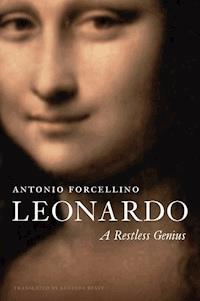
15,99 €
Mehr erfahren.
- Herausgeber: John Wiley & Sons
- Kategorie: Geisteswissenschaft
- Sprache: Englisch
A visionary scientist, a supreme painter, a man of eccentricity and ambition: Leonardo da Vinci had many lives. Born from a fleeting affair between a country girl and a young notary, Leonardo was never legitimized by his father and received no formal education. While this freedom from the routine of rigid and codified learning may have served to stimulate his natural creativity, it also caused many years of suffering and an insatiable need to prove his own worth. It was a striving for glory and an obsessive thirst for knowledge that prompted Leonardo to seek the protection and favour of the most powerful figures of his day, from Lorenzo de' Medici to Ludovico Sforza, from the French governors of Milan to the pope in Rome, where he could vie for renown with Michelangelo and Raphael. In this revelatory account, Antonio Forcellino draws on his expertise - both as historian and as restorer of some of the world's greatest works of art - to give us a more detailed view of Leonardo than ever before. Through careful analyses of his paintings and compositional technique, down to the very materials used, Forcellino offers fresh insights into Leonardo's artistic and intellectual development. He spans the great breadth of Leonardo's genius, discussing his contributions to mechanics, optics, anatomy, geology and metallurgy, as well as providing acute psychological observations about the political dynamics and social contexts in which Leonardo worked. Forcellino sheds new light on a life all too often overshadowed and obscured by myth, providing us with a fresh perspective on the personality and motivations of one of the greatest geniuses of Western culture.
Sie lesen das E-Book in den Legimi-Apps auf:
Seitenzahl: 636
Veröffentlichungsjahr: 2018
Ähnliche















Contents
Cover
Title Page
Copyright
Prologue
Notes
Part I Illegitimate Son
1 The Summer Child
Notes
2 In Florence
Notes
3 Verrocchio’s Workshop
Notes
4 Drawing
5 Early Experiments in the Workshop
Notes
6 Epiphany
Notes
7 Burning Youth
Notes
8 The Accusation
Notes
9 The Kite and the Vulture
Notes
10 Other Distractions
Notes
11 The New Humanity
Notes
12 Leonardo’s Technique
Part II In Milan
13 Virgins and Lovers
Notes
14 At Ludovico’s Court
Notes
15 The Virgin of the Rocks
Notes
16 Portrait of a Legend
Notes
17 Anonymous Portraits
18 Theatre and Science
Notes
19 The New Science
Notes
20 Salai
21 The Phantom Horse
Notes
22 The Last Supper
Notes
23 Addio Milan
Notes
Part III Back to Florence
24 A Fatherless Family
Notes
25 The Madonnas of the Yarnwinder
Notes
26 The Human Beast
Notes
27 Real Wars and Mock Battles
Notes
28 Waiting for Glory
Notes
29 Body and Soul
Notes
Part IV In Exile
30 Rome: The Great Illusion
Notes
31 A Modest Apartment
Notes
32 Leonardo and Rome
Notes
33 The Three Paintings Shown to Cardinal Luigi d’Aragona
Notes
34 A World of Women
Notes
35 The Mysterious Woman
Notes
36 The End
Notes
37 Inheritance
Notes
Plate Credits
Index
End User License Agreement
Guide
Cover
Table of Contents
Begin Reading
Pages
iii
iv
1
2
3
4
5
6
7
9
10
11
12
13
14
15
16
17
18
19
20
21
22
23
24
25
26
27
28
29
30
31
32
33
34
35
36
37
38
39
40
41
42
43
44
45
46
47
48
49
50
51
52
53
54
55
56
57
58
59
60
61
62
63
64
65
66
67
68
69
70
71
72
73
74
75
76
77
78
79
80
81
82
83
84
85
86
87
88
89
90
91
92
93
94
95
96
97
99
101
102
103
104
105
106
107
108
109
110
111
112
113
114
115
116
117
118
119
120
121
122
123
124
125
126
127
128
129
130
131
132
133
134
135
136
137
138
139
140
141
142
143
144
145
146
147
148
149
150
151
152
153
154
155
156
157
158
159
160
161
162
163
164
165
166
167
168
169
170
171
172
173
174
175
176
177
178
179
180
181
182
183
184
185
187
189
190
191
192
193
194
195
196
197
198
199
200
201
202
203
204
205
206
207
208
209
210
211
212
213
214
215
216
217
218
219
220
221
222
223
224
225
226
227
228
229
230
231
232
233
234
235
236
237
238
239
240
241
242
243
244
245
246
247
249
250
251
252
253
254
255
256
257
258
259
260
261
262
263
264
265
266
267
268
269
270
271
272
273
274
275
276
277
278
279
280
281
282
283
284
285
286
287
288
289
290
291
292
293
294
295
296
297
298
299
300
301
302
303
304
327
328
329
330
331
332
333
335
336
337
338
339
340
341
342
343
344
345
346
347
348
349
350
351
LEONARDO
A RESTLESS GENIUS
ANTONIO FORCELLINO
TRANSLATED BY LUCINDA BYATT
polity
First published in Italian as Leonardo: Genio senza pace © First published in Italy by Gius. Laterza & Figli, 2016. This edition published by arrangement with Grandi & Associati.
This English edition © Polity Press, 2018
The right of Lucinda Byatt to be identified as translator of this work has been asserted in accordance with Section 77 of the Copyright, Designs and Patents Act 1988
This book has been translated thanks to a translation grant awarded by the Italian Ministry of Foreign Affairs and International Cooperation.Questo libro è stato tradotto grazie ad un contributo alla traduzione assegnato dal Ministero degli Affari Esteri e della Cooperazione Internazionale italiano.
Polity Press65 Bridge StreetCambridge CB2 1UR, UK
Polity Press101 Station LandingSuite 300Medford, MA 02155, USA
All rights reserved. Except for the quotation of short passages for the purpose of criticism and review, no part of this publication may be reproduced, stored in a retrieval system, or transmitted, in any form or by any means, electronic, mechanical, photocopying, recording or otherwise, without the prior permission of the publisher.
ISBN-13: 978-1-5095-1855-5
A catalogue record for this book is available from the British Library.
Library of Congress Cataloging-in-Publication DataNames: Forcellino, Antonio, author. | Translation of: Forcellino, Antonio. Leonardo.Title: Leonardo : a restless genius / Antonio Forcellino.Other titles: Leonardo. EnglishDescription: Medford, MA : Polity Press, 2018. | Includes bibliographical references and index.Identifiers: LCCN 2017043968 (print) | LCCN 2017044512 (ebook) | ISBN 9781509518555 (Epub) | ISBN 9781509518524 (hardback)Subjects: LCSH: Leonardo, da Vinci, 1452-1519. | Artists--Italy--Biography. Classification: LCC N6923.L33 (ebook) | LCC N6923.L33 F6613 2018 (print) | DDC 709.2--dc23LC record available at https://lccn.loc.gov/2017043968
The publisher has used its best endeavours to ensure that the URLs for external websites referred to in this book are correct and active at the time of going to press. However, the publisher has no responsibility for the websites and can make no guarantee that a site will remain live or that the content is or will remain appropriate.
Every effort has been made to trace all copyright holders, but if any have been inadvertently overlooked the publisher will be pleased to include any necessary credits in any subsequent reprint or edition.
For further information on Polity, visit our website: www.politybooks.com
PROLOGUE
On 13 January 1490, the rooms of the castle at Porta Giovia, Milan, were brightly lit to celebrate a feast that would be chronicled as one of the most elegant of the Italian Renaissance, and certainly the most elegant at the Sforza court. Ludovico [Sforza, known as] il Moro, who had ruled Milan with an iron fist for over a decade, wished to honour the new duchess, Isabella of Aragon, granddaughter of the king of Naples, who had married Gian Galeazzo Sforza one year earlier: a legitimate heir to the duchy, yet deprived of all power by his uncle. The feast and its golden decorations were intended to silence the rumours that had circulated for over a year in the corridors of European courts regarding Gian Galeazzo’s failure to deflower young Isabella, who was as pure and virginal in Milan as she was when she left Naples.
A hundred young maidens from the cream of Milan’s noble families had been selected for the evening, accompanied by as many knights. In the palace chapel a tribune had been constructed to accommodate the guests and, facing it, a small stage, decked in satin cushions like a throne, where the ducal family sat with its most honoured guests. A powerful, hard-working city like Milan had not dedicated many occasions to such luxurious display in the past years, but now Ludovico il Moro intended to follow the example of his friend, Lorenzo de’ Medici, who had transformed festivities of this kind into an instrument of government.
This goes some way towards accounting for the amazement of the guests who, having climbed the stairs, found themselves in a room brightly illuminated by candles and whose walls were embellished with precious fabrics and verdant festoons interlaced with ribbons. At the back of the room a closed hemispherical object was just visible, raised on a platform. Many speculated that it was a huge egg, cut in half and covered over with a satin cloth. Curiosity stimulated glances and speculation among the guests, who were dressed in their finest attire. When the room was full, the pipes and drums struck up as the young duchess made her appearance (or perhaps it would be more apt to say her apparition), dressed in a white silk cloak that covered her gold brocade gown.
Giving everyone the time to admire her, Isabella took her place on the small throne. She wore such ornate jewels that the ambassador of the Este [rulers of Ferrara], whose account of the feast has survived, reported that he thought he was looking at the sun, such was the beauty of her figure and the magnificence of her ‘Spanish’ elegance. When the music struck up again she danced two very graceful dances with three young women from her retinue and for a few minutes she successfully rivalled the great Ludovico himself as the focus of attention. In honour of the duchess and of the Neapolitan court, he, too, had dressed in Spanish style, wearing a dark red velvet doublet trimmed with ermine and a black cloak lined with gold brocade on a white backing. It was an outfit that must have cost many thousand scudi, as many of the guests remarked.
The dancing continued for two hours, giving both Ludovico and Isabella time to savour the triumph of the occasion in full. Even the ambassador of the Grand Turk, who had ridden on horseback into the room and then sat on cushions at the foot of the throne, after the custom at his own court, delivered a message of good wishes and stressed that the Ottoman sultan did not usually send dignitaries to festivities organized by infidels, but that a special honour had been granted to the court of Milan and that of Naples.
Excitement among the guests reached a climax when the duke silenced the musicians and turned to look at the back of the room – where, as if by magic, the silken cloth slipped off the enormous hemisphere, revealing a mock cavern lined with gold and stars, in imitation of the celestial vault. Cries of amazement rose from the room as the guests watched the seven planets in the sky light up with the signs of the Zodiac. It was a representation of paradise, whose beauty outshone the inventions of any painter who had previously tried to imagine it in colour. Starting with Jupiter, the planets were celebrating the young duchess’s virtues in verses composed by Bellincioni, the court poet. Many in Milan found his compositions too flowery and specious, but that evening even courtiers with more sophisticated tastes found nothing to criticize. Even the expensive garments and jewels of the noble citizens faded into insignificance in an instant, as general attention was gripped by a scenic machine that appeared to be nothing short of miraculous.
Not that mechanical equipment of this kind was a novelty at Italian court festivities. For example, every Good Friday a representation of Christ’s Passion had been enacted in Rome, at the Colosseum, for as long as anyone could remember, during which angels flew around a cross suspended from pulleys and chains that were prepared months in advance by the ingenious members of the confraternity of San Giovanni Decollato. But the mechanisms had always been quite visible in such plays, while at the Castle in Milan that evening nothing seemed prepared, no wheels jammed, the complex mechanics of the whole apparatus were so clever and so well concealed that their naturalness was disturbing. Many of the guests looked around the room, searching for the inventor of that extraordinary stage machine and the equally stunning masquerades.
The man responsible smiled quietly, satisfied at the astonishment he had kindled among guests of all ranks and from all parts. The inventor’s name was Leonardo and he had been born 38 years earlier, in a small village near Florence. He had the body of an athlete, a physique as harmonious and well muscled as a Greek statue. His face was handsome, with exquisite, large eyes and a straight nose below evenly arched brows and a high forehead framed by hair whose well-tended curls fell onto his shoulders in tight ringlets. He took great care of his elegant appearance and, during his eight-year stay in Milan, he had already been noted for the grace and originality of his knee-length garnet robes and the coloured stockings that emphasized his muscular legs. His reputation made him the best known foreigner in Milan, although no one knew his exact role at Il Moro’s court. In the rigid hierarchy of the time, he was recorded as a member of the painters’ guild, first in Florence and then in Milan.
Leonardo da Vinci, who was savouring his first public success in Milan that evening, was musician, engineer, sculptor, architect and painter, and it was in this capacity that he had offered his services eight years earlier to the duke of Milan, with a letter from Lorenzo the Magnificent, lord of Florence and his first patron. Over the past years he had won over the court and the city. Here he had created paintings of unparalleled beauty and hydraulic projects that would rationalize the canals around Milan; he had offered ideas for a new lantern tower [tiburio] over the city’s cathedral, as well as designs for war machines that were still to be tested and machines of various kinds, designed to lift and transport heavy weights. His anatomical drawings and physiological studies lay in untidy piles; they were mainly written with his left hand and back to front, but in Milan they had already attracted their first admirers in these golden years. His, too, was the clay model of a huge monument to Francesco Sforza, Ludovico’s father, which he was preparing in the large courtyard of the castle in order to cast the statue in bronze.
He alone possessed that acute spirit of observation that drove him to investigate every natural phenomenon, which he did often with confused and contradictory methods, but firm in his conviction that a single law must govern the universe and everything in it, small and large, whether it was water or women’s hair, blood circulating through veins or lymph circulating through a tree’s branches. His knowledge did not look down upon any field of application, and he had created the stage machine representing paradise in this magnificent ceremony with the same care he put into designing machines to throw bombards and to fly above the ground. That evening Milan, too, was his, and very soon letters would be dispatched post-haste to the other Italian courts lauding the marvellous mechanisms of paradise.
Happy in the wake of this celebrated and acknowledged success, Leonardo was already preparing a new theatrical machine for a comedy that would be staged in Mantua, Orfeo by Angelo Poliziano, during which he would terrify the audience with a cavern that opened effortlessly to reveal Pluto emerging from the underworld, balancing on a sphere. His knowledge of weights and levers found in these theatrical machines an ideal way to impress the public at large. He succeeded in devising them by using his discoveries of how to balance weights and create mechanical cogs, because he made no distinction when applying this knowledge: the stage was as good as the battlefield as a foil for his genius. He moved like a magician between science and art, exploring with the same insatiable thirst for knowledge the mysteries of nature and those of the imagination, and in his omnivorous mind even he was perhaps not fully aware of the extent to which the former fuelled the latter.
His reputation as a painter was already well established in Italy, given that three years earlier Giovanni Santi, the father of Raphael – a young artist who would later come to rival him – had written a chronicle that singled Leonardo out as one of the greatest Italian painters. But by 1490 he already felt constrained by that reputation, and the atmosphere in Milan, so cultured and refined in every field of knowledge, was rapidly spurring him to delve deeper into many, perhaps all, of those fields, including mathematics – a new departure for him and a subject on which he would expend much of his energy from now on. Unfortunately the wondrous machines that amazed all Italy were among the few mechanical inventions that contemporaries had a chance to appreciate among the many he devised, imagined and partly created, in a process to which he devoted much of his life. Other inventions were intended to improve water flow and weightlifting, and many, the majority, were never even given tangible form: in the end the sum of his scientific genius proved dispersive and inconclusive. For the most part his mental exertions were confined to endless sheaves of paper that he never published, let alone ordered, before his death and that were largely dispersed soon afterwards. But, despite himself – perhaps precisely because during his stay in Milan he ‘lost patience with his brush’ [impacientissimo al pennello] – between an anatomy session and an hypothesis for a helicopter, Leonardo found time to paint a number of images that were so extraordinary as to embed his memory forever in the minds of subsequent generations. Since the volumes containing his studies were lost and forgotten immediately after his death, it was these images, overlooked during his lifetime, that kept his memory alive until the time when, centuries later, his studies were again rediscovered and published. His codices had such an impact on European scientists in the eighteenth and nineteenth century that they soon laid the foundations for a formidable myth, which is still growing today.
It is a myth that has overshadowed the often troubled life of Leonardo, the man and the painter, who attempted to verify all forms of institutional knowledge against direct experience and was more diffident than many towards the academic establishment, with which he never identified himself. Leonardo provocatively proclaimed himself in his writings ‘an unscholarly man’ [omo sanza lettere] in order to highlight that a pathway to knowledge of the real could be found even outside the universities of the time, which continued to teach uncritically a form of knowledge codified by antiquity and by the church.
Notes
• Details regarding the Feast of Paradise are taken from E. Solmi, ‘La festa del Paradiso di Leonardo da Vinci e Bernardo Bellincore: 13 gennaio 1490’, in
Archivio Storico Lombardo
, IV Series, I, 31, 1904.
•
L’Historia di Milano volgarmente scritta dall’eccellentissimo oratore Bernardino Corio
, Stamparia di Paolo Frambotto, Padua 1646.
PART IILLEGITIMATE SON
1THE SUMMER CHILD
On 15 April 1452, in the tiny hamlet of Vinci, not far from Florence, the peasant farmers were enjoying the scents of plum and apple blossom carried by the early evening breeze. In one of the roughly built stone and brick houses, a young country girl named Caterina was about to give birth to a boy who would be christened Leonardo.
By ten o’clock in the evening (‘three hours of the night’, as was said at the time), when her labour was over and the child was well, the midwives presented him to his grandfather, Antonio di Ser Piero da Vinci, an 80-year-old notary who was not wealthy but was nonetheless affluent enough to be the most notable citizen in the village. Antonio was the descendant of a family of notaries who had enjoyed prominence since at least 1333. He and his relatives owned a respectable house in the centre of Vinci, with an adjoining vegetable garden and a farm with some ten stadi of land nearby. From his tax returns [denunzie catastali] it appears that he also owned other, smaller farms that produced wheat, oil and wine. His total wealth, 1,400 gold florins, was deposited with the Monte Commune of Florence and yielded enough interest for a decent lifestyle. Antonio was happy with his new grandson. At his age he did not have many years for seeing his descendants, and he hastened to record the event in his family memoirs.
15 April 1452. My grandson was born, son of Ser Piero, my son, on 15 April, a Saturday, at 3 hours of the night. He was given the name Lionardo. The priest Piero di Bartolomeo da Vinci baptized him in the presence of Papino di Nanni Bantti, Meo di Tonino, Piero di Malvolto, Nanni di Venzo, Arigho di Giovanni Todescho, monna Lisa di Domenico di Brettone, monna Antonia di Giuliano, monna Niccholosa del Barna, mona Maria, daughter of Nanni di Venzo, monna Pippa (di Nannj of Venzo) of Previcone.1
However joyful the event and however welcome the birth of a baby boy, matters had not gone exactly as he had hoped: the child was not the son of the right woman and would remain ‘illegitimate’, a descendant who could not aspire to have full rights to the family inheritance, whether material or ideal. The previous summer his eldest son Piero, who was then a little over 20, had started his career as a notary in Florence, where he lived in a rented house. He had then come to spend the summer months at home in Vinci, and during those lazy hot days he had met and seduced a young peasant girl, Caterina, whose only defect, apart from being poor, was that she was exceedingly beautiful.
Piero had taken advantage of her without any qualms: she was, after all, a peasant and he was due to marry a Florentine woman of suitable social standing, Albiera di Giovanni Amadori. The sole justification for the passing affair was the couple’s youthful exuberance and the beauty of those summer evenings in the cypress-scented countryside. Moreover, the seduction of a poor girl by a well-to-do young man was such a frequent occurrence in the countryside around Florence that it hardly deserved a mention. Indeed Ser Piero had married Albiera that same year.
For her part, Caterina received perhaps, in compensation, a small dowry from the old notary and was married to a local man about whom we know very little, but whose name did not bode well for a comfortable future. The man was called Acchattabriga [‘Troublemonger’] and was the son of Piero della Vaccha – names that indicate humble origins and tricky temperaments. After her marriage, Caterina walked away from the da Vinci family and, judging by the silence of the sources, also from young Leonardo’s life. However, not straight away: as was customary, she breastfed her baby son, whether in her home or in the da Vinci household, for at least a year or two – just enough time for her to grow to love her son and then to suffer when he was taken away, because after that first stage the boy was completely entrusted to his father’s family.
Leonardo was cared for by old Antonio, his 59-year-old wife Lucia, and his second son Francesco, who was just 17. Another daughter, Violante, had already left home to marry a certain Antonio from Pistoia. As an illegitimate son, the boy did not receive a normal education, which in a Florentine bourgeois family involved learning, from the age of seven, Italian grammar, basic mathematical skills, and above all Latin, which was essential for an administrative career and for access to classical books and manuscripts (all of these were still in Latin at that time). However, this lack of formal education, which undoubtedly affected Leonardo later in life, was a source of happiness in his early childhood, since he was freed from the burden of strict learning as laid down by the rules of scholastic institutions. The boy’s rather eccentric upbringing at the hands of his grandparents and young uncle stimulated unusual avenues for his creativity and helped him to develop a lifelong curiosity for the natural world.
Leonardo spent his childhood in that house deep in the countryside, living with his aged grandparents and young uncle Francesco, who was uninterested in work of any sort, as Antonio noted in a later tax return: ‘he lives in the country and does nothing’. Francesco’s lazy lifestyle was a stroke of luck for the child, who benefited from much of his uncle’s extensive free time because life in the tiny hamlet of Vinci did not offer many other distractions and also because, as the notary’s son, Francesco was not expected to work on the land, like others of his age.
We know from later documents that Francesco was the only relative to have loved Leonardo (apart from his grandparents), so much so that he was even willing to challenge the strict laws governing inheritance for the sake of his nephew. It was probably he who taught Leonardo to read and write, indeed the latter’s handwriting retained the typical notarial script of fifteenth-century civil servants, whereas school pupils at the time were already taught to write with the rounded hand whose flowery style epitomized the enthusiasm for humanist studies that had become so fashionable in mid-fifteenth-century Tuscany. School pupils were taught this well-formed handwriting with the same rigour as they were trained in the rhetorical art of grammatical compositions – another trait that Leonardo’s prose would never acquire, despite the artist’s later efforts to fill the lacunae in his self-taught education. Leonardo’s writing, learned at home in an isolated village, far from any school, lacked discipline. Moreover, although quite capable of writing with his right hand, the boy preferred to use his left and to write from right to left, something that only the Jews did at that time. If he had attended any ordinary school, this habit would have been punished and corrected, but as an illegitimate son he did not have to live up to any intellectual expectations and no one wasted time correcting him: writing was a game for him and his grandparents did not think that he would use it much in life.
As time passed the boy’s upbringing became increasingly unusual and unorthodox. Occupied by his new marriage and by his career as a notary, Leonardo’s young father had little time to spare. Moreover, the mere presence of the boy was a constant reminder of a painful problem that Ser Piero now faced: the lack of children. Albiera could not conceive and Leonardo’s presence was an unspoken denunciation of her sterility. The years passed and Albiera and Ser Piero would have no legitimate heirs until Albiera’s death in 1465, after 13 years of what cannot have been a happy marriage. In Florence as in the rest of Italy during the fifteenth century, marriage was above all a financial transaction that served to consolidate social alliances and to ensure the continuity of private wealth and family honour. A childless marriage was a useless marriage and the fault always lay with the woman, who was held to be responsible for the couple’s sterility. However distant and confined to the small village of Vinci, the boy, who was growing up to be strong and handsome, was a source of sadness for Albiera and of embarrassment for Ser Piero: family reunions could not have been easy, either for the couple or for Leonardo. For the same reasons, the fact that the grandparents knew that another heir would not arrive soon increased their love for Leonardo, who grew up in their sometimes overly affectionate care.
The conditions in which the child was raised were very unusual. On the one hand, the absence of other children in the grandparents’ household meant that he was alone much of the time; on the other, this was not helped by the gulf between him and other boys in the village, which was due to the fact that the da Vinci family had to defend its standing in the rural community and certainly could not send this young grandson to work in the fields, like all the other boys of his age. Even if illegitimate, Leonardo was the son and grandson of respected notaries and, as such, stood apart from other village boys. A life of ease, freedom and solitude, albeit not lacking in basic education, was an ideal medium in which he could nurture a growing sense of curiosity in the surrounding world. But, on the other hand, what was certainly a painful relationship with his father and stepmother served as an equally necessary condition for the child’s creative introspection to develop, shielded as it was in the arms of his grandparents, who undoubtedly loved him even if they failed to discipline him.
Vinci was a world suspended between domesticated and wild nature. The village lay on the edge of the wooded ravines of the foothills to the Tuscan Apennines, where farmed countryside gave way to large areas of wilderness. Olive groves, vineyards and fields of wheat occupied part of the hillsides between the crags, while the soft outlines of the woods were broken by rows of cypresses. The rest of the surrounding countryside was full of narrow gorges excavated by streams as they flowed downhill to join the Arno, the majestic river whose sediments had moulded the valley over thousands of years and presented the boy with landscapes of extraordinary beauty. Fascinated by the wilderness, Leonardo started to explore it during his solitary childhood. Later, in early adolescence and during the heady phase of puberty, he undertook these explorations of the world around him with growing enthusiasm, and his observations became more systematic.
There was something else that the strange family could offer almost in spite of itself, something that would mark the rest of the boy’s life: this was paper, a material that was not lacking in a notary’s household. Large quantities of paper were purchased by the da Vinci family, as is borne out by a credit note dated 1451 and signed by grandfather Antonio, which mentions, among other debts, the 12 lire that Piero owed the cartolaio Giovanni Parigi.2 That paper, so precious to the notarial profession, must have been invaluable for the boy’s solitary games and adventures. Paper was not readily available, especially not to poor children, but Leonardo must have had access to considerable amounts, if only in the form of waste paper and cut-offs.
By a lucky coincidence, the best circumstances conspired to develop the boy’s genius: freedom, solitude and scraps of paper, the material on which he could give tangible expression to his thoughts and with which, early in childhood, he established a relationship that would remain unchanged for the rest of his life. Paper would become the principal medium through which he communicated with the rest of the world. Leonardo entrusted every observation, every memory to paper: whether in note form or as a sketch, his mind would project onto paper as if that were his alter ego, an extension of his self, a fetish that he could not be free of and with which he would be burdened to the end, passing from scraps to sheets of drawing paper and then to notebooks, and finally to the voluminous codices. His relationship with paper certainly stems from his unusual childhood in Vinci and paper was the best gift the family could have given him, much better than the social legitimacy his father would always deny to him.
Paper and ink became the boy’s playthings and companions, and then a precocious marker of his talent as he gradually began to reproduce on paper the shapes of what he observed during his long, lazy days. The story told by Vasari about the dying Leonardo contains a kernel of truth that counterbalances and confirms the insight offered by his grandfather’s accounts.
Nevertheless, in spite of the fact that he worked at so many different things, he never gave up drawing and working in relief, pursuits which appealed to him more than any others. When Ser Piero saw this and considered the level of his son’s genius, he one day took some of his drawings and brought them to Andrea del Verrocchio, who was a very good friend of his, and urgently begged him to say whether Leonardo would profit from studying drawing. Andrea was amazed when he saw Leonardo’s extraordinary beginnings, and he urged Ser Piero to make Leonardo study this subject; and so Piero arranged for Leonardo to go to Andrea’s workshop, something that Leonardo did very willingly.3
In this passage Vasari cleverly transforms the moment when Piero makes a derogatory choice for his illegitimate son: the choice of a ‘mechanical’ career of painter instead of a ‘liberal’ career of notary, which would have been open to Leonardo if he had been legitimate. Leonardo’s experience offers a parallel to that of Michelangelo, who was also born into a very affluent family, but in his case the family had fallen on such hard times that they could not afford a liberal career for their son. In both cases Vasari turns a derogatory choice into one dictated by the forceful manifestation of talent, even if years were to pass before this talent would become public. At all events, what emerges from Vasari’s account is that the drawings showed Ser Piero the direction of his son’s career. The drawings that the boy had first experimented with on scraps of notarial paper opened the way to the workshop that would set him on his future path.
Notes
1
. The document is in Archivio di Stato di Firenze, Notarile Antecosimiano, P38916192, f. 105v., and is published in Edoardo Villata,
Leonardo da Vinci: I documenti e le testimonianze contemporanee
, Raccolta Vinciana: Milan, 1999, p. 3.
2
. The document is published in Gustavo Uzielli,
Ricerche intorno a Leonardo da Vinci
, series 1 (1st edn), Pellas: Florence, 1872: ‘Ser Piero my son owes to Giovanni Parigi stationer lire 12’ (p. 143). The same document is reported differently by Villata,
Leonardo da Vinci
, p. 5: ‘Ser Piero my son owes to Giovanni Angelo stationer ff. 12 s.’ Uzielli’s book remains essential for a general overview of the historical context in which Leonardo was born and worked. Another important documentary source is Beltrami,
Documenti e memorie riguardanti la vita e le opere di Leonardo da Vinci
, Treves: Milan, 1919.
3
. G. Vasari,
Le vite de’ più eccellenti pittori, scultori e architettori nelle redazioni del 1550 e 1568
, edited by R. Bettarini and P. Barocchi, 6 vols, Sansoni: Florence, 1967–1987; here vol. 4 (1976), pp. 17–18. English translations are from Giorgio Vasari,
The Lives of the Artists
, translated by Julia Conaway Bondanella and Peter Bondanella, Oxford University Press: Oxford 1991; here p. 285.
2IN FLORENCE
We do not know the exact date when the boy moved from the small village of Vinci to the city where his father lived and worked as a successful notary. In all likelihood this happened around 1465, after grandfather Antonio’s death, which also coincided with Piero’s second marriage to a girl only a little older than Leonardo, a certain Francesca di Ser Giuliano Lanfredini. Unfortunately she could not have children either, and for this reason she was as unwilling as Albiera had been to welcome into the house the youngster born many years earlier from her husband’s passing affair.
Certainly the change could not have been greater for a boy who was used to simple country life and the protected solitude of his grandparents’ house. Coming to Florence was like arriving in a new world and, given his endless thirst for knowledge, the best of all worlds. In the 1460s the city on the banks of the Arno was living through a golden age. Forty thousand people lived there and the city resembled a single huge machine of beauty and productivity. The neighbourhoods were clustered around houses with traditional, tall medieval towers, fortified so as to host families that made up close-knit clans. But these were the families that, well over a century earlier, had invented a form of government and community life that was the envy of all Europe: despite its size, Florence was one of the busiest cities on the continent. With remarkable foresight, the Florentines had developed a manufacturing system capable of exporting textiles across the world and made possible an accumulation of wealth that generated the leading banks for deposits and loans, with branches in every major European city.
Despite continuing social friction, the city was governed by a group of aristocratic families that held and controlled all government offices while endeavouring to maintain a balance and to remain united, cemented as they were by their common interest to withstand the strongest states on the peninsula – the Venetian republic, the Papal States and the kingdom of Naples, which were threatened, by turns, by the foreign influence of Spain or France. Hence Florence’s survival as an independent state was linked to diplomatic balance and to the economic resources with which the city withstood external attacks.
Driven by an aim at internal expansion throughout Tuscany, in competition with the neighbouring cities of Pisa, Siena and Lucca, Florentine policy was ably guided by a family that had imposed its own hegemony over the others for some decades. The Medici were extremely wealthy bankers, skilled at forging alliances with major Italian states and the most influential families. Cosimo de’ Medici, known as ‘the Elder’, the first to establish the family’s dominion over the city, had died at Careggi in 1464, just before Leonardo moved to Florence. For 30 years Cosimo had enjoyed a de facto lordship over the city, broadening the bases of rule to the middle classes, which were easier to control. It was also easier to win their allegiance and curb the power of other leading aristocratic families, such as the Pazzi, who were also hugely wealthy and long-established.
Cosimo had shown immense skill in creating a form of government that appeared to be broad but was in fact discreetly controlled by the Medici family. Cosimo’s son Piero preserved the Medici’s hegemony for a further five years, and after his death the mantle fell on the shoulders of young Lorenzo (1449–92), who in the centuries to come would become the symbol of a form of rule in which unobtrusive influence merged with munificence and the promotion of those activities that benefited not only the family but also the state and all its citizens. This innovative policy generated in the city even greater intellectual fervour, whose fruits would soon attract the attention of the rest of the world. Cosimo had fostered the intellectual progress of the city with conviction, by refining the culture of the elites destined to govern it, and had made a more or less conscious choice to augment the city’s external influence by developing the arts.
First among the great politicians of the Italian Renaissance, Cosimo de’ Medici had understood that the arts could be a formidable instrument of government. Some of his decisions in this direction owe much not just to skilful political design but to an intellectual perspicacity that remains unparallelled in Italian history. When the fall of Constantinople in 1453 brought about the immigration of the great intellectuals who had guarded the centennial presence of traditions, texts and ancient knowledge in that capital of the East, this triggered a rush for classical Greek philosophical manuscripts throughout Italy. Cosimo went one step further by asking the famous scholar Giovanni [John] Argyropoulos to teach at the Studio Fiorentino, Florence’s university. From 1454 Florentines were able to learn Greek and study Greek philosophy.
For the first time these new scholars adopted a critical approach towards the ancient world: they looked at it not only as a model to imitate but, if need be, as a system that had been superseded and whose merits and defects could be assessed. But this valuation called for an approach that we would now call scientific, a rigorous knowledge of the texts and their authenticity that would become known as ‘philology’ and permitted the great humanist Lorenzo Valla to prove that the donation from Emperor Constantine to Pope Sylvester – an edict that provided the grounds for the church’s temporal power in Italy – was a fake produced long after Constantine’s death. Working at the behest of the king of Naples, Alfonso of Aragon, Valla demonstrated this by undertaking a detailed analysis of the text, which contained literary forms typical of the early Middle Ages.
Valla’s philology was the most striking example of how learning could free people from centuries-old tyrannies and how politics could take advantage of learning. Cosimo was very closely linked to the court of Naples, where he had maintained considerable commercial interests; and he clearly understood the message well. As well as attracting leading intellectuals to Florence, in 1462 he commissioned Marsilio Ficino, his doctor’s son, to translate some of Plato’s works from Greek into Latin and awarded him a stipend from the revenues of his villa in Careggi. Patronage of this calibre inevitably produced extraordinary results and the Studio Fiorentino became so famous during this period that even the Sorbonne in Paris would look forward to its new works as if they were gospel.
This intellectual passion, incandescent in its liveliness and innovation, spread from the Studio Fiorentino throughout the city and philosophical debate could be heard at every corner, in a form of generalized academy whose participants could be found in the Ospedale dell’Annunziata (dissection was practised there), but also on the shaded benches around the walls of the newly built great palaces. Such intellectual fervour did not produce abstract theoretical speculation but practical contributions to the lives and activities of all citizens, as the work of another famous professor from the Studio, Cristoforo Landino, demonstrated. This was the man whose Italian translation of Pliny’s Natural History, the first of its kind, was enormously useful to Leonardo and other Florentine artists.
This freedom, which other states did not afford their intellectuals, fuelled freedom of thought in Florence, because in it there are also the roots of the city’s commercial innovations. Even the shape of the city, its physical appearance, was radically transformed during the fifteenth century, as an expression of the rationality of this new thought. Its street plan, the design of its palaces, the rationality of its architectural details, all were the outcome of this reinvention of reality that stemmed from a new political discourse. The capabilities of the human mind took concrete form in Quattrocento Medici Florence in the materiality of objects, in the statues that filled every niche, in the bronze doors that were added to churches and in the paintings that adorned the walls of the palaces.
The critical analysis of the humanists who interpreted the classical traditions with new eyes sparked a train of thought that tended to imagine a future in which individuals invented their own destiny rather than being subservient to philosophical theories or theologies. Although humanists like Lorenzo Valla, Marsilio Ficino and Pico della Mirandola still formally celebrated the great classical schools of Platonism and Aristotelianism, their critical approach was completely new and their intellectual activity aimed to select philosophical thought on the basis of its ability to change the real world. Knowledge understood purely as the contemplation of an unchanging and given universe was the norm of medieval culture, but the humanist intellectual movement that had its fulcrum in Florence precisely during the time when Leonardo was there broke with this tradition of theoretical philosophical systems; and this rupture gave rise to a movement of ideas and people that used every available means to search for a kind of knowledge that would be useful to humanity and could bring about change in a world regarded as motionless in earlier centuries.
Without examining the intellectual climate in which Leonardo immersed himself upon arrival in the city it is impossible to understand either the unique formation that the artist received or the specific goals he set out to achieve through the studies undertaken in the streets of his new patria. This sentiment, which was widespread among intellectuals and artists and filled the air breathed by young Leonardo, is connected to the magical and alchemical processes handed down by Florentine craftsmen. These should be understood not as esoteric practices but rather as techniques for the transformation of reality; and they had been preserved above all in artists’ workshops and in the minds of entrepreneurs. The need to change the world was the common purpose that linked Florence’s politicians, its intellectuals and its artists; together they formed a new community, far from the rigid forms that had governed for centuries the institutions responsible for passing knowledge from one generation to the next, the studi universitari. This merging and synergy of interests prompted the leading Italian scholar of Renaissance philosophy to write:
The truth about the Renaissance … lies precisely in the Vallas, Albertis and Polizianos, not to mention the Massaccios, Brunelleschis, Leonardos, Michelangelos and Galileos, and in all the artists, the poets, the philologists, the historians and the scientists, and in the political historians like Machiavelli and Guicciardini, and last of all in the prophets and reformers from Savonarola onwards.4
But, if all this is true of the Italian peninsula in general in the second half of the fifteenth century, it was in Florence that the process underwent a tangible acceleration, in Leonardo’s presence, under the rule of the two great Medici, first Cosimo the Elder and then his grandson Lorenzo. Under their government the statutes of the Studio Fiorentino were at their most liberal, as is shown by the status granted to anatomical dissection in order to ensure that nullus potest esse bonus et perfectus Medicus nisi bene cognoscat Anatomiam corporis humani [‘no one can be a good and blameless doctor unless he is very familiar with the anatomy of the human body’].5 It was a statute that openly acknowledged the importance of actual experience for the advancement of knowledge. Moreover, for Leonardo, it would serve as the fundamental basis for his future research and would provide a modus operandi to which he would always remain faithful.
Such a ferment of innovative energy in such a small space brought together the various factors involved in this process of change in a manner that was unparalleled in Italy. In this drive towards knowledge and transformation, towards the exploration of the real world, artists found themselves working alongside philosophers and academics, because artists had their own tradition of empirical knowledge of nature, their own methodology of approaching the sciences of transformation; moreover, they were, alongside the manufacturing industries, at the forefront of the process of transforming materials and the world around them.
It is no coincidence that the best example of this merging of intellectual speculation and empirical knowledge of nature was a Florentine, Leon Battista Alberti, whose works had reformulated and combined the knowledge contained in the classical texts of Pliny or Vitruvius with the skills accumulated by Tuscan artists in their workshops, as expressed by Cennino Cennini in his Libro dell’arte – a treatise that was half chemistry and half natural philosophy. The production of pigments and paints and the techniques used to represent images created a common ground between chemistry, physics and philosophy.
Alberti had summarized and reflected on the transformation of reality for the purpose of building the city, but also of reordering society and the family. Alberti was the intellectual who, more than any other, raised the question of the practical aims of knowledge, and his works were debated in Florentine artists’ workshops and at university, in hospitals and in the intellectual circles that flourished throughout the city – so much so that philosophy became a topic of conversation under the loggia where the merchants met and on the banks of the Arno, or in the Studium [University] before it was moved to Pisa.
Florence became the city of machines that had started to change the world. It was the city where technology was gaining pace; it made the looms on which the finest cloth was woven. It was unique in Italy and admired throughout Europe. It produced the tools used to sculpt porphyry and, above all, to build immense works of architecture such as Brunelleschi’s dome (on which an immense, gilded bronze sphere of unprecedented size was to be placed when Leonardo arrived in Florence) and the bankers’ palaces.
Of course, the Medici, too, felt obliged to stay abreast of the competition. The most beautiful ‘machine’ that met young Leonardo’s eyes upon his arrival was the Medici palace, which the architect Michelozzo had been commissioned to build for Cosimo the Elder. With its monumental but sober lines and especially with its rational layout, it alone signalled the faith that Florence placed in the capacity of reason and in the building techniques. The Rucellai palace had been designed by Leon Battista Alberti himself; it combined a nostalgia for classical forms with a refinement that was more suited to the city’s richest bankers and their sober lifestyle. Likewise, across the Arno, the Pitti palace might also appear severe but rational at first sight, while the rational clarity of Brunelleschi’s churches was entirely comprehensible, even to the eyes of peasants who arrived at dawn carrying their delicious Marzolini cheese – those ravaioli that Michelangelo would later arrange to have sent to himself in Rome.
The whole of Florence spoke of a new and rapidly changing world. Even the minor examples of painting and sculpture, no less marvellous than the great stories of the palaces, conveyed the same febrile pace of the city’s expansion. The adolescent who had explored the woods around Vinci now explored the walls of churches and confraternities and the loggias of the merchant guilds. Giotto and Masaccio had brought the real world and real people into these buildings, giving their figures the same physical presence, the same expressions, the same clothes as they wore in the streets. In the Medici palace, on the chapel walls, Benozzo Gozzoli had painted the procession of the Magi with an elegance that no procession could ever have had in real life, even though from that year on (the painting was finished in 1459) the Medici themselves had tried to emulate its wealth and elegance in the processions they organized in the streets of Florence.
Leonardo was encountering a world that collected the exotic treasures of merchants who had travelled far and wide, bringing back likenesses of remarkable creatures, unheard of birds, and even skin colours of people who lived where the sun’s rays burned incessantly. Several of the statues by Donatello and Brunelleschi were terrifying for their realism. Florence contained everything that the world had discovered by 1465, and what was not visible on walls or on painted panels was described in the codices kept in the library at San Marco. The library was visited by scholars from all over the [known] world, and Leonardo would soon join them to satisfy his eager thirst for knowledge.
Lastly, there was something else that had recently arrived and astounded even the city that had invented double-entry bookkeeping and other modern contraptions. The first Flemish oil paintings were brought to Florence in the packing cases of Florentine bankers who worked in Flanders. The first paintings by Rogier van der Weyden and Jean van Eyck had arrived during those years in the houses of rich bankers, and painters were able to observe how the pigments they themselves used would appear more luminous if mixed with linseed oil instead of egg white, as in tempera. These new colours were responsible for a second creation, because such brilliant hues did not exist in nature. All the reams of paper sold by Giovanni Parigi to grandfather Antonio would not have been enough for young Leonardo to record everything he saw in Florence. A new season was about to commence.
Notes
4
. E. Garin,
Medioevo e Rinascimento
, Laterza: Rome/Bari, 1980, p. 92. Garin’s unsurpassed work, with its exhaustive bibliography, is the ideal companion for a closer examination of Leonardo’s scientific research and the artist’s relations with the culture of the period.
5
. Ibid., p. 301.
3VERROCCHIO’S WORKSHOP
When young Leonardo joined his father in Florence, perhaps soon after 1465, after his grandfather’s death, Ser Piero had already achieved an excellent social position in the city. Around 1469 he rented a house owned by the Wool Guild right in the city centre (where Piazza San Firenze now stands, a stone’s throw from the Palazzo della Signoria). In 1470 Piero became procurator for the large convent of Santissima Annunziata and his tax returns for the following years clearly confirm that the family’s property and wealth grew. The positions he held became increasingly prestigious and he soon started to work for the Florentine government itself in the Palazzo della Signoria. Even if Vasari was probably exaggerating when he described Piero as a friend of Lorenzo the Magnificent, there is no doubt that Leonardo’s father frequented the right circles and knew the artists patronized by the Medici.
One of them was Andrea del Verrocchio, a figure who epitomized that brilliant Florentine society, midway between creative craftsmanship and the most advanced scientific research in Italy. Born in 1435 to a humble furnace worker, Andrea had become an apprentice goldsmith in one of the city’s workshops, where he learned the complex procedure of handling molten metals and forming the clay models to be cast in gold. When the workshop where he trained was faced with a shortage of work, Andrea switched to sculpture, being described as a scarpellatore [‘stone carver’] in the catasto of 1457 [sc. the census of Florence and its subject territories made for tax purposes]. In his tax return of that same year, Andrea, who was not handsome but was a pleasant-looking man, made a disconcertingly honest declaration about his business and private finances. It reveals his extraordinarily compassionate nature as someone who not only refused to collect the small rentals owed by his tenants, but even justified their arrears by stating that they were so poor they could not afford to pay.
I am owed as much by various individuals, poor people who never have anything. I find myself at the age you see and with little business. I used to work with the goldsmith but because there is no work I am no longer there. My said brother works with Romolo Cechi, weaver, and is an apprentice on a salary, and we cannot earn our hose.6
Nowadays we imagine that an artist’s life must have been splendid in view of the fabulous legacy of the art that has survived, but in fact it was never free from the hardships of day-to-day survival. The workshop that Leonardo would join, about ten years after his earliest experiments with art, was a modest place in terms of equipment and earnings, yet it was at the cutting edge of technology for its day, at least with regard to metal casting. Many clues have survived of Andrea’s good character: he appears to have dedicated his entire life more to others than to himself. He never abandoned his sister’s orphaned children and never married, choosing instead to live together with his young pupils. It is indeed possible that this choice concealed a more ambiguous sentimental inclination, given that Andrea left almost all his inheritance to his closest pupil, Lorenzo di Credi, much to the fury of his own brother, who impugned the will. Despite such an unpromising start, Andrea was destined to make a profound mark on Renaissance art, even without taking into account the major contribution he made to young Leonardo’s training.
Now that studies of the Florentine Quattrocento have moved beyond Vasari’s legends and have returned to original documents, it can safely be said that the fame achieved by Andrea’s pupil Leonardo has undermined and cast a shadow over that of the master. Indeed, Andrea del Verrocchio was a man of such talent, endowed with such a broad outlook, that it is impossible to imagine Leonardo without him. The master’s teaching and interests contained (almost) all the topics that would later be expanded by Leonardo. But this generous master deserves the greatest credit for having accepted and protected the young man from the countryside for many years, and for offering his own affection to fill the vacuum left by Ser Piero – who, although living only a few hundred yards from his son, never welcomed him into his house and effectively treated him as an outsider. In Florence, Leonardo also felt the heavy burden of his stepmother’s sterility. Francesca di Giuliano Lanfredini, who was also from an excellent family, became Ser Piero’s second wife in 1465; but, despite her youth, she was unable to have children. Not accepted at his father’s house, Leonardo found family warmth and enthusiasm in Andrea del Verrocchio’s workshop.
According to the story told by Vasari, now blended with the myths surrounding Leonardo, Verrocchio appears as a self-made genius who had virtually nothing to learn, because such genius manifests itself as a fully formed gift. Of course, nothing could be further from the truth. Starting from his humble beginnings as a scarpellatore and with nothing but his immense talent and a capacity for self-denial, Andrea embarked in the 1460s on a career that would be first recognized in Florence before he moved to the splendid and wealthy city of Venice – where he died while working on his most famous work, the equestrian monument to Colleoni.
In 1470, soon after Leonardo’s arrival, Verrocchio’s workshop was already the forge of artistic avant-garde initiatives in Florence, and the master was commissioned to cast one of the most representative works of the Florentine Renaissance: the bronze group of Christ and Saint Thomas in one of the external niches of Orsanmichele. Above all, it was representative because it was a major technical challenge: Verrocchio cast both the Christ figure (except perhaps the lifted right arm) and that of Saint Thomas in one single piece.




