


8,39 €
Mehr erfahren.
- Herausgeber: Luath Press
- Kategorie: Sachliteratur, Reportagen, Biografien
- Sprache: Englisch
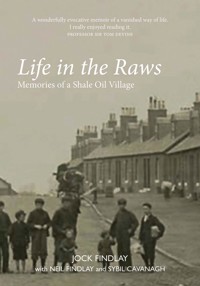
This book is the life story of John 'Jock' Findlay, rediscovered by his grandson Neil Findlay MSP after finding Jock's writing on the back of a plywood bath panel. Pumpherston village in Scotland, built by Pumpherston Oil Company in 1884, was home to the brave shale oil workers who faced life threatening conditions. In Life in the Raws the life of 'a proud, good, clever working class man' is revealed from 1919 to 1994 spanning almost a whole century of Scottish history. It presents the story of one man's life as well as the history of a unique Scottish village and its community and culture.
Das E-Book können Sie in Legimi-Apps oder einer beliebigen App lesen, die das folgende Format unterstützen:
Seitenzahl: 80
Veröffentlichungsjahr: 2020
Ähnliche



















JOHN ‘JOCK’ FINDLAYwas born in 1915, the youngest of a family of six. His eldest sister, Elizabeth, died in infancy. He went to school in Pumpherston and then went on to serve an apprenticeship as a plumber and lead burner with the Pumpherston Oil Company. He married Helen ‘Lena’ Johnston and the couple had twin boys, Ian and Leonard. After the war, he spent time working in the Middle East in the newly developing oil industry. Not long after he returned he lost his leg in a road accident. Undeterred by this, he worked at his trade up until his retirement. Jock was a skilled craftsman and enjoyed making and fixing things and working around the house and garden. He enjoyed travelling, reading, the odd bet on a horse and a nice glass of whisky. He is survived by his son Leonard, who still lives in Pumpherston.
This book has been transcribed from Jock’s memoirs by his grandson Neil. Special thanks are due to Robin Chesters at the Almond Valley Heritage Trust for his help in sourcing photographs, to the Trust for giving permission to use them and to Sybil Cavanagh for her support and excellent contribution to this project.
Life in the Raws
Memories of a Shale Oil Village
JOCK FINDLAYwith NEIL FINDLAY and SYBIL CAVANAGH
First published 2020
ISBN: 978-1-910022-35-1
The author’s right to be identified as author of this book under the Copyright, Designs and Patents Act 1988 has been asserted.
Typeset by Carrie Hutchison
All images © Neil Findlay except where indicated
© Neil Findlay, 2020
This book is dedicated to my Granda’ Jock, my Granny Lena and my Aunty Mary Wynne (Jock’s sister) and to Pumpherston and the shale industry – all have had a huge and lasting influence on my life.
Contents
John ‘Jock’ Findlay Family Tre
The People Who Made This Book
Scottish Shale Oil Industry Timeline
Pumpherston and the Shale Oil Industry: A Concise Overview -SYBIL CAVANAGH
Discovering Jock’s Journal -NEIL FINDLAY
Life in the Raws: Memories of a Shale Oil Village -JOCK FINDLAY
Postscript -NEIL FINDLAY
Jock in the Middle East
The Writing Discovered on the Bath Panel
Pumpherston Housing
Jock showing his domestic skills
Ian and Leonard aged 21
The People Who Made This Book
JOHN ‘JOCK’ FINDLAYwas born and brought up in the heart of the burgeoning West Lothian shale oil industry. His family and working life were shaped and dominated by the Pumpherston Oil Company or ‘the works’ as it was known locally. ‘The works’ provided jobs, housing, education, cultural events, sport and recreation.
Jock was educated at the local primary school before following other members of his family into the oil industry, working as an apprentice and tradesman chemical plumber; a job which saw him later spread his wings, with a spell in the Middle East. In his early 20s, he suffered very serious injuries following a motorbike accident, which resulted in him spending a year in hospital and ultimately losing his leg. He returned to work determined that his disability would not hinder him – it never did. He worked up to retirement age, travelled widely and was always occupied in his garden, his shed or the workshop in the old wash house at his home in the South Village raws.
Jock and his wife Lena had twin boys, Ian (Neil’s father, now deceased) and Leonard, who still lives in the village. It was Leonard, as the Chief Electrician at theBPdetergent works which occupied the site of the former Pumpherston oil works, who turned off the power and was the last man out when the plant closed in 1993, thus ending over a century of Findlay family connections to oil and chemical processing in the village.
Left to right: Mary Wynne (Jock’s sister), Jock Findlay, Ian Findlay (Jock’s son) at the back, Lena Findlay (Jock’s wife), William Findlay (Jock’s father)
Jock with his sons Leonard (left) and Ian (right)
SYBIL CAVANAGHgrew up in Fife and is a graduate of St AndrewsUniversity. After a diploma in librarianship at the University of Wales, she worked in Wigan and then Glasgow, where a longstanding interest in Scottish history developed into a particular interest in local history. She was for 26 years the local history librarian for West Lothian, and built up a comprehensive library of books, photos, maps and other information on the county, now housed in Linlithgow Partnership Centre. Since her retirement in 2016, she has continued her research into West Lothian’s history, with a particular interest in the 18th and early 19th centuries, and West Lothian’s links with the slave trade. She has published books on the history of Blackburn, Pumpherston, Bathgate and Whitburn.
Sybil Cavangh, former local history librarian West Lothian Council
NEIL FINDLAYwas born in Bangour hospital and lives in Fauld-house. Like his father and great-grandfather before him, he served an apprenticeship as a bricklayer and for ten years worked as a tradesman alongside his Da, Ian. He attended evening classes at West Lothian College before graduating from Strathclyde and Glasgow Universities. He worked in the social housing sector and was a secondary school teacher for ten years. In 2003, he was elected onto West Lothian Council as a councillor for the Breich Valley ward before being elected in 2011 to the Scottish Parliament as anMSPfor the Lothian region. He is standing down from parliament at the 2021 election.
Neil is married to Fiona and they have a grown-up daughter, Chloe. Neil has written many articles for newspapers and magazines and has previously published a bookSocialism and Hope: A Journey Through Turbulent Times.
Neil Findlay MSP
Note: ‘The Raws’ is a reference to the rows (‘raws’ in Scots) of cottage style houses that were generally of a uniform construction with common gable ends, built by the Pumpherston Oil Company to house shale miners and those who worked in the industry.
Typical shale miners’ raws at Addiewell
The South Village Pummpherston raws today
Lamp oil wagon (Almond Valley Heritage Trust)
Scottish Shale Oil Industry Timeline
Before 1850
The only oils available to fuel lamps or lubricate machinery were made from plants or animals. These oils were smelly and expensive.
1850
James ‘Paraffin’ Young created a process to produce oil from a special type of coal. They began to build the world's first mineral oil works at Boghead near Bathgate. He had a patent on this process meaning only he was allowed to use it to get the oil from the special types of coal.
During the 1850s
James Young developed a fuel for oil lamps which he called ‘paraffine’. This new fuel was an immediate success. The process is used throughout the world and James ‘Paraffin’ Young became rich and famous. James Young had a patent on this fuel meaning only he could use the process unless someone had paid him a licence fee.
1859
The world’s first oil well is drilled in theUSAproviding a much simpler and cheaper way of producing mineral oil. American oil is soon being imported into Britain.
1862
James Young’s patents run out sparking ‘oilmania’. Throughout the Scottish coalfields people try to get rich quick by opening their own oilworks. Most only last a few years.
1866
James Young begins construction of a huge oilworks at Addiewell which uses oil-shale instead of coal.
1870
James Young sells his interest in Young’s Paraffin Light and Mineral Oil Company, and retires to enjoy his fortune.
1877
The Broxburn Oil Company is established, using a new design of shale retort. The success of this new company encourages others to open large scale oil works.
1885
The invention of the motor car.
1894
The Pumpherston Oil Company invents an even better shale retort. The company grows quickly to become the most successful of the Scottish oil companies.
1901
Queen Victoria dies.
1905–1910
A time of success and richness for the five major shale oil companies. Oil works are made bigger and improved, but the Scottish companies continue to compete against each other instead of joining together to combat the threat of the American Oil import.
1914
First World War declared.
1917
The Russian Revolution.
1918
End of the First World War.
1919
The shale oil industry is unable to compete against cheap imported oils. The Scottish companies join together to form Scottish Oils Ltd, part of a government group that becameBP.
1922
Scottish Oils open the Grangemouth refinery to process imported crude oil. The skills and experience of the shale oil companies was vital in the development of the new international oil company.
1925
A public enquiry concludes that shale oil will never again be able to compete with cheaper imported fuels. Oilworks close with terrible consequences to the thousands employed by the industry. The General Strike takes place.
1927
The Jazz Singer,the first movie with sound released.
1928
Women win the same voting rights as men in theUK.
1931
The government reduces tax on Scottish oil to prevent the total closure of the shale oil industry.
1939
Second World War declared.
1941
New shale mines are opened and a major new oilworks is built so that Britain would not be so dependent on imported oils in the event of war.
1945
Second World War ends.
The 1950s
The tax advantage of shale oil is gradually reduced. Oilworks and mines close.
1962
The last Scottish shale oil works is closed.
1969
Man lands on the moon.
1971
The first email sent.
1993




