


Erhalten Sie Zugang zu diesem und mehr als 300000 Büchern ab EUR 5,99 monatlich.
- Herausgeber: Slovene Writers' Association
- Kategorie: Sachliteratur, Reportagen, Biografien
- Sprache: Englisch
This e-book is part of the Ulysses' Shelter project started in 2017 with the objective to build a network of exchange literary residencies aimed at young writers and literary translators. The second stage of Ulysses' Shelter is once again being co-funded by the Creative Europe Programme of the European Union, and coordinated by Croatian publishing house and literary agency Sandorf, with four partners, Literature Across Frontiers and Wales Literature Exchange in Wales, Krokodil in Serbia, Thraka in Greece and Slovene Writers' Association in Slovenia. This e-book represents a cross-section of external and internal events from each young literary creator in the months between August 2020 and the end of 2020. It consists of five chapters, each offering a unique insight into the artists' lives, thinking and fears in the last quarter of 2020, that is, in the year Covid-19 was born. At the end of the book, there is a short reflection by the young literary creators on the guest performances carried out in Ljubljana, Slovenia. Then there is a short presentation of all the literary correspondents.
Sie lesen das E-Book in den Legimi-Apps auf:
Seitenzahl: 123
Veröffentlichungsjahr: 2022
Das E-Book (TTS) können Sie hören im Abo „Legimi Premium” in Legimi-Apps auf:
Ähnliche



















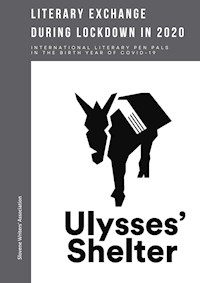
LITERARY EXCHANGE
DURING LOCKDOWN IN 2020
INTERNATIONAL LITERARY PEN PALS
IN THE BIRTH YEAR OF COVID-19
Authors: Sergej Harlamov, Maja Klarić, Aljaž Koprivnikar, Lloyd Markham, Dino Pešut, Kaja Teržan, Aljoša Toplak, Thomas Tsalapatis, Eluned Gramich, Katja Zakrajšek
Editor: Nataša Čebular
Translation of non-literary texts: Jason Blake
Translation of poetry from Slovene into English: Nada Marija Grošelj
Translation of poetry from Croatian into English: Polona Glavan
Translation of poetry from Aljaž Koprivnikar: Aljaž Koprivnikar
Proofreading: Jason Blake
Cover design: Nataša Čebular
Published by Slovene Writers’ Association, Ljubljana
Dušan Merc, President
First digital edition
Ljubljana 2022
https://tovar.hr/
Kataložni zapis o publikaciji (CIP) pripravili v Narodni in univerzitetni knjižnici v Ljubljani
COBISS.SI-ID 112926467
ISBN 978-961-6995-87-0 (ePUB)
FOREWORD
July 17, 2022
It is 2020 and a warm summer is upon us. Temperatures are rising, and for the past two months we have been able to roam around the city of Ljubljana, Slovenia, liberated from having to wear masks. Smiles or frowns are again clearly drawn on passing faces. Masks are stowed in purses or trouser pockets, left lying in cars or hanging from rear-view mirrors.
But the fear produced by the Covid-19 virus is still present. It has merely changed its appearance. It has morphed into a – personal or public – conversational topic. Otherwise (for now) it has lost its power. Despite the fact that we are all trying to forget about it as we go through our daily lives, official and media statistics, among other things, remind us of it.
‘Five infections in Cerknica. Kacin speaks of restrictions on gatherings’
rtvslo.si, July 7, 2020
‘560 tests, 14 infections. Kacin: “Parties, picnics and weddings are leading sources for new hotspots’
rtvslo.si, July 12, 2020
‘Fresh data. 10 new infections confirmed on Monday, including a kindergarten assistant in Hrastnik’
rtvslo.si, July 14, 2020
In spite of all that, we breathed a little easier during these summer months. Restrictions on crossing municipal borders in Slovenia have disappeared. Regional ones too. Ordinary citizens can once again cross national borders. With the Covid-19 virus, such borders re-emerged in the European Union. But now it’s summer. Although the city is veiled by haze and humidity, and temperatures are approaching heat wave levels, we breathe more easily. And we continue to breathe. And we breathe without masks.
With the summer and the dropping of protective mask requirements, the Slovene Writers’ Association hopes that we and our project partners will be able to carry out the international residency program Ulysses’ Shelter 2, intended for young literary creators and translators from five different countries: Croatia, Great Britain and Wales, Greece, Serbia, and Slovenia. I’m in the office, sending emails again with great enthusiasm, and asking the key question: ‘When would be the best time for you to spend your residency in Ljubljana?’ and ‘Do you meet the RVT conditions (Recovered – Vaccinated – Tested)?’ I am gradually receiving their answers and the timeline of our young literary guests for the rest of the 2020 year is finished. And I, too, can go in good conscience on my own holiday – out of town and near some water.
July 20–9 August 2022
From: Nataša Čebular <[email protected]>
Date: Thu, Jul 23, 2020 at 2:31 PM
Subject: Obvestilo o odsotnosti / Out of office notice
To: Undisclosed Recipients
Pozdravljeni,
trenutno nisem v pisarni in se vrnem v ponedeljek, 10. 8. 2020. Za nujne zadeve prosim pišite na [email protected].
- - - - -
Dear Madam or Sir,
I’ll be out of office till Monday, the 10th of August. For urgent matters please write to [email protected].
Lep pozdrav/Kind regards,
Nataša Čebular
Strokovna sodelavka v pisarni Društva slovenskih pisateljev
Društvo slovenskih pisateljev /
Slovene Writers’ Association
Tomšičeva 12
1000 SI-Ljubljana
e-mail:[email protected]
https://www.drustvo-dsp.si/
August 15, 2020
In a post-holiday spirit and with recharged batteries, I am again glued to the phone, regularly following the news.
‘17 infections confirmed on Monday, at least 8 of them from abroad’
rtvslo.si, August 11, 2020
‘29 new cases, most from abroad / Beović for stricter rules on the border with Croatia’
rtvslo.si, August 13, 2020
‘15 confirmed infections, at least 8 of them imported. Tightening of Croatian border increasingly likely’
rtvslo.si, rtvslo.si, August 16, 2020
‘Tuesday’s tests confirmed 37 new infections, again mostly among young people’
rtvslo.si, August 19, 2020
August 20, 2020
I turn on the television and see that the Slovenian media and state representatives have started urging holidaymakers to return home as soon as possible.
‘43 newly discovered infections / The highest jump in infections since April 3. Slovenj Gradec enters the white zone’
rtvslo.si, August 20, 2020
‘National Institute of Public Health: Most imported infections from Croatia, almost three quarters brought in by young people’
rtvslo.si, August 22, 2020
‘34 infections confirmed on Saturday after 760 tests’
rtvslo.si, August 23, 2020
‘Hojs: Between Saturday and Monday, about 60,000 Slovenian citizens returned from Croatia’
‘When crossing the border with Croatia, a 14-day quarantine is now mandatory. However, this does not yet apply to some of the exceptions set out in the decree. Without imports from abroad, Slovenia would have significantly fewer infections, says Government spokesperson Kacin’
rtvslo.si, August 25, 2020
Unbelievable! In order to make the appeals of government representatives as effective as possible, they introduced milder criteria for crossing the border back to Slovenia: ‘If you return by August 25, 2020, you do not have to quarantine for 14 days.’
At the same time, we all skimmed the news headlines – travel from one country to another will probably not be possible this year either. In all probability, regional and municipal border restrictions will also return, or even the shutting down of public transport throughout the country, as well as the general cessation of social and business life.
And what does this now mean for the international residency project Ulysses’ Shelter 2 and for our young literary creators in this project? I don’t know. And no one at the Slovene Writers’ Association knows either. We are again overwhelmed by a feeling of uncertainty about what will follow and how things will unfold over the coming months.
August 25, 2020
Uncertainty about the coming months is on the rise. The official numbers of those infected are also rising. At the Slovene Writers’ Association, after a thorough consideration of the Ulysses’ Shelter 2 project, we realize we have no choice but to try to bring together our young literary guests online in activities that will bring them closer to Slovenian literature and to the literary scene. So we came up with an idea: the Literary Exchange. In keeping with their literary interests and literary profile, we connected each young literary creator with a young Slovenian artist online. Thus, five literary couples were formed, who connected – one way or another – through the internet, the only world that remained open and without borders. They wrote emails to each other, some talked through audio-visual media, others threw themselves into joint personal projects or experimented with translations of poems. Each in their own way. Each in a unique way.
What follows is the correspondence they produced during the subsequent dark and lonely autumn and winter months.
A few years later, around May 25, 2022, or a little something about this e-book
This e-book represents a cross-section of external and internal events from each young literary creator in the months between August 2020 and the end of 2020. It consists of five chapters, each offering a unique insight into the artists’ lives, thinking and fears in the last quarter of 2020, that is, in the year Covid-19 was born.
At the end of the book, there is a short reflection by the young literary creators on the guest performances carried out in Ljubljana, Slovenia. Then there is a short presentation of all the literary correspondents.
By way of conclusion, let me just say that, rather than being a work of fiction, this publication merely reflects a shocking year and all the situations directly or indirectly related to the acute Covid-19 situation that cast its shadow over all areas of our lives, including the literary and literature itself.
CHAPTER 1: ELUNED GRAMICH AND KATJA ZAKRAJŠEK
“
One of the speakers quoted the Orwellian line, ‘Who controls the past controls the future. Who controls the present controls the past’. I suppose every nation has ghosts from its past that keep being used as stakes in current politics […].
Katja Zakrajšek
PARALLELS BETWEEN THE LANGUAGE POSITIONS OF SLOVENIAN AND WELSH
Subject: Greetings from Wales
Date: Mon, 31 Aug 2020 08:57:22 +0100
From: Eluned Gramich
To: katja zakrajsek
CC:
Dear Katja,
Živjo!1
Things have calmed down a little in my world – after moving house and the rest. Not sure how things are with you? I hope this is a slightly better time to start the email exchange for you too. How are your translation projects going?
Recently, I’ve been thinking more and more about language learning... I’m working on a short story about a widow in her sixties who visits her son in Munich. She decides to learn German there, and through it she discovers new freedoms and joys. It’s possibly too idealistic and rosy a picture, but personally I don’t think it’s too far from the truth, do you? When you live in another country, learning its language is practically, instantly, surprisingly rewarding – as well as hard work. When I lived in Tokyo, every month I spent learning Japanese was a kind of revelation: the streets opening up to me daily as I began to read the signs around me, and understand what was being said to me in cafes and shops. In Japan, especially, you are always being addressed, even when you enter the smallest corner shop – Irrashaimase! Welcome and please come in! The first time I went into a Conbini, I thought the shop assistant was warning me off!
Yesterday I met a friend and her new partner. He’s a Dutch linguist whose job it is to transcribe 18th-century letters. Because my friend is in love, she spends ten minutes every day studying Dutch on her phone, just as I try to spend some time every day improving my Brazilian Portuguese. It’s not exactly for our partners that we do it, but for their families, because the older generation (my husband’s parents and grandparents) never learned English at school. Every week my husband phones his 90-year-old Avó in rural Muria. I now know how to say ‘bença’ – bless me – to her, and she answers with lengthy blessings and prayers I’ve slowly come to understand... Whatever the reason for studying a language, it is a gift, really, to be able to ‘see’ the world in a new way.
I was only going to send you a short message, but it’s become quite long... Apologies! I would love to hear more about your translation practice and your language-worlds, when you have time.
Very best wishes, cofion cynnes o Gaerdydd
Eluned
On Sun, 25 Oct 2020 at 17:02, Katja Zakrajšek wrote:
Dear Eluned,
This was supposed to be an in-person conversation in Aberystwyth and Ljubljana. Instead, I’m writing this from another Covid-19 lockdown – and I think Wales is just doing a firebreak? Who’d have thought this was the vocabulary we’d all be learning in 2020.
Anyway, just before cultural venues were closed again, I’d managed to attend an exhibition opening at the City of Women festival in Ljubljana. Corneous Stories is a collective project centred around cosmetics: the material culture, the labour conditions and so on. Among the very international group of authors, perhaps the last ones to make it to Ljubljana for a while, was Mareike Bernien. Her name made me think of the Mareike in your story ‘The Book of New Words’. I loved how you wrote her struggles with her name suddenly going from unremarkable to foreign and ‘wrong’ as she moves to a new country – and the dilemma of whether to insist on it or to pick another name so as to blend in.
Names are so strange, aren’t they? While there’s no tension around a name, it seems so easy to be all ‘a rose by any other name’. But the moment it is challenged or denied, ignored or distorted – that’s an entirely different story.
It made me wonder how your own name is perceived (and pronounced) outside of Wales – especially in light of incidents I’d read of, where Welsh speakers were treated as speaking ‘foreign’. This is something I find mindboggling, at least until I remember how the UK is largely perceived as a monolingual block from the outside. (In Slovenian, we even often use ‘England’ and ‘English’ interchangeably with ‘Great Britain’ or ‘British’.) I suppose this reflects a view from the UK’s centre itself. It’s amazing how efficiently a multilingual reality can be made invisible in (self-)perception.
Incidentally, this was one of the reasons I was so eager to visit Wales as part of the Ulysses’ Shelter programme. My chosen focus in translation has been African and later African-diasporic writing, and while it first came about simply because I’d fallen in love with some books and continued reading, it’s become an amazing window into (perceived) margins of and enclaves within large, dominant languages (for me, mainly French and English) where other languages are present, resisting, inflecting, transforming the linguistic monoculture to create something much more interesting, a space for different voices and stories to emerge. It seemed to me that Wales would offer another interesting perspective.
Coming from a literary tradition that perceives itself as monolingual and is strongly marked by the idea of the mother tongue as the natural choice for literary creation, I’ve found that translating writing where the language of expression is not necessarily stable and taken for granted as challenging as it has been eye-opening and enriching. My very first book-length translation was Ahmadou Kourouma’s Allah n’est pas obligé, a novel that effectively explodes the idea of French in the singular – not only does the narrator weave together several Frenches, but he explicitly comments on the differences between them, even translating between them at times. There was no way of avoiding inscribing these differences within the translated text, even if I’d wanted to. And hence, no way of avoiding thinking about the relationship between languages and their different histories, even if I’d wanted to.




