


Erhalten Sie Zugang zu diesem und mehr als 300000 Büchern ab EUR 5,99 monatlich.
- Herausgeber: Amsterdam Publishers
- Kategorie: Sachliteratur, Reportagen, Biografien
- Serie: Holocaust Survivor True Stories WWII
- Sprache: Englisch
A treasure of individual strength, family love, community solidarity and Jewish History
This is the story of one remarkable young woman's unimaginable journey through the rise of the Nazi regime, the Second World War, and the aftermath. Mania Lichtenstein’s dramatic story of survival is narrated by her granddaughter and her memories are interwoven with beautiful passages of poetry and personal reflection.
Holocaust survivor Mania Lichtenstein used writing as a medium to deal with the traumatic effects of the war. Many Jews did not die in concentration camps, but were murdered in their lifelong communities, slaughtered by mass killing units, and then buried in pits. As a young girl, Mania witnessed the horrors while doing everything within her power to subsist. She lived in Włodzimierz, north of Lvov (Ukraine), was interned for three years in the labor camp nearby, managed to escape and hid in the forests until the end of the war. Although she was the sole survivor of her family, Mania went on to rebuild a new life in the United States, with a new language and new customs, always carrying with her the losses of her family and her memories.
Seventy-five years after liberation, we are still witnessing acts of cruelty born out of hatred and discrimination. Living among the Dead reminds us of the beautiful communities that existed before WWII, the lives lost and those that lived on, and the importance to never forget these stories so that history does not repeat itself.
READER'S FAVORITE GOLD MEDAL OF 2020 WINNER IN THE CATEGORY BIOGRAPHY
Sie lesen das E-Book in den Legimi-Apps auf:
Seitenzahl: 215
Veröffentlichungsjahr: 2020
Das E-Book (TTS) können Sie hören im Abo „Legimi Premium” in Legimi-Apps auf:
Ähnliche
















LIVING AMONG THE DEAD
MY GRANDMOTHER'S HOLOCAUST SURVIVAL STORY OF LOVE AND STRENGTH
ADENA BERNSTEIN ASTROWSKY
Living among the Dead. My Grandmother's Holocaust Survival Story of Love and Strength
Featuring the writings of Mania Lichtenstein
Narrative provided by her granddaughter, Adena Bernstein Astrowsky
Copyright © Adena Bernstein Astrowsky, 2020
ISBN 9789493056381(ebook)
ISBN 9789493056374(paperback)
ISBN 9789493056596(hardcover)
ISBN 9789493231450 (audiobook)
Part of the Series Holocaust Survivor True Stories WWII
Publisher: Amsterdam Publishers
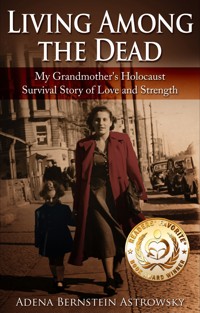
Frontcover: Mania Lichtenstein (‘Bubbie’) and Adena’s mother in Berlin after the Second World War.
All Rights Reserved. No part of this publication may be reproduced or transmitted in any form or by any means, electronic or mechanical, including photocopy, recording or any other information storage and retrieval system, without prior permission in writing from the publisher.
CONTENTS
Recommendations
Acknowledgments
Introduction
1. Bubbie
2. The World I once knew
3. Nechamka
4. Family
5. Life in Poland
6. Russian Control
7. Unforgettable Images
8. German Occupation
9. The Beginning of the End
10. Life in the Attic
11. A New Ghetto
12. One Thousand Remaining
13. In the Forest
14. Liberation
15. My Home
16. Looking for a New Home
17. Leaving ‘Blood-Soaked Europe’
18. Moving to a New Country
19. My odd Wedding Day
20. Righteous Among the Nations
21. More of Mania’s Writings
Postscript
Further Reading
Review Request
Notes
“... things that happened years ago keep flashing before my eyes. If they could only be rinsed away with the tears that they cause!” Mania Lichtenstein
I dedicate this book to my three beautiful children,
Sarah, Zachary, and Gabby.
They are the living reminders that although a total of 11 million people were murdered at the hands of the Nazis, Hitler failed in his quest to completely exterminate Jews from this planet.
May the memories of all those who have perished be for a blessing.
RECOMMENDATIONS
I was honored when asked to read and review Adena Astrowsky’s book, Living among the Dead. What stood out for me is how different this book is from many of the other Holocaust books. I was most impressed with two things: 1) the amount of important documentary information which is often not known or forgotten, and 2) the details about her grandmother’s life in labor camps. I feel it is a very important and well-written book that the world needs to read. As I told Adena, she did a “Mitzvah” (a good deed) for the world by documenting her grandmother’s story in such an excellent way. - Ben Lesser, Holocaust Survivor, Author, Speaker, and Founder of Zachor: Holocaust Remembrance Foundation
An inspiring story of values and tradition from generation to generation by a granddaughter who has dedicated her life’s work to being a prosecutor of victim-crimes. Narrative history of the Holocaust through discussions with her grandmother “Bubbie” who wrote poetry during the Holocaust as well as her thoughts through the years. “Bubbie’s” poems, such as The Nostalgic Past, could easily be adapted to middle and high school class lesson plans. - Jay Levinsohn, teacher
Even though it is incredibly difficult to read about the soulless cruelty inflicted upon Jews and other groups during World War II, it is imperative that we do so. The idea that the recurrence of the demonization of an entire race could ever happen again should seem not just implausible, but impossible. Tragically, however, we find ourselves in a world reeling from a resurgence of hate and violence. Against this backdrop, Adena Bernstein Astrowsky’s Living among the Dead can help serve as an important wakeup call.
Kudos to Astrowsky, Mania Lichtenstein’s granddaughter, for preserving her grandmother’s wartime experiences. “I was in elementary school when I first learned that my grandmother was a Holocaust survivor,” says Astrowsky. That early exposure to stories of the unthinkable cruelty inflicted on her grandmother left an indelible mark. Through their eyes, Living among the Dead — a collection of Lichtenstein’s writings and her granddaughter’s observations — becomes a gift of immeasurable importance for us all.
This book should be found in every library from middle school on up. Readers will come away feeling a range of emotions. Mine is of enormous sadness tempered with gratitude and the eternal hope that these lessons are not lost on this and future generations. - Linda F. Radke, President, Story Monsters LLC, formerly Five Star Publications, Inc.
I have twice been gifted the opportunity of helping bring forth the stories of Holocaust survivors — first when I helped write Cantor Leo Fettman’s biography (Shoah: Journey from the Ashes) and then, more recently, when asked to edit Living among the Dead. Understandably, I found both of these experiences to be deeply moving and emotional.
Living among the Dead is Adena Bernstein Astrowsky’s loving and careful reflection of passages from her grandmother’s private journal that Mania Lichtenstein kept as a way of coping with the memories of what she’d survived in World War II. In addition to these notes written by Mania Lichtenstein, Astrowsky also spent years talking with her grandmother about her experiences, difficult as though many of these conversations were.
So do we need another Holocaust book? The answer becomes obvious when one sees the rise of hate groups. Jews, Christians, Muslims, Hindus, agnostics, and atheists— we are all brothers and sisters. But when hatred and discrimination, born almost entirely from ignorance and fear, enter the mainstream of our lives, we very much need this book.
Living among the Dead is another valuable brick in the “never again” wall that demands constant attention and refortification. - Paul M. Howey, writer and editor
For most Americans alive at the end of WWII, news of the Holocaust came in the form of photographs in USA’s most popular magazine - LIFE – heaps of skeletal remains and barely human faces staring into cameras General Eisenhower ordered to document Nazi horrors in “concentration camps.”
A few years later, the “best-seller” was by the brilliant teenage daughter of a German-Jewish family hiding in Holland. Still read in many American schools, The Diary of Anne Frank ends without revealing the terrible fate we now know all but Anne’s father shared with “the six million.”
After half a century, we have come to know the limits of these best-known sources. Most Jews killed were not from Germany, but Eastern Europe. And most did not die in “camps”, but in their lifelong communities, slaughtered by Einsatzgruppen, then buried in pits, up to tens of thousands a day.
The genius of Living Among the Dead is not just that it is one of only a few memoirs to describe this form of death – 20,000 Jews slaughtered in Polish city of Wlodzimierz alone – but also conveys how Jews lived in Eastern Europe, which large numbers of today’s Jews identify as their place of origin.
Ostensibly co-written by two generations of authors – grandmother and grand-daughter - both self-designated “Memorial Candles” - there are actually three narrators: (1) the 17-year-old girl who cheats death by what she calls “fate” and we can see as an uncanny ability to always align herself with good people who can help her; (2) the mature woman she became, with the wisdom to flee “blood-soaked” Europe for Canada, then immigrate to America, working as a bookkeeper, becoming an avid reader of literary classics in multiple languages, persisting in writing her memoirs past loss of eyesight; and (3) her lawyer grand-daughter who persisted through years of sometimes difficult interviews, then skilfully constructed a narrative, beginning with the B’nai Mitzvot of her twins, days after death of their beloved B-Bubbie – the quintessential “survivor” who (as the author wrote) “wanted to be sure the rest of the world did not forget the beauty of the culture her family enjoyed before it was so despicably destroyed.” Wonderful book - a treasure of individual strength, family love, community solidarity and Jewish History. - Marcia Ruth, retired writer and editor
Using both her own words and her grandmother's, Astrowksy weaves the story of survival against all odds during the Holocaust. Before I had even finished the book, I felt I knew "Bubby" and could hear her unwavering voice through her poetry and her amazing story of war and strife in Eastern Europe. - Kimberly Klett, Museum Teacher 2003-04, United States Holocaust Memorial Museum and Executive Deputy Director, Educators' Institute for Human Rights
Living among the Dead is a riveting, heart-felt glimpse into one young girl’s path into and out of the Holocaust. A childhood once filled with joy and innocence was replaced with utter despair as she lost her entire family and had to learn to survive on her own. While her survival was nothing short of a miracle, the true significance of this story is the ultimate triumph of good over evil through a life well lived, and a legacy secured.
Living among the Dead transforms the study of the Holocaust from a distant event to a personal journey. As a teacher, I believe reading this book will help my students develop a richer, more intimate understanding of this period in history, and better equip them to do the important work of sharing the lessons of the Holocaust with future generations. - Sarah Armistead, M.P.A., 8th Grade History Teacher
Living among the Dead by Adena Bernstein Astrowsky is a memoir that features the writings of her grandmother Mania Lichtenstein who survived the atrocities of the holocaust. Astrowsky skilfully weaves her grandmother’s poetry and personal reflections into a narrative providing context and connection with the audience. From sharing her grandmother’s story, we learn through a first-hand account the horrific experiences she endured to survive, and through her survival we learn lessons of courage, resiliency, and the value of life.
The experiences that Astrowsky provides are more than a family history. It is a story of culture and meaning showing the importance of relationships and family during challenging and rewarding times. Many of the personal memories focused on the people that were involved; those who were lost, those who survived, and the family that surrounded her. It is easy to fathom how one would fall into despair as a result of these experiences; however, when we learn of how Lichentstein chose to live her life, we understand why it was important for her to have hope and persevere.
World War II was more than seven decades ago and many who lived during that time have passed away. In order to understand history’s impact is to have first hand accounts of those who lived it; it is also important to never forget the events of the holocaust so that history does not repeat itself. Living among the Dead is an excellent book that does both. Not only does Astrowsky share these important perspectives, she provides a wonderful tribute to her grandmother who loved her family. - Paul Becker, Secondary Language Arts Coach, Scottsdale Unified School district
ACKNOWLEDGMENTS
I would like to express my heartfelt gratitude to the many people that helped to memorialize my grandmother’s story of survival. Creating a book such as this requires a lot of time outside of my full-time job and away from my family. I would like to begin by thanking my husband, Brad, and my children, Sarah, Zachary, and Gabby, for their patience and love while I spent many evenings and weekends working on this project. I missed quite a few activities and social gatherings to sit at my laptop to research and write. It is with them in mind, however, that I decided to take on this project.
I would also like to thank my mother, Jeanie Bernstein, for spending so much time with me as I went through the entire story of her mother’s survival. She was very helpful in filling in many of the post-war gaps. Also, questions developed along the way that required additional knowledge of specific details that my father (Allan Bernstein), sisters (Joanna and Corinne), and their families were able to provide. I thank them as well.
Several people helped translate letters my grandmother wrote in Polish and Yiddish. I would like to thank my friend, Joanna Jablonski and her mother, Eva Morris, for their assistance in translating the letter and card in Polish. For the two letters in Yiddish, I thank Levi Levertov, Jeff Miller, and Etty Sims for all their help.
A profound thank you to the staff at Yad Vashem and the U.S. Holocaust Memorial Museum. Both museums provided many resources and assistance throughout the writing of this book. I would like to specifically thank Maria Sehen, with Yad Vashem, for her assistance in processing Janina’s nomination for consideration to be included in the “Righteous People Among the Nations” list and for her additional help with locating information about my grandmother’s hometown. Maria also put me in touch with a childhood friend of my grandmother’s, Genia Seifert, who provided additional details which helped me understand my grandmother’s childhood. I am so grateful to my college friend, Shira Gafni, who met with Genia in Israel and spent time at her home asking her many questions on my behalf.
I am forever grateful to Marcia Ruth, for her extraordinary insight and who was able to contribute so many historical facts to this book. Also, I would like to thank Paul Howey who helped edit the original manuscript before it was submitted to Amsterdam Publishers for consideration. Many people volunteered to read an advanced copy of this book and provide an honest review. I am thankful to all of you for your time, support, and words.
Finally, I am eternally grateful to Liesbeth Heenk with Amsterdam Publishers for agreeing to publish this book. From the moment we had our first Skype conversation, I knew this book was in good hands and we would develop a wonderful relationship. With the publication of this book we hope to remind each new generation to Never Forget.
INTRODUCTION
Adena and her grandmother on the beach (1974).
My name is Adena Bernstein Astrowsky, oldest granddaughter of Mania Lichtenstein. My Jewish name is Rivka Nechama. I was named after my grandmother’s two sisters, Rivka and Nechamka, both of whom perished in the Holocaust. I have always felt a strong connection to both women, not only because of our shared name but also because of the stories my grandmother told me. Writing this book allowed me to learn the details of her survival (she was known to her family as Bubbie), to think deeply about the odds she had to overcome, and to truly see her in the way she had come to see her mother — as a hero.
I was in elementary school when I first learned that my grandmother was a Holocaust survivor. Even as young as I was then, I knew the Holocaust was a horrendous and unthinkable time in the world’s history, and that she was very fortunate to have survived it. But, I must admit, I really didn’t think much more about it until I was in middle school when I began asking her questions about her experiences. None of my questions, however, were answered easily. In fact, learning the details of my grandmother’s survival was never easy.
I remember studying world history in high school and preparing a list of questions for her. Of course, I was a typically impatient teenager who didn’t have endless hours to sit and listen to the whole story.
I wanted my grandmother to answer my specific questions as quickly and succinctly as possible. But she always found it hard to give me simple answers.
Admittedly, my questions probably weren’t worded well, but it seemed that a question about one topic would lead her to talk about several other topics. I guess she didn’t want me to leave thinking that a single piece of information could represent the whole story. Or it could be the details and events were so intertwined that it was hard for her to separate out the facts I was searching for.
Looking back on my adolescent expectations, I came to understand why this was an impossible task for my grandmother. Each story involved multiple details that needed to be shared in order to answer what I presumed to be a ‘simple’ question.
What thwarted my efforts the most were the nightmares I came to learn she would endure, sometimes for weeks, after having shared with me her experiences. It’s a side effect common to many victims of trauma: recounting the awful event often forces them to suffer all over again. This was not something I wanted for her. Yet, she was not to be dissuaded.
Bubbie held steadfast to the strong desire that her family know its roots. She emphasized this time and again as her children had children, and those children had children, with the Holocaust becoming ever further removed from the consciousness of each generation. As she watched this happen, it became even more imperative for her that we know our shared history.
My grandmother’s purpose in this was not for us to dwell on the horrific details. Rather, she wanted to enrich our lives through knowledge of the past. In other words, she did not believe we were aware of what we were missing by not knowing the story of her survival, and of those who did not survive the Holocaust. It is my hope — with the writing of this book — that her descendants and others will know not just the horrors wrought by the Nazis, but also the beauty of the lives created by the Jews.
And so, over the years, my grandmother chose the medium of writing to cope with and express her feelings and emotions. Often at night, when she couldn’t sleep, she would sit at a desk alone in her bedroom and write. Even in the later years, when her vision became diminished, she continued writing with the aid of an Elmo magnifying machine. Writing was her therapy. For me, too, the benefits were enormous, as I was better able to understand what she was trying to tell me.
Through her writing, I was able to piece together the story of her survival. Bubbie wanted to be sure the rest of the world did not forget the beauty of the culture she and her family enjoyed before it was so despicably destroyed. She wrote:
So much idle time, only my mind keeps working…
So many memories of years gone by,
crowding my mind.
I must talk,
but who is there to listen?
Those who would relate and understand
are either gone or far away.
So I ‘talk’ by writing,
though I am the only one that listens.
It is the second best thing for me to ease my mind.
I can only guess why she considered it the second best thing. Perhaps because she had no one to talk with about it, which she would probably have preferred.
I was in law school when I learned of the Shoah Foundation, an organization founded by Steven Spielberg to help present and future generations learn about the Holocaust. It does this in part by collecting and preserving the personal stories of survivors and other witnesses of the Holocaust.
I arranged for someone from the Foundation to interview my grandmother and video record her testimony. I watched all four hours of her testimony several times. Doing so greatly enhanced my appreciation of what she’d endured — and, in truth, continued to endure. That experience further confirmed my decision to write her story.
When I began writing, she was still alive and living near me. I was able to interview her often about specific topics I felt were either confusing or needed more clarification and details.
Again, asking her questions wasn’t always easy, nor could I expect a simple, straightforward answer; but when I brought my young children — Sarah, Zachary, and Gabby — with me, it seemed to help her stay focused.
She answered my questions carefully because she could see that they, too, were trying to understand her story as fourth-generation survivors.
Zachary, Gabby, Bubbie, and Sarah.
Zachary, Gabby, Bubbie, and Sarah.
Two months after an earlier version of this book was published, my beloved grandmother passed away. May her memory be a blessing.
I have thought a lot about why this project is important to me. At first, my answer was simple: to memorialize the details of my grandmother’s survival for our children and all future generations to read and understand.
We’ve all heard the saying: We must never forget so that it never happens again. I believe that my generation holds the power of ‘Never Again’ by making sure the next generation will indeed ‘Never Forget.’
I continue to believe and hope that whatever we learn from one genocide can help us, G-d willing, prevent the next one.
I have long felt what psychologist Dina Wardi describes in her book, Memorial Candles: Children of the Holocaust, when she discusses what it’s like to be a family member self-selected to be the one to carry the memory and the legacy of those who did or did not survive.
I know that — as I’ve grown in my knowledge of the Holocaust and lived more years as a mother to three now teenage children — I have also become more aware of the anti-Semitism that still festers in countries throughout the world. I also know that genocide continues for other groups who, like the Jews about 80 years ago, are being murdered simply for their ethnicity.
Today, according to the United States Holocaust Memorial Museum, “The world is experiencing the largest humanitarian crisis since the end of World War II and the Holocaust. Syria, Afghanistan, and South Sudan account for more than half the 25 million refugees around the world today.” Many of these refugees are fleeing situations not unlike those faced by Jews throughout Europe prior to the war.
Thus, it was especially poignant in April 2019 when Temple Solel (my place of worship in Paradise Valley, Arizona) brought in a refugee family that had fled war-torn Syria through the Syrian Refugee Program. They were a family of four — mom and dad, son and daughter. They moved to the United States because their government was turning on its own people. The Syrian police shot at the father. They did not feel that they would survive staying in Syria. The Syrian Refugee office in Jordan that helped them emigrate chose the United States as their destination of safety. This family knew very little of Western culture, and even though they had been living in the United States for two years at the time they spoke at my temple, only the children could speak English.
The dilemma they were in — and the opportunity they were offered here in the United States — reminded me of my grandmother and the basic skills required just to survive, such as speaking the local language.
In addition to learning Polish in school and Yiddish at home, my grandmother would go on to learn Russian, German, French, and English out of a need to survive and provide for her family.
Similar to the refugee family that moved to America and had to learn English, my grandmother, too, was forced to learn new languages in order to assimilate, raise her children, maintain a job, converse with neighbors, and so on.
My hope in writing this book is to draw attention to people being persecuted for who they are. My goal is to foster understanding and empathy, especially when relating to a generation nearly gone, by telling my grandmother’s story of hope and survival when all else was lost.
My grandmother had one word to describe how she survived the Holocaust, the genocide that murdered her entire family:
As a survivor of the Holocaust, I am very often asked this question: “How did you survive?” Indeed, how? I, the youngest of the family, shy and insecure, far from being brave. I could answer it with one word: Fate. I was meant to survive three pogroms, which eliminated the town’s about 26,000 Jews. - Mania Lichtenstein, 1995
And she asked the same question that has been asked by so many for the past eight decades: Why did the Nazis murder millions of Jewish men, women, and children, Gypsies, Jehovah’s Witnesses, Seventh-day Adventists, homosexuals, political resisters and dissidents, and others?
Why
I wake up and cry,
My aching heart is uttering—why?
Why did they do this to us?
I cannot stop the tears,
That keep running down my face,
For the pain in my heart remains.
Mania Lichtenstein, 1980
What follows is the story of my grandmother.
1BUBBIE
Bubbie was a daughter, sister, wife, mother of two, grandmother of five, great-grandmother of ten. And she was a Holocaust Survivor. This is about her life — or at least the bits and pieces of that life that she shared with me in conversations and in her writings. She spoke of her earliest childhood memories and of living through the Holocaust.
Her story is now history. But, because she somehow miraculously survived horrific events and unimaginable degradation, her family, her faith, and her hope — they survive, too.
Like most members of my generation, born three decades after the end of World War II, I came to this story with almost no real understanding of the plight of Jews in the Holocaust, much less that of my own grandmother.
Adena held by her grandmother, right after she was born, April 1971




