


Erhalten Sie Zugang zu diesem und mehr als 300000 Büchern ab EUR 5,99 monatlich.
- Herausgeber: Saqi Books
- Kategorie: Sachliteratur, Reportagen, Biografien
- Sprache: Englisch
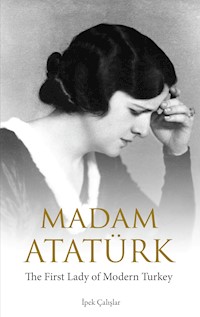
Mustafa Kemal Ataturk is hailed as one of the most charismatic political leaders of the twentieth century, but little is known today about his one and only wife, Latife Hanym. A multilingual intellectual educated at the Sorbonne, Latife's marriage to Ataturk in 1923 set her apart from her contemporaries, raising her to the pinnacle of political power. She played a central role in the creation of a modern and secular Turkey and campaigned tirelessly for women's right to vote. Throughout her marriage, Latife stood beside her husband and acted as his interpreter, promoter and diplomatic aide. She even twice risked her own life to save his. However, after only two years of marriage, Ataturk divorced Latife and she soon disappeared from public life. She was shunned, blamed for the failure of the marriage and portrayed as a sharp-tongued, quarrelsome woman who had strained Ataturk's nerves. Latife spent the rest of her life in seclusion. In the first biography to be written on Latife Hanym, Ypek Calyplar recounts the life of an exceptional and courageous woman, well ahead of her time, who lived through a remarkable period in Turkish history.
Sie lesen das E-Book in den Legimi-Apps auf:
Seitenzahl: 535
Veröffentlichungsjahr: 2013
Das E-Book (TTS) können Sie hören im Abo „Legimi Premium” in Legimi-Apps auf:
Ähnliche



















MADAM ATATÜRK
MADAM ATATÜRK
A Biography
İpek Çalışlar
Translated from Turkish by Feyza Howell
SAQI
Contents
Introduction
Translator’s Note
Glossary
1. Meeting
2. Latife’s Family
3. The Occupation of Izmir, Latife’s Hometown
4. Love Springs from the Ashes of the Great Fire
5. Mustafa Kemal Paşa Proposes
6. Waiting for the Wedding
7. Zübeyde Hanım, the Mother-in-Law
8. A Purebred Arabian as an Engagement Present
9. ‘Get ready; we’re getting married!’
10. Honeymoon
11. Arrival in Ankara, the Nationalist Base
12. The Bride Who Came to the Garrison
13. Latife Entertains the Foreign Press at Çankaya
14. Touring the Country Together
15. The ‘Impertinent’ Bride Who Wears Spurs
16. Bullet Holes in Latife’s Clothes
17. Latife Wants to Stand for Parliament
18. Life at the Residence
19. The Proclamation of the Republic
20. The Groom Has a Heart Attack
21. Latife Shields Her Husband with Her Own Body
22. Latife Prepares the State Protocol
23. Women of the Time
24. The Women’s Movement and Latife
25. Fikriye: The Former Consort Comes Back
26. Kick-starting the Economy
27. Autumn Tour
28. Days of Opposition
29. Was It a Love Match?
30. Divorce
31. Reverberations
32. Separation
33. Tears in Mustafa Kemal’s Blue Eyes
34. Latife Supports the Second Party
35. A Unique Surname from Atatürk
36. The Campaign of Vilification
37. Latife Hides Her Illness
38. Guarding the History of the Republic in Her Safe
Appendix I: Two Obituaries in the Foreign Press
Appendix II: An Obituary in the Turkish Press
Biographical Notes
Acknowledgements
Notes
Bibliography
Index
Introduction
Chance helped me identify my next project when I left my newspaper job: Madam Atatürk. She had for so long been brushed aside as plain, spoiled and impertinent that I, like many others, believed it all. The moment I discovered she had demanded Atatürk change the law to enable her to stand for parliament, I knew I had found the woman whose biography beckoned. The journalist in me kicked into action with an urgency that led me to the shelves to read every single book about her published eight decades earlier and every history magazine I could lay my hands on.
Despite her extraordinary intelligence and outstanding education, Latife Hanım, as she is better known in her native Turkey, has always been portrayed as an accident that somehow happened to Mustafa Kemal Atatürk. At a time when Bertrand Russell was standing as a candidate for women’s suffrage, Latife attended Tudor Hall School (then in Chislehurst, near London) prior to reading law at the Sorbonne.
Latife ‘Ouschaki’, who hailed from afar, from the Ottoman Empire, spoke English well enough to surprise her teachers. She had acquired her flawless command of the language years earlier from her English governess.
She shot to international stardom at the age of twenty-four when she married Mustafa Kemal, who delivered her country from occupation. Old Tudorians must have been thrilled to see her picture in the Illustrated London News. Now, ninety years on, their grandchildren can read the story of this first lady from Izmir who was a school friend of their grandmothers.
The spoiled woman label affixed to Latife was a conservative retort to her demand for equality. The history books that ignore women relished accounts of her petulance, but completely neglected to credit her love of freedom, her contributions to the steps taken in the early years of the republic or her status as Atatürk’s assistant.
All you needed to discover her secrets was to look with a woman’s eye.
Latife surprised me when I began scanning through newspapers from the 1920s. Her fame had spread around the globe as the unveiled wife of Mustafa Kemal and a defender of women’s rights. She was hailed as the harbinger of Turkey’s transformation and a celebrity. Her name topped the list of potential successors after Mustafa Kemal’s heart attack. Yet none of those comments published in the world press made it into Turkey.
Mustafa Kemal emerged as an exemplary husband, a man who delighted in his wife’s accomplishments in every field and who enjoyed exchanging views with her, disregarding the disapproval of his close circle.
Was this a love match? I have included all the clues I could find. The brevity of their marriage caused much pain to both of them.
Latife may have kept her silence until her dying day, but she had no intention of vanishing altogether. She wrote her memoirs hoping for eventual recognition and guarded all documents she valued in bank safes for disclosure in the future. These documents entrusted to the Turkish History Society are sadly destined to remain secret for some time yet. That being said, such a vivid portrait of Latife Hanım revealed itself as I wrote her biography that I stopped wondering a long time ago what they contained.
İpek Çalışlar
Galata, Istanbul 2012
Translator’s Note
Atatürk was known as Gazi Mustafa Kemal Paşa until he took his surname in 1934, nine years after he and Latife Hanım divorced. Throughout their marriage, his wife was addressed as Latife Gazi Mustafa Kemal, and to this day, all of Turkey refers to Madam Atatürk as Latife Hanım, the Lady Latife.
We have adhered to modern Turkish spelling for proper nouns and standard British spelling in the interest of consistency.
Turkish is phonetic, with a single sound assigned to most letters. A circumflex accent [^] either elongates the vowel upon which it rests or ‘thins’ the k or l preceding it.
The consonants pronounced differently from English are:
The vowels are equally straightforward:
Given names are usually accented on the final syllable, so Lah-ti-FEH, Mus-ta-FAH Ke-MAL, etc.
Abbreviations
CUP
Committee of Union and Progress
FRP
Free Republican Party
PP
People’s Party
PRP
Progressive Republican Party
Feyza Howell
London, 2013
Glossary
Bey: honorific title meaning ‘sir’, ‘lord’; usually follows the first name
Çarşaf: ‘sheet’; Turkish for chador, ‘a baggy, black cloak’
Efendi: honorific title meaning ‘esquire’; usually follows the first name
Gazi: ‘war veteran’, ‘victorious military leader’; a title frequently used to address Mustafa Kemal Paşa
Hacı: a person who has carried out a pilgrimage.
Hanım: honorific title meaning ‘lady’, ‘madam’; usually follows the first name
Hanımefendi: ‘noble lady’
Jandarma: the fourth armed force in Turkey, acting as military/provincial police
Kadı: an Ottoman judge with additional administrative duties
Müftü: a Muslim scholar, responsible for religious affairs of a county or district
Padişah: an Ottoman sultan regnant
Paşa: ‘pasha’, ‘general’, ‘high-ranking statesman’
Şeyh: ‘sheikh’; in Turkish, strictly limited to religious leaders
ud and kanun: also known as oud and qanun (from al oud in Arabic); stringed instruments
Usta: ‘master’; a term of respect
Zeybek: a folk dance of the Aegean region
Zılgıt: ‘ululation’; Turkish for zaghareed.
1
Meeting
It was an autumn evening in 1919 when a smartly dressed Frenchman alighted before the White Mansion in Izmir’s Göztepe district.
The blockade sentry strode threateningly towards the gate, where the closed phaeton flying the tricolour had come to a stop. His determination to bar the visitor’s path only earned him a rebuke:
‘I am the French Consul, here to play bridge with Muammer Bey.’
Although the soldier spoke no French, he drew his rifle to one side:the documents the diplomat pulled from his pocket impressed him enough to make him retreat.
Izmir’s Turks had been suffering untold hardship under Greek occupation since 15 May. Yet, mused the consul, gazing at the house wistfully as he walked down the rose garden, he had singularly failed to convince his friend to hoist the French flag. Why couldn’t he have followed the example of Turks from Damascus? They raised the tricolour, and they were spared Greek harassment.
The door opened before he reached the bell: Izmir’s celebrated merchant Muammer Uşşakizade, smartly turned out in his customary crisp white jacket, greeted his friend at the door, and the two men embraced. Spotting the suitcases as his feet followed the familiar route to the reception room, the consul knew the family were ready.
Prominent Turks had been under pressure to collaborate with the occupation, and Muammer was the most influential merchant in all Izmir. He had confided the last time they spoke freely, ‘They’re insisting I become mayor; neither does a day pass but that I don’t receive death threats.’
Both men were freemasons, and their friendship, which had begun at the Bridge Club, predated the occupation by some time. The White Mansion in Göztepe was something of a second home for the consul.
He was genuinely terrified at the risk of death Muammer faced, and had repeatedly urged expediency, adding how he had already assisted some of his Turkish friends to escape from Izmir.
All being well, Muammer and his family would leave for Marseilles on a boat sailing that night. The consul had arranged for tickets and passports for the entire family; these documents were hidden in a secret compartment of the case in his hand.
‘Is Makbule Hanım coming? What have you decided?’
‘No,’ replied Muammer, ‘my mother begs to stay behind: she says she is too old to travel. Travel is more risky for her than staying in Göztepe.’
‘The passports are ready. Here: Latife, Adeviye, İsmail, Ömer, Münci, Rukiye, Vecihe and yours … Here’s one for your mother, too; she might still change her mind, don’t you think?’
Adeviye entered, a glum-looking Latife beside her.
‘Please don’t sulk, Latife; these Greeks are only here temporarily,’ mumbled Muammer.
‘My grandmother,’ explained Latife, ‘she won’t come along. It’s not easy leaving her behind.’
The consul tried to placate her. ‘But we are here right beside her. Should anything go wrong, you could be back in three days. This curfew can’t last for ever, and the resistance is spreading … Everyone has great confidence in Kemal Paşa. He’s certainly impressed our lot; they refer to him as a military genius.’
The bridge table was set in the garden, as usual. İsmail and Latife joined in to make up the four. Talk was loud, as usual, and Latife had a good run of aces and kings. The bridge party went on until nightfall. A sumptuous dining table had been laid, again as usual. The servants busied themselves with their tasks, as the household followed routine. Adeviye gathered a few more items that had been overlooked and checked Münci’s medicines. Their youngest son had contracted polio; how he would cope with the journey was a real worry.
The family boarded the phaeton in the dark, careful not to be spotted by the sentries. Latife was the first to leave the house, followed by the rest as Muammer took leave of his friend. Makbule came out, a crystal pitcher in hand, and poured water at the roots of the old wisteria, honouring an ancient custom that bids travellers a smooth journey and a speedy return.
The phaeton was not big, so the younger boys had to lie on the suitcases and one of the girls sat on the other’s lap. They followed the last few passengers boarding the French ship when they reached the port. Once through passport control safely, they all gazed at Izmir one last time from the deck.
The consul sank into a book he had drawn at random after the departure of the fugitives; he would read all night, the mansion ablaze with lights. The Greek soldiers were accustomed to all night long bridge parties at the White Mansion.
He was whistling as he left in the morning, again as usual, albeit a little tense on this occasion, and walked out between the unsuspecting sentries. He had rescued his dear friend Muammer and his family.
Three years later
Latife was standing on the deck of the boat leaving Marseilles, her gaze fixed on the deep blue sea. She was on her way back to Izmir, then still under Greek occupation. Their worst fears had come true, and bad news did travel fast: her grandmother Makbule was ailing. The young woman stopped her father, who was preparing to return:
‘Father, they’d kill you; it’s best I return instead.’
Once she made her mind up, that was that. Muammer’s influence proved invaluable once more, and a French passport duly arrived, bearing a note: ‘Under special protection.’
The Greeks were losing to the Nationalists on all fronts. Latife had been following news of the resistance and trusted Mustafa Kemal to liberate Izmir. She was wearing his portrait – cut from a newspaper – in a locket for good luck.
The boat was destined for Istanbul, where she would spend a day before making her way to Izmir. Three years earlier, she had, in fact, been actively engaged in the resistance; this time, she had some papers to collect in Istanbul.
She had planned her every move during the passage. Collecting the documents at the address she had been given proved no problem at all; she boarded the Izmir boat without opening her case. Unusually for her, she was dressed in a çarşaf this time, taking special pains to avoid a search. Her passport might identify her as a French citizen, but she still was the daughter of a prominent Izmir family well known to the occupation.
She arrived in Izmir on 17 June 1922, as Mustafa Kemal met his mother in Adapazarı, an event witnessed by an emotional crowd. The general had taken the opportunity of a visit with a diplomat to arrange to meet Zübeyde Hanım. He knew he had been neglecting her, rushing from one battlefront to the next; the time had come to take her to live close to him.
In a strange coincidence, Mustafa Kemal and his mother had also spent three years apart. Chance would throw these people together a few months later.
It was Latife’s twenty-third birthday. Returning to her birthplace was not as straightforward as entering Istanbul had been. Suspicious of this Turkish girl travelling on a French passport, Greek officials wanted to search her. She was defiant: how could they search a Muslim woman? Haughtily she denied them permission to even touch her çarşaf, when, all the while, resistance documents were concealed in her undergarments.
The soldiers gave up on this covered girl and flung her into a cell instead.
‘No food or water’ was the order.
News spread instantly: the celebrated businessman Uşşakizade Muammer Bey’s daughter had returned. Yet there was no sign of her. The French had provided entrance documents, but could do little through diplomatic channels now. What if they compromised their earlier role in the entire family’s escape? So they took the next best course of action: making sure people learned of her arrival and immediate incarceration. It was not long before the entire city knew: ‘Uşşakizade Latife has returned, but is in custody.’
Her maternal uncle Ragıp Paşa had been warned before her departure. When she failed to turn up, he reached out to his influential contacts amongst the occupying forces. The solitary confinement of a Muslim girl increased the tension. Risk of an even greater reaction ultimately forced their hand, and the Greeks had no choice but to release her on the third day. Latife had indeed made it to her grandmother’s bedside within the week.
Sadly, their troubles were not yet over. An inflamatory letter she had written to a leading Izmir official in the early days of the occupation (‘The enemy might well have occupied these lands, but the time will come when Mustafa Kemal will liberate the country, and we will all be free’) had fallen into Greek hands, sparking her next ordeal. Now marked as a troublemaker, she was placed under house arrest.1
The brace of sentries posted at the Uşşakizade gate checked up on her hourly. To spite them, she frequently covered up in a çarşaf, pretending to be the ironing woman, going out and coming back as she pleased. Oppressed by the occupation, she had confided in a friend, ‘You know what I’m going to do? I’m going to marry the commander who liberates Izmir.’ Liberating commanders graced the dreams of many an Izmir girl.
Latife said much later, ‘It was an interminable nightmare; they could have executed me at any point. I never once considered escape; I was so convinced of our ultimate liberation.’ And encouraging news did indeed trickle in from the front.
She vowed to host Mustafa Kemal Paşa – whose valour she had found awe-inspiring – at her home, were he to enter Izmir victoriously.
As the Nationalist forces liberated the Aegean region step by step, Greek propaganda persisted in promising imminent victory. The truth was very different, however. Not even the Allies harboured any delusions of the Greeks’ ability to last one more winter in Izmir.
In spite of the war raging in the interior, life in Izmir had been curiously unaffected, even carefree, until the last days of August 1922. The city was the centre of the nation’s commercial and agricultural life, and although trade with the interior was diminished, the harbour bustled with traffic.
In season, baskets of rose petals lined the streets […] In some streets the smell of freshly baked bread overpowered the roses. […] The markets testified to an abundant harvest […] grapes, fresh figs, apricots, melons, cherries, pomegranates.2
On 26 August, news of the collapse of the Greek front at Afyonkarahisar reached Izmir. The Greeks and Armenians wanted to believe the Turkish advance to be of a temporary nature. The British Consulate, concerned at the turn of events, alerted its subjects to be on their guard. English clubs in Buca and Bornova buzzed with comments on the news coming from the front, and wealthy Greeks and Armenians would mention, in passing, impromptu plans for a short break abroad. All would become clearer within a few days, in any case.
Latife followed the reports in the local press and recounted tales from the front – spread by word of mouth – to her grandmother. Encouraged by the turn of events, Makbule Hanım brightened up visibly. Afyonkarahisar was retaken on the 29 August. The Greek army was surrounded in Dumlupınar on the following day. In Izmir’s attics, young women secretly embroidered crescents and stars in pearls on crimson fabrics, preparing to adorn the entire city come liberation day.
It was on this first day of September, too, that the Greek wounded began arriving. […]
Civilian refugees from the interior began to flood the city next – Americans estimated that by 5 September they were arriving at the rate of thirty thousand a day. Most came on foot with their children, their draft animals, and all the household goods they were able to carry. Some were taken in by relatives and friends, some by strangers, but the streets were massed with them […]. They […] stormed the foreign consulates pleading for visas. […] Within days the panic spread to the local Greeks and Armenians as well.3
On 7 September, General Hajianestis – commander of the Greek forces – departed, accompanied by a group of officers, and so ended the occupation of Izmir.
The sentries vanish
Latife arose early that morning and looked out of the window. She climbed up the terraced garden to the upper road: the sentries had vanished.
She was shouting, ‘Grandma, they’ve gone! We’re free! Mustafa Kemal Paşa will be here any time now!’ Makbule Hanım went out into the garden to offer a prayer of thanks. The two women hugged each other: Latife was finally free; the house arrest had ended.
The Nationalists entered Izmir on 9 September. Cheers from the Turkish quarters mingled with the retreating army’s yells of disarray. Yet Izmir was not entirely safe. Warships lay at anchor in the port, their guns facing the city, and gunshots were heard from a number of neighbourhoods. Troops running away from the front and minority Christians clamoured to get to the boats; the streets were strewn with furniture.
Mustafa Kemal Paşa entered Izmir on the 10th. A deliriously happy Latife and a few of her girlfriends joined the crowds flocking to greet the victorious commander.
He knew the end of the war had come. But what of the tension in Izmir? The next few days would be crucial – of this he was convinced. Staying on the waterfront whilst British and French guns faced the city would hardly be expedient. A house overlooking the bay but well outside the range of the warships, that was what he needed. There were not many houses that fit the bill; Muammer Uşşakizade’s residence was one of the few that did. Since he himself was out of town and the house occupied only by his mother and daughter, a letter of invitation was sought.
Osman Efendi, one of the clerks working for Muammer Bey, knocked on the Uşşakizades’ door on the morning of the 11th.
‘Madam, we’ve received a call from the headquarters of Mustafa Kemal Paşa. They would like a letter of invitation from you. They might consider using your house as a residence.’
Just what Latife had in mind! She ran to the desk, reaching for paper and her pen.
She handed Osman the letter that pleaded, ‘… would Mustafa Kemal honour us by considering our Göztepe house as residence, and indeed, not deny a Turkish family this distinction?’
Mustafa Kemal had spent his first night at the İplikçizade mansion on Karşıyaka’s seafront,4 but that house was in gunboat range. Hillside houses, on the other hand, offered a safer distance, but the finest belonged to the English. Hence Latife’s addition of ‘Turkish family’ to the invitation.
She fetched her phaeton, as much to check her daydreaming as to fulfil her pledge to hand out cigarettes, Turkish delight, bandages and medicines to the troops entering the city. Settling on the bench, ‘Come on,’ she called out to the horse and started driving. On that day, many Izmir ladies were similarly occupied with gifts of tobacco, cigarettes, bandages and soup.
Latife returned along Hatay Road, drawing up by the upper gate, her usual route when she went out in the phaeton. Opening the gate, she went down the terraces and arrived at the front garden to find an unfamiliar crowd standing around. Armed men in strange outfits had surrounded her home. This was, in fact, Mustafa Kemal’s guard detail, his Black Sea braves, but she could not have known that.
‘Halt! No entry!’
Entrance to the house in which she had been confined for three months under house arrest was now denied her!
Speechless, she stared at these ragged men. Young, tall and handsome, each and every one carried a rifle on his shoulder and wore a cartridge belt across his chest.
All she could think to say was, ‘But this is my home!’
Mustafa Kemal in her home
As Latife argued with the guards, word reached Mustafa Kemal: the lady of the house had arrived.
She spotted the handsome man sitting in a chair, legs crossed, a kalpak on his head, looking very much the master of the house. She had expected a reply to that morning’s invitation, but he had simply turned up instead. She had left the house briefly, and the commander she was so eager to host was there to greet her on her return.
Mustafa Kemal was smoking his cigarette, staring into the distance. Suddenly aware of her presence, he turned towards her. He got to his feet and descended the stairs; the September sun sparkled on his fair hair and blue eyes when he removed his kalpak in a gallant greeting. Latife saw the hand stretched out towards her.
‘Welcome, Paşam. Let me kiss your hand.’
Mustafa Kemal replied, ‘You’re welcome in your own home, young lady; let me kiss your hand.’
Latife could not stop thanking him. During this very short first chat, Mustafa Kemal had learned of her return to Izmir and how she carried his portrait in a locket. Her enthusiasm impressed him.
The house was suitable for his headquarters.
‘It’s a fine house. Would you allow me to stay here?’
‘Nothing would honour us more, Paşam,’ replied Latife. ‘Please give us a little time so that my grandmother and I can move out.’
Latife: all they could talk about
A few hours later Mustafa Kemal Paşa was telling Halide Edib, the writer and Nationalist fighter, of the young lady he had met. Latife was the talk of the evening: how she had suddenly left France, where she had been reading law.
‘The young lady knows you and speaks of you as her teacher.’ This might have been merely a title of courtesy, Halide Edib thought at first. Much later, she would learn that Latife had for a year attended the preparatory department of the American College for Girls, where the two women had indeed met.
The writer continued to relate Mustafa Kemal Paşa’s account:
‘She carried a locket around her neck with my picture in it. She came near me, and showing the locket said to me, “Do you mind?” Why should I mind?’ He chuckled delightedly. He was already imagining her in love with him. But at the moment all the Turkish women could have carried his picture in a locket around their necks without being in love with him at all. However, I thought, this was the best thing which could have happened to him at the moment. It would have a humanising effect on him, and keep him out of mischief.5
The novelist in Halide Edib described the young lady who had so captivated Mustafa Kemal:
She wore a black veil over her hair and her face was very pleasing in its sombre frame. The face was round and plump, so was the little body. Although the tight and thin lips indicated an unusual force and willpower, not very feminine, her eyes were most beautiful, grave and lustrous and dominated by intelligence. I can think of their colour now, a fascinating brown and grey mixed, scintillating with a curious light.6
As for Latife, she wrote to her dear uncle Halit Ziya (later, Uşaklıgil) of her emotions at meeting Mustafa Kemal, ‘I met a pair of beautiful blue eyes.’7
‘The girl who turned up at headquarters’
‘Although I had never met Mustafa Kemal, I invited him to be our guest during his stay in Izmir. I admired his courage, patriotism and leadership,’8 she would later tell journalists when asked about how they met.
Yes, she had invited Mustafa Kemal to stay. But the manner of this invitation was nothing like the myth that lingered for eight decades! A chic, unveiled young lady rides to headquarters, insists on speaking to Mustafa Kemal, enters his study and invites him to her home …
Where she had arrived was, in fact, her own home, converted into headquarters in half an hour. The letter of invitation had been written upon request. Behind it all was Mustafa Kemal’s courteous nod to the conventions of the era.
It might have been Latife’s unmistakable air of independence that gave rise to the myth of ‘the girl who turned up at headquarters’.
2
Latife’s Family
Who was this young lady who had so enchanted Mustafa Kemal in one brief meeting? What was her background?
Her mother, Adeviye, was the daughter of Havva Refika Hanım and Daniş Bey, of the Sadullah Efendizades, meaning ‘noblemen’s sons’, a leading wealthy family of Izmir. The family were known by the cognomens of ‘Despatchers’, and later, ‘the Postmen’. One branch of Adeviye’s family that hailed from Crete was known as the Giritlizades: ‘sons of the Cretans’.
Her father, Muammer, was the only son of a wealthy family originally from Uşak county, thus the family cognomen of Uşşakizade, ‘son of those from Uşak’. The family had been engaged in trade for the past three generations.1
Muammer’s father, Sadık, had begun trading in Izmir, his seed capital a mere three prayer rugs given to him by his own father, the carpet merchant Hacı Ali Bey. Sadık soon surpassed his father.
The great-grandfather Hacı Ali Bey
Tall and well built, Hacı Ali Bey looked even more imposing in his lightweight trousers, a fine silk kerchief wound round his fez and a loose jacket over his shirt.
That Latife’s disposition and demeanour took after her great-grandfather became more apparent as she grew up into a dominating personality commanding respect and obeisance.
Hacı Ali employed Greek clerks, Armenian stewards and traders of Jewish or Levantine origin. He had forged great relationships with Christian bank managers and non-Muslim merchants, who controlled the market in Izmir.
Aristocratic and prominent guests would gather in his reception room of an evening, chairs would be lined up, sometimes overflowing into neighbouring rooms, and the young Halit Ziya, then a bubbly thirteen- or fourteen-year-old, would be summoned as ‘reader’, his grandfather’s ‘Halit the Parakeet’. These sessions would last for a couple of hours. Steward Kevork collected the books ordered in Istanbul: Turkish and translated novels, some in instalments, The Red Mill, The Count of Monte Cristo, and many more … Young people’s taste in books fascinated Hacı Ali.
He held no truck with fanaticism. Constant learning was his principle, and he took pains to raise his family accordingly.
Education was an Uşşakizade family tradition. Tutors in Arabic, Farsi and French as well as the sciences, poetry and literature frequented Hacı Ali’s home. Yusuf, one of his sons, had published a small anthology of poems in his early twenties.
Izmir in the late nineteenth century was truly polyglottic: the upper classes spoke French amongst themselves, Greek to the servants and haggled in Italian in the shops. Commerce was conducted in Italian or French. English was relatively unpopular.
It was a time of great discovery and invention. Precious goods and innovations were presented to the entire world at expositions held in Paris and London. Uşşakizade carpets woven at the family workshops in Uşak were shown at the 1869 Paris Exposition and won a gold medal. Emperor Napoleon III presented the prize-winning carpet to his wife, the Empress Eugénie.
Sultan Abdülaziz (r. 1861–1876) attended these expositions on his European visit, the first such tour undertaken by an Ottoman sultan to develop commercial links with London and Paris. Upon his return, he placed an order with the Uşşakizade workshop for a carpet to be presented to Empress Eugénie, who was scheduled to pay the Ottoman Empire a return visit.
The grandfather Sadık Bey
Hacı Ali had made a fortune from the handwoven carpets he marketed worldwide. But when a newly founded foreign business named the Orient Carpet Company took over the market in 1907, his son Sadık rightly predicted a great future for the transport business. Forming a massive 2,000-camel caravan, Sadık soon dominated the transport of figs, sultanas, wheat and barley from Aydın to Izmir. He wanted shares in the new company that was constructing a railway between the two, but when he was rebuffed by the British, he vowed to establish a camel train long enough to form an unbroken line between Aydın and Izmir. And so he did. When his cheaper camel train proved more attractive to trade, the railway company had no choice but to concede.2
Sadık was a commercial genius, the first Turkish member of the New York Cotton Exchange. His son Muammer later carried on the membership.
Half the population of Izmir, the most commercially dynamic city of the empire, was Turkish. The other half included Greeks, Armenians, Jews and Levantines. Each community lived in its own neighbourhood. Foreign visitors frequently commented on the high proportion of Greeks, and with good reason: after the formation of an independent Greece in 1821, the Greeks, who had hitherto been Ottoman subjects, were given a choice, and some did take on Greek nationality.
The Armenians were the closest to the Turks in lifestyle and traditions. They spoke unaccented Turkish, stayed out of politics and lived quietly.3
The Jews, similarly, were quite insular, uninterested in politics or any controversy with the ruling classes. They enjoyed good relations with the Turks and the Armenians.
Foreigners and Levantines had the least contact with the Turks. Most were subject to their own laws, implemented by their missions. They lived in elegant quarters known as the Frankish Neighbourhood, led a life of pleasure and were exempted from taxes.
Izmir presented the image of a city of concentric circles.
In 1908, there were fifty-three mosques, fifty-one mescids – Muslim chapels – thirty-five churches and seventeen synagogues.4 The city was laid out along religious divisions. Some neighbourhoods even had walls and gates that shut at night-time.
The Armenian quarter was at the site of today’s Fuar (‘showground’). The Jews lived to the south of the showground, and the Turks to the south of the Jews; the Greeks lived to the north, whilst the Kordon, the waterfront promenade, was home to mostly foreigners. The Uşşakizade family had first settled in Basmane; that first house today is a hotel. The second stop for the family was Soğukkuyu in Karşıyaka. This was the house where Zübeyde Hanım would later be cared for during her final days.5 Sadık’s third Izmir house was the famous White Mansion in Göztepe, which Mustafa Kemal would later use as headquarters.
Following the custom of the day, Sadık picked the airiest part of town, ordering offal to be hung in various locations around the city to determine the site where the meat stayed fresh longest. One thousand steps led up to the two-storey house perfumed by the variegated honeysuckle; a fine terrace greeted the visitor, with huge wisteria framing the veranda.
The neighbourhood is known as Sadık Bey even today. Two bus stops, one named after Daniş Sadullah Bey, father of Adeviye, and the other after Sadık, continue to commemorate the Uşşakizade family in Izmir.
On a visit to Istanbul, Sadık fell in love at first sight with a Circassian concubine. He married the beautiful Makbule; the marriage proved to be a lifelong loving success. As open to western culture as he was, Sadık also cared passionately for his own culture. Makbule had a wonderful voice and was an expert ud and kanun player. Sadık, too, was accomplished on the kanun, and husband and wife made music together.
Their first child died in infancy. They named their second child, born in 1872, Muammer.
The boy was tutored at home first, learning English and French; later he went to the school his father had founded to educate the neighbourhood children.
When he turned sixteen, his father placed him at the Ottoman Bank as an apprentice clerk. Not for him a son to lord over the family business: the young man had to learn how to work for others first.
In the following year, the family sent Muammer and his cousin Halit Ziya on a long trip with the ultimate aim of vising the 1889 Paris Exposition Universelle. The two young men sailed to Piraeus in what was to become a delightful trip up and down every historic site, palace and beauty spot around Athens, and later, Italy. The last stop was the Place de l’Opéra in Paris. The exposition was so vast, and so impressive, that the two young men found little opportunity to visit the rest of the city. Halit Ziya published his account of the tour in Hizmet. By then great friends, they called each other uncle and nephew rather than cousins.6
Having started work at the Ottoman Bank, Muammer eventually took over his father’s export business. It was time for him to marry, and he chose Adeviye, a legendary beauty like a classical painting.7
Sadullah Bey wanted to make his daughter a woman of independent means. So he put one of his properties on the market – the historic Kızlarağası Hanı in Kemeraltı – to provide her with a dowry as well as a lifetime income. Adeviye was truly blessed: the purchaser turned out to be none other than her father-in-law, Sadık. The two fathers had acted in tandem to give the young woman a great wedding present: Latife came from a family that valued its women.
Adeviye was well educated, privately tutored in Arabic and French, and Muammer was an only son. Sadık expected a handful of grandchildren, and the young couple did not disappoint. Adeviye and Muammer had a total of ten children, of whom the youngest six survived. The first was Latife, born on 17 June 1899.8 Possibly as an evocation of divine intercession for her to be allowed to live, she was given the middle name Fatma, after the prophet’s beloved daughter (and wife of Ali). Two boys followed: İsmail and Ömer. Then came two more girls and another boy: Vecihe, Rukiye and Münci.
The family faced west, but preserved eastern values.
Muammer, a leading Izmir businessman by the time he was in his twenties, was a partner in the British Portsmouth Agency, which conducted sea trade between Britain and the United States. Few Turks were involved with exports in those years of Abdülhamid’s reign. Not content with trading with Britain, Muammer reached out to America, obtaining in 1900 his own seat at the Tobacco Exchange as its first Turkish member. His father, Sadık, had earlier earned a seat at the New York Cotton Exchange, which he had later transferred to his son. Muammer had visited the United States four times in those years, missing the birth of his middle daughter, Vecihe, in 1907: he was in New Orleans at the time, according to an article in İş Bank magazine from November 1988.
The Uşşakizade children were brought up to be independent. Adeviye never had to raise her voice, it is said, but directed her six children with a look. Muammer, in contrast, was an indulgent father. Vecihe’s grandson Muammer Erboy says, ‘He wouldn’t suffer disrespect gladly, though.’ He then adds, ‘However respectful they might have been towards each other, tales of Great-grandpa Muammer’s womanising did reach our ears from time to time.’
Latife
Latife grew up in a household of governesses, cooks, maids and gardeners. A child who looked people in the eye, there was no timidity in her.
Until the birth of her sister Vecihe, she shared the world of her brothers. Surrounded by boys’ toys and games, she learned to be assertive. She had little time to play with dolls.
Muammer, with such close ties to the outside world, placed great importance on his children’s foreign language education. Conscious of the ascendancy of English, he engaged an English governess for his first child, Latife. Treating his daughter differently from his sons was never an option. Latife began English lessons at the age of three or four; French, German and Latin followed soon after. Muammer engaged teachers from Britain, France and Germany. Muammer Erboy says:
Engaging so many teachers for one child alone would have been sinfully profligate in his view; so he commissioned a chalet-type building with eaves, below today’s Izmir Independent Turkish College. He designated this building a tutorial hall. Bright children of the neighbourhood, whose families could ill afford a decent education, came here for lessons. Every day. Just like a school. He had around twenty children so educated alongside his own. There were teachers from every nation and speaking every mother tongue.
Muammer and Adeviye were far ahead of their time in that they educated their daughters as equally well as their sons. Aware that his devotion to his daughters was unusual in his time and place, Muammer was known to remark on how it would be a couple of generations before suitable Turkish husbands for girls as well educated as them would come along.9
Educating girls was considered superfluous in the first quarter of the twentieth century; most families tended not to educate their daughters ‘too well to find husbands’.
Seventy-odd years earlier, the educational needs of Izmir’s Turks had been as neglected as everywhere else in the empire. The explorer Rollestone states that there were only eighteen Turkish schools in Izmir in the second half of the nineteenth century, attended exclusively by boys.
Turkish children had little opportunity to access education other than via the mosque schools, which primarily taught religion and a little bit of mathematics. Wealthy Turkish families educated their children privately. The 1900 Izmir city guide indicates a total of 707 pupils in eight boys’ schools and 436 pupils in five girls’ schools.10
By 1917, there were eleven Turkish schools, eleven foreign, twelve Armenian and nineteen Jewish. The Greek population ran one male teacher institute, two female teacher institutes, and five secondary and seventy-one primary schools.11
Tevfik Fikret and Halit Ziya
Once competent in foreign languages, Latife needed to improve her Turkish, Farsi and Arabic. Her uncle Halit Ziya, whose reputation as a littérateur had grown after his move to Istanbul, was the natural choice. He was the son of Hacı Halil Bey, Latife’s grandfather Sadık’s brother.
This was the ideal solution: Latife would lodge with Halit Ziya in Yeşilköy. He had spent his childhood and adolescence years in Izmir, developing a close bond with Latife’s father, Muammer. Since his move to Istanbul in 1893, he had served two sultans: chamberlain to Abdülhamid and chief chancery clerk to Mehmed Reşad, these positions having given him access to a large and influential circle.
Latife was fourteen when she arrived in Istanbul. Halit Ziya’s masterful pen impressed her hugely, kindling a love of literature. He tutored her in Arabic, and she studied Turkish and Farsi with Tevfik Fikret, another celebrated writer and poet of the time. Muammer Erboy says that his great-aunt was able to translate with equal mastery between these languages.
Halit Ziya supervised Latife’s progress in Turkish, French and general knowledge. She, in turn, became great friends with his son Vedad.12
We also know that she attended the preparatory department of the American College for Girls in the same year.
What the fortune teller said
An interesting episode from Latife’s younger years concerns a fortune teller.
She may have been thirteen or fourteen at the time. A flower seller–cum–fortune teller spotted Latife and her nanny as the two were walking down the street. The Izmir gypsy wanted to read Latife’s hand, but the nanny objected: ‘Hold on. This is Muammer Bey’s daughter.’ The fortune teller insisted: something inexplicable had compelled her. Her enthusiasm excited Latife, so the nanny gave in.
The gypsy took one look at Latife’s fate line and gulped, as if she really had foreseen the future: ‘Happiness and joy for you, the greatest ecstasy and devastation all at the same time. The cause of all this will be blonde and blue-eyed. Your destiny is a blonde, blue-eyed man. None other shall there be!’
In a strange coincidence, Joséphine, later the wife of Napoleon, had heard a similar reading during her younger days on Martinique. Both women lived to see these predictions come true; there were baffling parallels in their lives. Fortune tellers may well predict similar destinies for daughters of rich men around the world, but Latife never forgot what she heard.
She was said to take after her grandmother Makbule in looks, with a clear Circassian complexion and black hair. In stature, she took after her tiny maternal grandmother, Havva Refika Hanım. She laughed and glowered with her eyes. She spoke Turkish with a melodic intonation, now joyful, now haughty. Her demeanour demanded attention.
In Grey Wolf, Armstrong describes how she might have appeared to Mustafa Kemal: ‘She had a quiet air of authority, as one used to being obeyed, and she looked him straight in the eye as man to man, and not with the veiled-sex looks of the women to whom he was accustomed.’13
As the eldest daughter, Latife frequently supervised the dining table arrangements. The renown of the delicious fare offered on precious china at the Uşşakizade table had spread far and wide.
She was particularly talented in the arts, literature and music. Her grandfather Salih had brought a piano for her from London. The pianist Anna Grosser-Rilke, niece to the famous Austrian poet Rilke, gave her piano lessons for three years. She mentions Latife in her memoirs, entitled Nie verwehte Klänge (Never Forgotten Melodies):
Latife Muammer was the most remarkable Turkish woman I ever knew. She was but fifteen years old when I first met her, the eldest daughter of a millionaire Izmir merchant. They lived in a house decorated in the English style, and they lived like the English. This was how they had learned foreign languages so well. They spent a few months each year in London or Paris. Despite fewer visits to Germany, Latife adored all things German: the language, literature, arts, and in particular, music. She had beautiful and intelligent eyes and an expressive mouth. She impressed me the very instant we met. Her mother was one of the most beautiful Turkish women I have ever known. She looked like a Murillo Madonna. Latife interpreted for her mother. The purpose of their visit was to request I give Latife piano lessons. I asked her to play something for me. My astonishment doubled when she began to play the delightful Adagio from Beethoven’s Moonlight Sonata.
There were certain technical flaws in her playing, but her grasp of the piece was surprisingly good. I was delighted to have met such a talented student. I truly enjoyed the lessons I gave her until 1918. She spoke flawless German, and passionately admired the great German writers. She could recite the first section of Faust by heart. She was the most talented of all my students, and she will remain the most interesting always.14
The children frequently entertained their parents, just like in the days of Hacı Ali, displaying their talents and most recent accomplishments. Muammer engaged a companion for each of his daughters when they turned fifteen. Latife’s companion was an Izmir Greek girl named Kalyopi; the two would stay together all their lives.
The Ottoman Empire had enjoyed three decades of peace, Abdülhamid’s despotic rule notwithstanding. The sultan’s determined efforts to create a middle class had paid off: commerce and industry were in the ascendancy, and families with an appreciation of music, literature and painting had begun to appear on the social scene. The Second Constitutional Era had altered the nation’s lifestyle visibly.
The blue-eyed young man who died in Gallipoli
Latife reached adolescence at the start of the Great War. The Gallipoli campaign would alter the course of her life. A blonde, blue-eyed young man she was fond of at the time went to Gallipoli, never to return. Death had brought her first romantic attachment to a sad close, just as the fortune teller had predicted.
Latife was passionate about poetry and literature. She had an extensive library and was particularly fond of German literature, knowing quite a few books by heart. Fluency in Arabic, Farsi, Latin, English, French, German, Italian and Greek gave her access to the entire world.
She followed world events avidly. Many members of the family had welcomed the prevailing ideas of the time, with virtually every single philosophical or political movement in the empire having found an adherent or two: royalists, Young Turks, Union and Progress Party sympathisers, and even socialists. This wide range of views and open minds further broadened Latife’s horizons.
By 1916 Latife was reading all she could get her hands on regarding women’s issues, following women’s magazines published in Turkey, researching into women’s status and taking copious notes. She had studied women’s role in prehistoric times as well as in the Islamic societal order and was heard telling her mother, ‘Women may have a secondary place in the family, but they still have the capacity to rule their husbands by the power of their personality.’ The issues of polygamy and divorce occupied her thoughts. An ardent supporter of women’s rights, she would warn heiresses who intended to bequeath their own assets to their husbands not to do so.
She was a good rider and had named her horse Cici (‘Sweetie’). Also a good shot, though one who hated hunting as the sight of blood repelled her, Latife was energetic and vivacious; Anna Grosser-Rilke, her music teacher, describes her as a romantic …
A massive political upheaval raged in neighbouring Russia in 1917: the Tsarist régime was overthrown and the Bolshevists took over.
3
The Occupation of Izmir, Latife’s Hometown
Izmir was a small-scale Paris of the Orient with its hotels and cabarets, fine houses, and well-lit, wide roads. Two-storey houses stood on the Kordon, the waterfront road and promenade. The streets behind it, however, were wide enough to allow only a single carriage to pass.
The 1915 deportation of Armenians had little impact on Izmir. Of the population of a quarter million in the early twentieth century, 55,000 were Greek, 21,000 Jewish, 10,000 Armenian and around 50,000 foreign nationals. The rest were Muslim Turks.1 Some researchers note that the Greek population doubled prior to the war, reducing the Turks to a minority.2
The Turkish district was located at the highest part of the city, by the foothills of the ancient Byzantine fortress, where pergolas shaded narrow alleys and a multitude of fountains cooled the air.
Until the end of the nineteenth century, social clubs were the exclusive domain of Europeans and Levantines. Changes to admission rules enabled Greeks and Armenians to join and caused some members to snort, ‘What! Admit a man who only a few years since wore a kalpak and long robes?’
Few Turks joined any of these clubs. Latife’s father, Muammer, was an exception, being a member of the Sporting Club, whose fine gardens and sherbets had inspired a news item in The Times in 1905.
Cabarets, clubs, theatres and music played a major part in the life of the city, mandolins and guitars strumming Greek tunes on the streets. Cafés would fill with elegant patrons of an evening. Bands specially invited from Vienna, Budapest and Athens would play Viennese waltzes, tzigane tunes and hasapikos, Greek folk songs for Kordon cabaret dancers to perform to.
Shops, inns and taverns lined the Taverna Street by the Aya Fotini Church, enticing patrons with mezes, fish and alcoholic drinks: a few taverns in the Karantina district had obtained licences near the end of the nineteenth century.
The Odeon Theatre and the Key and Pathé cinemas stood on today’s Republic Square. Further back, to the rear of the Efes Hotel, rose the Italianate Izmir Theatre. Opera performances and concerts took place frequently; tickets to prestigious touring company shows sold out.
The first theatre building had opened in 1775 and had been staging regular performances since then. Others had arisen in time, turning the city into a major centre of attraction. Gustave Flaubert had visited Izmir in 1850 and mentioned two plays he had attended in his journals.
Yet women were barred from the theatre. Complaining of the lack of a single member of parliament to defend women’s rights, a reader named Ayşe İsmet from Izmir wrote to the Salonica magazine Kadın (Woman) in 1909:
Our sisters were subjected to attack last week in Izmir, and thousands of people gathered to forcefully ban Muslim women from going to the theatre, yet neither the forces of law nor government officials did anything more than watch this bigoted attack.3
Swimming in the sea was a male-only activity. There was a ‘sea bath’ in Alsancak. Bathers waded in wearing lightweight towels in Karataş, Salhane and Göztepe; some yalıs, ‘seafront villas’, had bathing machines for women. Girls of İnciraltı and Narlıdere swam surreptitiously, away from prying eyes.
Segregation of the sexes forced medical doctors to grow beards so that they might be identified as physicians and make professional calls on Turkish households with little hassle.
A number of cafés were frequently accused by the press of hosting prostitution on the upper floors.
When moving pictures came to Izmir on the heels of the Constitutional Monarchy in 1896, youngsters demonstrated, asking for Turkish subtitles. Women-only screenings began in 1914: the National Library cinema held women-only showings on Monday afternoons.
The women of Izmir
The degree of face covering was a clue to a woman’s ethnicity. Greek and Levantine women left their faces entirely uncovered, whilst Jews and Armenians covered half their faces. Turkish women tended to cover their faces completely.
Footwear was another clue: Turks wore yellow, Armenians red, Greeks black and Jews blue.4
The promenades Kazızade Hüseyin Rıfat took in Göztepe in 1909 with his silk-cloaked wife on his arm had caused tongues to wag for a long time.
The most elegant women of Izmir were the Levantines and the Greeks. The latter had thrown off the yoke of seclusion in the nineteenth century, and their beauty captivated countless foreign travellers. As for Turkish women, we do know that despite having to wear an overcloak of some description, as well as a veil covering the face, they did experiment with fashionable bobs and distinctive trouser and coat styles.
By the second half of the nineteenth century, Izmir’s Turkish women had rejected the older style of heavy facial veil, preferring brightly patterned silk dresses, ankle-high yellow boots and a sheer piece of fabric on the face. The Hizmet newspaper complained of women parading skimpily clad on the Kordon and in Göztepe in 1889; it would later lambast threateningly the latest fad for highly elegant ladies promenading in yellow cloaks.
Despite calls for police intervention, segregation on public transport was no longer enforceable.
Izmir’s women had clearly grown out of oppressive seclusion practices, especially in their clothing. Nor did they respect restrictions on their right to go outside the house.
The Hizmet newspaper claimed, in January 1890, that women had been flaunting themselves in outfits that defied the rules of hijab:
It has been observed in our city of late that certain women have been shunning the çarşaf in favour of European-style coats, and these coats, as known to all, are of such tight proportions as to reveal the entire figure of the person within, and moreover, by flicking the veil back over the head, neither do these women comply with the rule to cover the face.5
Newspapers in Turkish had been launched in 1869 in Izmir, and their numbers grew on the heels of the announcement of the Second Constitutional Monarchy. By the end of the nineteenth century, there were three Greek and four French dailies in Izmir. The Jews published two weeklies. Of the seventeen printers in the city, five published in Greek, three in French, three in Ladino, one in Armenian and five could handle any language.6
Muammer becomes mayor
Muammer’s involvement with the Izmir city council began in 1908. The Tilkilik District Progress and Union Club, which he served as chairman, had formed a committee named the House of Altruism. They used the City Club as their headquarters.
The most liberal election in the history of the Constitutional Monarchy took place in 1909; this was a city council by-election. Muammer won the mayor’s seat for a city council whose coffers were completely empty.
The Izmir Metropolitan Council web site of the 2000s introduces the businessman:
Uşşakizade Muammer Bey (1876–1951), who has served Izmir twice as mayor, was the father of Latife Hanım, Atatürk’s wife. It was he who brought the first motorcar and ferryboat to the city, and who established the gasworks.
Muammer issued a Council Improvement Declaration as soon as he took office: he prioritised the widening of roads to serve the city, followed closely by the development of public gardens, a power plant to expand electrification and an extension to the tramline from Kokaryalı through to Narlıdere. There was so much to do, but no money with which to do anything. The new mayor prepared a fifteen-item reform package to restart the faltering Izmir Council. This package included proposals for increasing council income as well as modernising the city’s lifestyle entirely; the County Council passed the proposals, albeit in a significantly truncated form. Work began on the items that were approved.
Inspections were carried out on scales and measures in the shops, the cleanliness of bakeries and the quality of the bread. The streets were cleaned regularly and carriage drivers regulated. Stonecutters and sweepers were put to work, and dressed paving stones were ordered to improve street furniture. Three wide boulevards were in the plans, as well as a public garden, clubs, theatres and a library. Support for the city council was strong in the press.
When the city council took over the management of the ferryboat company, citing corrupt practices, foreign companies initiated powerful opposition. Unable to raise new taxes, the city council found itself in trouble.
The newly appointed governor of Izmir County, Muhtar Paşa, took up arms against the city council from the start. Muammer’s first term as mayor did not last long.
The occupation of Izmir
It took newspapers two days to report that Izmir had been occupied on 15 May 1919. Newspapers that defied the censorship were slapped with a further twenty-four-hour closure. But the news went round anyway, by word of mouth or in print:
The Greek military occupation began with a big massacre yesterday morning. Troop carriers sailed into Izmir Bay at seven thirty; the first groups of soldiers disembarked at 8:40 …
Governor İzzet Bey was marched out of the County Hall, along with his staff, and forced to shout, ‘Zito Venizelos!’7 Ottoman officials were frogmarched along the harbour side, their clothes and fezzes torn, as jubilant local Greek girls in blue and white outfits walked alongside Greek soldiers. Armed bands of local Greeks brought up the rear; a single handgun shot was heard as soon as the line began to pass the barracks.
Ordered by corps commander Ali Nadir Paşa to refrain from resisting, Turkish soldiers had withdrawn to their barracks. Greek soldiers attacked the Turkish troops immediately after the gunshot. Bayonets at the ready, Greek detachments marched their captives along the Kordon and imprisoned them in the holds. Martial law was declared soon after.
Countless Turks were killed on the day of the occupation and many more arrested.
The city where Latife was born and had grown up was no longer the same. Halide Edib wrote of the first week of the occupation in her memoirs:
The waters near the shore were pink, according to the Izmir people, and this spectacle of human slaughter by torture was calmly watched by the allied warships, which were near enough to the shore to perceive the details of the show. Whilst this jubilee went on in front of the fleets, the Greek soldiers and some native Christians were entering the Turkish houses in the back streets, robbing and killing the men and violating the women. In a week this celebration by murder, robbery and rape went farther into Izmir regions.8
Mustafa Kemal’s departure from Istanbul coincided with the occupation of Izmir, which proved to be the final straw for the Turks and thus sparked the resistance. This newly appointed inspector of the Ninth Army sailed on the Bandırma on 16 May towards the Black Sea.
The demonstrators at the university gardens in Istanbul heard from a female student: ‘We are as aggrieved as you, possibly even more so. We wholeheartedly join in your effort and wish to make this one fact very clear: who says a woman is a small creature? A woman may well be the greatest creature.’




