


5,49 €
Mehr erfahren.
- Herausgeber: The History Press
- Kategorie: Sachliteratur, Reportagen, Biografien
- Sprache: Englisch
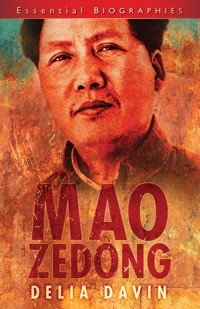
Mao Zedong, first chairman of the People's Republic of China, one of the founders of the Chinese Communist Party, and the architect of the Cultural Revolution, was active in Chinese politics for most of his 82 years, and became one of the most important revolutionary figures in the twentieth century. He spent the 1920s and 1930s struggling to build the Party. After the establishment of the People's Republic, he strove to impose his vision of socialism on his impoverished country, convinced that if the power of the people could be harnessed China could become an economically successful and egalitarian country. The Great Leap Forward which he initiated was, however, a disaster resulting in millions of deaths. Mao used the Cultural Revolution to re-impose his authority, his critics were persecuted and a personality cult was fostered. His Little Red Book sold over 740 million copies. This book is written by an eminent historian and offers the reader a powerful insight into the life and work of this unique man.
Das E-Book können Sie in Legimi-Apps oder einer beliebigen App lesen, die das folgende Format unterstützen:
Veröffentlichungsjahr: 2011
Ähnliche


















MAO
ZEDONG
MAO
ZEDONG
DELIA DAVIN
First published in 1997
This edition first published in 2009
The History Press
The Mill, Brimscombe Port
Stroud, Gloucestershire, GL5 2QG
www.thehistorypress.co.uk
This ebook edition first published in 2011
All rights reserved
© Delia Davin, 1997, 2009, 2011
The right of Delia Davin, to be identified as the Author of this work has been asserted in accordance with the Copyrights, Designs and Patents Act 1988.
This ebook is copyright material and must not be copied, reproduced, transferred, distributed, leased, licensed or publicly performed or used in any way except as specifically permitted in writing by the publishers, as allowed under the terms and conditions under which it was purchased or as strictly permitted by applicable copyright law. Any unauthorised distribution or use of this text may be a direct infringement of the author’s and publisher’s rights, and those responsible may be liable in law accordingly.
EPUB ISBN 978 0 7524 7396 3
MOBI ISBN 978 0 7524 7395 6
Original typesetting by The History Press
CONTENTS
Chronology
Introduction
1 CHILDHOOD AND FORMATIVE YEARS
2 LABOUR ORGANIZER AND PARTY WORKER
3 THE JIANGXI SOVIET REPUBLIC AND THE LONG MARCH
4 THE NORTH-WEST
5 THE COMMUNIST PARTY TAKES POWER
6 THE GREAT LEAP FORWARD AND ITS AFTERMATH
7 THE CULTURAL REVOLUTION
8 OLD AGE AND DEATH
9 MAO’S LEGACIES
Notes
Bibliography
CHRONOLOGY
26 Dec. 1893
Birth of Mao Zedong.
1911
Overthrow of the Qing dynasty. Mao enrols in Republican Army.
1912
Establishment of the Chinese Republic.
1913–18
Mao at Hunan Teachers’ College. Works in Beijing University library after graduation.
1919
May Fourth demonstrations in Beijing.
1920
Appointed primary school head and marries Yang Kaihui.
1921
Participates in Founding Congress of Chinese Communist Party (CCP).
1923–7
United Front between Guomindang and CCP. Mao works in both.
1925
Death of Sun Yat-sen.
1926
Northern Expedition launched by Nationalist-Communist coalition.
1927
Chang Kai-shek massacres communists and trade unionists in Shanghai.
1927
Mao Zedong leads Autumn Harvest Uprising and retreats to Jinggangshan.
1928
Zhu De’s forces join Mao’s in Jinggangshan. Mao and He Zizhen start to live together.
1930
Japan invades Manchuria.
1931–4
Chinese Soviet Republic in Jiangxi. Mao largely in eclipse.
Oct. 1934
Long March begins.
Jan. 1935
Mao strengthens hold on Party leadership at Zunyi Conference.
1935
Long March arrives in northern Shaanxi.
1937–45
Sino-Japanese War.
1938
Mao marries Jiang Qing.
1945
Seventh Party Congress provides formal recognition of Mao’s pre-eminence.
1946–9
Civil War between the Guomintang and the CCP.
1949
Mao proclaims the establishment of the People’s Republic of China.
1953–7
First Five Year Plan, collectivization of agriculture and nationalization of industry.
1956
February, Khrushchev denounces Stalin in secret speech at 20th Party Congress.
1956–7
Hundred Flowers Movement.
1957
Anti-Rightist Movement.
1958–60
Great Leap Forward followed by famine.
1959
Peng Dehuai criticizes Mao at Lushan Conference.
1966
Outbreak of Cultural Revolution and formation of Red Guards.
1967
Liu Shaoqi and Deng Xiaoping disgraced.
1968
Red Guards disbanded.
1969
Ninth Congress of the CCP, Lin Biao officially designated as Mao’s successor.
1971
Disgrace of Lin Biao. China recovers UN seat.
1973
Deng Xiaoping returns to Beijing.
Jan. 1976
Death of Zhou Enlai.
April 1976
Demonstrations in Tiananmen, Deng Xiaoping removed from office.
9 Sept. 1976
Mao dies.
6 Oct. 1976
Arrest of Mao’s wife and the other members of the Gang of Four.
INTRODUCTION
Mao Zedong was a figure of great historical importance. For most of his 82 years he was a central figure in Chinese politics. He spent the 1920s and 1930s struggling to build the Chinese Communist Party and to get his policies accepted by it. In doing so he ended its subordination to Stalin and created a Party with nationalist credentials capable of leading a successful popular revolution.
After the establishment of the People’s Republic, he became a revered but rather remote leader. He strived to impose his vision of socialism on his impoverished country, convinced that if the power and enthusiasm of the people were correctly harnessed, China could become a modern wealthy and egalitarian society. His impatience with the pace of economic development under the First Five Year Plan led him to launch the Great Leap Forward. When this failed he turned on colleagues who criticized the initiative and he refused to recognize the magnitude of the disaster swamping China.
Always irascible and wilful, he now became obsessively suspicious, seeing conspiracy everywhere. He turned against many of his revolutionary colleagues and had them persecuted, imprisoned and even killed. His ideas and actions became more and more unpredictable. Yet so great was Mao’s prestige that it was almost impossible for anyone to speak out against him. Even his victims participated in the most absurd manifestations of his cult, waving the Little Red Book and attributing almost magical powers to the study of his thought. His colleagues and members of his household became ever more preoccupied with appeasing him or manipulating his views. He in turn greatly feared the efforts of others to control him. But sycophancy did not always make people safe. Apparently loyal followers easily became suspects.
Many episodes in Mao’s life are still obscure. Edgar Snow, whose book Red Star Over China contains a biography based on interviews carried out in 1936, inevitably recorded the version of the leader’s life that Mao wished to make public. Most other original sources have particular interests to advance. Mao’s public utterances were often ambiguous or difficult to interpret. Debates persist among the experts over the true significance of many Party documents. All biographers of Mao have had to wrestle with these problems.
I have attempted to produce a short life of Mao that will be easily understood by readers without a prior knowledge of Chinese affairs. The task has been even more difficult than I expected. Inevitably I have had to simplify and to choose between competing interpretations of many events. Mao was a soldier, a political and military theoretician, a philosopher and a poet. He played too many parts on too large a stage for a short book to deal with the whole man. I have chosen to focus only on his political and his family life.




