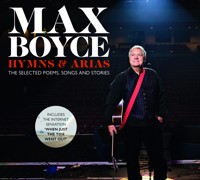
MAX BOYCE
, singer-songwriter, poet and entertainer, was born in 1943 in the village of Glynneath, south Wales, where he still
lives with his wife, Jean. They have two daughters, Cathy and Rhiannon, and two granddaughters, Rhosyn Alaw and Evelyn Grace.
Despite the fact that his father was killed in a mining explosion a month before Max was born, Max went on to work
underground in the local colliery at the age of sixteen – a profession he remained in for over a decade.
After releasing two records on a small Welsh label, in 1973 he recorded his iconic breakthrough album,
Live at Treorchy
, which
went on to sell over half a million copies. Several gold and silver records followed, including
We All Had Doctors’ Papers
, which went
to number one in the UK Albums Chart and is still the only comedy album to attain this coveted position. He has since toured the
world, playing sell-out concerts in some of the world’s great venues, including the London Palladium, Sydney Opera House and the
Royal Albert Hall.
His BBC television series attracted over twenty million viewers and merely confirmed Max’s popularity among young and old
alike. His exploits following the Dallas Cowboys, the American rodeo circuit and the 1985 World Elephant Polo Championship
in Nepal were chronicled in the bestselling book
In the Mad Pursuit of Applause
.
In 1999, he was awarded an MBE, which he received from Prince Charles at Cardiff Castle, and in 2013 he received the
Freedom of the Borough of Neath and Port Talbot, following in the footsteps of Sir Richard Burton and Sir Anthony Hopkins. In
2022, there are plans to unveil a bronze life-size statue of Max in his hometown – a fitting and deserved tribute to a modern-day
folk hero whose poems, songs and stories have become part of Welsh legend.
Where is the boy that I used to know,
Where did he run to, where did he go?
Parthian Books, Cardigan SA43 1ED
www.parthianbooks.com
Contents © Max Boyce 2021
All Rights Reserved
ISBN 978-1-913640-95-8
Edited by Robert Harries
Cover and interior design by Syncopated Pandemonium
Cover photographs by Luke Hodgkins
Photograph and illustration credits:
Rhys Padarn Jones/Orielodl (www.orielodl.com): endpapers; Max Boyce: ii, 17; Handshake Ltd: vii, 1, 10, 21, 39, 89–90,
100, 104, 106, 113, 117, 125, 130–172, 180; Matthew Horwood: viii; Jeremy Wood: xii; Gren: 2–8, 12–14, 18–19, 22–23,
26–27, 34, 42–44, 70, 76–77, 82–83, 98–99, 101–103, 111, 114, 174; Jimmy Giddings: 9, 123; PA Images/Alamy Stock
Photo: 24–25, 47; INchendio on iStock by Getty: 30; Darryl (Gren) Jones: 30–31; David Davies/PA Wire: 37; Action Images/
Paul Harding Livepic: 41; Mirrorpix: 46; Jeff Morgan 07/Alamy Stock Photo: 51; Anne Cakebread: 52–53, 64; Mirrorpix/
Reach Licensing: 55; Fran Evans (www.franevans.com): 56, 63, 69, 72–73; Trinity Mirror/Mirrorpix/Alamy Stock Photo: 61;
Mike Straw on Unsplash: 66; Russell Stanley: 74; graham bell/Alamy Stock Photo: 75; Mael BALLAND on Unsplash: 77; Leila
Cutler/Alamy Stock Photo: 78; REUTERS/Alamy Stock Photo: 85; Immo Wegmann on Unsplash: 87; ID 5738817 © Scol22 |
Dreamstime.com: 93; EMI: 96–97; Jonny Gios on Unsplash: 105; Character © 1982 Petalcraft Demonstrations Ltd: 108; tirc83
on iStock by Getty: 116; Jeff Morgan 04/Alamy Stock Photo: 178–79; Alison Carman: 179.
All attempts have been made to track down copyright holders where possible; uncredited material is reproduced in this book
under the terms of fair use, but both publisher and author endeavour to correct and offer full credit in future editions.
Printed and bound by Gomer Press, Cardigan
Published with the financial support of the Welsh Books Council.
British Library Cataloguing in Publication Data
A cataloguing record for this book is available from the British Library.
Foreword
ix
PART ONE:
THE POEMS & SONGS
Hymns and Arias
3
I Gave My Love a Debenture
5
I Am an Entertainer
6
The North Enclosure Song
7
The Divine Intervention
8
Dai Morris
9
E.N.G.L.A.N.D
10
The Incredible Plan
11
When a Tear Fell from Graham Henry’s Eye
15
The Outside-Half Factory
16
9–3
18
A Prop Named Sian
20
I Wandered Lonely
22
The Day Gareth Was Dropped
23
I Wear the Cloth of Parting Ways
(Eulogy to Cliff Morgan)
24
The Devil’s Marking Me
26
The Halfpenny Piece
28
The Glory That Was Rome
or: The Green, Green Grass of Rome
29
The Pontypool Front Row
32
I Said He’ll Never Do It
33
The Scottish Trip
35
With a Whistle in His Hand (Triple Crown at Cardiff)
36
He Picked a Fine Time to Penalise Wheel
38
The Unforgiving Moment
40
With a Wee Dram and a Song
42
If
45
All Beneath a Piece of Sky
46
Ten Thousand Instant Christians
48
Did You Understand?
49
A Winter Too Late (1984–85 Miners’ Strike Song)
50
Aberfan
53
Coal Picking
54
Close the Coalhouse Door
57
Duw! It’s Hard
58
Miners’ Fortnight (Ode to Barry Island)
60
The Sioni Winwns Man (The Johnny Onions Man)
61
When Just the Tide Went Out
62
Ar Lan y Môr (By the Sea Shore)
64
Bugeilio’r Gwenith Gwyn (Watching the White Wheat)
65
Swansea Town
66
Hiraeth
67
Rhondda Grey
68
Slow-Men at Work
71
Is God in His Paint Shop
72
Mêl-y-Bont
74
Sirhowy Hill
75
CONTENTS
The Seagulls of Llandudno
76
The Story of Christmas
78
I Guess It’s Been One of Them Days
(The Saddest
Ever
Country Song)
79
Johnny Mildew and the Scum
80
The Ballad of Morgan the Moon
83
The Boy Who Climbed a Mountain
84
The Richest Dust
86
Time
87
Yng Ngofal Dy Freichiau Di
(In the Shelter of Your Arms)
88
PART TWO:
THE STORIES
Berwyn’s Skull
91
Berwyn and the Aeroplane Ride
92
Gravestone FOR SALE
93
Berwyn’s Photo
94
Hop On/Hop Off
95
Childhood Memories
96
Ashes
98
Did He Suffer?
100
The One O’Clock Gun
101
The Rev. Goronwy Roberts
102
Australia ’78
103
Where Are You From?
104
‘In these stones . . .’
105
What’s That He’s Carrying?
106
Eli Jenkins
107
Leekes Cross Hands
108
What Goes Around Comes Around
109
L’Escargot
110
Bastille Louis XV
111
A True Story
112
In the Bleak Midwinter
114
The Night of the Long Shovel
115
Is That the Sun or the Moon?
116
How Do I Get to Carmarthen?
117
Evelyn’s Cake
118
Seve’s Wedge
119
The Max Boyce Classic
122
Becky
124
Gog Air
126
The Origins of Keeping Up with the Joneses
127
To God
128
A Travesty of Justice
129
From
In the Mad Pursuit of Applause
131
An Afterthought
177
Acknowledgements
179
FOREWORD
IX
FOREWORD
This collection of my poems, songs and stories is something I have promised to write for a very long time, but I never found the
time or the dedication to apply myself to the task of ‘carving words like jewels’.
There was also the haunting realisation that my words would have a sort of finality, no longer able to leave their final resting
place, disturbed only by the turning page. A sanctuary where they would listen quietly to their own silence and where their only
visitors were strangers . . .
My thanks then must go to Richard Davies and Parthian Books for believing in my work, and to Robert Harries for his endless
patience in painstakingly transcribing my handwritten manuscripts, which at times looked as if a spider had fallen into a bottle of
ink, climbed back out and crawled drunkenly across the pages.
This being so, we got it completed, and the returned ‘copy’ looked like someone else’s work that was infinitely better than
my own.
I’ve called the collection
Hymns & Arias
because it’s the title of a song I wrote hurriedly some fifty years ago, little thinking it
would stand the test of time and be sung on the terraces of Cardiff Arms Park, the Millennium (now Principality) and Liberty
(now Swansea.com) stadiums, where the faithful carry their songs like a soldier carries his rifle to war . . .
In more recent times I have used the chorus and tune of ‘Hymns and Arias’ to tell the story of some memorable moments that
I was privileged to be in attendance for, from Wales versus England at Wembley Stadium in 1999, ‘When a Tear Fell from Graham
Henry’s Eye’,
And so farewell to Wembley and to this foreign clime
Next year we’re back in Cardiff, if they finish it on time
They say it’s got a sliding roof that they can move away
They’ll slide it back when Wales attack so God can watch us play
to the opening concert of the Welsh Assembly in Cardiff Bay,
Here’s to our assembly that they’ve built along this shore
They built it here in Cardiff . . . though Cardiff voted NO!
X
MAX BOYCE: HYMNS & ARIAS
to the Wales rugby team’s arduous training camp regime before the World Cup in South Africa,
Why take the team to Doha I just can’t understand
The camels there have flip-flops on to walk upon the sand
And those ‘cryogenic’ chambers, their worth is still in doubt
They had to use the warm-up games to thaw some players out . . . !
and then Swansea City AFC’s first home game in the Premier League, against Wigan,
Here’s to all you Wigan fans, it does seem strange to me
That you used to have a pier but you haven’t got a sea . . .
These little vignettes would never have a claim to permanence, for their time with us was fleeting, but for a short while they
had their time in the sun and held a truth that was honest and authentic.
Some of the songs in this book took a lot longer to write. Songs such as ‘Rhondda Grey’, ‘Duw! It’s Hard’, ‘The Incredible
Plan’ and ‘When Just the Tide Went Out’.
They lay unfinished in cupboards and drawers, on the back of bits of paper, fearing the dark, worrying that no one would come
and find them. Till one day they were brought out blinking into the daylight, inspired by no more than a passing thought or word
or by some unknown alchemy.
I have likened my ‘Craft and Sullen Art’ to the skill of a blacksmith who puts his work into the heat of the furnace, waits till
it’s white hot and then bends it to his will. When it has cooled, he repeats the process.
In much the same way, I put my songs and stories into the furnace of performance, altering a line here and changing a word
there until I am satisfied they are the best they can be and best suited to the gifts I may or may not have.
These, then, are my poems, songs and stories formed in the embers of that furnace.
I know many people will recognise themselves in the pages of this book, for they have travelled the same journey, walked the
same paths. They have shared the same hopes and dreams, the joys and despair, and prayed to the same gods.
Many of these moments are revisited in the ‘Hymns and Arias’ of this book.
Those moments turn the well-thumbed pages of a book I have yet to take back . . .
M. B.
August 2021
To Jean, Cathy, Rhosyn, Rhiannon and Evelyn
Fy Ffortiwn (My fortune)
4
MAX BOYCE: HYMNS & ARIAS
So it’s down to Soho for the night, to the girls with the shiny
beads;
That shy away in corners just to tempt a Welshman’s needs.
One said to Will from a doorway dark, damn, she didn’t have
much on.
But Will knew what she wanted, aye . . . his photo of Barry John!
’Cos she was singing hymns and arias,
‘Land of my Fathers’, ‘Ar hyd y nos’.
THE POEMS & SONGS
5
I met her in the Con. Club in Pontypool;
The public bar was crowded so I offered her my stool.
I said, ‘Fair lass, pray tarry. Come stay awhile with me.
And I’ll give you my debenture – Block A, Row 3.’
Her eyes were pale as lyder; her hair was long and black.
The only thing that spoiled her was she wore a plastic mac.
I said, ‘Fair lass, pray tarry. Come sit upon my knee.’
She thought awhile and then she smiled. I thought,
‘Ho, ho, he, he, hee hee hee!’
She said she came from Crumlin and that her name was Ann.
She told me, ‘You can walk me home.’ I said, ‘I’ve got a van!’
We turned into a lay-by, where she told me she loved me.
So I gave her my debenture – Block A, Row 3.
That night I met her mother. (She was waiting for us there.)
Stockings round her ankles and curlers in her hair.
She was waiting on the doorstep, and she waved her fist at me.
So I showed her my debenture – Block A, Row 3.
That night when I was sleeping my love proved false to me;
And she left me for another who’s known as J.B.G.
I know I’ll not forget her for she was the rue of me;
And she’s got my debenture – Block A, Row 3.
So take my warning all you lads, for girls the likes of she.
They only want you for one thing – your debenture in Row 3!
So should you go to Crumlin, pray tread the night with care:
Take heed I pray and stay away from that girl with the long
black hair.
I GAVE MY LOVE A
DEBENTURE
Some years ago a debenture scheme was introduced by the Welsh Rugby Union. It
took the form of tickets put on sale to help raise money for ground improvements at
Cardiff Arms Park.
These tickets, or debentures as they are known, guarantee the owner the same
seat in the stand for all internationals at Cardiff. They were initially sold at the
reasonable price of £50 but have since escalated terrifically in value, £8,500 having
been offered recently for four.
Their present worth, however, is perhaps best illustrated by the song,‘I Gave My Love a Debenture’.
6
MAX BOYCE: HYMNS & ARIAS
‘I Am an Entertainer’ was written following the Welsh defeat at Twickenham in 1974. The referee that day; a Mr John West, an Irishman,
disallowed a perfectly good try (in my opinion) by J. J. Williams and Wales were defeated. I had often wondered since writing the poem what Mr
West had thought of it, so when I was introduced to him at a dinner I asked him.‘You’ve given me a sort of immortality,’ he said,‘but I think it’s
of a rather dubious kind.’ He was a lovely man and he had taken the song in the spirit in which it was meant.
Two years later I was having a quiet drink with some friends in the bar of Glynneath Rugby Club on the eve of the Wales–Ireland international
at Cardiff. Suddenly the door burst open and four Irish referees burst in with clenched fists shouting,‘Where is he?Where is he?’ The bar fell quiet,
even some of my best friends moved away from me and pretended they were at another table.
I slowly got up in that hushed room and said quietly,‘Here I am.’
The four wild Irishmen looked across and said,‘Ah, there you are, what are you having to drink?’ They had come over for the match and had come
down to see Glynneath to invite me to speak at some Referee’s Society dinner in Ireland. Unfortunately, I was unable to go, but I shall never forget
that night in the rugby club singing a mixture of Irish and Welsh songs in the bar until the early hours and ending up with ‘I Am an Entertainer’.
I am an entertainer and I sing for charity;
For Oxfam and for Shelter, for those worse off than me.
Bangladesh, Barnardo’s Homes. And though I don’t get paid,
It does one good to do some work for things like Christian Aid.
But of all the concerts that I’ve done for the homeless overseas,
The one I did that pleased me most was not for refugees.
’Twas for a home in Ireland that stands amongst the trees:
The sunshine home in Dublin for blind Irish referees!
I AM AN ENTERTAINER
THE NORTH ENCLOSURE SONG
I have always thought it a shame that the North Enclosure was done away with at Cardiff Arms Park.Traditionally it was where the singing always
started in international matches. It was there that the greatest
hwyl
*
and atmosphere were always to be found. However, for financial reasons
and because of the need for greater crowd control, plastic bucket seating has been installed where for years we had stood in all weathers lashed by
wind and rain:
*
hwyl
There were times I couldn’t see
But it was the only place to be ...
Oh! I’ll sing a fond farewell, and a story I will tell
Of when with my little North Enclosure I was there
And I think it’s such a shame, it’ll never be the same
As when with my little North Enclosure – I was there.
CHORUS
I was there
I was there
With my little North Enclosure I was there
There are stories I can tell, of when I didn’t feel too well
But with my little North Enclosure I was there
When there was nowhere I could go and I couldn’t wait no more
But with my little North Enclosure I was there.
Oh, I’ve stood out in the rain and I’d do it all again
With my little North Enclosure I was there
It was there I learnt to sing – ’cos I couldn’t see a thing
But with my little North Enclosure I was there.
When the ones that had it planned were all sitting in the stand
With my little North Enclosure I was there
So I think it’s such a shame – it’ll never be the same
As when with my little North Enclosure I was there.
8
MAX BOYCE: HYMNS & ARIAS
I heard it first on telly I thought that sounded odd
Bevan and Dai Richards in and Phil not in the squad
So I phoned the Rediffusion man when his number I had found
I said, ‘The picture’s all right, but there’s something wrong
with the sound.’
This chap came round in overalls and told me not to fret
He’d change the speaker and the valve and overhaul the set
He’d finished it by Sunday and left me with a laugh
I switched it on, and the fault had gone
It said, ‘Bennett, outside-half.’
Whilst down there in Llanelli the old folk knowing nod
And say recalling Bennett was true an act of God
And a preacher down in Felinfoel spoke in thanks and praise
‘The Lord,’ he said, ‘doth often work in strange and wondrous
ways.’
And he was there at ‘Twickers’ round collared in the throng
And he knew full well that Wales would win and he raised his
voice in song
But I spared a thought for England and for their hopes and pride
It wasn’t really fair to them with God on our side.
But this ‘frightfully pucker’ English chap thought otherwise –
And he knelt in prayer as well
And asked, ‘Oh Lord, let us see a try, we’re losing I can tell,
Oh Lord, let us see a try, something absolutely twiffic.’
And then J.P.R. scored again and God said, ‘You should have
been specific.’
THE DIVINE
INTERVENTION
This poem was written some time after it was announced that Phil Bennett had been omitted from the
Welsh Squad for the game against England at Twickenham in 1976. The decision to omit Bennett caused
a great deal of controversy in Wales. People in his home town of Llanelli were throwing themselves in
the canals. I wasn’t particularly concerned until I realised some of them had tickets on them. So there
I was, helping the Red Cross to drag them out – pinching their tickets – and throwing them back in.
Then came the ‘Divine Intervention’ when both the outside halves named before Phil were injured and,
to the great embarrassment of the Welsh selectors, Phil Bennett was asked to play against England after all.
THE POEMS & SONGS
9
Now Dai works down at Tower
In a pit called number four,
Some say he was quarried
From a rock a mile below,
He goes to work each morning
Much the same as you or I,
The foreman calls him Mister
But the children call him Dai
Some say that Dai was much too small
* That’s how it goes.
This man who works with iron
And that’s the reason why they say
He was never made a Lion
And though they never picked him
‘
Na fe bois, Felne mae
’*
There’s none that’s played
Though light he weighed
More genuine than Dai.
DAI MORRIS
When David Morris played for the combined Neath and Aberavon
side that lost 43–4 to New Zealand in 1973 I wrote:
They didn’t leave the score up long
We chipped in for a wreath
Neath blamed Aberavon
And Aberavon, Neath
Some there blamed the linesman
Some blamed you and I
We all blamed the committee
But no one there blamed Dai.
I have always thought it was a great shame that he was never
selected for the British Lions. Although he was forced to retire from
the international scene with a knee injury it is typical of David Morris that he is as enthusiastic as ever; he is still enjoying his rugby with the
village side Rhigos. Perhaps there have been more famous players, but none that are more respected than this gentle man of rugby who’s known to
all as ‘Dai’: a shy, unassuming person who gave his everything at all times, asking for nothing in return. He is one of the most genuine people I
have ever met, which is why I admire him more than any other player I know.
10
MAX BOYCE: HYMNS & ARIAS
E.N.G.L.A.N.D
‘E.N.G.L.A.N.D’ is a parody on the song ‘D.I.V.O.R.C.E’, in which a divorcing couple spell out the words they don’t want their child to hear or understand.
Our little boy was five years old and quite a little man
And we spelled out all the hurting words so he couldn’t understand
Like D.I.V.O.R.C.E and R.E.V.E.N.U.E (H.M)
But the word we’re hiding from him now
Tears the heart right out of me
CHORUS
E.N.G.L.A.N.D, we lost to them today
Me and little J. P. R., we cried when we walked away
When we left H.Q, well I think he knew that I had P.M.T*
’Cos it breaks my heart to lose to E.N.G.L.A.N.D
Our little boy is seven by now and I’m an O.A.P
And he thinks that his father’s an O.L.D.F.A.R.T
Yes, we spell out all the hurting words and turn our heads to speak
But I can’t spell away the hurt and the tears run down my cheek
E.N.G.L.A.N.D, we lost to them today
Me and little J. P. R., we cried when we walked away
When we left H.Q, well I think he knew that I had P.M.T
’Cos it breaks my heart to lose to E.N.G.L.A.N.D
We couldn’t even blame the R.E.F.E.R.E.E
* Post-match trauma.
THE POEMS & SONGS
11
There’s a story that’s told in the Valleys
And I’ll tell it as best as I can
The story of one Will ‘McGongale’ Morgan
And of his ‘Incredible Plan’.
It all started off on a cold winter’s night
A night that was strangely so still
When the Rugby Club’s General Committee
Banned ‘Sine Die’ their ticket Sec, my Uncle Will.
(Mind you, he was in the wrong, we knew all along)
There was no point in petitions or pickets
He was caught with this woman at the back of the stand
With the Club’s allocation of tickets.
And what made it worse, she wasn’t the first
He’d been caught with Ben Walters’ wife Ethel
We all knew her with her fox and her fur
She used to wear on Sundays to Bethel.
Anyway,Will was banned ‘Sine Die’ – he broke down and cried.
I’ve never seen a man in such sorrow
’Cos like Judas of old he’d sold more than gold
With the Scotland and Wales game tomorrow.
Then he had this idea: he’d go in disguise.
He had it all drawn up and planned.
And he went to the game (to his family’s shame)
As one of the St Albans Band.
Back in the village they all got to know
‘Make one for me’ they’d all say
There was such a demand, it got a bit out of hand
He was making about fifty a day.
So he put an ad, in the
Guardian
To employ a few men starting Monday
And he did, he started some men – I think about ten,
On three shifts, and some working Sunday.
They made about three or four hundred
When the night shift were sent two till ten.
The jigs were all changed, the tools rearranged,
And they started on ambulance men!
Then they ran out of buttons and bandage –
And policemen were next on the plans.
Whilst ‘B’ Shift made refs with dark glasses,
Alsatians, white sticks and tin cans!
Then production was brought to a standstill
And the Union could quite understand
THE INCREDIBLE PLAN
Anyone who has tried to get a ticket for a rugby international at Cardiff knows how difficult it is. My Uncle Will, however, got into the ground
without a ticket, dressed as one of the St Albans Band (the band that play at Cardiff Arms Park prior to the internationals).
The trouble was all Will’s friends and family got to hear of it (’cos he told Florrie Thomas not to tell anybody), and when the next international
was due to be played at Cardiff they all wanted to go as well.
‘The Incredible Plan’ is the story of what happened.