


Erhalten Sie Zugang zu diesem und mehr als 300000 Büchern ab EUR 5,99 monatlich.
- Herausgeber: The O'Brien Press
- Kategorie: Sachliteratur, Reportagen, Biografien
- Sprache: Englisch
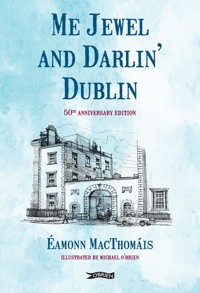
50th Anniversary Edition A beautifully presented and attractively laid out commemorative edition, with new introductions by Ivan O'Brien, MD of The O'Brien Press and best-selling author Dónal Fallon. The very first book published by The O'Brien Press in 1974 celebrates fifty years in print. The O'Brien Press launched its first publication in November 1974. Me Jewel and Darlin' Dublin , written by Éamonn MacThomáis and published while the author was in jail, was an immediate success and has become a classic. Full of historical facts, anecdotes and Dublin wit, this book evokes the spirit, the characters and colours, the sights, sounds and even the smells of old Dublin. With sections on markets, pawn shops, street characters, the Liberties, slang and wit of Dublin's newspapers, the city's history is traced right back to Brian Boru, the Huguenots, 'the debtors' prison', and Dublin's troubled history of risings and revolutions . Celebrating fifty years of Me Jewel & Darlin' Dublin – and of The O'Brien Press.
Sie lesen das E-Book in den Legimi-Apps auf:
Seitenzahl: 290
Veröffentlichungsjahr: 2024
Das E-Book (TTS) können Sie hören im Abo „Legimi Premium” in Legimi-Apps auf:
Ähnliche



















Contents
6
Publisher’s Foreword byIvan O’Brien
Dublin was a very different place when Me Jewel and Darlin’ Dublinwas written, back in 1974. The attitude of those in power was dour and unimaginative; they seemed intent on knocking down old buildings, rather than seeing beyond the decay to what lay beneath.
Éamonn MacThomáis saw things differently: having grown up in the south inner city he had a deep affection for the city of his birth. His Republicanism also gave him a different perspective: he wasn’t afraid to express pride in the good things his country had. About St George’s Church on Hardwicke Street, he writes: ‘The spire is a comforting sight, a beautiful sight, from the barred windows of Mountjoy Jail.’ As editor of AnPhoblacht, the Republican newspaper, Éamonn was considered a threat to the state and held for a period without trial. With time to fill he got to ‘thinking about my childhood, the people I had met, the places I had seen, about Dublin and its people.’
Tom O’Brien, my grandfather, ran a printing company on Parliament Street. This company was moving towards being a publisher, and Éamonn wrote to Tom (or Tommy, as Éamonn knew him) with an outline of a book that would look back at the Dublin of his youth with affection and humour. 8This was a pretty revolutionary idea in a country in the grip of a seemingly never-ending recession and with the Northern Ireland conflict taking place.
Éamonn picks up the story:
Withinadayortwo,ayoungmanwithaveryblackbeardcalledtoseeme.Hewas,ofcourse,theoneandonlyMichaelO’Brien,artist,andsonofTommy.Well,withoutTommythebookwouldneverhavebeenwritten,andwithoutMichaelthebookwouldneverhavebeenprintedandpublished.Oh,howhefoughtformymanuscriptsatthejailgates.Thecourageofthefather TommywaswellmatchedbythecourageofthesonMichael.
And so, with the encouragement and help of his wife Rosaleen, Éamonn allowed his memories to flow and the spirit of the city he loved to make its way onto the page.
Me Jewel and Darlin’Dublin was the first book that The O’Brien Press published. With many illustrations by Michael O’Brien, an activist for the preservation of Dublin’s architecture, as well as photographs and other illustration, the production standards were lavish for the time: it was a substantial risk, but one worth taking.
The importance of a native publishing industry to an independent country might seem obvious now, but at the time almost no one was producing books, other than school books, in Ireland. Michael, along with other young turks like Steve McDonagh (Brandon) and Seamus Cashman (Wolfhound) set out to change that, but it wasn’t easy. Long used to getting their books from London publishers, some of Dublin’s booksellers suggested that there was no need for books to be created here. However, the sales figures (and some of their braver female employees, like Maura Hastings in Eason) soon proved them wrong, and showed that there was a real audience for what Éamonn had to say. Further books (GurCakeandCoalBlocks; TheLabourandtheRoyaland Janey Mac, Me Shirt is Black) followed, and I fondly remember his trips down memory lane on the radio in my youth, with his inimitable ‘Dublin, 9my Dublin’ signoff.
A twentieth-anniversary edition of the book was published in 1994, significantly updated to reflect the changes that the city had undergone in the interim, with more buildings let fall into ruin: but there were real improvements too. I know that Éamonn would be thrilled that his son Shane was able to drive the building of an important interpretive centre in Glasnevin Cemetery, and that he would approve of the long-overdue Croppies’ Acre Memorial Garden. The renovation of Smithfield, while flawed, has brought new energy to that part of the city and there is a genuine pride in the city’s beautiful Georgian heritage.
For this fiftieth anniversary edition, it was impossible to update the book in a meaningful way. So much has changed, with the docks now a vibrant technology hub, Temple Bar a party zone and the trams returned in the new guise as the LUAS light rail. Éamonn would mourn the passing of the Tivoli, but recognise every bit of the maze of streets behind Mother Redcaps, and be glad that Moore Street still has the energy of a vibrant street market.
This book is a celebration of a time that has passed, a time when the city was small enough for everybody to have met Bang Bang or seen Jimmy O’Dea performing with Maureen Potter. For The O’Brien Press it marks half a century of publishing Irish books for Irish people of all ages. With almost 2,500 books published, and more booksellers than ever throughout the country, we are determined that the legacy of Tom and Michael O’Brien, and Éamonn MacThomáis, is respected and built on.
So have yourself a read and let a master storyteller take you back to the childhood of a man who was born in Dublin nearly a century ago, in 1927.
Ivan O’Brien, 2024
10
ThepresentchurchofStNicholasofMyrainFrancisStreet.
Foreword by Donal Fallon
Before Éamonn MacThomáis, he was Edward Patrick Thomas.
Born in Rathmines in 1927, the man who would become Dublin’s most familiar historian was the son of a chief fire officer in the Rathmines Fire Brigade. With its own fire service, town hall and local authorities, Rathmines was a township beyond the canals that defined a very different Dublin. Only a young boy when his father died, he would recall the family being moved on to Goldenbridge, and how:
ThefurniturevanwasgoneandIrememberstandinginthehallwayofthe emptyhousewithasmallgreenvaseinmyhands.Inoticedthatthewallpaperwascleanerinthoseplaceswhichhadbeencoveredbypictures.Atthat momenttheRathminesTownHallclockrangoutandInearlyletthevasefall.ItwasthefirstandthelasttimeIhearditstrike.
Like many in the Republican movement of his time, he would change his name to Irish, and it is the name of Éamonn MacThomáis that is remembered. Still, his life before historical research and Republican political activity helps us understand the paths he would take. As a young delivery boy working in the city, he came to know the city intimately, and to question itsorigins. He remembered delivering to Henrietta Street, and entering a tenement home to find that ‘the banisters were broken in parts, and the paint was worn from the stairs. I later found out that ten families lived in each house that was broken down. The nice houses were doctors or solicitors or offices or convents... the broken houses were part of the slums of Dublin.’
Active in the Republican movement from the early 1950s, MacThomáis was part of the IRA’s Border Campaign, which initially galvanised Republican 12feeling in the south, before fading out. It led to periods of imprisonment, an environment in which he would intellectually thrive, using time to research, write and lecture.
His first publication, released in October 1965 on the eve of the Golden Jubilee of the Rising, was DownDublinStreets:1916. It contained the classic formula of a MacThomáis text – it was as much about topography, and the streets of Dublin, as history. It sought to show the hidden histories of familiar places. It was unashamedly Republican. It was accessible. It was also a great success. It was published by The Irish Book Bureau, through Joe Clarke, a 1916 veteran. His second book TheLadyattheGate(named in honour of the republican women who held vigil outside prisons like Mountjoy and Kilmainham) was published by the same press in 1967.
When later imprisoned as a result of his editorship of AnPhoblacht, the Republican newspaper, Mac Thomáis commenced work on this book, a work that led the IrishPressto insist ‘only James Joyce and Flann O’Brien have caught the mood of Dublin as well as Eamonn MacThomáis.’ When Éamonn was briefly granted parole to attend to a family matter, newspapers reported that the ‘author of the current best-selling non-fiction book in the country, MeJewelandDarlin’Dublin, is due to return to Portlaoise next Saturday morning.’
Dublin in the 1970s was a city some viewed as only fit for the wrecking ball, a time captured well in Frank McDonald’s battle cry text TheDestructionofDublin.But here, amidst so much destruction, was a celebration of the Liberties, of Ringsend, of the backstreets and alleys. More than anything, it was a celebration of the working-class people of Dublin and their traditions.
In time, MacThomáis would also shine as a broadcaster, working with the brilliant team of David and Sally Shaw-Smith to produce Dublin:APersonalView. That this show has enjoyed a revival of interest in recent times, with clips trending on social media sites and even TikTok, is testament to the ability 13of such social history to transcend barriers of age or demographic.
Reflecting on how the city has changed in the fifty years since the first publication of this book, it’s worth noting that MacThomáis was not only a Republican activist, but also a campaigner for the city. He provided a heartfelt introduction to Deirdre Kelly’s HandsOffDublin, a book produced by the Living City Group which made a passionate argument that the inner-city required people and communities to live within it. It was time, MacThomáis argued, to acknowledge that ‘the destruction of Dublin has gone on too long, it’s time to call a halt.’ Several campaigns that MacThomáis was a supporter of succeeded in saving some of the historic fabric of the city.
MacThomais died in August 2002, at the age of seventy-five. He was survived by four children and his beloved wife Rosaleen. Newspaper headlines heralded him as the ‘City’s Champion’ and the ‘Quintessential Dubliner’. There was beautiful continuity in his son, Shane, pursuing a career as a historian, with the same commitment to a kind of history that was both thorough and accessible. Shane would remember Éamonn’s funeral as a fine tribute, capturing what he meant to so many different Dubliners:
The gathering of people could be described as nothing short of eclectic. Everyshadeofpoliticswaspresent,fromthecommunistredstothegreenultranationalists.Butthedivergenceswerenotjustinpolitics.LollypopwomenstoodbesideTrinityprofessors,whileballadeersandnewsreaderslookedateachother’sshoes.ItwasatthatpointthatIrealisedthatafuneralwas,inaway,ashortbiographyofaperson’slifeandthatsomuchcouldbelearnedfromone.
Donal Fallon, 2024
14
CHAPTER 1
A Child’s World
THE FOURPENNY RUSH
FIRST IT WAS THE TWOPENNY RUSH, then the Threepenny Rush and, when they got the picture house painted and new woodeners and cushioners installed, it went up to the Fourpenny Rush.
My friend Bonker said that the price now was ‘universal’.
‘What does that mean?’ we asked. ‘All over the world,’ said Bonker, ‘it’s fourpence everywhere. It’s something to do with the union.’ But we were never able to figure out what the South Dublin Union – St James’s Hospital for the poor – had to do with the price of the pictures on a Saturday or Sunday afternoon.
The Fourpenny Rush in the local cinemas kept the kids off the streets. It taught them what they never learned in school. It was a college in memory training because every kid could tell you, line for line and act for act, all about the Big Picture or the Follier-Upper (serial picture).
An hour before the show started a queue would form. The ushers would beat the children back with leather belts. ‘Keep in line, keep in line,’ they shouted as the sweat rolled off their brows. It was quite an effort trying to handle a thousand children pushing and shoving, pulling pigtails, throwing 16orange peels and clutching dearly to the fourpence admission fee.
Bonker was right. It was fourpence everywhere as we toured the local cinemas of Dublin. They were: the ‘Core’ at Inchicore, the ‘Ri’ (Rialto) and the ‘Leinster’ at Dolphin’s Barn, the ‘Fountain’ in James’s Street, the ‘Tivo’ in Francis Street, the ‘Mayro’ in Mary Street, the ‘Phoeno’ on the quays and the ‘Broad’ or the ‘Manor’ in Manor Street. All these cinemas have since been closed, except for the ‘Tivo’ which is now the Tivoli Theatre, run by Tony Byrne.
Sometimes we went into town to the Pillar cinema or the Grand Central in O’Connell Street or around to the Masterpiece or the New Electric in Talbot Street. At other times, we would take our custom to the Camden or the ‘Lux’ (De-Luxe) in Camden Street or the Green in St Stephen’s Green. Now and then we ventured out as far as the Stella and the ‘Prinner’ (Princess) on the Rathmines Road, nearly facing ‘Homeville’ where I was born. It was Shanks’s mare there and back from our homes in Kilmainham. If we had a penny to spend, the last thing we’d spend it on was a tram or a bus. Wet or fine, we walked everywhere.
The hero in the picture was known as ‘the Chap’. He always had a ‘Pal’ and a dog or a horse which could do tricks. They all got a roaring standing ovation, while the head crook and the other crooks all got a hiss and a boo. We hated love pictures. What we liked best were Gene Autry, Tom Mix, Roy Rogers, Buck Jones and Tarzan because they never kissed girls. No matter how tough the fight, Gene Autry never lost his hat – and he could kill twelve Indians with one shot out of his gun.
Best for laughs were Wheeler and Wolsey, Charlie Chaplin, the Keystone Cops, Pop-Eye and his girlfriend Olive Oyle and Laurel and Hardy (‘This is another nice mess you’ve gotten me into, Stanley.’) Although we hated girls, Shirley Temple was different and we all saw The Little Princess three times. Dublin had its own Shirley Temple contest and a little girl from the road 17where I lived was in the first ten.
The outstanding greats of those days were Boys’ Town with Mickey Rooney and Spencer Tracey, the Dead End Kids in Angels with Dirty Faces, James Cagney and The Roaring Twenties, The Bolero with George Raft, Northwest Passage, Mr Stanley and Dr Livingstone, Jesse James, The Daltons Ride Again, and Charlie Chan. We also loved Peter Lorre in detective pictures, Murder at the Wax Museum and the wonderful singing pictures of Nelson Eddy and Jeanette McDonald.
The ice-skating queen, Sonja Heinie, starred in the film One in a Million. The nearest we ever got to an ice-rink was when the dog pond froze over in the winter. It was a far cry from Torville and Dean, though now there are skating rinks in Phibsborough and Dolphin’s Barn.
The former Tivoli Cinema, Francis Street, later used as a theatre.
18The local cinema was more than a picture house. It was a community centre, a place to kill a few hours, something to look forward to, a chance for your mother to wear her new hat, a university of conversation, because whoever saw the picture first would come home and tell the whole road about it.
Television nearly killed the local cinema – though now it seems to be making a come-back – and it is helping to kill conversation. Practically everyone now watches films on television, because everyone has a telly. But the local cinema was different. Each cinema had two, sometimes three, different shows per week. If you missed the picture on Monday, you made sure that you saw it on Tuesday or Wednesday. No matter how good the telly, it’s not a night out for the woman or man of the house. Men and women, boys and girls, could see a three-hour show sitting on the woodeners for fourpence.
At one stage, several cinemas took jam-jars instead of cash. That happened in the Twopenny Rush days. If you handed in a threepenny bit, you might be stuck with two one-pound jam-jars for your change. Can you imagine sitting on the woodeners, trying to balance two jam-jars, peel your orange and keep your eye on the Chap and the crook or worry yourself sick in case Stanley might not be able to find Dr Livingstone in the jungle? As my friend would say: ‘To think that he could find him in a jungle like that and we got lost on the way home from the Roxy last Sunday!’ The Roxy later became the Rotunda and then the Ambassador.
I knew a man who could neither read nor write, yet never missed a picture at his local cinema. He was a gifted story-teller and had the greatest memory in all Kilmainham. One day I said to him: ‘You are a remarkable man. I wonder what you would be to-day if you could read and write!’ He laughed and said: ‘I never missed the books and the pens and sure there’s only bad news in the newspapers. I learned all I ever wanted to know at the Fourpenny Rush in the Tivo. And do you see them Pullman seats to-day 19at £2.50 a go? Sure, you can’t balance a drink on them. They can’t hold a candle to the woodeners in the old Fourpenny Rush.’
A DUBLIN PENNY
‘DID YOU SEE HIM, MARY?’ my mother would say. ‘Did you see him, looking up into their faces for a penny?’ Whenever we stopped to talk to people on the street, I was always accused and bashed for looking up into their faces for a penny.
A penny was a lot of money in those days. With it you could buy the evening newspaper, weigh yourself, take a tram ride from Inchicore to College Green or buy a dinner for a poor man at the Little Flower Hall in the Liberties. A penny would buy a small bottle of milk or a large bag of broken biscuits from the Kingdom Stores in James’s Street, a quarter of a pound of fat rashers (for a coddle), 2 ozs. of Maggie Ryan (margarine), a penny pot of jam, a large slice of Miss Noone’s gur cake (fruit cake) hot from the oven or two coffin nails (cigarettes) and a few matches.
It would also buy a small packet of Lyons tea, a ball of blue, a tin of polish, a packet of Drummer dye, a pair of boot-laces, a seat on the fancy toilet in the Metropole, which is now demolished, or a box of Beecham’s Pills, which the David Allen billboards said were worth a guinea a box. Perhaps for your penny you would like a white clay pipe which you didn’t have to pick up if it fell, a split loaf (cat’s lick and all), a large turnip, four onions or a pint of paraffin oil for the Sacred Heart lamp.
One of the many types of pennies used in Dublin over the centuries – George IV Copper Penny of 1823.
For the same penny you could have 20a half-a-stone of logs, a little coal or a hot buttered egg from the Monument Creamery. A really special treat was a penny ice-cream wafer in Coppolo’s of Cuffe Street, which you’d still be sucking at Rialto Bridge. A variety of sweets was available for the same penny – 12 rainbow caramels, 32 aniseed balls, 16 Jembo balls, 2 Peggy’s legs or 2 lucky bags. You might prefer a pear, an apple, an orange or two taffy apples, a fishing net or two black babies – they were a halfpenny each. I can remember being sent home from school to get the halfpenny for the black babies which I forgot to bring with me that morning. Despite all the money I gave to the nuns and masters, I never saw any results and was always bitterly disappointed that they never brought in my black babies.
A long line of pennies all used in Dublin:1. Hiberno-Norse Silver Penny struck in Dublin around 1000 - 1010 A.D.2. Edward I Silver Penny struck in Dublin 1280.3. The once-familiar Victorian Bronze Penny.4. The ‘golden hen’ Irish Penny commonly used until replaced by decimal coins.
A penny would take you into Mass on a Sunday by the back door (the front 21door was threepence). It would light a candle, buy a holy picture or could be presented to the poor woman with the child in her arms, sitting outside the church door. There were three types of Dublin pennies – the black Victorian type, the brown Edwardian type and the ‘golden hen’ with a harp on the other side. When my uncle came to visit, he always gave me a brand new golden hen. With a bit of skill the new penny could be transformed into a half-crown and, if I got a chance, I would change it in Muldowney’s pub.
A story is told of a Dublin man who saw a large bottle of Gold Label whiskey in a public-house. On it was a price-tag marked ‘One Penny’. He ordered the bottle, but the publican explained that a mistake had been made: the price was really ‘One Pound’. With that a policeman came into the pub, heard the story and told the publican: ‘The law says you must sell the bottle for a penny.’ The lucky man then left the shop with the bottle. A few days later, the policeman met the man in the street. He laughed and said: ‘Be the hokey, I’ll never forget the look on the publican’s face when I told him he would have to give you the big bottle of whiskey for a penny.’ The man laughed back and said: ‘You should have seen the look on his face when I went back the next day for a penny on the empty bottle.’
STREET GAMES
‘ALL IN, ALL IN, THE GAME IS BROKE UP. All in, all in, the game is broke up.’ Someone wasn’t playing the game (Re-lieve-eeo); at least he wasn’t playing it according to the Rowserstown rule book. So the words rang out in the night, like the old town criers: ‘All in, all in, the game is broke up.’ You could hear it a half-a-mile away. It always seemed to come just as you had found a good hiding-place in the Robbers’ Den or across the Camac river near the old mill.
After the ‘All in’ sound we would come back to the street-lamp near the steps to the high road. The flies and moths were playing their own chasing game around the bright glow of the old gas lamp. ‘What is it now?’ ‘Who broke up 22the game? Tell me who it was and I’ll burst him.’ ‘Let’s play another game.’ ‘Let’s go home.’ ‘Let’s start a fire.’ ‘Let’s box the fox in the seven orchards.’ ‘Let’s go up to Goldenbridge and play “Mind the Thread”.’
‘You-a, you-a, all the gang! You-a, you-a, all the gang! Don’t forget your hoops’ (a bicycle wheel without spokes or tyre and a piece of stick to beat the hoop along). Within seconds, fourteen hoops would be belting up Rowserstown and down to Kilmainham cross-roads. There were no traffic lights in those days and, if you stopped to let a tram pass, you were chicken.
Now for ‘Mind the Thread’. ‘Who’s going to be on it? OK, you two.’ Two boys, one at each side of the path, would sit on the ground pretending to be holding a piece of thread between them. It was held about six inches off the ground. The game would start as a man or woman came walking up the path. As soon as they came quite near, one of the boys would start shouting: ‘Mrs., Mrs., mind the thread’. The poor woman thinks there’s a thread on the ground so she starts lifting her legs, jumping and dancing to avoid it. ‘Ah Mrs., Mrs., don’t Mrs.’ – that really had her hopping and we all sitting on the far side of the road, holding our sides with the laughter. Of course, some people knew we had no thread and entered into the game for fun. I played it a thousand times and I never remember anyone getting cross or cranky. Some were even surprised they could hop so high. If they had a sour face coming to the thread, they usually had a smile and a laugh leaving it.
‘Follow the Leader’ was a dangerous game, particularly if you were at the end of the line. The leader started off and the rest had to follow in single file. Anything the leader did, the others behind had to do also – knocking on doors, ringing bells, rattling ash-bin lids. By the time the last few got to the door or ash-bin, the owner was on the scene and all those at the rear of the line ended up with a few clouts on the ear or a kick in the backside.
‘Kick the Can’ was another favourite. I think this was invented for those 23who couldn’t afford a football. The boy ‘on it’ stood by the can and we had to kick the can without the boy ‘on it’ touching us. A lot of skill was required because some boys nearly sat on the can – nevertheless the can was often kicked up and down the road. The game usually ended with a good chase from Mr Kearney, who always threatened to get the po-liss. Poor Mr Kearney, he never had a dull evening.
We used to play another game called ‘Rope the Door’. We would tie a rope to the door-knob and pull hard, then someone would knock on the door. Inside, poor Mr Kearney would be trying to open the door in and, at the same time, we would pull the door out. The tug-o’-war would go on for about five minutes. Then Mr Kearney would slip out the back-door wearing a pair of white runners and the Goldenbridge Steeplechase would begin. In later years, Mr Kearney told me that while he was mad with rage at the start of the chase, he was always in great form at the end of it. He was surprised that he could run so fast – he often caught a few of us – and it also helped to keep his weight down.
Whips and wooden tops, Taw in the Hole (marbles played like golf), Kattie, Combo Round Towers, Hide and Seek, Tip and Tig, Blind Man’s Buff, hurling and football were all played on the road until you heard ‘L.O.B., L.O.B. – Look out, boys, it’s the cops.’ Some children called them police, others called them cops, peelers, rawsers, or po-liss. The local sergeant often arrived on his upstairs model of a bicycle with its weak carbide lamp. The L.O.B. rarely failed. Even if it did, there was always plenty of time to get away. The sergeant took about ten minutes to get down off his bicycle, take the bicycle clips off his trousers and put out his carbide lamp before producing his notebook and pencil.
Card-playing was another favourite – rummy, pontoon, 15s, 25s, Snap, Old Maid, Dawn and Solo. Of these, Dawn was the most popular. It was played like this. The nine of trumps was known as Big Fat and the five of 24trumps as Little Fat. You played it with partners like whist. If you wanted your partner to lead with a certain suit of cards, you would work the tip-off system: Spades – ‘I saw your father digging the garden to-day’; Diamonds – ‘Mary Murphy’s getting married. Her fella gave her a lovely ring’; Clubs – start singing ‘The dear little shamrock, The sweet little shamrock’; Hearts – Put your hand on your chest and say: ‘I’ve got an awful pain there’. Pretty primitive stuff, but it’s surprising how it worked.
My favourite game was pitch and toss or ‘Up to the Mottie’, which was another form of it. Morning, noon and night I would play pitch and toss. I really loved it, until the man next door told my mother that he saw me playing it and that it was a very common game, as common as ditch-water, he said (a terrible insult) and she should make me give it up. A common game? If I’d known that night what I know now! Far from being a common game, it was in fact a royal game. It was started by King Edward III and the piece of stick on which you balanced the two coins got its name from him. They say he got very angry when he lost and used to throw down the tossing stick and say ‘Feck it, feck it’. Thereafter the tossing stick has become known as the ‘feck’. You put the two halfpennies on to the feck and toss them into the air – heads you win; harps or tails you lose.
An American visitor once said that the Dublin people were the holiest people in the world. ‘How come?’ asked his friend. ‘Well,’ said the American, ‘at every street corner in Dublin the men stand around in circles, look up to Heaven, bow down their heads to the ground and shout out: “Good Christ, show us a head this time”.’ Pitch and toss was not only a child’s game but was, and still is, a man’s game. At the big pitch and toss school in the Brickfields I saw a man lose all his money and also his pony and trap. He had to go home on the crossbar of a friend’s bicycle.
‘Up to the Mottie’ was another game. Our mottie was a small square piece of white broken delft stuck into the black clay on the side-path. When the25Corpo (Dublin Corporation) put concrete over this clay patch, we changed the game to ‘Up to the Wall’. You needed only a halfpenny to enter the game. Each player pitched his halfpenny to the path wall, the nearest to the wall being the winner. He also got the first chance to toss the halfpenny for the next round.
After every wedding, well almost every wedding, in our local church, the groom or best man would ‘grush the money’. As the newly-weds were about to drive off, the shouts went up: ‘Mister, Mister, grush the money, grush the money’ and a paper bag of pennies, halfpennies, threepenny bits and a few odd sixpence pieces would sail into the air and crash down in all directions, jingling and rolling. If you were lucky, you’d get a few pence or maybe a six-penny piece. If you were unlucky, you’d get a kick on the ear and a black eye. The wedding of the year was judged by the size of the grush. With a penny grush-money and a lucky game of pitch and toss, you would have the price of the pictures and a few pence to spend or could take part in another game of pitch and toss the following day.
Sometimes we played the girls’ games of skipping, swinging on a rope tied to a lamp-post or ‘Piggy Beds’ and ‘Shop’. We always backed out when the games changed to ‘School’ or ‘House’ (mammies and daddies). ‘Piggy Beds’ was played on the paths with square or round rings marked out with chalk. The beds were like a ladder and you tipped the piggy (a shoe-polish box filled with clay) and it slid from bed to bed. If it went into the wrong bed or onto the chalk line of the bed you were out of the game. As you tipped the piggy with one foot, you hopped along at the same time. This really was a game of skill as you had to balance on one foot, tip the piggy with it and hop from bed to bed.
‘Shop’ was played with ‘chaney money’. Chanies were pieces of broken delft, about the size of a new halfpenny. The more colourful the piece of chaney, the better it was as you could buy more with a few coloured pieces26than you could with white ones. The contents of the ‘shop’ consisted of ‘dog’ or dock leaves (very good for cooling your hand if you got the sting of a nettle). Dandelion leaves were also for sale. We dried them in the sun, allowed them to rot and used them in clay pipes for tobacco. Other items were empty boxes, an odd jam-jar, comics and cigarette cards.
At that time cigarette cards were all the rage. They came free with every packet of cigarettes and were very colourful and educational. They came in series and a full set could be exchanged for gifts. Wills’ ‘Gold Flake’ gave little playing cards and Carrolls gave ‘Sweet Afton’ coupons. For hours we would stand at Kilmainham Cross or at Sarah Bridge: ‘Mister, any cigarette pictures, please?’ Our pockets would be bulging with all sorts of cards. We never got any gifts for them but we got hours of pleasure. We swopped them for comics, sweets, a cigarette butt, a look at your Mickey Mouse watch. ‘A go on a gig’ cost 50 cigarette cards. The ‘gig’ was a flat board on four ball races (wheels) with a piece of strong twine for steering tied to the front axle. As you sat on the gig, your pal pushed your back; going down hills, it was all free-wheel.




