


Erhalten Sie Zugang zu diesem und mehr als 300000 Büchern ab EUR 5,99 monatlich.
- Herausgeber: Crown House Publishing
- Kategorie: Fachliteratur
- Sprache: Englisch
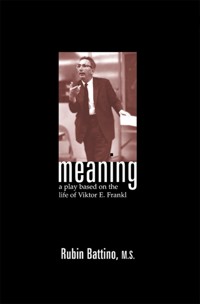
Meaningis a biography in play form. Using many of his own words, the play focuses on key moments in Frankl's life: it explores his experiences in a Nazi concentration camp, his development of Logotherapy and his insights into the human condition. His book "Man's Search for Meaning" has influenced millions of people worldwide.
Sie lesen das E-Book in den Legimi-Apps auf:
Seitenzahl: 103
Veröffentlichungsjahr: 2002
Das E-Book (TTS) können Sie hören im Abo „Legimi Premium” in Legimi-Apps auf:
Ähnliche


















Meaning
A play based on the life of Viktor E. Frankl
Rubin Battino, M.S.
Mental Health Counseling Adjunct Professor, Department of Human Services (counseling) Wright State University, Ohio, USA
Dedication
To Viktor E. Frankl and his wife Elly, for just being who they are and for what they’ve given humanity.
Table of Contents
Title Page
Dedication
Acknowledgments
Foreword
Preface
Production Notes
Act I
Scene 1 About Man’s Search for Meaning
Scene 2 A Selection Process: Camp to Camp
Scene 3 Premium Coupons
Scene 4 The First Phase is Shock
Scene 5 The Bath—Textbooks Tell Lies!
Scene 6 Suicide
Scene 7 Apathy—The Second Stage
Scene 8 Dreams and Food
Scene 9 Politics and Religion
Scene 10 My Wife’s Image
Scene 11 The Inner Life of the Prisoner
Scene 12 Psychological Factors in the Camps
Scene 13 Being a Typhus Doctor and Acting Like a Sheep
Scene 14 The Science Teacher
Act II
Scene 15 The Size of Human Suffering
Scene 16 Art in a Concentration Camp
Scene 17 Decisions and Escape
Scene 18 Faith in the Future
Scene 19 After Liberation
Scene 20 Dr J.’s Story
Scene 21 Some Personal Stories
Scene 22 General Philosophy
Scene 23 Frau Kotek
Scene 24 The Science Teacher
Copyright
Acknowledgments
Permission to use and adapt Frankl’s words for this biographical drama from the following sources is gratefully acknowledged:
Frankl, V.E., The Doctor and the Soul. From Psychotherapy to Logotherapy (New York: Vintage Books (Random House), 1955/1986).
Frankl, V.E., Man’s Search for Meaning (New York: Simon and Schuster, 1959/1984).
Frankl, V.E., Psychotherapy and Existentialism (New York: Washington Square Press (Pocket Books), 1967).
Frankl, V.E., The Will to Meaning. Foundations and Applications of Logotherapy (New York: A Meridian Book (Plume) 1969/1988).
Frankl, V.E., The Unheard Cry for Meaning (New York: A Touchstone Book (Simon and Schuster, 1978).
Frankl, V.E., Viktor Frankl. Recollections. An Autobiography (Cambridge, MA: Perseus Publishing, 2000).
We gratefully acknowledge the following sources for the photographs reproduced in this book.
Bartoszewski, W. (1968). Warsaw Death Ring. 1939–1944. Drukarnia Zwiazkowa w Krakowie, Poland.
Frankl, V.E. (2000). Viktor Frankl. Recollections. An Autobiography. Cambridge, MA: Perseus Publishing.
Zelizer, B. (2000). Visual Culture and The Holocaust. New Brunswick, NJ: Rutgers University Press.
Klingberg, H. (2001). When Life Calls Out to Us. The Love and Lifework of Viktor and Elly Frankl. New York: Doubleday.
Fischel, J.R. (1998). The Holocaust. Westport, CT: Greenwood Press.
Hartmann, E. (1995). In the Camps. New York: W.W. Norton & Company.
Poznanski, S. (1963). Struggle, Death, Memory. 1939–1945.Warsaw, Poland: P.P. Wydawnictwa Artystyczne I Filmowe (Artistic and Film Publications, State Enterprise).
Viktor Frankl Institute, Langwiesgasse 6, A-1140, Vienna, Austria.
Foreword
Albert Camus wrote in The First Man, “There are people who vindicate the world, who help others just by their presence.”
For those of us who have encountered these precious souls who seem to “vindicate the world,” it may be difficult to describe the qualities that make them different from others, but we know when we have been touched by them. Their mere presence seems to charge the moment, giving sudden depth and clarity to simply being alive. Often, these people have suffered greatly; they are the wounded healers who have taken their own suffering and made it a resource from which to draw the strength and empathy to help others.
Viktor Frankl was a man whose presence vindicated the world. I was privileged to know him and his family. I was among the multitudes who admired him, learned from him, and loved him unabashedly. I am a better man for having known him.
As a psychologist, I try to define the driving passion of such prodigious souls. What is it that allows a human being to bear, and even to transcend, seemingly unbearable burdens—to thrive where another might wither? For Frankl, the answer was in a simple little word that contains the world: meaning. He was the high priest of meaning, and it was a sacred word to him, without which there could be no true motivation.
Viktor E. Frankl, M.D., Ph.D., was born in Vienna, Austria, on March 26, 1905, and he died there on September 2, 1997. He was Professor of Neurology and Psychiatry at the University of Vienna. A guest professor at several universities in the United States, he held 29 honorary doctorates from universities throughout the world. During World War II, he spent three years at Auschwitz, Dachau, and other concentration camps. Frankl’s 32 books appear in 26 languages. According to a Library of Congress poll, his Man’s Search for Meaning is one of the ten most influential books among readers in the United States.
Frankl was the founder of Logotherapy, the third Viennese school of psychiatry, Freudian and Adlerian being the other two. Logotherapy maintains that there are three main avenues to creating meaning in life: the first is through deeds and working; the second is through relationships (loving and experiences); and the third is through facing a difficult fate and then building upon that challenge in order to help others.
Meaning: A Play Based on the Life of Viktor Frankl brings Frankl to life in full dimension—his spirit, determination, wisdom, and integrity. Battino has chosen to set the play for the most part during the Holocaust, bringing into sharp focus the extraordinary power of this man to extract from the bleakest of circumstances a reason to live. After all, in contradiction, there is inherent drama. And, while this is a play written in homage to Viktor Frankl, it is, more than that, a play about love and meaning, no matter that reality seems to be calling for something quite different. In these pages, we are reminded of what it is to live profoundly, as we have the opportunity to be in Frankl’s presence once again.
Jeffrey K. Zeig, Ph.D. Director of The Milton H. Erickson Foundation, President of Zeig, Tucker & Theisen, Inc., Publishers.
Preface
I have visited Vienna many times. On one of those occasions, perhaps fifteen or more years ago, I had occasion to call Dr Frankl to ask if I could see him. He invited me to a lecture he was giving to some visiting Americans. Afterwards, we chatted briefly. He was as I expected: charming, witty, erudite, and full of an irrepressible passion for life. He exuded energy, vitality, and compassion. I had read many of his books, listened repeatedly to audiotapes, and watched him on videotapes. At another time in an audience of more than five thousand therapists in Anaheim when he received a standing ovation before he talked.
At some point I conceived of the idea of writing a play about Frankl and his life. (As a hobby, I participate in community theater and have written more than one dozen plays.) On a trip to Vienna about six years ago I called and was graciously invited to visit with him and then to join him and his wife Elly for lunch. After some conversation I broached the idea of writing a play. Frankl rightly surmised that I was requesting his permission for this project, maybe even his blessing! The idea of a “blessing” may appear to be unusual, but there is in Jewish tradition the idea of the Lamed-Vov, 36 unknown saintly men who are alive at any given time. It is on their behalf that God allows the world to continue to exist. To my mind, Frankl was one of this group. In response to my query, he responded quite appropriately that I was, of course, free to write whatever I wished—I did not need his approval or permission. We had a lovely lunch at a nearby Italian restaurant. Although Frankl’s family have seen this play, that is all.
Before I began to write, I had the challenge of how to organize in dramatic form a presentation of this man’s life. Reading his autobiography (1997, and see other references below) and his most famous book, Man’s Search for Meaning (1984), told me that the most dramatic parts of his life were the war years spent in Nazi concentration camps. The rest of his long and productive life seemed to be an elaboration of the themes discovered in his youth, which were expanded and consolidated during the concentration camp years. The play would have few characters. In explaining the project to my niece Katharine Solomon and my wife, I hit upon the idea of writing the play in a Brechtian style with many scenes illustrated by projected photographs on a bare stage, and with title boards indicating the nature of each scene. So, there are 24 scenes, mostly set in the concentration camps. (For a complete and authorized biography of the Frankls, see Klingberg (2001). Zeig, Tucker & Co., Inc. (3618 North 24th Street, Phoenix, AZ 85016. 877-850-0442, [email protected]), are the official source for all of Frankl’s audio and video tapes.)
But, what do you do for dialogue? I chose to use Frankl’s writings, mostly from Man’s Search for Meaning, to be as authentic to his speech as was possible. Frankl needed a foil, and this developed into Frankl’s Colleague, a person who has many roles—colleague, interviewer, reporter, biographer, alter ego, conscience. Much of the Colleague’s dialogue is also from Frankl’s writings. As a playwright, I had to take some liberties to make the dialogue smooth, dramatic, and with appropriate transitions and connections. Yet the words in this play are mostly Frankl’s.
Frankl died peacefully on September 2, 1997.
The play was improved by comments made by the members of our monthly play-reading group. Thus, I owe thanks to: Donna and Al Denman, Barbara and Dave Case, Helen and David Westneat, Mary and Len Cargan, Molly and Keith Gunderkline, Martha Kline, and my wife Charlotte.
The support of my editor at Crown House Publishing, Bridget Shine, was unwavering. She finally convinced the editorial board that a biographical play would be appropriate for them to add to their list. The board did not know what to do with a play, but a biography in play form was acceptable!
Thank you, Bridget.
References
Frankl, V.E., Man’s Search for Meaning (New York: Simon and Schuster, 1959/1984).
Frankl, V.E., Viktor Frankl. Recollections. An Autobiography (Cambridge, MA: Perseus Publishing, 2000).
Klingberg, H., When Life Calls Out to Us. The Love and Lifework of Viktor and Elly Frankl (New York: Doubleday, 2001).
Rubin Battino Yellow Springs, Ohio December 2001
Production Notes
Characters
Professor Viktor E. Frankl (Frankl) Frankl’s Colleague (Colleague) Capo Man Inmate Foreman Guard Woman Science Teacher Frau Kotek Frankl’s Father Old Doctor
Time
Mostly during World War II in the concentration camps.
List of scenes
Act I Scene 1: About Man’s Search for Meaning Scene 2: A Selection Process: Camp to Camp Scene 3: Premium Coupons Scene 4: The First Phase is Shock Scene 5: The Bath—Textbooks Tell Lies! Scene 6: Suicide Scene 7: Apathy—The Second Stage Scene 8: Dreams and Food Scene 9: Politics and Religion Scene 10: My Wife’s Image Scene 11: The Inner Life of the Prisoner Scene 12: Psychological Factors in the Camps Scene 13: Being a Typhus Doctor and Acting Like a Sheep Scene 14: The Science Teacher
Intermission
Act II Scene 15: The Size of Human Suffering Scene 16: Art in a Concentration Camp Scene 17: Decisions and Escape Scene 18: Faith in the Future Scene 19: After Liberation Scene 20: Dr J.’s Story Scene 21: Some Personal Stories Scene 22: General Philosophy Scene 23: Frau Kotek Scene 24: The Science Teacher
Set and production
The play is performed on a bare stage. There are high stools for Frankl and Colleague. It is anticipated that the play will be done as a staged reading rather than have the cast memorize lines. The subsidiary characters sit on chairs arranged at stage right and stage left, and do several roles. Upstage center is a large screen on which appropriate slides are projected. The directions for each scene indicate the slides to be used. Some scenes use several slides. In the book version, photos are included in each scene. There is a smaller screen set at an angle, easily seen by the audience, and above the actors on stage right. On to this screen is projected the title of each scene and other relevant information like dates and settings. This information is indicated under “Title Board” at the beginning of each scene. The Title Board also indicates the characters




