


Erhalten Sie Zugang zu diesem und mehr als 300000 Büchern ab EUR 5,99 monatlich.
- Herausgeber: Crown House Publishing
- Kategorie: Fachliteratur
- Sprache: Englisch
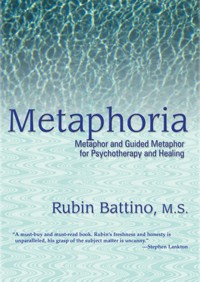
This is the comprehensive guide for all those wishing to explore the fascinating potential of metaphor. Containing sample scripts and suggestions for basic and advanced metaphors and a history of the use of metaphor. " Rubin's freshness and honesty is unparalleled, his grasp of the subject is uncanny."
Sie lesen das E-Book in den Legimi-Apps auf:
Seitenzahl: 597
Veröffentlichungsjahr: 2005
Das E-Book (TTS) können Sie hören im Abo „Legimi Premium” in Legimi-Apps auf:
Ähnliche

















Acclaim for Metaphoria
“It is comprehensive, giving not only Battino’s original ideas about metaphor, but excellent summaries of the other major contributors’ in this area. This book gives precise instructions for using a vague art and method. Highly recommended.”—Bill O’Hanlon, author of Do One Thing Different, and co-author of In Search of Solutions and A Guide to Possibility-Land.
“This is a thorough piece of work, offering a broad perspective of intervention possibilities that are directed by ‘knowing what you are doing if you are addressing a client in therapy.’ The line throughout the book, keeping the awareness of man’s individual uniqueness, is a fine tune, making sure that mechanistic application is not going to happen. For students in communication, it is a very helpful and powerful guide.”—Willem Maas, Professor of psychotherapy with the European Psychotherapy Academy in Vienna.
“The theory and practice relating to metaphor has become so extensive that Battino’s book is indeed very welcome. Metaphoria canvasses, in a concise and reader-friendly manner, metaphor across most of its applications in various psychotherapies. But what brings it to life is Battino’s subtext telling his own ‘history’ of meeting different ideas and practices and how he has made them over into his own. Battino also reminds us how central Milton Erickson was to all that has evolved.”—David Epston, The Family Therapy Centre, New Zealand.
“From the wisdom I have encountered in this book I can recommend it as an excellent resource for those interested in healing. Required reading for every healthcare professional.”—Bernie Siegel, MD, author of Love, Medicine & Miracles andPrescriptions For Living.
“I highly recommend Metaphoria to all therapists. For the student therapist, it is a guidebook that answers the question, ‘What do I need to learn to eventually become a great therapist?’ For the seasoned professional, it is a catalog of clinical building blocks that tells us which elements we may need to fill our sets. Metaphoria is a major contribution to the study and art of psychotherapy.”—Richard Landis, Ph.D., Executive Editor of the Milton H. Erickson Foundation, Inc. Newsletter.
Metaphoria
Metaphor and Guided Metaphor for Psychotherapy and Healing
Rubin Battino, M.S.
Mental Health Counseling Adjunct Professor, Department of Human Services (Counseling) Wright State University
To my grandchildren:
Eleanor Cecilia Lily Jayne Anabel Lark Toma Kataoka Miaki Kataoka
May their lives be stories full of wonder
Permissions
The author greatly appreciates permission to reproduce materials (exact citations given throughout the text) from the following sources:
Family Therapy Networker (Psychotherapy Networker)
O’Hanlon, W. H., (1994) “The third wave,” Family Therapy Networker, Nov./Dec. pp. 19–29.
W. W. Norton & Company
Berg., I. K. and Dolan, Y., Tales of solutions. A collection of hope-inspiring stories (New York: W. W. Norton & Company, 2001).
O’Hanlon, W. H. and Hexum, A. L., An uncommon casebook. The complete clinical work of Milton H. Erickson, M.D. (New York: W. W. Norton & Company, 1990).
Miller, S. D. and Berg, I. K., The miracle method. A radically new approach to problem drinking (New York: W. W. Norton and Company, 1995).
Rosen, S., My voice will go with you. The teaching tales of Milton H. Erickson (New York: W. W. Norton and Company, 1982).
Watzlawick, P., Weakland, J. and Fisch, R., Change. Principles of problem formation and problem resolution (New York: W. W. Norton and Company 1974).
White, M. and Epston, D., Narrative means to therapeutic ends (New York: W. W. Norton and Company, 1990).
Riverhead Books (Penguin Putnam Inc.)
Remen, R. N., Kitchen table wisdom. Stories that heal (New York: Riverhead Books, 1996).
Remen, R. N., My grandfather’s blessings. Stories of strength, refuge, and belonging (New York: Riverhead Books, 2000).
Jossey-Bass Publishers (John Wiley and Sons)
Haley, J., Ordeal therapy. Unusual ways to change behavior (San Francisco: Jossey-Bass Publishers, 1984).
Impact Publishers
Close, H. T., Metaphor in psychotherapy. Clinical applications of stories and allegories (San Luis Obispo, CA: Impact Publishers, 1998).
Crown House Publishing Ltd.
Berman, M., and Brown, D., The power of metaphor. Story telling and guided journeys for teachers, trainers and therapists (Carmarthen, UK: Crown House Publishing Ltd., 2000).
Irvington Publishers Inc.
Erickson, M. H., Rossi, E. L., and Rossi, S. I., Hypnotic realities (New York: Irvington Publishers Inc., 1976).
Brunner/Mazel (Taylor and Francis Group)
Gilligan, S. G., Therapeutic trances, the cooperation principle in Ericksonian hypnotherapy (New York: Brunner/Mazel, 1987).
Havens, R. A., and Walters, C., Hypnotherapy scripts. A neo-Ericksonian approach to persuasive healing (New York: Brunner/Mazel, 1989).
Kopp, R. R., Metaphor Therapy. Using client-generated metaphors in psychotherapy (New York: Brunner/Mazel, 1995).
Lankton, C. H. and Lankton, S. R., Tales of enchantment. Goal-oriented metaphors for adults and children in therapy (New York: Brunner/Mazel, 1989).
Lankton, S. R. and Lankton, C. H., Enchantment and intervention in family therapy. Training in Ericksonian approaches (New York: Brunner/Mazel, 1986).
Table of Contents
Title Page
Dedication
Permissions
Foreword
Introduction
Socialization
Discovery and inspiration
Consciousness
Therapy
Metaphoria
Preface
Contributors
Chapter 1Introduction
1.1 A brief history of the use of metaphor
1.2 Some definitions
1.3 The power of metaphor
1.4 A brief guide to books on metaphor
1.5 Varieties of metaphors
1.6 Metaphors for learning and exploration
Chapter 2Language for Metaphor
2.1 Introduction
2.2 Delivery
2.3 Words
2.4 Suggestions, implications, and presuppositions
2.5 Negation
2.6 Binds
2.7 Poetry
2.8 Some language-rich metaphors
2.9 Summary
Chapter 3Delivery of Metaphor
3.1 Introduction
3.2 Rapport-building skills
3.3 The utilization approach
3.4 Theatricality
3.5 Informed consent?
3.6 Some personal stories
Chapter 4 Basic Metaphor—Structure and Development
4.1 Introduction
4.2 The four elements of a metaphor
4.3 Goal-directed metaphors
4.4 Themes for basic metaphors
4.5 Some basic generic metaphors
4.6 Summary
Chapter 5Analysis of Published Metaphors
5.1 Introduction
5.2 Berman and Brown
5.3 Lee Wallas’s stories
5.4 Mills and Crowley’s Therapeutic Metaphors for Children
5.5 D. Corydon Hammond’s edited Handbook of Hypnotic Suggestions and Metaphors
5.6 Concluding comments
Chapter 6Advanced Metaphor
6.1 Introduction
6.2 Amultiple embedded metaphor for psychotherapy
6.3 AMultiple embedded metaphor for healing
6.4 Henry T. Close’s “The Slimy Green Monster”
6.5 Carol and Stephen Lankton’s Tales of Enchantment
6.6 Concluding comments
Chapter 7Richard R. Kopp’s Metaphor Therapy
7.1 Introduction
7.2 What is Metaphor Therapy?
7.3 Outline for doing Metaphor Therapy—Current Metaphors
7.4 Outline for doing Metaphor Therapy—early-memory metaphors
7.5 Kopp’s Metaphor Therapy and the metaphoric structure of reality
7.6 Commentary on Kopp’s Metaphor Therapy
7.7 Alternative ways of doing Metaphor Therapy
7.8 Concluding comments
Chapter 8Guided Metaphor
8.1 Introduction
8.2 Step-by-step guided metaphor
8.3 Workbook for guided metaphor
8.4 Concluding comments
Chapter 9Reframing as Metaphor
9.1 Introduction
9.2 First- and second-order change
9.3 Reframing
9.4 Some examples of reframing
9.5 Concluding comments
Chapter 10Metaphoric Psychotherapy and Hypnotherapy
Chapter 11Ambiguous-Function Assignment as Metaphor
11.1 Introduction
11.2 The Lanktons on ambiguous-function assignments
11.3 Some general ambiguous-function assignments
11.4 Six Erickson case studies
11.5 Concluding comments
Chapter 12Ordeal Therapy as Metaphor
12.1 Introduction
12.2 Haley’s systematics of ordeal therapy
12.3 Types of ordeal
12.4 Some literature case examples
12.5 Concluding ordeals and metaphors
Chapter 13As-If, the Miracle Question, and Metaphor
13.1 Introduction
13.2 As-ifs
13.3 Solution-focused therapy and the miracle question
13.4 A few solution-focused case studies
13.5 The power of as-if
13.6 Placebo as as-if?
13.7 Concluding comments
Chapter 14Narrative Therapy
14.1 Introduction
14.2 Elements of narrative therapy
14.3 Summary
Chapter 15The Arts as Psychotherapeutic and Healing Metaphors
15.1 Introduction
15.2 Drawing
15.3 Guided metaphoric art therapy
15.4 Summary
Chapter 16Psychodrama and Metaphor – Joan Chappell Mathias, M.D.
16.1 Introduction
16.2 Training in psychodrama
16.3 A psychodrama session
16.4 It’s never too late to learn to play
16.5 Empathy and attunement
16.6 Commentary (by RB)
Chapter 17Guided Metaphor for Healing
17.1 Introduction
17.2 Elements of guided metaphor for healing
17.3 Generic healing metaphors
17.4 Two case examples
17.5 Summary
Chapter 18Preparation for Surgery and Other Interventions
18.1 Introduction
18.2 Preparing for surgery
18.3 Hearing under anesthesia and the doctor’s letter
18.4 Thea’s surgery preparation tape
18.5 Summary
Chapter 19Metaphors for Meaning and Spirituality
19.1 Introduction
19.2 Professor Viktor E. Frankl
19.3 Dr Douglas Mawson
19.4 The meaning of meaning
Chapter 20Rituals and Ceremonies
20.1 Introduction
20.2 Navajo Talking Circle
20.3 Rachel Naomi Remen’s wisdom
20.4 Other uses of ceremonies
20.5 Connections to metaphor
Chapter 21Closing Thoughts
21.1 Metaphors for special purposes and populations
21.2 A story
Bibliography
Index
Copyright
Foreword
Stephen Lankton
Introduction
Metaphors are the looms over which we stretch our experience. There is something about stories and metaphors that has a profound effect on listeners: they teach, inspire, guide, communicate, are remembered, and, most of all, are everywhere!
I see stories or complex metaphors as more than a description of one thing in terms of another. They are an altered framework within which listeners can entertain novel ways of experiencing. Metaphors play a central role in all learning and communicating. They mediate between feelings, thinking, perception, and behavior. They are the symbolic equivalent of sensation. I use the term to extend the story, analogy, and anecdotes as well, as they all act the same on consciousness. When a story is involved, it incorporates plot and character development and drama. These entrainconscious attention and provide an evermore profound manner of impacting listeners at an unconscious level.
Complex stories such as those in myths, epics, and legends created historical backdrops as well. I imagine that some people somewhere listened to a storyteller long ago as she told about Prometheus creating humans and stealing the fire from Mount Olympus for human use; how Zeus then created Pandora for revenge, and sent her to Earth. And the storyteller told how Pandora’s curiosity led her to open that special box and release all human troubles—and, too, how in fright she shut the box just before hope was released.
Some of the listeners were concerned about the tattered fabric of their own lives. For some it was “worn thin,” or in many ways “torn,” for some their life had “faded,” and for others it was drab or just old. And the listeners saw the storyteller’s facial expressions as well as hearing the tale of Pandora. They saw a quick glance over there, a frown here, a questioning look there, and a smile here. And the listeners remembered: they thought about the origins of their own troubles and the need for courage—courage to look in the box of their life to find their own hope.
Elsewhere, other storytellers were remembered differently by their listeners. In the back of their minds people remembered hearing how characters invariably meet a god, confront a monster, overcome a challenger, complete a task, yield to a wise man, or ponder a riddle.
Listeners, just as do the protagonists within the stories, come to show jealousy, purity, wisdom, foolishness, piety, shame, doubt, or hesitation. They, like people everywhere, have been attracted to sirens who will ruin them, have exposed an Achilles’ heel, are afraid to look into the box for hope or to take another risk, and are afraid to love or to cry. Yet the storyteller and the story help them to tap into their own resources and to cope with their own challenges in creative and personalized ways.
Myths retain a mystery and wisdom even though we may be too “enlightened” to believe. They also contain common sense and education. Homer’s Iliad (c. 700 B.C.) tells of an episode in the Trojan War and the wrath of Achilles with its tragic consequences, including the deaths of Patroclus and Hector. But, too, Homer wove a tale that, perhaps inadvertently, explained how to launch a ship, talk to the other gender, prepare certain meals, negotiate a contract, and more.
Socialization
For better or worse, metaphors socialize us. We have “cultural myths” or “cultural metaphors” that infuse our growing minds with a nearly unexamined set of ideas. They soak into our minds as moisture penetrates a sponge. Without so much as a complaint, we can come to accept these so-called truths: “Men are strong, women are weak”; other religions or racial groups are better or worse; “God is on our side”; we should all act like Davie Crockett or Betty Crocker, James Dean or Marilyn Monroe, Superman, Rambo, or Madonna or the Madonna. Then, too, tales of our values bias what we believe about American justice, Native Americans, our unique history, our neighborhood, and even civilized progress.
Even the metaphor of “progress” has come to mean leaving things behind us, and has utterly obscured the idea of real growth, which means leaving things inside us. Metaphors and myths of progress tell us: For the want of a nail the shoe was lost (for the want of the shoe, a horse, a rider, a battle, a kingdom etc.). And, from within the cultural cage, we cannot evaluate reality for ourselves. Yet, at the same time, we are told via still other stories, other metaphors, that we can indeed evaluate reality for ourselves.
There are also cultural metaphors that concern even our biological attributes and address characteristics such as red hair, green eyes, long fingers, blonde hair, fatness, skinniness, and so on. There are children’s metaphors that guide or tease out self-image. We hear labels such as Pinocchio, “Anna-Rexia,” and Gumby as children. We have family metaphors that include everything from “I can fix anything” and “our family is never good at math” to an idea that our family name can determine our occupation. And, of course, there is the favorite family “sphincter” (Berne, 1972, p. 164) that develops from repeated attention focused on how life is a “thrill to the heart,” or “a pain in the butt,” or “a constant upset,” a “pain in the neck,” “pisses me off,” or “oh, my aching back.” Metaphors are everywhere and they influence our being from cradle to grave, from our expectations to our attitudes and to our visceral experience.
Discovery and inspiration
But metaphors do even more. Let’s remember Dr Carl Jung, who pointed out the fact that even when our senses react to real phenomena—sights, and sounds—that they are then somehow translated from the realm of reality into that of the mind. That is, as our sensation happens, the experience has been affected or absorbed subliminally without our conscious knowledge, and ideas well up later from the unconscious as a sort of afterthought. These ideas may appear in the form of a dream or an inspiration. As a general rule, the unconscious aspect of any perceptual event is revealed to us in dreams, where it appears not as a rational thought but as a symbolic image, that is, a metaphor. In other words, our discoveries and inspirations are neither more nor less than the residual processing of perceptions in areas that are related metaphorically to our novel observations and conceptions.
Consider the view of heaven before the Renaissance. To put this in a proper historical perspective, it is helpful to realize that this was the time of the Second Crusade (1147–49). The ideology of this crusade was preached by St Bernard of Clairvaux after the Christians lost at Edessa (1144) to the Turks. This was around the time that Saladin captured Jerusalem for Islam (1187) and built the wall we still see today in the “old city.” In this time frame a Persian poet and mathematician named Omar Khayyam (1050–1122) said that all we ever know is a reflection in a shadow box with the sun at the center.
We are no other than a moving row
Of Magic Shadow-shapes that come and go
Round with the Sun-illumined Lantern held
In Midnight by the Master of the Show …
He wrote mathematical studies and participated in a calendar reform, but he is best known for The Rubáiyát of Omar Khayyam, a collection of epigrammatic quatrains that express an apparently hedonistic philosophy. The point in relating this, however, is that a heliocentric view of the universe was first proposed as a metaphor. And this was several hundred years before Copernicus, Kepler, Galileo, and Brahe set the world on fire with the same idea, but with telescopes to back it up!
In still another great moment, Kekulé in 1847 had a dream of a snake swallowing its tail. Friedrich August Kekulé von Stradonitz (1829–96) was a German organic chemist. He was a professor at Bonn who is most noted for his representation of the molecular structure of benzene as a ring. Such rings are the basic structural feature of many organic and all aromatic compounds. While all of us as modern chemistry students are simply given such details, Kekulé came to the realization of the structure of benzene in a dream—that is, a metaphor. Once again an inspiration that changed the world came first via metaphor.
And then there is the Scottish novelist, poet, and essayist Robert Louis Stevenson (1850–94), who got the idea for Dr. Jekyll and Mr. Hyde in a dream. But more mysterious still is that he claimed that the dreaming was done by “Brownies.” Four plays written with W. E. Henley (1885) had little success, but the adventure novel Treasure Island (1883) and A Child’s Garden of Verses were very popular. In 1886 came two of his best-known works, Kidnapped, an adventure tale set in Scotland, and The Strange Case of Dr. Jekyll and Mr. Hyde. Stevenson claimed that all of these, including that science-fiction thriller with moral overtones, was a story told to him by his internal “Brownies.”
But, years before, Archimedes (c. 287–212 B.C.) had another historically enlightening experience from metaphoric insight. Archimedes sat in a tub of water pondering, for Heredes II, how to determine the composition of a crown presumably made of gold. Archimedes was a Greek mathematician, physicist, and inventor. His reputation in antiquity was based on several mechanical contrivances, such as, “Archimedes’ screw,” which he is alleged to have invented. One legend states that during the Second Punic War he protected his native Syracuse from the besieging armies of Marcus Claudius Marcellus for three years by inventing machines of war, such as various ballistic instruments including the catapult, and, perhaps more interestingly, mirrors that set Roman ships on fire by focusing the sun’s rays on them. His best-known experience was that of realizing how his body displaced an exact amount of water that was determined by his body’s composition—and that a quantity of gold would do the same. Thus, the metaphor of his body in the bath would lead to theories of density and displacement (and incidentally prove that the king had indeed been cheated in the manufacturing of that “gold” crown). Archimedes was inspired to invention through his metaphor.
The artist is a receptacle for emotions that come from all over: from the sky, from the earth, from a scrap of paper, from a passing shape, from a spider’s web. Consider the works of Pablo Picasso (1881–1973), the Spanish artist. Or consider the writer Henry Miller (1891–1980), who stated, “I didn’t have to think up so much as a comma or a semicolon: it was all given, straight from the celestial recording room. Weary, I would beg for a break, an intermission, time enough, let’s say, to go to the toilet or take a breath of fresh air on the balcony. Nothing doing.”
Indeed, the psychologist Timothy Leary (1920–99), a one-time Harvard psychologist, stated that science itself is all metaphor (Leary, 1980). We should see not just individual breakthroughs of scientists and artists as metaphor and metaphor-derived, but the entire fabric of science itself as metaphor. After all, does not science attempt to describe the universe in terms other than what it in fact is?
Many do not realize that Isaac Newton was the best-known pupil of René Descartes. These men are individually or collectively considered the “parents” of modern science. Descartes, who was not a believer in the occult, “nevertheless attributed all of his philosophic ideas to images which appeared to him either in dreams or when he was in the hypnagogic state just before awakening.” (Mishlove, 1993, p. 51). In fact, he stated that an angel had informed him in a dream that mathematics was the only true method of knowing reality. Thus, mathematics was the only thing to believe in and, unless the mathematical relationship could be proven, nothing should be believed. Ironically, he came to this conclusion by a message from an angelic visitor in a decidedly non-mathematical dream (Kafatos & Nadeau, 2000, p. 120)!
Consciousness
Consciousness can change experience. Neural net models of the mind began in 1943, and identified nets with circles and nets without. That is, those without circles have no feedback and reverberation and cannot continually activate. Unfortunately, these nets are the ones that have been studied the most. This is much like the way we developed our worldview. It is the metaphor developed by science and that of Newtonian mechanics. We forget to study the change created by the very act of studying! In our civilization we come to think in terms that are born out of linear causation, objective observation, external truth, reductionism, and specialization.
Experts of the mind are not usually experts of the body. Children are nowadays often unaware of the question: “Which came first—the chicken or the egg?” But it is possible or even likely that neither came first—the world of cause and effect is an illusion. The world of experience and metaphor is “real.”
Yet experience is often recognized as sequential—we live in a world with a dimension of time. Currently most of us are aware of four or five dimensions of experience on this planet. We know we can exert control over three of them: length, width, depth. Time is a fourth dimension, over which we feel no control but which we believe carries us along. And consciousness is perhaps our fifth dimension, which in some invisible manner gives rise to the feeling we each have of a unique and basically enduring identity.
I can mention Grandma, and you become aware of a familiar face, a tone of voice, maybe a setting, a smell of a kitchen on a holiday, and so on. But how does this occur? This is called the binding problem. My words bind your experience—they entrain experience. My story, my metaphor, binds your experience and your “cause-and-effect” is set in motion.
This is in part due to the fact that we can monitor only 150 nerve cells at once. This is probably the result of language limitation. The human mind has been developing in hominids for 10 million years. Yet the development of language seems to be only in the last 100 thousand years. Knowledge as we relate it to language has not developed in parallel to the growth of the size of the brain. Rather, knowledge appears to have mushroomed in growth after the size of the brain stopped its evolutionary expansion and, in fact, declined in average size in modern Homo sapiens. It is as if growth in mass equals smaller increase in knowledge, and no growth in mass equals more increase in knowledge.
With respect to metaphors of the mind, we use the more recent technologies as our way to “best” describe brain and mind activities. While at present we often speak in computer terminology of “retrieving experience” or “programming our mind,” in an earlier era we used to speak in terms of astronomy, as in this example from Charles Sherrington (University of Edinburgh 1937–38 lecture): “The great topmost sheet of the mass, that where hardly a light had twinkled or moved, becomes now a sparkling field of rhythmic flashing points with trains of traveling sparks hurrying hither and thither. The brain is waking and with it the mind is returning. It is as if the Milky Way entered upon some cosmic dance. Swiftly the head mass becomes an enchanted loom where millions of flashing shuttles weave a dissolving pattern though never an abiding one; a shifting harmony of sub-patterns.”
Now, we like to speak of the mind as a computer. By using the computer metaphor many feel we are advancing to an understanding of the brain and maybe the mind. But I want to remind readers to be wary of these metaphors. We create computer neural networks that consist of fewer neurons than those in a frog. These are only a couple of thousand neurons at most and therefore the number is more closely related to the brain of a slug, or a cockroach, and most certainly a brain smaller than that of a cat. The mind is far more complex—10 billion neurons—than that of the largest parallel processing computers we now design. All computer metaphors of the brain should be considered extremely inadequate and must be held in suspicion. The best metaphor to describe our mind or our brain has not yet been spoken! Beware. “The mind of the thoroughly well-informed man is a dreadful thing. It is like a bric-à-brac shop, all monsters and dust, with everything priced above its proper value.” Thus spoke the Anglo-Irish playwright and author Oscar Wilde (1854–1900), in The Picture of Dorian Gray (1891/1974, Chapter 1).
Therapy
Finally, the discussion of metaphor comes to the arena of personal change and professional therapy. History, culture, art, science, and human growth all hinge on the magic of metaphor. Naturally, there is a manner for using it that will facilitate therapeutic change. Perhaps modern clinicians owe Milton Hyland Erickson, M.D., of Phoenix, Arizona, the ultimate gratitude for the use of storytelling in therapy. His pioneering work, more than any other, has triggered the revolution in effort and thinking that has brought the use of therapeutic metaphor to light.
Erickson wrote “The Method Employed to Formulate a Complex Story for the Induction of an Experimental Neurosis in a Hypnotic Subject” in 1944. In the discussion he shows that the use of a story whose content parallels that of the client’s neurosis will indeed bring the experiential material closer to consciousness for the subject. He concluded correctly that these stories can exert significant influences upon the behavior of hypnotic subjects. Furthermore, Erickson speculated that the method by which the story is told may be even more important than its content. In this warning we find an essential caveat for therapists. That is, training and supervision are essential for the acquisition of new skills and techniques. Excellent sources of material may make it possible for therapeutic metaphors to be constructed, but written material will fall short of the goal of honing perception and skill in verbal delivery.
Metaphors work because the mind is metaphoric. It holds attention due to drama—material presented out of sequence. It creates experience because people live in a world of ambiguity. It leads to change when properly conducted, because experience can be elicited, associated, linked, and eventually conditioned to occur in novel ways and in novel situations. Consciousness will generally follow the plot line and stick to the need for resolution of the drama of a story (no matter how minimal), and yet the mind listens to plot while the unconscious responds to the experiences retrieved. As a result, images, ideas, affects, and urges can be elicited and basically brought into play to better assist a client in personal or interpersonal adaptation.
Therapeutic metaphors and longer stories are (1) not to be used at random, (2) built with constrained or guided elaboration of ambiguity that is chosen to work effectively for the unique listener, and (3) used to impart known experience into domains in which listeners have no information or insufficient experience. Context gives meaning to metaphor, and while clients can make no subjectively adequate response they will have an increasing need for some kind of response. When the context of therapy is conducted correctly, its meaning will have an opportunity for an admixture of relevant experience, memory, and perception. This means, ultimately, that internal and external events can come to be linked to therapeutically useful feelings, ideas, behaviors, and complex patterns.
There are many different ways to go about using metaphor that include everything from talking, bibliotherapy, and cinema, to extramural assignments and physical activity. There are also many types of goals for the use of metaphor in therapy. At first one might think the entire matter is too overwhelming to embrace. But that is just why a book like Metaphoria is so appropriate.
Metaphoria
Metaphors (1) provide a cluster or gestalt of associations, (2) resist reduction, (3) facilitate thinking, (4) are more compelling than structured language, and (5) are more easily assimilated. Elaborations are limited by constraints of perceptual experience: biological, social, personal. Metaphors allow for new models and concepts of life. They are the principal structures by which psychological change and growth can occur. They are how the mind transforms itself! Metaphoria is the most complete overview and reference book to date on the various approaches to metaphor.
Rubin Battino’s motivation for writing this book is to present an accurate and comprehensive guide for the existing ideas and literature concerning metaphor or storytelling in therapy. In this new millennium, this is the first book to embrace such a courageous goal. I am thrilled to say that Battino has succeeded in his effort. Not only is Metaphoria comprehensive in scope, but it is also very readable. At several points in the book readers feel they are sitting around a fire with Rubin and hearing his opinions and detailed summaries of all the contributors in the area of metaphor.
Maybe I failed to mention a story about a therapist with a great deal of experience who attempted to put his own expertise into a presentation. Laying aside his personal opinions, he attempted to be balanced and fair about the professional colleagues he knew. He spoke about the skill, the contribution, the value, and the intricacies of each colleague. At times it seemed he had to resort to story-telling, or, more precisely, he chose to entrain his listeners with tales that enchanted them. Sometimes, he presented examples of his colleagues’ ideas, and at other times he perfectly articulated teaching their contributions to the field and the details of their approaches. His listeners—people from universities and private training institutes, competitors, young hero-worshippers, trained professionals seeking direction, and experienced clinicians needing a comprehensive overview for reference—all of them came to listen. All of them walked away after the experience, enriched. All of them realized that they were enhanced and stimulated by this therapist’s ideas and his grasp of the ideas of others. There was no competition, no ego, no games. All there was, in the therapist’s recitation, was value. All there was was learning. All there was was accurate details, footnoted backup, and creative examples.
Rubin Battino, a long-time colleague of mine, has done just this in his magnificent work. Is this volume about metaphor worth the time to buy and read? Absolutely! In fact, it is a must-buy and a must-read book. There are so many ideas about the use of metaphor in professional circles that it would be nearly impossible for an individual therapist to look at and review all of it. Furthermore, there are dozens of authors and clinicians who are ever so insistent that their material be accurately represented. I am but one of those authors. And I can say from my personal experience that Rubin Battino has accomplished the task of accuracy, comprehensiveness, and brevity everywhere throughout this book.
Here is a glimpse of what you find within. Battino reviews the literature and covers every imaginable angle of metaphor in therapy, whether they be spoken or enacted metaphors. He provides numerous examples and at all times speaks to you, the reader, as a person who is a colleague and collaborator. His freshness and honesty are unparalleled, and his grasp of the subject matter is uncanny. Readers will know how and why to construct all manner of therapeutic metaphor, and can act with confidence, knowing what sorts of responses clients will create. From creation of metaphors to rapport, from application to specific case illustrations, this book is a chest of golden treasures. It will shine for some time to come.
—Phoenix, AZ February 2002
Bibliography
Berne, E., (1972), What do you say after you say hello? New York: Grove Press.
Erickson, M. H., (1944), “The method employed to formulate a complex story for the induction of an experimental neurosis in a hypnotic subject,” Journal of General Psychology, 31, pp. 67–84.
Kafatos, M. C. and Nadeau, R., (2000), The conscious universe: parts and wholes in physical reality New York: Springer, p. 120.
Leary, T., (1980), “An interview with Timothy Leary,” Contemporary Authors, Vol. 107, No. 24, September.
Mishlove, J., (1993), The roots of consciousness: the classic encyclopedia of consciousness studies Tulsa, OK: Council Oak Books, p. 51.
Sherrington, C. S., (1937), Lectures. University of Edinburgh (1937–8). Also see: Sherrington, C. S., The brain and its mechanism Cambridge: Cambridge University Press.
Stevenson, R. L. and “Brownies.” See, e.g., Elwin, M., The strange case of Robert Louis Stevenson (London: Macdonald & Co., Ltd., 1950), p. 199, where RLS is quoted commenting on Olalla and The Strange Case of Dr. Jekyll and Mr. Hyde: “both … were in part conceived by ‘the little people who manage man’s internal theatre’—the ‘Brownies,’ ‘who do one-half my work for me while I am fast asleep, and in all human likelihood, do the rest for me as well, when I am wide awake and fondly suppose I do it for myself’.”
Wilde, O., (1891, 1974), The Picture of Dorian Gray Oxford: Oxford University Press, Chapter 1.
Preface
When I was asked to consider writing a book on the subject of metaphor, my first reaction was that there were several books already available. (This project was recommended to the publisher by John Roberts, Ph.D.—thank you, John.) I thought about the project at odd moments—in one of those the title of this book, Metaphoria, popped into my head. Somehow, this invented word caught my imagination with its hints of euphoria, metamorphosis, passion, and moments of delight. Once I had this working title, the book became an established entity, just waiting for an opportune time to put words to paper. This preface is being written in the lakeside town of Mondsee, Austria. The “opportunity” is that my wife, Charlotte, is singing in the Berkshire Choral Festival in Salzburg, with rehearsals and accommodations in Mondsee. So, while she vocalizes and rehearses, I write (or tour!).
For a while, I felt that “Metaphoria” was sufficient as a title, until I decided that an explanatory subtitle was needed. This is: “Metaphor and Guided Metaphor for Psychotherapy and Healing.” The word “guided” connects with my work in guided imagery, and the phrase “guided metaphor” is an accurate description of the ways I use metaphor in a structured manner for both psychotherapy and healing. With this extended title the book had to be written.
There are a number of good books on metaphor (see Chapter 1 for a guide to these books). How is the present book different? The major difference arises from my many years in academia—this book is written more in the style of a textbook or primer on the subject than a collection of case studies with some theory thrown in. That is, the book is designed to systematically teach the reader new to the field how to construct and use metaphors in a variety of circumstances. In addition, the style and content of the book are influenced by my training in and practice of Ericksonian psychotherapy and hypnosis. Milton H. Erickson, M.D., was a master storyteller and his ability to weave helpful ideas into his stories is legendary. I have been much influenced by his work. The accompanying audio material for this book provides an illustration of metaphors for a variety of purposes, and also a guide to their delivery.
Chapter 1 deals with definitions and a survey of the literature. Throughout the book illustrations of relevant uses of metaphor are given by using both published metaphors and those created by me. Since metaphors are basically stories using words, Chapter 2 is a systematic summary of appropriate language forms and usage—just what words, phrases, and grammatical structure will enhance the content of a metaphor? There is a section on language-rich metaphors.
Metaphors are stories, and you need to be a good storyteller to use them effectively. Chapter 3 is then concerned with the delivery of metaphors. This involves material on rapport building as a basis for connected communication. Theatricality is important, as well as the discipline of speech and communication. Chapter 4 covers the basic structure of a metaphor—what are the essential elements and how are they combined? This chapter recognizes that there are many storytelling styles. There is a section on themes for basic metaphors.
A special feature of the book is the analysis of published metaphors that is presented in Chapter 5. Using a two-column format, parts of several published metaphors are critiqued and analyzed. Alternate ways of saying the same thing more effectively are also given. Metaphors can involve a complex structure as in multiple-embedded metaphors; these are treated separately in Chapter 6 on advanced metaphor, which also contains several literature and author examples.
Richard R. Kopp’s Metaphor Therapy is such a significant contribution, basically a paradigm shift from therapist-generated to client-generated metaphors, that an entire chapter (7) is devoted to describing his pioneering work. This chapter includes a critique and some alternate ways of doing Metaphor Therapy.
Chapter 8 describes the author’s guided-metaphor approach. This is based on guided imagery, Metaphor Therapy, and the author’s experience as a hypnotherapist. This chapter also includes a workbook for structured writing on guided metaphor.
The next group of chapters connects metaphor with a number of therapeutic approaches. Reframing, or the art of changing the meaning of an event or idea or memory, is discussed in Chapter 9. This chapter starts with a discussion of first-order and second-order change, or the nature of change. Chapter 10 deals briefly with the uses of metaphor in psychotherapy and hypnotherapy. Ambiguous-function assignment (Chapter 11) and ordeal therapy (Chapter 12) are special applications of metaphor.
Solution-focused therapy as practiced by Steve de Shazer and his colleagues generally involves the use of the “miracle question,” a special application of the “as-if” frame. Pretending is an inherent part of listening to and being engrossed in a story—Chapter 13 covers this aspect of metaphor. Narrative therapy (see Chapter 14) was developed by Michael White and David Epston and is a creative and effective way of using a person’s own story to help them. The elements of narrative therapy work are presented.
Many of the “art” therapies (Chapter 15) are variants of metaphor in media other than words. There is a section on guided-metaphor art therapy. Chapter 16 is a specialty chapter on psychodrama and metaphor written by my guest contributor Joan Chappell Mathias, M.D. There are illustrations and a discussion of psychodrama.
In Chapter 17 the uses of metaphor for healing are presented, particularly the use of guided metaphor. The use of stories for preparation for surgery and other invasive interventions is the subject of Chapter 18. A major use of metaphor has been in the search for meaning and in spiritual practices (Chapter 19). Two examples are given in the lives and experiences of Viktor E. Frankl, M.D., and Douglas Mawson, Ph.D. Chapter 20 is on rituals and ceremonies with definitions and illustrations of different kinds of ceremonies. Finally, Chapter 21 is a summarizing chapter ending in a closing metaphor. There is an extensive list of references.
Special thanks are due to my friend and colleague Howard H. Fink, Ph.D., whose helpful comments and suggestions improved the manuscript, and whose enthusiastic support was always evident. Jane Chernek-Shaw did all of the rough typing and graciously adapted to my requirements. Bridget Shine, editor, sustained me through many of the ups and downs in the process of writing this book—her considerate support was and is gratefully appreciated.
Your comments are always welcome (email address: [email protected]).
Rubin Battino Yellow Springs, Ohio Fall 2001
Contributors
Rubin Battino, M.S. He has a private practice in Yellow Springs, and also teaches courses for the Department of Human Services at Wright State University where he holds the rank of Adjunct Professor. This book is based on one of those courses. He has over ten years of experience as a volunteer facilitator in a Bernie Siegel-style support group for people who have life-challenging diseases and those who support them. Also, he has many years of experience in individual work with people who have life-challenging diseases. He is President of the Milton H. Erickson Society of Dayton, and coauthor with T. L. South, Ph.D., of Ericksonian Approaches: A Comprehensive Manual, a basic text on Ericksonian hypnotherapy and psychotherapy. His other books from Crown House Publishing include Guided Imagery, Coping, and Meaning. He is currently Professor Emeritus of chemistry at Wright State University.
Joan Chappell Mathias, M.D. Dr Mathias received her M.D. in England and worked as a G.P. in a slum-clearance estate in north London before qualifying as a psychiatrist in order to specialize as a psychotherapist. Her training included Balint groups at the Tavistock Clinic, a full analysis with the late Dr J. L. Rowley, and work with the Family Planning Association. Encouraged by the late Joshua Bierer, she trained in encounter, bioenergetic analysis, Gestalt therapy, NLP, transactional analysis, and finally in psychodrama. She is now a Distinguished Member of the ANZ (Australia/New Zealand) Psychodrama Association (ANZPA), with Max Clayton being her primary trainer.
In 1970 she and her husband Norman moved to New Zealand, where she worked in the Hospital Psychiatric Service, was visiting psychiatrist to the Women’s Prison in Christchurch, and supervised in Marriage Guidance, the City Mission, and Life Line.
Although she is retired now and living in Tauranga, she is sought out for supervision by a chaplain, workers in the Dual Diagnosis and Alcohol and Drug Treatment Services, and by experienced members of the ANZPA seeking accreditation as trainers, educators, and practitioners in Psychodrama.
Chapter 1
Introduction
1.1 A brief history of the use of metaphor
The tribe gathers around the fire. It is night and the sparks that fly upward mimic the stars. The sparks last for moments, the stars are eternal, slowly moving across the sky in their daily trek, their yearly changes. Backs are cold and faces and hands are warm in the glow of the fire. In the ever-changing patterns of flame and glowing embers there is mystery and myth and the world of dreams. Enchantment. And the Old One tells once again the story of their origin, how the world began, how man was formed, how this tribe came about. And there is great comfort and wonder in hearing the old stories. Each member of the tribe is part of the story, is the continuing story. This is who they are. It is also who we are—simply a story, words strung together, connections with our past, our present, and our future. Words and stories …
Stories are transformative. When you listen to or read or observe a story unfolding there is a magical transformation into the world of story, its events, and its participants. You become “entranced” in the tale. Your boundaries extend beyond your body to the limitless “out there” of the imagination. You fill in the details out of your uniqueness, your memories and connections. The story may take place in a forest or a city or a room—the forest is your forest, as is the city and the room. We all know what a forest is—trees and undergrowth and open spaces. Your forest may be all evergreen, or all deciduous, or some unique personal combination. Is the forest flat or hilly, does it have a stream or a river, is it winter or summer, are there animals and insects and flowers, are you alone or are others present? Such a simple word, “forest.” The magic, the power of a story, a word, an image, a metaphor, is in the detail that you realize about it in this moment. This book is about the transformative power of words consciously used as metaphors for therapy and healing.
“Read me a book.” “Tell me a story.” Most stories at this time are the retelling in some medium of those created by a writer. It is rare to experience a spontaneously generated story. The medium controls the amount of detail explicitly presented. Printed stories generally allow the most variation in the recipient’s mind. Illustrated printed stories are more restrictive in presenting specific images. Listening to a story is much like reading one, except for the reader’s delivery, which highlights particular words and phrases. Theater is more restrictive in the way the words are spoken, in the movements and body expressions of the actors, and in the visual constraints of the sets. Movies and television restrict even more with the images chosen by the director. There is less left to the imagination and more is controlled.
It is my contention that the most effective use of metaphor, of stories, is in the precise use of vague language. All poets know this. It is no mistake that the great epics and sagas of many cultures are in poetic form. This holds for The Iliad and The Odyssey as well as for the Bible and other religious writings. The poet knows the art of the minimal use of precise words to create an image or evoke a feeling. Too much detail confines the reader. What about the myriad details in Look Homeward Angel or Moby Dick? Although the reader may be overwhelmed with descriptive words, each reader still interprets all of those details in her own way.1 Sufficient information is needed to match your client’s language, interest in detail, and own personal story; or to utilize her own self-descriptive metaphors.
The history of humanity is a story that is manifested in many ways. There are the oral traditions of preliterate man, whereby significant tribal stories were learned verbatim and passed on for thousands of years, as in the case of the Australian Aborigines. The accuracy of those oral-tradition stories is quite incredible. When all you have to rely on is remembering stories to tell over and over again, then that is what storytellers do. Since it is easier to remember rhymed poetry, or even blank verse, many of these old stories were in poetic form. In fact, the language forms of poetry have much in common with the language forms of metaphor. The writings and sayings, and particularly the parables, of all religions are rich in metaphor. God and the Great Spirit or other deities are mostly described indirectly by metaphor rather than directly. In Judaism you cannot even speak or write the name of God. Through all ages wandering storytellers (troubadours in the Middle Ages) were always welcome for their diversions and their news.
Joseph Campbell (1968) has written about the “ hero’s journey,” a particular kind of story that appears to be universal. The Hero sets out on a quest for either personal enlightenment or advantage, or for some communal benefit. After many adventures involving “Heroic” challenges and deeds, the heroine wins through to her personal goal or that of the tribe. The difficulties of the journey are many, as are the obstacles in everyone’s life. The retelling of these stories provides a comfort to ordinary people in identifying with the hope of success. The hero’s journey also becomes a rite of passage into manhood or womanhood in many cultures. Is the modern involvement of many with the superheroes of sports a current re-enactment of the hero’s journey? Most probably. Of course, there has been an evolution in particular in Western cultures over who is considered to be a hero, and what deeds are considered heroic. We have Nobel laureates, and sports stars, and selfless people like Mother Theresa and the Dalai Lama, but rarely political leaders in modern times.
1.2 Somedefinitions
When searching for definitions I always like to start with my treasured copy of the second edition of Webster’s New International Dictionary, unabridged. For me, the very weight of this tome adds value to the definitions therein. The word “metaphor” is a noun, and comes from the French metaphore, the Latin and Greek metaphora, and from the Greek metapherein, which means to carry over, to transfer, as in its roots of meta, meaning beyond or over, plus pherein, to bring or bear. So in this sense a metaphor is something that is brought or carried over or beyond. In the context of rhetoric it is defined as the use of a word or phrase literally denoting one kind of object or idea in place of another by way of suggesting a likeness or analogy between them (the ship plows the sea; a volley of oaths). A metaphor may be regarded as a compressed simile, the comparison implied in the former (a marble brow) being explicit in the latter (a brow white like marble). The only synonym listed is the word “comparison,” although the reader is also directed to the word “trope.” The rhetorical definition of this latter word is: “The use of a word or expression in a different sense from that which properly belongs to it, for giving life or emphasis to an idea; also, an instance of such use; a figure of speech.” Tropes are chiefly or four kinds: metaphor, metonymy, synecdoche, and irony.
Continuing with this merry chase of definitions, metonymy (whose Latin and Greek roots mean changing a name) is: “Use of one word for another that it suggests, as the effect for the cause, the cause for the effect, the sign for the thing signified, the container for the thing contained etc. (Darkness was the saving of us, for the cause of saving; a man keeps a good table, instead of good food; we read Vergil, that is, his poems; a man has a warm heart, that is, warm affections.” The roots for synecdoche indicate that it means to receive with or jointly, and the rhetorical definition is: “A figure of speech by which a part is put for the whole (fifty sail for fifty ships), the whole for a part (the smiling year for spring), the species for the genus (cutthroat for assassin), the genus for the species (a creature for a man), the name of the material for the thing made, etc.”
The word “ irony” comes from the Greek for “dissimulation,” a bit different from the previous words. Three definitions are given: “1. Dissimulation; ignorance or the like feigned to confound or provoke an antagonist. 2. A sort of humor, ridicule, or light sarcasm, which adopts a mode of speech the intended implication of which is the opposite of the literal sense of the words, as when expressions of praise are used where blame is meant; also, the figure of speech using this mode of expression. 3. A state of affairs or events which is the reverse of what was, or was to be, expected; a result opposite to as if in mockery of the appropriate result; as the irony of fate.” Simile is defined rhetorically as: “A figure of speech by which one thing, action, or relation is likened or explicitly compared in one or more aspects, often with as or like, to something of different kind or quality; an imaginative comparison (‘Errors, like straws, upon the surface flow’; ‘Reason is to faith as the eye to the telescope.’).”
Finally, with respect to definitions, it is commonly said that when you are using metaphors you are telling “stories.” The word “story” has its roots in the Latin historia or history. Definitions of story include: “1. a. An account or recital of some incident or event. b. A report; an account; a statement; as, the man’s story was not convincing. c. An account of the career of a particular individual, or of the sequential facts in a given case; also, a group of facts, told or untold, having a particular significance in respect of some person or thing, as, the story of my life; the story of a mine. d. An anecdote, especially an amusing one; as, his speech contained several good stories. 2. In literature: a. A narrative in either prose or verse; a tale, especially a fictitious narrative less elaborate than a novel. b. The intrigue or plot. 3. A fib; a lie; a falsehood. 4. Tradition; legend; as, to live a story.”
In his later years it was said that a significant amount of Milton H. Erickson’s teaching was via the telling of stories. He had an enormous fund of these “teaching talks” (Rosen, 1982) and was adept at adapting them to individual clients and audiences. He also did symbolic metaphoric teaching via activities such as taking quite a bit of time and effort to pick up a rock near his wheelchair and to suddenly throw it at someone. The “rock” was a realistically painted piece of Styrofoam. He didn’t need to emphasize the message of “things are often not what they appear to be.”
1.3 The power of metaphor
I recall a radio interview with Isaac Bashevis Singer, the Nobel Laureate for literature. Singer was asked about his own writing style. In reply, he was essentially critical of “modern” novelists who were too analytical and too much in the heads of their characters. He said that these authors were forever telling the reader what was going on in their characters’ minds, and also what were their feelings and motivations. Singer said that he was basically a storyteller, and that he let the stories of his characters convey what was going on inside of them. So Singer left a great deal up to the imagination of the reader. The making and creating of connections within the reader’s/listener’s mind is the power of metaphor. The artfully constructed metaphor permits the listener to develop her own unique interpretation. This, then provides an alternate way of perceiving her own reality. Rather than being stuck on one response, the metaphor opens up the possibility of alternate responses, many of which may be more appropriate and healthful.
Combs and Freedman (1990) devote an entire chapter (pp. 27–43) to a “Batesonian Perspective,” based on the work of Gregory Bateson (1979). Kopp (1995) writes about Bateson’s ideas (pp. 97–9) and builds on them in his Epilogue (pp. 170–3), where he considers that Bateson’s ideas serve as a fundamental theoretical basis for the effectiveness of metaphor. Bateson (1979) proposed that mind and nature are unified within a single principle, that of “the pattern that connects.” He maintained that metaphor is the pattern that connects, i.e. a pattern that characterizes the evolution of all living organisms. Bateson stated that patterns within a person that connect are first-order connections; and that second-order connections are external, i.e. between people and things. Metaphoric structure identifies the pattern that connects two different things. Kopp (1995, p. 99) states:
Metaphor, does, in fact, point to a resemblance between two different things. The two things compared in a metaphor can be both differentand similar because their difference and similarity involve different levels of comparison. The fact that a metaphor is false as a literal statement does not address or pertain to the way in which it is true as a correspondence of similar pattern or organization.
Kopp also states (1995, p. 99):
… the “pattern that connects” is a “nonlinear” resemblance of pattern and organization between two things that are different when considered as discrete entities belonging to two different “linear” logical classes.
Thus, metaphors are characterized by nonlinear causal chains—in other words, the patterns that connect are not logical. We close this discussion of Bateson’s work with several quotations from Combs and Freedman (1990), with the page citation at the end of each quotation:
… Bateson argues persuasively that in mind all is metaphor. We can never definitively know anything about external reality. The best we can do is to seek more and more workable metaphors for it … (p. 30)… the metaphor is not of the same logical type as the idea it represents. A metaphor can point to an idea, but it can never BE the idea. (p. 31)Because metaphor is indirect, multidimensional, and multimeaningful, it is a communication form that incorporates some randomness. (p. 39)… stories are how a mind connects individual bits of data. (p. 42)… each person is his own central metaphor. (p. 43, part of “metalogue” written by Mary Catherine, Bateson’s daughter)… telling stories is a natural technique for evoking resources in clients. (p. 53)The indirectness of metaphor allows clients to try out a new perceptual frame without having to decide consciously whether to accept or reject it. (p. 68)Words, stories, images, imagination, as-if, and dreams allow safe explorations of new ideas, new feelings, new connections, new ways of being in the world. There are fairy tales and fables and myths and heroic journeys in which we can participate vicariously. The magic of all these metaphoric activities lies in the fact that the mind finds it hard to distinguish “reality” from “fantasy.” How real is it really? When you imagine it, whatever it is, it takes on its own reality. These ideas, used effectively, can be and are effective change and healing agents.
There is a line in Robert Burns’s “To a Louse. On Seeing one on a Lady’s Bonnet at Church” that goes:
O wad some Pow’r the giftie gie us
To see oursels as others see us!
To see ourselves as others see us, to step outside our mind/body boundaries, to get perspective, a new vantage point—this is the power of metaphor.
1.4 A brief guide to books on metaphor
There have been quite a variety of books published on metaphor, particularly as applied to its use in psychotherapy. This section is a brief guide to those books with my comments on each. Each book has good things to offer in its own way. Many of these books will be referred to in more detail in later chapters. There is a general reference list at the end of this book. (The following is arranged by date of publication.)
Martin Buber, Tales of the Hasidim (1947) Buber’s book begins with (p. 1): “The purpose of this book is to introduce the reader to a world of legendary reality.” The Hasidic movement was founded by the Baal Shem Tov (1700–60), and the core of Hasidic teachings is the concept of a life of fervor, or exalted joy. These tales are in two books: those of the early masters followed by those of the later masters. They are full of mysticism, wisdom, and wonder, with a richness of metaphor that is inspirational.
Viktor E. Frankl, Man’s Search for Meaning (1959, 1962, 1984) Frankl’s remarkable story is not technically about metaphor: it is a metaphor. It is the story of one man’s search for meaning during his time in the Nazi concentration camps of World War II. In fact, the story of the rest of his life (Frankl, 1997; Klingberg, 2001) continued that search. His life and his works have had a profound effect on millions of readers.
Sheldon B. Kopp, Guru. Metaphors from a Psychotherapist (1971) After a general introduction in Part I, Kopp discusses in separate chapters, under the heading “An Enchantment of Metaphors”, metaphors from primitive religion, Judaism, Christianity, the Orient, ancient Greece and Rome, the Renaissance, tales for children, science fiction, and the “Now Scene.” There are many illustrative metaphors in this erudite book. The perspective is that of becoming a guru via the use of metaphor. Kopp’s many books are well worth studying and are rich in the use of metaphor. He was a storyteller. You may particularly enjoy reading If You Meet the Buddha on the Road, Kill Him! (1972).
David Gordon, Therapeutic Metaphors (1978) Gordon’s book was the first that really popularized the use of therapeutic metaphors. He comes out of an NLP (neuro-linguistic programming) background and the book reflects this. The material on the nature and structure of metaphor is quite good, as are the sections dealing with language usage. There are many illustrative metaphors, a good list of references, but no index. This is the book to read first in a serious study of metaphor.
Sidney Rosen, My Voice Will Go With You (1982)




