


Erhalten Sie Zugang zu diesem und mehr als 300000 Büchern ab EUR 5,99 monatlich.
- Herausgeber: Books on Demand
- Kategorie: Sachliteratur, Reportagen, Biografien
- Sprache: Englisch
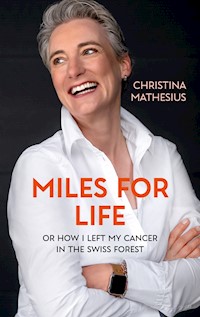
Now that the kids are finally old enough, and her husband´s career is on track, Christina is determined to return to the working world once their summer vacation in Sardinia is over. However, during a routine check-up, fate steps in. Diagnosis Cancer. But where many others might see it as a stroke of bad luck, Christina sees it as a challenge to start fresh. She will not let another day go by without finally taking charge of her life. It is an illness that only she alone can bear, take responsibility for, and overcome. Foregoing the usually prescribed chemotherapy route, she decides instead to start training for a half marathon. She runs because of inherit healing effects endurance training provides, and soon discovers that it has set her on the path to a much more self-determined, happy, and heartfelt life. Immediately following her multiple operations and within the space of only one year, Christina organized an international move from Switzerland to the United States and participated in five half marathons as well as a 100-mile challenge in 2020. She attributes her accomplishments to her dry humor, a long-lost love, and her two courageous children. A marvellous book for all women. It is like having a top-notch life coach neatly wrapped into a paperback book. Seldom have I highlighted so many passages in any other book as much as I did in this one or made as many connections to countless people around me. But read it for yourself. Gaby Abels, Hamburg, Germany Sensational! A super good book that tackles life´s poignant topics. Very humorously written. A must read! Joséphine Saffert, Nashville, TN/USA
Sie lesen das E-Book in den Legimi-Apps auf:
Seitenzahl: 243
Veröffentlichungsjahr: 2021
Das E-Book (TTS) können Sie hören im Abo „Legimi Premium” in Legimi-Apps auf:
Ähnliche


















For my two children. It is for them that I live. It is for them that I fought my way back to life.
Disclaimer: This book is an account of the author’s personal journey in overcoming breast cancer and is not to be taken as an authoritative source on breast cancer, but to empower the reader to believe in themself. It is by no means intended as a substitute for the medical advice of a board-certified physician. If you have or suspect you have breast cancer, please get checked and follow the advice of a doctor you trust. The names of the people portrayed in this book have been changed to protect their privacy.
Contents
Mile 1
Mile 2
Mile 3
Mile 4
Mile 5
Mile 6
Mile 7
Mile 8
Mile 9
Mile 10
Mile 11
Mile 12
Mile 13
Acknowledgements
About the Author
Mile 1
Well, here I am again. For the third time in seven months. I never would have thought I’d be taking part in a half marathon. Unlike with the other marathons, this time I’m totally relaxed. By now, I know what to expect, and I also know I can do it. Like so much else in the last two years.
“Another thirty seconds, row sixteen. Are you ready?” an enthusiastic voice booms through the loudspeakers. The crowd around me cheers loudly in response. I am. I’m totally ready for this race and for much, much more!
“So, let’s count down together: ten, nine, eight, seven, six, five, four, three, two, one.” And then I and a hundred other people all start moving at the same time, all of them at roughly the same level of speed and endurance as me. The stronger runners in the corrals before us have already started, and behind me, another enthusiastic throng is raring to go. Slowly, and in small steps at first, we start our journey to the finish line.
I am not alone in the group. Three other women from my running club are here with me. Four of our other clubmates started a few corrals ahead of us and will be there at the finish line to cheer us on when we finally get down to that last mile. There are about eighty of us in the club who regularly meet for group training. We’re all at different levels of ability and have vastly different personalities, but we support each other, not only as fellow runners.
Ahead of me lie 13.1 miles. It’s a warm autumn day, and just before I cross the starting line, I tap the stopwatch function on my smartphone and turn on my music. I’ve put together a separate playlist for each individual mile of the race. I’m eager to see where my thoughts take me today. For as challenging as running such a distance still is for me, my mind takes an altogether different journey each time, running its own course through faraway places, memories, and aspirations.
As my feet cross the starting line, the excitement and exhilaration around me fades into the background. James Blunt croons “You’re Beautiful” in my ears. And I have to admit, my life really is brilliant.
The hardest challenges I’ve ever had to face in my life up to this point are already behind me, but at this very moment, it almost seems like it was all a bad dream or a really bad joke.
* * *
“See you guys later. I’ll be back in about an hour. I just have a quick doctor’s appointment.” This was the last thing I said to my two children as I left the house. That was two years ago. I’d just wanted to run over there and quickly get the mammogram over with that’d been on my calendar for weeks so we could start focusing on our summer vacation in Sardinia, Italy.
In the eight months prior to this, my life felt like I was flying down the fast lane on the autobahn, pedal to the metal, never stopping to take a break. And for the first time in years, I was happy again. Over were the years of committing myself solely to my children and holding our family together so that my husband could focus on his international career as a top manager. After so long, I now, too, had things to talk about and no longer played the role of the attentive listener and sparring partner. Our children, Sophie and Frederik, were fifteen and twelve, and it was time for me to go back to work. It had always been my dream to become a professional corporate trainer and business coach, and now, I was about to take the final exam of my certification program in Munich. But then this happened.
“It’s cancer! I can’t believe it!”
I’d gone in for the mammogram in a perfectly good mood only to leave the hospital practically on my deathbed. A mere three-quarters of an hour is all it took for the diagnosis: breast cancer. The scene that had played out within this short time was inconceivable. I still get goose bumps to this day when I think about it.
* * *
My breathing starts to falter and I lose my rhythm. The memories are simply too overwhelming. They suffocate my lungs, turn my legs to lead. I force my mind back to the here and now, see my girlfriends next to me. “It’s over, Christina. Everything’s okay! You did it!” I whisper to myself, confidently and decisively setting one foot in front of the other. What a difference to back then!
* * *
I left the hospital in Liestal, Switzerland, as if in a trance and stepped into a world where the sun was shining, the birds were singing. The beauty of that summer day immediately felt absurd to me. I no longer fit into the picture. How was I supposed to leave for a vacation in Sardinia the next day? Two weeks with some friends that I’d been looking forward to, and for such a long time. We’d planned a week of yachting and a week at an amazing villa with a pool. Just relaxing and having fun.
How should I tell Conrad? And the children? My thoughts circled around them as I walked back to my car. I was so relaxed when I went in for the mammogram. Didn’t think anything of it when the x-ray attendant answered my question of how often a woman should have a mammogram with, “This is special for you. We’ll also be doing another ultrasound.” I pulled my blouse up over my head again and we changed rooms. While I made myself comfortable on the table—my bare breasts exposed— the doctor came in to start the ultrasound. Like me, she was also German, and in Switzerland, fellow Germans are usually quick to strike up a conversation. We chatted casually, and we both obviously liked each other. We also established that we’d both studied in Münster.
She paused for a moment and her demeanor abruptly changed. “Oh my God! I am really sorry I found this here.” She pointed to a spot on the screen and drew a circle around it using the machine controls. I couldn’t see anything there. “Just a moment, Mrs. Mathesius. I’m just going to get the chief physician.”
A few minutes later, the doctor came in and did another ultrasound. “Yeah, that doesn’t look good. That doesn’t look good at all. We’ll take a biopsy right away. Today is Thursday ... The results ought to be at your gynecologist’s office on Monday. She’ll discuss the details with you. Since we aren’t your primary doctors, we can’t say anything further.” With this cryptic proclamation, the head physician and his entourage left the room, only to return two minutes later and announce, “Every thing is ready for the punch biopsy.We need to do it right now, Mrs. Mathesius.”
“What does that mean?” I asked helplessly. “Do I have cancer? I’m leaving for vacation tomorrow. We’ve already got everything packed.” He looked at me earnestly and replied, “You can still go on vacation. The next two weeks aren’t going to make any difference. But the biopsy needs to be done right away. I’m just going to spray the area with a numbing spray; that way you won’t feel the needle of the local anesthetic as much. Once the breast is numb, I have a special tool I use to take three tissue samples from the exact spot. It sounds a little intimidating, but the pathologist uses these samples to determine exactly what type of tumor we’re dealing with.”
There were different types? I didn’t understand anything the doctor said. My thoughts were spinning. “Damn it, it’s cancer! I have cancer! Me? I can’t believe it! No, not me!” A nurse came into the room and held up a cloth in front of my face, and then everything happened very fast. I heard what sounded like a stapler being pushed against a hard surface. Five minutes later, it was all over and I was told I could get dressed again. “Okay, and now what?” I asked helplessly. The doctor had long since bid me farewell with a curt nod, and the German doctor, who’d just been so unbelievably personable, simply said, “We’ve done all we can do. It’s up to the pathologist now. Have a good day, Mrs. Mathesius.” I was dumbfounded. One of the nurses walked me to the door, but avoided my eye contact. Even though none of them had ever said the word, I knew that I had cancer.
Once I got home, I called Conrad at the office. “I just had a mammogram. I think you’d better come home right away.” And while I usually had to wait for hours for my husband, and even sometimes wrote appointments on our calendar an hour earlier than they actually were just so that he’d be on time, today he was home in less than forty-five minutes. “Christina, no matter what it is, it’s our illness. We’ll face this together. No matter what happens,” my husband told me, and tried to take me into his arms. There are moments in life that are simply branded into your mind that you never forget. I can still vividly remember I looked at him in complete disbelief and answered flatly, “No, Conrad. This is my illness alone. And I will face it by myself. No matter what happens. There are things that can’t be shared.” There was just about nothing in our years together that I hadn’t shared with this man! But at this moment, it was astonishingly clear to me that it simply wasn’t possible. We later broke the news of the last few hours to our two children together, even though we knew no further details yet. “What is it exactly? How bad is it really? Was I going to die or live?” I didn’t know, and that’s also how I communicated it to my fifteen-year-old daughter and twelve-year-old son. Because I had always strived to be open and honest with them.
“Are we still going on vacation?” Sophie asked me guardedly.
“Of course!” shot out of me like a bullet. “Everything’s packed. Besides, it’ll be better to be on vacation than to be stuck at home in a state of shock.” On the inside, though, I was almost at the breaking point, but this moment made it clear to me that I needed to fight for my children and give them the hope that I would make it through—that I would live!
* * *
Udo Lindenberg’s smoky voice permeates my headphones and carries me back to the race. “Durch die schweren Zeiten ...” Through the hard times. A quick sip from my water bottle and I watch the landscape pass me by on this gorgeous October day in 2019 in Louisville, Kentucky, as I keep running. There are only a few people on the sidelines here and there, cheering us on. I retreat into Udo Lindenberg’s song. He’s been there for me the entire time and I have cried rivers of tears to his music when I had no idea of what the future would bring.
* * *
I decided that regardless of what the doctors might have found, the best thing now was to still go through with our family vacation. As they say in German, “Augen zu und durch!” which means something like “close your eyes and hope for the best!” It’d been my motto in just about every phase of my life. After the first eight-hour leg of our car journey, we stayed the night in Genoa, and took an absolutely endless ferry ride to the island of Sardinia the next day. The sun beat down, it was extremely hot, and the people were in a cheery vacation mood, especially around the port, where my friend Susanna and her two children came our way with huge, happy grins.
We’d known each other since our school days, although we hadn’t always kept in touch since then. Until one day we ran into one another, purely coincidentally, on Germany’s North Sea island of Spiekeroog during a tour of the vast tidal mud flats. Since then, we’d started seeing each other regularly. Our children were the same ages, and our husbands also got along really well. It was another reason why I’d been so looking forward to our time together for the past many weeks.
At some point that afternoon, I broke down and told Susanna the events of the past two days. I was sure that she, being a doctor, would know how to handle it. And since I am an extremely open person, I wouldn’t have been able to keep it from her for the entire time anyway. But I was blown away by her reaction. She was in complete shock and told me time and again how sorry she was to hear it. And that was the moment I truly felt scared for my life for the first time.
In my despair, I let the others go off shopping without me, so that they were distracted. I stayed back on deck and had a look around the boat that was to be our weeklong home on the sea. Despite its spaciousness with four cabins and three baths, it was suddenly apparent to me that it may not have been the best idea to cling to this plan in my current frame of mind. I had come in gritting my teeth, determined to make the best of the situation, but at that moment, I was overcome with claustrophobia and anxiety. The two days until I could get the results of my punch biopsy felt like an eternity. I counted down the hours until I could finally call my gynecologist for the results.
Life on the sailboat was terribly hot and sticky and cramped. The nights were the worst—I lay next to my husband, wide awake, tossing and turning. And during the days, I could barely manage to hold even a casual con versation with anyone. So, I decided to spend the majority of my time in our cabin, reading. It was a small compartment with one narrow bed and two small portholes; not the lap of luxury, but at least somewhere I could be alone. Susanna had made it clear to me soon after we’d talked that she just wanted to enjoy her one vacation of the year, as she’d been looking forward to it for a long time and wasn’t able to deal with me and my illness. She said that she urgently needed relaxation, and for a doctor, that included staying away from all manner of disease. That hit me like a punch to the gut! It wasn’t as though I’d talked her ear off, I tried to placate myself. Nevertheless, my mind was filled with worry: “Was that it? Is this my last summer? Am I going to die? How bad off am I? Will I survive?”
When Monday came, I optimistically tried multiple times to reach my gynecologist, but was unsuccessful. In between my attempts to call her, I scoured the internet— as much as our connection allowed—and read everything I could find on breast cancer. I managed to get through to the office on my third attempt, only to be brushed off by the receptionist once again, who said the doctor was with a patient and would call me back as soon as she could. At that, I finally broke down in tears. “I’ve been waiting for three days for the damn results. Day and night, I have the feeling I’m dying! Would you please be so kind and make sure the doctor calls me back within the next few minutes to explain the results? I can’t take it any longer!”
Twenty minutes later, she finally called back. “It doesn’t look good,Mrs. Mathesius,” she said, and paused for a long time. Presumably, it was just as uncomfortable for her to have to call me and give the news as it was for me to hear it.
“Does that mean I’m going to die?” I asked in a monotonic voice.
“I wouldn’t go that far just yet, but to tell you the truth, the tumor is malignant, and we will only know your chances of survival after we operate. Once we know whether the cancer has spread into the lymph nodes, we’ll know more. The only thing we can do right now is to prepare for the procedure so that you can be operated on as soon as you’re back home. Think about which hospital you’d like to go to, and we’ll take care of the rest.”
“Which hospital I’d like to go to? To a breast center; there’s one in Basel,” I answered. I had already been able to gather from my internet research that breast cancer centers are typically the best option for breast cancer surgery, as they offer the most familiarity and experience with the procedures and also have the corresponding certification. Nevertheless, I still asked my doctor which hospital she’d had in mind. She recommended going to the Claraspital in Basel, as they had a new head of gynecology—a woman who was extremely caring and experienced in her field.
Should I take her advice based on her judgement? After our conversation, I again spent hours on the internet. Who was this woman? How much hands-on experience did she have? To this day, I still can’t explain it, but somewhere deep inside, I instinctively knew that only a woman could understand what it meant to lose a part of her breast, or even her entire breast. For this reason, I decided I wanted a female surgeon to perform my operation. Even though I consider men to be equally capable as doctors and surgeons, I just had the idea that when it comes to ensuring a woman's survival, male surgeons tended to cut away more than what’s necessary.
The telephone lines between Germany and Sardinia were red hot this afternoon. Not only did I call my parents to tell them, I also called the oncologists in the family, and as to be expected, they all had a different opinion. If it was going to be a breast center, then the one in Zurich was the best in Switzerland, was my family’s advice. Susanna, as a doctor, gave me her own piece of advice: “You need to rely on the doctors and just do everything they tell you. As a lay person, you can’t take on this responsibility by yourself.”
Her statement still leaves a bad taste in my mouth. I am the sort of person who likes to have everything in order and under control. And now suddenly, I was just supposed to hand off the reins to someone else?
* * *
Just at this moment, I register my breathing. It’s a new experience for me to feel my entire body so vividly. I always use the first mile to steady my breathing and find my stride. When I first started out with running, I used to breathe shallowly, but since running regularly, my lung capacity has tremendously improved. The crisp autumn air penetrates my entire body. Gone are the days when I had to gasp for breath just going up one flight of stairs.
* * *
Basically, I was happy when the others passed the time swimming or snorkeling and I could be alone on the boat. But at some point, I was desperate to talk to someone— anyone! Talking to Conrad was not an option. He wanted me to completely give myself over to the doctors and have the operation in Zurich. In his view, it didn’t make any difference who performed the surgery, since I didn’t know any surgeons personally anyway—an attitude on the subject I strictly disagreed with. I also needed someone to talk to just to loosen the knot of fear that constricted my throat and chest.
In our small family, I had always been the anchor, just as much for the children as for my husband. The majority of the decisions were made by me. Things like which school to send the kids to, or what area we would live in. Conrad was able to devote himself to his career because I was there in the background keeping everything running. This role didn’t exactly fulfill me, but I also wanted him to climb the corporate ladder—perhaps even more than he did himself—and for that reason, I took on the secondary role. I was always the strong one who didn’t tolerate any weakness, and suddenly I was supposed to put my life into someone else’s hands?
I needed to talk, but with whom? My cell phone was filled with hundreds of numbers, just as it is today. But now that things were serious, I had no clue who to call. My relationship with my own family had been strained for years; everyone lived their own lives and there was truly no one I felt I could trust in my vulnerable state. The realization that I’d always portrayed the perfect image over the past years and never let anyone get close to me was painfully hitting home. There was no one, apart from perhaps a certain someone I would have liked to call, but calling him was not an option.
* * *
How I managed to keep a clear head over the next weeks, I’ll never know. But I can remember I spent part of my time planning for my operation and the rest of it reading the literature. I started off with the horror stories of having cancer, which only increased my desperation, but it still didn’t drive it home to me that my situation was real and this was actually happening tome. I, the one who had been so resilient since my childhood, was supposedly now terminally ill?
And did my image of myself over the past few years even reflect reality? Thinking back to my constant migraine attacks and hair loss, I had to admit that I probably hadn’t always been healthy. I may have still functioned effortlessly on the outside, but how I felt on the inside was a secret not only to everyone else, but to me as well. Once I’d recovered physically from my migraines, I did everything I could to put those painful days behind me and forget it all. Until the next attack occurred. They were so intense at times that I needed to vomit close to thirty times a day and isolate myself in the bedroom. These attacks had come to control my life, as well as my family’s life to such a degree that there were days when the children came home from school and fearfully asked, “Mama, are you sick today or are you okay?”
These memories of the past few years along with the image of my two terribly courageous kids, who at only twelve and fifteen were so good at hiding their fear, circled around in my head as I thought about my cancer. The fact that my children and my husband were beside themselves with concern about me was obvious. And like always, they tried hard to not make it any worse for me.
One evening, we went ashore, and on the way from the boat to a restaurant, and as so often in little Sardinian fishing villages, there was a small artists’ market. I love the atmosphere of such markets and like to look at every little thing there is to see. However, this time, I walked past it without an ounce of interest until my eye caught a certain stand. It was an attractively decorated table full of bracelets that drew me over. The handmade bracelets glowed in every color, and they were each adorned with a little anchor. I was immediately reminded of a lesson during my coaching training in Munich. We had just previously learned about Neuro-Linguistic Programming (NLP) which associates a positive response to a so-called anchor as a technique that can be used to help a person to overcome their anxiety. On impulse, I grabbed two of them, one for me and one for Sophie.
The present situation was a breaking point for all of us, and we all tried to deal with it in our own way. Talking about the diagnosis and the future seemed less helpful an idea to me, especially since we didn’t yet know the results of the upcoming operation. Nonetheless, I spoke to my children about it now and then whenever they felt safe enough to ask me about it. It was in just such a moment that I gave Sophie that anchor bracelet and put on the one I’d bought for myself. All the while I repeated my words like a mantra: “I promise you, sweetie, I will do everything I can to get healthy again. I will do everything I can possibly do.”
What exactly this would entail and whether it was going to succeed, I didn’t know. And I purposely didn’t promise my daughter that it would end well. But I reassured her that I would do everything in my power. This moment was, both for her and for me, a very powerful and at the same time comforting exchange. I used this ritual to calm the raging fear inside of me, and she also found a little more peace.
* * *
I need more strength for this hill I’m climbing, but I can already see the top. It’ll be easier after that. It always is, as long as I keep moving and keep going. Sometimes it’s a bit harder, sometimes a bit easier. How it will end, when it will end, I cannot say. But can anyone know that?
* * *
It was a simple silver anchor on a dark-brown cloth bracelet that I wore on my right arm, and yet it meant so much to me. Whenever my panic took over in the following weeks, I looked at that anchor and repeated my mantra to myself: “I don’t know how this will end, but I will do everything I possibly can to get healthy again. One day I will die, but until then, I will have lived every single day to the fullest!” A half year later, I spontaneously gave this bracelet to an acquaintance of mine who had just separated from her husband. I vividly remember taking off the anchor during dinner and saying to her, “You can use this more than me.” It was important to me, on the one hand, not to latch onto material things too much, and on the other, to put her needs above my own. I miss my little anchor occasionally and am pretty sure it will never help anyone else as much as it did me in my situation at the time. Perhaps because the humble, unpretentious material it was made of taught me to appreciate what was important: me, for example.
* * *
I’m still happily trotting along through the autumn air and enjoying the casual atmosphere around me. It’s nothing spectacular, but it’s where I am—in the middle of a half marathon that only a short time ago, I never would have been physically close to accomplishing.
The first mile is almost over! Somehow the running is easy today. I’ve been training three to four times a week recently, covering an average of about twenty-one miles per week. But it’s not only the strength of my lungs or heart that have brought me this far. I’ve also been balancing it out with upper arm and back exercises. Whowants flabby arms?! I have to immediately grin from ear to ear. I’ve never felt so fit and healthy as I do now at the age of fifty!
The bottleneck of runners around me starts to loosen. Everyone is reaching their tempo. The fast ones are already miles ahead of me, but there are still a lot of runners behind me. It’s comforting to know that I am not the slowest or the last. Why should that matter anyway?
I always was and still am an ambitious person who thrives on a challenge. That hasn’t changed much since the time of my diagnosis, even though it has violently catapulted me to the here and now. Here and now. Inhale, exhale. Left foot, right foot. Keep on going.
* * *
The first days after my breast cancer diagnosis were consumed with reading every horror story I found on the internet. But after the dinner where I gave my friend my anchor bracelet, I started the next morning reading stories of people who had survived their cancer. I was fascinated by the various approaches they had all chosen to become healthy again. One book especially, a collection of stories of people who had healed their cancer, gave me a new sense of hope. It was called “Radical Remission” by Dr. Kelly A. Turner, a renowned American cancer researcher. Dr. Turner had followed a group of people who’d been deemed hopeless cases after their tumors had unexpectedly returned. On top of that, the author had studied at Harvard and Berkeley. I literally soaked up the story of her worldwide search for alternative healing methods, her key argument in favor of holistic medicine.




