


Erhalten Sie Zugang zu diesem und mehr als 300000 Büchern ab EUR 5,99 monatlich.
- Herausgeber: Saqi Books
- Kategorie: Sachliteratur, Reportagen, Biografien
- Sprache: Englisch
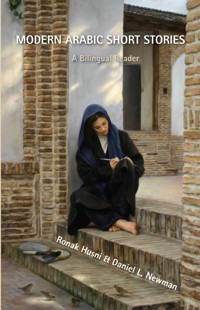
The stories collected here are by leading authors of the short story form in the Middle East today. In addition to works by writers already wellknown in the West, such as Idwar al-Kharrat, Fu'ad al-Takarli and Nobel Prize winner Naguib Mahfouz, the collection includes stories by key authors whose fame has hitherto been restricted to the Middle East. This bilingual reader is ideal for students of Arabic as well as lovers of literature who wish to broaden their appreciation of the work of Middle Eastern writers. The collection features stories in the original Arabic, accompanied by an English translation and a brief author biography, as well as a discussion of context and background. Each story is followed by a glossary and discussion of problematic language points.
Sie lesen das E-Book in den Legimi-Apps auf:
Seitenzahl: 263
Veröffentlichungsjahr: 2012
Das E-Book (TTS) können Sie hören im Abo „Legimi Premium” in Legimi-Apps auf:
Ähnliche


















Ronak Husni & Daniel L. Newman
MODERN ARABIC SHORT STORIES
A Bilingual Reader
SAQI
eISBN: 978-0-86356-886-2
First published 2008 by Saqi Books
This eBook edition published 2012
Copyright © Ronak Husni & Daniel L. Newman, 2008 and 2012
All rights reserved. No part of this book may be reproduced or transmitted in any form or by any means, electronic or mechanical, including photocopying, recording or by any information storage and retrieval system, without permission in writing from the publisher.
This book is sold subject to the condition that it shall not, by way of trade or otherwise, be lent, re-sold, hired out, or otherwise circulated without the publisher’s prior consent in any form of binding or cover other than that in which it is published and without a similar condition including this condition being imposed on the subsequent purchaser.
A full cip record for this book is available from the British Library
A full cip record for this book is available from the Library of Congress
SAQI
26 Westbourne Grove, London W2 5RH
www.saqibooks.com
Contents
Introduction
Note on Transliteration
Abbreviations
‘Izz al-Dīn al-Madanī
The Tale of the Lamp
Zakariyyā Tāmir
A Lonely Woman
Muḥammad al-Zafzāf
The Sacred Tree
Ibrāhīm al-Faqīh
Excerpt from The Book of The Dead
Najīb Maḥfūẓ
Qismati and Nasibi
Ḥanān al-Shaykh
Yasmine’s Picture
Muḥammad Shukrī
The Night and the Sea
Idwār al-Kharrāṭ
At the Theatre
Salwā Bakr
Ancestral Hair
Fu’ād al-Takarlī
A Hidden Treasure
Laylā al-‘Uthmān
Night of Torment
Yūsuf Idrīs
A Tray from Heaven
Bibliography
Introduction
The short story (qiṣṣa, uqṣūṣa) is a particularly vibrant genre in contemporary Arabic literature, and almost all major authors have at one point or another in their careers ventured into this field. The present collection provides the reader with a taste of the prowess of the masters of the modern Arabic short story. All except Najīb Maḥfūẓ, Yūsuf Idrīs, Muḥammad Shukrī and Muḥammad al-Zafzāf are active to date.
Naturally, when putting together a reader of this type, it is not always easy to decide whom to include and exclude. The selection process involved many an hour vividly discussing the multitude of stories from which we had to choose. At the same time, we did not focus exclusively on an author’s most recent work; instead, we chose to include those stories that were most appropriate for the reader, and which had not been translated.
All too often, works of this kind, though claiming to represent Arabic literature in general, are decidedly “Eastern-centred” inasmuch as the focus is on Middle Eastern authors. As one of the aims of the present book is to provide readers with a sample of the best in modern Arabic short stories, we wanted to make sure that all areas of the Arab world would be represented, from Morocco to Iraq and the Gulf. Similarly, we also aimed to include both male and female authors, without, however, falling prey to “political correctness”; rather, the objective was to provide as complete a picture of the modern Arabic short story landscape as possible.
The potential readership for this book is varied. Though the primary target audience consists of students of Arabic, the fact that each story is accompanied by an English translation makes the book accessible to all those interested in contemporary Arab fiction but who lack the language skills to read the stories in the original. There are ample notes following each story in which relevant language and cultural points are discussed, making this reader eminently suitable for both home and classroom use. The stories in the book can be used in core language classes as well as in a Modern Arabic Literature course at all levels. Although some of the texts may be too challenging for novices, they will provide good practice for more advanced students. We have taken this into account by arranging the texts in order of difficulty, the easier ones first. The added advantage to this graduated approach is that it enables students to chart their own progress and proficiency.
Anyone dealing with Arabic texts has to confront the issue of language variety in view of the diglossic nature of the language, i.e. the fact that there are competing varieties, linked to register, many of which are mutually unintelligible. As this is neither the place nor the occasion to enter into a disquisition on this controversial topic, suffice it to say that we have decided to include only stories written in the normative (supranational) variety, known as Modern Standard Arabic (MSA), or fuṣḥā. At the same time it is, of course, impossible to exclude the colloquial (‘āmmiyya, dārija) altogether, since no Arabic speaker has MSA as his or her mother tongue, so it is only natural that in dialogue most authors render the language that is actually spoken. In those cases, the vernacular expressions are fully glossed in the notes with their equivalents in MSA. As a result, the book also offers highly interesting insights into the sociolinguistics of the colloquial and the interaction between MSA and the vernaculars, while containing interesting samples of colloquial expressions from all over the Arabic-speaking world.
All words in the language notes – including the titles of the books mentioned – are fully vowelled, whereas the conjugation vowels of the imperfect tense of form I verbs are added in brackets, e.g. (u). If there is more than one possibility, both are given, e.g. (i, u). So-called diptote forms are marked by a ḍamma, e.g. . In all other cases, declension vowels are omitted, as is the “nunation” – the regular indefinite inflectional noun endings – except for the accusative singular in certain words, e.g. , but (rather than ).
As texts and translation appear together, the language notes are, quite naturally, much shorter than they would have been had we opted for a traditional reader with only the original texts. Here, too, we have been led by a commonsensical and pragmatic approach, in that we have excluded comments on language points that the learner can easily find in standard translating dictionaries. Indeed, there is little point in simply repeating the translations that appear opposite the text! Notes were added for unusual meanings and/or cultural or intertextual references that were thought to be unfamiliar to our target readership. In this, we have been guided by our extensive joint teaching experience. At the same time we are fully aware that this process is to some extent subjective, and the results open to debate.
As far as the translations are concerned, we have taken into account the fact that the reader will primarily be used as a teaching and learning resource; as a result, an attempt was made to provide both an idiomatic translation and a crib for the student. All the translations are ours, except for the Qur’ān translations in the notes, which are those of M. Pickthall (1996).
The original texts appear in the way they do in the original publications, i.e. without any post-editing on our part, which includes, for instance, the often inconsistent vowel and declension markings.
Each story is preceded by a brief biography of the author, his or her key works and a brief background to the story.
Finally, we should like to thank the authors and others who have kindly granted permission to include the stories in the book. We are especially indebted to Salwā Bakr, Idwār al-Kharrāṭ, Fu’ād al-Takarlī, Zakariyyā Tāmir and Laylā al-‘Uthmān, who offered very useful advice on a number of issues and also provided us with biographical details.
Ronak Husni & Daniel L. Newman
Note on Transliteration
The transcription does not reflect the regressive assimilation of the lateral in the definite article al with the so-called “sun letters” (t, th, d, r, z, s, sh, ṣ, ṭ, ḍ, ẓ, n), e.g. al-Ṣaḥrā’ rather than aṣ-Ṣaḥrā’.
In line with common usage, hamza is not transcribed in word-initial positions, whereas the “nunation” (see the Introduction, above) is dropped throughout.
In the narratives of the short stories themselves, proper nouns and technical terms appear in their “recognized” – i.e. “broad” – transliteration forms in order to minimize “exoticness” in the narrative.
Abbreviations
CA
Classical Arabic
coll.
collective noun
dial.
dialectal
ECA
Egyptian Colloquial Arabic
ICA
Iraqi Colloquial Arabic
fem.
feminine
Fr.
French
It.
Italian
LCA
Lebanese Colloquial Arabic
masc.
masculine
MCA
Moroccan Colloquial Arabic
MSA
Modern Standard Arabic
pl.
plural
pron.
pronoun
sg.
singular
SCA
Syrian Colloquial Arabic
‘Izz al-Dīn al-Madanī
Born in Tunis in 1938, al-Madanī is one of Tunisia’s leading literary figures, and has been active in many different genres; his oeuvre includes novels, short stories, literary criticism and theory (see, for instance, his seminal essay , “Experimental Literature”) and plays. He has been particularly prolific as a playwright, and one may cite, for instance, (The Revolt of the Zanj, 1983), set against the backdrop of the black slave revolt in ninth-century Baghdad; (Carthage); (The Ḥafṣid Sultan), about one of Tunisia’s mediaeval dynasties; (Al-Ḥallāj’s Journey), about the famous Persian-born mystic theologian al-Ḥallāj (857–922); and (On The Overflowing Sea). He has also published a number of short story collections, the most famous of which are (Tales of Our Time, 1982), (Legends, 1968) and (The Aggression).
In addition to having been a special advisor to Tunisia’s minister of culture, al-Madanī has also been editor-in-chief of a number of Tunisian dailies and magazines. In 2006, he was awarded the Theatre prize for his entire dramatic oeuvre at the Doha (Qatar) Cultural Festival.
Al-Madanī frequently uses Arab history, folklore and classical Arabic literary genres as a spectrum through which he addresses contemporary issues such as governance and power. One such example is the story presented here, (“The Tale of the Lamp”), which appears in the above-mentioned collection . The story contains all the author’s hallmarks inasmuch as it is an allegorical tale inspired by classical literature and loaded with intertextual references revealing al-Madanī’s wide reading. At the same time, the language used is sparse and formal, devoid of the embellishments one would normally associate with the genre. In spite of its setting, the events depicted in the story clearly have an underlying link with issues bedevilling present-day society.
The Tale of the Lamp
.
“I found myself in Baghdad, yearning for the azad date …” They claimed – and God knows it was true – that it was a year of drought and famine (may God preserve us all!), which had struck like lightning in one of the ancient capital cities of the Maghrib such as Qayrawan, Fès, Sijilmasa, Gafsa or Mahdia.
Food had run out, and people went into the desert to look for cacti and grass to assuage their hunger. After their hopes had been dashed, they preferred death over life. May God preserve us from oppression, evil and hunger! The drought lasted for seven years until the camels knelt down, too weak even to carry the humps on their backs. God is kind to the Believers! The people always remembered the horrors of these dark years, which became a milestone in their history from which they counted events and feasts.
Once upon a time, there was a man who lived in one of these ancient cities. He was extremely clever. Living in a time of plenty and opulence, he believed that contentment was an everlasting treasure. The story goes that during the day this man repaired sandals in a nice shop located next to the Abu ‘l-Inaya school, although some people claimed it was next to the shrine of al-Sayyid al-Sahib. Still others said that the man’s shop was close to the black-roofed gallery that had been built by the caliph Isma’il al-Mansur al-Shi‘i. At night, our protagonist would busy himself with his family – his women, sons and daughters. His and other people’s lives were filled with such contentment that not even a cloud on a summer’s day could spoil it. However, when he was struck by catastrophe, and had to face crises from all sides, his heart and mind deserted him, and when he saw the camels kneel out of sheer weakness, his deep-rooted belief in contentment being an everlasting treasure vanished. His conviction wavered and then faded away. There was nothing left for him to hold onto! He flew into a wild rage, but to no avail.
He said: “I’ve got to get food for my family. I just have to, even if it means going out stealing or killing!”
So, early one morning he left his house, armed with a knife. He walked close to the houses, looking around intently. The only thing he saw were the bodies of starving people piled up along the street, hordes of flies hovering around them. The red-hot sun beat down from a clear blue sky, while a scorching wind was blowing hard. What a horrendous sight! Look at this miserable humanity! The poor man cried and wept. Was there any point to any of this? None!
So what was he going to take back home? Wax? Was he going to turn wax into food for the children? Were they supposed to chew on it until it melted in their mouths? Damn this age of injustice!
The man threw the wax into the house, and the mouths caught it. Then he returned to his shop, took a large sack and filled it with everything he owned: sewing needle, thread, some nails, a hammer, knife and the lamp that hung from the ceiling. He locked the door to the shop, secured it and said to himself: “Let me get out of this place and explore the wide world.” As the poet says:
Alexandria is my home
If that is where I am.
The man left his native land and everyone in it and embarked upon his journey, travelling day and night, week after week, month after month, not knowing what he would come across. He crossed deserts, wastelands and oases, encountering neither flowers nor animals. Then, he disappeared … However, according to some storytellers, the man saw the walls of the city of Ghadamis appear before him, while others say that he continued on the Golden Road. The storyteller Abu Shu’ayyib Muhammad Bin Sulayman was certain that the man died of hunger and thirst in the Great Desert. However, Sahib al-Tayr Abu al-Barakat asserted that the man was observed by the pigeons of the city of Timbuktu in front of its walls. Whatever the case may be, let us assume that the man continued his journey, despite severe hunger, thirst and fatigue, since we do not want our story to end here …
It was only with great difficulty that, on a crystal-clear night, the traveller reached the walls of a city made of red clay which had suddenly appeared in the bleak desert, much to his surprise. Excited, but perhaps also fearful, he knocked on the gate. A guard appeared, who said: “Welcome to the city of Timbuktu. You are among brothers.”
This allayed the man’s fears; he regarded this welcome as auspicious. He asked the guard for some water – for water means salvation – to wet his parched mouth. The guard said:
“Drink! However, one of the conditions of entry into the city is that you spend the night outside its walls. On the morrow, you may enter, provided you have a gift for our ruler, the Sultan.”
Then the guard disappeared, and the man remained alone all night. He wondered what he was going to do about this gift for the Sultan, since he had nothing in his bag that he could give. What could he do? Damn this age of injustice!
When the voice of the muezzin calling the faithful to the dawn prayer resounded, the guard came out of the gate and hurried to rouse the man, who was purposefully very slow in waking up. The guard took him first to the mosque, where the traveller performed his ablutions, which he also stretched out for a very long time. Then, he prayed, taking his time with the genuflections and prostrations and stalling his prayers. His heart was throbbing like mad, the pulses reverberating like a drum.
The guard offered him some dates and milk. After having eaten, the man was finally led to the palace. He felt as though he were a prisoner of this kindness and courtesy, this merciless hospitality.
What would he give to the Sultan? The hammer? He would use it to smash his head in! The knife? He would slaughter him with it! The sewing needle? He would use it to sew his eyelids and lips! The thread? He would use it to truss him, saying: “You dog! You dare present me with wretched thread after we have treated you as our guest, honoured you and elevated you above ourselves! You dog!”
To which the traveller would retort: “May God protect me from the Devil!”
Finally the man found himself in front of the Sultan, who was surrounded by his retinue of servants. The Sultan rose from his throne and descended the dais to welcome his guest, saying: “Greetings. Welcome in our midst, esteemed guest.” The Sultan then embraced his guest and kissed him, as though he was greeting a dear friend he had not seen in a long time. He bade the man sit next to him on the throne. The man continued to clutch his bag close to his chest, whereas the Sultan did not take his eyes off it. Suddenly, the ruler asked:
“Is that our present you’ve got in that bag of yours?”
All the members of the Sultan’s entourage fell silent, agog in anticipation to see the wonderful gift for the Sultan.
The man mumbled: “Yes, my lord, this is your gift in the bag.”
The Sultan shrieked with joy, while the man imagined his head on the chopping block. He put his hand into the bag, and hit upon the lamp. He took it out and gave it to the Sultan, who looked at it in wonder:
“What’s this?”
The man said: “It’s a lamp.”
The Sultan was speechless, while everyone in his entourage craned their necks to get a better look at the object. Then the Sultan said: “A lamp?”
“Yes, my lord – a lamp made out of copper.”
“What does ‘lamp’ mean?” enquired the Sultan.
The man replied: “It is a device made of copper, with a wick and a little bit of oil.”
The Sultan asked: “What does it do?”
“It gives light.”
With increasing amazement, the Sultan asked: “It gives light just like the sun or the moon?”
“It lights up the world when the sun has disappeared and it is cloaked in darkness.”
The Sultan was quite taken aback. “So, this is a piece of live coal from the sun?”
The man replied: “If you wish, my lord.”
As the Sultan gazed at the lamp, turning it every which way, he said: “Does it give light at this moment?”
The man replied: “No, it’s not giving off any light at the moment, my lord. Let me light it.”
With a magical movement the man ignited the lamp, and light suddenly began to spread throughout the hall, leaving the Sultan quivering, almost fainting with joy and glee. The members of his entourage were clapping their hands and cheering, praising God for His munificence. The Sultan took the man to his side, grabbed the lamp and proceeded towards the window looking out onto the streets of the city. Lo and behold, they were thronged with people eager to know about the Sultan’s gift. Then, the Sultan cried out:
“This is the lamp!”
The crowd cheered, their eyes glued to the lamp:
“Long live the lamp! Long live the Sultan! Long live the lamp! Long live the Sultan!”
The Sultan then kissed his guest and said to him: “We didn’t know about the lamp, and thanks to you, our esteemed guest, we’ve learned something that we didn’t know. You’ve lit up our darkness. You’ve let the sun into our world, and for this, I’ll make you a minister!”
The man said: “My lord, I am but a commoner, a God-fearing man. I enjoy peace and tranquillity and wouldn’t know how to advise a Sultan.”
However, the Sultan insisted, upon which the man said: “My lord, I implore you to relieve me from this post. I’ll be a faithful servant and devoted friend.”
The Sultan exclaimed: “Outstanding! Bravo!”
Then the Sultan ordered the Treasurer to come to him. When he arrived, the three of them went to the Treasury.
The Sultan said to the traveller: “Take what you like from these worldly goods and improve your situation with it!”
The man grabbed as much jewellery, pearls, diamonds and other precious stones like coral as his bag could take. Then the Sultan bade the Marriage Judge of the city of Timbuktu to come to him immediately. When he arrived, the Sultan said to him:
“I am going to wed this man to my daughter Zubeida. I want you to write the marriage contract, and be quick about it!”
The Sultan then dressed the traveller in a gold-embroidered silk robe of honour and guided his guest to the princess in the presence of the courtiers. When the man saw his bride-to-be, he thought she was the most beautiful girl his eyes had ever beheld. She brought to mind the words of the ancient poet:
My night, this bride is one of the Zanj
Adorned with pearl necklaces.
The Marriage Judge said: “Forsooth, I’ve never seen anyone as beautiful as Zubeida, nor anyone as tender, fragrant, slender or more delicate. She is like musk and amber, silk and velvet, like a flower and jasmine. It is time to draw up the marriage contract!”
The man made thousands of lamps for the Sultan, his courtiers and all the people. He hung them everywhere: in the palace, the mosques, the schools, streets, squares and houses. He employed one thousand black men to light the lamps until the entire city and its inhabitants bathed in light night and day. As for our traveller, he enjoyed a life of comfort and happiness for many years, though only God knows for how long, until… yes, until he began to yearn for his native land, and to see his children and people again. He realized that the lean years must have ended by now, and that the fat years must have started, bringing with them prosperity and blessings. Yet, who knows? He asked the Sultan for permission to travel to his native land. The Sultan agreed, and the traveller began to prepare a caravan of camels, horses, donkeys and mules carrying rugs from Kairouan, mastic from the Yemen, teak from Niger, amber from the Sudan, ivory from Ghana, and other fineries.
And so the traveller left the bright lights of Timbuktu for his native land, under the protection of God the Almighty. As soon as he and his caravan arrived in his native city, people began crowding around him to grab his possessions; soon fights erupted over them, and they even began to kill each other. The mob attacked the camels, the horses, mules and donkeys with knives and ate them all. The traveller enquired what was happening, and was told: “The people in the city haven’t had anything to eat for about twenty years.”
He remembered his famous saying and former indignation, and said: “Damn this age of injustice!”
There was another man there, sitting motionless, observing the dreadful spectacle. Then he looked at the traveller. His eyes alternated between the terrible scene and the traveller, who was still sitting on his camel and staring at the humanity milling around like a swarm of locusts. Finally, the man got up and greeted the traveller. He said:
“I know you. You used to work as a cobbler, and your shop was next to the shrine of Moulay Muhammad al-Dakhil. My shop was opposite yours. I used to repair sandals. My shop used to be next to the shrine of Moulay Muhammad al-Kharij. You must remember me by now. Tell me, honestly, how did you manage to acquire such wealth? What have you been doing? Tell me, since we work in the same trade. I was your neighbour in the souk, and your companion on the day you started in the profession. Which country did you travel to in order to collect all these fine things? Tell me, for I am keen on bread and meat, silk, women, gold, tranquillity and sweet dreams. Save me from the pain and misery of this age of injustice!”
The traveller replied: “Leave this land, my friend, and follow the road until its end. There, you will find a city, and one of the conditions for entering it is that you offer a gift – any gift – to its Sultan. And the strange thing is that they reward you for it, too! As you can see, it is quite simple.”
So the other man left his country in search of the good life, meat, silk, women, gold, tranquillity and sweet dreams. He travelled until the end of the road and crossed the desert until, one clear night, he arrived at a city made of red clay, like Marakkech or Tozeur, which had suddenly sprung up in the middle of the desert.
He knocked on the gate, after which a guard came out and greeted him in the most splendid fashion. The following morning, the guard woke him up and said: “Do you have a gift for our lord the Sultan?”
The man immediately answered: “Yes, I’ve got a gift in this bag.”
The man quickly went through his ablutions and prayers and hastened to the palace, hurrying in to meet the Sultan and his entourage. He quickly prostrated himself and kissed the ground before the Sultan. When he raised his eyes he saw that the Sultan was barefoot, as were all the courtiers, including the guard who had brought him in. He rose from the ground, slipped his hand into the bag, and took out one of the most beautiful and best sandals that had ever been made in the city of Fès since its foundation.
Surprised, the Sultan asked him: “What’s this?”
“This sandal is a gift for you my lord.”
The Sultan asked: “What’s it for?”
The man answered: “It is to be worn as follows.”
Thereupon the man took a few steps in the sandals. The Sultan was extremely pleased with this, and the courtiers all applauded.
They called out:
“Long live the sandal! Long live the Sultan! Long live the sandal! Long live the Sultan!”
The Sultan then went up to the man and said: “This is a most wonderful present you’ve given me, and it merits the greatest reward!”
The Sultan then ordered the Treasurer to come, and when he arrived, the Sultan told him: “Return whence you came.”
The courtiers were surprised at this.
The Sultan said: “This man deserves a better reward than mere filthy lucre.”
He turned to the man, and said: “Esteemed guest, please raise your eyes towards the ceiling.”
The man lifted his head.
The Sultan asked him: “What do you see?”
The man replied: “I see a lamp.”
“Behold the reward for your gift!”
.
.
.
Language Notes
1. extract from the opening line of the so-called composed by the Persian-born Fāris al-Hamadhānī (968–1008), who is credited with the invention of the genre (lit. “standing”, but usually translated as “session” or “assembly”), which consists of social vignettes recounted in razor-sharp, eloquent rhyming prose The are also a cornucopia of rare and archaic words. The genre was further developed by Abū Muḥammad al-Qāsim Ibn al-Ḥarīrī (1054–1122).
2. also known as (“the white lily”), it is a type of date known for its exquisite taste.
3. the usual meaning of this term is “Excuse me!” or “Don’t mention it!” (in response to “Thank you”). However, it can also mean “of one’s own accord”, or “spontaneously” (cf. “spontaneous” and “spontaneity”).
4. this formula, which literally translates as “God knows best” or “(Only) God knows”, is traditionally used to express doubt regarding the veracity of a statement.
5. in this example of lexical repetition all three words denote “drought”, with having the additional connotation of “dearth”, or even “famine”.
6. lit. “May God spare us”; it is used when someone is faced with a particularly dire prospect.
7. the modern word for “capital (city)”, but used in the past for any major urban centre.
8. this term, which currently refers to “Morocco”, used to denote the Islamic lands in the west ( “the place where the sun sets”). Note that in English, “Maghrib” tends to be synonymous with “North Africa” (i.e. Morocco, Tunisia, Algeria and Libya).
9. a town (and governorate capital) in central Tunisia, approximately 150 km from Tunis. An old centre of Islamic learning, Kairouan is the site of the first mosque in northern Africa (or ), and was the first Islamic capital of the region (and a base for military expeditions).
10. the traditional capital of northern Morocco, Fès (or Fez) boasts the oldest university in Morocco, dating back to the mid-ninth century and the famous mosque. Between the twelfth and fifteenth centuries, Fès was the undisputed political, economic and intellectual centre of the entire region. The town also achieved great fame as a religious centre.
11. the ancient capital of the district, situated some 300 km from Fès, it acted as the gateway to the desert and was also the centre for a number of Moroccan dynasties. Today, only ruins remain of this most evocative of sites.
12. a town in Tunisia some 350 km southwest of Tunis. Its name is derived from the Arabicized form of Capsa, which was the name of the Roman settlement on that site. After playing a considerable part in the country’s history, (even including a short independent spell in the eleventh and twelfth centuries), Gafsa (its current Latinized form reflecting the local pronunciation of as /g/) dwindled into oblivion.
13. a Tunisian town and provincial capital (named after its founder, d. 934 AD), located on the coast some 200 km south of Tunis.
14. “cactus”, “Indian fig” (or “tamarind”). However, there is also a possible play on the homographic meaning “(smooth) stones” in Classical Arabic.
15. (coll.), which, in addition to “herbs” or “grass”, also denotes “hemp” (cannabis).
16. lit. “May God preserve us and you (from imminent evil).”
17. this is a reference to the fixed expression (“contentment is an everlasting treasure”), which is attributed to ‘Alī Ibn Abī Ṭālib (d. 661), the Prophet’s cousin and son-in-law, who was also the fourth caliph in Islam.
18. originally denoted “sole”.
19. this Fès-based school was founded in the fourteenth century.
20. “to report, narrate”). Also related are (“novel”) and (“novelist”).
21. lit. “corner” (of a building) originally meant the cell of a Christian monk (also ). In Islam, it refers to a small mosque (which in many cases houses a saint’s tomb), prayer room or (especially in the Maghrib) a building for members of a brotherhood
22. originally the roofed portion of a street.
23. this is the feminine form of (“black”, especially referring to eyeṣ, with the plural form being homonymous with “antimony”; “kohl” (pl. ).
24. this was the traditional title of caliphs in Islamic history.
25. Mawlāy Ismā‘īl b. al-Sharīf Abū ‘l-Naṣr, the second sultan of the Alawid dynasty, who reigned for fifty-five years, between 1672 and 1727.
26. this is a Qur’ānic phrase: (“Return unto thy Lord, content in His good pleasure”; 83:23, ).
27.




