


6,99 €
Mehr erfahren.
- Herausgeber: Parkstone International
- Kategorie: Geisteswissenschaft
- Sprache: Englisch
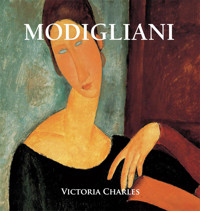
Modigliani (1884-1920) was a painter of great unhappiness in his native Italy and felt only sorrow in his adopted country of France. Out of this discontent came forth Modigliani’s original work, which was influenced by African art, the Cubists, and drunken nights in Montparnasse. His portrayal of women—sensual bodies, almost aggressive nudity, and mysterious faces—expresses their suffering and feelings of being unloved and unjustly disregarded. Modigliani died at the age of 36.
Das E-Book können Sie in Legimi-Apps oder einer beliebigen App lesen, die das folgende Format unterstützen:
Seitenzahl: 40
Veröffentlichungsjahr: 2013
Ähnliche
Author: Victoria Charles
© Confidential Concepts, worldwide, USA
© Parkstone Press International, New York, USA
ISBN 978-1-78160-600-1
All rights reserved. No part of this may be reproduced or adapted without the permission of the copyright holder, throughout the world.
Victoria Charles
TABLE OF CONTENT
From Tradition to Modernism A Reinterpretation of Classical Works
Discovery of New Art Forms
The Nudes and Moral Values
An Unconscious Liberation
The Art of “Close-Up”
Emotional Involvement A Depersonalizing Process
An Aesthetic Quest
Conclusion
Biography
LIST OF ILLUSTRATIONS
1.Self-Portrait, 1919.
Oil on canvas, 100 x 65 cm. Museu de Arte
Contemporanea da Universidade de San Paulo, Brazil.
Amedeo Modigliani was born in Italy in 1884 and died in Paris at the age of thirty-five. He was Jewish, with a French mother and Italian father, and so grew up amidst three cultures. A passionate and charming man who had numerous lovers, his unique vision was nurtured by his appreciation of his Italian and classical artistic heritage, his understanding of French style and sensibility, in particular the rich artistic atmosphere of Paris at the turn of the 20th century, and his intellectual awareness inspired by Jewish tradition.
Unlike other avant-garde artists, Modigliani painted mainly portraits–typically unrealistically elongated with a melancholic air–and nudes, which exhibit a graceful beauty and strange eroticism.
In 1906, Modigliani moved to Paris, the centre of artistic innovation and the international art market. He frequented the cafes and galleries of Montmartre and Montparnasse, where many different groups of artists congregated. He soon became friends with the post-impressionist painter (and alcoholic) Maurice Utrillo (1883–1955) and the German painter Ludwig Meidner (1844–1966), who described Modigliani as the“last, true bohemian”(Doris Krystof,Modigliani).
Modigliani’s mother sent him what money she could afford, but he was desperately poor and had to change lodgings frequently, sometimes abandoning his work when he had to run away without paying the rent. Fernande Olivier, the first girlfriend in Paris of Pablo Picasso (1881–1973), describes one of Modigliani’s rooms in her bookPicasso and his Friends(1933):“A stand on four feet in one corner of the room. A small and rusty stove on top of which was a yellow terracotta bowl that was used for washing in; close by lay a towel and a piece of soap on a white wooden table. In another corner, a small and dingy box-chest painted black was used as an uncomfortable sofa. A straw-seated chair, easels, canvases of all sizes, tubes of colour spilt on the floor, brushes, containers for turpentine, a bowl for nitric acid (used for etchings), and no curtains.”
Modigliani was a well-known figure at the Bateau-Lavoir, the celebrated building where many artists, including Picasso, had their studios. It was probably given its name by the bohemian writer and friend of both Modigliani and Picasso, Max Jacob (1876–1944).
2.Landscape in the Midi, 1919.
Oil on canvas, 60 x 45 cm.
Private collection.
3.Tree and Houses, 1919.
Oil on canvas, 57 x 45 cm.
Private collection.
While at the Bateau-Lavoir, Picasso paintedLes Demoiselles d’Avignon(1907), the radical depiction of a group of prostitutes that heralded the start of Cubism.
Other Bateau-Lavoir painters, such as Georges Braque (1882–1963), Jean Metzinger (1883–1956), Marie Laurencin (1885–1956), Louis Marcoussis (1883–1941), and the sculptors Juan Gris (1887–1927), Jacques Lipchitz (1891–1973) and Henri Laurens (1885–1954) were also at the forefront of Cubism.
The vivid colours and free style of Fauvism had just become popular and Modigliani knew the Bateau-Lavoir Fauves, including AndréDerain (1880–1954) and Maurice de Vlaminck (1876–1958), as well as the Expressionist sculptor Manolo (Manuel Martinez Hugué; 1876–1945), and Chaim Soutine (1893–1943), Moïse Kisling (1891–1953), and Marc Chagall (1887–1985). Modigliani painted portraits of many of these artists.
Max Jacob and other writers were drawn to this community. These included the poet and art critic (and lover of Marie Laurencin) Guillaume Apollinaire (1880–1918), the Surrealist Alfred Jarry (1873–1907), the writer, philosopher and photographer Jean Cocteau (1889–1963), with whom Modigliani had a mixed relationship, and AndréSalmon (1881–1969), who went on to write a dramatized novel based on Modigliani’s unconventional life. The American writer and art collector Gertrude Stein (1874–1946) and her brother Leo were also regular visitors.
Modigliani was known as“Modi”to his friends, no doubt a pun onpeintre maudit




