


Erhalten Sie Zugang zu diesem und mehr als 300000 Büchern ab EUR 5,99 monatlich.
- Herausgeber: Books on Demand
- Kategorie: Sachliteratur, Reportagen, Biografien
- Sprache: Englisch
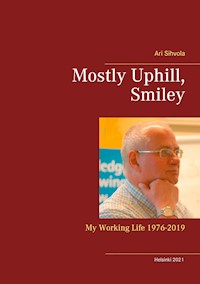
Ari Sihvola (born 1951) began his career at the Finnish Ministry for Foreign Affairs as a young civil servant in the 1970s. Over the years, Ari has played a key role in the development of public governance and the development of the skills of civil servants, especially in EU affairs and leadership. In addition to Finland and the European Commission, Ari's expertise has been brought to bear in many demanding international projects in four continents. Known for his anecdotes and colourful true stories, Ari looks at governance with an analytically critical yet gentle, understanding approach. As a teenager, Ari did not think of working, as an adult, for the Foreign Ministry or becoming a manager of international development projects. The desire to grow guided his choices. Ari believes that we have a desire to constantly improve ourselves and our skills. "An impressive tale, nicely written. Sihvola's personality shines through." - Willian Peskett
Sie lesen das E-Book in den Legimi-Apps auf:
Seitenzahl: 327
Veröffentlichungsjahr: 2021
Das E-Book (TTS) können Sie hören im Abo „Legimi Premium” in Legimi-Apps auf:
Ähnliche


















CONTENT
INTRODUCTION
1
FAREWELL TO YLIOPISTONKATU
2
HOW TO VIEW MY CAREER
3
WHERE THE STORY BEGINS
4
DAILY BLUES IN THE FOREIGN MINISTRY
5
AT THE HEART OF MFA'S RECRUITMENT POLICY
6
WHAT WAS THE FOREIGN SERVICE LIKE IN THE 1970s AND 1980s
7
WHAT I LEARNED AND ACHIEVED AT MFA
8
AND SO, I LEFT THE FOREIGN MINISTRY
9
GO WEST - FROM THE SHADOWS OF MOSCOW TO THE LIGHTS OF BRUSSELS
10
STUDYING GOVERNANCE AND LIFE IN EUROPE
11
WE LIVED IN A “LIPPONIAN TIME”
12
I JOINED THE EUROPEAN COMMISSION
13
WORK AND RELATIONSHIPS
14
BALANCE SHEET OF MY YEARS IN BRUSSELS BALANCE
15
FOCUS ON THE WORLD
16
AFTER THE WAR, HELPING KOSOVO
17
FIGHT AGAINST CORRUPTION IN ROMANIA
18
THE CHINESE ”LONG MARCH” TO LEARNING
19
TOWARDS THE SUNSET
20
THE GOOD LIFE
NAME INDEX
INTRODUCTION
As my transition from work to retirement inevitably approached, I began to consider making an intellectual testament of my career. I had served the working life 43 years and was about to retire to man’s “troisième âge” as fully-served at the age of 68. I thought I should tell my children and grandchildren what “our father” and “muffa” had done at work all those years. That is, after all, what children ask their parents and grandparents. Likewise, I figured that there were people in public administration, for whom the years which this book covers were just as much an important generation experience as they were for me. I considered it my duty to pass on the institutional memory of my own generation to future generations.
I started writing in the autumn of 2019. I wrote a couple of pages at a time, usually during the quiet hours of the evening and night. Sometimes I did other work I had started to accumulate as a pensioner. Then I went back to my computer. Getting started was tricky every time, but when I caught up on the plot again, I forgot the passage of time. All the years of greatness and fields of glory came back to my mind as living memories. Memories were transferred to paper. They began to take shape in the written form of my working life, the story of Ari’s work.
When I finished the draft text in the winter of 2020, I turned to colleagues and friends. I wanted to get their opinion of my story. I express my thanks to Eero Vuohula, Nina Laakso, Juha Rumpunen, Ari Holopainen, Eveliina Salonen, Eero Koskenniemi and Liisa Peura for their valuable comments. My special thanks go to Sampo Sihvola, who also read the manuscript and commented on it. I finished the Finnish text during the Covid-19 pandemic in the spring of 2020. The English version I completed one year later, when the pandemic was still among us. I am grateful to William Peskett, an author, poet, and editor from Northern Ireland, for his valuable comments on the English text. It goes without saying that I take all the responsibility for the contents of the book.
Finally, I want to say that even though I speak about events related to the Finnish Foreign Ministry, the European Commission and the HAUS Finnish Institute of Public Management, these memoirs are not the history of those organisations, but my history. I was only one of the actors on the stage of the administrative play. The ideas I put forward here are my thoughts, not the opinions of the institutions.
Helsinki, May 2021Ari Sihvola
1
FAREWELL TO YLIOPISTONKATU
My long career at the HAUS Finnish Institute of Public Management ended on the last of March 2019. The next day I became a pensioner. However, my farewell party took place a month later, on the eve of Labour Day. I had said in the workplace that I did not want the traditional managing director’s “talk that talk”, nor fundraising by the staff, but everything else was negotiable. However, my wish did not fully come true. Our new managing director Kyösti Väkeväinen (who started in February 2019) delivered a short speech: “Thank you, Ari,” and gave me two gift cards, one from the management and the other from the staff.
HAUS communications manager Janina Himberg and I had together planned a slightly different farewell ceremony from the standard one in HAUS. I wanted to leave a legacy of all the 22 years that I had worked for the company, the homeland, good governance, and human growth. I had seen and experienced great success, swallowed the bitter lime of losses, always getting back to my feet. I was, indeed, amazed that I was the first HAUS staff member to retire at the full age of 68.
Together with Janina, I combined my message with suitable melodies of popular music. Most of my colleagues were present at the ceremony. It was overshadowed by the fact that HAUS had just started co-operation negotiations with the staff to revive the company’s economy. The previous year had been tough, the traces of which were visible in people’s faces and could be heard in their talk. The farewell ceremony, however, gave people a welcome break from gloomy thoughts.
We stood in a large circle in the beautiful HAUS lobby. Then we started marching around like geese to the rhythm of Peter, Paul & Mary’s song “Weave Me the Sunshine”. The song encourages you to forget your grief and believe in the sunshine. After one verse we stopped, and I presented my own thoughts on times past.
First, I said that one of the key HAUS tasks was still the development of learning methods. I remembered the early years of my working career, when all we training managers in the Finnish public administration studied cognitive learning theory under Professor Yrjö Engeström’s guidance at HAUS. Behaviourist learning technology was, indeed, our bad guy. The initial cell, constructive conflict and orientation basis were our mantras. It is difficult for me to accept the current digital learning method because it emphasises the importance of technology. Nevertheless, I had not wanted to start criticising the ideology of digital learning. I lacked a basic knowledge of the intricacies of the new method. However, I said I hoped that those HAUS people who were now eagerly speaking in favour of digital learning would accept different, critical views of future generations against the mainstream view. Otherwise, today’s radicals will be tomorrow’s conservatives, putting on the brakes for development.
Then again, we marched in a ring with Peter, Paul & Mary singing “Weave me the Sunshine”.
Secondly, I presented my views on the management of HAUS major changes of the past year. Somewhat sarcastically, I said I was glad the responsible leader left and that he left so quickly. I also said that HAUS should never have signed a job contract with him. Such great turmoil, a downright hash, he managed to create in a year. I felt it unfair that the new managing director and the staff had to clean up the mess that he had caused. The past years had taught me that – at the end of the day – the staff must always pay the bill caused by the bosses’ bad economic decisions.
Next, I said that during all those years that I had worked in HAUS I had been convinced that the staff had done their job tenaciously and kept the company going in spite of the then management policy and regardless of the financial situation. We had had a strong belief that we had done important work. The experts mastered their business and the teams worked wholeheartedly to keep the customers satisfied. The people, the colleagues, were the best thing in HAUS. We shared with each other the joys and sorrows of everyday life. We helped each other, stood together against the pressure, and resisted together the punches we got. We were happy of the good work that we had done, and the success we had received. Our level of integrity was high.
I then presented my opinion of HAUS new premises. HAUS managed to keep its headquarters in Munkkiniemi at Hollantilaisentie 11, in an old cadet school, for more than 40 years (since 1976). Then the state-owned real estate company Senate, in its greed for money, decided to sell the house. HAUS and the Customs School, operating in the same building, were forced to leave. HAUS found new premises in the city centre, in the Heimola building, next to the main campus of the University of Helsinki. The move took place in the winter of 2018.
Yliopistonkatu’s (University Street) new facilities were certainly clean, and the location was brilliant. However, we did not have enough classrooms or meeting rooms. We had to constantly rent premises from elsewhere. The scarcity of training facilities was explained not only by cost savings but also by the proliferation of digital learning. People would no longer need to be physically present, the managers argued; distance connections would suffice for them. Customers could study online independently at their own pace when it suited them. I was not very convinced of that. In my opinion, a large part of learning is based on social interaction, which is difficult to replace by technical solutions. Social interaction is particularly necessary in management and leadership coaching. In the coaching process learning new knowledge or new skills is not as important as dialogue with your colleague. Dialogue is needed to change attitudes. Basically, coaching is about listening and understanding the arguments of both parties to be able to negotiate a solution and a new policy.
In addition, we moved from Munkkiniemi’s spacious premises into a multi-purpose office landscape, where no one had a workstation of his own, let alone an office. The premises were simply overcrowded. I was haunted by this. The walls were too close, people spinning around each other’s feet all the time. We moved to a culture of silence where knowledge did not flow. My own soul remained in Munkkiniemi, even though my body moved to the city centre. I think that institutions like HAUS need a proper building, to which the director of the house is happy to invite foreign guests and where each staff member has a space to breathe and at times think about his own business.
Then we stopped the farewell goose march. We settled into a circuit, and I delivered three messages for future generations. I referred to the fact that nobody is irreplaceable. And even though I had worked 22 years in HAUS, my files would be transferred to a new owner. This is how institutions live. Clowns change, the circus remains, I said. Meanwhile, Janina and I played the Kinks song “ Death of a Clown” (Let us drink to the death of a clown!) in the background.
I cannot claim that I was the only one to create brilliant HAUS business solutions. However, I had a glimpse of hope, as we all have for sure, that a memory of me would remain in the history of HAUS. I had chosen Gilbert Bécaud’s song “Quand il est mort le Poète” (when the poet is dead) as the next background music. The lyrics are quite simple: when the poet is dead, all his friends cry. In fact, the whole world is crying. His star is buried in a cornfield, and therefore the whole cornfield is full of cornflowers. The idea here is that while the cornflower is a weed, it is also a powerful source of pollen for insects. Cornflower needs the cornfield to spread its pollen more widely. That is what I thought of myself; that I could be like a cornflower, whose ideas spread and live in time forward to the following generations.
Finally, I confessed my love to all my colleagues. Business is not only tough toil for your daily bread, but also a lot of common caring. It is hard to finish a long relationship, but time goes by and finally it is the moment of departure. To describe this feeling, I recited the verses of the song “Les feuilles mortes” (autumn leaves) written by the French poet Jacques Prévet. The last verse ends with the following words, “But life separates the lovers from each other. And the waves of the sea wash away from the beach sand the footsteps of separated lovers.” This is how I felt now about the final adieu.
2
HOW TO VIEW MY CAREER
As my career began to end, I was supported by the idea that it was necessary to write down the things that had been important to me in my own career. I would need a reasoned account of my own thoughts and actions. I feel that it is my duty to deliver a balance sheet of my working life to the following generations. I want to transmit my professional last will to my colleagues and co-workers, who feel that their own work to manage the future business is based on the achievements of their senior colleagues. It is therefore a matter of transferring the institutional memory from the sunset rider to the attention of the young heroes.
Recollection of old business always includes the personal interpretation on how things were. The autobiographer tends to emphasise the good things he did and the results he achieved; the misfortunes he would be happy to forget, even if they gave him lessons to learn. Human memory is in this sense selective. On the other hand, I have tried to be honest with myself. I have not wanted to talk just about victories and success. That is not my style. In the end, in all my subjectivity, I have tried to be objective.
My everyday duties, consisting of human resources development and organisational development, implied working with people. I wanted to mention in the book the merits of my colleagues. I did not want just to tell things in passive form. Nor did I want to describe events by using only people’s professional titles. However, the names of all the colleagues I have met throughout my career do not appear in the text. This does not mean that I would not have appreciated their contribution or importance to my own getting along. I wanted to avoid long lists of names so that the narration would remain solid and understandable. I have included in the text the people with whom I have worked for a long time on many occasions, or who have been important to me in my personal growth.
At no point in my career did I keep a diary in which I would have recorded the day’s events and moods. Keeping a journal has its own limitations too, if the writer is thinking about how to convey to future generations the interpretation of himself in his own way. However, I have a lot of notebooks in which I wrote important points of meetings, interviews, and reports for many years. I took especially many notes when I was the director of the international business at the HAUS Finnish Institute of Public Management. So much happened every day that I needed external support for my memory.
Towards the end of my career portable computers began to replace notebooks. Growing older made me convinced that I knew my profession and my main tasks and objectives well. I thought that it was enough to write up only such things that were important. Over the years, however, notes began to wane. I thought of this that I had learnt wisdom to such an extent that I trusted in myself and my own thinking. Besides, I also found that my younger colleagues were better and faster than me in all the detail. I wanted to give them a chance to show their skills and to grow in their work.
My active career lasted 43 years. I started as a summer assistant at the Finnish Postal Service, as did thousands of other young people of my age. When I graduated, I got a job at the Finnish Ministry for Foreign Affairs. My assignments there lasted 18 years. Then I moved to the HAUS Finnish Institute of Public Management, where I worked in two phases for a total of 22 years. At times, I was on the payroll of the European Commission in Brussels. Afterwards I was stunned to realise how many years of my life I sacrificed for my career. On the other hand, I think that work has been the pivotal content of my adult life. This could be a generation experience for us born after WWII: the country needed to be built. I always thought about my work with respect to the large entities: the state, society, public administration. Curious unselfishness, I admit, but that is the kind of guy I have always been. Even when sick, I dragged myself to work and never demanded from my employer anything other than decent projects and a regular salary.
I certainly have wanted to be noticed for my work performance, but I have been embarrassed if praised. The substance has been more important to me than lust for power. Truly, I have not wanted to flatter the hierarchy to get higher positions, nor have I demanded leadership. On the other hand, I have considered it important that others succeed in their work. Honour and fame should be given to those who deserve it by their actions. My mentality is to support the weaker party. Even when I watch a football match, in my mind I always support the weaker team. However, I have taken the lead when others have remained passive.
I have been criticised for not being tough enough as a leader. Critics say that soft values guide me more than the tough laws of business. It is true that I was soft on people. Throughout my career, I always tried to conciliate the contradictions arising with my team members and with customers. I tried to be more of a diplomat than a tough business manager. However, I was persistent in completing my assignments. I did not easily give up on the unfinished job.
As is customary in Finland, during my years as a boss, my management and leadership skills were assessed several times by my superiors, colleagues, and staff members. The appraisals focused on my behaviour in various management situations, such as decision-making, willingness to change, planning, teamwork, listening and development skills, as well as problem solving. This is the so-called 360-degree feedback. People gave their feedback anonymously by answering questionnaires. I got positive feedback from all the surveys. I was considered a good boss.
Although I regarded myself as a good manager, I have always been interested in substance. Whenever I was the leader in international projects, I wanted, at the same time, to perform in activities. Similarly, in domestic public administration reforms, I wanted to learn new things: how to draw up a strategy for an agency or a department, how to develop the quality of the work processes, and how to improve the work of a management team.
I did not reach the highest peak in my career. I never became managing director or director general. Therefore, this book includes no description of glamorous steps up on the career ladder to the highest cabinets of decision-making. Other colleagues had a stronger drive for competition, a bigger desire for power and a better environment for social growth. Nevertheless, my own career was unique, simply because nobody else had a similar one.
I have focused in this autobiography on my work career. Aspects of my private life have been included when they are linked to the turning points at work. My choice has been cognisant. When the date of my pension was not further away than a year, I asked the HAUS management if it would be possible for me to organise a “Studia Generalia” i.e., a series of lectures describing the different time periods of my career. The idea had revolved in my head for a long time. I found it a natural way for me to make an account of the past because, in my profession as a trainer and facilitator, I constantly appeared in front of an audience. Talking was my tool.
After receiving a positive response from the management, we started organising events with HAUS communications manager Janina Himberg at the turn of the year 2018-2019. The lecture series proved to be a success. To our delight we had a full house for all the three lectures. People listened to and gave comments on my interpretations of the past decades in the field of organisational and human resources development. Participants were officials and colleagues of all ages. Among them were experienced senior managers, who recalled their own experiences of those years. We also enjoyed the participation of young people, who reflected the importance of the delivered history as a building element for their own early careers. Similarly, we managed to get many busy mid-career people to come along. Briefly put, the air was thick with common memories and the heroic deeds of civil servants of the past decades.
The lecture series assured me that such a story could find readers. By and large, in this book I have followed the structure and contents of the series of lectures. However, a lecture is like a piece of art drawn on the sand. It is to live in the moment when it is created. Then it disappears over time, swept away by the wind. Only the engram remains in the listener’s mind. It is also characteristic of the lecture that it lives a lot in interaction with the audience. I become inspired when I notice that the audience is following along with me and participating in the session with questions and comments.
When writing memoirs, I must imagine my audience and ponder what the reader might be interested in. However, I thought that any reader would be welcome. The reader may have lived in the same era as me. He also may know the topics told in the book or he may have been personally involved in the same events that I describe. Memoirs also open the door for the reader to view the narrator’s worldview, his selfdom. Memoirs are a man’s account of his view of life.
In the early 1960s, when I was a 10-year-old schoolboy, I received a book from my parents as a birthday present called "Smiley" by Australian Moore Raymond (1904-1980). “Smiley” was published in 1945 and the Finnish version "Hymy-Pekka" two years later. The book was about a schoolboy of my age, who dreamed of getting a bike. He did a lot of work to earn the money he needed, experienced moments of happiness and disappointment. Eventually, after all the ordeal, he managed to get his very own bike. The book spoke to me. At the time, the bicycle was my dream too. I read the book probably half a dozen times. "Smiley" is still on the bookshelf of our summer cottage.
Dad took a photo of me at the age of four sitting on a rock in a forest near our home. As an adult I have often cycled through my old forest in the summertime. The same rock is still in place, though over the years the forest has acquired new outdoor trails. My story begins in the early 1950s in the Old Town of Helsinki, in the shadow of the Arabia factory.
3
WHERE THE STORY BEGINS
I was born and have lived the biggest part of my life in Helsinki. So, I am a native son of the capital: stadilainen in the Helsinki slang. I was born in March 1951. I spent my childhood and early youth in the shadow of the Arabia porcelain factory. We lived in the Old Town at the street address Hämeentie 152. Five apartment buildings had been completed on the site immediately after the Second World War. My parents had bought a 3rd floor apartment in House C. The apartment was quite small from the current point of view, only 53 m2, and it did not have a balcony. It had a living room, two bedrooms, a kitchenette, a bathroom, and a small hallway. However, the apartment could well accommodate us four – father, mother, and children. We lived there until the year 1972. Then our father bought a bigger apartment in a new suburb, Pihlajisto. In retrospect, it feels weird that he saved money for more than 20 years to get a bigger apartment, and when he had enough means to buy that Pihlajisto apartment, we children moved away in a few years.
My parents had two children: my elder sister Aila and me. As a child’s growth environment, our Old Town was ideal. Just behind our home building there was the forest-like park of Annala Manor, which was full of oak trees suitable for little boys to climb. In the forest we played, skied, cycled, and ran in summer and winter. We went home to eat and sleep. The houses at Hämeentie 152 were full of kids, so there was no shortage of playmates.
As a toddler, I had an accident when the elder kids of our house pushed me down in a sled across a snowy construction site. My left leg got stuck in some rebar and my femur broke. The neighbour’s uncle took me in his car to Aurora Children’s Hospital, where I recuperated well from the accident. Due to the trauma, my left leg remained a little shorter than the right one, which made my walking style sway.
Ari at the age of four on a rock near his home in Helsinki’s Old Town 1955. Photo: The author’s collection.
I was born into a family of officials. My father Olavi was a long-serving official at the Post and Telegraph Service. My mother Saara, on the other hand, was a tax clerk throughout her working life, first in the provincial government of Uusimaa, then in various units of the Tax Administration. I got the impression that adult work was official work. This probably influenced me to apply for the civil service myself in due course. It was only in adulthood that I learned to understand that a person could also live as an entrepreneur or in the service of a business. In fact, for the second half of my career – 22 years – I worked as a profit-responsible manager or consultant in a state-owned enterprise and company.
My understanding of adult work was reflected in how I understood the professional ethos of officials. Work was done from eight in the morning to four in the afternoon. My father always had a briefcase with him when he left for work or came home from work. He wore a neat suit, collared shirt, and tie on workdays. In all written communication, even in private matters, my father used a formal official language. We other members of the family were amused when we often saw on the dinner table documents related to our condominium drawn up by dad just as if he had been on duty in the office: “Checking the minutes of the previous meeting...” It was also important for father that his oral presentation was correct. More than once I heard him rehearse his future speeches in front of the mirror.
Although I thought I was an ordinary little boy, I had one trait that set me apart from many of my peers. I am left-handed. This difference became clear to me in elementary school when we first-graders began to learn calligraphy. At the time, in the late 1950s, pupils used pens to write. I had to use a special oblique blade on my pen. I did my best, but my handwriting never developed into decent beauty. In addition, the cuff was smearing and blotting.
Except for calligraphy, being left-handed has not caused me great trouble. Though, when I was a rookie in the army, I found it difficult to learn the dismantling and assembling of weapons, because I had to do it all on the contrary to what the trainer taught. Left and right got me confused. Similarly, at a later age it was difficult for me at official dinners to take a serving dish, as the waiter handed it to me from the left.
In 1962, I applied to move from primary school to secondary school, more specifically to the private Kallio co-educational school. That school was then unofficially called Sörkän Yliopisto (University of Sörkkä). It was not an elite school, rather the contrary; Kallio and Sörkkä (officially Sörnäinen) were districts of working-class people in Helsinki then. However, the school was an important route for the social rise of the working-class. Dad had promised to buy me a bike if I passed the entrance exam. And I passed: I was one of the last selected that year. It did not bother me, because I got my own bike. It was a red Hellberg (a popular Finnish bicycle brand at the time) and it had two gears. The bike was a part of me through the childhood. I cycled all day long from early spring, as soon as the snow had melted, to late autumn, when evenings darkened.
The first years in middle school were a time of socialisation for me. I wanted to be an ordinary pupil of the class. On cold mornings, I had to make sure – by peeking unnoticed from the stairs of Kaikukuja, the lane leading to the schoolyard – that the other classmates were wearing a beanie too. If they did, then I could have mine on. Otherwise, I had to stuff the beanie quickly into the school bag before anyone saw it.
In middle school, I developed myopia. When it was revealed at the school health check, I did not dare put glasses on at first. At the time, I thought only sissies wore glasses. My learning outcomes began to decline until I gave in, put spectacles on, and asked to be transferred to a front row desk in the classroom.
Kallio co-ed school (founded in 1902) was the first school to the north of Pitkäsilta (in English: The Long Bridge), in a district of working-class people. The leading idea of the school’s founder, Ms Hanna Castrén (1861-1943), was to provide education and learning opportunities to the children of labourer families. Besides being a route for the social rise of working-class youngsters, the Kallio co-ed school was a very human educational institution. The headmaster was then Hugo Knuutila, who was also a clergyman and a Latinist. One dimension of caring for students was the abundance of hobby or extracurricular activities. The self-expression skills of pupils were particularly encouraged by the school. Various theme evenings were organised with plays and dancing. I participated in the “Hungarian evening” programme (1967) as a dancer in the folk-dance group composed of my classmates. Our dance was such a great success that the headmaster persuaded his old friend Mr Niilo Tarvajärvi, a well-known media figure, to invite us to his popular TV show called “Welcome” (Tervetuloa in Finnish). The investment in the school hobby activities evolved finally into the core competence of the new Kallio upper secondary school of performing arts (Kallion lukio, 1985).
The last years of the middle school went satisfactorily for me and I was able to continue to upper secondary school. Thoughtless as I was, I chose the maths line because all my important classmates chose it too. However, I did not have a maths head at all, neither then nor later. Likewise, adolescence confused the young man’s head. The teenager did not know what he wanted. I repeated the class twice because I failed the exam of maths.
When I stayed in the class for the second time (1970), my mother, eventually, intervened. She wrote to headmaster Knuutila querying whether her son could switch to the humanities line because the maths was not going well. Mr Knuutila responded positively and asked me to report to Dr Gösta Lindholm, the new headmaster, in autumn at the beginning of the school year. I did so and I immediately continued my studies with a focus on the humanities. That is when I started to grow mentally. I started taking responsibility for my own studies, my own life.
I began to make progress in all subjects. I was particularly fascinated by learning history. History was taught by the assistant headmaster Eino Kangas, to whom the pupils had given the nickname “Kuiva-Kalle”, meaning in English Charles the Dry. In my opinion, however, he was not at all dry. On the contrary, through his teaching of the events of the past he made history alive in my mind. I began to understand the causes and consequences of things. I also made progress in learning languages and other subjects so that I took the matriculation examination with the highest marks (laudatur) in four subjects. It was the top performance at Sörkän Yliopisto at the time. Paradoxically, I got the highest mark in short maths and that would have given me the direct right to study maths at the University of Helsinki. However, I wanted to start studying history, and a prerequisite for that was passing the faculty’s entrance test. I passed the test in the summer of 1972, when I was already performing military service. I received permission from the university to start my studies a year later after completing my civic obligation in the military.
At the age of 21, I joined the army in 1972-73. I had said cycling was my hobby at the call-up event, so I ended up in the garrison of Upinniemi (Obbnäs in Swedish or Öbis in jargon) in the Coastal Jaeger Battalion. There was a lot of cycling in the battalion, especially during the rookie time. As soon as I entered the service, I became a pacifist. I am a kind and obedient guy by nature, but military discipline was repulsive for me in every way. The soldier is not allowed to think with his own brain. I submitted to my destiny, though, and served the full 330 days which then was the longest military service duration. I did not excel myself in just about any field of military skill. I was a mediocre shooter, I almost always conked out on bike marches and in orienteering I regularly got lost in the woods. My only fitness leave I gained in the cross-country obstacle course run when the clerk made an incorrect entry in the results list. However, I attended non-commissioned officer school. I did not want to go to the Reserve Officer School, even if I was sent there. At the end of my service, I got my military passport, which included a mark for my field eligibility of “satisfactory”.
I started my studies at the University of Helsinki, called my “Alma Mater”, in the autumn of 1973. The faculty was the philosophical faculty in the Department of Historical-linguistics. My major was general history, with minor subjects in Finnish history, art history and, in the Faculty of Social Sciences, political science. The Department of History was then next to the university’s main campus in the Heimola building on the 5th floor at Ylipistonkatu 5 (the name of the street was at the time Hallituskatu, in English Government Street). It is a funny coincidence that the facilities were the same that the HAUS Finnish Institute of Public Management, my long-term employer, moved to in the winter of 2018.
At that time, history students had to take a language test pro exercitio in Latin. The test measured skills in translating a Latin text into Finnish. The texts of Caesar and Cicero became familiar. It was permitted to use a dictionary in translation exercises and in the actual test. It did not, however, help much, because the dictionary could give quite different, even opposite meanings for the same Latin word depending on the context. Anyway, thanks to persistent hard work, I was able to pass the test by the end of the first semester.
Likewise, a history student had to become familiar with old handwriting of the past 500 years. For this purpose, we went to the State Archives (now known as the National Archives) to study genuine documents with different handwriting styles from the 16th century until the 19th century. The oldest texts were in Latin and those from the 17th century onwards in Swedish. Spelling and phrases in the documents differed quite a lot from the present Swedish. Thanks to hard work and the teacher’s patience, I managed to complete the course.
Because I was interested in French history, I started studying French. Docent Matti Klinge said in a lecture that French history could not be studied if one did not speak French. I had not studied French in school, so I had to start from scratch. The French language became for me a lifelong hobby. French was useful to me both when writing my doctoral dissertation and performing my duties, especially in the European Commission in the early 2000s.
I accomplished the studies leading to a Master of Arts (MA) degree in less than three years. Anyhow, when I got a permanent job in the spring of 1976, I continued my studies to a licentiate degree. I completed it in 1978. The topic of my licentiate work was the coinage of ancient Rome during the reign of Emperor Augustus. My postgraduate tutor was Professor Jaakko Suolahti. He was a great humanist who encouraged us students to practise writing. I attended his essay seminar for several semesters. From the seminar I got in touch with writing in a reader-friendly manner. Unfortunately, academic argumentation is often emphasised at the expense of written presentation skills.
Although I had already a permanent job, and quite a demanding one in the Ministry for Foreign Affairs (MFA) training unit, I wanted to continue my studies to a doctoral thesis for a PhD. My official work made it impossible for me to continue my studies on the coinage of Augustus. Therefore, I decided to change the subject of my study to the history of ideas. My interest in French history and philosophy led me to study the political ideas of Jean-Jacques Rousseau, the focus being on his unfinished manuscript of “Projet de Constitution pour la Corse” (1764). My supervisor was Professor Pekka Suvanto.
Excerpt from Ari’s study book from the University of Helsinki, 1990. Photo: The author’s collection.
At that time, writing a dissertation was a lonely project. The University of Helsinki neither had coaching programmes for doctoral students nor regular seminars, in which the PhD students would be able to test their own ideas. Thus, writing the dissertation became a test of human endurance for me. It took me 10 years till it was ready for the public defence of the thesis. In hindsight, I cannot help but wonder how I survived the whole project. All my free time I spent reading and writing. I had to do my work at the ministry as well as the housework for my growing family. My wife Päivi worked in shifts in a round-the-clock kindergarten. I had to coordinate my time and energy between childcare and persistent focus in the darkness of the night on Rousseau’s political ideas.




