


15,99 €
Mehr erfahren.
- Herausgeber: tredition
- Kategorie: Fachliteratur
- Sprache: Englisch
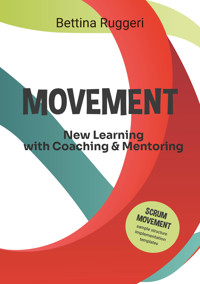
Learning in organizations often fails to unfold where it is needed most: in everyday work. Trainings leave little impact, formats lose momentum, and development turns into good intentions. The Movement brings coaching, mentoring, and collective practice into a structured framework that anchors learning sustainably—embedded in daily work, repeatable in its design. This book shows how learning culture can generate impact—within teams, across the organization, and throughout the system. Using a complete Scrum-Movement with clear learning objectives, roles, workbooks, and reflection formats, it illustrates how the Movement works—and how its structure can be applied to other topics. For everyone who wants to embed learning in everyday work and develop it together.
Das E-Book können Sie in Legimi-Apps oder einer beliebigen App lesen, die das folgende Format unterstützen:
Seitenzahl: 238
Veröffentlichungsjahr: 2025
Ähnliche
















Table of Contents
Imprint
Dedication
Book Description
About the Author
Introduction
Chapter 1 - Why We Need a New Way of Learning
Chapter 2 - The Movement Framework
Chapter 3 - The Scrum-Movement
Chapter 4 - Designing Movements Yourself
Chapter 5 - Formats and Tools in the Movement
Chapter 6 - AI & Education
Chapter 7 - Backgrounds & Models
Afterword
References
Imprint
Title: Movement – New Learning with Coaching & Mentoring
Author: Bettina RuggeriDesign, Layout & Cover: Bettina RuggeriGerman Editing & Proofreading: Manuel FernandesEnglish Translation: chatgpt
Self-published byBettina RuggeriTherese-Giehse-Allee 11081739 Munich, [email protected]
Production & Distribution:tredition GmbH, Heinz-Beusen-Stieg 5, 22926 Ahrensburg, Germany
ISBN: 978-3-9827259-9-4
© 2025 – All rights reserved.This work is protected by copyright. Any use—including excerpts—as well as reproduction, distribution, or public presentation requires the express written permission of the author.
While every effort has been made to ensure accuracy, no liability can be accepted for the content. The author welcomes suggestions or notifications of errors at: [email protected]
Dedication
For everyone who has taught, inspiredand accompanied me.And for Detlef
Book Description
How does learning succeed in organizations—beyond trainings and tools? How can development take root instead of merely being initiated?
The Movement is a structured learning format for sustainable capability building—through coaching, mentoring, and collective practice in everyday work.
It works wherever people want to learn together and take responsibility—regardless of topic or role.
The principle is transferable—the program is structured. It links individual development with collective learning and creates spaces in which mindset, capability, and culture reinforce one another.
Using the Scrum Foundations as an example, this book provides a fully deployable Movement program—with clear learning objectives, roles, workbooks, feedback formats, and practical insights from more than six years of experience. Readers can use it directly to try the Movement in their own organizational context—and adapt the structure to a wide range of topics.
For everyone who wants to reshape learning culture in organizations: repeatable, practice-oriented, and collectively supported.
A book about learning that endures—because it creates movement.
About the Author
Bettina Ruggeri has spent more than 20 years supporting people and organizations at the intersections of leadership, development, and learning culture.
As an Agile Coach (CEC, CTC, Accreditation Coach), systemic and hypnosystemic coach, NVC trainer, and organizational consultant, she brings structure together with depth, clarity together with relational awareness—and impulses for change together with inner alignment.
With the Movement programs she co-developed, she designs new learning spaces for organizations that integrate coaching, mentoring, and self-organization. These programs are proven in practice, accessible across contexts—and an invitation to see learning as a shared experiential space.
Her work draws on agile practice, hypnosystemic foundations, Nonviolent Communication, and a guiding compass: A Course in Miracles, which has shaped her thinking and actions in recent years.
What drives her is the conviction that sustainable development requires more than the transfer of knowledge—it grows through relational work, resonance, and collective exploration in everyday work.
The Movement is her contribution to a learning culture built and carried by many.
Introduction
We live in a state of constant change. Digitalization, AI, agility, and social uncertainty define our time — a time of ongoing transformation with no guaranteed outcome. Organizations are searching for stability. They invest in tools, frameworks, and training programs, only to realize again and again: it’s not enough. Most initiatives barely touch the surface, fade in daily operations, or create frustration instead of progress.
What is needed today is something else: learning ability as a key resource — both individually and collectively — as a competence anchored in structure and relationships. We need a new form of learning development that enables rather than prescribes. Learning must lead to both personal and collective growth.
In recent years, learning itself has changed. AI-supported systems are transforming how we learn, communicate, and work. They take over technical tasks and increasingly shape our educational reality — often faster than existing concepts can capture. The challenge lies less in technology itself than in the assumptions we bring to it. AI can structure, analyze, and support — yet it remains distant. Emotional awareness, trustful connection, and the ability to respond situationally and relationally to learners remain distinctly human.
This book aims to inform and inspire — to bring the collective power of shared learning to life: for sustainable competence development in everyday work, through coaching, mentoring, and collaborative learning in practice. The direct form of address is intentional. It reflects the mindset that guides the Movement approach: open, collegial, and development-oriented.
This is about learning — not in the form we know from trainings, workshops, or e-learnings, but about a different understanding of how learning becomes effective today — in a world that no longer follows fixed plans or predefined roles.
Movement
This is where the Movement unfolds its strength. It offers a framework for a new learning culture — one that also shapes how we engage with AI. The Movement’s stance is supportive and integrative. Its structures create both orientation and freedom to explore. Learning remains human because it emphasizes the interpersonal dimension — creating an atmosphere in which sustainable learning becomes possible.
That is what this book is about. It describes a form of learning that places the human being at the center, aligning both individual and collective development with clear learning goals. A form of learning aimed at sustainable change. It combines coaching, mentoring, and peer learning — with a clear structure grounded in relationship and responsibility.
The Movement is a bridge — between people, between change and impact, between the need for orientation and the courage to step into something new. It is an invitation to understand, to shape, and to take part.
This book takes you on a reading journey in seven parts:
Chapter 1 explores the landscape of thinking and learning we find ourselves in today — and why traditional logics of professional development often no longer work.
Chapter 2 introduces the Movement concept: its principles and roles, along with examples and impulses for implementation.
Chapter 3 describes how to initiate and conduct a Scrum Movement within an organization.
Chapter 4 supports you in designing your own Movements — whether as a Facilitator, as a leader, or as a catalyst for change in your organization.
Chapter 5 collects methods that accompany and deepen the Movement: tools for reflection, self-organization, dialog, and decision-making. They can be applied directly or adapted to the respective context. They serve both as structured building blocks and flexible tools for shared learning in groups.
Chapter 6 offers a look ahead at the role of AI in education — and an invitation to consciously shape that space as well.
Chapter 7 provides an overview of the theoretical backgrounds and models — as foundation, as inspiration, and as an invitation to dive deeper. Whenever something seems unclear, this chapter may offer helpful context.
You are invited to take what you need — and to open yourself to what becomes possible: a learning development within the tension of daily work and time pressure, between people as well as between knowledge, experience, and practical application.
Why I Wrote This Book
It pains me to see how many trainings fail to make a difference. How much is invested in programs and methods — and how little of it truly finds its way into daily work. How learning becomes an obligation instead of an opportunity, and how much potential quietly goes to waste.
What’s missing are spaces where people can truly grow — reliably, with guidance, right in the middle of their work context. Spaces that are integrated into daily routines yet deep enough to enable lasting development.
That’s exactly what the Movement Framework was created for. It establishes the conditions for genuine learning development — structured, connected, and practice-oriented. And it becomes reality wherever people are invited to contribute and grow together: in organizations, teams, and communities. Whether the focus is on psychological safety, nonviolent communication, software architecture, or leadership — the principle remains the same: learning happens self-organized, in community, and embedded in everyday life.
The roots of the Movement lie in my background as an Agilist. I developed the first Movement programs in agile environments — with Scrum Teams, Product Owners, and leaders. That was where the need was most urgent and the impact most visible. Some say today: “Agility is dead.” And when you see how often it has been reduced to tools, roles, and frameworks, that might even seem true. In many organizations, the vocabulary is agile — but the culture is not. What’s missing is a deeper understanding of the underlying principles. What’s missing is the connection between people, values, and their lived expression. And what’s missing is the capacity to reflect and learn together.
I don’t want to give up on agility. On the contrary — I want to give it depth. And I’ve seen how that can happen: through collective learning, through resonance, through development. That is exactly what the Movement Framework makes possible — far beyond agile roles and methods.
My wish is that learning becomes effective in everyday life — both individually and collectively. That knowledge within organizations becomes lasting because it is shared, applied, and continuously developed together. This book was written out of a wish: that people can grow without burning out. That development becomes possible — with depth, with human connection, with shared responsibility, and with clear structure.
That is my longing: to understand learning as a shared endeavor, where training and mentoring both have their place. Where learning is intentionally structured and at the same time experienced as a shared path. Collective development builds on trust and participation — with room for responsibility, diversity, and co-creation.
What Is a Movement?
A Movement is a learning program with concrete learning objectives and a defined structure that runs over several months. Participants engage, alongside their daily work, with topics that are relevant to their role or organization — self-organized, in groups, and individually supported by mentors.
Learning takes place through:
content and structured assignments based on Bloom’s Taxonomy [Bloom’s Taxonomy, 2025],self-organized collaboration in small groups,mentoring, feedback, reflection, and practical application in the workplace.Knowledge is both shared and further developed — across departmental boundaries. Many participants continue their learning journey and, in subsequent rounds, take on a mentoring role themselves. This approach helps break down silos and build systemic connection.
A Movement operates according to the principle of inspect and adapt. It thrives on participation, concrete action, and continuous adjustment. The learning journey is structured, practice-oriented, and transferable — and that is what makes it effective.
What We Mean by Movement
In our context, Movement refers both to the overarching framework and to the programs that emerge from it. The term was chosen deliberately: inspired by Derek Sivers [Sivers 2010], a Movement represents an initiative that people join voluntarily — out of inner conviction. It is about collective action and change that grows from small, visible steps — fueled by participation, intrinsic motivation, and the shared desire to make a difference together.
In German, the word Bewegung also carries additional meaning — movement in the sense of development, dynamic change, and a shared alignment toward values and goals. A Movement creates spaces where people take responsibility, learn from one another, and design new ways of working together. Personal growth and collective development arise from the energy of the many — not from the directives of a few.
Future Readiness Requires Community
Future readiness emerges where different perspectives come together. In a world where no one can know everything, shared learning becomes the foundation for development.
Future readiness grows when people engage in collaboration — when they support, challenge, and accompany one another. When they are willing to develop themselves further and take responsibility for what they create together.
That is also the idea behind the Movement. It represents both individual movement — the development of a person — and collective movement within teams and organizations. And it stands for the concrete program introduced in this book: a structured learning framework that fosters personal growth and supports shared learning.
The Movement is both a learning format and a collective process. It creates spaces where learning with and from one another becomes possible — embedded in real work contexts. Experiences are shared, moments of friction are explored, and insights are expanded. Professional orientation is part of the process — together with the exchange of perspectives, reflection on experiences, and collaboration on concrete topics.
Many of the experiences described in this book stem from such approaches: from initiatives started within teams, communities, or organizations — driven by commitment, responsibility, and reliable relationships. In these groups, orientation, development, and collaboration take shape in everyday work.
This book is therefore addressed to individuals, groups, teams, and organizations alike. It can be read alone or used together — as an impulse, a working basis, or an invitation to further development. In this way, learning becomes both an individual and a collective experience.
What Works – and What Lasts
The demands on organizations are increasing: new technologies such as AI, an ongoing shortage of skilled professionals, constant reorganization, and social uncertainty all require both adaptability and learning capacity. It is no longer enough to provide knowledge. It must be anchored, shared, and lived.
Research findings are clear: sustainable learning requires relationship, practical relevance, and reflection. Coaching and mentoring significantly increase performance, well-being, and the ability to adapt to change [Theeboom 2014, Hüther 2011, Schmidt 2017]. Peer learning creates emotional safety and strengthens the integration of new perspectives [Siegel 2012].
The Movement brings together effective elements — structured, practical, and human-centered. It creates spaces where learning becomes part of everyday work. Instead of isolated interventions, learning is embedded in workflows, conversations, and decisions.
What Awaits You – and What You Bring
This book is for people who take responsibility — in their role, in everyday work, or in supporting others. For learning facilitators, HR professionals, leaders, and everyone exploring how development can truly happen in the work context.
You don’t need prior knowledge in didactics or organizational development — openness and curiosity about learning are enough. In this book, you’ll find impulses, questions, and perspectives — and in some places, concrete approaches that have proven effective in practice. They can help you initiate, accompany, and reflect on development — for yourself and together with others.
You can read this book on your own or, even better, use it together with colleagues. Some chapters include reflection questions, practical impulses, and invitation texts that can be applied directly in your team or organization.
The book unfolds its impact where you transfer it into your work context — in thinking, in conversation, and in shared experimentation.
Chapter 1
Why We Need a New Way of Learning
Learning – What It Was, What It Can Be
Learning Is Experience. Everything Else Is Information.
(attributed to Albert Einstein)
The demands of the working world are constantly changing — sometimes gradually, sometimes in fast and dynamic movements. With every shift, expectations rise: organizations are expected to become more adaptable, decentralize responsibility, and foster self-organization. At the same time, people within these organizations face the challenge of developing themselves further, building new competencies, and coping with uncertainty. Terms such as agility, new work, and transformation describe these growing challenges in everyday life.
Yet one central question remains: how can learning succeed under these conditions — in the context of work, under pressure, amid constant change?
Trainings and traditional development programs provide structure and orientation. At the same time, both research and practical experience show that learning becomes more effective in everyday work when it is linked to practice, shared reflection, and continuous development. Learning requires space, repetition, and opportunities to integrate new experiences into one’s own context.
In this way, learning becomes a strategic task — supported by individual initiative and organizational responsibility alike.
Learning Under Industrial Conditions
For a long time, learning was understood as an orderly, linear process — prepared, delivered, tested, completed. A beginning, a curriculum, a certificate — and with it, an apparent sense of security. This understanding follows the logic of the industrial modern age. The principle was simple: those who possess knowledge can plan. Those who plan can control. And whatever can be controlled can be standardized. Learning becomes a measurable product.
Within this mindset, learning took place largely separate from work — in seminar rooms, on intranet platforms, or in training series. Theory and practice followed one another: first the input, then the application. Work and learning appeared as consecutive steps with a clear separation.
Jeremy Rifkin describes the Industrial Revolution as both a technological transformation and a shift in human self-understanding [Rifkin 2010]. The logic of the factory reduced human beings to manageable units and learning to a process driven by standardization and efficiency. Knowledge was broken down into small units, delivered through standardized routines, and certified through examinations. This way of thinking still shapes many training formats today — with clear objectives, measurable outcomes, and time-limited learning phases.
But in recent years, the demands have changed. Traditional learning formats continue to provide orientation and methodological foundations, yet they often fall short when situations become more complex, dynamic, or less predictable. Challenges arise not only from a lack of expertise but also from ambiguity, systemic interconnections, and the interplay between people and expectations.
This is why a broader understanding of learning is needed — one that is practice-oriented, enables reflection, and is firmly embedded in the work environment.
Learning as a Living Process
Organizations are not machines, and people are not interfaces to be updated. Learning doesn’t function like a software download or a format that can simply be installed once. It is alive — dynamic, social, open to irritation, and sometimes even contradictory.
We learn when we recognize a need for development and feel personally affected. Learning also takes place when what once worked no longer holds and what is new has not yet taken shape. It unfolds through concrete challenges, in interaction with others, in everyday life, and in moments of friction and doubt.
Often, learning happens precisely where it wasn’t planned — when things turn out differently than expected. In moments of uncertainty. In conversation. In stumbling. When irritation leads to pausing. When people ask themselves, “What’s happening here? What does this have to do with me? And how do I want to respond?”
As early as the 1990s, organizational developer Peter M. Senge observed that companies can only remain future-ready if they become learning organizations [Senge 1990]. This involves more than simply offering training opportunities — it means fostering a culture in which learning is a natural part of daily work. A culture in which questions spark development, mistakes are used as sources of learning, and reflection happens continuously.
In such a culture, learning becomes a shared practice. Individuals grow while the organization as a whole becomes more adaptive. Teams learn how to communicate, make decisions, and deal with tensions. Leadership creates the conditions for development. Collaboration itself becomes a field of learning.
In this sense, learning is not an add-on — it is a strategic prerequisite for any organization that wants to thrive in a world that no longer follows predefined procedures or plans.
Learning as Part of the System
Gregory Bateson already pointed out in 1972 that learning takes place on multiple levels — he spoke of Learning I, Learning II, and Learning III [Bateson 1972].
Learning I refers to the practice of behavior — we learn how something works, how to apply a method, conduct a conversation, or use a tool.
Learning II means recognizing and questioning habitual patterns — for example, noticing that we respond to certain situations in the same way every time.
Learning III, finally, describes those profound moments when our entire frame of reference shifts — our view of ourselves, of others, and of the world.
In dynamic contexts — wherever certainty is lacking, complexity is high, and expectations change rapidly — this higher-level learning becomes especially relevant. It cannot be deliberately produced or scheduled. It arises in contexts that enable trust, allow ambiguity, and foster self-encounter in thinking — beyond the mere acquisition of new tools.
What Bateson described theoretically can be observed in everyday work situations — when people use new tools while at the same time questioning their perspectives on leadership, collaboration, or responsibility. Learning takes place both at the individual level and within the shared cognitive and behavioral frameworks of organizations.
Learning as Cultural Evolution
Jeremy Rifkin — renowned American economist, social theorist, and futurist — writes in his book The Empathic Civilization that every major transformation in history has also brought about a shift in human consciousness [Rifkin 2010]. For him, one thing is clear — technological revolutions require a new relationship between humans, themselves, and their communities. Learning is not a reaction to change — it is its prerequisite.
This perspective shifts the focus — learning is not the repair shop for competence gaps. It is not the correction applied when people seem unable to meet expectations. Instead, it is a cultural, collective, and sometimes uncomfortable process through which new attitudes, ways of thinking, and forms of relationship emerge.
For organizations, this means that learning must not take place at the margins — it belongs at the center, right alongside day-to-day business.
The Challenges of the New
Learning — as it is needed today — confronts people and organizations with demands that break with the old rules. It is no longer linear, predictable, or teachable in the traditional sense. It is fluid, context-dependent, and often contradictory — and that makes it challenging.
For individuals, this means engaging with the unknown — without a safety net, without familiar ground to rely on. They are expected to take new paths, even though no one can guarantee success. They are asked to take responsibility for their own learning, to reflect on themselves, to change — all under time pressure and amid the tension of expectations, goals, and daily work. It is no longer enough to “learn correctly” — what’s needed is a willingness to engage with uncertainty, to allow irritation, and yet remain capable of action.
Today, learning often means searching for orientation where there is none — finding one’s footing amid conflicting demands and making decisions even when the outcome is uncertain. Those who embrace this need not only motivation but also inner flexibility, psychological safety, and the experience of not being alone with these tensions.
For organizations, too, the conditions have changed. Structuring learning spaces remains important, yet what’s also needed is a broader understanding of what enables learning. Because learning means development — and often also irritation. People who learn question the status quo. They need honest feedback. They need structures that provide orientation while leaving room for their own exploration. And they need leadership that creates clarity while being able to navigate openness and uncertainty.
Organizations that want to enable learning must therefore learn as well — to handle ambivalence, to see mistakes as signals of development, and to make decisions collectively. They need patience, because the kind of learning needed today is not fast — but it goes deep. And when it succeeds, it changes not only behavior — it transforms culture.
Unfolding: Movement Learning
Movement Learning understands learning as a continuous process — over time, in collaboration, and within the work context. It is not a course, not a platform, and not a new label for familiar formats. It offers a structured framework in which people learn, reflect, and take responsibility — aligned with their daily work and grounded in real-life relevance.
At its center lies the shared effort to achieve effective self-organization, vibrant knowledge transfer, and sustainable development — both individually and as a team. Learning unfolds through conscious participation — people choose to dedicate their time intentionally and pursue a shared goal within an agreed structure.
In this process, spaces emerge that encourage inquiry and questioning, where experiences are shared and the status quo is challenged — with the goal of honoring what works and exploring what could be new. In small, stable groups, a setting develops that provides both safety and challenge — offering structure without prescription, orientation without instruction.
Over a defined period of time, people work toward clear learning objectives. They reflect, experiment, and apply what they’ve learned directly in their daily work — supported by peers, mentors, and a shared commitment. Movement Learning combines the depth of coaching with the continuity of mentoring and stays firmly rooted in practice. It fosters the application of learning and creates shared experiences of development.
In this way, a learning culture emerges in which knowledge becomes effective and learning remains reliable, practical, and relevant to everyday work. Change is not merely endured but actively shaped — through intrinsic motivation and deliberate action.
≡ What Remains
Learning is not an add-on. It is not a repair shop for deficits. Nor is it a storage place for methods. In a world that is continuously changing, learning is what enables adaptability and development — for individuals, teams, and entire organizations.
But this kind of learning now follows different rules than it once did. It cannot be fully planned, standardized, or handled on the side. It needs new conditions — less instruction, more responsibility. Less testing, more exploration. Less control, more trust.
What organizations need today is more than a strong training portfolio. They need an expanded understanding of what learning can achieve — as a continuous process anchored in everyday work. Learning becomes part of the culture. It is carried collectively, not left to individuals alone.
☼ Reflection
In many organizations, learning is organized as a formal measure — with clear goals, fixed timeframes, and measurable outcomes. These structures can be helpful in providing orientation and supporting development. At the same time, practical experience shows that learning becomes most effective when people actively think along, co-create, and take responsibility.
It is worth examining the conditions under which learning truly succeeds — when do we feel safe enough to ask questions? When are we ready to challenge routines? And what does a team need in order to grow together in a way that allows it to reach its goals, even in uncertain times?
Learning becomes visible in behavior — in decisions, communication, and collaboration. It develops within the work context itself — embedded in everyday life, shaped by concrete demands, and sustained by how people work together as a team.
››› Continuing the Journey
Rethinking Learning — It Sounds Good, and Necessary
But what does it actually mean for everyday life in organizations? For people under pressure, for teams that need to deliver results, for leaders expected to meet expectations?
Many companies still rely on trainings, seminars, and programs in the hope that new knowledge will lead to better outcomes. That’s understandable — structures, budgets, and routines are already in place, along with a genuine desire to equip people to handle growing complexity.
Yet the question is becoming increasingly urgent — does it still work? Do the learning initiatives we design actually produce the desired results? Or are we creating formats that are well-intentioned but bring little real change in practice?
In the next chapter, we’ll take a closer look and ask:What prevents learning from reaching where it’s most needed?Why do so many trainings remain ineffective, even though so many resources are invested?And what really matters if learning is to become sustainably anchored in teams and across the organization?
Why Traditional Trainings No Longer Work as They Used To
“Knowledge is a treasure, but practice is the key to it.”
(Thomas Fuller)
In many organizations, trainings are still seen as the universal answer to change. When employees are expected to communicate better, a communication training is organized. When leaders are asked to take on more responsibility or lead with greater empathy, a leadership seminar follows. When a company wants to become more agile, it launches a series of workshops on the new world of work — from Scrum and Design Thinking to New Work basics.
This reflex is understandable. A need for knowledge becomes visible, and efforts are made to meet it. The idea behind this is as simple as it is plausible — and, at first glance, even appealing: if people are to learn something new, give them the right format; if they are to improve, they need the right methods. Of course, developing competencies in a targeted way makes perfect sense. Yet what sounds convincing in theory often reaches its limits in practice.
Even when trainings are carefully planned, professionally designed, and accompanied by high expectations, a quiet disappointment often remains. Much has been said — but little has changed. The work was intense — but daily routines continue as before. Clear impulses were given — but few of them have found their way into everyday practice.




