


Erhalten Sie Zugang zu diesem und mehr als 300000 Büchern ab EUR 5,99 monatlich.
- Herausgeber: The Lilliput Press
- Kategorie: Sachliteratur, Reportagen, Biografien
- Sprache: Englisch
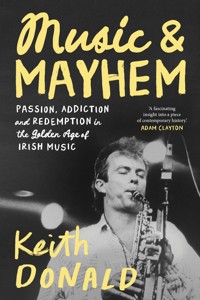
Music and Mayhem charts the immersive and explosive life of one of Ireland's most important musicians, and the golden decade of Irish music he was at the very centre of. Keith Donald's story begins in Unionist east Belfast, hurtling through vivid memories of a childhood as a musical prodigy, first performing at the BBC aged ten. His story takes him to the classics department of Trinity College Dublin in the early 60s, a hotbed of new ideas, before he becomes enveloped in the beauty of tenor sax. Jazz clubs by night and studying classics by day, Donald soon felt the early onset alcohol addiction, fueld by childhood PTSD. From university he joined the booming showband scene with The Federals in Belfast and The Greenbeats in Dublin, touring the dancehalls and marquees of the Irish country. The 70s saw Donald building a music career in Dublin and Europe, coping with addiction, a crumbling marriage, and forging a separate life as a qualified social worker. It was the 1980s however, when his greatest breakthrough came to pass withthe formation of the Celtic rock supergroup Moving Hearts. With the Hearts Donald was manager, star performer and inspiration, alongside bandmates including Christy Moore and Donal Lunny. Their fusion of jazz, rock and traditional music created the soundtrack of an era and paved the way for a generation of Irish musicians.
Sie lesen das E-Book in den Legimi-Apps auf:
Seitenzahl: 451
Veröffentlichungsjahr: 2025
Das E-Book (TTS) können Sie hören im Abo „Legimi Premium” in Legimi-Apps auf:
Ähnliche


















Music and Mayhem
Music & MAYHEM
PASSION, ADDICTION and REDEMPTION in the Golden Age ofIRISH MUSIC
Keith DONALD
THE LILLIPUT PRESS DUBLIN
First published 2025 by
THE LILLIPUT PRESS
62–63 Sitric Road,
Arbour Hill,
Dublin 7,
Ireland
www.lilliputpress.ie
Copyright © Keith Donald, 2025
10 9 8 7 6 5 4 3 2 1
All rights reserved. No part of this publication may be reproduced in any form or by any means without the prior permission of the publisher.
Cover photo from the author's personal archive. Every effort has been made to source the original photographer, and we welcome information on this photograph's provenance.
A CIP record for this title is available from The British Library.
Paperback ISBN 978 1 84351 918 8
eBook ISBN 978 1 84351 937 9
Set in 12 pt on 16 pt Adobe Garamond Pro by Compuscript Printed and bound in Ireland by Sprint Books
To Alex
1
JANUARY 2023
My days are numbered. Sure, you might say everyone’s days are numbered, but my numbers are a tad more predictable because I have cancer. The wonderful doctors in St James’ Hospital here in Dublin can’t be definitive but the fact that treatment hasn’t started yet (I got the cancer diagnosis in April 2020) and they see me at three-month intervals gives me some hope that my number of days has at least three digits. Whatever the number, I’d better complete the memoir I’ve fumbled with for years. Why’d I never finish it before? Because the act of remembering shit stuff (that I’ve done, that others have done, that just happened) has a shit effect on me. So why write it? If some reader gets something helpful or hopeful from it, it’ll be worthwhile. If not, finishing it just might be good for me.
This book is about music. Music and drink, not always in that order, and sometimes one without the other. As soon as I found music, or it found me, it took me over. Ditto drink. So that you’ll understand my need for them, I’ll start from the beginning. I’ll be truthful. I’ll race through the mundanities and slow down for the hard stuff (pun intended).
I was born in the Mary Rankin Maternity Home in Coleraine on 8 February 1945 to Denise and Raymond Donald who lived in Portstewart, County Derry with my brother, Philip, who had just turned eight. They had moved from Belfast when many homes on the Antrim Road were bombed by the Luftwaffe. Reports say that the Germans had either mistaken a reservoir for Belfast Lough and thought they were bombing the nearby shipyards, or were trying and failing to bomb Belfast’s water supply. Either way, German efficiency had taken a holiday.
My parents came home one day to find they were in danger of not having one, so they moved in for a year with my aunts and their families in rural County Down before my father got a job in Portrush, on the north Antrim coast.
Dad, a tall, bulky, genial man, quite loud too, worked in an office by day and played golf at the weekends with American GIs on the links courses in Portstewart and Portrush. Mum, who was quiet and calm, played bridge. Philip learned to swim and play golf almost as soon as he could walk. We lived in several rented houses. The last two were on O’Hara Drive, where the little houses were separated from the North Atlantic by a patch of grass, a lane and rocks. When there was a storm, huge seething waves would crash onto the rocks and their foam would clothe the houses and gardens. Sometimes it looked like snow in summer. It must have been idyllic but my memory hadn’t begun yet so I’ve pieced all the foregoing together.
My memory kicked in at the end of 1949 and went straight from zero to overdrive. So many things happened in quick succession, few would have coped. I didn’t.
We moved to the city. No more seaside, no more sea sounds, no more salt in the air. We were no sooner settled in a rented bungalow in East Belfast when my father’s father, Thompson Donald, a former MP in Westminster and in the first Northern Ireland parliament, came to live with us. Before he had unpacked, he and Mum had a row, which I overheard but didn’t understand. Listening outside the door, I became confused and unhappy, angry at the stranger who was upsetting her, wanting to defend her but not knowing how. When he took on the chore of walking me to the torture they called school, I summoned all the dislike I was capable of and focused it on him. I was rude to him when nobody else was around and it made me feel guilty, unsettled.
I just used the word ‘torture’. I meant it. Even now, seventy-three years on, I get a shiver when I have to think about it. For a five-year-old, school should encourage curiosity and creativity and be a gentle introduction to learning. If you ask me what was the dominant feeling in St Hilda’s, I’d have to say fear, with a capital F. Soon after I started there, the headmistress, Miss Hucker, a plump, scary, unsmiling, middle-aged woman, began putting her hand up the leg of my short trousers. It unnerved me so much that I was in a state of terror every moment I was in the same room as her. Fear consumed me. It became a barrier to learning. She would punish me for my lack of comprehension by making me stand in a corner of the classroom, where I couldn’t see anyone but they could all see my disgrace. I’d stand for up to an hour, feeling twenty pairs of eyes boring into my back, sweating with shyness and embarrassment, a country mouse freaked out by the city. When that failed to improve my learning skills, she’d grab me by the ear and haul me to the back corridor where she’d open a trapdoor and push me down wooden steps into a coal cellar. She’d slam the trapdoor and I’d hear her strut away ranting while I stood crying. The smell of coal dust, the silence, the complete absence of light disoriented me, terrified me.
I had to escape.
Grandpa would leave me off each morning at the school gates. I soon found an alternative route and ran home before he got back. I hid under the bed until my mother’s panic-struck face peered at me hours later. She made me promise not to do it again. In desperation, I tried another escape: as soon as Grandpa turned to walk home, I’d hide behind bushes before walking miles around East Belfast. Grandpa began handing me over personally to Miss Hucker, like he was transferring a troublesome prisoner.
Miss Hucker’s abuse removed all my confidence and left me in a state of constant tension. But, and it’s a big but, she was unwittingly the major factor that determined the course of my life because my third escape route was music. I’ll get to that presently.
It’s a strange thing that cruelty has a life of its own, transferring its attention from victim to victim, making brutes of the brutalized. I was five and the only living things I could hurt were me and the family dog, a lovely, affectionate cocker called Judy. As a lover of animals, I wouldn’t be able to live with myself if I’d hurt her seriously but I am ashamed to say I made her yelp with discomfort. I hated myself for doing it but gained a twisted relief from it. I also experimented with a razor blade on the inside of my thigh. Childhood innocence lost to abuse, fear, pain and guilt. Three years of it. Three years is eternity to a child.
I’ve never told anyone this: soon after the abuse started, I raided the family medicine cabinet and took away bandages and safetypins. Why? I must have seen someone with a bandage and the attention and sympathy they got. But my bandaged hand and arm attracted only bemusement from the adults, not the attention, the warmth, the love I imagined I’d get. My unknowing metaphor for trauma had failed.
Did I tell anyone about Miss Hucker’s abuse? Not for decades. At the time I didn’t have the vocabulary or the confidence to describe it. Maybe if I hid it, it would go away. Although I knew what she did was wrong, I didn’t know how it was wrong, how it transgressed the boundaries of trust, how much of an abuse of power it was, in short, how it was bloody well criminal. It still angers me.
There was always music in the East Belfast bungalow, recorded music, mostly jazz played on 78s on a wind-up gramophone. Mum had been a piano teacher and loved the songs from 1920s and 30s Broadway shows, the music of her youth. Dad had been a semi-pro musician in the late 1920s, playing banjo in a Dixieland band around Belfast. He bought me a ukulele when I was six, maybe sensing that I was somehow troubled, perhaps hoping that music might help. Then he brought me to the Smithfield markets to buy sheet music. Smithfield was like a wonderland, a huge covered market with hundreds of stalls. Books, old instruments, magic tricks, clothes, furniture, tools. A treasure trove and a source of wonder for a six-year-old.
I escaped into the uke and by the time I was seven, I could play and sing dozens of old tunes like ‘Up a Lazy River’ and ‘Chattanoogah Choo Choo’. Alone in the tiny dining room, I’d figure out the chords from the diagrams on the sheet music, try to remember the melodies I’d heard on records and practise the songs over and over. Whenever I’d got to grips with a new song, I’d trot across the hall to the sitting room where Dad, Mum, Philip and Grandpa would be sitting reading, and play it for them. My first audience. Nobody had a TV in 1952, so my singing and playing became the family’s entertainment. Or was it? Fighting the fretboard with little fingers creating incorrect chords, making melodic mistakes, starting and stopping, a squeaky voice effortlessly destroying their favourite songs. How did they stick it?
The long-playing record, the LP, was invented in the late 1940s, and in the early 50s Dad bought a gramophone that you didn’t have to wind up. Philip had inherited Dad’s love of jazz and began buying LPs of big bands like Artie Shaw’s and Benny Goodman’s. I fell in love with their sound on clarinet and asked for one. But there wasn’t much money around so they bought me a little wooden descant recorder instead. For the family this meant relief from my singing. For me it was a heaven-sent alternative to the hell that was school and I began to practise for several hours every day, figuring everything out for myself from a fingering diagram that came with the instrument. Nobody told me what to do. Even more importantly, nobody told me what I couldn’t do. So I began working out the tunes that Benny Goodman played. I’d often have to transpose them to fit the recorder’s limited range. It took ages but was the best ear-training money couldn’t buy. After a few months I had learnt a few tunes but knew something was missing: I didn’t have a name for it but I did understand that Benny Goodman would play a tune and then play something different but somehow related. It puzzled me.
I was out walking on my own one day, aged seven or eight, when a thought arrived in my head unbidden: if I can whistle an alternate melody, why shouldn’t I be able to play it too? What my mouth does when I whistle is what my fingers will learn to do. It might have been the most significant thought I’d ever have.
I walked quickly back home to try it out. By counting the taps of my feet while hearing the tune in my head, I worked out little decorations that developed into snatches of alternative melodies that in time became full-blown improvisation. I was an eight-year-old jazz musician who didn’t know it. I was driven by curiosity and the desperation of the escapee. When I left Miss Hucker’s ‘school’ later that year, the only thing I could do was play the ukulele and the recorder.
In music I’d found an escape that worked for me, a refuge that afforded me some peace and relief from chronic tension. Lacking self-respect and confidence, I’d been given something I could excel at, an area of life where I had some control, something I could lose myself in, something to make the outside world fade away, something that was mine.
I was eight when I left preparatory school. I was sixty-three when preparatory school began to leave me.
2
You know Woody Allen’s movie Zelig? In which the eponymous guy keeps popping up at hugely significant historical events? Sometimes I feel like Zelig’s unlucky twin brother who keeps popping up in hugely dangerous situations. The list includes an earthquake in Yugoslavia, an avalanche on the Antrim coast road, falling masonry in London, the collapse of a theatre roof, a fall in another theatre, nearly bleeding to death in hospital, seven car crashes, two fires and falling through floorboards. Not much of it my fault either. I’ve stayed in ten hospitals, some of them multiple times. I’ve had more than a score of operations. My heart and lungs stopped for over two minutes. And that’s only the headlines. No wonder I was diagnosed with lifelong PTSD. Here’s an example of trauma and its effect.
One beautiful June day in 1956 my uncle Sidney took my cousin Christopher and me to an air display at Sydenham airport. A huge crowd ooh-ed and aah-ed as small planes swooped overhead and large planes droned by. One pilot, Squadron Leader Wally Runciman, the chief test pilot for Short and Harland, thrilled everyone as he skimmed low, accelerated, banked and returned. Then something went wrong, the engine sputtered and he plunged into the runway just in front of us. There was an explosion, a plume of flame, a pall of black smoke, an acrid smell and terrified people running in every direction like their lives depended on it. I lost contact with my uncle and cousin and it was ages before they found me and we drove home.
I thought nothing of it until decades later when I met Leo Barnes of the Hothouse Flowers backstage at a festival in Denmark where I was playing with the Danish band, Still B. Leo invited me to ‘have a blow with the band’. After I’d guested with the Flowers, Liam Ó Maonlaí suggested he and I leave the dressing room and head out among the crowd to watch Bryan Adams. In amongst the huge throng I got a panic attack and I’m sure it related to the panic in the crowd at the air display.
I imagine, dear readers, that if you were asked to go on stage and perform in front of fifteen thousand people, without a minute of rehearsal, that you might run a fast mile away. You might even hide in that huge crowd. Some conditioning alchemy has made me your exact opposite: being invited on stage at short notice gives me a thrill of expectation that I will soon experience as a warm, familiar feeling of comforting achievement. If there’s ego massage involved, it’s the merest of sprinklings, like chocolate flakes on a knickerbocker glory. The main reward is the playing. I imagine sportspeople get the same feeling when they’re performing well, like an out-of-body experience that derives from the purest of concentration and the consequent absence of anything negative like worry or fear.
When I was ten, Dad bought our first TV, a twelve-inch Bush black and white. Grandpa was surprised to hear its sound. He had thought TV would be like film and would start with silent TV before developing into talkie TV. To my shame, I laughed at him. (I was watching a TV programme in 2021 about the foundation of Northern Ireland a hundred years earlier when up popped a still photo of MPs, including grandpa. So he made it silently onto TV sixty-five years after he died. I think he’d have liked that.)
When I was eleven, Grandpa got sick and retired to bed, only getting up when Mum helped him to the toilet. Guilt consumed me for I was convinced that my constant rudeness to him had in some way contributed to his illness. All he could drink that winter was Lucozade and I spent all my pocket money on it for weeks. Maybe Lucozade will make him not sick. Bad little me. Poor dying Grandpa.
Then he was taken to hospital and I never saw him again. Nobody grieved openly and I wasn’t taken to his funeral. For decades the slightest reminder, like the Titanic that I imagined him working on, or Westminster, gave me an unsettling sick taste of guilt. I was in my sixties when counselling helped me make sense of it: too many things that traumatized me coincided and at such a young age I had neither the vocabulary nor the experience or the intellectual tools I needed to cope. Grandpa’s arrival in our house was within a month of my family’s move from seaside to city, a stranger’s probing fingers up my trouser leg and the blackness of the coal hole. Those concurrent threats initiated my sensitive five-year-old psyche into a pattern of expecting the worst, distrusting what was good and a guarded view of other people. Post-traumatic stress disorder. No wonder Grandpa and I did not get on.
What’s ptsd like? If somebody gave you a lift in a car, you’d be grateful. When someone gives me a lift, I’ll have the safety belt on immediately, will be a tad relieved if the car has airbags and will be silently, nervously assessing the driver’s capability. Another example: to this day, it’s one of life’s best gifts when I see my daughter, Alex. I’ll be driving away from her house with the warmth of love and affection coursing through me when my brain will start imagining bad things happening and I’ll shout out loud, ‘Oh just stop. For God’s sake leave me alone.’ And the warmth is momentarily gone. Apply that to everything and you’ll understand how ptsd can suck all the good out of life and substitute a ceaseless, rattling expectation of disaster. The sufferer needs help to recover real enjoyment of what’s good. I finally got great help in my seventies. I’ll tell you about it later.
I had my first addiction experience when I was seven or eight. Dad, Mum, Grandpa and Philip had gone out somewhere for a couple of hours leaving me alone with instructions not to turn anything electrical on. Aunt Joan Catchpole happened to call and left a present of a biscuit tin full of fudge she had made, not rubbery like shop-bought fudge but delicate, almost flaky. They won’t mind if I have a couple of squares before they get home, I thought. Ummm, delicious. Then I wanted more and more, until I was on a sugar high that was reinforced by the forbidden nature and adrenaline rush of more … until it was half finished. I’m going to be in trouble anyway so I might as well have just one more.
When they got home and I told them I’d eaten the lot, they merely marvelled that I hadn’t got sick. If instead Dad had beaten the crap out of me, if he had said, ‘Son,’ slap, ‘this is for your own good,’ slap, slap, ‘and it’s hurting me more than you, but metaphorically,’ slap, slap, ‘and I’m slapping you now so that you won’t turn into an addict or an alcoholic when you grow up, or even earlier. In fact, so that you will grow up,’ slap, ‘are you getting the message?’ slap, slap, ‘there’s a downside to addiction, a price to pay, and every reward has a risk or responsibility attached. OK, son?’ If my greed had been thus punished, would my addictive traits have been checked or delayed or interrupted? Or was addiction an inevitable destiny?
3
I changed schools when I was eight, moving to Strandtown Primary, a half-hour walk from home. No posh St Hilda’s nonsense here, just a straightforward working-class school. So no more tiny classes where I stuck out as the sensitive country child I was, merely teachers controlling big classes where I could blend in.
Morning assembly at Strandtown was bizarre. While hundreds of children trooped outside and lined up in rows, two senior pupils carried a wind-up gramophone and a fold-up card table out to the tarmac quad, managing to maintain straight faces as they set up the table, wound up the gramophone and played a scratchy recording of ‘God Save the Queen’. In all weathers we stood to attention in our short trousers and long skirts, mentally cursing the cold and the monarch while being carefully conditioned to send her victorious. Long to rain over us indeed.
I was an inventive child. I liked making up stories, working out what would happen, the what if? Although I could tell fact from fiction, the teacher couldn’t, so she got in the habit of sending me to the headmaster, Mr Martin, for telling lies. He’d beat my hands with a cane. Finally it was fact that drove my creativity inwards. One day Mum and I were walking to the shops when an old Morris Eight got its skinny tyres stuck in the tram lines. The driver must have tried to steer out of it and the car suddenly flipped on to its roof and came to a halt a hundred yards later, sparks flying, a crashing grating noise getting everyone’s attention. When I told that true story in class, the teacher sent me off for the ritual caning. But it’s true, Sir. When I was ten in 1955, Aunt Biddy told her next-door neighbour about her nephew who played jazz on the recorder. The neighbour was a BBC producer and I was invited to play on a children’s programme. Over the phone, someone asked what I wanted to play and I said, ‘Lullaby of Birdland’, a jazz tune I had taught myself.
I thought about nothing except playing as well as I could and spent the journey on the trolleybus with my mother into central Belfast and Broadcasting House thinking about the tune and practising some improvisations in my head. I didn’t take in the surroundings – the huge edifice that was the BBC, the corridors, the people, the studio, its equipment.
‘Lullaby of Birdland’ has complex chords but, in my naivety, I thought everyone would know it. Including the BBC pianist who didn’t. I suppose she thought some ten-year-old was coming in to play a nice wee lullaby so she didn’t ask for any rehearsal and I didn’t bring any sheet music because I’d never had it. A recipe for disaster, especially as the show went out live to the province.
Someone gave me a hand cue, I launched into the tune and straightaway noticed the look of panic on the pianist’s face as her hands hovered in indecision over the keys for ages. Then she had to either commit or else admit defeat. She began to play. Were we even in the same key? If anyone was listening they would have endured the most horrendous, cacophonous jazz ever broadcast, chords clashing with improvisation, the logical beauty of George Shearing’s tune shattered crotchet by crotchet.
But I’d done something that people appeared to find remarkable. I had made my parents proud. It’s possible nobody had ever heard jazz tackled by recorder and piano so they didn’t know what to expect. Maybe the very fact of it happening made it ok, justified it.
Soon after the BBC, I got some blood disorder that confined me to bed for months, lying in a tunnel that Dad had made of wire so that bedclothes wouldn’t touch my skin that had erupted with boils, all over me, up to ten at a time. They would start tiny and grow into excruciating lumps the size of a big coin. Then they’d pour blood that was almost black. Not nice but I made the best of it, reading book after book and increasing my recorder repertoire exponentially.
Mum was so good to me then. She was good to all of us, always, but my suffering and her caring created something very special between us.
The first of a long series of doomed romances happened in my last year of primary school when I was pre-puberty, ten years old.
She was Josie. Her face was more freckles than skin and she seemed determined to retreat behind her hair. But I liked the freckles so I asked where she lived and could I walk her home. Our walks to the Holywood Arches, near where she lived, became regular, at least once a week. Totally innocent, we’d chat about school and the people in it. Gradually she forgot about hiding her freckles. Then one day she asked me in and I met her parents, down-to-earth, friendly, working-class adults. This went on for months. We never held hands or kissed, probably because I never thought of it.
One afternoon I was walking out the school gates with a boy whose family milk business overlooked the school grounds.
‘There’s something I want to show you,’ he said.
I followed him into the milk yard and we stood behind a line of electric milk floats, peering through a hedge into the school grounds. There was a circle of kids, nine, ten, eleven years old, in a sheltered grassy area. They were all cheering and shouting at something on the ground.
‘They’re here most days after school. What do you think they’re doing?’ asked the milkman’s son.
Then the crowd parted momentarily and we could see two kids on the ground, a boy on top of a girl, fully clothed.
‘I don’t know,’ I said, for I had no idea.
This was something I knew nothing about and did not like the look of. Suddenly we could see their faces and I felt pinpricks of shock all over when I recognized Josie’s sweet freckled face laughing, revelling in the attention, having more fun than she’d ever shown with me.
‘Are you OK? You look like you saw a ghost,’ said my schoolmate.
‘Yes I’m fine,’ I lied, for there was too much to tell and I didn’t know how to tell it, so I told nobody. My walks with Josie stopped. My interest in girls curled up and hibernated for years.
Some months later I had my first drink. I was eleven. Mum and Dad had a Christmas party for the neighbours and my aunts and their families. I was given the job of barman and waiter, taking drinks orders and ferrying trays of drinks from kitchen to sitting room. Curious, I added a couple of gins that nobody had asked for and took a detour to my bedroom. I downed them rapidly and carried on. Nothing much happened except I now knew I didn’t like the taste.
Then whoooosh!
A wonderful physical rush followed by the removal of all cares. My customary tension replaced with social confidence. For the first time ever I felt at ease with people, even able to be funny around adults. Of course I took more detours, utterly prepared to tolerate the bad taste if I could get more of this anaesthetic cure-all.
I’d found another escape route.
Being abused as a child means you can never go home again, if home is a secure haven characterized by trust and love. The calmness of a good home is a state of mind that’s now gone. You can’t get home and it makes you edgy and rattled, not good with people, even less good with yourself.
Then along comes alcohol, and for a while it masquerades as a new home you can visit, an alternative home with fake warmth and treacherous affection, a new home that the addict mistakes for home home. Then you need more and more alcohol to get to the new home. And the journey home becomes dodgy, full of peril and unpredictable danger, riddled with insidious lies told by others and yourself. I see that now. When I was eleven, all I knew was that it helped.
4
‘Donald, you attained 89 per cent in your French exams, 91 in Latin. Therefore you will study Greek.’
‘Yes, Sir,’ I said, it all being Greek to me, for I was only interested in music and everything else was a distraction. In a way, I’d become a victim of the eleventh commandment that was reserved for northern Protestants: thou shalt achieve.
Mr Bullick, the head of the Classics department in Methody, thus informed me I’d be studying Greek with him. What a life-changer those two percentage points were to become.
Methodist College Belfast, aka Methody, was the largest grammar school in the UK, with two thousand pupils and a campus that stretched from the girls’ boarding department on the Lisburn Road to the boys’ boarding department on the Malone Road. I started there as a day pupil in 1956, commuting on four buses every day. I worked hard in year one and Greek was apparently my reward. Not music, Greek.
I’d already started into ten years of studying dead languages when I was summoned to the music department to meet its head, Mr Willis.
‘Your ability on the recorder has been brought to my notice. Really you should be studying music but it’s too late for that now. But I can offer you a clarinet or a flute. Which would you like?’
Joy of joys. I can finally have a go at Benny Goodman tunes on the right instrument.
‘A clarinet please, Sir.’
‘You don’t need to think about it? Consult your parents?’
‘No, Sir, definitely a clarinet.’
He went on to tell me I’d have to join the school orchestra and that I’d need lessons. He gave me the phone number of a teacher, Mr Johnston.
That same evening I persuaded Dad to ring Mr Johnston and set up my first lesson. I forgot to mention I’d been selected to study Greek.
My parents had very little disposable income, never went to a pub or a restaurant and were the last I knew to get a TV and a car. But they were good to Philip and me. Paying for clarinet lessons was another example of that.
Methody gave me my first clarinet a week later, a new Boosey & Hawkes Edgware in a black wooden case with black velveteen lining. I couldn’t wait to get it home and kept sneaking peeks at it between classes.
I started on my own at home that afternoon, figuring out how the five pieces of clarinet fitted together and how the reed and ligature were affixed by studying photos on Benny Goodman albums. Then utter disappointment: I tried for hours but couldn’t get a sound out of it that even remotely resembled a clarinet. And it left me panting for breath.
Some days later Dad drove me to my first clarinet lesson in the little Austin he’d bought. I was so excited to meet Mr Johnston, a slim, wiry man in his early forties who was principal clarinet in the Ulster Orchestra and in the BBC orchestra. While I wanted to rush into tunes, or at least fingering and scales, he gently explained that it was going to take time. At the end of an hour I knew how to assemble the instrument without risk of damage, how to clean it, that I should buy Langey’s clarinet tutor, where my fingers should go for a basic F scale and how to hold the mouthpiece between my lips. At the end of the lesson I wanted to hear a clarinet close up, rather than on record, so I asked him to play something. He chose a written piece from his library and played. It was fast, technical and thrilling, with the sound down low rich and woody and the sound up high pure and clear. Inspiring me on purpose I think. On the bus home, I was happy: this one lesson armed me with the basics. I could now assemble it and make a start on transferring jazz tunes from recorder to clarinet.
I was determined to master it. After two buses home from school, I’d assemble the clarinet, prop up Langey’s tutor and escape for hours every day. It needed time: the recorder, like the oboe, flute and saxophone, ascends predictably, eight notes at a time, C up to B, then the next C up to the next B: octaves. On those instruments the fingering for a D in the lower octave is almost the same as a D eight notes above. But the clarinet ascends via an interval of a twelfth and then an octave into an area of unpredictable fingering known as the ‘cross-fingered register’. So the fingering for a G in the lowest register (Mr Johnston’s rich, woody sound) is almost the same as a D in the middle octave. And the next D (his pure, clear sound) is out on its own somewhere, stranded in a spaghetti of fingers. An ergonomic headwrecker.
My poor mum. I practised hard, squawking, squeaking, playing bum notes, repeating scales a hundred times, all in the room beside the kitchen where she’d be preparing dinner. Never once did she complain or ask me to go to my bedroom. As she was my whole audience, I wanted her to get at least a tiny bit of enjoyment out of it. I asked her what her favourite tunes were and learned them. Actually they were the first tunes I learned on clarinet. Then I’d do request time after the repetitive torture of scales played badly.
‘What would you like to hear, Mum?’
And a thankful voice from the kitchen, ‘Do you know “I’ll see you in my dreams”?’
I’d concentrate hard on getting the phrasing just right for her.
Every Sunday evening I took two buses to Mr Johnston’s house in the Galwally area at the top of the Ormeau Road. I had a one-to-one lesson with him for three out of four Sundays. On the fourth, there would be a group lesson that lasted a couple of hours. Mr Johnston always played the bass clarinet parts while four students moved from chair to chair playing the other parts in turn. The music we played was Mr Johnston’s own arrangements of classical pieces by all manner of composers from Gabrieli to Gershwin.
Mr Johnston knew I was different. I wasn’t a brilliant reader of music like many of his other pupils and he found it intriguing that when I got lost I could make up my part, never straying into a wrong key or playing something that didn’t fit. He’d just smile and say, ‘Well done, everybody. Keith you need to practise your reading, though some of what you played sounded like an improvement on the original.’
My passions now were Classics and the clarinet. I’d quit athletics and rugby even though I’d won races, been trained by the legendary Ron Pickering and the future Olympic gold medallist Mary Peters, and captained rugby teams. I simply didn’t have the time to train properly and do sport well so I made a decision to run whenever I could, but not competitively.
Drink also had a bearing on my fitness. Between school and home, I’d sometimes visit the Spanish Rooms, a bar in downtown Belfast where teenagers in school uniforms drank alongside hardened, bemused drinkers in mid-afternoon. I’d often down three pints of scrumpy, a potent cider, before snoozing on the trolleybus home. I’d still get hours of homework and clarinet practice done before stopping around midnight. Funny thing: I never went near the scrumpy bar on days when I had an evening gig, already protecting the music from the drink.
Knight’s Bicycle Shop on Great Victoria Street became a regular haunt. Dougie, the son of the owner, started a jazz and blues record shop on his father’s premises. Effectively it was a library: if you paid fourteen shillings for an LP marked E for excellent and brought it back in the same condition, Dougie would allow you thirteen shillings off your next purchase. He was also kind enough to steer me to albums, musicians and tunes he thought I might like. Thus I built up a repertoire of tunes I loved. I even practised them on the buses to and from school: my fingers would find their correct positions on my school ruler while I heard the tunes in my head. If I was unsure, I’d check the melody on the clarinet when I got home. I liked to work things out for myself. It was the same as everything else about jazz: nobody told me what to do and nobody told me what I couldn’t do.
I could almost say the same about drink, but it wouldn’t be the whole truth. I loved the feeling of freedom from the past that I’d get after a few drinks, but even then, though nobody told me, I sensed danger: drink had to be dangerous because of what I’d seen it do to other people, including a much-loved uncle. But because of the temporary boost to self-confidence, the ease it gave me around people and the release from constant tension, drink was hugely attractive. So I’d have to live with the danger. Unknowingly, I was embarking on a thirty-year internal battle between attraction and revulsion, emotionally up when the drink kicked in, down when it wasn’t available, the rollercoaster of addiction.
5
In 1959, when I was fourteen, I’d been learning clarinet for two years when a boy I didn’t know, Chris Doran, stopped me in a Methody corridor and introduced himself.
‘We’re getting a wee jazz band together. Do you want to come along to a rehearsal?’
This was different. New and exciting. Up to this point music had been a solitary experience that had been instigated by a desire to escape from abuse, then from engagement with other people. My one public performance had been almost solo too, on BBC radio. Now music had dragged me into social interaction: you can’t be a loner in a band.
At our first rehearsal there was Chris on piano and drums, Davy Shannon on guitar and banjo, Davy McKnight on drums and me on clarinet. We could all sing. Interesting that three of us went on to be professional musicians and Chris combined architecture and music throughout his life. We rehearsed in a room in school and played some gigs including a school dance, a musical and some private parties. We played on UTV’s teatime programme Roundabout, just after the station opened and got a write-up in the Belfast News Letter, which gave us fleeting fame in Methody.
Were we brilliant? No. Could we play like adults? No. But what we lacked in ability we made up for in enthusiasm and energy. A teacher came to hear us and asked us to play for the school dance. We asked two musicians to join us, Tom King on trumpet and Jim Armstrong on trombone. All went well and the dancers seemed to like us.
Naively I sang alternative words to a song, words that might be construed as blue, but so innocent and funny they’d be deemed pastel blue. Next day we were getting congrats from our classmates for our playing when I was summoned to Mr Rose the viceheadmaster’s study and threatened with expulsion from Methody if I didn’t provide a written apology forthwith. Apparently the teachers who were supervising the dance took exception to the ‘filth’ I’d sung. That’s conservative, Protestant 1950s Belfast for you. Some of those same teachers could be found falling out of the pub up the Lisburn Road, the Four in Hand, during school hours. Some of them had whiskey breath every afternoon. A couple of them even had illicit relationships with underage pupils. Hypocrites.
The Classics teacher, Mr Bullick, began to bring me to his holiday home in Cushendall on Antrim’s glorious coast road, ostensibly for grinds in Classics, in reality to be a companion to his son Brian who was two years older than me but had a condition that left him looking normal but with the mental capacity of a six-year-old. Extraordinarily, Brian had taught himself to play hymns on a church organ. The Bullicks acquired a harmonium for Brian’s older sister in the hope that she might be interested to learn how to play it. She wasn’t, but Brian was. Without any lessons he began to press keys. The family ignored this but came running from other rooms when he began to play church hymns. Nobody could explain it. I got on great with Brian. Although he was older and bigger than me, he became like my little brother.
When I had finished the day’s quota of Classics, Brian and I would head out on foot or on bicycles, often hanging out with a bunch of other teenagers on holiday. I used some of my jazz earnings to buy a canoe, which let me get away from everybody, often paddling far out to sea.
It was an innocent time until I was fifteen and some of us began drinking together in secret. One calm summer night, six of us stole a parent’s car and drove to another village for drinks. The next day I was told that I had had eighteen drinks, nine glasses of lager and nine glasses of sherry. I tried to drive the car but they wouldn’t let me. I went for a swim fully clothed. I didn’t remember any of it. It was my first blackout and other people were around to hold up the mirror of their memory. I was shocked at myself but I didn’t learn from it. Rather, I learned the wrong lessons: I never considered giving up drink but I did resolve to watch what I drank, never again marrying grape-based drinks with their grain-based first cousins. Was this the first move in a strategy of lying to myself? Was it the first time the disease of alcoholism manifested its devious, insidious nature?
Throughout my teens, Dad and I spent many Sunday mornings at the home of my Aunt Joan and Uncle Harry. I idolized my uncle. He was a very successful solicitor, witty, a great storyteller and the owner of a collection of cars when most families struggled to have one. I was eight when he put me on his lap and let me steer an MG TD. He taught Philip to drive in a Jaguar Mk VII. He even had a Bentley and an AC Ace but what I admired most was his understanding of car mechanics and his ability to fix them. They lived with two children in a six-bed red-brick near Stormont. It sounds idyllic but there was a problem that affected everything: my beloved uncle was an alcoholic who went on benders. A binge drinker who fought his illness all his adult life. The family kept his problem hidden, getting him to treatment in private clinics when they had to. I became aware only because I witnessed twelve-year-old cousin Owen trying to get his very drunk father up the stairs to bed one Sunday morning. It was pitiful. Owen was obviously embarrassed and I tried not to show my shock. When I asked Mum about it, she shook her head, stayed tight-lipped, merely muttering, ‘Poor Harry.’
I felt an invisible, unspoken bond with my uncle: we were both secret drinkers.
When I played a jazz gig with the Embankment Six, I couldn’t drink because those decent men had promised Dad they’d look after me. When I gigged with any other band I’d be playing with adult strangers who felt no need to look out for me. So I’d get drunk, coming home from gigs at three or four in the morning, making myself sick quietly in the kitchen sink before sleeping for a couple of hours until breakfast at 7 am and the buses to school. Why did I make myself sick? Because I’d got sick from drink in bed one night and was ashamed.
I remember a bunch of adult men making bets about how much alcohol their teenage clarinettist could hold. I remember another long night of jazz on a ship in the docks when I and four other musicians drank so many bottles we were able to line the stage with them, all the way round three sides. Like drink was a competition.
As Dad and I were preparing to head to Uncle Harry’s one Sunday morning in 1960, a stranger phoned and asked for me. He introduced himself as Jimmy Compton. I knew him to be a famous trombone-player and bandleader. His clarinettist had an abscess on a tooth.
‘Strange he didn’t have it last night when the gig was in Belfast,’ said Mr Compton who wanted me to play with his band in the Republic of Ireland that night. The divisive Northern education system never mentioned the War of Independence or Irish geography so I had never heard there was a republic in Ireland, but I said yes, being thrilled to be asked.
I was collected at 2 pm in a noisy, smelly Bedford van and introduced to the other musicians, men in their forties and fifties. Jimmy Compton himself was sitting in the front passenger seat and appeared to be sleeping soundly. To my surprise, the surprise of a Belfast Protestant boy used to men pottering with cars on quiet Sundays, a bottle of whiskey was already circulating in the van. When it reached me I went to take a swig but another musician put his hand on the bottle and said, ‘I think you’re a bit young for that, son.’ The Bedford was almost clapped out and it was 7 pm when we finally stopped. I had a headache from the exhaust fumes that percolated up through the floor. One of the band said, ‘No posters up,’ and somebody replied, ‘That’s a bad sign.’ There was no sign of a ballroom either and we parked opposite a phone box. I was surprised it wasn’t red. They woke Jimmy and he headed off to phone his manager in Belfast. He took ages. Eventually he stormed back to the van.
‘Do you know what it says inside that phone box? Dromore West. Which of you friggin’ geniuses navigated us here?’
‘What’s the problem, Jimmy?’
‘The problem is I distinctly remember saying “Dunmore East” before we left. Which is near friggin Waterford. You managed to get us to Dromore West, out beyond Sligo, and there’s no way we’ll get to Waterford from here. It’s diagonally across the whole friggin’ island.’
‘Sorry, Jimmy,’ muttered the driver.
The musicians left the van and their fifteen-year-old clarinettist and headed for the pub. I sat alone and hungry for three hours, playing tunes in my head, reading their newspapers, not much bothered by anything except the huge disappointment of not playing with the band. Then they came back out in high spirits, climbed in beside me and handed me a doorstopper ham-and-cheese sandwich, their banter fast and funny. This time, when the bottles circulated, nobody stopped me from gulping some. One by one they fell asleep, their farts merging with the exhaust fumes, until there was just me and the driver awake. I gently prised a whiskey bottle from someone’s sleeping hands and was quite drunk when we pulled up in East Belfast at six in the morning. No point in going to sleep for an hour.
My first real gig: no music, no money, no meal, no sleep. Just a hangover that throbbed all day while I tried to master irregular verbs in a dead language in Methody.
Like every teenager I struggled to understand the world that presented itself to me. What’s OK? What’s not? Was it men circulating a whiskey bottle at lunchtime on a Sunday? Was it people doing a job where it’s acceptable to have a few before work? Where you’d be thought boring or even a threat if you didn’t partake? What’s normal to some might be surreal to others. I just know that the addictive me was happy to be camouflaged by older drinkers in our version of normality.
The world I was in was scarily adult. Abuse made me want to escape, first to solitary walks, then music, then drink. Music and addiction brought me to places no fifteen-year-old should be. Looking back I want to protect that boy but of course I can’t. Maybe nobody could have.
6
Jim Armstrong, the trombonist who had augmented the Chris Doran Band, rang me in 1961 and asked if I would come to a rehearsal with the Embankment Six. The rehearsal room was over Dougie Knight’s record shop on Great Victoria Street and I was nervous ascending the bare wooden staircase. The band specialized in arrangements of ragtime music for a six-piece Dixieland band, especially pieces by Scott Joplin. I struggled through written arrangements and blew solos as well as I could in the hope of becoming a band member. My luck was in and they hired me, booking me for regular Tuesday and Thursday residencies in Sammy Houston’s, the Mecca of jazz in Ireland.
My first jazz session as a semi-professional sixteen-year-old was an ear-opener. Dad drove me to the club on the second and third floors at 32a Great Victoria Street, four doors from the world-famous Crown Bar. It was all new to me and I tried to affect casual interest as Dad and I walked up the stairs and across the sprung dance floor, our movements reflected to infinity by walls of mirrors. I was really a wide-eyed ingénu, fascinated by new surroundings, excited to be in a place of jazz, wondering how the night would progress. I sat in the band room as the musicians arrived, nodding to me in an offhand, adult way while Dad took a seat near the stage.
Then the gig. I sat transfixed at the side of the stage as the five musicians, Billy Bosomworth on drums, David Smith on double bass, George Hayes on banjo and guitar, Jim on trombone and John Ritchie on trumpet started fast and got faster. In minutes it seemed the music was a licence for wild jiving, men throwing women under their legs, women twirling with speed and grace, nobody colliding, their bodies managing an unchoreographed, collective carousal. The whole place was soon blue with smoke and hot with sweat and smelly with perfume and powder and people.
I’m to wait to be announced. My stomach cramps. Three tunes pass until:
‘And now, ladies and gentlemen, please welcome on stage a brilliant young clarinet player, Keith Donald.’
Dad claps harder than anyone. I’m shaking as I walk the few steps onto the stage. Jim points to a microphone and we’re off. The first song is ‘Sweet Georgia Brown’. Trumpet leads. I try to find spaces to weave in and around the trumpet and trombone, concentrating, eyes closed, listening hard. John sings and Jim nods for me to play obligato. I do it the way I’ve heard it done on record, playing between lyrics, contributing, not featuring. When John finishes the song, Jim shouts, ‘Clarinet solo.’ Off I go and it feels like the rhythm section changes gear. I’m flying as all my nerves leave. My ally the clarinet and I are one as it responds to my thoughts. Muted trumpet and trombone start a low riff behind me. Another couple of choruses. I don’t want to stop but I know I should. Jim’s trombone starts to solo. John leans towards me and shouts, ‘Riff on third chorus, follow me.’ Third trombone chorus and John’s trumpet starts a new riff. I listen, understand, join in with a harmony. Feels good, like all my years of listening to, and loving jazz, all the years of figuring out complex stuff on my own, all the lessons with Mr Johnston, all the hundreds of hours of solo practice have coalesced to form me, a musician who can move people’s bodies on a dance floor and connect with their emotions too, a kid who can get respect from adults.
They kept me on stage for their whole set and I had to maintain huge concentration: my playing, their playing, who was next to solo, my volume and closeness to the mic, all of it new and all of it crucial. After two hours I was exhausted but didn’t realize it, wanting to play all night.
Compliments came in the band room. I found it embarrassing and didn’t know what to say. Blushing just makes you blush more.
Outside. Cold air. Dad’s car and home. I could sense his pride beside me.
I couldn’t sleep at all. I replayed the whole gig in my head, hearing every note, playing alternative solos. I fell asleep after 5 am and got up for school at 7. It felt like winning an Olympic gold medal one day and going out training in the rain the day after.
7
I was consumed by jazz. Practising or performing, I could disconnect from the passage of time. I’d learn a new tune and an hour would feel like minutes.




