


Erhalten Sie Zugang zu diesem und mehr als 300000 Büchern ab EUR 5,99 monatlich.
- Herausgeber: The History Press
- Kategorie: Sachliteratur, Reportagen, Biografien
- Sprache: Englisch
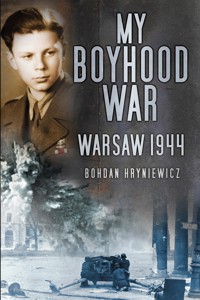
My Boyhood War, Warsaw 1944 is an intensely personal account of Hryniewicz' life in Poland during the Second World War, centered primarily on the Warsaw Uprising of August 1944. Despite being the longest urban battle between lightly armed irregular forces and the most professional Army of its day - in terms of ferocity, compared by the Germans themselves to the Battle of Stalingrad - the Warsaw Uprising still remains one of the least known chapters of World War II. In this first-hand account, the harrowing details of life under years of occupation and heavy urban combat are told with disarming authenticity through the eyes of a 13-year-old boy. Hryniewicz was eight when the war began and 13 when he became a runner to the Commanding Officer of a Polish Home Army Unit, making him both witness and participant in the midst of the 63-day long battle. These impressive personal recollections are explored together with the author's broader insights into the connected events that so transformed the map of Europe, which continue to dictate geopolitics today Praised by eminent historians, authors and statesmen alike, the author's account stands as a cautionary tale about the brutal and lasting effects of war. As tensions in Russia, Ukraine and Eastern Europe continue to mount, this book serves as a timely reminder of the ever present dangers of Imperial annexation on Europe's eastern flank.
Sie lesen das E-Book in den Legimi-Apps auf:
Seitenzahl: 473
Veröffentlichungsjahr: 2015
Das E-Book (TTS) können Sie hören im Abo „Legimi Premium” in Legimi-Apps auf:
Ähnliche



















‘Told with the wisdom of one who survived the deafening noise of war, as well as the deafening silence of the peace that followed, this riveting story of heroism and betrayal is indispensable for understanding political events today. Narrated with elegance, gravity and a writer’s eye for the harrowing details that shaped life on the front, Hryniewicz’s book reminds us all of the urgency of the past …’
Krystyna von Henneberg
Historian
‘An intensely personal yet politically significant account of a major World War II battle … It also enhances a better understanding of Russia’s current goals in East–Central Europe.’
Zbigniew Brzezinski
Former US National Security Advisor
‘Hryniewicz’ engrossing and detailed memoir of the Warsaw Uprising adds the unvarnished insights of an adolescent “runner” for the underground to a story that never fails to move the reader with its tragic consequences for Poland and for the Poles.’
Norman M. Naimark
Professor of East European Studies, Stanford University
‘A fascinating personal memoir …’
Halik Kochanski
Historian and Author
‘This first-hand memoir is a welcome addition to our knowledge of what [the Warsaw Uprising of 1944] meant for ordinary people.’
Count Adam Zamoyski
Historian and Author
To Andrzej,
and all the boys and girls who so bravelygave their lives in Warsaw, 1944.
Author’s Note
When I wrote my dedication to my older brother Andrzej – and all the young boys and girls who died in the sixty-three days of the Warsaw Uprising – I automatically wrote … gave their lives ‘for Poland’. There is no question in my mind that they believed they did. So did I. But did they really? What did they achieve by giving their young and very promising lives? We will never know. It has been, and will be, debated for years.
On one hand, there was the complete destruction of Warsaw, the deaths of over 200,000 human beings, the loss of the Polish nation’s most valuable human asset. The impact on Polish society and potential, from the loss of its best and brightest, can never be assessed. We all know now that the Uprising was doomed from day one. Stalin deliberately stopped the Russian Army from liberating, or even helping Warsaw, giving the Germans free rein. The Allies, turning a blind eye, did not help either.
After the Second World War ended, nobody talked about it. The story of the Battle for Warsaw, the largest and longest urban battle of the Second World War, between lightly armed, irregular forces and the most experienced, well-equipped army of the day, was virtually unheard of until the fall of communism. It was simply an ‘inconvenient truth’.
The Germans obviously did not want to have their war crimes exposed: the indiscriminate murder of combatants and a defenceless civilian population – men, women and children – the bestial murder of wounded soldiers and nurses; rapes; the unnecessary destruction of an evacuated city where, after 80 per cent of the buildings were looted and burned, the remaining structures of any historically significant buildings were systematically dynamited.
The Russians could have taken Warsaw, and at little cost, in the first few weeks of the Uprising. They opted instead to give the Germans total freedom to liquidate that element of the Polish population they knew would always resist communism. They also prevented the Allies from airdropping badly needed supplies to the insurgents.
The Allies – particularly the US under President Roosevelt – did not want to disclose that they had sold out Poland, and the rest of Central Europe, to Stalin at the 1945 Yalta Conference.
On the other hand, many believe that the rise of Solidarność (Solidarity), which later precipitated the fall of communism, would not have happened without the Uprising. I believe (or do I desperately want to believe?) that those lost lives, given so willingly, were not lost in vain. That the generation that produced Solidarity was inspired by those sacrifices, as they were by the sacrifices of their forebears in the Polish-Bolshevik War of 1920, the failed Uprisings of 1863 and 1831, and the Polish participation in the Napoleonic Wars.
* * *
In November 2009, at the celebration of Independence Day at the Polish Embassy in Washington, the Polish Ambassador presented me with the Commander’s Cross with the Star of the Order of Merit, awarded by the President of Poland. In my acceptance speech I said (or rather I tried to say as I became overwhelmed with emotion) that the Chinese curse ‘May you live in interesting times’ applied to me. I wanted to share the three most significant days of my life during those ‘interesting times’: the saddest day was 19 September 1939, when I woke to the sound of Russian tanks arriving in Wilno; the happiest day was 1 August 1944, when the Polish national colours, red and white, once again flew from the highest building in Warsaw; and the most disappointing day was 3 October 1944, when my commanding officer would not allow me to go to a prisoner of war camp with the other soldiers of our battalion.
* * *
For many years my children, and others, have been after me to write my memoirs. I did live in interesting times, times of significant change in Poland. I am old enough to remember life before the Second World War in the Second Republic of Poland, newly reborn in 1918. I also remember conversations and stories of life before the First World War, of times and a way of life that will never return. I lived through the Second World War, the Russians crossing the Polish border seventeen days after the Germans in 1939; the brief annexation of Wilno by the Lithuanians; the return of the Russians; the arrival of the Germans in June 1941; the German occupation and Warsaw Uprising in 1944; the re-entry of the Russians and the end of the Second World War in May of 1945; the communist takeover and the creation of the Polish People’s Republic; and finally the fall of communism and the rebirth of the Third Republic of Poland. I lived to see, once again, a free, independent and democratic Poland.
I would like to stress that my experiences in the Second World War and particularly in the Warsaw Uprising were not at all unusual or unique. Many boys and girls my age, both younger and older, took an active part in the fighting and the Polish Underground. The figures speak for themselves. After the capitulation of the Uprising, about 15,000 men, 2,500 women and 1,100 adolescent boys were transferred to German POW camps. One of those camps, Stalag 334 at Lamsdorf, held 5,800 men and boys, and 1,000 women including 14–17-year-old girls. On 18 October 1944, the Germans held a special roll call for underage POWs. From about 550 young POWs present, there were eight between the ages of 11 and 13, fifty-seven between 13 and 14, 115 aged 15, and 175 aged 16. Among them were two recipients of the Order Virtuti Militari, the highest Polish military decoration for valour, eighteen recipients of the Cross of Valour and 206 who received promotions.
* * *
I thank my daughter Elisabeth and my cousin Andrew Korab, who edited parts of this memoir. I am grateful for the support and encouragement of all my children, Andrew, Sarah, Elisabeth and Gregory. My special thanks to Elisabeth, who on her own decided to be my literary agent and was successful in having this book published.
I would like to thank my wife Anne, whose love and friendship I cherish. Her strength and support were invaluable through the difficult process of reliving some of the experiences while writing.
I dedicate this book to the memory of two of the most important women in my life. My mother Janina (1906–2001), who awed and inspired me with her strength, fortitude and sang-froid in the face of life’s adversities, her ability to go on and never give up under the weight of personal loss, the love that she always gave Andrzej and me. To Linda Kelly Hryniewicz (1937–2001), always loved and never forgotten, life companion of forty-two years, mother of our children. And to the new generation: my grandchildren Janina (Nina), Sophia-Linda, Alexander, Bryce and Neve in the hope that they never have to live in ‘interesting times’.
Contents
Title
Quote
Dedication
Author’s Note
Part 1: Outbreak of the Second World War
1 The Summer of 1939, June–19 September 1939
2 Soviet Occupation, 19 September–28 October 1939
3 Lithuanian Annexation, 28 October 1939–17 June 1940
4 Return of the Soviet Occupation, 17 June 1940–22 June 1941
Part 2: German Occupation
5 German Arrival, 23 June 1941–June 1942
6 The Best Holiday, June–August 1942
7 From Wilno to Warsaw, September 1942–19 March 1943
8 Warsaw, 19 March 1943–December 1943
9 Warsaw, December 1943–31 July 1944
Part 3: Battle for Warsaw:
Gloria Victis
10 Centre of Town, 1–5 August 1944
11 Old Town – Town Hall, 6–11 August 1944
12 Old Town – Telephone Exchange Building, 12–20 August 1944
13 Old Town – Radziwiłł Palace, 20–24 August 1944
14 Evacuation to the Centre, 24–29 August 1944
15 Centre North, 29 August–4 September 1944
16 Centre South, 4–17 September 1944
17 American Airdrop – Centre South, 18–29 September 1944
18 Capitulation, 29 September–4 October 1944
Part 4: Under German Occupation
19 Transit Camp ‘Dulag 121’, 4–8 October 1944
20 Kościelec, 8 October–November 1944
21 Rzerzuśnia, November 1944–16 January 1945
Part 5: Russian Return
22 Return to Warsaw, January 1945
23 Miechów and the End of the Second World War, February–9 May 1945
24 Second Visit to Warsaw, May–August 1945
25 Szczecin, August 1945–July 1946
26 Third Visit to Warsaw, 31 July–11 November 1946
27 Escape from Poland, 11 November–25 December 1946
Part 6: Germany
28 Berlin, 25–31 December 1946
29 British Zone of Occupation, 1 January–July 1947
Part 7: England
30 Nicholas Copernicus Polish College for Boys, July 1947–June 1949
31 London, June 1949–8 December 1950
32 Newark, NJ, 8 December 1950–September 1954
Epilogue
Abbreviations
Code Names
Select Bibliography
Suggested Reading
Plates
Copyright
PART 1
OUTBREAK OFTHE SECONDWORLD WAR
1
The Summer of 1939, June–19 September 1939
I awoke to the sound of metallic clatter on cobblestones. It was early morning and grey light filtered into the bedroom I shared with Andrzej, my older brother. I got out of bed and sat on the windowsill clutching my knees, still in my nightshirt, and was quickly joined by my brother. The noise was getting louder and louder, punctuated by the sound of shots. Looking through the second-floor window towards Arsenal Street, about 200ft away, I could see a column of tanks against the outline of the trees in Cielętnik Park, advancing towards Cathedral Square. The tanks were much larger than the Polish ones I was familiar with. From time to time I saw a puff of blue-grey smoke accompanied by the sound of a shot – but they weren’t shots; their engines were backfiring. Red stars stood out on the turrets, growing larger and more menacing as they approached. The Russians were here, just as my father warned us late last night.
I was in Wilno (Vilnius), Poland. It was 19 September 1939, nineteen days after Germany attacked Poland and started the Second World War, and two days after the Russian Army also invaded us from the east. I was eight and a half years old and could feel excitement building inside me.
The summer of 1939 began like any other. My older brother and I had just completed our fourth and third years of primary school in Wilno, Andrzej with all As, while I barely passed. Older by a year and two months, Andrzej was a very serious and studious boy. I, on the other hand, was a hellraiser who did not like to study.
Every summer we would move to the country house with our governess, Miss Krysia. Our property was in Kolonia Wileńska, a summer community 3 miles from Wilno. In the morning we would commute to school by train with our father, who worked in the Military Bureau of the Polish State Railway, returning in the afternoon by ourselves. Kolonia was halfway between Wilno and Nowa Wilejka, a small town with a very large military garrison comprising the 85th Wilno Rifles (father’s old regiment), the 13th Wilno Ułans and the horse artillery regiment. Because of its proximity to the Russian border, Wilno had a significant military presence. It was the headquarters of the entire military district, with an infantry division and cavalry brigade. Several regiments were stationed there, including an armoured battalion where my favourite uncle, Lt. Karol Smolak, commanded a squadron of armoured cars. Our immediate neighbours in Kolonia were all families of army officers serving in the nearby regiments.
School ended on the last Friday of June. Miss Krysia left for her usual one-month holiday and was replaced by our maid and cook, Pola. Our mother stayed in Wilno to run her beauty salon, and joined us on the weekends. Every summer we would reconnect with our old buddies: next door were Ryszard and Zdziś (sons of Major Kulczyński, company commander of the Wilno Rifles, with whom father served during the Polish-Bolshevik War), next were the three sons of Capitan Misiewicz and last, to complete the pack, was our slightly younger sidekick Staś Slusarski, son of a local farmer and cavalry sergeant from the Polish-Bolshevik War.
As summer progressed, we fell into our usual routine of playing our own version of cowboys and Indians (Polish Army and the Bolsheviks), and generally raising hell. When the area near us was used for manoeuvres by troops from the nearby regiments, that was real fun! We would follow either ‘reds’ or ‘blues’, betraying one side or the other in exchange for a ride on a horse, a meal from the field kitchen or some other special treat.
The day we most eagerly awaited was 24 June, St John the Baptist’s day, important for two reasons. Firstly, it was mother’s name day (in Poland we did not celebrate birthdays only imieniny, the day of the patron saint after whom you are named); secondly, and more importantly, it was the day we could start swimming. It didn’t make any difference what the temperature was, you could not swim until 24 June.
Mother was born on 23 June and the closest acceptable patron’s day was St John’s, so she was named Janina, a female version of John. The whole custom of Noc Swiętojańska, or St John’s Night, originated from pagan times. Originally, it was celebrated a few days earlier, during the vernal equinox, the longest day of the year. The pagan Slavs celebrated this festival of fire, water, sun, moon, fertility, happiness and love by frolicking in the woods, lustfully chasing one another. The Roman Catholic Church very cleverly embraced this custom, minus the lustful frolicking, as the church holiday of St John the Baptist. Mother’s name day was always celebrated in the country house and was a reliably merry affair with lots of people. This summer, I eagerly awaited the arrival of my Aunt Marysia and her husband Lt. Karol Smolak, who had a soft spot for me. However, to my great disappointment, she showed up without him, explaining that duty had kept him away.
The much-awaited first swim took place in the River Wilejka, a tributary that joined the Wilja in the centre of Wilno. A fifteen-minute walk from our country house took us to a place where the Wilejka was dammed, forming a reservoir which fed a water mill. The dam was wooden, about 12ft high, with water overflowing onto a wooden spillway below. The long spillway was covered with moss, creating a wonderfully slippery surface. The water cascaded over the top of the dam making a tunnel over the spillway, which we entered from the sides, and made our way towards the middle, inching along on our behinds until the water hit our backs. The force of the water would send us flying down the spillway landing in the water below with an enormous splash. This was great fun, which we repeated ad infinitum, rubbing large holes in our bathing suits in the process.
Our greatest collective achievement that summer was making gunpowder. Uncle Karol jokingly gave me the recipe: take three parts sulphur, three parts charcoal and four parts saltpetre; pulverise each separately; gently mix together; wet and mix more thoroughly; spread thinly and dry out in the sun and finally, when dry, break up by hand and pulverise very gently. Getting charcoal was no problem, but the other two ingredients presented a greater challenge. We used Staś, our factotum, to purchase the missing ingredients. We gave him money and sent him to the general store with the following stories: first, ‘we have bedbugs and my mother wants to fumigate, so we need 9oz of sulphur’; then ‘we slaughtered a pig and my daddy needs 9oz of saltpetre’. With all the ingredients in hand, we proceeded to manufacture our first small batch. We ‘borrowed’ a brass pestle and mortar from Misiewicz’s kitchen and proceeded according to the recipe. When our concoction had dried out in the sun, we gently pulverised it into real gunpowder. The time to test it finally arrived, and we decided to make a small petard first. We used a little metal pillbox, made a small hole in the side, into which we placed a miniature firecracker to be used as a primer. We filled it with our newly made gunpowder and wired the box securely. We decided to test the powder by exploding it around the corner of Mr Slusarski’s barn. I placed our masterpiece on a brick in such a way that only the fuse protruded around the corner. Since it was my recipe and my idea, I had the honour of lighting the fuse. With great anticipation, and using a very long match, I lit the fuse. The resulting explosion, producing a large amount of bluish black smoke, was very satisfying. As the ringing in our ears cleared and we congratulated ourselves, a very angry Mr Slusarski, who we had assumed was absent at the time, appeared. After ascertaining that none of us were hurt, he confiscated the rest of the gunpowder. He promised not to tell our parents if we gave him our word of honour that we would never repeat the experiment.
On 1 July Miss Krysia returned from her holiday and Pola left. Pola went to her sister and brother-in-law’s small farm near Troki every August, returning more tired than when she left, since she spent the whole time helping to bring in the crops. Pola had been with our family since before I was born and was very devoted to my mother and family. Her previous employers had thrown her out when they discovered she was pregnant, a detail mother was not aware of when she hired her. Pola gave birth to a boy, the day before I was born, who unfortunately died in childbirth. As a result, she transferred her love to me and we had a very close bond.
As August unfolded we noticed changes from the year before. Father, who normally spent as much time as possible in the country, hardly showed himself. Mother, who always closed her business in August to holiday at some spa, cancelled her trip. Uncle Karol did not visit us at all. We also saw much less of our friends’ fathers and other neighbours, most of whom were officers in the nearby regiments.
Around the third week of August we returned to our apartment in Wilno. This too was unusual as we normally stayed in the country until mid-September, commuting to school with our father. All the adults seemed very preoccupied; we overheard talk about war with Germany. Personally, I was looking forward to it since I was sure that our Polish Army would quickly win any war. Did we not have the best army in the world? Did we not win against the Bolsheviks in 1920? Did we not regain lost territories from Germany after the world war? Wasn’t our cavalry the best fighting force in the world? I had seen our soldiers marching smartly in national holiday parades right under our balcony. I had been to the barracks, ridden in tanks and armoured cars, watched the cavalry horse shows and military manoeuvres, visited army shooting ranges, stood in the chow line with soldiers to get food from the field kitchens. I knew officers like Uncle Karol and Major Kulczyński … I knew they were the best!
A few days later, we bid a tearful goodbye to Miss Krysia, who had to return to her family. Mother hired a woman to cook and clean temporarily, but my brother and I didn’t want another governess. Father started spending more and more time in his office, sometimes overnight, coming home only to grab a quick meal and change clothes. He seemed completely preoccupied and more unapproachable than ever.
Mother decided we should all have gas masks. She obtained patterns from the Government League for Air Defence (Liga Obrony Powietrznej i Przeciwgazowej, LOPP) and proceeded to make them from sheets of latex taped together with surgical tape. The eyepieces where cut out from stiff cellophane and the inhalers were purchased already loaded with activated charcoal. We had a bit of fun trying them on but they certainly were not comfortable. After a few minutes you would start sweating, the latex would stick to your skin and the eyepieces would fog over, but you could breathe without a problem. Mother’s next project, which we helped with, was to glue paper strips onto the windows in the form of an ‘X’ to stop glass fragments from flying if they were blown out by bombing.
During the last days of August the radio blared martial music, which was broadcast on the streets through loudspeakers. The military choir would sing, ‘Marshal Rydz-Smigły is a gallant commander; nobody will take anything from us as long as he is with us.’ The streets were plastered with posters showing pictures of the Marshal, resplendent in his uniform, superimposed on planes, guns, tanks and marching columns of infantry. An inscription in bold letters stated, ‘Violation by Force Must be Repelled by Force,’ and further down, ‘In case of war, every man regardless of age and every woman will be a soldier.’ I was sure that the latter applied to me: I was a ‘man,’ age did not matter. After all, I knew that young boys and even girls, called ‘Young Eagles of Lwów’, fought to defend their city from Ukrainians and Bolsheviks in 1918–19. One of them, only 13 years old, was the youngest recipient of the Order Virtuti Militari, the highest Polish decoration for bravery under fire. And the youngest Eagle was only 9 years old. ‘Well’, I thought, ‘in a few months I’ll be 9.’
On 30 August, around noon, the streets were plastered with large yellow posters. The President of the Republic, Ignacy Mościcki ordered the general mobilisation of the military. Large groups of men were gathering to read the orders; there was a new feeling of excitement in the air. We noticed long columns of troops marching out of their barracks towards the railway station, cheered along by the gathering crowds. That night uncle Karol came to say his goodbyes while his staff car waited downstairs. He looked splendid in his officer’s black riding boots and black leather coat of the tank troops over his elegantly tailored uniform. He had a brown leather Sam Browne belt; his large, heavy 9mm VIS pistol hung in a triangular tan leather holster on the right side of his belt with a pleated leather lanyard around his neck. A leather map case hung on his left side while field glasses and a gas mask in a metal canister completed his equipment. Brown leather gauntlets where wedged under his belt and a black beret of the tank troops, with the Polish eagle and two silver stars signifying his rank of first lieutenant, capped his head. His orderly stood behind him carrying his helmet and holding Rex on a leash. Rex used to be our dog, a big male cross between an Alsatian shepherd and a Great Dane. Our old white female Spitz didn’t want him in our city apartment and constantly attacked him so uncle Karol took him in. Now, I thought, with uncle Karol and Rex going to war we were certain to win. On the last day of August, more troops marched towards the railway station. Father briefly stopped by our apartment to discreetly speak with my mother; after he left we did not see him again for a while.
The next morning was 1 September 1939. I was awakened by the sound of the radio in the living room, where mother was sitting on the couch and listening. She looked at us and very quietly said, ‘the war has started, the Germans attacked us this morning,’ and then she hugged us.
The next couple of days were uneventful but the radio was on all the time, alternating between solemn and martial music periodically interrupted by a grave voice saying, ‘attention, attention, arriving …’ followed by co-ordinates that meant nothing to us. The Air Defence was giving coded positions of German planes on bombing raids over Poland. Then on 3 September, there was great jubilation: France and England had declared war on Germany! Now we were sure that the war would end soon with a quick German defeat. There was no way they could stand up to the combined might of the Polish, French and English armies. After all, weren’t the French supposed to attack Germany immediately? And wouldn’t the British bomb them and send us new planes through Romania?
One day, when the air sirens sounded we ran to the balcony and looked up. I spotted a few small planes in the distance and heard explosions from the direction of Porubanek Airport. Then I noticed one small plane rising up to meet them, two planes came from above to attack it. They were circling each other, sparks appearing on the wings of the attacking planes and on the fuselage of the small plane. They looked just like the sparks from my toy tank. I had a wind-up toy tank with a gun that had a lighter flint. In the evening I would turn off the lights in my room, making my tank march forward over obstacles, its guns blazing sparks, just like the planes were doing. The air battle did not last very long. We watched in stunned silence as heavy black smoke started to trail behind the small plane, which was now falling. There was an explosion. Andrzej and I looked at each other in disbelief, how could this happen? Weren’t our pilots and our planes the best?
The next few days were again uneventful. Being in the far north-eastern corner of Poland, Wilno was not attacked by the Germans or their planes in the early days of the war. In the drive to capture Warsaw, their army concentrated on overcoming the resistance of the Polish Army in the west of the country. Radio and newspapers gave accounts of heavy fighting, lost battles, withdrawals to new lines of defence and the heavy bombing of Warsaw. The streets of Wilno were deserted since all cars, trucks and buses were requisitioned by the army, the only vehicles still moving were horse-drawn. Lines started to form in front of shops and food became harder and harder to find. A few days after the war started we hoarded one sack each of flour, groats, sugar and salt in the maid’s room. Later on, we added a few sides of smoked bacon and a few smoked hams. Our parents had been through the First World War and knew that food would be in short supply. At night the streets were dark and streetlights were turned off but the blackout was not strictly observed. During that period father hardly left his office, spending most nights there, coming home only occasionally to bathe, change clothes and grab a bite to eat.
On the morning of 16 September, air sirens blared again. We heard the drone of planes and then heavy explosions from the direction of the railway station. It didn’t last very long and soon the all-clear sounded, but as soon as people started to emerge from wherever they had taken shelter a second wave of planes descended. Realising that we had no anti-aircraft artillery, the German pilots started bombing from a very low altitude, strafing the people below. The air raids lasted for several hours, leaving many fires burning into the night. On the next day, the 17th, Andrzej and I snuck out to see the bombing damage near the railway station. We saw collapsed buildings and big craters in the street with broken pipes leaking water and sewage. We saw people trying to salvage their belongings from the ruins. We stared in fascination at a three-storey apartment building whose front was completely gone, as if it had been cleanly cut off. Pictures were still hanging on the exposed back walls and furniture still stood on what remained of the floors. When we returned home we expected to be punished or at least chastised by our mother since we had left without her permission and had been gone for quite a while. I was surprised that her only reaction to our unauthorised absence was admonishment that in the future we must always tell her in advance where we were going. She seemed so preoccupied and sad. Again she hugged us, making me uneasy: I sensed that something was not right but I didn’t know what. Later that day father again came home to speak to mother briefly and in private, returning again to his office.
On the 18th, mother told us that we had to stay at home. We lived on Mickiewicz Street, the main street in the centre of town. From our balcony we could see Cathedral Square, some of the streets feeding onto the square, and up and down our own street as well. We noticed a lot of unusual activity in the city, people moving in and out of government offices, large lines forming in front of shops and banks. There was tension in the air. Then, in the early afternoon, great news was announced on the radio through public loudspeakers and in a special edition of the newspaper: the Polish Army had broken through the German defences! Revolution was taking place in Germany! The Allies had started an offensive on the Western front! People were cheering in the streets. In the fading afternoon light long columns of troops marched under our balcony, towards the west. The loudspeakers continued churning out information on the breakthrough in the German front in Eastern Prussia, where the remaining troops of the Wilno Garrison would now take part in the offensive. Mother, Andrzej and I were standing on our balcony, watching people cheer the marching troops in the fading light. As the dark of night descended, father came and stood behind us in silence. When the last marching columns of soldiers disappeared in the distance I heard him say to mother, ‘this is all a lie, the Russian troops are already at the outskirts of Wilno; our troops are escaping to Lithuania.’ After a moment of silence he added in a soft, sad voice, ‘the Russians will be here tomorrow morning.’
2
Soviet Occupation, 19 September–28 October 1939
While we watched the last Russian tank rumble through the streets from our window, early on the morning of 19 September 1939, an eerie silence descended on the town. We left our room and joined our parents in the kitchen. As mother hugged us they tried to reassure us that this was only temporary, that in the spring the French and British armies would attack, defeat Germany and liberate Poland. Once again I asked about uncle Karol, and once again I was told that no one had heard from him. Father said the fighting with the Germans was still going on and that many Polish troops were withdrawing to Hungary and Romania and would go to France to re-form the Polish Army, just as they had in the First World War. We all knew that the German Army had overrun large parts of Poland but Warsaw, the capital, was still defending itself. A few days before the arrival of the Russians, my uncle Richard and aunt Fela arrived from Warsaw (Fela was originally from Wilno and had family there). It took them more than a week to reach Wilno. They told us of indiscriminate bombing in Warsaw, strafing of civilian trains by German pilots and congestion on the roads as people fled the advancing Germans. Thousands of refugees had already flocked to Wilno. As the day progressed we saw more and more Russian troops pouring into town. There were cavalry units mounted on small shaggy horses; they looked so different from the Polish cavalry on their much better, larger horses. There were infantry units marching and singing. Each unit had a soloist who would start the first verse, in a very loud voice, and then the unit would boom out the refrain. They all had strong voices and the streets would echo with ‘Moskva moya, moguczaya, ty samaya lybimaja’ (my Moscow, powerful, only you are my love). Trucks and artillery roared by. Supply columns of wagons drawn by small, long-haired Siberian horses bivouacked in the centre of the city. Soldiers lit open fires to cook their meals and warm themselves. The troops looked tired, dirty, covered with dust, dressed in coarse grey overcoats – a stark contrast to our soldiers.
The streets were deserted and we all stayed at home. Slowly the Russian troops moved out of the centre of town and into the barracks vacated by the Polish Army. Starting the next day, bit by bit, the population of Wilno re-emerged onto the streets. There was no traffic except for Soviet troops and vehicles. The Polish population remained almost completely silent. This contrasted starkly with the segment of the Jewish population with communist leanings, mostly young men, even teenagers, who came out wearing red armbands, carrying rifles and pistols, welcoming the Russians. That day we watched from our windows and balcony; the next day, we were finally allowed out. Russian tanks with soldiers sitting on top of them were still parked in Cathedral Square. They didn’t object when people approached.
When I first saw the tanks in the grey light of the morning two days before, I immediately spotted their Christie suspension. After visiting my uncle’s squadron a few months before, he showed me different types of tanks and armoured vehicles in his military books. He pointed out the Christie tank, designed by an American engineer, as the best. He couldn’t understand why the American Army never embraced Christie’s design. Polish officers had recognised its superiority and the government entered into a contract with him to buy one tank and a licence to produce them in Poland. After Christie received payment, he broke the contract and sold the same thing to the Russians for more money, which is why only the Russians had these tanks with their superior suspension.
As I was standing right next to this tank, admiring its four large rubber-covered wheels with treads running on top and bottom, I saw somebody climb onto the tank and start to yell. I noticed he was wearing a Polish uniform and field cap. His army overcoat, lacking a belt, was hanging unbuttoned sloppily. As I watched him, the red band on his arm jumped out at me as he welcomed the Russian Army as ‘liberators’. He proceeded to take his army cap off, rip off the Polish eagle insignia, spit on it and throw it to the ground. He continued by ripping off his army buttons – stamped with the Polish eagle – and throwing them to the ground while still praising the Russians. The small crowd that had silently gathered around started to become restless and hostile towards him. Finally the Russian soldiers told him to get off and get lost. He sulked away, acquiescing to the hostility of the crowd and the lack of support from the Russian soldiers. I stood there shocked, unable to comprehend how a Polish soldier could behave that way.
Soon the Russian soldiers disappeared from the streets, confining themselves to their barracks. There were no bad incidents with soldiers as they were not allowed to enter private dwellings and generally did not bother civilians. The families of Russian officers started to arrive in large numbers and bought everything in sight. In a matter of days all the shops were stripped bare and there were shortages of all goods. Pola complained that food was impossible to find, even to get bread she had to wait in line for hours. Our parents’ foresight in stocking sacks of staples at the beginning of the war kept us from going hungry. The most valuable commodity turned out to be the sack of salt, which Pola used for bartering. Even matches were hard to come by, I remember father using a razor blade to cut each match into four slivers, with which he very carefully lit his cigarettes.
The Russian authorities ordered all Polish officers to report to their headquarters for registration. The very few who did were detained and sent to Russia, most of them never to be heard from again. Father did not register, nor did he return to work. A few days after the Russian troops arrived, the People’s Commissariat for Internal Affairs (Narodnyj Komissariat Wnutriennich Dieł, NKWD) came in and took over the old Polish court building a few blocks down our street. Their officers were very noticeable as their uniforms were different from the army: they wore army tunics with navy blue trousers and their army caps were blue with a red band. With the arrival of the NKWD, the arrest of prominent Poles began, usually carried out in the middle of the night. Father decided to move to our country house, a very remote property near the end of a long country lane that terminated at Mr Slusarski’s farm. Because of its secluded location, any car approaching the property would be noticed in time to allow him to escape into the woods.
Life in the city started to return to quasi-normality. The Russians formed a new administration and militia, which replaced the Polish police. Our school reopened with the same Polish teachers and books but more crowded classes. A few weeks after we went back to school, my brother started to complain about a pain in his knee. Mother examined his leg and found nothing more than a small black mark on the upper part of his right knee, so she told him to go to bed. I woke up early next morning while it was still dark, to the sound of Andrzej sobbing quietly. He showed me his knee, which by then was very swollen and red. Mother immediately sent Pola to get a droshky (carriage) and took him to the hospital, where he was operated on right away. His knee was opened from both sides and a drain was inserted through it. He had a very serious infection and was on the verge of getting gangrene. As the hospital was overcrowded with war casualties there were shortages of medical supplies and medicines, including sulfa powder, which my mother found on the black market. In the days before penicillin and antibiotics, this was the only medicine against infection. My mother and Pola took turns staying with Andrzej in the hospital. Every few hours a nurse would come and pull back and forth on the drain that went through his knee to keep the wounds from scabbing over. It was very painful. After a few days, when the drains were removed, Andrzej came home sporting scars two inches long and half an inch wide on each side of his knee. Eventually he told us what happened. One morning at school, before the teacher arrived, some boys were playing with peashooters. Andrzej held a pen with a steel nib dipped in ink between his teeth and as he instinctively ducked to avoid being shot, he had jammed the steel nib into his knee.
In October we started to hear rumours that the Russians would give Wilno to Lithuania. At the same time they started very openly to remove and cart away all manner of equipment, machinery, furniture and art from office buildings, universities and private residences. One day, coming from school I watched as all the merchandise was removed from a very large, five-storey department store of the Jabłkowski Brothers. I saw trucks full of upright pianos, radios, furniture, carpets, all being carted away and taken to the railway station. In the last week of October, as the Russian Army started to move out, the NKWD intensified its arrest of prominent Poles, who were then all shipped to Russia. I watched convoys of military trucks loaded with equipment and soldiers, confiscated city buses with officers’ families, guns and tanks all moving out. The same tanks that I first saw six weeks before were now rumbling through the streets of Wilno on their way out of town.
3
Lithuanian Annexation, 28 October 1939–17 June 1940
The day the Lithuanian Army entered Wilno, 28 October 1939, was overcast and gloomy under a light drizzle. Later, a parade was held. Just as they had before the war, troops marched down our street and under our balcony to Cathedral Square. We all watched, including our father, who had come back from the country house. The previous few weeks, when the Russians were here, he visited us a few times during the day, always using the kitchen entrance and wearing simple workman’s clothes. Parading Lithuanian troops, infantry, cavalry and horse artillery looked almost like the Polish Army, which had very similar uniforms in the same khaki colour. The only differences were their German helmets and double-breasted officers’ overcoats. The departure of the Russians and arrival of the Lithuanians brought immediate relief to the city. The fear of the Russian secret police (NKVD), arrests and deportations abated. There was also an immediate improvement in the food supply; there were no more shortages. Lithuania had a very advanced agriculture geared towards export. The two principal co-operatives, Miastas for meat products and Pienocentras for milk products, immediately opened several very well-stocked shops. However, the problem was that those stores accepted only Lithuanian currency – litai. Before banks started to exchange a very small amount of old Polish currency (equivalent to £4 per family), only the newly arrived Lithuanians were able to shop there. Father found enough litai in his box of foreign coins to buy some wonderful fresh ham.
After the arrival of the Lithuanians, uncle Karol appeared dressed as a labourer. He had avoided capture by the Germans and the Russians and made his way to our country place when the Russians were still there. When I finally got him to myself I bombarded him with questions: how many Germans had he killed, how many tanks he had destroyed, what had happened to Rex, and on and on. Well, to my great disappointment Rex was not a hero. At the beginning of the second week of war, when they were under heavy artillery shelling, Rex ran away. He ran from the edge of the woods where my uncle and his troops were in position, through the open fields, towards a village where the Germans were. Through his binoculars my uncle later saw Rex on a leash led by a German officer. I was hurt that Rex was not only a coward but a traitor too. My uncle said that German superiority in the number of troops, tanks and planes made fighting very difficult. Nevertheless, the Polish Army fought well and bravely, inflicting heavy casualties on the Germans. In the engagement where Rex ran away, the dismounted cavalrymen destroyed several German tanks with their 37mm Bofors anti-tank guns. In the same engagement, uncle ambushed and destroyed three German trucks loaded with troops in his armoured car. The accompanying armoured car with its machine gun inflicted heavy losses on German soldiers. Eventually, all eight of his armoured cars were lost. The Poles were making a fighting withdrawal towards Hungary when the Russians entered from the east. My uncle and some of his soldiers managed to escape and avoid capture, making their way to Wilno. He holed up in our country house with my father and one other officer.
Life started to return to normal except that now, instead of the white and red Polish flag, a very large yellow, red and green Lithuanian flag flew from the tower on Castle Hill visible from our bedroom windows. Mother reopened her beauty salon. Pola no longer had a problem buying food as the shops were full once again. More and more Lithuanians moved into Wilno, taking over the administration of the city. A very aggressive policy of de-Polonisation began in the city. Lithuanian was made the official language and all the streets where renamed in Lithuanian. Wilno University, the second oldest in Poland, was closed. Many Polish university teachers were laid off and Lithuanians took their place. This influx of Lithuanians, combined with the thousands of Polish refugees who arrived in September, created overcrowding and shortages of accommodation. The Lithuanian administration started to requisition rooms in private dwellings. One of our rooms, the one with the balcony, was taken over for a Lithuanian teacher. She turned out to be quite pleasant, spoke Polish and created no problems.
The capital of Lithuania was transferred from Kaunas to Wilno (Vilnius), bringing with it embassies of neutral nations, opening a window of escape to the West. Under pressure from Germany, men of military age (between 18 and 50) were not allowed the necessary permits to leave Lithuania. Mother used her professional skills to make some Polish officers look either younger or older. Her success rate with the ‘older’ group was 100 per cent but not so good with the younger. Most of them made their way through Sweden and joined the Polish Armed Forces in France.
Two months after the Lithuanians arrived, their government made sweeping changes in all schools and we were assigned to a different one. Half of the Polish teachers were laid off and substituted with Lithuanians. There were more classes every day, including intensive Lithuanian lessons, as well as Lithuanian history and geography, taught in Lithuanian. Teaching of the Polish language was greatly reduced. Lithuanian is a Baltic language with no similarity to Polish. What especially irked everybody was the forcible change in our names to correspond with Lithuanian. I, Bohdan Hryniewicz became Bohdanas Hryniewičius. We all tried to rebel against this change. We had one young male teacher who was very chauvinistic. Any infraction of the rules, such as speaking in Polish during his class, or giving our names in the Polish version, had been immediately and harshly punished. His favourite punishment was to have a boy stand in front of him with both hands covering his eyes while he snapped a heavy rubber band into his nose. I can attest that the pain was quite excruciating.
The first Christmas of the war arrived. There was no joy and all festivities were very subdued. During Christmas time a letter came from mother’s older brother, Stefan, postmarked from Portugal. Before the war he was in the Polish Air Force Reserve and was mobilised. Poland managed to evacuate a large portion of Air Force personnel through Hungary to France, where the Polish Armed Forces where re-formed. He wrote this letter from France. It was mailed through the Red Cross and postmarked in Portugal because France was a belligerent nation.
As soon as snow began to fall we started skiing again. Now we skied on Three Crosses Hill. It took us about fifteen minutes of cross-country skiing through parks to get there. There were no lifts. We walked up the hill for ten to twenty minutes in order to ski down in three to five. We built small jumps and started learning to jump. It was a lot of exercise and a lot of fun.
We dreaded the return to school because of the tension between us Polish students and the Lithuanian teachers. We particularly hated the teacher who used rubber bands on our noses and we all wanted our revenge. One fine spring day we got it. This teacher was always elegantly dressed and on this day he was sporting a new white linen summer suit. We had previously noticed that upon entering the classroom he usually sat down on his chair without looking at it. His chair had a dark brown concave plywood seat. During the break between classes we poured ink on the chair seat. He entered staring at us sternly and sat down without looking. As we watched him he started to wiggle, and got up touching his backside. The look of rage and horror on his face, when he brought his hand to his eyes, more than compensated for our previous suffering. Unfortunately, this prank had severe repercussions. All parents were given heavy penalties for our bad behaviour.
The first half of 1940, the second year of the war, destroyed our hopes that the war would end soon. Instead of an imagined French offensive that would defeat Germany, the opposite happened. The complete collapse of France made us realise that the war would go on much longer. Nevertheless, everybody still believed that Germany would be defeated and Poland would be independent again. The only consolation was that our national honour was preserved since France, with a much larger army and helped by the British, did not last much longer in May–June 1940 than Poland had in September 1939.
While the world’s attention was occupied with France, Stalin took over all the Baltic states. On 17 June 1940, Russian troops entered Wilno for the second time. A few days later, on 22 June, France capitulated.
4
Return of the Soviet Occupation,17 June 1940–22 June 1941
The entry of Soviet troops to Wilno did not go according to plan. The troops entered the city from several directions and were supposed to meet at the Green Bridge over the Wilja and continue towards the interior of Lithuania. A tremendous bottleneck formed at the bridge. Several units arrived at the same time, each trying to force its way first. The tanks were forcing their way through horse-drawn artillery, the cavalry through the infantry. Nobody wanted to give way to the others. It took some time for the officers to establish order and the units to start moving on again. The appearance of the soldiers was worse than when they came the first time in September 1939. Soldiers in the same unit were dressed in different uniforms and hats. The equipment looked uncared for. The Russian troops disappeared into the barracks. From then on, a solitary Russian soldier was never seen on the streets of Wilno. From time to time a unit would march through the streets singing. Once I saw a Russian platoon marching with the officer leading and the sergeant behind him. Hanging by a string from the sergeant’s neck was a large alarm clock.
On the surface there were no noticeable changes; Lithuanian police were still on the streets and in charge while Lithuanian soldiers wore their same uniforms and insignias. The NKVD arrived but kept a low profile. There were no mass arrests, apart from some prominent Poles. The arrival of the Soviets terminated our school year. And again I barely managed to complete Year 4.
After the Russians gave Wilno to the Lithuanians, father returned from our country house to the apartment. This arrangement did not last long and he moved back to the country. His return visits to the city were becoming less and less frequent. There was also a visible change in the interaction between our parents, much colder and more restrained. That did not seem to bother me; I did not feel much closeness to my father, only to mother. Andrzej, on the other hand, was definitely affected. When the summer of 1940 started we did not go to our country house. Instead we played with our school friends in town. We reconnected with the Kulczyński brothers, who were now living in town with their mother. They had not heard from their father since he left for the September 1939 campaign. At the end of July, mother told us that we would stay with father in the country for the rest of the summer. We packed our knapsacks and when father came we left immediately with him. He told us that we would not take a train but would walk instead. It was not far, slightly more than four miles. This visit to the country was no longer fun. Neither Kulczyński nor the Misiewicz boys were there. Staś Slusarski had to work on the farm as his father had not returned from the September 1939 campaign. Father was working on his garden, orchard, beehives and a new venture of raising rabbits. He was occupied all the time. We were asked to help and were assigned different tasks, removing weeds, picking fruit and vegetables, collecting grass for the rabbits. The fun and gaiety of pre-war summers was not there anymore. After three weeks, and well before the summer was over, I wanted to return home and father walked us back to the city.
The autumn of 1940 brought many changes to Wilno. The independent country of Lithuania ceased to exist but, together with Latvia and Estonia, became a Soviet socialist republic: the Lithuanian SSR. The Lithuanian police were transformed into a Russian-style militia. In place of the previous operetta-style uniforms, which had earned them the sobriquet kalakutas (turkeys), they were now wearing Russian navy blue uniforms. Their ranks were swelled with Russians and Belarusians. Lithuanian soldiers wore their same uniforms but now sported red stars on their caps. Shortly thereafter, they disappeared from the streets of Wilno altogether. There was a large influx of Russians and their families. There were officers, government officials and NKVD. Many Lithuanians started to return, including the teacher who used to live in our requisitioned room. Instead of her, we got two young Russian officers with their wives. Our large dining room was divided into a passageway and two small rooms, by a 7ft high partition that left a 3ft space beneath the ceiling. I imagined the Russians were used to the lack of privacy. They turned out to be very pleasant and well-behaved people. Since mother was fluent in Russian there was no problem with communication. The young wives asked mother’s advice on how to dress and behave. They lived with us for almost a year without any problems. Individually and in private, Russian people can be very warm and hospitable. Russian women, the wives of officers and officials, started coming to mother’s beauty salon. One of them was the wife of an Air Force colonel. She and her husband were cultured and educated people from the upper classes of old Imperial Russia. They were saved from the purges by his degree in aeronautical engineering. Once they became friendly with mother, in the privacy of our apartment, they told her what life was like in Stalinist Russia.




