


18,49 €
Mehr erfahren.
- Herausgeber: The History Press
- Kategorie: Sachliteratur, Reportagen, Biografien
- Sprache: Englisch
Wartime Italy is a place of sunshine and shadows. A country torn apart by the turbulent dictatorship of Mussolini and the horrors of Nazi occupation, struggling to repair itself during the Allied liberation. Yet, it is also the land of spaghetti and spumante, the shores of Lake Garda and the Dolomite mountains, and into this drops an English girl who is quickly enchanted by the Italian landscape and way of life. A woman's memoir of wartime is very rare, but Lucy de Burgh writes a sparkling eyewitness account of her time in Italy serving with the Auxiliary Territorial Service – Britain's famous 'girls in khaki'. Every day is a new adventure – from receiving a landmine as a love token from a would-be admirer to midnight swimming in 'a small black lake, reflecting in its passive waters the millions of twinkling stars, the blue-black sky like silk spotted with polka dots'. Although she sees the tragedy and cost of war first-hand, she also makes friends, finds beauty and civility wherever she goes and is moved by the love of life of those who have lost everything. My Italian Adventures is being published as a contribution to The Monte San Martino Trust, a charity dedicated to commemorating the bravery of those Italian who had sacrificed their lives for sheltering Allied soldiers escaping the Nazis.
Das E-Book können Sie in Legimi-Apps oder einer beliebigen App lesen, die das folgende Format unterstützen:
Veröffentlichungsjahr: 2013
Ähnliche



















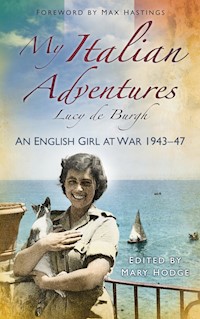
Cover image: Author’s collection.
Contents
Title
The Monte San Martino Trust
Foreword
Chapter 1 Joining Up
Chapter 2 My First Posting
Chapter 3 Wheels within Wheels
Chapter 4 To an Unknown Destination
Chapter 5 Algerian Interlude
Chapter 6 See Naples – and Live!
Chapter 7 Just the Job
Chapter 8 All Roads Lead to Rome
Chapter 9 On the Fringe of the Eternal City
Chapter 10 Mädchen in Uniform
Chapter 11 Do in Rome as Rome Does
Chapter 12 Excursions
Chapter 13 Live and Learn
Chapter 14 Roman Winter I
Chapter 15 Roman Winter II
Chapter 16 Posillipo
Chapter 17 Bella Napoli
Chapter 18 Torn’ a Sorrento
Chapter 19 A Journey of Discovery
Chapter 20 Back in Harness, But not for Long
Chapter 21 Home, Sweet Home
Chapter 22 Traveller’s Joy
Chapter 23 Retrenchment
Chapter 24 A New Job – and a Fresh Angle on Italy
Chapter 25 Roman Carnival
Chapter 26 Will Proceed to Milan
Chapter 27 Milano!
Chapter 28 Verona and other Peregrinations
Chapter 29 Italian Summer
Chapter 30 Investigations!
Chapter 31 Cavalcade
Chapter 32 Trieste
Chapter 33 Sacred and Profane
Chapter 34 North of the Border Once More
Chapter 35 Last Roman Christmas
Chapter 36 Onore al Merito
Chapter 37 Winter Journey
Chapter 38 Nearly a Bad End
Chapter 39 A Rivederci!
The Author
Plates
Copyright
The Monte San Martino Trust
In September 1943, after Italy signed an armistice, tens of thousands of Allied prisoners of war sought to make good their opportunity to escape from captivity and recapture by the Germans.
The author of this book, Lucy de Burgh (née Addey), has donated her royalties to the Monte San Martino Trust, a charity established to commemorate the bravery of those Italians who assisted the fugitives.
Lucy Addey was the intelligence officer in the Allied Screening Commission, which investigated the fate of those fugitives after the Allied invasion of Italy. She later married its commanding officer, who had himself been helped following his own escape from Fontanellato Camp, near Parma. Their admiration for the Italians whom the Trust seeks to remember is recorded in this book.
The Monte San Martino Trust is named after a small village in the Marche region of Italy, as a tribute to the villagers, who were amongst the first to help the founder of the organisation, Keith Killby, and many others.
The Italians, many of them extremely poor farmers, shared what little food they had, provided clothing and shelter, and generally did what they could to help the escapers on their way. In doing so, they risked imprisonment and the loss of their property. Many even paid with their lives.
Every summer, the Trust brings twenty young Italians to England for a month to learn English, in Oxford and London, and to experience the British way of life. The students come from the regions of Italy where escaping prisoners found refuge, and many of them come from families who themselves sheltered prisoners – and possess Alexander Certificates to prove it.
The Trust links the escapers, and their descendants, with the Italian families by organising fundraising events and commemorative trails in Italy. The Trust also has an archive of 100 POW manuscript diaries and books, an important source for historians of the period, and a priceless memorial to some very brave Italians, and their kindness to strangers.
My own father was also in Fontanellato Camp, and owed his own eventual safe return to the many families who sheltered him and, in particular, to two Italian partisans who died helping him cross the final mountain range.
The Trust (registered charity No.1113897) relies entirely on donations to carry out its work. If you would like further information, or if you would like to make a donation, please visit our website www.msmtrust.org.uk
Sir Nicholas Young
Chairman, Monte San Martino Trust
Chief Executive, The Red Cross
London, August 2012
Foreword
M any twenty-first century people who are not Italian merely have a vague notion of Mussolini’s Italy during the war as a Fascist state that was a bungling accessory to Hitler’s tyranny. In truth, as historians know, the principal victims of Mussolini’s grotesque political and imperialistic pretensions were his own people. If he had preserved Italian neutrality in 1940, instead of plunging into the war in hopes of a share of Nazi booty, I believe that he might have sustained his dictatorship for many years in the same fashion as General Franco of Spain, who presided over more mass murders than the Duce, yet was eventually welcomed into membership of NATO. It is unlikely that Hitler would have invaded Italy merely because Mussolini clung to non-belligerent status; the country had nothing Nazi Germany valued. As it was, however, between 1940 and 1945 the catastrophic consequences of adherence to the Axis were visited upon Italy. What I mostly want to do here is to offer a brief narrative of what ordinary Italian people suffered in the war, especially in its last two years.
Italy’s surrender in 1943 precipitated a mass migration of British POWs, set free from camps in the north to undertake treks down the Apennines towards the Allied lines. A defining characteristic of such odysseys, many of which lasted months, was the succour such men received. Peasant kindness was prompted by an instinctive human sympathy, rather than by any great ideological enthusiasm for the Allied cause, and it deeply moved its beneficiaries. The Germans punished civilians who assisted escapers by the destruction of their homes, and often by death. Yet sanctions proved ineffectual: thousands of British soldiers were sheltered by tens of thousands of Italian country folk whose courage and charity represented, I suggest, the noblest aspect of Italy’s unhappy role in the war. A young Canadian soldier, Farley Mowat, arrived in the country with a contempt for its people. But he changed his mind after living among them. Mowat wrote home from a foxhole below Monte Cassino:
…it turns out they’re the ones who are really the salt of the earth. The ordinary folk, that is. They have to work so hard to stay alive it’s a wonder they aren’t as sour as green lemons, but instead they’re full of fun and laughter. They’re also tough as hell… They ought to hate our guts as much as Jerry’s but the only ones I wouldn’t trust are the priests and lawyers.
For many months even before Marshal Badoglio’s government surrendered to the Allies, his fellow-countrymen saw themselves not as belligerents, but instead as helpless victims. The American-born writer Iris Origo, living in a castello in Tuscany with her Italian husband, wrote in her diary:
It is... necessary to… realize how widespread is the conviction among Italians that the war was a calamity imposed upon them by German forces – in no sense the will of the Italian people, and therefore something for which they cannot be held responsible.
The Italians’ overthrow of Mussolini and declaration of war on Germany in October 1943, far from bringing a cessation of bloodshed and freeing their country to embrace the Allies, exposed it to devastation at the hands of both warring armies. The view of many Italians about their nation’s change of allegiance, and about the Germans, was expressed in a letter one man wrote two days later: ‘I won’t fight on their side – nor against them, although I think them disgusting.’ Iris Origo noted: ‘The great mass of Italians “tira a campare” – just rub along.’ Emanuele Artom, a member of a Torinese Jewish intellectual resistance group, wrote:
Half Italy is German, half is English and there is no longer an Italian Italy. There are those who have taken off their uniforms to flee the Germans; there are those who are worried about how they will support themselves; and finally there are those who announce that now is the moment of choice, to go to war against a new enemy.
Artom himself was captured, tortured and executed in the following year.
Nazi repression and fear of being deported to Germany for forced labour provoked a dramatic growth of partisan activity, especially in the north of Italy. Young men took to the mountains and pursued lives of semi-banditry: by the war’s end, at least 150,000 Italians were under arms as guerrillas. Political divisions caused factional warfare in many areas, notably between Royalists and Communists. Some Fascists continued to fight alongside the Germans, while the Allies raised their own Italian units to reinforce the overstretched Anglo-American armies. Italians were united only in their desperate desire for all the belligerents to quit their shores.
Instead, their agony persisted and deepened. In June 1944, amid the euphoria of the Allied armies’ advance on Rome, the commander-in-chief General Sir Harold Alexander made a gravely ill-judged radio broadcast appeal to Italy’s partisans, calling on them to rise in arms against the Germans. Many communities consequently suffered savage repression, when the Allied breakthrough proved inconclusive. After the war, Italians compared Anglo-American incitement to a partisan revolt, followed by the subsequent abandonment of the population to retribution, with the Russians’ failure to succour Warsaw during its equally disastrous Warsaw Rising in the autumn of 1944. The lesson was indeed the same: Allied commanders who promoted guerrilla warfare behind the Axis lines accepted a heavy moral responsibility for the horrors that followed.
The Germans, having previously regarded the Italians merely as feeble allies, now viewed them as traitors. An Italian officer, Lieutenant Pedro Ferreira, wrote: ‘We are poor wretches, poor beings left to the mercy of events, without homeland, without law or sense of honour.’ He was serving in Yugoslavia, where many of his comrades were shot by the Germans after the armistice. The Nazi General Albert Kesselring ruled Italy with a ruthlessness vividly documented in his order of 17 June 1944:
The fight against the partisans must be conducted with all means at our disposal and with utmost severity. I will protect any commander who exceeds our usual restraint in the choice and severity of the methods he adopts against partisans. In this connection the principle holds good that a mistake in the choice of methods in executing one’s orders is better than failure or neglect to act.
He added on 1 July: ‘Wherever there is evidence of considerable numbers of partisan groups a proportion of the male population will be shot.’
The most notorious massacre of innocents was carried out at Hitler’s behest, with Kesselring’s endorsement, under the direction of Rome’s Gestapo chief. On 23 March 1944, partisans attacked a marching column of German troops in the Via Rasella. Gunfire and explosives killed thirty-three Germans and ten civilians. In reprisal, Hitler demanded the deaths of ten Italians for each German. Next afternoon, 335 prisoners were taken from the Regina Coeli prison to the Ardeatine Caves. They were a random miscellany of actors, lawyers, doctors, shopkeepers, cabinet-makers, an opera singer and a priest. Some were communists, and seventy-five were Jews. Two hundred of them had been seized in the streets near the Via Rasella following the partisan attack, though none was involved in it. In batches of five, they were led into the caves, executed, the bodies left where they fell; the Germans used explosives to close a shaft in a half-hearted attempt to conceal the massacre. Still, the caves became a place of pilgrimage and tears.
There were a handful of survivors of another massacre, in the churchyard at Marzabotto, a picturesque little town at the foot of the Apennines, where in September 1944 Waffen-SS troops exacted a terrible revenge on the civilian population for local partisan activity and assistance given to Allied prisoners: ‘All the children were killed in their mothers’ arms,’ wrote a woman who miraculously lived. Though herself badly hit, she lay motionless under the dead:
Above and beside me were the bodies of my cousins and of my mother. I lay motionless all that night, through next day and the night following, in rain and a sea of blood. I almost stopped breathing.
At dawn on the second day, she and four other wounded women crawled out from beneath the heaped corpses. Of her own family, five had been killed. In all, 147 people died at the church, including the priests who had been officiating when the SS arrived; twenty-eight families were wiped out. At nearby Casolari a further 282 victims perished, including thirty-eight children and two nuns. The final local civilian toll was 1,830, and moved Mussolini to make a vain protest to Hitler. This was the sort of price many Italian communities paid for resisting Nazism, and which contributed heavily to the country’s wartime civilian death toll of 153,000, three times that of Britain. Three-quarters of that number perished after the Italian armistice.
If the Allied invaders never matched the sort of horrors the Nazis inflicted on Italians, they were parties to lesser crimes: French colonial troops, especially, committed large-scale atrocities. ‘Whenever they take a town or a village, a wholesale rape of the population takes place,’ wrote a British NCO, Norman Lewis:
Recently all females in the villages of Patricia, Pofi, Supino and Morolo were violated. In Lenola… fifty women were raped, but – as these were not enough to go round – children and even old men were violated. Today I went to Santa Maria a Vico to see a girl said to have been driven insane as the result of an attack by a large party of Moors… She was unable to walk… At last one had faced the flesh-and-blood reality of the kind of horror that drove the whole female population of Macedonian villages two centuries ago to throw themselves from the cliffs rather than fall into the hands of the advancing Turks.
Such Allied excesses, matched by the effects of air and artillery bombardment through the long struggle up the peninsula, ensured that few Italians gained much joy from their ‘deliverance’. Two soldiers of 4th Indian Division were chasing a chicken around a farmyard when a window of the adjoining house was thrown open: ‘A woman’s head appeared, and a totally unexpected English voice called out “**** off, and leave my ****ing ’ens alone. We don’t need no liberation ’ere.”’
The wild Italian countryside and hospitable customs of its inhabitants prompted desertions from the Allied armies on a scale greater than in any other theatre. The rear areas teemed with military fugitives, men ‘on the trot’ – overwhelmingly infantry because they recognised their own poor prospects of survival at the Front. Thirty thousand British deserters were estimated by some informed senior officers to be at liberty in Italy in 1944–45 – the equivalent of two divisions – and around half that number of Americans.
Both the Germans and Allies distributed broadsheets to the population, making competing demands for their aid. Iris Origo wrote:
The peasants read these leaflets with bewildered anxiety as to their own fate, and complete indifference (in most cases) to the main issue: Che sara di noi? – What will become of us? All that they want is peace – to get back to their land – and to save their sons. They live in a state of chronic uncertainty about what to expect from the arrival of soldiers of any nationality. They might bring food or massacre, liberation or pillage.
On the afternoon of 12 June 1944, Origo was in the garden of her castello rehearsing Sleeping Beauty with her resident complement of refugee children, when a party of heavily armed German troops descended from a truck.
Full of terror, she asked what they wanted, to receive a wholly unexpected answer:
‘Please – wouldn’t the children sing for us?’ The children sang ‘O Tannenbaum’ and ‘Stille Nacht’ (which they learned last Christmas) – and tears come into the men’s eyes. ‘Die heimat – it takes us back to die Heimat!’ So they climb into their lorry and drive away.
Less than two weeks later, the area was occupied by French colonial troops. Here were the alleged liberators, yet Origo wrote bitterly:
The Goums have completed what the Germans begun. They regard loot and rape as the just reward for battle, and have indulged freely in both. Not only girls and young women, but even an old woman of eighty has been raped. Such has been Val d’Orcia’s first introduction to Allied rule – so long and so eagerly awaited!
Allied forces sustained a sluggish advance up the peninsula, but from the summer of 1944 onwards, it was a source of dismay to Alexander’s soldiers that Mediterranean operations and sacrifices commanded diminishing attention at home. ‘We are the D-Day dodgers in sunny Italee’, they sang, in irony, ‘always on the vino, always on the spree…’. So they were regarded by some foolish people, who knew nothing of the reality of the mud, blood and misery in which the rival armies, and the Italian people, existed for most of the war years, the condition of the civilians being rendered far worse in the last years of the war by desperate hunger, indeed in some cases starvation.
For Italians, hunger was a persistent reality from the moment the country became a battlefield in 1943: ‘My father had no steady income,’ recalled the daughter of a rich Rome publisher:
Our savings were spent, we were many in the house, including two brothers in hiding. I went with my father to the [public] soup kitchen because my mother was ashamed to do so. We made our own soup from broad bean skins. We had no olive oil… A flask of oil cost 2,000 lire when our entire house had cost only 70,000. We bought whatever was available on the black market, bartering with silver, sheets, embroidered linen. Silver was worth less than flour; even our daughters’ dowries were exchanged for meat or eggs. Then in November with the cold weather we had to exchange goods for coal: the longest queues formed at the coal merchants. We carried the sacks back on our own, because it was better that no man showed his face [lest he should be conscripted for forced labour].
The Allies who were supposedly liberating Italy treated the country with remarkable callousness. In December 1944, when there was hunger verging upon starvation in Italy, a British Embassy official in Washington visited Assistant Secretary of War John J. McCloy to protest against the policy of shipping extravagant quantities of supplies to US forces overseas, while Italian civilians were in desperate straits. ‘In order to win the war,’ he demanded of McCloy, ‘were we not imperilling the political and social fabric of European civilization on which the future peace of the world depended?’ This drew from Mr McCloy the immediate rejoinder that:
It was in British interests to remember that, as a result of the complete change in the economic and financial position of the British Commonwealth which the war had brought about, we, in the UK, depended at least as much upon the US as we did upon Europe. Was it wise to risk losing the support of the US in seeking the support of Western Europe? This was what was involved.
The shocked British official persisted in pressing the case for feeding Europe’s civilians. McCloy stuck to his guns, asserting that it would be fatal for Britain ‘to argue that the war in the Pacific should be retarded in order that the civilian population of Europe should be fed’. The Foreign Office in London professed acute dismay on receiving the minute of this meeting, but British impotence in the face of US dominance remained a towering reality. That only a relatively small number of Italians died of starvation between 1943 and 1945 was due first, to the illicit diversion of vast quantities of American rations to the black market, and thereafter to the people – much to the private enrichment of some US service personnel; and to the political influence of Italian-Americans at home, which belatedly persuaded Washington of the case for averting mass starvation.
So there it is – just a few vignettes which I hope help to illustrate the nature of the tragic experience that the Italian people endured in the Second World War. It is because, as a historian, I know more than most people about the story, and about the noble part played by some of its humblest people, that I am so happy to support the work of the Monte San Martino Trust. It strives to keep alive an understanding of what we, the British, owed to many fine Italians; to show our recognition of that old debt of our fathers and grandfathers; and to renew the bond. It is sometimes said that in Britain, we remain in the twenty-first century too preoccupied, even obsessed, with the Second World War. But there are some aspects of the legacy that richly deserve to be kept alive, and indeed to be renewed, in the fashion that the Trust aspires to do.
Sir Max Hastings
1
Joining Up
W hen the war broke out, I was at university studying French and German. Of course I wanted to rush off and join up, like everyone else, but my father persuaded me to stay on and finish my course, saying I would be more useful to the country fully trained than with no diploma or certificate at my fingertips. I hope subsequent events proved him right. In any case, my military career would undoubtedly have taken a different course had I not finished my studies and rounded them off with an arduous secretarial training course.
So it was eventually at Christmas 1941 that I had to make up my mind what form of war work to take up. I had an interview with my principal, who told me in no uncertain terms that she considered that I should join up. I was still attracted by the idea, but other forms of war work were gradually evolving for girls, and I had an interview for an interesting job, dealing with the foreign, in particular the enemy, press. If I had taken that, I would probably have stayed in the university town for the duration, but my principal was quite annoyed when I asked her for a reference for it, saying she had already told me it was my duty to join up. What finally decided me to join the ATS (Women’s Auxiliary Territorial Service), which I shall continue to call them, as the WRAC (Women’s Royal Army Corps) did not come into being until my service was over, was the fact that people in the provincial town where my home was, in our immediate circle, seemed to think it was shocking. In those days, the ATS were still a bit of a novelty and wild stories were in circulation about their supposed immorality, their undisciplined form of life, their rough ways and toughness and so on. The thought of joining this apparently ill-conditioned crowd of reprobate young women appealed to me tremendously, and within a short time I had applied at the local recruiting office. I was told that as I spoke German I must write to a certain branch of the War Office, which I did.
In due course, forms arrived for me to fill in and eventually I was called for interview in London. I went up for the day, dressed plainly, but I hoped not frumpily, in a check tweed costume and brown hat to tone in. The Board consisted of about five men and two women, one of whom later asked me questions in German. I don’t remember being asked if I played cricket, but if I was, then the answer was in the affirmative. Fortunately, the interviewers would have no chance of measuring my utter lack of skill before taking me in or throwing me out. I was told that if accepted I would do a basic preliminary training followed by an officer’s training, and then be posted to whatever work was in store for me. I had not wanted to become an officer, at least not so quickly, but as I was apparently being interviewed for the Intelligence Service, and at that time the only women allowed into it were officers, so I would have to be commissioned. As I knew absolutely nothing about army life, this information really made a very small impression on me. As long as I joined up, I really did not care what happened.
That interview was in April 1942. After being told in a letter that I had been accepted, I waited until June for instructions to proceed somewhere to start my training. It was a beautiful summer and it was my last at our home in the town where we had always lived. We did not have many raids, so the time passed pleasantly enough, but I was anxious to be off and on the job.
Finally, when the posting instructions did come, on 20 June, I discovered that I was not to go to a preliminary training centre, but straight to an OCTU (Officer Cadet Training Unit) in Edinburgh. I was not worried about going straight to the OCTU until I got there and found a most terrifying array of sergeant majors, CQMSs (company quartermaster sergeants), sergeants and corporals there for the same purpose as I, all bursting with military zeal and efficiency, and wondering who on earth this stray civilian was who had clocked in with them and appeared to be trying to get herself kitted out in second-hand khaki. Fortunately, I had two companions in distress, like myself under the Army Officers’ Emergency Reserve arrangement. They were also in civvies, but by the end of the second day we were as well dressed as possible in new, part-worn uniforms, and fresh khaki stockings. We found the shoes agonising on parade. Luckily, I had come in an old pair of brogues, which I substituted as often as possible for the cruel new ‘shoes leather lacing brown ATS’ or whatever they were listed as. Needless to say, we three peculiarities were not sorry when our ultra-efficient companions all had to strip off their badges of rank. From then on we were all just officer-cadets.
Of course for us civilians, the new girls, life was all very strange and trying, to say the least, though even the ‘old soldiers’ who were with us did not find the OCTU course a party. During the first week I felt I should never survive it, and that I should soon become a raving lunatic. Lectures, parades, PT (physical training), kit inspections – all followed in a dizzy succession. And one dare not be late for anything. This last was particularly gruelling for me, not long from the gentler and more casual ways of a university town, but by the end of the first week I was resigned. If I were flung out, then that would be that. There was nothing humanly possible I could do about it, so it was better bow to the inevitable, and meanwhile do my best and enjoy what I could, the latter of which was was almost everything. With the aid of this philosophy of resignation, and the practical help and guidance of Tim, my room-mate, I was able to carry on, and even when large-scale sackings occurred round about the fourth week of the course, I remained unperturbed. The idea of becoming a private, possibly in ‘Ack-Ack’,1 was beginning to appeal to me. After all, what did I want with a commission? I wanted to begin at the bottom and work my way up like the others. Only the thought of my father’s disappointment if I failed to come through clouded my horizon – for his sake I would gladly sacrifice romantic dreams of a gun-site and the company of hearty and tough he-men of the Bombardiers.
Here a word about Tim. She was a real brick if ever there was one. She taught me how to make my shoes shine, how to polish my buttons all four at once, how to barrack my bed, how to lay my kit out for inspection, how to put on my cap (that most uninspiring portion of feminine attire), exactly how and whom to salute, and a hundred-and-one other useful bits of knowledge, without which I should have found the whole course far more trying than I actually did. She cheered me up when I was in despair, and she sympathised with me when nothing seemed right: my hair was too long and wouldn’t stay in its net, my skirt was too long, or my pockets were undone, etc., etc. She was a real pal and we had great fun in our tiny little room. Of course at first she was astonished to find herself sharing a room with a queer bod like me, but she soon swallowed her amazement and set to work to mould me into at least a fairly presentable cadet, who very soon after the first week forgot she had just stepped into OCTU off a passing bus, as it were, whereas everyone else had been travelling towards it for some considerable time.
In our off-time we went off into Edinburgh and ate large sumptuous teas at one of the comfortable restaurants along Princes Street, or just walked up and down, studying the different uniforms, and getting quite a lot of fun out of saluting all officers, male and female, including the Poles, who were there in force at that time. The first time I attempted to salute a male officer, I nearly slipped and fell backwards, being so nervous about the correct procedure. After that I was more careful of my ground before I ventured on saluting when in town.
As I had an aunt in Edinburgh, I was sometimes able to get away from the military atmosphere and have a change. But I never minded going back. Timmy and I always had some spicy bit of gossip, mostly about our instructors, to entertain each other with. In the evenings sometimes, I studied King’s Regulations and ATS Regulations with diligence, though how much I was really able to absorb in such a short time is doubtful. I managed to read the whole of the ATS Regulations, but fortunately perhaps there was no time to read any other army handbook in full.
When our passing-out parade took place, the Princess Royal took the salute. I was very impressed by her charm, and her wonderful complexion and hair. Thank goodness she did not speak to me, as I should have been frozen stiff with terror and am sure would not have been able to utter a word. As it was, a major misfortune befell me that day. While we were standing at ease before the parade really began, a bird dropped on me, and it was with the utmost difficulty that I surreptitiously cleaned away the mess from a shoe and my tunic. For years I looked upon that as a hideous and horrible occurrence, and a long time afterwards when I at last had the courage to confide in someone about it, they laughed and said that on the contrary it was a sign of good luck and nothing to worry about. Otherwise I thoroughly enjoyed the passing-out parade, as it was particularly inspiring to march to the band of the Dragoon Guards.
These parades meant extensive preparatory training and the sergeant major was busy for days drilling and grooming us all in readiness for the great events. She was of medium height, impeccably smart, and as peppery as one would ever wish a female sergeant major to be. ‘Swing those arms,’ she would roar, ‘they won’t come off,’ as we trudged, or goose-stepped, up and down the parade ground. And we swung our arms shoulder high, so that nearly all the muscles of our backs and shoulders were stiff and aching, and one almost longed for one’s arms to drop off, to prove the RSM (regimental sergeant major) false, if nothing else. Her eagle eyes picked out in a second any irregularity in the line, a hair out of place, or too generous an application of lipstick. This latter she would order to be removed with a handkerchief. To me she was on a pedestal of military perfection – a sort of Goddess Diana of the ATS. And I could never see her without thinking anxiously of how much I had put in my tunic pockets, or whether my shoes might be down-at-heel or my hairnet too low on my collar. She made us conscious of our appearance and bearing to the last.
As may be imagined, after these harrowing times, I went home on my end-of-leave course feeling quite an old hand after such a concentrated baptism of fire. I travelled down by train at night, spending most of the time in the corridor. The train was packed, and soldiers were lying along the floors, or on the racks, and even in the cloakrooms. Needless to say, sleep was impossible, but as long as one is going on leave one does not worry about sleep.
We had approximately ten days’ leave, which I spent mostly in ordering and being fitted for my uniform by our tailor at home. It was expensive, but they made it well and to fit, and today one of my barathea uniforms has been transformed into quite a smart black costume, trimmed with black corduroy, which testifies to the quality of the material. I had my greatcoat lined with red, as that seemed to be the fashion at OCTU, even though my family was of the opinion that it was too flashy.
During this leave I received my posting orders, to an ‘unknown destination’, and was told that I would be met at a certain station. It all sounded terribly cloak and dagger, especially the mysterious letters denoting the name of my future unit. This was it. My military career was to start.
Note
1 Anti-Aircraft Artillery.
2
My First Posting
I have no very clear recollection of arriving at my first unit, as a second subaltern, ATS. I was appalled and overwhelmed by the preponderance of men over women in the mess – something I was to get far more used to later on. I felt gawky and quite speechless and was exceedingly glad when nobody took much notice of me, although everyone I was introduced to was extremely kind and friendly. But I felt very much at the bottom of the form. I had two companions in distress with me, however, and I found myself sharing a room with one of them, a girl of about 34, very attractive, who soon acquired the nickname of ‘Birdsnest’ on account of her hair-style, which was swept up and attached with combs at the crown.
We all started work in the general office, and to my chagrin I found my work consisted mainly of copy-typing, not even translating. For this, older and more experienced girls were employed, all of course holding officer rank. As for my work, mostly typing stencils in German and English, it did not seem worthwhile being commissioned for, but I consoled myself with the fact that it was at least ‘TOP SECRET’.
I soon made a friend of Jacqueline, who had been in the original FANYs (First Aid Nursing Yeomanry), and when that corps was divided into the so-called Free FANYs and ATS, had elected to join the ATS. We used to go for walks after dinner in the evening, along the peaceful country lanes, and she would tell me of her ambition to go overseas and also of her many admirers of the opposite sex, though at times she seemed herself to have an innate contempt for the men we came into daily contact with. She told me I should not stay ‘stuck in the mud’ at this secret address, c/o the GPO, for all the war, but should also try to get abroad.
I had only just joined up, and frankly the idea of going overseas had not yet suggested itself to me, but I wrote to my father, whose advice I always sought, and to my surprise he said it would be an excellent idea and urged me to apply without delay. But I dallied a little longer, and meanwhile Jacqueline went off, wearing an engagement ring on the fourth finger of each hand, and I missed her exhilarating company and robust sense of humour. I heard some months afterwards that she had gone out to a corresponding unit in Cairo, affiliated to ours, and had been the only woman on a large troopship. In those days, the convoys made an enormous detour across the Atlantic, and Jacqueline landed in Brazil, or touched there, and finally put in at Cape Town and Durban, completing the rest of the journey by train from South Africa. She told me that on Christmas Day 1942 she had been invited for a drink by every man on board, but as she was completely teetotal, had herself only drunk lemonade, having been able to play skilfully with the glasses and, unobserved, leave them untasted on the bar, so that she offended no-one. Needless to say, her drinks were not wasted.
Jacqueline had worked in a different office from mine, which she shared with one other girl and two men officers, and her place was taken by another ATS subaltern. I had occasionally assisted Jacqueline with the typing of her long reports in English, as we in the office were not always at top pressure, and likewise were sometimes able to give her successor a hand. She was called Roberta, and she also had applied for overseas service. When she too went off, it was not really unnatural that I should be chosen to take her place. This pleased me greatly, the office was smaller and I was away from the madding crowd. I had some very interesting indexing to do, which would have made me happier had it been of more use, but so much effort seemed to be put into what was little used. The worst of war is that you must always prepare for any eventuality, and so much spadework was necessary, and so I worked away on the index; indeed, to my intense gratification and that of the other people working on it too, it was sometimes used for important reports.
My new boss was an intellectual captain, very keen on his job, so much so that he used to ascertain whether the CO (Commanding Officer) was free to grant him an interview by peering through the keyhole of the door leading directly from the colonel’s office to the main corridor of the block. Captain Heath was large and burly and the portion of his anatomy thus protruding caused quite an obstacle in the traffic up and down the passageway.
Our other male member was a Captain Smithers, affectionately known as ‘Auntie’. His chief claim to eccentricity was that he ate no lunch. While we were all digesting whatever RASC (Royal Army Service Corps) had provided, his poor inside would be painfully rumbling between 2 p.m. and 3 p.m. At three o’clock he broke his fast and allowed himself his sandwiches, neatly packed in a tin each morning by his wife, for he was billeted at home. Occasionally, when a general’s inspection was in the offing, Auntie had to retire to the office cupboard and demolish his sandwiches in hiding. His main meal of the day was in the evening and he then made up for his missing lunch. Sometimes he would invite us all to dinner, where we fed like Epicureans. He and his wife were experts in food and wine, and even in 1943 they were able to produce caviar.
But an even more happy memory is that of the delightful evenings we spent in the Smithers’ large and attractive flat, forgetting the war for a time and discussing many interesting things, such as art and foreign travel, which one tended to forget in those gloomy days. Captain Heath and his wife also entertained us very kindly, and these excursions away from the mess made a very pleasant change from the customary routine of dinner, coffee, chores and bed.
Hilary, the other ATS officer, was a junior commander, with three pips. She was a strange, quiet and modest person, but we got on well together, though she hated and shunned social life, whereas I enjoyed it. After my initial shyness had worn off, I was beginning to find interest in the huge crowd, constantly changing, in the large inter-service mess in which we lived. Once a week or so, I went to the Other Ranks’ (ORs) dances, and began to realise what very good dancers the soldiers were.
We had a company of ATs attached to us, and they did all the cooking, batting for the women officers and administrative clerking. Later on, as manpower became tighter and tighter, they also did batting for the male officers, but only after very specific rules had been laid down for their observance – and that of their officers. They were not allowed in the officers’ quarters before 8 a.m. or after 8 p.m., etc., etc. My batwoman was a twin, or rather the two twins batted for our wing. To me they both looked exactly alike and I never could tell the difference, although people told me that one of them had false teeth and was therefore distinguishable from her sister. Anyway, they looked after us splendidly and were always bright and cheerful.
As regards the food, it was not at all bad, though I have felt positive nausea ever since at the sight of a bread-and-butter pudding, so often did the spare bread get used up in this way. One thing in connection with the food was the tinned milk – we had mostly tinned milk, some sweet, which took a lot of getting used to. When the unit qualified for a full time ATS messing officer, the catering improved. Funnily enough, I became very friendly with the messing officer and found that I had known her husband, then serving overseas, since childhood.
I had a small electric ring stove, on which I used to boil cocoa at night (I think we scrounged a little left-over milk). This was most comforting last thing, although it was forbidden to use electrical appliances. We even made marmalade out of one or two oranges – or even just orange peel – later on, after everyone was given individual rations of sugar. The girls made excellent cakes for afternoon tea, which we had in the mess, going back to the office afterwards. We appreciated that tea, which was most refreshing after poring over reports and papers all afternoon, especially in the hot summer. Something which grew in abundance locally was mushrooms, which could be gathered in the fields around our stately home. I had a nice boyfriend, who picked them for me and gave them to an ATS waitress before breakfast. I can still see her look of conspiratorial glee as she served me with the token mushrooms.
During my work at this time I met many interesting people, who in civvy street had done all sorts of different jobs. Most of them had travelled, some very extensively. There were among us a famous pianist, a conductor, a well-known actor, an outstanding psychiatrist, people who had been in business or the consular service, teachers, lawyers and people of other professions. The psychiatrist was held in awe by some, in scorn by others, but in general was universally liked, and quite well aware of the effect that his designation, belonging to the ‘Army Psychiatric Corps’, had on the most hard-bitten of officers. I always remember him at breakfast, which he invariably attended bright and early; he was very alert at all times, perhaps in contrast to everyone else, especially first thing in the morning. With a charming smile he would bend towards his next-door neighbour, or the man opposite, and enquire quite innocently and apropos of nothing, ‘And what do you think of Beethoven?’ Some people maintained that he was writing secret psychological analyses of us all, while others quoted him as saying that the only sane person in the whole unit was the transport officer. I just remember him making me earrings of cherries at a dance in summer 1943, but doubtless he had forgotten psychology on that occasion.
Christmas 1942, my first in the army, was wonderful. The officers served the troops at midday and had their own party in the evening. I remember washing up and scouring some of the most enormous pots and pans I had ever seen. It was tremendous fun, as was also the Christmas dance. We had a very good band, for talent was not lacking. Most of the soldiers were not afraid to dance with one if one wore pips on one’s shoulders, thank goodness, or we might have had a pretty thin time. Our office cleaner used to make a point of dancing with all the ladies – in fact sometimes more than convention permitted. Sometimes his swarthy Celtic face with its shock of unruly black hair would appear at our office windows at the most unexpected moments, with a naughty look in his black gleaming eyes. His nickname was Sambo. We missed him when he went off to more active service, as a lot of our other ranks did as time wore on.
The girls lived in a compound away from the main building, mostly in Nissen huts. They were probably not too comfortable, but complained very little. At least they had good food, and enough of it, and they could never have lacked boyfriends.
During 1943 our American invasion began, and we soon had a great many Americans of different ranks and services attached to us. Some of them were still ‘unassimilated’, as one might say, i.e., they were still more European, of different countries, than actually American, with their own particular accents and mannerisms. But somehow they already bore a stamp that unmistakably marked them out as from the US.
In our office also we had a change. Hilary went away for health reasons, and I took over from her and was given one assistant, and then another. The second wore her hair in a swept-up style like my room-mate and became known, likewise affectionately, as ‘Bath-Cap’. She had a double-barrelled name that took one right back to Killarney, or some such place, and was, I would say, an Irish rebel. She eventually succeeded me in the office.
Meanwhile, I had put in my application for a transfer overseas after Christmas 1942. It was not viewed with much favour and, I suspect, was shelved for some months. I submitted it three times in all, either written or verbally. On one occasion, the colonel told me I was a ‘naughty girl’ to wish to go overseas, but that did not deter me. My father kept on pressing me to be more active about it, but I had a horror of senior ranks and interviews with them, and I hated making a nuisance of myself – my parents did not realise that the commanding officer and the second-in-command were like the gods in Valhalla to a young, inexperienced and nervous second subaltern. But finally the index got me down, and as I was becoming increasingly interested in the administrative side of ATS work, I decided to try for a transfer to that, and asked to be sent on the admin course at Egham. Needless to say, my request was refused, but I think the powers-that-be were tiring of my applications, because a short time afterwards the colonel’s personal assistant sent for me and told me that I had just half a minute to make my mind up: did I want to go abroad, to an unknown destination, at any moment, or not? It did not take me half a minute to form my decision. It was the chance I had been waiting for and it would also get me out of an awkward predicament in my personal affairs, which was on my mind and had to be disposed of somehow. This was not the first time that I felt there is a hand guiding one’s human destiny. I felt instinctively that this opportunity must be grasped, come what may.
3
Wheels Within Wheels
A fter the first thrilling moment of decision, there was a wait of about a month or six weeks. I was gripped in an agony of suspense, but meanwhile the battle for Naples had taken place and the Allies were moving up the Garigliano.
Two other girls were on the same venture with me – one a nice junior commander, with whom I had been associating at work during the last few months, and the other girl married to an officer who had been with our unit. She had been brought up and educated in Italy, and was hoping to join her husband, or be near him, somewhere in the Mediterranean, where we all hoped to be going, though we had not the slightest information on which to base our hopes.
While I was doing my secretarial course, I had started learning Italian with a German philosopher who had spent several years in Rome. We had begun the highly entertaining reading of Boccaccio, until my omniscient parent got wind of it. He then decreed that either I gave up Boccaccio or I gave up Italian. That was how we came to embark on Dante, but I am afraid The Divine Comedy is still more or less a closed book to me. During the evenings, however, I had been continuing my lessons with a charming Italian lady in London. It was rather an effort to get to her, but well worthwhile, for the lessons were entertaining. I thought that perhaps one day a slight knowledge of the language might come in useful – you never could tell.
After the interim period was up, I was sent for one day and told that together with the other two ATS officers I was to go on an ATS intelligence course – I believe the first of its kind, so we were very privileged. On 11 March 1944 we three joined the train at King’s Cross en route for Leicester. From there, we were transported in a troop carrier to an enormous, bleak and rather forbidding barracks on the edge of the city. There was a contingent of ATS stationed there, and among other things, they looked after our messing and quarters. The former was excellent – in fact some of us went away with expanded waistlines – but the quarters were not so comfortable, as it was bitingly cold. We were in old-fashioned billets, which were extremely chilly and draughty and only heated by coal fires, which had to be lit after lecture hours and did not really warm the rooms, even by the time we went to bed. In our lecture room, which was a Nissen hut, we had a petrol stove contraption of some kind, which at times gave out a smoke-screen that made one cough and puff. At other times it radiated a fairly friendly warmth, which enabled one at least to concentrate, wrapped up in battledress, jerseys, scarves, and sometimes greatcoats.
But if we suffered a little from cold, all that was compensated for by the extreme interest of the course, to a large extent due to the excellence of our instructors, who did everything they could to make the subjects interesting, easily understandable and varied. Of course some of it was difficult for us to grasp, and when it came to an appreciation, most of us floundered at least a little (I did a lot), but in the ten days allotted to us, we acquired a very comprehensive panorama of intelligence in most of its branches, and came away feeling much better informed than when we arrived. Our instructors also brightened our classes with a host of amusing anecdotes and personal and practical experience in field security work, such as the attempted capture of Rommel in the desert. Anyway, a good time was had by all, and we regretfully parted from Leicester, our sorrow somewhat mitigated by relief at leaving the cold, draughty billets.
We returned to our units, but not for more than a month at most, as we then had three weeks’ embarkation leave, a more than generous allowance. This I spent almost entirely at home, and was very busy collecting an enormous store of articles that I had heard were in short supply, such as cosmetics, toothpaste, kirby grips, sewing materials, notepaper, certain medicines and ointments and Keatings flea powder. In fact I had something like a small scale NAAFI (Navy, Army and Air Force Institutes) in my tin trunk, which I purchased in London while at the ATS holding unit in Bayswater.
We were posted to the holding unit about the middle of April, and there we were instructed on what kit we would need, told to buy some, and were issued with other. Some of the girls had managed to procure wonderful gabardine costumes in London, or were in the process of doing so, but as gabardine was difficult to come by and very expensive, I decided to make do with the issue of khaki drill, which included a tunic, into which brass buttons were fitted.
We naturally met other officers, and girls, like us posted overseas, and of course we were all speculating as to where we were going, especially as we were later listed in different drafts. In the transit mess there must have been about fifty of us at that time, and the CO of the holding unit decided it would be a good thing for the officers awaiting their posting to do drill every morning after breakfast. So drill we did, some of us feeling rather foolish, not having drilled for so long. But the sergeant major was very kindly, and took us quite gently, so that no too terrible faux pas were performed for the delectation of Other Ranks passing by.
After our drill we were usually free for the rest of the day to assemble our kit, buy our trunks and camp kit, say our goodbyes, or meet our boyfriends. My mother came up for two days and we went to two theatres, one where we saw Noel Coward’s Arc de Triomphe and the other a magnificent play about the war in Greece, the title of which was There Shall Be No Night.
The holding unit was situated in a delightful modern patch of Bayswater, and I believe luxury flats now stand where our mess was. We were in a quiet corner, so that there was space for drill without being much overlooked, and altogether there was a little hive of ATS life concentrated in that one small area. There were four or five of us in one bedroom, which was large and airy, and there was a constant va-et-vient and an air of suppressed excitement.
We were of course all medically examined, and by the only woman MO (medical officer) I have ever come into professional contact with. Any inoculations we had not already had were brought up to date, including vaccination. I was still awaiting tetanus injections, but of that more later.
One morning we were issued with our khaki drill from the ‘Q’ stores. This was quite a ceremony. Each of us got three drill skirts, a drill tunic and brass buttons and rings to fit in, two bush shirts, three tropical Aertex shirts, cellular vests and pants for hot climates, a large tin mug, water bottle, haversack and kitbag. We were also given two mess tins and a small white coarse linen bag for haversack rations. In addition, those without camp kit were issued with it while we were at the holding unit. This consisted of a large canvas valise, which rolled up, containing a camp-bed, three army blankets, a small hard pillow, a ground sheet and a canvas bucket. I inherited my father’s brown carpet-style kitbag from the 1914–1918 war. This included a nice camp chair, which folded up very conveniently in two pieces, a canvas bath that I never used, another bucket and a kapok mattress to go on the bed, which I got new.2 I also bought a black tin uniform case from a shop in Praed Street, where we were recommended to go to buy containers for our luggage. The tin trunk was invaluable, and still is. We were otherwise allowed two cabin suitcases and a small hand-grip. The latter I had in brown leather with a zip. In addition, when we eventually left, we had to carry on our backs our haversacks holding the mess tins and sandwich bags with haversack rations in them, our gas masks, helmets, water bottles, with our tin mugs attached to the inside strap of our haversacks; this latter contraption made a cheerful jingling sound as we moved in our harness. It must have been a fine peep-show for any Other Ranks about when we were paraded and drilled in full regalia of haversacks, gas masks, helmets, water-bottles and tin mugs, sweating in our battledresses one afternoon in a late and hot April. The hour chosen for the parade was needless to say 1400 hours sharp.
The quartermaster was very kind and helpful. She made sure that we were issued with all the kit that we would need, come what may, and gave us advice on fitting it, and so on. In one thing she failed us. She said that all khaki drill would shrink tremendously and we must buy it at least three sizes too big. Our discipline was good enough to ensure that we did this, but later results proved that the shrinkage was nothing like enough to warrant buying drill three sizes too large. If the New Look had come in a few years earlier, things might have been easier. The quartermaster told us to mark all our luggage with white paint, in large capital letters, with our name, rank, number, service and draft letters. I painted these symbols boldly, clearly, but without much artistry on my trunk, my two suitcases, my kitbag with camp kit, and my ordinary blue kitbag, also on my small handbag, my camera, and my mug, as I was taking no chances. As it was, I put one letter too many on my kitbag, so that my surname ensued with three ‘As’ on it. My room-mate Iris painted her letters on neatly and beautifully. She was ultra-efficient, and her inscribing was finished long before most of us had begun to clean our fingers that were glutinous with paint. We assisted a major of the Royal Army Medical Corps (RAMC) to paint her inscriptions on when we had done our own, so the job cannot have lacked interest. There was plenty of time for it, but what a job erasing it after service days were over! My camera is still embossed with my name, number, rank and service.
Eventually the notice was put up giving marching instructions for our draft. We were to leave by lorry at 2300 hours for an unknown destination. Haversack rations were to be collected from the mess, all cabin and hand kit would go in the troop carrier with us. Our ‘hold’ baggage would be taken off earlier and we would very probably not even see it until we arrived at our destination. We all had to be in the mess for our evening meal that night, but I managed to slip out afterwards to say some goodbyes. It was of course a strict secret that we were leaving that night. There was an air of suspense everywhere. The draft-conducting officers were getting very busy, for several drafts of ATS Other Ranks were due to depart soon after we had left, and everyone was wondering where we would be in another twenty-four hours’ time, and what the journey would be like.




