


Erhalten Sie Zugang zu diesem und mehr als 300000 Büchern ab EUR 5,99 monatlich.
- Herausgeber: Books on Demand
- Kategorie: Sachliteratur, Reportagen, Biografien
- Sprache: Englisch
A hopefully reasonably coherent string of tales about the odd, funny, exhilarating and at times sad experiences I have survived through many years in Africa. From a childhood and teenage-years in Tanzania and then around many countries in Africa until today where I am still fortunate to live, work and travel around this incredible continent. I have endeavoured to let the characters I have met along the way be the thread that carries the reader through the abundance of colour, music, pure human energy and determination to succeed which constantly confronts the observer in Africa. Restless and aimless but with highs of love and lows of broken promises; some dreams came true, others not. My relationship with Africa is complicated. The Africa that will never let go of me.
Sie lesen das E-Book in den Legimi-Apps auf:
Seitenzahl: 488
Veröffentlichungsjahr: 2023
Das E-Book (TTS) können Sie hören im Abo „Legimi Premium” in Legimi-Apps auf:
Ähnliche


















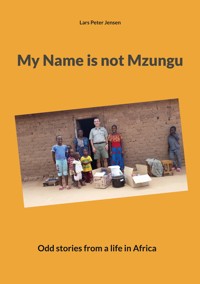
My Name is Not Mzungu
A hopefully reasonably coherent string of tales about the odd, funny, exhilarating and at times sad experiences I have survived through many years in Africa. From a childhood, through teenage years in Tanzania and then around many countries in Africa until today where I am still fortunate to live, work and travel around this incredible continent.
I have endeavoured to let the characters I have met along the way be the thread that carries the reader through the abundance of colour, music, pure human energy and determination to succeed which constantly confronts the observer in Africa.
Just to provide contrast, I have included a few passages from those periods which found me desperately doing my best to conform and fit into what some call home, in the Nordics – rarely successful and always at great personal costs when it just wouldn’t work and Africa beckoned again.
Restless and aimless but with highs of love and lows of broken promises and dreams characterise my relationship with Africa.
The Africa that will never let go of me.
If I have ever seen magic, it has been in Africa
John Hemingway, Grandson of Ernest
For my parents who confused a little boy by taking him to Africa
Table of Contents
FROM SUBURBAN WINTER TO COLOURS IN TANZANIA
MOZAMBIQUE
LESOTHO
MEANWHILE BACK IN MOZAMBIQUE
SO LONG, MOZAMBIQUE
DENMARK
ZAMBIA
ZAMBIA AND A SAFARI IN ANOTHER TIME, TWENTY YEARS EARLIER
ZAMBIA - CONTINUED
ICELAND
ZAMBIA – BACK AGAIN AND A LONG RUN
TANZANIA – LOVE AT FIRST SIGHT
BACK IN TANZANIA IN ANOTHER AGE
UGANDA – YET AGAIN – STILL A FRIENDLY PLACE
THE INDOMITABLE SPIRIT OF AFRICA
FROM SUBURBAN WINTER TO COLOURS IN TANZANIA
Early February 1975 in Denmark, winter, slushy dirty snow, some a deep yellow hue and some a foul-smelling brownish, not at all suitable for snowball fights. Apart from these colourful splotches, everything seemed grey and white. I was ten, almost 11 years old in fifth grade in one of the new mega-schools, Tjørnelyskolen in the new suburbs south of Copenhagen. I played the trumpet in the school band, hated maths and was good at swimming. I did my best to stay away from football, being slight in stature, not much keen on the back-slapping bravado and had no idea who was ahead in the Premier League. 70’s acid-rock also didn’t appeal to me and my first cassette tape, bought with carefully saved pocket money in the new mega shopping centre, was the latest – or probably first Abba tape.
I had never given Africa any thought, except when pictures on TV showed what my parents explained were pictures from civil war in Angola, Mozambique, Rhodesia or yet another atrocity in a village in Idi Amin’s Uganda.
I had never seen a real black person, let alone an African, except in the movies. As far as I knew there were no Africans in Denmark, not to mention our suburb where not even the railway had reached yet.
What first struck me as the door of the aircraft swung open in Nairobi was the hot breeze wafting into the stuffy cabin carrying scents of dust and dry grass from the savannah. And the light. Coming from grey, overcast monochrome in Denmark, the light was painful. Not because the sky was blue; rather it was a bright white and very intense
This was my first encounter with Africa and a life-long love affair with the continent which I can’t explain but which ever since and fatefully has defined my life.
What follows is a hopefully not too incoherent tale of some of the odd, funny, hilarious, exciting and at times possibly sad experiences which over many years in Africa have shaped my life in one way or another. Sometimes for better sometimes for worse.
Starting off, but not necessarily recounted in that order, with a wonderful childhood and teenage years in Tanzania, across many other countries in Africa and to today, where I remain so fortunate as to work, live and love in a beautiful part of this vast and colourful continent
The tale attempts to somehow tie a thread through some of the wonderful people who have crossed my path but also to give you, dear Reader, a sense of the colours, music, dynamism, vibrancy and not least indomitable people who make this part of Africa an intertwined part of my fate.
In contrast to life in this part of the world, I have had to include a few paragraphs on the chapters of my life where I did my utmost, gave it my all, to try to „settle“ down in what family and friends call „home“ in the nordic parts of Europe. Rarely successfully and always at great personal cost when it just could not work out.
Besides living and working in Africa, I am also an Engineer with almost three decades of managing large infrastructure projects, primarily in Africa but in between also in Denmark, Iceland, UK and Greenland.
The motivation to share these odd but definitely not tall tales matured over several years as family and friends, having had to endure my lengthy letters, in exasperation started asking why I did not just „write a book“.
Thus over the recent years in between contemplating that life probably doesn’t get any better than the current, I started writing.
There is a saying in Swahili: ”haraka haraka, haina baraka” – to hurry does not bring any blessings.Or ”pole pole ndio mwendo” – It’s best to do things slowly.
The desire to share the tales became especially dominant as I yet again found myself trudging around and feeling lonely in some Godforsaken airport terminal with my inevitably heavy hand-luggage, waiting for an airplane to yet again take me to some new job, leaving behind, at least for a time, those I hold most dear.
A longing for stability, continuity and a more predictable life among those I love is at constant battle against restlessness, rootlessness and a dollop of self-doubts and striving to try my own limits. In other words, not an easy person to get along with.
Farewells and reunions have somehow been dominant in my life throughout. Always one or the other.
With age, it is becoming harder to say farewell as the expiry date rushes ever closer.
As I struggle to round off this story, I am also struck by the consciousness that life probably doesn’t get any better so I should make the most of it now, although I do have some regrets to contend with. Decisions which took me on the high road, when possibly I should have taken the low road and not left the ones I love. But that’s another story for another time.
MOZAMBIQUE
The heat was oppressive as we tried to compete for a bit of shade in front of the small and slowly but dignified decaying airport in Maputo that morning in May 1994. Only a slight and humid breeze carrying a hint of the Indian Ocean not far away, rustled ever so lightly in the depressed palm trees lining the car park
The doors to the arrivals terminal were locked from the inside by a heavy chain and padlock, so I and every one else were confined to battle for shade on the pavement outside.
It was a motley crowd. Taxi-drivers, boys selling cashew nuts and soft-drinks, bearers and many others waiting for their guests, tourists, bosses, boyfriends, girlfiends, husbands, wives, families.
European families with newly washed and combed blond-haired children, jumping up and down, unable to contain their excitement at the prospect of presents from grandparents.
Finally an elderly man with an enormous bunch of keys and plenty of time walked sedately towards the door inside the terminal and, having finally identified the right key, opened the doors.
The arriving passengers from the Air France from Paris, started to come through the doors. Young volunteers with dread-locks, baggy shorts and slippers. Portuguese who looked like Portuguese anywhere, furrowed, short and stout, the men wearing short-sleeved, checkered shirts and the wives in flower-patterned dresses. Business-men who had travelled 24 hours wearing the same sweaty shirt and suit, staggered through the doors into the stifling heat, completely unprepared for the ensuing battle with taxi-drivers and bearers trying to get hold of the poor guy’s suitcase and carry it off to one of the old Peugeot taxis, inevitably painted in bright colours but otherwise held together by gaffatape, wire and paper-clips.
The lucky ones were rescued by one of the uniformed hotel-chauffeurs who could lead them dazed and confused towards one of the air-conditioned shuttle-buses.
I also waited, full of excitement – and some apprehension. Two months had passed since I had said good-bye to my wife, Jona and our five-month old son, Hjalmar on a freezing morning at Karup Airport in Denmark.
I remember sitting with Hjalmar on my lap and I remember the feeling of impending separation, hanging over our forced conversation like an icy, unbearably heavy weight on my chest. The knowledge that I was about to leave my little family was like I imagine must be the last companion of the condemned man, taking his final steps to the gallows.
We had had some wonderful months together since Hjalmar came into our lives on a sunny day in September 1993. We stayed in my parents‘ small cottage in the countryside by Sallingsund and just enjoyed being together, just the three of us, during the first weeks of Hjalmar’s life. I was writing job-applications and occasionally had to take the train somewhere for interviews, but mostly we just enjoyed being by ourselves.
I still see Jona, wearing the green jumper, I had given her for her birthday sitting by the kitchen table, just quietly reading her book with Hjalmar on her lap.
I remember Hjalmar one evening, as he lay in his cot whilst we were watching TV, and suddenly he started giggling, a bubbly kind of laughter. But I also remember Hjalmar, so rigid with rage that the only remedy was to put him in the pram, wrapped in warm blankets and go for a long walk along the dark, windy roads, past dark summer-cottages devoid of life during winter. Then he would eventually calm down and fall asleep.
I had not attended the birth as I was doing my final exams at the university in England, where we had stayed for a year, so I could do another, more „Africa-relevant“ Masters degree - in water supply. Jona took the boat to Denmark ahead of me in August, staying with my parents who made sure she was comfortable. I arrived a couple of days late, but when I picked up Jona and Hjalmar at the hospital in Thisted that sunny late summer’s day, I was bursting with pride and love at having taken joyful part in bringing this tiny but utterly perfect person into the world.
Jona and I had been married just over a year but had lived in sin for almost five years and now we were a family. Quite a thought as it dawned on me.
We had met whilst studying at university in Aalborg and had at first moved into a tiny student’s flat. After my graduation and compulsory stint in the Army we moved to the South of Denmark, to the island of Als, where I had secured my first “real” job as an Engineer.
I sometimes recounted for Jona how she had actually been pre-ordered: When I had moved into the students’ dorm in 1985, there were almost no girls as originally this particular dorm had been exclusively for men. All flats, dorms etc for students were allocated by a central committee. Fortunately one of the student reps on this committee was also doing Engineering and lived next door to me. As the long holidays approached and the committee were about to meet to allocate rooms for the coming term, we cornered Per and told him not to bother returning after the holidays unless he had done his utmost to ensure that a significant proportion of the the soon-to-be-vacated rooms were allocated to beautiful female students.
But with end-of-term exams reasonably successfully passed and a long summer break reaching into the distant future ahead, the promise of female neighbours was not at the top of my mind.
A friend and I, each with elderly motorbikes, rode to Greece, looking at girls all the way south through Europe. We camped each night at some camp-site, drank cold beer, ate fast-food and only occasionally splashed out on overpriced gourmet meals which we could barely afford, let alone pay a tip for.
However, people we encountered along the way were generally very friendly. One Sunday afternoon in southern Germany, the kick-starter on my bike fell off as the thread had worn. This was a bit of a problem since the electric starter only worked on special, unannounced occasions.
We pulled into the driveway of a local farmer who had obviously just come back from church with his family and greeted him in the traditional south German way of “gruss Gott”. He beamed a smile at us, and having understood the problem, threw off his green jacket with shiny brass buttons, pulled out his welding machine and in five minutes he had welded the kick-starter back on.
We took the ferry across from Italy to the Greek island of Corfu and camped there for a week. Initially we had lost each other, as at some point I thought my friend had left the hostel so went out to try and find him. In the meantime he thought I had left, so went to try and find me. We finally caught up after a day and a half. Imagine what a difference a mobile phone could have made.
Having found each other again, we spent the next week or so just enjoying the sunshine, touring the narrow lanes between the olive groves, swimming in the clear blue water, eating and drinking Greek food and Ouzo if not so much the Retsina. And of course looking at girls.
One morning it dawned on us that the new school term was about to start in a few days’ time so we packedtook the ferry across to Dubrovnik in Yugoslavia, stayed one night and, I regret to admit, did not take time to see the old town, but headed north along the winding coastal road with sheer drops and dazzling blue sea on our left and the unfriendly rock-face on our right.
That night, completely stiff and worn out we found a small Gasthof in Austria for the night and, having been told that the kitchen was closed, crawled into the double bed and shared a bag of pistachio-nuts and tap water before falling asleep, each oblivious to the snores and farts of the other.
A few days later we were back in Denmark where the late summer had already given way to the first autumn storm and howling gale-force winds and icy rain blowing in horizontally from the west.
The sun, turquoise sea and warm breeze against the face were already becoming distant memories. Also being relegated to distant memory were the endless road-side repairs, tiny, mouldy and unreasonably pricy B&Bs and exhausted attempts to find some rest next to the snoring travel companion. At intervals he would stop breathing completely until some internal alarm triggered a deep breath and a resounding fart followed by more snoring. Good thing that none of us smoked as the fire hazard was considerable.
The first day of the new term and my friend Per had kept his promise. Four or five girls moved in along our corridor at the students’ hostel and it didn’t take me long to fall for Jona’s laughter, long hair and pretty face although she had to endure numerous mediochre movies at the cinema and spicy dinners at the Mexican restaurant, listening to my braggings of the motorcycle trip to Greece.
At the hostel we ended up in the same food-club taking turns cooking and perhaps she thought that someone with such appaling cooking skills must surely have other redeeming qualities to compensate. Thus started our lifetime together.
After my graduation in 1989, the Army reminded me of my civic duties so for the following year, Jona and I only spent the weekends together whilst I spent my time learning how to march, stand to attention and not least what was front and rear on an elderly American M1 Garand rifle. This famous rifle played a major part in the D-day landings being ultimately successful and as we recruits were prone to drop it in mud and sand, its hardiness was evident, even after so many years. The Sergeant drilled into us to respect our rifle, taught us to take it apart blindfolded and polish our boots so that “you can see if the girls are wearing knickers when you stand in front of them”.
Conscription – or “scout camp-out” as Jona called it did give a much needed breather after five intense years at university – and we were paid a salary more than double the students’ bursary.
On having completed my army-time and to my surprise, I managed to find a job as an Engineer in a small company on the island of Als in southern Denmark, so in 1990 Jona and I moved into a tiny brick and mortar house from the 17th century. It was a lovely old house with low ceilings, cold floors and strange squeeks, bumps and knocks in the night.
Als is a wonderful part of Denmark with much tragic history of loss and conquest. In 1864 after a short but very bloody war against Bicmarck’s Prussian and Austrian armies, superior in numbers and with modern guns against Danish muzzleloaders, the whole of Southern Denmark in one fell swoop became part of Germany. For 56 years, from 1864 to 1920, it was an obscure, empoverished province in Northern Germany, where the German authorities did their utmost to “germanise” the population. Only following a local referendum in 1920 did a new border reflect the national sentiments of the local population and Als reverted to Denmark. In a solemn ceremony the Danish King on his white horse fulfilled an old prophecy when he crossed into Danish territory from the North.
In the autumn of 1992 after a couple of wonderful years of rural life where both Jona and I had had good jobs within our professional fields, we upped tent pegs again and moved to England. I had been awarded a scholarship to study water supply at Silsoe College, Cranfield University at Bedford, north of London.
1992 was a great year in many ways. During the summer, on a beautiful but windy summer’s day in July, Jona and I got married in the church at Thingvellir in Iceland. The church was full to capacity, which sounds grand but the church is tiny, so our families were all it could just about seat. It was a beautiful wedding and Jona looked stunning in her green silk-dress, which had previously been worn by her Grandmother decades earlier at her own wedding.
We didn’t really go on a honey-moon. That is, I went hiking with Thor, my Father-in-Law as well as my younger brother and the Best man from Denmark. I took the upper bunk whilst Thor had the bottom bunk to himself. Meanwhile Jona took my parents and aunt sightseeing and horse-riding.
In England we moved into a student’s flat on campus and soon found many new friends from all over the world. Several other couples had recently married and it became a bit of a fashion to “declare good news”. Jona and I had been together for almost seven years and agreed that it might be time to see if the cannon could fire more than blanks. As regards Hjalmar, the rest is therefore history…
Thus, as the plane taxied away from the terminal on that icy, grey winter’s day in 1994, all I could do was stare into the frosty mist, trying to hold it together at the thought that I was leaving Jona and Hjalmar behind. What had I been thinking accepting a job in Mozambique, without the faintest idea of what precisely the job was about and without a clear idea about when I would see my little family again. In a strange way, I was jealous of Jona; she would be alone with Hjalmar, travel with him to visit her parents in Iceland. Hjalmar would form bonds which in a way I would be prevented from doing by deliberately following my ambitions back to Africa.
It was a long journey to Maputo in Mozambique that day in early 1994. I clenched my teeth and looked ahead with both trepidation and excitement.
I nevertheless still recall the empty feeling as I the following day after having been picked up at the airport in Maputo by my soon-to-be predecessor sat on the bed in the Hotel Escola Andalucia in the heart of Maputo, all alone.
The hotel might have had a glorious past but there was nothing glorious but plenty of past in my room with its stained, mouldy carpets and the A/C which alternately rattled, shook and whined.
From the streets below came the sounds of the city; honking horns, shouting, music, all underlaid by the deep eternal pulsating rhythm, which can be heard anywhere and everywhere in Africa. A breeze from the sea, just on the opposite side of the street carried wafts of fish and seaweed.
I opened my suitcase. The suitcase which Jona had helped me pack just a short while ago. The shirts folded neatly, the bag of toiletries with the toothpaste from Denmark.
But Africa embraces with its promise of adventure, new experiences, rhythm, lives, kindness and constant inconveniences. New friends, colleagues, a girl who was disappointed that I wasn’t single. Time rushed by in a blur of exotic life in tropical Africa.
Without email, telefax, skype, zoom and every other inventive way of communicating which we take for granted today, it had besides airmail and a weekly but highly scratchy telephone call been difficult to keep in touch. It was almost unbearable to talk with Jona and hear Hjalmar’s busy but incomprehensible chatter on these weekly calls which cost a fortune but were worth every cent. They seemed happy in Denmark but preparations to travel to join me in Mozambique were well advanced with inocculations and essential shopping.
All these heavy thoughts vanished as they finally came through the door of the terminal and into the blinding morning sunlight. Jona was carrying Hjalmar on her arm and he lit up in the biggest smile as he spotted me in the crowd. Three months had passed since our farewells in Denmark and that is a long time for a small boy, now aged six months, but all my fears were forgotten by that one smile and soon Hjalmar sat on my arm and put his head against my neck. All was as it was supposed to be again. We were together again and a new chapter was about to start for all three of us.
In my arrogance, I had not considered how enormous a change it would be for Jona to live in Africa. We had only been together in Tanzania on a two-week safari a fews earlier. Hardly the same as suddenly being catapulted into a suburban life in Africa.
In Africa it is quite common with a nanny or maid in the house and I had employed Gertrudes, a young woman in her mid-twenties and told her to come around on the day Jona and Hjalmar arrived. Gertrudes had previously worked for a Danish family with two small children and when they were preparing to leave for home, I had agreed to employ Gertrudes to their big relief.
I don’t remember if I had told Jona about this in one of our few long-distance telephone calls, but there stood Gertrudes, ready to do what she was good at; looking after the house and small children of other people.
On top of the long journey and the daunting prospect of a new life in a strange country in Africa, this was too much of yet another surprise for Jona. A shy maid who spoke only Portuguese and now stood in front of Jona, ready to take Hjalmar and change his nappy. What was Jona supposed to do? For all of Hjalmar’s life of six months she had not left Hjalmar for more than moments and now Gertrudes was ready to replace her part-time.
Gertrudes started only looking after cleaning and otherwise just be around if Jona asked her to help with anything. Hjalmar and Gertrudes got along from the first day. As Jona began to settle in, our new life in Maputo began to take shape.
Jona started taking Portuguese classes in the mornings at the Brazilian language school and soon made friends among other expatriates and learn the language. Every other day Jona would go to the local market for basic shopping for a few hours and then it was good to have Gertrudes around to mind Hjalmar at home. With Hjalmar tied firmly on her back, Gertrudes could do the cleaning as well whilst she would sing to him or just sit on the floor and play with him.
Hjalmar was a sweet boy, easy to make laugh and usually cheerful. I recall one breakfast when I picked up a hard-boiled egg and broke the shell by knocking it on my forehead. Hjalmar, probably about a year old, looked at me with total disbelief written all over his face and then he began to laugh with tears running down his cheeks and just couldn’t stop until eventually giggling took over.
Often when I sat in the sofa reading with my feet up he would sneak up and tickle my feet. Teasing and playing practical jokes are still some of Hjalmar’s favourite past-times.
When he was exhausted, however, and had worked himself up into a furious corner, only Jona cold calm him. We celebrated our first Christmas in Reykjavik as a family and one night Jona was going out with some friends and her parents and I were to stay home with Hjalmar. All went well, until he, exhausted refused to sleep and started crying and howling inconsolably such that in the end we had to call Jona and ask her to hurry home. As soon as she took him in her arms he was like a different person and immediately fell asleep. Those who have watched the animation movie The Incredibles will know why I might compare Hjalmar with the toddler Jack-jack who is mostly just a happy toddler but can at any time transform into a fire-spewing monster. I wonder if other fathers.
It is safe to say, that I had no idea what I had signed up to professionally when I, to my surprise, landed the tough job as General Manager of the Mozambique branch of a Danish electro-mechanical engineering company.
The company had projects around the country so I frequently had to brave domestic flights on the national carrier, Linhas Aeras de Mozambique, LAM which among frequent and ever-patient travellers became the acronym for “Later and Maybe”. The civil war had just ended and the country-side was effectively still ruled by heavily armed former soldiers who were yet to respond to the national amnesty and surrender their weapons. What roads still existed were more potholes than roads and driving on the verges could be fatal as millions of land-mines had been left behind everywhere. There was therefore no alternative to flying with one of the two Boeing 737’s operated by LAM to service the entire country, by flying from early morning until late into the evenings.
I did my best to convince Jona that LAM definitely serviced the aircraft every night. One of the ageing Boeings was dubbed “Old Smokey” due to the trail of black smoke being streaked across the blue sky from one of the engines. In any case it was always difficult to predict if a visit to our project in Tete could be done in the planned three days or would take a week. There were two scheduled flights a week between Maputo and Tete and these were always overbooked. A confirmed ticket meant nothing. Hard-tried business people and tired project managers wishing to return to Maputo as planned and not have to endure another three days at the Hotel Zambezi, another three days of galinha com frites, chicken and chips or hammered bifsteke with chips were desperate and fist fights were not uncommon at the check-in counter in Tete Airport.
It was the same at all the other domestic airports: Beira, Nampula, Quelimane etc.
Sometimes the aircraft would have a technical break-down, fortunately before take-off. On one occasion at Tete, I had endured the additional three days at the formerly glorious Hotel Zambezi due to overbooking and now I was at the airport, hours before planned departure, full of expectation and looking forward to returning to Jona and Hjalmar.
As might have been expected it was indeed Old Smokey misbehaving. The mechanics would start the engines and rev them up into what would have been the red on a car’s rev-counter. I and all the other would-be passengers watched from the roof terrasse with bated breath. Suddenly a cannon-shot bang was followed by a thick cloud of black smoke from the deviant engine and the stench of burned jet-fuel, whereupon a crackling voice from the loudspeakers announced that “the flight to Maputo is ready for departure”. We all cheered and ran for the exit. I had secured a seat in Business Class to increase my chances of securing a seat. They always filled Business Class first and evicted people from Economy Class to accommodate any overbooked passenges from up front.
In my own little selfish bubble I seldom thought about what Jona thought about these trips. She never knew if I would return home as planned. Mostly I did but on a few occasions I had to find a telephone and call her with bad news of being delayed. Mobile phones were a thing of the future, so if I did not manage to find a phone, there was no way of letting her know what the problem was.
Sundays we often packed the company car, an elderly Volvo Stationcar and headed for the beach at Macaneta, north of Maputo. The last few kilometres of the road meandered between sandy dunes and I suspect that some of the local children sometimes deepened the ruts to earn a few Meticais pushing the “Mzungus” – white people out of the sand. We were frequent customes because the heavy and low-slung Volvo inevitably got stuck.
The trip to the beach involved a short ferry crossing and there was always a queue wating where we usually met friends and acquaintances.
Hjalmar didn’t much like the beach; the sand was hot and sticky and he preferred to sit on his blanket. Usually I did manage to get him wet by holding him in my arms and slowly walking into the waves with him.
Through the language school, Jona had become acquainted with a Brazilian Lutheran pastor, who found out that Jona was a good paiano player and enticed her into coming to his church once a week and play at the weekly community meeting.
This implied that I was to be alone with Hjalmar a few hours a week and now in my past-mid-fifties I simply can’t understand why I thought this was overwhelming. We had eaten, Hjalmar had been bathed and all we had to do was play or I read for him. I found it so difficult to fill these precious hours with my son, that it was always a relief when Jona returned later in the evening. I have no idea why I did not allow myself to enjoy these precious hours and regret it.
Our little family enjoyed the daily life in Maputo. When I wasn’t travelling around to the project sites I usually came home for lunch as it is a tradition in Mozambique that all offices close for a couple of hours during the midday heat.
In the morning, Jona might have been to the fish market and purchased a metre-long barracuda fish which Hjalmar would stare at in awe as the monster sat on the kitchen table-top, with its blank stare and gaping mouth of razor-sharp teeth waiting to be sliced into huge steak-sized chunks by Balate, our elderly but very distinguished Chefe.
Balate had been head-cook or Chefe at a Portuguese restaurant in Maputo for many years and before that, as many of his generation, he had toiled in the mines in South Africa, probably the cause of his constant back-pains and a generally fragile health. He was, however, a very proud and dignified man with a wonderful cheerful spirit, and he loved the children,often allowing them to “assist” in the kitchen, usually something to do with stirring or kneading.
As Branch Manager it was very convenient to have a good cook, when we had visitors from the head-office in Denmark or the regional Director came over from Malawi. Balate didn’t require many instructions from Jona in order to magically put three courses on the dinner table. His avocado-salad with giant prawns or tender fish-filet and chips were were favorites. When finally, after wonderful years in his company, we had to leave Mozmbique, we all cried our hearts out. How do you say good-bye to an elderly man who to such an extent we had loved, who had given so much joy and smiles to our little family and who you knew in your heart that we would never see again in this world. I somehow take pleasure in a consoling and strange conviction that I will meet Balate again in another place, where he will be among those welcoming me. This tall, smiling, dignified man.
For now, though, we enjoyed his company and his cooking.
My parents had always smoked heavily, but when we moved south with their first and at that time only grandchild, they realised that just by quitting would save them so much money that they would soon have saved enough for the flight tickets to Mozambique. And then we would pack the ageing Volvo and head out on safari, squeezing Hjalmar in the back seat between Jona and Mum, whilst my Dad sat in the front.
It wasn’t quite as cramped as I remember another trip to the country side in Denmark long ago when my two brothers and I, plus our Grandmother and our dog had somehow managed to fit in the back seat of our Morris Mini, with Granddad sitting in the front seat wearing his hat and Mum driving. All the luggage for a week’s holiday was strapped to the roof. This was in the days before seatbelts.
But when my parents came out to visit us in Mozambique the Volvo was slightly roomier. We would sometimes go up to Nelsruit in South Africa, close to the Kruger National Park.
As I mentioned, the Civil War had only just ended and on the road up the border we often met the white armoured cars of the UN peacekeepers. The drive was risky so if possible we tried to team up with the UN convoys or just other cars heading the same way. The potholes were as big as the Volvo so trying to keep up with a convoy of flashy new 4x4’s meant two options: Keep up or dodge the potholes. In any case not a very comfortable ride, but usually the Volvo managed well, though occasionally we had to stop and refasten the rear exhaust muffler which had a propensity to drop down.
Not a soul lived along the road once we had left Maputo’s suburbs behind us. People were still too scared to move back to their land, which they had left during the war for the relative safety of the city.
Burned out buses and cars along the road were another testament to the brutality of the war and its devastating impacts on the civilian population. It’s a wonder that there were any sane people left, that not everyone had been injured in mind and body.
And then there were the landmines, these vile contraptions that kill and maim indiscriminately. In between the massacres, the different warring factions had placed hundreds of thousands of landmines, so although the war may have ended, it was still extremely dangerous to wander from the road to admire the view or take a leak. Obviously no one had any idea how many mines had been placed or where, and every rainy season they shifted, pushed by the flood waters and buried again in the mud. A common disability in Mozambique was to have only one leg. These were the lucky ones, who had at least survived stepping on a mine.
United Nations deployed hundreds of Mine-clearing supervisors to Mozambique from Europe and US to assist in the enormous task of finding and destroying land mines. Obviously they had the latest technology, but the minefields had in most cases already been chillingly identified by relatives and neighbours of the victims whose bodies lay bleached and pathetic beyond reach of recovery and a dignified burial.
The foreign supervisors trained local volunteers on how to neutralise and remove the mines. This was a new profession and employment opportunity in one of the poorest countries in the world with less than 10% of the local population being formally employed. It was hard and dangerous work, paid according to how many mines were brought in for destruction. In many cases the land mines would be carried in plastic bags, carried by bicycle or on the head to the nearest UN post where professionals would receive them, hand out the due payment and destroy the mines.
Some aspiring Champions League children in Quelimane in the west of the Mozambique had often been playing football on the local pitch using their homemade football made of plastic bags, tightly wound with string. One day a lone cow wandered on to the pitch and set off a hidden land mine, killing the cow and blasting a crater in the middle of the pitch. Very fortuitously the children had not been heavy enough to set off the old mine.
The use of anti-personnel mines was banned in late 1997 by most countries, with the perhaps exected exceptions of USA, Russia and China
The civil war in Mozambique which ended officially in 1992 was one of the longest and bloodiest on the African continent, which has seens its share of self-inflicted horrors. The warring factions obviously had their outside sponsors. South Africa supported RENAMO whilst the governing FRELIMO enjoyed a cocktail of support from Mugabe’s Zimbabwe, East Germany and Soviet Union. As the Iron Curtain was lifted in Europe and the white minority Government in South Africa after Nelson Mandela’s release was totally pre-occupied by the transition to majority rule and at the same time trying to prevent total melt-down in South Africa, so the main sponsors of the war in Mozambique kind of lost interest.
In South Africa the Xhosas and Zulus were effectively at war and in many urban townships thick black smoke billowed from burning cars and tyres, some of them used as so-called “neck-laces” to execute anyone found on the wrong side of the street at the wrong time.
East Germany and the Soviet Union became pre-occupied with sorting out their own future and so the war in Mozambique ran out of fuel and Dollas, or Rubles and Ostmarks.
Maputo and the main urban centres in Mozambique were straining at the seams as the rural population fled their lands for the relative safety.
It was commonly known that “the day belongs to FRELIMO, but the night belongs to RENAMO” which hints at the horrors in the countryside as the civilian population got caught in the middle.
Mozambique gained independence from Portugal in 1975 after a bitter struggle between FRELIMO and the Portuguese army. The war was extremely unpopular in Portugal as thousands of young Portuguese men were conscripted into the army and sent to fight the various liberation movements in the far-flung colonies. Following the Carnation Revolution in Portugal and the transition to democratic rule there was no appetite for a continuation of the colonial wars. In Mozambique power was transferred to the Marxist liberation movement, FRELIMO without any kind of electoral process. In neighbouring white-ruled Rhodesia this changing political landscape caused panic. The bush war in Rhodesia was atrocious with frequent incursions into Rhodesia of among others Robert Mugabe’s guerrillas, operating out of bases in Mozambique and in order to create some kind of friendly buffer-zone, support for RENAMO was ramped up.
Independence in Mozambique marked the end of almost 500 years of Portuguese influence and rule. The Seafarer Vasco da Gama waded onto a brilliantly white beach in 1498 on his way east, liked the weather and the local girls and soon Portugal had established trading stations along the coast, the largest at the Mousuril Bay, where a fortress was built, Sao Sebastiao de Mocambique.
Over the centuries the Portuguese traders ventured further and further inland and along the coast line’s endless white beaches, establishing trading routes, many of them corridors for slavers and ivory merchants. The territory was run as a company and it wasn’t until the 1880’s as Africa was carved out among European powers, that Mozambique was formally recognized as an exclusive Portuguese sphere of interest. Bismarck, the Iron Chancellor of Prussia had seen through the plot being hatched by the Belgian Kind Leopold to add the vast jungles along the mightly Congo River to his private but rather modest Belgian estates. This was an area larger than all of Europe so obviously raised nervous eyebrows in London, Berlin and Paris and despite Leopold’s assurances that the annexation was merely a philanthropic venture to bring Christianity, civilisation and enlightened trade to primitive peoples who were desperate to trade their rubber and ivory for old guns and glass beads. Hence, Bismarck convened an international conference in Berlin in 1884 to ensure that Germany was not left behind in the scramble for Africa pre-empted by Leopold. Bismarck realised that France, Britain, Portugal and now Belgium would simply agree amongst themselves on which areas they should each have exclusive trading rights to, so only by taking the initiative could he secure German membership to the exclusive club of colonial powers.
The Berlin Conference was convened at his official residence in Wilhelmstrasse and attended by representatives from all the European powers as well as USA and a couple of observers from Ottoman Turkey. A large map of Africa was displayed on one of the walls in the conference hall and within a few weeks the delegates had agreed to recognize King Leopold’s annexation of the Congo Basin, had agreed who could trade where and drawn the first formal borders across Africa, most often just straight lines with little or no regard for who lived where. It goes without saying that not a single African had been invited to attend the conference.
When Mozambique gained independence in 1975, it was not officially even a colony, but a Portuguese province.
The roughly 250.000 ethnic Portuguese who left this province over a space of a few months in 1975 took with them the the entire system of governance and left Mozambique to fend for itself without the basic structure of administration in place. The Portuguese had not bothered too much with building a capable local administration.
Encouraged by the now-President, Comrade Samora Machel, leader of FRELIMO who now moved into the Governor’s residence, still wearing his green bush-fatigues, hundreds of thousands of ethnic Mozambicans took over the lush sub-urban villas and high-rise apartment-blocks.
Now in the 1990’s as I was still learning to make my way around Maputo one of the first lessons I learned was to always look up when passing a high-rise building, as presumably any plumbing in the buildings had long since clogged up. A bucket of dirty water from the daily wash, a rubbish bag or some other household waste when dropped from the twentieth floor constituted quite a hazard and even when the fortunate pedestrian avoided being struck down both dirty water and rubbish bag when impacting the pavement beneath was transformed into a foul-smelling splash, which stuck to facades, parked cars and white shirts.
Parquet flooring made of beautiful dark hard-wood was a traditional Portuguese part of the interior décor, but people who had just moved from a hut made of clay, dung and wattle into an apartment in Maputo had more need for firewood than hard-wood parquet flooring.
As the Civil War had just ended, there were thousands of guns in circulation and armed assault, violent car-jackings and hold-ups were commonplace. Our elderly Volvo provided some protection compared to the new shiny 4x4 Landcruisers. Who would want to hijack a car like that? Still, when heading up to the border, the best strategy was to put the pedal to the metal whether or not in convoy with someone else heading the same way.
Having finally, after three-four hours’ punishing race, reached the border at Resano Garcia / Komatipoort we all breathed a sigh of relief and walked into the passport control to show our passports. Jona’s Icelandic passport usually required a closer scrutiny by the gruff Boer officials behind the counter but having replied with a smile to the usual statement “it must be cold there” we were on our way again. On our way into another world along broad roads without potholes passing the large fruit plantations on the way to Nelsruit in Eastern Transvaal. In the new South Africa these would soon be called Mbombela in the province of Mpumalanga.
In Nelspruit we often stayed at a lodge with small, self-contained chalets and brought our own food, shopped at the local supermarket. The first night, however, after having survived the drive from Maputo without being ambushed, the temptation to eat out was usually irresistible. A good, juicy, plate-sized and un-hammered steak with a bottle of decent South African red wine was the prize, we longed for.
In April 1994 South Africans of all races were for the first time allowed to vote on equal terms in general elections. It was the formal end to apartheid which had been official Government policy since 1948, causing untold misery to millions of South African citizens who happened to belong to the majority.
The sense of optimism was palpable like when the sun breaks through the dark clouds at the end of winter. Most South Africans collectively breathed a sigh of relief that after years of international condemnation and sanctions and fruitless demonstrations in the face of crushing power the future seemed bright and full of promise. It could have gone entirely different. For months ahead of the elections many urban areas were essentially locked in a civil war. On the face of it it seemed to be between supporters of the Zulu-dominated Inkhata Freedom Party and the ANC, the likely winner of the elections. Daily horrors were flashed across the international media showing mob-executions such as “neck-lacing,” where the victim had a tyre pulled down firmly over the head and arms and was then doused in petrol and set alight.
The victim could be a neighbour, a school teacher who had flunked a pupil or just anyone caught on the wrong side of the street as the mob of angry young men, armed with knives, clubs and home-made spears came chanting and dancing down the street of the poor townships.
Nelson Mandela had been released from prison after 27 years and through sheer force of personality and righteous conviction had established himself as the single most unifying figure of ANC, the African National Congress. It still required all his stature as leader and the symbol of the freedom struggle to convince the leader of the Inkhata Freedom Party, Chief Mangosuthu Buthelezi to join forces towards the peaceful transition to majority rule and democracy. The Chief called his supporters to order and gradually the violence abated, but thousands had lost their lives, hundreds of thousands of children and youth had dropped out of school and would for years afterwards contribute to the desperate levels of crime in South Africa.
South Africa, this enormous and beautiful land created out of hundreds of years of strife over land, gold and diamonds, started out as a vegetable garden at the foot of Table Mountain four hundred years ago and has had a special place in my heart since I first visited the country in 1983.
I was embarking on an adventure in Lesotho, a tiny kingdom high in the mighty Maloti Mountains. A kingdom geographically and metaphorically surrounded by South Africa, but still very much fiercely independent and proud of its unique heritage.
LESOTHO
After two fantastic years at United World College of the Atlantic – ”Atlantic College” – in Wales from 1981 to 1983 with 350 other young people from around the world, and having passed the International Baccalaureate exams I was fortunate to be one of two students selected for a volunteer-position as instructors at Outward Bound in Lesotho. Outward Bound is a world-wide non-profit organisation offering mainly young people opportunities to experience unfamiliar challenges which will test and develop their endurance, inspire self-confidence and teach them the power of cooperation and team work. There are Outward Bound schools all over the world; usually in remote locations.
Like Atlantic College in Wales and Gordonstoun School in Scotland, Outward Bound was the brain child of German-British Educator Kurt Hahn. As a progressive Jewish school Master he had left Germany in 1933 soon after Hitler and his thugs took power, predicting that neither the Nazi or previous Prussian view on enlightened education had much of a future in Germany. He arrived in Britain, only bringing his philosophy that the best way to educate young adult boys and make them responsible and compassionate citizens was to show them respect, give them responsibility and let them discover their own potential for achievement whilst respecting fellow human beings.
I and Karine from Norway were to be assistant Instructors in Lesotho at a school in the middle of nowhere, at Thaba Phatsoa at the foot of the Maloti Mountains. As a Norwegian, Karine had been born with a rucksack and hiking boots whereas I had climbed Kilimanjaro a few times and was good at swimming and playing the trumpet but otherwise I had absolutely no idea why I had been selected and much less what I was getting myself into.
Thus, in early August 1983 we travelled together, first on the ferry to England and then onwards from London on the overnight flight to Johannesburg in South Africa.
At the Jan Smuts airport in Johannesburg we were met by a grey-bearded short, stout Scot wearing hiking boots and tiny shorts. Roger Binns was the Director at Outard Bound Lesotho and fiery but friendly and good-humoured. I only saw him loose it once during my stay in Lesotho and fortunately not directed at me.
After a night at the house of some friends of his, close to Johannesburg, we crammed into Roger’s tiny blue VW beetle and headed east towards new adventures.
The school was hidden behind a bend at the end of a dusty road in a remote valley at the foot of the yellow and barren Thaba Phatosa mountains in the northern part of Lesotho, 50 kilometres from the nearest paved road and even further from the nearest payphone or post-office.
The landscape looked like something from a western, all weathered limestone hills. You might anytime expect Clint Eastwood to come over the crest of the valley and remind you that “You see, in this world, there’s two kinds of people, my friend; those with loaded guns and those who dig. You dig.”
However, one thing the mountains in Lesotho did have in common with the Wild West: Virtually all transport of people and goods was on horseback. The Basuto are rather compact but proud people and riding their just as compact Basuto ponies, they would sit slightly laid back in the saddle, wrapped in a blanket and wearing the traditional woven straw hat.
The small ponies carried heavy sacks of goods, containing all kinds of goods, mealie flour and Chinese buckets and plastic slippers over mountain passes and across rushing rivers of icy water
All of Lesotho is mountainous and it is the only country in the world with a minimum altitude of over a thousand metres.
The mountains of central Lesotho appear almost magical in their dark and threatening brutality. Tolkien, who was born at nearby Bloemfontein in South Africa might have had some of his inspiration for Middle Earth from the Malothi Mountains with their foreboding dark, vertical cliffs.
These were the mountains which in the 1820’s provided a safe haven for Moshoesho the First, King of the Basutho people.
The king of the Zulus, Shaka Zulu had set off an extremely violent campaign dubbed Mfecane, “the great crushing” or “the removal” which today would likely be called ethnic cleansing. The Zulus dominated the areas known today as Kwazulu Natal in South Africa but it was period of continuous struggles for land and the Zulu king decided that the only way to get more “lebensraum” was to kick out anyone not in agreement and family members who might disagree
It is estimated that between one and two million people were either killed or displaced between 1815 and 1840. The result was enormous migrations of people to other parts of the region where they in turn displaced other people, both south and north of the two mighty rivers, the Limpopo and the Zambezi River, the natural boundaries to the north. Mzilikazi, once one of King Shaka Zulu’s most trusted generals fell out with the king, decided that he wanted to keep his head, packed up his belongings and together with a few thousand others took all their cattle along and settled in what is today Zimbabwe where for the next 150 years as the Matabele tribe they never became friends with the Shona people who were there first. Even today they are wary of each other. The Ngoni people crossed the Zambezi and settled in what is today Zambia. The Shangane people in Mozambique and the Xhosa, the tribe of Nelson Mandela also settled in new areas. A thousand kilometres away to the west in what is Botswana Mfecane was also felt as some of the displaced people killed and burned their way west.
Moshoesho, chief of the Basuto and his people also decided that their best option was to avoid the rampaging Zulu impis and head for the mountains, where they settled at Thaba Bosiu at the foot of the Butha Buthe Mountain.
Unfortunately this was not enough to ensure a peaceful existence. Trek Boers from the Cape, intent on forging their own destiny away from the constraints of English Law, started staking out large farms and putting Moshoesho’s land to the plough. Major and minor skirmishes ensued over the years but usually it was the Basuto who had to concede more and more land having nothing more than spears to defend themselves with against the Boers’ modern rifles.
Sometime in the 1860’s King Moshoesho wrote a long, flowing letter to Queen Victoria asking her to protect his kingdom against the Boers and in 1869 the British envoy at Durban reached agreement with representatives of the Boers and King Moshoesho that Basutoland was to become a British Protectorate within mutually agreed borders. These borders more than halved the Basuto Kingdom but at least the Basuto could now live in reasonable peace without having to learn Dutch.
Anglo-American, one of the largest mining companies in South Africa at the time was the main sponsor of Outward Bound in Lesotho and also paid for the airtickets for Karine and myself. Apartheid was the national policy of South Africa, governing every tiny aspect of life in the country, but Anglo-American, probably under pressure from their international shareholders, had realised that there was not much future prospect for a system differentiating people by the colour of their skin rather than what was between their ears.
They had therefore started to develop bright young black staff who would become the future leaders of the company and Outward Bound in independent Lesotho provided a perfect venue for multi-racial team-building for groups of their middle and up-and-coming managers, both white and black being thrown together over two intense weeks.
A team-building training at Outward Bound extended over two trying weeks and it was always a special experience witnessing the transformation among a group of diverse people of all colours, the whites arriving with all their racist prejudices and never having even contemplated sharing a dormitory and ablutions with black miners. Most of them had not volunteered in the first place and many arrived in a state of dark sulk.
Initially they teamed up for the group challenges according to colour and tribe but over just a few days of testing both physical and mental boundaries, most groups morphed into a bunch of individual characters who respected each other and could solve challenges as a team.
Occasionally, we had groups of mixed sexes – obviously not sharing dormitory with the guys - and colour as well and that added a challenge for the guys as the women in the groups had to contend with the typical South African male chauvinism : “can I carry your rucksack for you” or “give me your hand and I will help you over the wall”
Mostly, though, all went away having become friends.
To better appreciate the kind of challenges an Outward Bound training entailed, Karine and I were soon “invited” to join two groups starting off on their adventure of chilly early morning dips in the dam, scaling the rocks, kayaking or slogging it up the mountain in pouring rain.




