


4,95 €
Mehr erfahren.
- Herausgeber: T2Pneuma Publishers LLC
- Kategorie: Sachliteratur, Reportagen, Biografien
- Sprache: Englisch
Stephen J. Hiemstra (Phd) chronicles his early life, schooling, military service, and service in the federal government. In this rages-to-riches story, read about how an Iowa farm boy finds love, earns a doctorate, serves this country, combats hunger, advises presidents, and starts the first doctoral program in hospitality anywhere,
Stephen is a Professor Emeritus at Purdue University and former Senior Research Fellow in the School of Business and Public Policy at George Washington University. He is the founder and Director of the hospitality Ph.D. program in the Department of Hospitality and Tourism Management at Purdue University.
Stephen grew up on a mixed, grain-livestock farm in near Oskaloosa, Iowa. He is a graduate with a bachelors and master’s degree from Iowa State University in Ames, Iowa. He received his doctorate in agricultural economics at University of California at Berkeley in 1960, after service in the U. S. Air Force. He is currently retired and living in Reston, Virginia.
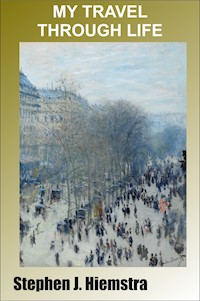
The cover image is Claude Monet’s Boulevard des Capucines, 1873-1874. Oil on canvas. The Nelson-Atkins Museum of Art, Kansas City, Missouri. Purchase: the Kenneth A. and Helen F. Spencer Foundation Acquisition Fund, F72-35. (http://www.Nelson-Atkins.org).
Heart he words; Walk the steps; Experience the joy!
What people are saying...
His role in the evolution of USDA's programs that now feed millions of Americans should not be understated. There is much more to learn and enjoy in this very readable journey of a very productive life.
- John E. Lee, Jr., Retired Administrator and Professor Emeritus
As we learned from Dr. Stephen J. Hiemstra, life is a journey where we travel from moment to moment, from research to education, from government to university, from discovery to discovery.
- Hailin Qu, Professor, Oklahoma State University
Dr. Hiemstra was a brilliant thinker, problem solver, patient with those who didn't have his intellect, and a man of God. He was a statesman, leader, and, more importantly, my friend.
- Dr. Carl A. Boger Jr., Professor, University of Houston
Sie lesen das E-Book in den Legimi-Apps auf:
Seitenzahl: 286
Veröffentlichungsjahr: 2023
Ähnliche



















Contents
Endorsements
Title Page
Copyright
Dedication
Foreword
Preface
INTRODUCTION
GROWING UP IN IOWA
Beginnings
Family Life
Family Trips
Grade School and Beyond
The Farm
IOWA STATE UNIVERSITY
Student Life
Roller Skating
Canadian Relatives
Canadian Travels
UNITED STATES AIR FORCE
Lackland Air Force Base
Scott Air Force Base
Service in Korea
Off Duty in Korea
GRADUATE SCHOOL
Master’s Degree
Doctor of Philosophy
Travels in California
ECONOMIC RESEARCH SERVICE, USDA
Transition
Marketing Economics Division
Economic and Statistical Analysis Division
Interesting Travel
FOOD NUTRITION SERVICE
New Assignment
Food Stamp Program
Child Nutrition Programs
Child Care Food Service
Women, Infant, and Children Program
Personal Travel
Mr. Hekman‘s Retirement
New Administrator
COUNCIL ON WAGE AND PRICE STABILITY
New Program
The FAT Division
Industry Meetings
Second and Third Years
Program Evaluation
Other Travel
RETURN TO THE FOOD NUTRITION SERVICE, USDA
Changing of the Guard
Peru Trip
Other Travel
A SON'S REFLECTION
Family Life
Professional Work
Purdue University
Past Time
Faithfulness as a Churchman
REFERENCES
ACKNOWLEDGMENTS
ABBREVIATIONS AND ACRONYMS
T2PNEUMA PUBLISHERS LLC
APPENDICES
Appendix A: Family Chronologies
Brief History of Friesland
Hiemstra Family History
A Brief History of Ede
Tysseling, Van Zee, and DeKock Family Histories
Appendix B: Biography of Stephen J. Hiemstra
Appendix C: Places Lived and Churches Attended
Appendix D: Reflection
Notes
Stephen J. Hiemstra’s My Travel Through Life brings back wonderful memories of the formative times in U.S. food policies and programs, and the people involved. Those who were active in agricultural economics from the 1960s to the end of the century are reminded that this creative period saw the birth pangs, growth and refinement of food programs that are taken for granted by many today. For most of those programs, Hiemstra was present at the creation, preparing the necessary preliminary research, analyzing options, evaluating results, advising policy makers and informing important audiences. His role in the evolution of USDA’s programs that now feed millions of Americans should not be understated. There is much more to learn and enjoy in this very readable journey of a very productive life."
Dr. John E. Lee, Jr.
retired Administrator of USDA’s Economic Research Service and Professor Emeritus, Mississippi State University.
I remember my nephew Stephen as a handsome and well mannered young man. I knew he would be successful as he grew up with good Christian parents. After he married Hazel, they would always visit John and I on the farm when they came to Iowa. I normally served coffee time which included my homemade buns. I always enjoyed Stephen and Hazel, and appreciated their visits.
Aunt Leona (Hiemstra) TerLouw
Pella, Iowa
As we learned from Dr. Stephen J. Hiemstra, life is a journey where we travel from moment to moment, from research to education, from government to university, from discovery to discovery. As one of his first doctoral students, I caught his passion for the journey, his passion for research, his passion to live life in its fullest—it was an honor to have been his student. For me, he was a role model and a mentor that I will never forget.
Hailin Qu, Ph.D.
Regents Professor & William E. Davis Distinguished Chair. Director of the Center for Hospitality & Tourism Research. School of Hotel and Restaurant Administration, Oklahoma State University
Stephen Hiemstra’s accomplishments are overshadowed by the care he showed as a father, husband, mentor, and colleague. His autobiography shows his journey throughout his life, how his life work touched the lives of thousands, and his contributions to his discipline, government, and organizations that he committed his professional life. Dr. Hiemstra was a brilliant thinker and problem solver, who was patient with those who didn’t have his intellect. He was also a man of God, a statesman, a leader, and, more importantly, my friend.
Dr. Carl A. Boger Jr.
Professor, Clinton L. Rappole Endowed Chair. College of Hotel and Restaurant Management, University of Houston
Dr. Stephen Hiemstra was my advisor during my doctoral program at Purdue University and I would like to thank him for his dedication in helping me begin my own career as a hospitality researcher. He is a real gentleman who invited doctoral students to his house for dinner, a practice which I have continued with my own students.
Dr. Woody G. Kim
Professor, Robert H. Dedman Professor of Hospitality Management. Director of Graduate Studies and of the International Center for Hospitality Research and Development, College of Business, Florida State University
Dr. Hiemstra is a great example of the value to society (and for himself) of higher education, made possible for many through the land grant university system. His impact on society through his work at Purdue University and the United States Department of Agriculture will be long remembered.
Dr. Neil E. Harl1
Charles F. Curtiss Distinguished Professor in Agriculture. Emeritus Professor of Economics , Member, Iowa Bar. Former Director, Center for International Agricultural Finance
MY TRAVEL THROUGH LIFE
Memoir of Family Life
and Federal Service
Stephen J. Hiemstra
MY TRAVEL THROUGH LIFE
Memoir of Family Life and Federal Service
Copyright © 2017 Stephen J. Hiemstra
ISNI: 0000-0000-2990-6376
All rights reserved.
All rights reserved. With the exception of short excerpts used in articles and critical reviews, no part of this work may be reproduced, transmitted, or stored in any form whatsoever, print or electronic, without prior written permission of the publisher.
T2Pneuma Publishers LLC
P.O. Box 230564, Centreville, Virginia 20120
www.T2Pneuma.com
Publisher’s Cataloging-in-Publication (Provided by Quality Books, Inc.)
Hiemstra, Stephen J., 1931- author.
My travel through life : memoir of family life and
federal service / Stephen J. Hiemstra.
pages cm
Includes bibliographical references.
LCCN 2015916810
ISBN 978-1942199038 (Paperback)
ISBN 978-1942199137 (Kindle)
ISBN 978-1942199441 (EPUB)
1. Hiemstra, Stephen J., 1931- 2. United States.
Department of Agriculture—Officials and employees—
Biography. 3. Agricultural economists—United States—
Biography. 4. United States. Department of Agriculture
—History. 5. Farms—Iowa. 6. Autobiographies.
I. Title.
HD1771.5.H54A3 2016 338.1092 QBI16-900008
The cover image is Claude Monet’s Boulevard des Capucines, 1873-1874. Oil on canvas. The Nelson-Atkins Museum of Art, Kansas City, Missouri. Purchase: the Kenneth A. and Helen F. Spencer Foundation Acquisition Fund, F72-35. (http://www.Nelson-Atkins.org)
Cover design by SWH.
DEDICATION
To my wife, Hazel, and our family, especially our four children—Stephen Wayne, Diane Sue, Karen Lee, and John David—who inspired me to do my best and to write this memoir.
You are always in my thoughts.
FOREWORD
By Rev. Dr. John E. Hiemstra2
In this foreword I am pleased to introduce my brother, Stephen's, memoir from the days on our family farm through his service as an economist with the U.S. Department of Agriculture.
Although I was 3 years older than my brother, Stephen was clearly the brains of the family. This became obvious when our family moved from one farm to another in March of 1936 and our mother, Gertrude, took me to enroll in the area's one room school house, Walker No. 6 of Spring Creek Township which was 3 miles south of the County Seat of Oskaloosa, Iowa and about a half mile from our new home. At the time, the school enrolled about 10 or 12 students in the eight grades offered.
After enrolling me in the third grade, the teacher turned to my brother, who was standing quietly alongside my mother, and asked: “Who is this?” She was told that Stephen would be five years old next month in April. With a gleam in her eye and perceiving a bright, young man, she said: I can enroll him in kindergarten now and in the fall he can start the first grade. Stephen's academic pursuit took off from that moment forward. As the brightest of the three sons in the Hiemstra family, he went on to high school, college, and graduate school where he earned a doctorate, always at the top of his class.
One of three boys, Stephen grew up on the 160 acre farm that our father, Frank, worked hard to support us. And it was hard. When the crops failed in the depression, our Dad had to surrender his other farm east of Oskaloosa. Having lost much of his investment in the first farm, he moved to the less expensive farm in 1936 where he was able to start over and provide for his family—without the aid of tractors and power machinery—having only his own manual labor. As boys, we learned to plow and cultivate fields behind a team of horses. But we never felt poor having the example of a dedicated and hard working father and a loving mother.
Not only were we well taken care of physically, we had the gift of God's love. The focal support point for the family was the Bible and the Central Reformed Church in Oskaloosa, Iowa, a protestant church of mostly Dutch heritage members. The church was one of about 20 Dutch churches, descendants of a colony of Dutch immigrants who founded Pella (16 miles West of Oskaloosa) in 1847.
Church life had a strong influence on our family. We attended Church twice on Sundays—Sunday school and worship on Sunday mornings and worship again on Sunday evening. We also attend weekly Bible study and catechism on Saturdays. Sunday afternoons were spent reading or taking a nap, unless we were visiting our grandparents.3
The Christian faith deeply affected our father and our family. He prayed with us every day and urged us to maintain a deep commitment to Jesus Christ. As a youth, my father wanted to become a minister and started attending the Central Academy to pursue this dream, but family obligations forced him to drop out. So he encouraged his sons to enter the ministry, which I did—as a boy of seven or eight I took his dream as my own and studied to be ordained later as a minister in the Reformed Church in America.
This deep religious surrounding and commitment also impacted my brother, Stephen, but his faith took him in a different direction. Stephen wanted to be a farmer, like his father, but he wanted to be a more informed and educated farmer. His academic bent therefore took him to enroll in Iowa State College at Ames, Iowa. But, having experienced the academic life, he never returned to the farm.
After completing a two year degree aimed at farm operation, Stephen switched to a four year program in agricultural economics. Ironically, his love for agricultural economics led him to his other love, the lovely Hazel (Billie) Deacon, who he met while attending an agricultural economics conference in Guelph, Ontario, Canada. They were married during his last year at Ames. After attending the Reserved Officer Training Corps (ROTC) in college, he enlisted in the U.S. Air Force where he was commissioned as a Second Lieutenant and was sent to serve as a communications officer at a base near Seoul, Korea. After completing his military service, he returned to Iowa State to complete a master's degree and, later, to the University of California in Berkley to complete a doctorate (Ph.D.) in agricultural economics.
After graduate school, in 1960 Stephen accepted a position with the in the U.S. Department of Agriculture (USDA). In USDA, he distinguished himself in research, publication, and administration. From 1960 to 1969 he wrote numerous articles for the National Food Situation (NFS), but in July of 1969, he and a colleague, Al Egbert, published a study, “Shifting Direct Government Payments from Agriculture to Poor People: Impacts on Food Consumption and Farm Income,” which set the stage for the rest of his career. He soon joined the Food and Nutrition Service (FNS) where he worked on: Food Stamp Program, the Child Nutrition Programs, the School Lunch Program, the Child Care Food Service, and the Woman, Infants, and Children Program (WIC).4 Stephen details the research and implementation done in these programs in this book.
Following his years with the FNS, Stephen served as an executive in the new Council on Wage and Price Stability created by President Jimmy Carter in October 1978 and later dissolved when President Ronald Reagan took office in 1981. At that point, Stephen returned to USDA.
In this book Stephen chronicles experiences that he had, including an invitation to an event with his family in the White House with President Carter. In 1983 Stephen retired from federal service and moved to West Lafayette, Indiana where he accepted a teaching and research position with Purdue University. There he founded and directed a doctoral program in the Department of Hospitality and Tourism Management, which was the first such program in hospitality anywhere in the world.
In addition to his professional accomplishments, Stephen remained devoted to his faith and his family. He was baptized and confirmed at the Central Reformed Church5 in Oskaloosa, Iowa and was later ordained as an elder by the Presbyterian church, another denomination in the reformed tradition. Details of the Hiemstra family history are found in the appendices.
PREFACE
By Stephen W. Hiemstra (Son)
Dad's work on this memoir spanned a period of years, starting around 2005 and running through 2012, when I came in possession of a hardcopy manuscript. In the summer of that year, I scanned copies of the manuscript for a family CD which I distributed at my parent's 60th wedding anniversary in September of that year.
Dad's writes about his life from early childhood through 1983, when he took early retirement from federal service at age 52. The Thursday night before he retired from federal service, we talked about the prospect of early retirement. The next day he filed his paperwork and said his goodbyes. On Saturday and Sunday, he played a couple rounds of golf. By the end of the following week he had found a position as associate professor in the hospitality and tourism management department at Purdue University.
The years that followed were some of his happiest and most productive. In three years, Dad was promoted to full professor and he inaugurated one of the first doctoral programs in the fields of hospitality management and tourism. Students that he advised are now leaders across the field, as endorsements to this book attest. Unfortunately, he was never personally able to chronicle his years at Purdue.
INTRODUCTION
My professional interests have progressed from farm production to food away from home to hotel and tourism management. As a young man, I dreamed of following my father into farming. Under the influence of the 4-H Club and Future Farmers of America (FFA), however, I realized that I wanted to becoming an educated farmer, which required attending college. Under other influences, my interest in farming shifted even further. Now, my most recent adventure as a Senior Research Fellow in Tourism Management at George Washington University is entirely outside the fields of farming, agribusiness, and food. These career shifts transgressed many educational and professional boundaries, and were far removed from my agricultural roots.
The constants in my professional life have been economic analysis and research, while the constants in my personal life have been my faith in God and a stable family life, for which I thank my parents and my wife. Without these constants and the blessings of a few favorable financial decisions, life would have been very different.
This story details my life's wandering through open doors and avoiding the closed ones, but always with prayerful consideration. Plans must sometimes change to account for new opportunities both at home and abroad. Still, I learned early on that variety is the spice of life.
In fact, my career was full of such spice. I served in the U.S. Air Force, including a year in Korea. After completing my military service, I worked in two different agencies in the the U.S. Department of Agriculture, the Economic Research Service (ERS) and the Food and Nutrition Service (FNS). While at FNS, I was also assigned for two years at the Council on Wage and Price Stability (CWPS) in the Office of the President and had my picture taken in the Oval Office with then President Jimmy Carter. Following my federal retirement, I started an entirely new career as a professor at Purdue University, in West Lafayette, Indiana.
While I am now retired from Purdue and living in Northern Virginia, a bit down the road from Iowa, I never forgot my father's legacy or the farm that we worked together so long ago, as I hope you will agree having read the pages that follow.
GROWING UP IN IOWA
Beginnings
Family Life
Family Trips
Grade School and Beyond
The Farm
Beginnings
I was born in Iowa on April 17, 1931, the second of three sons. My older brother, John Elmer was born June 21, 1928 and my younger brother, David Lee was born August 27, 1932.6 We lived on a farm about four miles south of Oskaloosa, the county seat of Mahaska County.
Oskaloosa, an Indian name,7 is a typical small mid-western town with a stable population of 10,000—then and now—and prominent red-brick court house opposite the town square. The town square has a park with a statue of Chief Mahaska and an elevated band-shell at its center.
As I remember it, summer band concerts on the square were the focal point of social life on Saturday evenings. Everyone came to town for the concerts—some came to sit and listen to the band; others came to show off their new cars by driving around the square. I continued to live near Oskaloosa on the farm through my college years and afterwards I visited it as often as time allowed.
Family Life
My father, Frank Henry Hiemstra, was born on August 30, 1898 near Otley, Iowa, about 5 miles north and west of Pella on state road 63. My mother, Gertrude Henrietta DeKock, was born June 30, 1906, near Leighton about halfway between Oskaloosa and Pella on state road 63. Dad and mom were married on December 17, 1925 and were married for 74 years when she died at the age of 93 on April 22, 1999. Dad died the following year at the age of 102 on October 4, 2000.8
Mom told us kids that you have to eat a pint of dirt sometime during your life so don‘t be too fussy about a little dirt. My mother was herself always immaculately clean. She also liked to run the vacuum cleaner early in the morning before us kids were out of bed. She was an early riser, like 5:00 am, especially on “washday,” which was Monday, and I mean every Monday.
Dave and I both developed a case of whooping cough when we were young. We whooped all one winter, and even later when we would get a cold we would sometimes start whooping which is a very distinctive, repetitive cough. Most of you have probably never heard of this disease. I remember getting the measles, both red measles and the 3-day, German variety but I never got anything really serious like diphtheria or scarlet fever that other people occasionally would get.
For those diseases, families would be quarantined in their houses for a few weeks. I think my brother John had smallpox but it was before Dave and I were born so we did not catch it from him; I’m not sure if my parents had it or not.
I remember one incident from my childhood that was not very pleasant. I don‘t know what I was doing at the time, but somehow several bees got up the pant leg of my bib overalls (we did not wear jeans) and stung me many times. My parents rushed me to the doctor and he gave me some medication and calmed me down. I remember that it hurt a lot at first, but I did not have a severe reaction to the stings so I survived. Maybe it gave me immunity to bee stings. I understand that kids that grow up on farms have fewer allergy problems than kids who live a more sheltered life in town because they grow up with pollen, rag weeds, etc., from which they gain immunity.
I’m not sure that helped us kids though because my brother Dave had a severe case of asthma when he was young and almost died from it. Mother and Dad tried various poultices and hot packs on his chest but nothing seemed to help. Finally, the doctors told us to give him plenty of fresh air, and that seemed to cure him. Of course, that was before the days of penicillin. Ever after, we had lots of fresh air in our bedroom, which I shared with Dave.
I do remember getting one serious disease, mumps, but not when I was a kid. I got it from Diane Sue who brought it home from nursery school when we lived in Lanham, Maryland about 1961. I was deliriously sick with it having a temperature of about 104 which is bad for adults. I took baths in ice water to get the temperature down. It lasted about two weeks. I apparently had no lasting effects from it; mumps can cause sterility in men but that was before John David and Karen Lee were born so apparently it did not affect me. They don’t know how closely they came to never being born.
Pella, which was 16 miles north and west of Oskaloosa, was founded by a community of immigrant Dutch people about 1850. My mother was fond of telling us that her grandmother was the first child born in Pella after the settlement was established. My father’s family arrived in Pella about the same time and they were also from Holland.9 As a result, I am a purebred Dutchman even though I never learned to speak the language. I later fit right in when walking down the street in Amsterdam.
My father (but not my mother) could understand and speak Dutch because his parents spoke it at home till he was five years old. But, Dad never tried to teach us the language. He felt that since we were Americans we should be Americanized and speak English. That was not true of several of our relatives who harbored more inclination to hold onto their heritage. In later years, I wished that Dad had at least taught us the basics of Dutch but I am supportive of his reasoning that we should adjust to our community. Just the fact that Dad and Mother had moved near Oskaloosa and away from Pella gave us a whole different outlook on life from that of many of our relatives.
Pella, the home of nationally-advertised Pella Windows (in earlier years called simply the Rollscreen), remains to this day a settlement of Dutch people. Pella was founded about 1850 and named for an ancient city founded in the fourth century B.C. east of the Jordan River where Christians sought refuge during the Jewish revolt from Rome in the period A.D. 66 to 70.10 It is the location of Central College, a church supported, liberal arts school founded by the Reformed Church of America (RCA). My brother, John, graduated from Central College and went on to become an RCA pastor.
Every year, Pella celebrated “Tulip Time’’ for several days, around about May 10, and they still do. They commemorate the Dutch heritage by wearing Dutch costumes, including wooden shoes, in daily parades and washing the streets. The streets are still lined with tulips every spring and the town now sports a new development that includes a block-long canal, a huge windmill, and neighboring streets with houses that mimic the classic styles of those in Holland. Tulip Time draws growing numbers of Dutch people and their friends and families from long distances. Pella joins Holland, Michigan and Orange County, Iowa in hosting such celebrations.
Mother and Dad both came from large families, of eight and 11, respectively. The families were close knit and most remained near the Pella or Leighton areas. Most of my many cousins still live there although several are now scattered around the country. Like my own parents, most of their brothers and sisters also lived long lives; all of them lived into their 70s and many into their 90s. However, my father still holds the record for longevity. At my current age of 74 (2005), I currently have two aunts on my father‘s side and one aunt and one uncle on my Mother‘s side who are still living.
Religion played an important role in my family’s life, both my immediate family and most of my parent’s brothers and sisters. We grew up in the RCA which is often tagged with the misnomer of the Dutch Reformed Church. We had one such church11 in Oskaloosa and there were three of them in Pella. I joined the church by profession of faith when I was in high school. There was never any question what we would do on Sunday mornings. We always went to church and Sunday school. In the afternoons, we often went to visit one or both grandparents who both lived in Pella. But, during the busy farming seasons, we took naps on Sunday afternoons.
My father liked to talk about his growing up years near Otley, a few miles west of Pella. Being the oldest son in the family, he quit school at about the third grade to help his father farm. They farmed with horses and drove a horse and buggy to town. They never had a car until my father was 19 years old, which was in 1917 when they bought a “Model T’’ Ford. His father never learned to drive a car but his mother did. Dad bought his own Model T as soon as he could afford to pay the few hundred dollars that they cost at that time.
Dad farmed with his father till he was 21 years old, which was the custom at the time. Then, he bought three horses and rented an 80-acre farm nearby. At that time he went to farm with his Grandmother for a year. Then, his sister Emma needed help with her farm because her husband had died, so he lived with his sister and farmed her farm for two years until he got married.
Mother and Dad were married on December 7, 1925. Emma moved to town at that time and Mother and Dad continued to farm her farm, which was near Otley. In 1928, my folks bought a farm east of Oskaloosa.
With the onset of the depression in 1929, it was a bad time to go into debt, Times were tough in the early 1930s, with extremely low prices (like 10 cents for a bushel of corn) and then back-to-back years of extreme drought and hordes of grasshoppers, which I vaguely remember. Dad said that coal was more expensive to buy than the money he could get for his corn during some of these years. Many farmers burned their corn for heat, Dad told me once. But, he was against the idea on principle because many people were going hungry in the towns. I wonder now what he would think of making ethanol out of corn.
With the depression, my Dad could not keep up his mortgage payments and he gave up the farm to his creditors and rented it back for a few years. In 1936, he scraped together enough money to buy another farm south of Oskaloosa, 160 acres for about $10,000. One of my earliest memories (I was 5 years old) was of the day that we moved to the new farm and I began to go to school. Dad and Mother lived on that farm for 38 years until he retired from farming and moved to town at about age 75.
Mother quit school about the fourth grade, but she was not happy about dropping out. She stayed home to help care for her several younger sisters and brothers. When several of them later completed high school, she felt deprived.
Mother’s experience staying home may have motivated her to support me when I wanted to go to college. I was one of the first—if not the first—of our close relatives to attend college.
Family Trips
My parents never did much traveling, in part, because my father did not seem interested in it unless we were going to see some relatives at a distance. Most of our immediate relatives lived within 30 miles of us. We had one exception: Dad’s sister, Mabel and her husband Clifford DeJong. They left Oskaloosa and moved to Chicago because the U.S. Post Office transferred him to Chicago for a few years. When I was about 10 years old, we decided we should go visit them in Chicago. We drove our Model A Ford there and had a great time visiting the Chicago zoo and other attractions, such as the Buckingham fountain located in a park on Grant Street near Lake Michigan. I was much impressed both by the zoo and by this fountain which changed colors at night. Not many years ago, I noticed that the fountain is still there. And the zoo is still a great zoo.
The only other trip I remember taking was a trip with my mother and brother Dave to Denver when I was in high school. Dad did not want to go along, and I don’t think John did either. Dad did not care for mountains—he thought a good field of corn was more impressive. We saw the usual attractions and marveled at the mountains and other sites near Denver: Pikes Peak, Garden of the Gods, Seven Falls, and Red Rock, a natural amphitheater near Denver. We drove up Pikes Peak in our 1939 Chevrolet. I was driving and it was the highlight of the trip. Many cars had troubles and were stopped along the road with their radiators boiling over, but we managed ok. I think we stopped occasionally to let the engine cool. We stayed in a motel, which was perhaps a first for us. We drove home late at night and at one point driving across Nebraska we had a disagreement about the direction we were driving; there were no interstates at that time, the road signs were infrequent, and the road was desolate. We stopped the car in the middle of nowhere and looked for the North Star, which we found. It confirmed that we were headed east and toward Iowa.
The next trip out of state that I remember taking with the family was a drive to Kansas to visit my brother, Dave, who had enlisted in the Army and was inducted at Fort Riley. I was in college at Iowa State at that time (about 1952). Later, we drove to Indianapolis to visit Dave when he was stationed there.
Grade School and Beyond
My brothers and I attended a one-room school with a single teacher that had 10-12 students as long as I attended. The school was about a half mile from home and we walked it every day when the weather was fit, and sometimes not so fit. Two others students, Byron and Garlyn Engelhoven, lived on a farm beyond ours, so we normally walked together. There were four students in my class, which made it the largest class in the school. When I started school, I was the only one in my class. I was moved up one grade to be with a larger class after consultation with the county superintendent who came out to talk to the teacher and me about it. As a result, I graduated from high school just one month after reaching 17 years of age.
We had some good grade school teachers. One that stands out in my mind was Adeline Moore, who stimulated me to do a lot of reading outside of class, reading science and biology books that greatly influenced me in my interest in education. One of my three classmates, Jack Thorp, became a specialized medical doctor, who now lives in San Francisco. I met him at our 50th high school graduation anniversary after not seeing him since high school. Our other two classmates did not even go to high school. Go figure.
We had no middle schools in Iowa. Elementary school contained eight grades and high school contained 9th through the 12th grade. I went to high school in Oskaloosa. We had no school buses so we had to furnish our own transportation. At age 14, I obtained a school permit to drive a car, which meant that I could drive only to and from high school or with an adult until age 16. I had learned to drive at about age 12, by driving a tractor and our Model A Ford around the farm. My older brother, John, was two grades ahead and a younger brother, Dave, was two grades behind me, so I always had someone to accompany me to high school. We carried sack lunches to high school, as we did to grade school. I don’t remember if the high school even had a cafeteria; the kids in town usually went home for lunch. I usually went to the Young Men’s Christian Association (YMCA), wolfed down my lunch, and played basketball or swam during the lunch period.
In high school, I developed quite an interest in basketball. Our Future Farmers of America (FFA) class sponsored basketball teams with neighboring towns’ teams. At home we played at the YMCA, and we had a good coach, Max Franklin. Max’s younger sister, Norma, later married my brother, John. Leonard, Norma’s younger brother, was also on the team. I played forward or center because I had long arms for my height. Ken Bailey, another guy on the team, was taller than me but I often could out-jump him. Our team did quite well and my senior year I often scored about 20 points per game. I often regretted not being able to play basketball till I got to high school. I would like to have played on the varsity team.




