


13,99 €
Mehr erfahren.
- Herausgeber: The History Press
- Kategorie: Sachliteratur, Reportagen, Biografien
- Sprache: Englisch
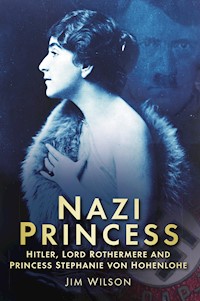
Born to a middle-class Viennese family and of partly Jewish descent, after marriage to (and divorce from) a German prince Stephanie von Hohenlohe became a close confidante of Hitler, Göring, Himmler (who declared her an 'honorary Aryan') and von Ribbentrop. After arriving in London in 1932, she moved in the most exclusive circles, arranging the visits of the Duke and Duchess of Windsor and Lord Halifax to Germany in 1937. Most notoriously, she was paid a retainer of £5,000 per year by Lord Rothermere, owner of the Daily Mail and the Daily Mirror, who was an open supporter of the Nazi regime. In 1939 she fled to the USA; a memo to President Roosevelt described her as a spy 'more dangerous than ten thousand men.' In this new biography, Jim Wilson uses recently declassified MI5 files and FBI memos to examine what motivated both Stephanie and Rothermere, shedding light on the murky goings-on behind the scenes in Britain, Germany and the USA before and during the Second World War.
Das E-Book können Sie in Legimi-Apps oder einer beliebigen App lesen, die das folgende Format unterstützen:
Veröffentlichungsjahr: 2011
Ähnliche


















In memory of my Father and Mother, James & Winifred Wilson and their friends Jack & Annabel Kruse
CONTENTS
Title
Dedication
Introduction
1Twice Wed in New York
2Rothermere and Churchill
3The Golden Couple
4Throw of the Dice
5Whose Go-between?
6A Friend in Berlin
7Threat from the Sky
8Enter the Blackshirts
9Nazi Party Gold
10The Language of Butter
11The Princess, the King and Wallis
12Intrigue in America and London
13Chatelaine of Schloss Leopoldskron
14Comic Opera in the High Court
15Exile
16Trailed by the FBI
17The President’s Anger
18Just Desserts?
Notes
Bibliography
Copyright
INTRODUCTION
I strongly believe in the motto: Never explain; never complain Princess.
Stephanie von Hohenlohe
The populace get angry with fervent admirers of the arch-villain.
Collin Brooks, on Lord Rothermere
I learned to admire the excellence of British propaganda. I am convinced that propaganda is an essential means to achieve one’s aims.
Adolf Hitler
I felt compelled to write this book for a number of reasons.
First, by any standards, and whatever view one takes of her motives or her actions, Her Serene Highness Princess Stephanie von Hohenlohe-Waldenburg-Schillingsfürst was a fascinating character. The so-called ‘personal ambassador’ for Lord Rothermere, one of Britain’s foremost newspaper owners, yet at the same time Hitler’s ‘lieber Prinzessin’, ‘dear Princess’. As the world moved inexorably towards world war, hers is a story of intrigue, manipulation, espionage and duplicity in Britain, the United States and Europe. She carried this off with charm, intelligence and undoubted political skill. If it suited her cause, and it frequently did, she exercised the attributes of temptress and seducer.
Second, her exploits during the 1930s encompass an absorbing cast of characters at a crucial time in history, when the policies of influential people in Europe and America were being played out against the receding shadow of one terrible world war, and in the gathering storm of another; in a climate of misunderstanding, appeasement and the dangerous blooming of fascist dictatorship.
Third, an intriguing thread runs through the narrative of links to my own family. Indeed, much of this story might never have happened had my Great-Aunt Annabel not made the fatal introduction that threw Lord Rothermere and the princess together, which led to her passionate love affair with Adolf Hitler’s closest adjutant, and made Stephanie, born a Jewess, the Führer’s ‘dear Princess’.
Without access to secret British intelligence files, only derestricted and released to The National Archives in 2005, and a large collection of Princess Stephanie’s own papers now held in the Hoover Institution Archives at Stanford University in California, it would not have been possible to tell her story.
Finally, my thanks to my wife Judith for her loving support and her patient forbearance.
Jim Wilson OBE
Norfolk
1
TWICE WEDIN NEW YORK
The British secret service described her as ‘the only woman who can exercise any influence on Hitler’.1 The FBI called her ‘dangerous and clever’, and as a spy ‘worse than ten thousand men’.2 Hitler referred to her as his ‘dear Princess’. Lord Rothermere, newspaper magnate and owner of the Daily Mail, employed her as his go-between with Hitler and his henchmen. She was courted in British, American and European high society, and she had access to most of the royal families of Europe. But others, particularly those who knew of her deception, regarded her as a temptress, manipulative and immoral, and prepared to use any means to gain her ends.
She was Princess Stephanie von Hohenlohe-Waldenburg-Schillingsfürst, mistress of Hitler’s closest adjutant and a political intriguer of extraordinary ingenuity and skill. Duplicitous, intelligent and charming, as the 1920s and ’30s drifted from the horror of one world war to the unknown terrors of the next, she wormed her way into British society, spreading Nazi propaganda at the highest levels. With her lover Fritz Wiedemann, Hitler’s commanding officer in the First World War and then his personal adjutant, she pursued Hitler’s mission in the United States fostering Nazi sympathies and working in the Nazi interest to keep America out of the war. The story of the princess and the newspaper proprietor is one of double-dealing and irony. What began as a genuine attempt to foster a closer understanding between Britain and the new dictatorships in Europe, ended in the most devastating war in history. Yet post-Second World War, Princess Stephanie emerged from internment in the United States to move in some of the highest circles in Washington as the guest of Presidents.
Many in influential positions in Britain, who might have been expected to show greater foresight, pursued a path of appeasement with Nazi Germany as Hitler inflamed tensions on the path to Europe’s second disastrous world war. None did so with more tangled motives than one of the most powerful propagandists of his time, a genuine visionary and friend of Churchill. The story of Lord Rothermere, co-founder of the Daily Mail, and his dangerous flirtation with Hitler through the machinations of the Führer’s Nazi princess, might stretch the imagination were it not true, as indeed would the extraordinary cast of characters who feature in it. One who played a pivotal part was Annabel Kruse, my great-aunt. She and her wealthy husband, owner of one of the most iconic collections of classic touring and rally cars between the wars, were close friends of both the princess and Lord Rothermere. Together they were the catalyst for this story of espionage and propaganda which, until secret MI5 files were declassified and released to The National Archives in 2005, could not be fully told. It is what these files contain, together with records and memoranda from America’s Federal Bureau of Investigation, which prove how seriously the authorities in both countries regarded the princess’ activities. They also point to the fact that although it was the press baron Lord Rothermere who employed her, it was the Führer to whom she gave her loyalty. Princess Stephanie spent half a lifetime denying what was obvious to those who knew her story, but with nerve and force of will she overcame all the suspicions and accusations to carve out a distinguished career in the 1950s and ’60s as a ‘fixer’ for some of the most prominent publishers and newspaper owners in Europe and the United States.
My great-aunt was American, born Annabel Adora Belita Maria Colt in Georgia, Alabama, in 1893. Her father, George R. Kane, was owner of a chain of hotels. Her mother, Alma, was Spanish. With that clear Spanish blood in her family background she possessed the personality and temperament that came with it. She was petite, slim and full of fun, an intriguing girl with the ability to electrify any company. When she married my father’s uncle, George Wilson, Annabel was only 21 but she had experienced the highs and lows of emotion in her life, having already been married and widowed. George brought her the companionship she was seeking. He was a ships’ purser on a liner plying the North Atlantic passage between Liverpool and New York, and an on-board romance blossomed between them. They were married on 13 April 1914 in the grand surroundings of New York’s City Hall. Annabel’s address at the time was 610 West 127th Street, New York. On the impressive marriage certificate, now lodged in The National Archives at Kew and signed personally by an alderman of New York City Council, George gave his rank as ship’s officer from Hartlepool, England.3 The marriage lasted through the horrors of the First World War, but for whatever reason the relationship broke down and in 1923 Annabel was granted a decree nisi. The marriage was over when Annabel again crossed the Atlantic in 1924. She may have been contemplating moving back to the United States permanently, but a chance meeting in New York changed her life entirely. The man Annabel met and fell for in New York was Jack Frederick Conrad Kruse, a flamboyant, extremely handsome, 30-year-old eldest son of a banker. Kruse was not only physically attractive, he was a man with a distinguished war record, a captain in the Royal Navy Reserve, and seriously rich.
Jack Kruse was born in South Weald, Essex, on 20 September 1892. His father, Herman Conrad Kruse, was from a family that had originated from Germany and subsequently migrated to Holland. Before Jack was born, the family uprooted again, this time to settle in England. Jack was educated at a series of public schools and by the age of 20 he was managing an 800-acre fruit farm at Salehurst in Kent, owned by Sir Harold Harmsworth. Harmsworth was one of two remarkable brothers, Alfred and Harold, who together in May 1896 had founded the Daily Mail. Alfred was in many respects the inventor of the modern newspaper. He was a Fleet Street genius, whose brilliant news direction and unrivalled understanding of what would sell newspapers in quantities never before achieved, alerted readers of the Daily Mail to events that would change their lives. His flair was to produce a newspaper that grabbed its readers’ attention and held their loyalty in a way previous publications had never been able to achieve. He invented the banner headline and put emphasis on human interest stories, as well as introducing a much wider coverage of sport. Within three years of the Harmsworths founding the Daily Mail, it was selling over a million copies daily.
Alfred and Harold were the proprietors who ensured modern journalism came of age. The Harmsworths followed their ambitious expansion of the popular press by founding the Daily Mirror in November 1902. Their newspapers’ campaigns during the First World War arguably changed the course of the war and influenced the policies of the politicians who were prosecuting it. They owned the most popular newspapers on the Western Front. The soldiers in the trenches found the Mail and the Mirror reminded them of home. They enjoyed the way they carried so many pictures of life back in Blighty. The Daily Mail and the other Harmsworth publications also set the pace for the introduction of new technology. A year after the Mail was founded a telegraphic link was established between London and New York, the first transatlantic connection in Fleet Street. Through Alfred’s uncanny grasp of the headlines, features and competitions that would appeal to a mass audience, the Mail became the biggest success story in Fleet Street. Three years after the founding of the Mirror, Alfred was elevated to the peerage with the title Lord Northcliffe.
Harold’s genius was in finance. He understood the stock markets; he had a reputation for successful investment; he excelled in projections of profit and loss and he controlled costs robustly. His task was to make his brother’s prowess at journalism pay, and he did it so successfully that the two brothers came to own the largest magazine empire in Britain, and two-thirds of the newspaper titles on Fleet Street. Harold, like his brother, was also elevated to the peerage from the Baronetcy he had held since 1910, associated with his then estate at Horsey in Norfolk. In 1919 he took the title of Lord Rothermere. When Northcliffe died, three years later in 1922, Rothermere inherited all the publications and became reputedly the third richest man in Britain, with an estimated fortune worth £780 million in today’s money.4 By 1926 he had driven the Daily Mail to a daily sale of two million.
Like his brother, Rothermere exercised considerable power and influence, not only through the newspapers and magazines he controlled and owned, but also through his wide contacts in political circles. While he could be remarkably prescient in some of his judgements and predictions, he could also be ill-advised in the way he placed his influence behind causes and ideas others might hesitate to become identified with. Unlike his brother Northcliffe, who was inventive, outgoing, impetuous and personable, Rothermere’s personality was more reserved, some said shy and ponderous. His introspective personality was emphasised by his physical stature and the walrus moustache he wore as a younger man. As he grew older he trimmed the moustache but not his manner, which as one writer described it was that ‘of the proud gruff captain of industry’. He could be exceedingly forthright and blunt – even demanding and rude. Princess Stephanie later went on record as calling him ‘erratic, a creature of rapidly changing moods, able to back the idlest of impulses with his millions, open to any suggestion and perfectly ruthless in carrying out any scheme that might bring him journalistic fame or personal prestige’.5
With his two favourite sons killed in the Great War and unhappily estranged from his wife Lilian, whom he never divorced, Rothermere, despite his riches and his influence, was a somewhat retiring and lonely figure who was inclined to take associates who he liked and respected under his wing. When he befriended someone, Rothermere had the money and the inclination to be immensely generous to them. Jack Kruse was just such a person. Rothermere had been impressed by Jack’s management of his fruit farm in Kent before the First World War. He also admired Jack’s war service in Gallipoli. After the war he asked Jack to be his private secretary, and subsequently promoted him rapidly through the ranks of his company; by 1924 Jack was a director of the Continental edition of the Daily Mail, published in Paris to cater for the needs of British expatriates in Europe.
In March 1924 Lord Rothermere, Kruse, his lordship’s valet and a Daily Mail journalist called Arthur Fuller sailed from Monaco, a favourite playground of the rich where Rothermere had a private villa, to New York. Rothermere always travelled first class and stayed in the best hotels. In New York they were booked into the Plaza. It was Jack Kruse’s first time in the United States and it is clear he was impressed, not just by the pace and vigour of life in the vibrant city, but also by the people he met. One of those people was Annabel Wilson. Whatever the circumstances that brought Annabel and Jack Kruse together, it must have been special enough for her to make an immediate impression on Jack, and incidentally on Lord Rothermere, too. The romance was whirlwind by any standards. Within a few weeks of meeting Jack, and a year after her divorce from George Wilson, Annabel, at the age of 31, entered her third marriage. In May the party were back on a transatlantic liner bound for Southampton. This time the passenger list recorded Jack and Annabel Kruse as husband and wife, together with Winifred R. Butcher, described as Annabel’s personal maid. The speed of the courtship and of their marriage in New York was swift by any standards, even by those of the era they were living in, the carefree ‘Roaring Twenties’.
2
ROTHERMEREAND CHURCHILL
Wealthy and handsome with a distinguished war record, Jack Kruse was one of those young men who ‘had it all’. After returning from the torment of action in one of the harshest theatres of the First World War, the ill-fated Gallipoli Campaign, he sought to put behind him the stress and horror of war by becoming involved in the world of fast sports cars. In the 1920s, motoring was coming of age. Famous marques like Rolls-Royce and Bentley in Great Britain were competing with Continental manufacturers Alfa Romeo, Bugatti and Lancia in Italy, and Mercedes-Benz in Germany. Each company was endeavouring to outdo the others in developing the cream of touring and sporting models. The roads were comparatively traffic free. Speed restrictions and speed cameras were a long way in the future. The open road enticed those with the money, a taste for excitement, and a pioneering spirit. Major sporting competitions, like the Monte Carlo Rally, the Alpine and Le Mans, were magnets to those looking for high-profile thrills. Kruse, with his money and his flamboyance, was well placed to gain pole position in this highly competitive and expensive world.
He had served with distinction in the war. Initially, when the call to arms came, he had signed up to join one of the most select and fashionable units in the British Army, the Queen’s Westminster Volunteers. But once in khaki he was not as enthralled by the army as he thought he would be, and he opted for a transfer to the senior service, the Royal Naval Division, as a second lieutenant. The Royal Naval Division was a creation of Winston Churchill, then First Lord of the Admiralty. In most previous wars a naval brigade had fought alongside the army, and because there was a surplus of officers and men left over from service in the Fleet, Churchill decided they, together with a large part of the Royal Naval Volunteer Reserve, should be formed into one single fighting unit similar to an army division. Probably because Churchill was behind the Dardanelles venture, the Royal Naval Division was among the units sent to Gallipoli. Once appointed to the division, Kruse found that rapid promotion followed, greatly assisted, it would seem, by his friendship with Rothermere.
Lord Rothermere was a close associate and friend of Winston Churchill. Indeed, Churchill frequently wrote for the Daily Mail. In his ‘wilderness years’, when he felt rejected by the mainstream of British politics, Churchill knew he could always turn to Rothermere and the Mail to boost his income and give wide currency to his views. In the 1930s he was writing as passionately as Rothermere himself about the need for Britain to build up its air force. In the First World War Rothermere served briefly as Britain’s first Secretary of State for Air. Appointed by David Lloyd George, he gave loyal support to the British government. He took the post with the ambition of creating the Royal Air Force, hoping to give a modernising boost to Britain’s capability to prosecute war in the air. At the time, military flying was in the hands of the Royal Flying Corps, aligned to the army, and the Royal Naval Air Service, rather than a separate military organisation. It was Rothermere who, in December 1917, appointed General Sir Hugh Trenchard as his Chief of Air Staff. Trenchard of course went on to become, in the eyes of most people, the father of the RAF. But a share in that glory must also go to Rothermere, though the RAF did not emerge until after Rothermere left his ministerial post. Rothermere encountered strenuous departmental resistance to the sweeping reforms he had hoped to carry out. The strain on him was severe and he had to resign his ministerial post before his dream of forming the Royal Air Force as a third military arm could be realised. ‘Your work,’ Lloyd George wrote to him, ‘has been of inestimable service to the nation, and time will bring with it a full recognition of your achievement.’1
Rothermere’s interest in air power and his unshakeable belief in the future of aircraft in war marked him out, alongside Churchill, as a leading advocate of building a strong, well-trained air force, and this remained true long after his spell as Secretary of State. In the latter part of the 1930s, when Germany was manufacturing warplanes at a remarkable pace, Rothermere’s view of the bomber as the 1930s’ equivalent of the weapon of mass destruction, and his conviction that there was no adequate defence against it, dominated the campaigns he ran in his newspapers to persuade Britain to rearm, build up her air power and address her defences against aerial bombardment. He had held strong views on the potential of flying for many years. In 1906 the Daily Mail had offered a prize of £1,000 for the first cross-Channel flight, and a prize ten times that amount for the first flight from London to Manchester. Rothermere’s energetic promotion of these challenges in his newspapers drew ridicule in some quarters. Punch magazine thought the idea preposterous, and lampooned it by offering its own prize for the first flight to Mars. But Rothermere had the last laugh. By 1920 both his prizes had been won.
Much of Rothermere’s extensive correspondence with his friend Winston Churchill is in the Churchill archives at Churchill College, Cambridge. One letter, written shortly after the start of the First World War, indicates that he lobbied Churchill as First Sea Lord, asking him to pull strings on behalf of Jack Kruse to gain him promotion to the rank of captain.2 Rothermere was granted this favour by Churchill and Kruse secured his promotion. But Rothermere’s intervention in no way guaranteed Jack Kruse an easy war. He was sent to Turkey to fight in the trenches in Churchill’s ill-inspired and costly Gallipoli Campaign. Kruse was among the last to be evacuated from that disastrous adventure in which so many British and Anzac troops lost their lives. On his way home he faced further danger when his ship was torpedoed. But his luck held. He was one of those pulled exhausted from the water and he survived. Eventually, he returned to England to be transferred into the Royal Marines. When the Armistice came he resumed civilian life, rejoining Rothermere at the newspapers, now known as Amalgamated Press.
Rothermere himself was devastated by the war, having lost his two favourite sons, Vere and Vyvyan. Lieutenant Vere Sidney Harmsworth RNVR, like Jack Kruse, endured the horrors of Gallipoli only to die on the Western Front, gallantly leading a charge of his troops from the Royal Naval Division at the Battle of Ancre on 16 November 1916. Captain Harold Alfred Vyvyan Harmsworth died two years later of wounds suffered in action at the second Battle of Cambrai. Rothermere never fully recovered from the loss of his two eldest sons, and he had a fraught relationship with his only surviving son, Esmond. His married life had been just as tragic. He had married Lilian when she was 18. She went on to have a fairly open love affair with his younger brother St John, who was then paralysed in a car accident. Unsurprisingly, it had left Rothermere lonely and depressed, searching for a purpose other than his business, and to an extent living life at the mercy of events rather than entirely in control of them. The sadness of his personal loss in the First World War never left him and was certainly a factor in his later support of Chamberlain and his policy of appeasement.
Rothermere’s brother, Northcliffe, fell out with Churchill over the disaster of the Gallipoli landings. In his newspapers Northcliffe directed much of the blame for what had happened at Churchill, who under severe criticism went on to lose his seat in the Cabinet, and, temporarily breaking from politics, took himself off to the Western Front. Despite his brother’s newspaper campaign, Rothermere remained friendly with Churchill. But the war had taken its toll on him. Later in life, Churchill would recall an emotional moment while dining with Rothermere, when a weary Vyvyan was home on leave from the front line. Rothermere invited Churchill to tiptoe into the boy’s bedroom where he proudly showed Winston the young officer fast asleep. As Churchill noted fondly, Rothermere was ‘eaten up with love of this boy’.3
Possibly the tragic loss of his two sons explains Rothermere’s kindness towards Jack Kruse. On his return home from war, Kruse was immediately welcomed back to employment with Amalgamated Press on a handsome salary, and it was not long before Kruse was one of Rothermere’s closest, most trusted associates. Shortly before Jack’s marriage to Annabel Wilson, Lord Northcliffe died, leaving a generous legacy in his will of a bonus equal to three months’ pay to all 6,000 of his employees. Rothermere inherited the Amalgamated Press empire, becoming not only one of the most influential men in Britain, the Rupert Murdoch of his day, but also one of the wealthiest. He was owner not only of the Daily Mail and the Daily Mirror, two of the highest circulation newspapers in the country, but also the Sunday Pictorial, Sunday Dispatch and the London Evening News, together with a number of magazines. In conjunction with Lord Beaverbrook he also bought the Hulton Press, becoming, at the time, the largest newspaper owner in the world.4
3
THE GOLDEN COUPLE
When she met and married Jack Kruse, Annabel was not alone in being a divorcee. In July 1918, almost as soon as Jack had returned from war service, he had first married Lilian Kathleen Gilbert. Their marriage certificate describes Jack as an officer in the Royal Marines.1 Just out of military service, he wanted for little. He was living in London at an expensive address, 41 Pall Mall, and he gave his occupation as ‘of independent means’. Lilian was only 21 and came from Hastings on the south coast. A son, John, was born the following January while the couple were living at Tunbridge Wells. Jack had by then rejoined Rothermere at Amalgamated Press, and while he was described as private secretary to the newspaper owner, his responsibilities were increasingly demanding. They entailed constant travel, both in Britain and on the Continent. A second son, Anthony, was born in July 1920, but it seems Lilian rebelled at the demands Jack’s job was making on their marriage and she began to see another man, George Ernest Took from Folkestone. Jack petitioned for divorce in 1921, citing Took as the co-respondent and claiming custody of the two children. By the following year, when he met Annabel in New York, Jack, father of two sons, was free to pursue her favours. Both were released from unsatisfactory marriages, seeking happiness in their new relationship.
Lilian soon remarried. Not to George Took, but to an army officer named Jennings with whom she moved away from the mainland to live on the Channel island of Jersey. Although Jack had won custody of the children, it would have been difficult for a single man, engrossed in a responsible and demanding job, to provide a suitable home for two young children. An amicable agreement was made that Lilian and her new husband would take the two boys with them to Jersey. Sadly, Annabel was unable to have children herself, so Kruse and his new wife later struck a deal with Lilian, whereby John, then aged 4, left his mother to live permanently with his father. As it turned out, the little boy would have no further contact with his natural mother for the next sixty years. Not surprisingly, he came to regard Annabel as his true mother.
Jack seems to have been spurred on to greater business activity following his marriage to Annabel, both on behalf of Amalgamated Press and on his own account. With the help of Rothermere’s celebrated financial and business advice he set up a number of businesses in Amsterdam, London and later in Hartlepool. They all seem to have prospered. When business allowed, Jack and Annabel were enjoying a high-society life in London. They took up residence at 25 Park Street, Mayfair, one of the capital’s most exclusive addresses. The two made an attractive and glamorous couple, and it was not long before they were being welcomed into some of London’s most glittering society circles. The London scene in the climate of the 1920s was lively and carefree. The war had emancipated many women, irrevocably changing their place in society. Those who could afford to go to the best restaurants, to theatre premieres and be seen at society events enjoyed the freedom and the gaiety of the new era that peace had brought. There was a feeling, following the misery of war and its horrific human toll, that life was for living; a spirit reflected in the music, the dances, the fashion and the generally lighthearted attitude of the time. Jack and Annabel revelled in the newfound freedoms in the dance clubs and the revue bars. Smart venues, like the Embassy Club in Bond Street, were favourite haunts of glamorous ‘couples around town’. In the overcrowded cellar room that was the Embassy, members of London’s high society, all in evening dress, clustered at packed tables around the tiny dance area, the genial host Luigi in attendance, and Ambrose’s band playing the latest quicksteps and foxtrots for the couples who squeezed onto the club’s crowded dance floor. It was here in the early 1930s that the Prince of Wales and the still married Wallis Simpson would engage in raucous and lively conversation, while the long-suffering Ernest Simpson sat patiently in a thick fog of cigarette smoke on the periphery of the royal group. It was a place to be seen, and the Kruses were among the patrons who frequently danced the night away there.
In 1925 Jack and Annabel moved further upmarket to Upper Brook Street in Mayfair, where their next-door neighbours could hardly be higher up the social scale. Lord and Lady Mountbatten were not only cousins of royalty, they were influential in many areas of national life. Lord Louis was destined to become the last Viceroy of India, and later Chief of the Defence Staff. He and his new wife lived and entertained lavishly. It was said Edwina Mountbatten never understood the idea of living within one’s means, the cash simply flowed.2 A friendship with the Mountbattens was an entry to the top rung of society. Edwina and Dickie Mountbatten had married in the same year as Jack and Annabel. She was the granddaughter of the hugely wealthy Sir Ernest Cassel; he the son of the former Prince Louis of Battenberg. At Brook House the Mountbattens employed twenty-seven indoor staff and two outdoor staff when they were in residence, and fourteen indoor and three outdoor when they were away. This was the neighbourhood, and the aristocratic surroundings, in which the Kruses lived. And they kept up appearances themselves. In the summer they moved temporarily out of the city, renting houses in Sunningdale or Sunninghill near Windsor where they could escape from the bustle of central London and enjoy the ‘season’ of society events that inevitably included racing at Epsom and Ascot, polo, Wimbledon and the Henley regatta. It also meant that they were close to Fort Belvedere where the Prince of Wales had his residence, a magnet for all who aspired to the peak of society, and where Prince Edward entertained and pursued the favours of his mistresses.
In 1927 Annabel and Jack bought Sunning House at Sunningdale, a huge mansion standing at the heart of Sunningdale golf course. Together they virtually rebuilt the house, employing Spanish and Italian craftsmen to give it a distinctive ‘Mission style’ look. Inside, Annabel furnished the rooms with expensive antiques, collecting many of the pieces through her visits to the major London sales houses. The couple lived at Sunning House in conspicuous luxury and they employed servants on a scale more appropriate to times before the First World War than after, rivalling the aristocratic Mountbattens. Fifteen servants ran the domestic side of their lives, while a further seven were employed to tend the gardens and look after Jack’s growing stable of sporting and touring cars. Of the seven outside staff, four were gardeners and no fewer than three were chauffeurs. In the grounds of their mansion they built a tennis court and a luxurious swimming pool. An extensive garage wing was added to the main mansion to accommodate Jack’s cars – his fleet generally consisted of seven vehicles at any one time and most were iconic models of that most elegant era of motoring. During the years 1924 to 1937, records now in the National Motor Museum at Beaulieu show that Jack purchased no fewer than forty-seven cars.3 Twenty of them were Rolls-Royce in a range of different models and styles – broughams, cabriolets, drop-head coupes, saloons, and sports tourers. The rest were mainly Bentley, and latterly Alfa Romeo, Bugatti, Lancia and Mercedes-Benz, with a Buick, a Lincoln Zephyr, an Invicta and a Ford as ‘also rans’. Side by side with Jack’s cars in the garage at Sunning House were Annabel’s vehicles, most of which displayed her personal crest and monogram emblazoned on their polished coachwork.
Jack had a voracious appetite for the fastest and most elegant models, and from the early 1920s he developed a well-recognised love for the finest hand-built cars the Rolls-Royce factory could produce. He was widely recognised as one of that famous manufacturer’s leading and most discriminating customers, always in search of the optimum model for competitive events, sometimes changing cars so rapidly that he would keep a car for only a few weeks before swapping it for a new model. In the eyes of many experts, he represents the ultimate motoring sportsman of the ‘Roaring Twenties’. In the correspondence columns of the motoring press he sparred with the Bentley Boys, that famous group of sporting characters led by Tim Birkin, who so captured the imagination of the public at the time. Several of Jack’s cars still survive in different parts of the world, now hugely valuable because of their provenance and carefully tended by discerning collectors. Some have remained in England and are listed in the register of famous classic vehicles; others have passed to collectors abroad. The cachet of owning a vehicle that had once been in Kruse’s ownership is enough to add thousands of pounds to its value today.
Although having chosen Sunning House as their main home, the Kruses had not entirely abandoned life in the city. Annabel maintained an apartment at the Grosvenor House Hotel, and a permanent suite at Claridge’s. She was a major supporter of charities, as is clear from some of the entries in the court circular published in pages of The Times. For instance, in 1930 Annabel is mentioned as one of a handful of people sponsoring boxes, at a cost of 250 guineas a time, at a Midnight Revue organised by the impresario Charles Cochran at the London Pavilion, in aid of the Prince of Wales’ personal fund in support of the British Legion. It reflects her friendship with Edwina Lady Mountbatten, who was chair of the organising committee.4 Annabel and Edwina were both free spirits.
Kruse has been described by some commentators writing of that era as a cross between a character from Jeeves& Wooster and James Bond.5 Whether he himself would have recognised that caricature is debatable, but what was probably his most famous car does in an indirect way link him to Ian Fleming, Bond’s creator. In 1925 Kruse bought one of the first ever Rolls-Royce Phantoms, registration number 31HC, and in his quest to acquire the ultimate grand tourer he commissioned a talented engineer, Charles Amherst Villiers, to extensively modify it and fit it with a supercharger. Such modification of a Rolls-Royce was unheard of then and since. The purpose of the supercharger was to force more air/fuel mixture into the engine and increase the car’s potential speed. The result was described in the motoring press at the time as ‘The Stately Super-car’. It was an elegant car, a one-off and a classic example of the early days of supercharging. Jack himself referred to it as ‘the first and last supercharged Rolls-Royce’.
Villiers was an engineering genius. He had built up a considerable reputation tuning cars for the celebrated racing driver Raymond Mays, increasing the power of his Brescia Bugatti, and successfully modifying his 1.5 litre AC sports car. Villiers later supercharged a 1922 Tourist Trophy Vauxhall. His most famous accomplishment was designing Malcolm Campbell’s land speed record-breaking Bluebird. These achievements had been noted by Kruse, and he gave Villiers virtual carte blanche to rework his Phantom. Villiers was in fact a close friend of Ian Fleming. Indeed, when he wrote his Bond books, Fleming cast his master spy as a fast-car enthusiast who owned a supercharged 4.5 litre Bentley, which was his passion. As Bond enthusiasts will recall, he drove it with almost sensual pleasure. Fleming would have known that in 1929 Amherst Villiers, with the agreement of the Bentley company, had modified a number of 4.5 litre production Bentleys, fitting them with superchargers so that a team of these special ‘Blower Bentleys’ could be raced in 1930 at Le Mans. He would also have known that the forerunner of the supercharged Bentley was Kruse’s ‘Stately Super-car’, fondly christened ‘Sheila’.
As well as being an engineer, Villiers, who was a cousin of Winston Churchill, was also an accomplished portrait painter. His portrait of Fleming hangs today in the National Portrait Gallery. As a young journalist Fleming, as his Bond novels confirm, was devoted to cars, and in 1930 he reported the Le Mans 24-hour race for the press agency Reuters. The following year he participated in the Alpine Rally with Donald Healey as his co-driver. They won their class in a 4.5 litre Invicta. Kruse and Fleming were certainly known to each other, since Alpine rallying and touring was Kruse’s first love and both he and Fleming participated in the same rally in 1931. As the two were acquainted, it is not entirely fanciful that Kruse’s flamboyance, love of powerful, elegant motor cars, and his considerable wealth and charm may well have made him, at least in part, a role model for the famous character Fleming later invented.
It took Villiers two years to supercharge Kruse’s Phantom, working on it at premises he acquired at a disused mill at Staines in Berkshire. To ensure he was not deprived of his favourite Rolls while work progressed, Kruse obtained a second Phantom. Villiers decided that the supercharger should not be driven by the Phantom’s engine, because to do so would rob the car of its main unit of power, reducing the output the modification was aimed at achieving. Instead, he designed a separate unit to drive the blower. This extra engine, which had its own ignition and starter, produced an additional 10hp. It was mounted beside the nearside front wing, where the spare wheel would normally have been housed. Two spare wheels were mounted on the other side of the car to provide the necessary balance for the 200lb engine/blower unit. The Phantom’s dashboard was equipped with some fourteen instruments, which included an altimeter for use during Kruse’s Alpine trips. There were also additional controls to prime and start the blower engine. The interior seats of the Rolls were pneumatic. However, the considerable additional weight, the whining of the blower, and the roar of the exhaust must have all made for an exhilarating, memorable, if queasy and ear-splitting, ride for those on board.




