


Erhalten Sie Zugang zu diesem und mehr als 300000 Büchern ab EUR 5,99 monatlich.
- Herausgeber: The History Press
- Kategorie: Sachliteratur, Reportagen, Biografien
- Sprache: Englisch
When suffragette Emily Wilding Davison hid overnight in the Houses of Parliament in 1911 to have her name recorded in the census there, she may not have known that there were sixty-seven other women also resident in Parliament that night: housekeepers, kitchen maids, and wives and daughters living in households. This book is their story. Women have touched just about every aspect of life in Parliament. From 'Jane', dispenser of beer, pies and chops in Bellamy's legendary refreshment rooms; to May Ashworth, Official Typist to Parliament for thirty years through marriage, war and divorce; and Jean Winder, the first female Hansard reporter, who fought for years for equal pay; the lives of these women have been largely unacknowledged – until now. Drawing on new research from the Parliamentary Archives, government records and family history sources, historians and parliamentary insiders Mari Takayanagi and Elizabeth Hallam Smith bring these unsung heroes to life. They chart the changing context for working women within and beyond the Palace of Westminster, uncovering women left out of the history books – including Mary Jane Anderson, a previously unknown suffragette.
Sie lesen das E-Book in den Legimi-Apps auf:
Seitenzahl: 497
Veröffentlichungsjahr: 2023
Das E-Book (TTS) können Sie hören im Abo „Legimi Premium” in Legimi-Apps auf:
Ähnliche



















ABOUT THE AUTHORS
DR MARI TAKAYANAGI is a Senior Archivist at the Parliamentary Archives and has worked there since 2000. She is also a historian, currently researching Parliament, women and politics c. 1918–1945 with a view to celebrating the centenary of Equal Franchise in 2028.
DR ELIZABETH HALLAM SMITH was the first female Librarian at the House of Lords and before that was the Director of Public Services at The National Archives, Kew. Now attached to Parliament’s Architecture and Conservation team, she is researching the history of the Palace of Westminster and the people who worked there across the centuries.
ADDITIONAL PRAISE FOR NECESSARY WOMEN
‘An illuminating slice of history and a rattling good read.’
Andrew Makower, Clerk of Procedural Practice,House of Lords
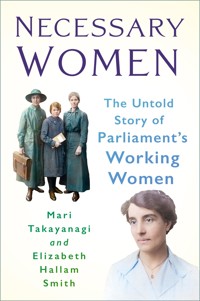
Cover illustrations: Front, top left: War Office workers: a supervisor, an infoor messenger and an outfoor messenger (© Imperial War Museum, Q030342); bottom right: Hannah Frances Mary ‘May’ Court (© Courtesy of Charles Court). Back: Parliament (Luke Stackpoole/Unsplash).
First published 2023
This paperback edition first published 2025
The History Press
97 St George’s Place, Cheltenham,
Gloucestershire, Gl50 3QB
www.thehistorypress.co.uk
© Mari Takayanagi and Elizabeth Hallam Smith, 2023, 2025
The right of Mari Takayanagi and Elizabeth Hallam Smith to be identified as the Authors of this work has been asserted in accordance with the Copyright, Designs and Patents Act 1988.
All rights reserved. No part of this book may be reprinted or reproduced or utilised in any form or by any electronic, mechanical or other means, now known or hereafter invented, including photocopying and recording, or in any information storage or retrieval system, without the permission in writing from the Publishers.
British Library Cataloguing in Publication Data.
A catalogue record for this book is available from the British Library.
ISBN 978 1 80399 403 1
eBook converted by Geethik Technologies
Typesetting and origination by The History Press
Printed and bound in Great Britain by TJ Books Limited, Padstow, Cornwall
CONTENTS
List of Illustrations
Prologue
1The Chaotic World of the Old Palace of Westminster: Meet the Women
2Ellen Manners Sutton: Scandal at the Speaker’s House
3Woman in Charge: Jane Julia Bennett, House of Lords Housekeeper
4Catering for the Members: Jane, Goddess of Bellamy’s
5The Admirable Mrs Gully and her Gallery
6‘Losing their Reason’: Eliza Arscot and her Fellow Housekeepers
7The Ever-Youthful Miss Ashworth: Typing Comes to Parliament
8For One Night Only? Emily Wilding Davison in the Cupboard
9A Wartime Innovation: The Girl Porters
10The Monstrous Regiment: Women Managers in the Lords
11Miss Bell and her Bell: The Later Housekeepers
12Expert Shots and Dragons: Parliament at War
13‘GIRL CLERK IN COMMONS’!
14Hansard and the Battle for Equal Pay
15The Strain of Carrying Ladders: The Library and Archives
Epilogue
Thanks and Acknowledgements
Sources and Further Reading
Notes
LIST OF ILLUSTRATIONS
INTEGRATED ILLUSTRATIONS
1Ellen Manners Sutton in about 1833, engraving after a portrait by Sir Thomas Lawrence. (© National Portrait Gallery, NPG D32595)
2Pocket plan of the House of Commons for the use of MPs, 1843. (© Parliamentary Archives HC/LB/1/114/19)
3Miss Shelley Gully, from Parliament Past and Present. (© Parliamentary Archives, BOOK/2301)
4Mrs Gully with her female Private Secretary, from Parliament Past and Present. (© Parliamentary Archives, BOOK/2301)
5Plan of the first floor of the Palace of Westminster, 1881. Detail showing the main Ladies’ Gallery, Mrs Speaker’s Gallery next to it, and the Serjeant’s Ladies’ Gallery at the opposite end. (© Parliamentary Archives, HC/LB/1/114/37)
6Harry Furniss, A Corner in the Ladies’ Gallery, c. 1888. (© Parliamentary Archives, HC/LB/1/112/248)
7Eliza Arscot, photographed c. 1906. Hanwell Asylum case book. (© London Metropolitan Archives, H11/HLL/B/19/50, p. 414)
8Miss May H. Ashworth, 1891. (The London Phonographer, vol. 1, no. 4, Sept. 1891, p. 1. © British Library P.P. 1891.pc: reproduced with permission from Bridgeman Images UK)
9Tony Benn’s plaque to Emily Wilding Davison, 1991. (© UK Parliament)
10War Office workers: a supervisor, an indoor messenger and an outdoor messenger. (© Imperial War Museum, Q030342)
11Robert Ambrey Court, c. 1914. (© Courtesy of Charles Court)
12Hannah Frances Mary ‘May’ Court, 1922. (© Courtesy of Charles Court)
13Miss Bell’s bell, photographed in 2022. (© Parliamentary Archives)
14Mr and Mrs Hills, photographed by Benjamin Stone, 1904. (© National Portrait Gallery, x44726)
15Palace of Westminster Home Guard lining up for inspection by the Speaker, Douglas Clifton Brown, and the Lord Chancellor, Lord Simon, October 1944. (© Parliamentary Archives, HC/CL/CH/3/10)
16Palace of Westminster Home Guard, October 1944. Left to right: Corporal Harry Charleton (MP for Leeds South), Pamela Ward, Pauline Bebbington, Barbara Shuttleworth, Pamela Matthew. (© Parliamentary Archives, HC/CL/CH/3/10)
17Mrs Hodges at the capstan lathe, Westminster Munitions Unit, 1945. (© Parliamentary Archives, WMU/1/2)
18Josephine Davson’s Palace of Westminster war service certificate, 1945. (© Courtesy of the Wolfe family)
19The Staff of the Official Report, 1947. Includes Jean Winder (standing, centre, behind Editor of Debates Percy Cole and his wife Clara). (© Parliamentary Art Collection, WOA 1512)
20‘Records Girl’, press cutting, August 1950. (© Parliamentary Archives, HL/PO/RO/2/66)
PLATE SECTION
1Sketch plan of the old Palace of Westminster, 1834, by John Rickman, showing the extent of the fire. (© Parliamentary Archives HL/PO/LB/1/2/2)
2Anne Rickman, Our House in New Palace Yard, watercolour, 1832. (© Westminster City Archives E133.3 (004))
3Sketch of the Ventilator in the roof of the former St Stephen’s Chapel, from where women were allowed to view the proceedings of the old House of Commons. Pencil drawing by Frances Rickman, 1834. (© Parliamentary Art Collection, WOA 26)
4The Destruction of the Houses of Lords and Commons by Fire on the 16th of October 1834, William Heath, colour lithograph. (© Parliamentary Art Collection, WOA 589)
5Painting of Elizabeth Garrett and Emily Davies presenting the 1866 women’s suffrage petition, by Bertha Newcombe, 1910. (© Women’s Library, London School of Economics)
6Plan of the new Palace of Westminster, principal floor, superimposed on a reconstruction of the old Palace. Drawn by G.F. Checkley for the Ministry of Works in 1932. (© Historic England Archives, Swindon, PSA01/08/00003)
7Census form of Mary Jane Anderson and Ethel Marie Anderson, 1911. (© The National Archives, RG 14/6944)
8New Dawn, sculpture by Mary Branson. (© Mary Branson, photo credit: Parliamentary Art Collection, WOA S753)
PROLOGUE
On 2 April 1911, the suffragette Emily Wilding Davison hid overnight in the crypt chapel in the Houses of Parliament. This dramatic protest was to record her presence there on census night, as a woman in the male bastion of Parliament, and to make a claim to equal political rights with men.
What Davison may not have known was that there were sixty-seven other women resident in Parliament that night, by right – housekeepers, kitchen maids, domestic servants, and wives and daughters living in households. Their homes ranged from the extremely grand – the Speaker’s House, a palatial dwelling within the Palace of Westminster with a distinguished family and multiple servants – to humble single-person rooms, such as the one occupied by the House of Lords Housekeeper. And while Davison hid in the crypt, other women were also hard at work in Parliament. Although not resident, they were performing necessary roles, as they had done for many centuries.
This is their story.
IN OUR OWN WORDS
In 2017, we realised by chance that we were both researching women working in Parliament – not as MPs, not as Members of the House of Lords, but behind the scenes. The women we found so compelling were largely invisible yet essential: out of sight, keeping the show on the road, making the engine run. They were cleaning the corridors of power, feeding parliamentarians through long night sittings, typing up the debates, ensuring that fees and wages were paid. Mari was filling out twentieth-century wartime innovations, pioneering Girl Porters and female clerks, painstakingly teasing their stories of prejudice and unequal pay from obscure office files. Liz was excavating tales of women enduring the hugely unpleasant working conditions in the Palace of Westminster a century earlier, prising them out of the cracks of the building, finding them selling oranges, working in cramped, smoky kitchens and – conversely – named as high office holders despite never coming anywhere near their place of work. We were both fascinated by the parliamentary families we came across – wives, sisters and daughters popping up in the lofty accounts of their menfolk; the births, marriages, deaths and toxic relationships which cruelly ended some lives and careers while giving opportunities to others; the great and hidden underbelly of women living on site exposed in census returns for the Palace.
We clinked glasses over lunch, nearby in Westminster Abbey Cellarium, and agreed that we would put all these women into a book, reconstructing their lives and work – some extraordinary, some mundane, and many deeply poignant – and showcasing their achievements. A couple of years later, having celebrated a suffrage centenary in 2018 and a century of women in the legal profession in 2019, and completed research projects on lost buildings of the Palace of Westminster, we returned to our plan mid-global pandemic. A couple more years later, informed by a huge amount of new research, especially drawing on freshly released online historical newspaper sources and the 1921 census, we are proud to present our cast of Parliament’s ‘Necessary Women’.
THE NECESSARY WOMEN
Women have always been part of the history of Parliament at Westminster. As workers, they emerge obliquely and occasionally from historical sources from the Middle Ages onwards, but by the late Georgian era, they begin to appear more strongly and visibly as real people whose stories can be told. We pick these stories up from around 1800, drawing on hitherto untapped parliamentary archives, government records, works of art and family history sources. These provide striking new evidence, enabling us to trace and understand the lives of some of these unheralded women. We explore their duties, lives and families, and recognise their often unknown yet essential support for Britain’s evolving political world.
A ‘necessary woman’ was a woman employed to ‘do the necessary’, such as emptying chamber pots. Parliament employed necessary women both literally – the first known Necessary Woman was Margery Hatrum, appointed in the Lords in the late seventeenth century – and also figuratively, as women worked for the House of Commons and House of Lords in necessary roles as cleaners, fire-lighters and cooks. Such women could be prominent and important in parliamentary life, such as Jane Julia Bennett, keeper of the keys of the House of Lords for more than fifty years; and Elizabeth Burton, the famous ‘Jane’ who dispensed beer, pies and chops in Bellamy’s legendary refreshment rooms. Others had much shorter and less-successful working lives. Our most tragic story is probably that of Eliza Arscot who, as we discovered late in our research, went from reigning as Principal Housemaid at the House of Lords to being consigned to a lunatic asylum for thirty years.
Some women served parliamentarians in local hostelries and coffee houses or ran fruit stalls in the very heart of the Palace of Westminster. Other women provided essential support as the wives, daughters and servants of the male occupants of official grace-and-favour residences. This might entail being the supreme political hostess and leading the parliamentary community, as did Elizabeth Abbot, Ellen Manners Sutton and Elizabeth Gully, wives of Speakers of the House of Commons; acting as unpaid secretary to a senior Commons official, as did Anne Rickman for her father John, the Clerk Assistant; or playing a leadership role during the fire that burned down the Palace of Westminster in 1834, as did Anne’s resourceful sister Frances.
By the time that Emily Davison hid in the crypt in 1911, women had entered office work in the wider world. In Parliament, this move was spearheaded by the redoubtable and ever-youthful May Ashworth, who provided typewriting services to Parliament for decades, unaffected by marriage, war and divorce. Ashworth’s manager in the House of Commons was Ethel Marie Anderson, and as we put the finishing touches to this book, we made the thrilling discovery of a hitherto unknown suffragette – her American mother, Mary Jane Anderson, who scrawled ‘Votes for Women’ across their census form. Like a schoolteacher correcting a wayward student, the census enumerator struck it out in harsh red ink.
Meanwhile, Amelia de Laney stubbornly refused to give up her on-site residence as House of Lords Housekeeper and demanded furniture for it. During the First World War, as men were called up in increasing numbers and women entered many new areas of work in society, the House of Commons found itself compelled to employ Girl Porters. This radical change was very successful – although not successful enough to survive the war, alas. However, as Parliament granted the vote for the first set of women in 1918, the House of Lords employed its first woman Clerical Assistant, May Court. She kept her job and rose to become Accountant, with a career spanning the decades through to another world war before her retirement in 1942.
The Second World War brought Blitz bombing to the heart of Westminster, where Commandant Edythe Mary Thomson ran the First Aid Post, Elsie Hoath served meals to the House of Lords and other women staff and volunteers watched for fires, drilled with the Palace of Westminster Home Guard, and toiled underneath Central Lobby in the Westminster Munitions Unit. The war also necessitated radical, if temporary, changes in the House of Commons, with the appointment of pioneering female clerks, who ran committees and provided expert specialist advice to MPs. A huge milestone was reached when Jean Winder was appointed as the first permanent Hansard reporter in 1944 – only to spend the next ten years fighting the Treasury for equal pay with male colleagues, in common with so many other working women. Winder’s retirement in 1960 brought with it something of a lull in the appointment of pioneering female parliamentary staff and brings this book to a natural close.
Overall, women were present in large numbers, working in the centre of British political life, with significant responsibilities, and making a far greater contribution at both the political and domestic levels than has hitherto been recognised. Their stories are of great interest individually, and collectively they uncover many new perspectives on the political and social cultures of the changing life of the ‘Westminster Village’. Parliament had much in common with other workplaces in many ways yet was unique in aspects such as its timekeeping and seasonal work, linked to the sittings of the House of Commons and House of Lords. And being there gave some of these women access to, and even some influence over, the people – almost invariably men – who shaped laws and policies for the country at large.
In Her Own Words
‘Poor Mamma was much overcome at first, but that made me stronger, as I felt I must look to everything. I chained the door so as to prevent any dangerous visitors. Henry Taylor and Edward Villiers insisted on being active chief managers under me.’
Frances Rickman, daughter of the Clerk Assistant,House of Commons, on her part in rescuingthe family’s possessions from the 1834 fire
1
THE CHAOTIC WORLD OF THE OLD PALACE OF WESTMINSTER: MEET THE WOMEN
In 1792, during the long reign of King George III, the Lobby just outside the House of Commons chamber bustled with Members of Parliament, officials and journalists going about their business. None of these were women – and yet, a woman was also present. A young female orange seller called Mullins was plying her trade in the heart of Parliament, in the very place where Prime Minister Spencer Perceval would be assassinated some twenty years later. Oranges would have been a welcome snack for politicians working long into the evening, but Mullins’s trade had long been linked with prostitution – and it was with this scandalous implication that she was described by a satirist:
A young, plump, rosy-looking wench, with clean white silk stockings, Turkey leather shoes, [and a] pink silk short petticoat, to show her ankle and calf to the young bulls and old goats of the House. With her black cloak thrown aside a little, her black eyes, and black hair, covered by a slight curtained bonnet, did that young slut kill members with her eyes.
The scurrilous author was Joseph Pearson, a celebrated Commons Doorkeeper. From his box in the Lobby, Pearson directed Members to their parliamentary business in his famously stentorian tones – and would have had ample opportunities to observe Mullins’s charms with repelled fascination while excoriating what he saw as the undue influence that she exercised over besotted MPs. Alongside young Mullins was, he tells us, her employer, another woman of a rather different nature: ‘Old Mother Dry’, with, sneers Pearson, her baskets of hard biscuits and sour fruit. Characterised – inevitably – as the orange seller’s pimp, ‘she knows more of members’ private affairs than all the old bawds in Christendom put together’.1
‘Mother Dry’ was in reality that rare thing, a successful female entrepreneur in her own right. Born in 1761 as Jane Caroline Drybutter into a wealthy, unconventional and litigious family, she had been apprenticed in 1773 to a draper and milliner in Chelmsford, Essex; such roles were a prestigious way for girls to enter the world of business. Possessed of a strong entrepreneurial streak, by the 1790s Jane had become a wealthy confectioner and fruiterer in the Westminster area. Although by now she was known also as Gibbs, there is no evidence that she ever married.
Jane Drybutter achieved her success without any help from her male relatives. Her colourful uncle Samuel, a prosperous jeweller and bookseller who ran an upmarket souvenir stall in Westminster Hall, had gained spectacular notoriety and experienced several arrests for his openly homosexual lifestyle and fled to Paris around 1778 after being attacked by a violent mob. He had ‘always had a great dislike and disregard’ for Jane and disinherited her. Meanwhile, her estranged father, James, described her in his will as his ‘very wicked and undutiful daughter’ and cut her out of his substantial estate with a shilling – far more, he said, than she deserved.2 Jane died in 1803, a prosperous businesswoman, having made her own way in life.
Selling oranges might seem a rather trivial occupation, but the sale of fresh fruit – a luxury item which was the snack of choice for MPs during sittings – was a profitable operation in the late eighteenth century. Behind his sneers and innuendos, Pearson suggests that her trade gave Jane Drybutter and her young employee Mullins privileged access to – and perhaps even some influence in – the corridors of power. And they were only the least invisible of Parliament’s necessary women.
THE CHAOTIC WORLD
Many features of the political world that Joseph Pearson and Jane Drybutter inhabited look familiar today: the periodic parliamentary elections; the sitting periods known as sessions; the ceremonies of State Openings and Prorogations; and even the striking visual signifiers of the green benches in the Commons and the red in the Lords. And there were clerks, just as today, who supervised and recorded the business and proceedings of Parliament, with Black Rod in the Lords and the Serjeant at Arms in the Commons there to maintain order and oversee ceremonial occasions.
But much of this world is deeply unfamiliar too, for the parliamentary reformers had yet to begin the process of widening the franchise and laying down the standards under which elections must be conducted. MPs were sent to Westminster on the say-so of a very limited number of constituency electors who were often open to bribery – or, in the case of rotten boroughs such as Old Sarum, were chosen by individual grandees. ‘Old Corruption’ – of which much more below – was rife across many parts of the public service. From the 1780s, the clamour for political and administrative reforms grew ever louder, but vested interests and political considerations always got in the way of progress. Not until 1832 did this begin to change, with the hotly contested passage of the first Reform Act.
Portrayed by the reformers as a metaphor for political corruption, the old Palace of Westminster was also a world away from the new Palace, the Victorian gothic behemoth which today occupies much the same site. Unlike the well-ordered Palace of today, framed by Big Ben at one end and the Victoria Tower at the other, the fabric and layout of the old Palace was chaotic: travel-writer Thomas Allen dismissed the effect from the river as ‘a confused and ill-formed assemblage of towers, turrets and pinnacles, jumbled together without taste or judgment’.3 Its component parts were an eclectic mix of medieval and later structures, tightly interwoven. It was contested space too, as the old Palace housed not just Parliament but also the Law Courts and several government offices, including the Exchequer, all of whose officers were constantly vying for extra accommodation. At its core was the vibrant, and at times lawless, public meeting place of Westminster Hall, dating back to 1098 and easily the oldest and most historic part of Parliament; and New Palace Yard to the north of the Hall, which had also long been a famous location for riots and disturbances. The old Palace also encompassed several official residences, private offices and numerous and often ill-managed record stores along with coffee houses and taverns. Many of its buildings and their contents were highly flammable.
As is still the case today, the House of Lords was located at the southern end of the Palace, sitting in the compact medieval White Hall until 1801 and then in the great Romanesque Lesser Hall. The House of Commons had been housed in medieval St Stephen’s Chapel nearby since 1548. Despite numerous modifications, by the early nineteenth century this small space, once a sublime expression of royal piety and power, was recognised as being grotesquely inadequate for its vital parliamentary functions. But for more than a century, all attempts to improve Parliament’s accommodation had foundered. In 1834, a major fire would reduce both chambers and much of the rest of the old Palace to a smouldering shell, as graphically revealed in a sketch plan by Clerk Assistant John Rickman (Plate 1). That momentous event would tear apart the lives of many of its inhabitants – men and women alike.
AN INVISIBLE ARMY OF WORKING WOMEN
Almost all the senior posts in the old Palace were filled exclusively by men. An exception was the role of Housekeeper, characteristically also a female preserve in the world outside. The House of Lords Housekeepers – mainly women, during the eighteenth century – were rather grand. With a substantial suite of rooms next to the chamber, they were tasked with overseeing security and cleaning for the House. Their equivalents in the Commons, the Deputy Housekeepers, also mainly female, had more mundane but still well-paid duties – including managing the ventilation system for the chamber and organising the flushing out and cleansing of the infamous Commons stool room. Unappealing as it might sound, this was a sought-after post: back in 1758 no fewer than three rival claimants were vying for it, two of them women.
In 1773, John Bellamy was appointed as Deputy Housekeeper to the Commons and branched out by setting up an official dining room close to the Lobby, known to posterity as Bellamy’s. Its fame rests on the parliamentary legend that, on his deathbed in 1806, Prime Minister William Pitt the Younger asked for one of Bellamy’s meat pies. This might be assumed to refer to John, but in fact it was ‘Mother Bellamy’, John’s wife Elizabeth, who presided in the dining room, also selling copious quantities of the wine in which they traded as a lucrative sideline. The satirist Joseph Pearson remarked, ‘Here the Members, who cannot say more than Yes or No below, can speechify for hours to Mother Bellamy about beef steaks and pork chops.’ Enduringly popular with the customers, the cooks and waitresses who dished up delicious meals to hungry MPs were soon to attain a legendary status in their own right.
Clinging to the old Palace of Westminster like barnacles, there was an ever-changing array of other, unofficial, catering outlets such as bars and coffee houses which relied heavily on female labour. Pearson mentions Alice’s, good for soups, which were not on Mother Bellamy’s menu, and Jacob’s, ‘kept by a Black fellow of that name in Old Palace Yard’, where MPs’ servants awaited their masters’ whims. Meanwhile, serving the House of Lords was the ever-popular Waghorn’s coffee shop, which during State Trials extended its opening hours to accommodate all comers. The death of its famed proprietor, Sarah Butler, in 1789 at the age of 70 was even noted officially in the Gentleman’s Magazine.4
By the 1830s, most of the coffee houses had been cleared away, but one, Howard’s, successor to Alice’s, survived next to the House of Lords and was a magnet for MPs, peers and the many barristers working at the Law Courts. All of the women working in these establishments would have had significant interactions with parliamentarians and with other staff from both Houses, as would those serving in the many local pubs, including the Star and Garter in Old Palace Yard.
Away from the dining rooms and bars, an invisible army of workers, many of them women, was needed to keep the chambers and committee rooms running to the high standards demanded by parliamentarians. The great majority of these – including almost all of the housemaids and cleaners – lived offsite, mostly in the warren of streets around the old Palace. Some, such as Martha Harrison who in the 1770s was paid about £3 a year for night work and for emptying the privies of both Houses, and Elizabeth Mills, Hall-keeper, who opened and shut the doors for the workmen, start to be named in the records. So too do the Necessary Women. They were traditionally domestic servants tasked with ‘doing the necessary’, emptying chamber pots and cleaning. But the Lords’ Necessary Woman post was so valuable that in 1726 it was awarded to a man as a sinecure – before being wrested back by a woman, Mary Phillips, in 1761.5
There was space for a few resident staff on the premises of the two Houses; at the time of the 1834 fire, six were to be found in the Commons, all of them waiting staff and four of them female – including a legendary waitress known as Jane, of whom more anon. The Lords had room for about twenty, again more than half of them women. They included Jane Julia Wright, the young Deputy Housekeeper (also of whom more anon), and her servants, as well as a few housemaids.6 Other servants, male and female, lived in the old Palace too – in the Law Courts and in the grace-and-favour residences of the Speaker and other parliamentary and government officials. Irrespective of station or rank, many of these women would have an important part to play on the night of the cataclysmic fire.
THE RICKMAN FAMILY
Within a stone’s throw from the House of Commons but separated from the waitresses, cleaners and orange sellers by a huge social chasm, lived well-to-do John Rickman, a senior Commons official, and his wife Susannah. Their invaluable papers gives us rare insights into family life in the old Palace. In line with the social norms of the day, the role of Susannah – and of the couple’s two clever daughters, Anne and Frances – was to support John Rickman’s professional and personal life to the full. Yet, although behind his austere and formal manner Rickman was clearly devoted to his womenfolk, he was also an unusually controlling and exacting taskmaster.
By 1805, Rickman, prodigiously active secretary to the Commons Speaker, had grown tired of living in his small official residence near Westminster Hall with no more than his housekeeper and a maid to look after his needs. He decided to marry, and picked Susannah Postlethwaite, a long-standing and valued acquaintance whose views he claimed to have moulded and shaped over the previous decade.7 Driven by the conviction that statistics offered a cure for social ills, John packed his days with his many official duties: setting up and managing Britain’s censuses; organising important Royal Commissions; and discharging with distinction a succession of responsible roles in the House of Commons. Any spare time he filled to the brim with an array of literary and scientific pursuits. But Susannah had been waiting for Rickman and knew what to expect. Dutiful and subservient, she was also efficient, good-natured and sociable – qualities which well fitted her for the role of his wife.
As well as running his household, Susannah was required to entertain her husband’s friends from among the literary, political and scientific elite of London and to engage in high-powered discussions with them. After an uncertain start, her kind and hospitable nature won them over and, as John became increasingly busy with duties in the House in the evenings, she mixed freely and frequently with them in her own right. She proved herself a most suitable spouse for Rickman.
Susannah and John produced three children who survived into adulthood: Anne, born in 1807; Frances who followed in 1810 – and who was named after a close family friend, satirical novelist and bluestocking Fanny Burney; and William, who arrived in 1812. Their earliest years were spent under the care of their kindly mother and the housemaids in their small official residence near to Westminster Hall. Susannah encouraged the children to play in the beautiful gardens, with lawns fringed by cherries, jasmines and vines that stretched behind their house to the banks of the Thames, often with the family of their neighbour and friend Samuel Wilde, Teller of the Exchequer.
From a young age, the Rickman children received instruction from their father – who demanded much of them. For his time, John had a relatively progressive approach to educating his daughters and drummed into them a wide range of subjects, including mathematics, science, Latin and history – as well as expecting them to mix and converse with his high-powered friends. This was not least to train Anne and Frances to share the role of his secretary, amanuensis and companion. Intelligent, diligent, self-effacing and compliant like her mother, ‘little Anne’ could readily be shaped for these tasks. Having visited all of England’s cathedrals by the time she was 8, at the age of 12 she was put to work to index the 700 illustrations in Camden’s Britannia, a gargantuan task. But while she was at least as clever, Frances, who was sent away to school in Brighton to benefit her health, would prove considerably less compliant than her sister.
In 1820, Rickman was promoted from Second Clerk Assistant to Clerk Assistant in the Commons, with pay of £2,500 (equivalent to some £143,000 today), a larger house and a continuing remit to improve the way in which the procedures of the House were recorded. He also continued to lead Royal Commissions on roads, bridges and churches in Scotland, working with leading engineer Thomas Telford. Anne was required to act as her father’s assistant, for much of her time being ‘occupied seated square before a sheet of paper, copying out some official papers, circulars or otherwise, or drawing papers from beneath Papa’s hand just so exactly that he could go on signing paper after paper to the number of 500 or more perhaps!’ ‘Now you see,’ she adds in her memoirs, ‘why I never could stitch but always could write.’8 So fine did her script become that she was frequently tasked with making multiple copies of papers for her father’s many meetings on Highlands roads and bridges.
Eventually, in 1823, even the gentle Anne rebelled – to her father’s cold fury – declining to ‘acquire the preliminary knowledge to make [her] useful as a scribe and assistant’ in etymology, which Rickman was pursuing as a new interest.9 But equilibrium was soon restored, and she always maintained a special bond with John. His expectations of her were extremely high and – despite some setbacks – she was a thoroughly satisfactory secretary to him. This was a part she would continue to play until his death in 1840, a few months before his fifth population census was taken.
MEMORIES OF OLD WESTMINSTER
Insofar as her duties allowed, Rickman encouraged Anne to observe and record events in the old Palace. Her memoirs have a particular interest, as ‘her girlhood was lived through stirring times’.10 She was fascinated by the travails of Caroline, estranged wife of King George IV and a great crowd-pleaser. In 1820, the queen was facing a Bill of Pains and Penalties in the Lords – in effect a trial – on a charge of adultery. Anne describes how, while this was happening, she and her father sat behind the barricades protecting their house, avidly watching Her Majesty travel past by carriage each day to face her accusers. After chaotic proceedings and scenes of violence from her supporters in New Palace Yard, from which the Rickmans emerged unscathed, the queen was acquitted for lack of evidence – but the king remained unreconciled with her.
The next stage of Caroline’s battle with George IV took place during his coronation, in 1821, an event again enthusiastically recorded by Anne. From outside their new house in New Palace Yard, the Rickman family witnessed the first of Caroline’s doomed attempts to join the vast royal procession and her ignominious departure. They all enjoyed the day enormously: the pageantry and spectacle of the colourful procession, the immense and glittering royal banquet in Westminster Hall which they observed in turn from the gallery, and the illumination of the streets all around with coloured oil lamps.11 Anne also made many sketches and watercolours of the Palace and its surroundings, including one of their house in New Palace Yard (centre), with her father walking out of the front door (Plate 2). Alongside her memoirs, these artworks provide a unique insight into this lost world.
ELIZABETH ABBOT, HEAD OF THE PARLIAMENTARY COMMUNITY
John Rickman owed his career at Westminster to Charles Abbot, Speaker of the House of Commons from 1802 to 1817. Upwardly mobile, combative, reforming and brilliantly clever, Abbot’s role placed him firmly at the top of the social tree among the residents of the Palace of Westminster. And Abbot’s wife Elizabeth, who was Anne Rickman’s godmother, was the very model of a competent and respectable Speaker’s consort. Although hers could only ever be a supporting role, it still had value and significance to her husband and his office.
Charles had married Elizabeth in 1796 when a backbench MP, her higher social status and ample fortune giving him considerable satisfaction. Their union was evidently a success and would produce two sons. Born in 1760, Elizabeth had been raised by her mother in England, at Hilton Park Hall, Staffordshire. Her father was the wealthy Sir Philip Gibbes who farmed Springhead Plantation, Barbados, where as many as 300 enslaved African people produced sugar for the British market. Gibbes was an ‘ameliorationist’ – one of those men who advocated that for both moral and economic reasons enslaved people should be treated with ‘humanity’ – but the extremely cruel system over which he presided was founded upon forced labour.12 Abbot, who counted leading abolitionist William Wilberforce as a close friend, had been sympathetic to his cause before he married Elizabeth. Thereafter, he no longer supported it openly, although the Abolition of the Slave Trade Act was passed in 1807 on his watch as Speaker. But it was not until 1833 that slavery was made illegal in the British Empire, and the repercussions of this unconscionable practice remain unresolved to this day.
Abbot’s election as Speaker in 1802 thrust Elizabeth into the limelight. Whenever the Commons was sitting, she was expected to reside with him at the Speaker’s House and to act as his consort and hostess. Simply being there posed a considerable challenge: the Speaker’s large and crumbling mansion, recently acquired by the Commons from the Exchequer, was undergoing a major and much-needed restoration and remodelling. While the project included the provision of new private accommodation with ample space for the Speaker’s family and servants, the layout and styling of the house was the domain of fashionable official architect James Wyatt, for whom Abbot was now the client. Only occasionally was Elizabeth permitted to make decisions, and these were on relatively small matters such as the final choice of wallpaper.
Worse still, the project was so complex and ill-managed that it took almost a decade to complete, and at an embarrassingly large cost to the public purse. The Abbots had, meanwhile, to reside in the middle of a building site when at Westminster, at considerable inconvenience and discomfort, and often took refuge at their private estate at Kidbrooke Park, Sussex. But eventually, in 1809, the Speaker’s House emerged as a glittering and opulent gothic revival palace. Confected as a manifestation of the antiquity and prestige of Abbot’s office, it formed an ostentatious showcase for his political discussions and entertainments. Although it was criticised by some contemporaries as a riot of bad taste and shoddy workmanship, for Abbot’s friend William Wilberforce it was ‘much the handsomest thing of its size I ever saw’. He was ‘intoxicated with the glitter and parade’ of dining there.13
While Abbot’s regular round of lavish official banquets were for male guests only, it fell to Elizabeth to preside over their grand private dinners and receptions, which wives and daughters could also attend. The palatial Speaker’s House was also a magnet for visiting dignitaries, both national and international, and, as Abbot was required in the House during sitting hours, Elizabeth was required to host them as his representative. Among these many distinguished visitors were three royal princesses, daughters of King George III, in 1812, and two years later Tsar Alexander I of Russia and his sister the Grand Duchess Catherine. In 1815, Anne Rickman excitedly observed a party of grandees passing by to a luncheon given by Elizabeth: ‘It was Queen Charlotte and the Duke and Duchess of Wellington after the Battle of Waterloo, when the Duke came to the House of Commons to receive public thanks.’14
Elizabeth also took on a leadership role within the little community living around the House of Commons, signified by the regular Sunday processions for the residents of the Palace to attend church services in St Margaret’s, Westminster. Stepping out in front with her husband, she evidently looked the part. On one occasion, Anne tells us, she sported a ‘bright emerald silk pelisse, trimmed with deep ermine, a muff as large as a pillow, deep cuffs and a long tippet, the footman behind her with her prayer book’.15
For fifteen years, Elizabeth Abbot did everything that could have been expected of a Speaker’s wife, setting high standards as his consort and hostess and acting as the doyenne of the Palace community. Then in 1817 Charles Abbot stepped down as Speaker for reasons of ill health. Ennobled as Baron Colchester, he died in 1829, but Elizabeth, now Lady Colchester, did not pass away until 1847. Respectably domiciled in London with family members, she would outlive by two years her colourful and dramatic successor at the Speaker’s House, Ellen Manners Sutton.
POLITICS AND INFLUENCING: ELITE WOMEN IN THE VENTILATOR
The departure of Speaker Abbot led to a change for female visitors to the House of Commons. Many women from the social and political elite of the land – the great and the good of their age – were keen to visit Parliament to observe the proceedings and to promote their menfolk’s interests. For them, the spaces from where the ladies could watch the proceedings of both Houses were vital political spaces: places to see and be seen, to observe and seek to influence politicians and events, and to form political alliances. In the House of Lords, an area was reserved for the ladies, and especially the wives of peers, to listen from behind the royal throne. Here they were often concealed behind a curtain – but by the early 1830s attendance levels were so high that female observers often spilled out into the body of the House, to the annoyance of their Lordships.16
The Commons was an infinitely more hostile environment for these women spectators. Since 1778, they had been banned by the Speaker altogether, a prohibition generally upheld until the arrival of Abbot’s successor, Charles Manners Sutton, in 1817. In 1818, Manners Sutton quietly permitted a few select women – the first probably the eminent prison reformer Elizabeth Fry – to access the attic storey above the House of Commons on an occasional basis, under the supervision of the Serjeant at Arms. There they could view the proceedings by peering down through a ceiling void known as the Ventilator, designed to void hot and foul air from the chamber below, in cramped, dirty and unpleasant conditions.
The area soon developed into a semi-official viewing gallery for the ladies, with Manners Sutton – a man known to have a strong liking for the ‘fair sex’17 – turning a blind eye. After some major works in the roof space, by 1822 an expanded Ventilator had been surrounded by a large octagonal wooden structure known as the Lantern. Through its sixteen apertures, the women could peer down on the proceedings below; the view was restricted, but the acoustics were better than in many parts of the chamber itself, enabling them to hear more of the debates than most of the men in the House and its galleries. Despite the discomforts, the Ventilator became a popular attraction, and to control access, twenty-five tickets were issued each day by the Serjeant at Arms. The successful applicants were ushered into the roof by the younger John Bellamy, Deputy Housekeeper, who in 1811 had succeeded his father of the same name. He and his staff ensured that MPs who ascended to converse with the ladies did not linger to listen, taking up spaces reserved for women. Bellamy also supplied them with food and drink, and at times a festive atmosphere prevailed, to the fury of MPs below when their speeches were drowned out by the noise of female chatter.
The draw for many elite women was the opportunity to hear serious political debates on issues such as slavery and parliamentary reform, and the Ventilator was a significant political and social meeting place for them. Here were to be found influential female political commentators and the wives of MPs, generally seated on party lines, along with society ladies, often with their servants in attendance. These ladies could listen to the proceedings and consult with and advise Members who were their husbands or friends and who were speaking in debates. Political and social alliances were forged, and information harvested for sharing. Some of the regular attendees penned descriptive letters which were circulated among their friends, and in the early 1830s one, possibly Caroline Sheridan, published in-depth reports from the Ventilator in the Court Magazine.18
When an important debate was scheduled to take place in the Commons, John Rickman often acquired tickets to the Ventilator for Anne and Frances. Here, the sisters could mix with the ladies and hear some of the greatest orations of the day. The most informative image of the Ventilator to survive is a pencil sketch by Frances, drawn on 25 June 1834, a quiet day when the main business in the House was the committee stage of the Highways Bill (Plate 3).
‘SHE IS OF FIRM MIND’: FRANCES RICKMAN AND THE 1834 FIRE
Later that same year, on the night of 16–17 October 1834, much of the old Palace was burned down in a fire which began in the heating furnaces of the House of Lords. Anne Rickman was away, staying with an uncle, but fortunately, Frances was at home. The letter she sent to Anne the next day, one of the most vivid accounts to survive of this cataclysmic event, reveals the vital part she had played in saving her family’s worldly goods. Frances describes how fear gripped the residents of the Palace as flames ‘burst from the House of Commons windows’ and ripped through the surrounding areas. Firefighting equipment was in short supply and all the efforts of the firemen, soldiers and passers-by were directed towards saving the precious Westminster Hall. That left the neighbouring houses of the Speaker, the Wildes and the Rickmans in serious danger.
As the flames advanced towards their residence, John Rickman, having returned from a good dinner at the Athenaeum Club, was provokingly disengaged – perhaps in disbelief. And Susannah was at first in a state of panic, so, Frances told Anne, ‘I felt I must look to everything’. In great contrast to the terror and confusion which prevailed elsewhere, Frances competently devised and oversaw an orderly operation to evacuate her family’s possessions. In this she was assisted by their servants and friends, and by two of Rickman’s recent dining companions, man-of-letters Henry Taylor and aristocratic lawyer Edward Villiers, who were ‘active chief managers under me’.19 As an appreciative Rickman reported, ‘Miss Fr did not quail in the least’, for she ‘is of firm mind’.20 Frances also found time to comfort their frightened maids, Hannah and Jane, and to ensure that their friends the Wildes were safe.
In the event, the flames did not reach the Rickmans’ house, and although they were very shocked by the dramas of the night, once the fire had died down their belongings were soon put back in place. When John Rickman and Frances toured the ruins during the next few days – including a visit with the king when Frances was the only lady present – they realised just how fortunate they had been.21 In this, they were in a minority. While the Rickman sisters would go on to marry clergymen, to produce eleven daughters between them and to live out their days in placid respectability, the conflagration would completely reshape the Palace and the lives of many of its other inhabitants – including several of the women whose stories we tell below.
About Ellen Manners Sutton
‘Her history is no secret in the higher circles.’
Press criticism of Ellen, wife of Commons SpeakerCharles Manners Sutton, February 1835
2
ELLEN MANNERS SUTTON: SCANDAL AT THE SPEAKER’S HOUSE
On 6 December 1828 the Rt Hon. Charles Manners Sutton, great-grandson of the third Duke of Rutland, son of the Archbishop of Canterbury and Speaker of the House of Commons, married beautiful and vivacious Irish widow Mrs Ellen Home Purves at St George’s Church, Hanover Square:
In vain his daughters … threw themselves at their parent’s feet and implored him not to disgrace himself; tears and supplications were in vain. The Speaker would have his way, would give his casting vote and Mrs Purves is at length nestled within the precincts of St Stephen’s Chapel.
Or so speculated William Beckford, embittered social outcast, expressing horror that Manners Sutton, ‘the ex-officio as it were of public morals’, was now bound to ‘that errant lady’.1 The contrast with Ellen’s predecessor, respectable Elizabeth Abbot, could not have been greater.
Other contemporaries agreed. Although Ellen Manners Sutton was soon established in high society, her past – reputedly as a kept woman and the mother of several illegitimate children – was always to be held against her by those professing more traditional values. So too was the fact that she was the younger sister of Lady Blessington, a high-profile author and literary hostess, much reviled for her own racy life.
But the Speaker’s new spouse soon became one of the ‘fashionables’, a prominent society hostess and a powerful, dominating and dramatic presence in the Palace of Westminster. The press reported her activities with relish, and she evoked a mixture of repulsion, envy and admiration. The story of her rise reveals the extent to which an attractive, unconventional, determined and ruthless woman was able to carve out political and social influence at Westminster, while at the same time enjoying the benefits of her lifestyle to the full. However, her later decline into financial hardship and ill health shows how fragile and transitory such a gilded existence could be.
ELLEN’S FORMATIVE YEARS
Born in 1791, at Knockbrit near Clonmel, County Tipperary, Ellen hailed from an old Irish Catholic gentry family. Her father, Edmund Power, a magistrate and businessman, was unstable, violent and periodically insolvent. Ellen first comes into public view in her early teens, attending society assemblies in Clonmel. Here, she and her older sister Margaret, both well educated, were said to have impressed the people of the town with their precocious cultivation and charm, although Ellen, already very comely, ‘seemed conscious of being entitled to admiration’.2 At this time, there was nothing to suggest that these two sisters would go on to lead lives which – even discounting jealous gossip and vitriol – would enthral any modern soap-opera audience and which would take them to the heart of the British establishment.
In 1804, as soon as she reached 15, the legal minimum age for marriage, Margaret was forced by her parents into wedlock with an apparently prosperous army captain, Maurice St Leger Farmer. Farmer soon proved violent and abusive towards Margaret and was disgraced after making a brutal attack on his commanding officer. He was rapidly banished to serve in India, but Margaret’s refusal to accompany him there left her a social outcast. Ellen’s name was, meanwhile, linked with polished and cultured William Stewart of Killymoon, later a lieutenant colonel and Westminster MP, and a pillar of Irish society. One of her many detractors later alleged that she produced three daughters with him out of wedlock, who would subsequently be brought up by her first husband.3 This oft-repeated canard is not supported by any other evidence.
In about 1809, Captain Thomas Jenkins, a family friend, became Margaret’s protector. He spirited her away to England, installing her in his house in Hampshire with his mother and sisters. This liaison would change Ellen’s life as well. For when in 1810 – beautiful, vivacious and penniless – she went to stay with Margaret and the Jenkins family, she met John Home (soon styled as Home Purves), of Purves Hall, Berwickshire. A gentleman of independent means, he was a good marriage prospect. In September 1810, Ellen, aged 19, duly wed John at the Anglican parish church of St George, Hanover Square, London, with her sister Margaret Farmer as a witness. The couple settled down into a respectable union, producing a son and heir, John, born in 1815, and four daughters who survived into adulthood. The eldest was Louisa, born in 1811 – well after the end of any liaison that Ellen might have had with William Stewart – and the youngest was Ellen, born between 1820 and 1823. By that time, though, the relationship between Mr and Mrs Home Purves was coming to an end.
In 1816, Ellen’s sister Margaret had found a new protector in the person of a very wealthy and hedonistic Irish peer, Charles John Gardiner, Viscount Mountjoy, who installed her in style in his house in Manchester Square, London. The fortuitous death of Margaret’s husband in 1817 – from injuries sustained during a drinking spree at the King’s Bench prison – enabled her to marry Mountjoy, by now Earl of Blessington, in 1818. To be known henceforth as Marguerite, Lady Blessington, and an exquisite and accomplished woman, she reinvented herself as a society hostess and author, residing mainly on the Continent, in France and Italy.
A ‘KEPT WOMAN’
On 30 September 1823, on one of his journeys across the Alps, Lord Blessington was both delighted and very surprised to encounter Ellen Home Purves, his sister-in-law, in the company of Charles Manners Sutton, Speaker of the House of Commons. They were staying together at a fashionable inn just outside Geneva, along with all their respective children, nannies and governesses. After travelling convivially with them for a month, Lord Blessington offered Ellen the use of his grand house in St James’s Square, Piccadilly, on her return to London. This became Ellen’s official residence for the next few years, where she entertained the Speaker in private. She was also to be seen in company with Manners Sutton at dinners and events, and in 1824 travelled with him to Paris to see the sights.4 But she was a social outcast in much of polite society, which regarded her as a kept woman.
What had become of John Home Purves, the husband whom Ellen had left for the Speaker? As a contemporary euphemistically put it, ‘circumstances led to him separating himself from his country and his family’.5 In April 1824, having obtained a posting as the British Consul for Florida, he set off for Pensacola, a strategically significant and far-flung port recently acquired by the United States from Spain. But this appointment, although dutifully discharged, did not bring him contentment. Pensacola was an expensive place to live and his consular salary of £500 (approximately £28,000 today) was ‘barely sufficient to live on with any degree of respectability, or importance, that the situation otherwise authorises me to keep up’.6 In September 1826, Purves died aged 43, one of the many victims of Pensacola’s notoriously unhealthy climate. Ellen was now free to marry her paramour.
As already noted, Charles Manners Sutton had been Speaker since 1817. Tall and gentlemanly in demeanour, with a sonorous voice and a commanding presence, he soon gained the respect of the House despite retaining his strong Tory views in private. Charming, witty and congenial, although not a heavyweight intellectual, he was noted for his facility in managing debates. Moving with him into the Speaker’s House were the servants needed to sustain his daily life and the pomp of his office, along with his much-cherished two young sons and one daughter from his marriage to Lucy Denison, who had died in 1815, leaving him a widower.
Manners Sutton continued his predecessor’s custom of holding grand political banquets and receptions, and in July 1821 he hosted the new king, George IV, at the Speaker’s House on the eve of his coronation. But behind its glittering gothic revival surfaces all was not well with the structure. In 1824, some substantial and costly alterations were suddenly set in train and in 1826 the Speaker’s kitchens were cleared out of the central cloister court and relocated as the smoke from their chimneys was annoying the residents.7 It is tempting to see Ellen’s hand in all this, not least as some contemporaries were of the view that she was living there.
THE SPEAKER’S WIFE
When Ellen married Charles Manners Sutton in December 1828 at St George’s, Hanover Square, he was 48 years old and she was 39, and ‘still very beautiful’ according to an admiring guest (Figure 1).8 She was now at last officially resident at the Speaker’s House, and an old friend, the Irish poet Thomas Moore, visiting her in February 1829, was ‘not a little amused to see her enshrined in her magnificent establishment’. On a further visit in May, he was beguiled by the beauty of the house and garden and again ‘amused to see her, in all her state, the same hearty, lively Irish-woman still’.9
A crucial part of the duties of the Speaker’s wife was acting as her husband’s hostess for his frequent soirées and private dinners at his Westminster residence and accompanying him on official engagements. Ellen shone in this role, famously enlivening her husband’s entertainments both formal and informal with vivacity and wit. She also ensured that the extensive private entertaining space in the house was fitted out to the height of fashionable opulence, purchasing costly furniture and fittings to supplement those provided at public expense. The couple’s spending spree was made possible by the Speaker’s generous allowance of £6,000 a year (with a further £500 for coals and candles) on top of his personal wealth. By 1834, with these possessions supplemented by more furniture from his former country seat at Mistley Hall, Essex, the Manners Suttons had amassed enough for two or three residences.
Figure 1: Ellen Manners Sutton in about 1833, engraving after a portrait by Sir Thomas Lawrence.
Although she was soon presented to King George IV at Court in April 1829, Ellen’s colourful past continued to be held against her by many contemporaries. The influential Mrs Harriet Arbuthnot, snobbish Tory political obsessive – and close confidante of Prime Minister Arthur Wellesley, Lord Wellington – squarely blamed the king for letting down the royal dignity by receiving her.10 Mrs Arbuthnot and her cousin, the famous political hostess Sarah Villiers, Lady Jersey, were leading lights at Almack’s Club, the prestigious assembly rooms in London’s West End. Membership was highly prized and while the Speaker was clearly welcome at the glittering receptions and balls held there, Ellen’s recorded appearances at Almack’s events were infrequent and must have been on sufferance.
The arrival of children prompted further unkind comment. In December 1829, Ellen gave birth to a daughter, Frances Diana Manners Sutton, and a son followed in 1831, but died at birth. Having been born after her marriage, these children were, sarcastically carped the Whig diarist Charles Greville, ‘triumphant witness of her immaculate virtue’.11 Novelist Mary Shelley was, it seems, so enraged by Ellen’s treatment by her critics that in 1830 she befriended her, although this may not have helped Ellen’s advance in society.
But Ellen could be ruthless too. In 1831, she insisted that her eldest daughter, Louisa, married the underwhelming John Fairlie, land agent to the Duke of Rutland, apparently against Louisa’s own wishes. Ellen’s sister Marguerite, Lady Blessington, returned to London in 1830 after the sudden death of her husband in Paris, and notoriously set up a home and literary salon with her own stepdaughter’s estranged husband, the handsome French dandy Alfred, Count d’Orsay. Marguerite’s many detractors criticised this setup as vulgar as well as scandalous, and by July 1831 the newly respectable Manners Suttons had, lamented one of Marguerite’s more loyal friends, ‘thrown my Blessington overboard’.12
All this was set against the background of the social whirl in which Ellen was now caught up and which she had clearly craved for so long. Despite being ostracised by parts of respectable society, she cultivated a wide circle of friends and the press portrayed her as one of the ‘fashionables’. Her comings and goings, splendid parties and attendances at society events and performances, both with and without the Speaker, were widely reported. She was spotted dining with King William IV in Brighton and presiding over lavish dinners and entertainments at Mistley Hall, her husband’s seat.
Noted too were her appearances in London, at the Vauxhall Pleasure Gardens, at the circus, at the ballet and at the opera where, ‘strikingly conspicuous’, her presence was said even to have outshone the singers.13 At the State Opening of Parliament in 1830, she completely upstaged all the other ladies attending the Lords chamber. They were clad in sombre mourning for the recently deceased George IV, but Ellen dramatically and elegantly subverted the rules of etiquette by wearing ‘a few brilliants intermixed with jet in her hair and ears’.14




