


Erhalten Sie Zugang zu diesem und mehr als 300000 Büchern ab EUR 5,99 monatlich.
- Herausgeber: The History Press
- Kategorie: Sachliteratur, Reportagen, Biografien
- Sprache: Englisch
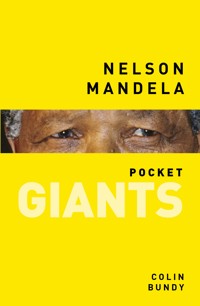
'Colin Bundy has given us an incredible insight into the person of Mandela. What a man and what a gift Madiba was to the world.' - Desmond Tutu Nelson Mandela's place in history is secure: he was one of the best known prisoners in the world even before his election as the first president of post-apartheid South Africa; secondly, he became a global icon, an elder statesman, with a degree of moral authority matched by very few. Coming to terms with a dizzying sequence of roles, this biography explores Mandela's various identities – dashing young urbanite, charismatic nationalist politician, underground military commander and Black Pimpernel, tried, convicted, and a political prisoner for 27 years; on his release president of a democratic South Africa – and assesses these independently of his iconic, nigh-mythic status. This book revisits the well-known contours of Mandela's career, but resists hagiography: it outlines what he achieved, but also identifies aspects of his personality and politics that are far less familiar.
Sie lesen das E-Book in den Legimi-Apps auf:
Seitenzahl: 136
Veröffentlichungsjahr: 2015
Das E-Book (TTS) können Sie hören im Abo „Legimi Premium” in Legimi-Apps auf:
Ähnliche



















Contents
Title
Introduction
1 Man and Myth: The Construction of an Icon
2 Early Years: The Making of a Nationalist
3 Defiance and Rivonia: The Training of a Heavyweight
4 Prison Years: The Forging of the Steel
5 Release and Reconciliation: The Building of a Nation?
6 Last Years and Legacy: Remembering Mandela
Abbreviations
A Note on Terminology
Timeline
Further Reading
Web Links
Copyright
Introduction
It’s impossible to make small talk with an icon
Which is why, to find my tongue,
I stare down at those crunched-up
One-time boxer’s knuckles.
In their flattened pudginess I find
Something partly reassuring,
Something slightly troubling,
Something, at least, not transcendent.
Jeremy Cronin, 19971
The South African cartoonist Zapiro celebrated Nelson Mandela’s eightieth birthday with a scene called ‘Nelson Mandela: The Early Years’. An African primary school teacher, holding sheets of paper her tiny wards have handed in, confides to a colleague: ‘This one can’t make up his mind: he put down “lawyer, activist, freedom fighter, prisoner of conscience, president, reconciler, nation-builder, visionary and 20th century icon”.’ Zapiro’s homage not only provides a thumbnail sketch of a famous career but also hints at the dilemma confronting anyone writing a short biography of the man. So many aspects of Mandela’s life are familiar that they challenge a biographer to find fresh meaning in them: the rural childhood, an early adulthood shaped by opposition to apartheid, a watershed decision to take up arms, a famous trial and a life sentence; and after twenty-seven years in jail, a remarkable policy of reconciliation and his election as the first president of democratic South Africa.
Consider, too, the quite extraordinary veneration and affection he won from people across the world – never more obvious than in the torrent of tributes and avalanche of encomia that greeted his death. How does any observer sift the actual life of an individual from the idealised hero: a secular saint, symbol not only of his own nation’s rebirth but moral leader of humankind, whose death reminded a world of its hunger for hope, for a better future? How does one trace the tentative steps, mistakes and mishaps, the flaws and failures which are the lot of any human life from an air-brushed, formulaic, eulogised life-story that seems to transcend mortal measures?
There is an element of retrieval involved in a posthumous Mandela biography, however brief: an attempt to rescue the man from the myth. After all, what was the legacy of the man who died in December 2013? Those who rushed to wrap themselves in Mandela’s mantle included Havana and the White House, Israelis and Palestinians, the Vatican and ayatollahs, Chinese government and China’s dissidents – and countless others across every political spectrum. Does any death so universally mourned not require a life and its achievements to have been universalised and sanitised, stripped of complexity, hallowed and hollowed, remade as an identikit icon? And if so, the challenge is to arrive at a biographical narrative that recognises Mandela as a compelling and complex political actor, but subject to the kinds of constraints and contradictions that describe any career.
So this biography locates Mandela in his time and place, indicating the social and political currents that bore him. It reminds readers of a point made frequently by Mandela himself: that his own achievements were part of broader, collective efforts – and that they cannot be otherwise understood. And it shows that his political efforts and those of the African National Congress (which he served for seventy years) involved the compromises, short cuts and shortcomings that are intrinsic to any politics in a complex world.
To write a biography that eschews hagiography is not an attempt to belittle Nelson Mandela, nor to carry out some sort of hatchet job on his reputation. Mandela’s stature as a ‘giant’ is beyond question. As nationalist leader, his place in his country’s history is comparable to those of Atatürk, Nasser, Nehru, Nkrumah, Sukarno and Ho Chi Minh; as exemplar of moral and civic virtues, he ranks with Lincoln, Gandhi and Martin Luther King (although he did not share the last two’s adherence to non-violence as a principle); as a twentieth-century public figure who inspired love and respect, he belonged to a tiny club including perhaps Pope John XXIII, Mother Teresa and the Dalai Lama. Mandela – observed J.M. Coetzee – was, by the time of his death, universally held to be a great man: ‘he may well be the last of the great men, as the concept of greatness retires into the historical shadows.’2
Yet the conundrum persists: how much of his towering reputation derived directly from Mandela-the-man, his principles and practice, his deeds and words – and how much was the product of a constructed version, Mandela-the-myth, an image deliberately burnished for political purposes? It is worth reflecting that Mandela’s place in history is guaranteed by his role after his release in February 1990; the man who walked into the transfixed gaze of the global media that Sunday afternoon was already a legend. He was the world’s most famous political prisoner; he was absent, yet imminently present; his silence reverberated. He had ‘acquired an almost posthumous eminence’,3 showered with honorary degrees and prizes.
How does one explain so singular a renown? In order to answer this question, this biography does not begin with Mandela’s childhood and then trace his life throughout ninety-five years; instead, it commences with a history of Mandela-the-myth, the making of the icon, and then resumes the more conventional form of a life history.
Notes
1 Cronin, J., ‘Poem for Mandela’, from Even the Dead: Poems, Parables and a Jeremiad (David Philip, 1997), p.30.
2 Coetzee, J.M., ‘On Nelson Mandela (1918–2013)’, New York Review of Books, 9 January 2014.
3 Nixon, R., Homelands, Harlem and Hollywood: South African Culture and the World Beyond (Routledge, 1994), p. 176.
1
Man and Myth:The Construction of an Icon
21 years in captivity
Are you so blind that you cannot see?
Are you so deaf that you cannot hear?
Are you so dumb that you cannot speak? I say
Free Nelson Mandela
Free Nelson Mandela
Free Nelson Mandela
The Special A.K.A., 19844
The day before Mandela died, the Cape Times – Cape Town’s morning newspaper – carried two short news stories separated by a photograph captioned ‘Our Icon’. The first item reported that a photographic portrait of Nelson Mandela had been sold for a record $200,000. The portrait, by Adrian Stern, was sold to a New York private collector who wished to remain anonymous.
The second story reported the announcement in Johannesburg of a book in production – the Nelson Mandela Opus. The book would be half a metre square and weigh 37 kilograms. Only 10,000 copies would be available worldwide – although ‘derivatives’ would be more widely available. The book, in burnished leather covers, was being produced by Opus Media, self-badged as ‘the foremost luxury publishing brand’. It was the latest title in a series on ‘iconic organisations and personalities, which include brands such as Formula One, Ferrari, Manchester United, Michael Jackson, Sachin Tendulkar and the Springboks’.
This chapter is not about Mandela as a brand, or as a commodity; yet the pricey portrait and the brazen excesses of the Opus project cannot be comprehended without some sense of the construction, over several decades, of an iconic Mandela. In the years from 1950 to 1990 the person of Mandela became the vehicle for an increasing freight of symbolic meaning. Many hands were involved in the enterprise, adding details, heightening the lustre, positioning the heroic subject in ever more favourable light. But crucial contributions to the project, in the 1950s and early 1960s, were made by Mandela himself.
All the major commentators on Nelson Mandela have noted his acute awareness of his own presence, of the potency of the image and the strength of the symbolic gesture or stance. Elleke Boehmer writes of ‘his chameleon-like talent for donning different disguises; his theatrical flair for costume and gesture; his shrewd awareness of the power of his own image’. Tom Lodge places special emphasis on ‘Mandela’s political actions as performance, self-consciously planned, scripted to meet public expectations, or calculated to shift popular sentiment … For Mandela, politics has always been primarily about enacting stories, about making narratives.’5
Richard Stengel, who worked closely with Mandela as editor and co-writer of the autobiography Long Walk to Freedom, presses the case even further. Throughout his life, Mandela was concerned with how things looked. He loved clothes: ‘He always has … His view is that if you want to play the part, you have to wear the right costume.’ And so as a young lawyer, Mandela wore bespoke suits to impress the court; when he went underground, he donned fatigues and grew a beard. Mandela was not merely sartorially sensitive, he was ‘concerned about appearances on a far grander scale than just what suit he was wearing. He understood the power of the image … Mandela thought deeply about how his actions would be interpreted by voters or the media … “Appearances constitute reality”, he once said to me.’ As a young man, Mandela was keen to be photographed; as elder statesman, he loved the celebrity photo-op: ‘Like Lincoln, who took every opportunity to have his picture taken, Mandela is aware that images have tremendous power.’ ‘All his life, he cultivated and curated images of himself.’6
As the young Mandela rose rapidly through the ranks of the African National Congress (ANC) in the 1950s, he emerged as one of its most visible and popular leaders. The novelist Lewis Nkosi recalls him during this decade: ‘a tall, handsome man with hair parted in the middle … wearing a charcoal grey suit and [flashing] a big white-toothed smile of success.’ In her autobiography, Call Me Woman, Ellen Kuzwayo wrote: ‘I remember the glamorous Nelson Mandela of those years. The beautiful white silk scarf he wore round his neck stands out in my mind to this day.’7
Mandela and his photogenic second wife, Winnie, often featured in the pages of Drum magazine (edited by Anthony Sampson, later Mandela’s official biographer), radiating style, confidence and ambition. Tom Lodge reminds us that Drum carried ‘the first photo-journalism directed at black readers’, and in its pages Mandela became ‘a visually public personality’.8 Defining moments in Mandela’s self-presentation took place after the crisis precipitated by the Sharpeville shootings in March 1960 and by the ANC’s decision – after it was banned by the government – to operate illegally. By March 1961, Mandela was in hiding – yet not out of the spotlight.
On 22 March he made a surprise appearance at a conference in Pietermaritzburg, a show of strength for the proscribed ANC. Mandela was rapturously greeted by the 1,400 delegates: ‘the panache of his emergence from hiding gave his image a new magic,’ says Sampson.9 Over the next couple of months, Mandela held a series of covert meetings with journalists, pressing the justice of his cause – and was dubbed the Black Pimpernel, a soubriquet whose appeal he cultivated. Mandela spent the first six months of 1962 visiting independent African states (and made a brief trip to London). He returned to South Africa – clandestinely – in July 1962, but was captured by the police two weeks later.
Mandela was taken aback during his African travels by the extent to which the rival Pan Africanist Congress (PAC) was seen by some African leaders as more authentically African: the ANC in their eyes was compromised by its alliance with whites, Indians and coloureds. Ever since the formation of the PAC, Mandela had countered its Africanist claims. In 1961, he arranged to have his photograph taken by Eli Weinberg in African ‘tribal’ dress as a visual reminder of his own ‘authentic’ identity. This produced the familiar image of a seated Mandela, torso bared, wearing a beaded necklace, bracelets and a blanket. The message was clear: here was a dignified, powerful African proud of his traditions and heritage.
Even more explicit was Mandela’s dramatic stage management of his trial in Pretoria in October 1962. Charged with inciting a strike and with leaving the country illegally, he entered the courtroom wearing a traditional Xhosa kaross (a cape made of animal skin). Winnie attended, wearing Xhosa headwear and an ankle-length skirt. His costume expressed visually what Mandela told the court: ‘this trial is a trial of the aspirations of the African people.’ Years later, he spelled it out: ‘I had chosen traditional dress to emphasize the symbolism that I was a black African walking into a white man’s court.’ 10
The magistrate sentenced Mandela to five years’ imprisonment, so he was already in prison when his senior ANC colleagues were arrested at Liliesleaf Farm in Rivonia, Johannesburg, in July 1963. Mandela joined the others as Accused No. 1 in what became known as the Rivonia Trial. From the dock, he made a speech which remains his best-known public utterance. After nearly three hours, Mandela concluded by putting down his papers and speaking from memory:
I have cherished the ideal of a democratic and free society in which all persons live together in harmony and with equal opportunities. It is an ideal which I hope to live for, and see realized. But if needs be, it is an ideal for which I am prepared to die.
Mandela’s speech – which outlined the ANC’s history and the reasons for launching a sabotage campaign – and especially its remarkable peroration were widely reported at the time and quoted over and again in later years. It was the key text underpinning his iconic status as nationalist leader and as political prisoner.
If Mandela himself was a prime shaper of his image, as it took form, the most important agent in the longer term was the organisation which he came to symbolise: the African National Congress. Founded in 1912, it was for nearly forty years the vehicle of a tiny stratum of African intellectuals and professionals; in the 1950s it embraced the tactics of civil disobedience and recruited thousands of new members. In 1955, the ANC and its allies convened the Congress of the People and adopted the Freedom Charter – a ringing call for equal rights for all South Africans. Banned in 1960, the ANC’s dual response was to set up a presence in exile and to operate illegally inside South Africa.
In early 1961 the internal ANC leaders, including Mandela, made the challenging shift to clandestine activism. Reflecting on the moment thirty-four years later, Walter Sisulu – Mandela’s closest friend and comrade – said that he believed at the time that the ANC should have a single leader underground, and that it must be Mandela: ‘When we decided that he should go underground I knew that he was now stepping into a position of leadership … We had got the leadership outside but we must have a leader in jail.’ Anthony Sampson comments that Sisulu ‘clearly foresaw the need for a martyr’.11
In October 1962, as Mandela awaited his first trial, the underground ANC distributed leaflets headed ‘Mandela is in Prison: The People are in Chains’, promoting ‘the new image of Mandela as the uncompromising outlaw, the lone fighter who symbolised the unity of the people’.12 Once the trial began, the ANC set up a Free Mandela Committee, issuing the call, ‘Free Mandela’. In his autobiography, Mandela recalls that ‘the slogan began to appear scrawled on the sides of buildings’.13 Twenty years later, the call to ‘Free Nelson Mandela’ was daubed on countless walls again – but not only in South Africa. It became the rallying cry of an international solidarity movement, a pop song, a staple of editorials and headlines around the world, a demand and a credo.
It was not a call that echoed consistently from the early 1960s to the 1980s. A petition opposing death sentences for the Rivonia accused won 180,000 signatories; but after the verdict the campaign lost its raison d’être and its momentum. Global awareness of Mandela, which flared briefly in response to the Rivonia speech and his life sentence, subsided. The attention span of international media is limited. In 1964 the London Times referred to Mandela fifty-eight times, and the New York Times made twenty-four mentions. By the following year these figures had shrunk to two and none. For the next ten years, Mandela scarcely existed in the global consciousness: the icon was out of sight and largely out of mind. Even in the British Anti-Apartheid Movement (AAM), not a single action for Mandela was taken between 1967 and 1970.




