


Erhalten Sie Zugang zu diesem und mehr als 300000 Büchern ab EUR 5,99 monatlich.
- Herausgeber: Pocket Essentials
- Kategorie: Sachliteratur, Reportagen, Biografien
- Sprache: Englisch
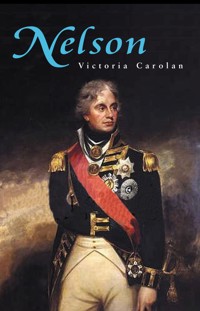
Nelson continues to fascinate academics as well as the general public. He is still considered one of Britain's greatest heroes and featured within the top ten of the BBC poll of such figures. But why does Nelson still remain such a prominent figure in the national imagination? With 2005 being the bicentenary of the Battle of Trafalgar, Victoria Carolan embarks on a timely reappraisal of Nelson, the myth and the man. Beginning with Nelson's early life and an analysis of the condition and practice of the Navy at the time of Nelson's entry into service, Carolan goes on to examine Nelson's naval battles before Trafalgar, particularly the pivotal Battle of the Nile in which the then Rear Admiral Horatio Nelson, with a fleet of fourteen ships, captured six and destroyed seven French vessels out of a total of seventeen and in the process achieved one of the most decisive victories in the age of sail and re-established British command of the Mediterranean. Devoting a full section to the Battle of Trafalgar, Carolan looks in detail at the build-up to the battle, the events and progress of the battle, at the Admirals of the French and Spanish navies and explains why the battle was so decisive in the Napoleonic Wars. She goes on to look at the immediate aftermath of Nelson's death and his state funeral and then to his legacy, the building of monuments (particularly Trafalagar Square and Nelson's Column), the development of the Nelson myth, his depiction in film, his value for propaganda purposes during the two world wars and the current state of scholarship on Nelson.
Sie lesen das E-Book in den Legimi-Apps auf:
Seitenzahl: 165
Veröffentlichungsjahr: 2015
Das E-Book (TTS) können Sie hören im Abo „Legimi Premium” in Legimi-Apps auf:
Ähnliche


















NELSON
Nelson continues to fascinate academics as well as the general public. He is still considered one of Britain’s greatest heroes and featured within the top ten of the BBC poll of such figures. But why does Nelson still remain such a prominent figure in the national imagination?
In this pocket essential guide, Victoria Carolan embarks on a timely reappraisal of Nelson, the myth and the man.
Beginning with Nelson’s early life and an analysis of the condition and practice of the Navy at the time of Nelson’s entry into service, Carolan goes on to examine Nelson’s naval battles before Trafalgar, particularly the pivotal Battle of the Nile in which the then Rear Admiral Horatio Nelson, with a fleet of fourteen ships, captured six and destroyed seven French vessels out of a total of seventeen and in the process achieved one of the most decisive victories in the age of sail and re-established British command of the Mediterranean.
Devoting a full section to the Battle of Trafalgar, Carolan looks in detail at the build-up to the battle, the events and progress of the battle, at the Admirals of the French and Spanish navies and explains why the battle was so decisive in the Napoleonic Wars. She goes on to look at the immediate aftermath of Nelson’s death and his state funeral and then to his legacy, the building of monuments (particularly Trafalagar Square and Nelson’s Column), the development of the Nelson myth, his depiction in film, his value for propaganda purposes during the two world wars and the current state of scholarship on Nelson.
Victoria Carolan
Victoria Carolan is a cultural historian specialising in maritime history and film. She completed her doctoral thesis, British Maritime History, National Identity and Film 1900-1960 at Queen Mary, University of London. She previously held a two year research fellowship at the Jan van Eyck Academie, Maastricht funded by the Dutch Government, looking at maritime identities through history, philosophy and photography. With a first degree in Literature and Film she completed her MA in Maritime History at the Greenwich Maritime Institute in 2002. Victoria is also the secretary of the Heritage and Craft Committee for the Society of Nautical Research.
This book is dedicated to my parents, Michael John Carolan and Valerie Carolan with love and thanks.
Acknowledgements
I would like to offer my thanks to Sean Martin for his support throughout this project, for reading through chapters in the middle of the night and sending me copious notes! Many thanks to my sister Philippa Carolan for her encouragement and belief in me.
I would also like to mention the following people who are not directly responsible for helping me in the writing of this book but without whom I would never have got to this point. Lucy Smith who was the one always telling me to ‘give up the day job.’
Professor Sarah Palmer and Professor Roger Knight, my tutors at the Greenwich Maritime Institute who tried to shape me into a decent maritime historian – whatever faults there are in the following book are my own and no reflection on their excellent teaching!
My thanks also to my erstwhile fellow students at Greenwich especially Chris Ware, for his encyclopaedic knowledge of all things maritime (and much else besides) and his unfailing good humour, and Richard Bateman for his unstinting support, quiet diplomacy, and many a bottle of red wine!
Author’s note
This book is intended primarily as an introduction to Nelson, to give a concise history of his life and legacy and to provide pointers towards newly discovered material and other sources for further study.
New material is being discovered about Nelson all the time and this book aims to be as accurate as possible in using the information that is currently available. Where I have found minor discrepancies in details of his life I have pointed them out to the reader or chosen the version that appears to make the most sense.
Nelson’s Early Life
Burnham Thorpe
When Horatio Nelson was born on 29 September 1758 there was little to indicate that he was destined to be the most famous admiral that Britain has ever known. He was the third surviving son of Edmund Nelson, the rector of Burnham Thorpe, in Norfolk. Edmund was himself the son of a rector and, while he was by no means poor (he was able to keep four servants), he was neither rich nor a member of the gentry. Nelson’s mother, Catherine Sucking, however, did have some illustrious connections and, more importantly for young Horatio, a brother who had distinguished himself in the Royal Navy.
Catherine was daughter of Dr Suckling, the Prebendary of Westminster, and her grandmother was the sister of Sir Robert Walpole, the prime minister to both George I and George II. Nelson’s family was not considered of a high enough social position to be invited to Houghton Hall, the nearby seat of the Walpoles: however, from time to time, the Nelsons received a gift of a brace of pheasants from the estate. At the time of Horatio’s birth, Catherine Nelson’s brother, Captain Maurice Suckling, was fighting the French in the Caribbean, and had become something of a family hero.
Little is known for sure about Nelson’s childhood, and he does not appear in his father’s records of the family history until he joined the Navy at the age of 12. There are, however, various tales that may or may not be true that have often been repeated in accounts of his life. Most of these stories come from a book, written in the year after Nelson’s death, by James Stainer Clarke and John McArthur. The biography contained many inaccuracies, most of which can be traced back to Nelson’s brother William who wanted to present an unblemished account of his sibling. It is illustrated with various tales of Nelson’s childhood which are chosen to show that heroism and compassion were evident in his character even when he was a small boy. For example, it is reported that Nelson once became lost while out looking for birds’ nests. His grandmother was worried that he had been carried off by gypsies and, when he found his way back, she said to him ‘I wonder that fear did not drive you home’. Young Nelson replied: ‘I never saw fear. What is it? It never came near me’.
In a similar vein is the tale of Horatio and William trying to get the coach to school after heavy snow and returning home to say that they could not get through. Their father sent them out again, telling them not to return until they had made quite sure that it was impossible to get to the school. When William decided that, indeed, it was impossible, Horatio disagreed, saying ‘Remember, brother, it was left to our honour’. Whether these are myths or not, there is a ring of truth in them when one considers his adult devotion to duty and honour, and his tendency towards arrogance and confidence in his own ability. Certainly his family regarded him as a boy of spirit.
The most traumatic event of Nelson’s childhood was the death of his mother in 1767, when he was just nine years old. He later said that ‘the thought of former days brings all my mother to my heart, which shows itself in my eyes’. Her influence on Nelson was clearly a strong one. It was known that she had a patriotic and vehement dislike of the French and held naval officers, like her brother Maurice, in great esteem. Nelson was the only one of her sons to join the navy, although he was later to take one of his brothers to sea with him as a ship’s chaplain.
After his mother’s death, Nelson left the Royal Grammar school in Norwich where he boarded during the term time and was sent first to Downham Market and then to Sir William Paston’s School in North Walsham. When Horatio returned home for the Christmas vacation in 1770 with his brother William, they discovered that their father had gone to stay in Bath to take the waters. At the same time their uncle, Maurice Suckling, had been given command of the 64 gun shipRaisonnable. The ship was being fitted out at Chatham as part of the mobilisation to defend the Falkland Islands from Spanish claims. As soon as he knew this, Nelson wanted to join his uncle at sea, and according to his brother William, Nelson asked him to write to their father to request that Suckling took him onto the ship. Captain Suckling gave the now famous reply:
‘What has poor Horace done, who is so weak that he, above all the rest, should be sent to rough it at sea? But let him come and the first time we go into action a cannon-ball may knock off his head and provide for him at once.’
This was the decision that would dictate the rest of Nelson’s life.
Joining the Navy
Nelson lived through a period of revolutionary change throughout the world, which, in turn, would change the patterns of war. First came the American Revolution (1775-83) with the revolt of the British North American colonies, caused by their opposition to British economic exploitation and their objection to paying for a standing army. Next was the French Revolution (1789-99) which would pave the way for Napoleon’s bid to conquer Europe and the Napoleonic Wars. These were the two principal events that would provide the backdrop for Nelson’s career. He was also joining the Navy at a time when it was one of the most successful military forces the world has ever witnessed. Since the navy was the island nation’s principal form of defence, it had enormous support from both the government and the commercial sector. As it also protected merchant shipping it was in everyone’s interest to keep the navy strong. In 1763 the Seven Years War (a conflict over colonial supremacy) culminated in Britain and Prussia defeating France, Spain, Austria and Russia. Britain took control of India and many colonies previously governed by France. Both France and Spain suffered humiliating defeats and spent the following years re-building their naval forces and looking for opportunities to take their revenge. This was the reason France entered the American War of Independence on the side of the rebels, seeing the possibility of weakening British power. The later Revolutionary Wars with Napoleon saw the French and Spanish fleets built up to such an extent that their combined strength exceeded that of the British Navy. This was what Nelson and his colleagues were to face throughout these years.
So Nelson arrived in Chatham in March 1771 at 12 years old, having to find his own way to theRaisonnable. It was not unusual for a 12-year-old boy to go to sea. In fact, some joined the navy as early as seven. Their schooling would be continued in service, with lessons directly relevant to the profession, such as mathematics for the purposes of navigation. Coincidentally, when Nelson reached Chatham,Victory,the ship that he would command at Trafalgar, was in dock under repair. There was no welcome because his Uncle was away and the boy was not expected. The weather was windy and it was snowing – not an auspicious beginning to his career. He was assigned a berth in the orlop deck, dark and below the waterline. Even a boy who had never known fear must nevertheless have questioned his resolve for a career in the Navy that first day.
Nelson was rated as a midshipman by his uncle as was usual for boys who were expected to become officers. Without the influential patronage Nelson had when he became a midshipman, it was extremely difficult, although not impossible, to rise from the lower decks to become an officer. The infamous Captain Bligh of ‘Mutiny on theBounty’ fame was one such officer who made the transition. Nelson however was destined not to reach the Falkland Islands. Within a few weeks, by the time that the ship had been fitted out, Spain had withdrawn her force andRaisonnablewas taken out of service. Luckily, Suckling was offered another command. Otherwise, Nelson would have been sent straight back home to Norfolk.
This second ship, however, still did not quite get Nelson to sea. It was the stationary 64 gun guardship,Triumphwhich protected the Medway and never actually went out to sea. Nelson learnt to pilot the ship’s cutter along the Thames but, without seagoing experience, he had limited opportunity to learn his profession. To address this Suckling arranged for him to sail for a year with a merchantman which traded out of Florida, Bermuda and the Lesser Antilles. It is not known precisely where Nelson went or what the name of the ship was, although the Master had previously served with his uncle. Nelson wrote of his experience:
‘I returned a practical seaman with a horror of the Royal Navy and with a saying then constant with seamen, “Aft the most honour, forward the better man!”.’
He had been influenced by the merchant seamen’s fears of discipline in the Royal Navy. This experience must have contributed to his own style of command in later life since he was to have a reputation for inspiring enormous loyalty from his men, for compassion and a distaste for flogging (although he did sometimes use it as a punishment). Of course he also overcame his prejudice against the Royal Navy!
From the Frozen North to the East Indies
At the end of his year with the merchantman, Nelson returned to duty on board theTriumph. He had remained on the ship’s book which was a standard practice, or an accepted scam, in the Navy at that time. The reason for it was that a boy had to have six years of experience at sea before he could progress and take the examination to become a lieutenant. However he did not stop on the guardship for very long. In 1773, he was to get his first real taste of a naval expedition. Midshipman Nelson was accepted aboard theCarcassunder Captain Skeffington Lutwidge. It was an expedition to the North Pole with the purpose of collecting astronomical information for the Royal Society. The wider aim of the voyage was to discover a northwest passage to the east for which George II had offered a substantial reward that was still waiting to be claimed.
At the beginning of JuneCarcassset sail together with theRacehorsewhich was captained by the leader of the venture, Constantine Phipps. The two ships had both been specially prepared for their destination with thickened hulls and buttressed bows so that they could cope with the pressure of ice. There were double rations of wine and spirits for the cold. Just in case the ships were lost they also carried bricks so that shelters could be built on the frozen land. Despite all the forethought, the expedition ran into trouble within a few weeks of reaching Spitzbergen. The ice to the north was so severe that the sea was blocked and the ships were trapped and in danger of being crushed. Strong winds began to blow the ice floes apart and the ships quickly took advantage of this to escape back south to the safety of Spitzbergen. Overall the expedition failed to fulfil any of its objectives but for Nelson it was not a total loss. He was captivated by the beauty of the region and the wildlife. He also caught the notice of his captain. He wanted to take a polar bear skin back for his father and set off with a fellow shipmate in the middle of the night. They duly found a bear but Nelson’s musket misfired and he was ready to attack with the butt of the gun. At this moment he was separated from the bear when a chunk of ice broke away. This probably saved his life. He was reprimanded on return to the vessel, because he had ignored the Captain’s call to return. Yet, overall, Nelson had a good report from the captain of his ship. Even this incident showed his fighting spirit, as well as his propensity to disobey orders. He was still only 15 years old.
When Nelson returned it was again his Uncle Maurice who managed the next stage of his career. Through Maurice’s patronage Nelson was found a place on a twenty-one gun frigate, theSeahorse.This time he was to go east – for the first and the last time in his life. He said himself that he visited almost every part of the East Indies, from Bengal to Bussorah. Another first and last during this voyage was his experience of gambling at cards – he won £300. Since the pay of a midshipman at this time was around £60 per annum, this was a considerable sum but, when Nelson thought of what he could have lost, he resolved never to play again.
Like many of Nelson’s early voyages this one was not to run smoothly. He became extremely ill with the malaria which was to recur throughout his life. It was arranged for him to return home, virtually dying, on theDolphin. It was fortunate that the ship needed to stop at Simonstown in Africa for a month for repairs, as this meant that fresh food was available and the ship was able to replenish its supplies. The nutrients undoubtedly contributed to Nelson’s eventual recovery, although he was at a low ebb:
‘I felt impressed with a feeling that I should never rise in my profession. My mind was staggered with a view of the difficulties I had to surmount and the little interest I possessed. After a long and gloomy reverie, in which I almost wished myself overboard, a sudden glow of patriotism was kindled within me and presented my King and Country as my patron. Well then, I will be a hero, and, confiding in Providence, I will brave every danger.’
When he says ‘little interest’ he means that he did not have a wide circle of influential men who could advance his career.
Promotions and Patronage
When the ship got back to England things immediately looked brighter for Nelson’s future. His uncle had been made Comptroller of the Navy, and, as such, was also the chairman of the Navy Board which was responsible for the management of the dockyards and the appointment of warrant officers. Next to the First Lord of the Admiralty it was one of the most influential positions in the navy. It was rather a surprise appointment since it usually went to a very senior officer, and it is not known how Suckling had so impressed the then First Lord, Lord Sandwich (the man after whom sandwiches were named because of his habit of having his meat between slices of bread when reluctant to leave the gambling table). However, for Nelson, it was a godsend. Since the navy operated on the system of patronage, he was now in a very strong position. The First Lord was unlikely to ignore any request from his comptroller. Indeed, as soon as Nelson was signed off theDolphin, he was appointed acting lieutenant to the 64 gunWorcester.The mission this time was to convoy merchant ships back and between Gibraltar and the North Sea.
The captain of theWorcesterput Nelson forward by introducing him to the port admiral and taking him to dinner with the Mayor of Portsmouth. Nelson also proved himself professionally, the captain expressing complete confidence in him when he was placed on watch. Nelson’s rank of acting lieutenant could not be confirmed because it was necessary for him to pass an examination to be a full lieutenant and this was his next step when he returned to England.




