


15,00 €
Mehr erfahren.
- Herausgeber: Halban
- Kategorie: Sachliteratur, Reportagen, Biografien
- Sprache: Englisch
"Alice Shalvi is one of the few women in the world who lived through a world devastated by fascism, and advanced a democracy in which people are linked, not ranked. Reading about her past will inspire our future." Gloria Steinem
Das E-Book können Sie in Legimi-Apps oder einer beliebigen App lesen, die das folgende Format unterstützen:
Veröffentlichungsjahr: 2018
Ähnliche



















“Alice Shalvi is one of the few women in the world who lived through a world devastated by fascism, and advanced a democracy in which people are linked, not ranked. Reading about her past will inspire our future.”
Gloria Steinem
“Alice Shalvi—feminist leader, seeker of justice, proponent of peace, innovative educator and one of Israel’s most admired women—reflects poignantly on her personal and public odyssey in a book that blends her own challenges, achievements and failures with those of Israel during the past seventy years.”
Naomi Chazan
“Professor Alice Shalvi, scholar, educator and heroic activist, tells the story of her life in a simple, almost matter-of-fact manner, as though each stage of her very rich and varied career simply flowed most naturally the one from the other. There is in this kind of presentation an underlying tone of modesty, one which downplays the struggles, the persistence and enormous energy which resulted in her massive achievements in the areas of social activism and feminism. This energy tempered with such modesty resonates as an undercurrent throughout this classic autobiography.”
Daniel Sperber
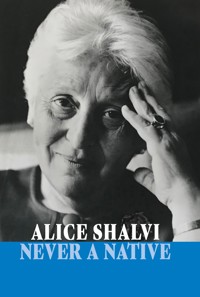
ALICE SHALVI
NEVER A NATIVE
These memoirs are dedicated with profound love and gratitude to the memory of the three men who shaped my life:
My father, Benzion Margulies, whose love for humankind I inherited;
My brother, William, who with unstinting generosity dispensed not only sound advice but also the material assistance that enabled my entire family to live well beyond our means;
My husband, Moshe Shalvi, the “rod and staff” who throughout 63 years of marriage unfailingly partnered, encouraged and supported me.
And to my children, who undoubtedly suffered as a result of my over-indulgence in public affairs, I sincerely apologise. I take comfort in seeing how different are the choices that they themselves have made.
Contents
Acknowledgements
In 1997, having retired from my academic and public activities, I was the happy recipient of a month’s residency at the Rockefeller Foundation Centre in Bellagio. In its tranquil grounds, amid the natural beauty of Lake Como and the intellectual stimulus provided by my fellow residents, I succeeded in writing the first 30,000 words of my memoirs – a rich harvest.
Then I returned to the reality of Jerusalem, home, family, social and political involvement, and throughout long intervals the field of writing lay fallow. Only after a year of mourning for my husband Moshe did I find the strength of mind, soul and body to continue with my labours, urged on by the incessant queries of friends demanding to know when I would finish. They didn’t crack a whip, preferring to offer lumps of sugar. Another year was devoted to editing various versions of the manuscript. The final incitement was an invitation to celebrate my 90th birthday in New York with a group of women whom Moshe had collectively dubbed “FOAs” (Friends of Alice), harking back to the years of fundraising in which I enlisted the financial and moral support of Friends of Pelech, Friends of the Israel Women’s Network and so on. I could not disappoint them.
One last intensive burst of writing, comparable to that in Bellagio, and I was finished.
I cannot thank them enough.
My thanks are also due to the many friends and colleagues who provided invaluable assistance and feedback as I traversed the stony path of authorship: the late John Felstiner, who wrote the (perhaps unwarranted) glowing recommendation that won me the stay at Bellagio; my Solstice Sisters, who constituted an invaluable sounding-board for the sections I read to them at our biannual gatherings; my collaborators at the Israel women’s Network, board members as well as staff, provided their recollections of our accomplishments; Aloma Halter, an experienced editor who helped me put my thoughts in order; Judy Labensohn, who served as an occasional critical reader and coach; my friend, Omi Morgenstern-Lesser, who selflessly agreed to read the entire manuscript; my beloved Rabbi, Tamar Elad-Applebaum, who restored my spirits and nourished my soul; and above all Elisheva Levy, whom the Divine Force sent to me in my hour of need, while I was sitting shiva for Moshe, and who has been a loyal companion and dear friend. Her intelligence, ingenuity and imperturbability are beyond compare.
Antecedents
A Portrait
THEY SIT SIDE by side on a sofa, a glimpse of its carved headboard and brocade upholstery forming a background bridge between them. Both are looking directly at the camera. He is handsome and well-groomed: a high forehead; hair, already slightly receding, neatly parted on the left; a small, carefully trimmed moustache just above the bow of his upper lip. His dress is formal and festive: a dark suit, white shirt with high, stiff collar and white bow-tie. His arms are folded across his chest; his left hand is tucked into the crook of the right, the right barely visible among the folds of his left sleeve, as if he were hugging, or restraining, himself. A whole man, self-confident, complete, with a sense of occasion.
She sits to his right, wearing a simple scoop-necked dress with elbow-length sleeves, devoid of any ornament. Her bosom is soft, uncorseted. Her thick dark hair, combed softly back from a high forehead, frames the upper part of an oval face. Her head tilts slightly to the side, like a startled bird. Her large, dark eyes, pupils – like black buttons – a focal point in the picture, are sad, beseeching, a contrast with his almost expressionless impersonal ones. Her mouth curves gently upwards, wistful, shy, perhaps attempting a smile. Although she, too, is looking directly at the camera, she leans slightly forward, her body half turned towards him. Her left arm, an echo of the curved carved back of the sofa, is concealed, from the elbow down, behind his back, as if she felt a need for physical contact, for reassurance. Her right arm lies across her body, the curled hand resting gently on her lap. His firmness and self-assurance form a sharp contrast with her hesitancy and need for contact. It is a picture not so much of a couple as of two people.
These are my parents.
Innumerable questions arise, doomed never to be answered. When was the photograph taken? It could hardly have been on their wedding day, since on that occasion, attended by numerous family members and recorded in one of the wide-lens photographs of the period, she wore white. Is this an engagement photo? I know, from an invitation that has been preserved, that a month before the wedding there was a party at my grandparents’ home one Friday afternoon to mark the signing of the marriage contract. Is the simple dress she is wearing the one she brought with her from her impoverished post-war home in Galicia, her only one, which she laundered once a week?
My father’s sisters didn’t welcome her, although she was their cousin. They were, and forever remained, of the opinion that he could have made a far better match with one of the more elegant, wealthier, self-confident young women who had displayed an interest in him. Perhaps there was some truth in their claim that he was marrying her out of pity, having met her for the first time a year earlier, in 1919, on his way back to Germany from captivity in Russia (where he had served as a medical orderly with the Austro-Hungarian army). He was, indeed, a very compassionate man, quite capable of self-sacrifice. Were these the grounds for her insecurity, her need for reassurance?
They had, on the whole, a good marriage, despite the extreme contrast in personalities – he a dyed-in-the-wool optimist, she an eternal pessimist. They quarrelled a great deal: she contended that he was too immersed in his communal voluntary activities, too liberal in donating his hard-earned and not always plentiful income. Extremely generous by nature, he was easily moved to charitable deeds. She believed that charity begins at home, though she never turned away any of the beggars who came to our door, often inviting them in to partake of a bowl of soup and a slice of bread. Yes, they quarrelled, but he once assured me that this did not mean that they didn’t love each other.
In the early summer of 1933, fully aware that Germany was no longer a safe place for Jews, he emigrated to England. For 11 months they were separated, while she, her mother, my brother and I moved to another town to live with my oldest aunt until such time as my father secured the entry permits that would enable us to join him. The anguished letters she sent him, almost daily, reveal her distress. The handwriting is uncontrolled, the lines uneven, crowded as far as possible onto one sheet, in order to save on postage. On one occasion she apologised for not having written for some days, explaining that she had lacked the money to buy stamps. She was unable to keep up contributing her share to the household expenses and felt herself disliked, unwelcome and a burden. The separation and, in particular, the uncertainty as to when, where and whether we would all be reunited were unbearable. The same need for comfort, reassurance and closeness that had already found expression in the photograph taken a decade and a half earlier filled her once again.
When my father died, too young and too soon, she was desolate. She had nursed him devotedly, tended to his every physical need during his last years of illness. She mourned him until the day she, too, died.
Perl Margulies, My Mother
Perl Margulies was born in Huyzhatyn, Galicia (in today’s Ukraine), on 25 January 1893, the daughter of Ze’ev and Margola (née Margulies). She was the fourth child, with two sisters and two brothers. She attended a German-speaking school, receiving a grounding in Hebrew and Jewish practice at home. In 1920 she moved to Mannheim, where she married her cousin, Benzion (Benno) Margulies (born in 1890 in Skalat, also in Ukraine). Their oldest son, Ze’ev, was born in 1921, before the couple moved to Essen, where two daughters, Edit (1922-9) and Alice (1926), were born.
In 1933, when Benzion emigrated to England, Perl wound up the family business, and moved with her mother and children to Mannheim, where she remained until May 1934 before receiving entry visas to join her husband in London. Early in 1949, Benno suffered a stroke that left him partly paralysed until his death of a second stroke in February 1955. Perl died in Jerusalem on 21 November 1962, while on a visit to her daughter. She is buried in the Sanhedria cemetery, to which Benno’s body was also transferred.
These are the facts, the bare bones to which flesh and blood must be added if we wish to know and perhaps understand this woman, my mother.
Whence does one derive that flesh, that blood, the details that constitute a life, a being, a personality? From oft-repeated family stories, frequently told by unreliable, biased narrators; stories that differ, Rashomon-like, according to the speaker’s point of view; an occasional revelatory remark; family lore and mythology, tales passed down from generation to generation, with inevitable omissions, distortions and accretions; overheard conversations; documents; old letters and photographs; one’s own relationship with the object of scrutiny. No two people experience an event in identical fashion or have exactly the same impression of a person’s appearance or character. All is subjective, open to interpretation.
My portrait of my mother is based on personal observation, shared experiences, stories repeatedly told by my maternal grandmother as she sat at my bedside before I went to sleep, events reported by my father, my brother, other relations. My mother herself spoke comparatively little about the details of her life until the autumn of 1960, when I spent six weeks in London in our family home, speaking to each other for the first time as two adult women, married (in her case already widowed) and mothers of children.
I was conducting research for my PhD, spending my days at the British Library (then in the British Museum), returning home each evening to find dinner – always my favourite dishes – waiting for me. After dinner, we would sit together and talk. I would brush her hair, which she liked, and slowly I gained a greater knowledge and a deeper understanding of a life dominated by memories of deprivation and disaster.
My mother’s parents, Welwel (Ze’ev) and Margola, were both members of Hasidic families, a tradition so devoutly carried on by her father that he transferred his home from Skalat, where his parents and siblings remained until their move to Germany prior to the First World War, in order to study at the court of the saintly Rebbe of Huyzhatyn. Here he spent all his days and frequently even his nights, while his wife ran a small grocery store that provided the family income. Perl was the fourth of their five children, preceded by Sarah, Lazel and Rebekka, and followed by Avraham, an ardent communist for whom his mother regularly baked two additional Shabbat chalot (plaited bread loaves) to be given to needy neighbours of his choice. While Perl received her Hebrew and Jewish practice at home, where Yiddish was spoken, she attended a German-language school where she became particularly fond of poetry. For many years, she enjoyed reciting poems by Heine, Goethe and Schiller. Years later, when I had to learn poetry by heart, she used to hold the texts, while I recited works by the English Romantics – Coleridge, Wordsworth, Keats and Shelley – and she loved them too.
She assisted her mother in the shop, where customers included a number of colourful characters whose activities inside and outside the shop provided material for many lively anecdotes. My mother’s stories, unlike those of my grandmother, tended to focus on the less salubrious townsfolk, who for her were a source of disgust rather than humour. The monotonous life in the shtetl was relieved by trips to the nearby city of Tarnapol, to purchase hats and dress patterns in an attempt to be fashionable. There was a young man to whom she was attracted. And there were occasional blissful moments. One of them was sitting on a balcony with a friend who taught her the words of the Merry Widow waltz.
Then came the war. Located on the border with Russia, Huyzhatyn changed hands several times. Each time, the population was transported and then returned, by sled, in storms, snow and ice. On one of these journeys, Sarah contracted typhus and died in 1916. The following year, Avraham left to join the Revolution in Russia. Welwel died. Rebekka married and also moved to Russia. Lazel moved to Lemberg (Lvov) in search of employment. Perl was left to care for her widowed mother. They were poor, anxious. Their future was uncertain. Then, in 1919, her cousin Benzion arrived to find out what had become of his uncle and his family. At this point the facts are fairly clear but the motives become blurred.
Fact: in summer 1920, Benno sent for my mother and on 20 August they were married. Conjectures regarding motives: was it love at first sight? My mother was not a classical beauty but she had beautiful, expressive eyes, a sweet, shy smile and an aura of vulnerability that must (might?) have moved my father. I have always wanted to believe that they married for love but have no proof of any kind to support that belief. My aunts, on the other hand, had very strong opinions on what they considered an inappropriate match. They maintained – and continued to maintain, even after my mother’s death – that he felt intense pity for her and in his customary generosity decided he must help her in the only way he could. They behaved coldly to her. They contrasted her with the numerous women – more beautiful, wealthier, better connected – who were pursuing my father. They didn’t hesitate to show their dislike. My mother told me she had arrived in Mannheim with only one dress. When it had to be laundered, she had no option but to stay in bed until it dried. In consequence, my aunts accused her of laziness, of behaving like a “lady”, which she was not, of not contributing her share to the running of the household. She became a Cinderella and was relieved when, in 1921, after the arrival of their firstborn, Ze’ev, she and my father moved to Essen. They sent for my grandmother, who had been present at neither the wedding nor the Pidyon Ha-ben (Redemption of the Firstborn) 11 months later but now remained with her daughter till she died in 1938.
It was the Depression. My parents set out to buy their furniture with a suitcase full of banknotes which, by the time they reached their destination, barely sufficed to purchase what they had hoped to buy. They were, and remained, middle class but ours was a cultured home: a gramophone, records of Gigli, Jan Kipura, famous cantors; opera, cinema, theatre. In 1932, a performance of The Merchant of Venice aroused so much anti-Semitic venom in the audience that my parents fled in fear. There were outings to the Stadtwald (municipal woods). They read books, newspapers and periodicals. Unlike my uncles and aunts, they never played cards. My father was active in the Ostjüdische Gemeinde (East European Jewish Community), the religious Zionist organisation and his synagogue. My mother worked with him in their wholesale business of linens and cutlery. My grandmother kept house. We had a Kindermädchen (nanny).
In the middle of it all came tragedy again. Black-eyed Edit died of pleurisy in 1929, just before Purim, the festival on which Jews are commanded to rejoice. It is our carnival. But from then on, my mother could never bring herself to celebrate. Each year, as she lit the memorial candle for my sister, she would say, in Yiddish, “ein finstere Purim!” (“a black Purim!”). In June 1933, after our house had been searched by the Gestapo, my father left for London. She had difficulty eliciting payment from debtors and was harassed by creditors. Meanwhile, Ostjuden were leaving, with threats of expulsion hanging like thunderclouds. When would the lightning strike? In September, we moved to Mannheim. Once again she was the subject of opprobrium, as the expected few weeks stretched into months. Finally the longed-for visas arrived. We reached London on Sunday 12 May 1934.
This was life in a new and very different country, in a new language, with different foods and customs. It took a while to adjust, also now to being a full-time homemaker. She’d asked my father to find a one-floor flat. He found a three-storey house, with two rooms we used only when there were visitors and insufficient bedrooms. There was a great deal of housework, with a mother-in-law who never lifted a finger but went to the cinema and for walks, while Perl and her mother toiled for a household that now numbered five adults (my youngest uncle lived with us) and two children.
Matters improved when my paternal grandmother went to Palestine in 1935 and we moved to a modern house. I went with her to buy our first gas stove and refrigerator. We had an electric water-heater. Life was easier. We even took a holiday by the sea but could afford only a single room. So my father went alone, and the following week my mother and I shared a bed. I lay watching her at the wash basin, soaping her face, her neck, lifting her heavy breasts to sponge the body underneath. In January 1938, my grandmother, who had lived with Perl since her marriage, died of a stroke.
“She had too short a better life,” my mother said.
When the Second World War broke out and I was evacuated with my school, my parents and brother moved to a country house in Waddesdon, in Buckinghamshire, with my uncle and his very Anglo-Jewish wife. Once again my mother was a “guest”, with no say in what was on the menu or entrée to the kitchen. There was a cook for that. She had to go into the nearby town surreptitiously to buy my brother the cream cakes he liked. She became ill, vomiting whenever she ate. This was dismissed as psychosomatic: Perl and her problems again! But it was, in fact, gallstones, which were successfully treated by our family doctor. My parents moved back to London and I too returned but when the Blitz began they moved back to Waddesdon in Buckinghamshire, now to a less luxurious house of their own.
Throughout her life, my mother practised two cardinal virtues of Judaism: charity and hospitality. No one asking for help was ever turned away. Even in the harshest of times there were a small coin, a slice of bread, a bowl of soup. People who needed a meal were welcome. There was hardly a Friday night or Shabbat lunch without a needy guest, sometimes a stranger from out of town whom my father had met at synagogue. One Passover during the war my father was asked to find hospitality for Jewish soldiers stationed in the neighbourhood. On the Seder night, the eve of Passover, we ourselves ended up hosting over 30 of them, for whom no other hospitality had been found.
In 1946, returning from the third commemoration of the Ghetto Uprising in Warsaw, my father phoned from Paris to say he was bringing three Yiddish notables (two writers and a singer) for the Seder. By way of compensation he also brought a huge carp – a fish much-loved by east European Jews but barely available in England. My mother took everything in her stride. Hating to see food wasted and always trying to diet, she rarely served herself but ate the leftovers of others. Then she would wail, “Why am I so fat? I never eat anything!” Feeding, life-giving, characterised her. She sent endless parcels – to my brother and me when we were at university (a weekly portion of Shabbat chicken, her tasty rogalkes, yeast pastries, chocolate wafers and other delicacies). When I left for Israel in 1949, she cried, asking my father “Why are we letting her do this?” He replied, “We raised her for it” (“Wir haben Sie dazu erzogen”). I left. Parcels continued to arrive, with items unavailable in Israel due to austerity and rationing.
After the war our family was wealthier. We had a car, chauffeur and daily help. My parents occupied the best seats at concerts and operas. My mother reluctantly bought some fashionable clothes. My father bought her a fur coat and diamond jewellery (which she seldom wore).
“What are you saving it for?” he asked.
Then, “Was tut Gott?” (“What does God do?”), my mother asked back in Yiddish.
In February 1955, my father had a second stroke while he was in the bathroom, preparing himself for the day. My mother heard him fall and rushed upstairs but it was too late. For years she would each week rehearse the sequence of events: “It was Tuesday, at such and such o’clock…”. He was buried on the day of my oldest son’s third birthday. My mother went into lasting mourning. She deprived herself of every pleasure. On my visits to London my brother would purchase three tickets for theatre or opera but even as we reached the front door she would stop and turn back. “I can’t”, she’d say and would not be persuaded. She was alone and lonely. My brother travelled a great deal. I came with my sons in the summer of 1956 to begin my doctoral research but she had difficulty coping with two lively young boys, so we went to Cambridge, visiting her at weekends – and receiving food parcels.
Early in 1962, quite by chance, my mother discovered that her sister Rebekka was alive and living at the same address she had lived at before the war. Letters my parents wrote to the USSR had remained unanswered out of fear of the authorities. My uncle Avraham had been executed for corresponding with someone in fascist Germany. My mother and brother travelled to the USSR and ultimately met my aunt, her widowed daughter, daughter-in-law and granddaughter in Kharkov. Avraham had been posthumously “rehabilitated”. My mother visited his widow, dying of leukemia in a hospital. It was a profoundly emotional experience that affected her health. Half a year later, when she had a heart attack in Jerusalem, I told my wise German-born doctor about this reunion. His response was:
“The heart cannot bear such extremes of joy and sadness. It is like a glass that is moved from the heat to a cold surface. It breaks.”
What word could sum up my mother? She “cared”, in every sense of the word. She cared about, she cared for, she was involved with her family, her children – perhaps sometimes too involved. We were the centre of her life, her reason for being. Nothing was too good for us. No prospective spouses were sufficiently eligible. She had an uncanny psychic connection with me. She knew I was pregnant with my fourth child before I did. When I had a rare eye infection, she urged me, in a letter penned the previous week, to take care of my eyes, since they were essential to my livelihood.
In October 1962 she came on what proved to be her final visit to us. I watched her cross the tarmac from the plane, a little old lady weighed down with hand-luggage that contained smoked salmon and chopped liver, and my heart went out to her. She thought I was having too many children and was annoyed to find me pregnant once again. “Wann wirst Du aus den Windeln kriechen?” (“When will you crawl out of your nappies?”) But the following month, as she lay on her deathbed and I stood opposite her, she prophesied, in Yiddish, referring to my pregnancy:
“You are carrying your father”. (The son to whom I gave birth three months later indeed bore his name, Benzion.) She begged us not to send her to hospital. The doctor said it was the only hope for saving her life but I suspect she did not really want her life to be saved, though she worried over who would take care of my brother’s laundry. I shall never forget the beseeching look in her eyes as the ambulance men carried her out of our house. We should have heeded her request. Instead, she lay in a hospital bed, tubes attached to wrists and nose, suffering, still worrying. Her last words to me were “You have no bread in the house”. I was not with her when she died in the night. I cannot forgive myself for having gone home, exhausted, and failing to respond to the phone call in which my brother suggested to my husband that I join him again at the hospital. I did not give her a final farewell kiss. I was not privileged to close her eyes. My brother was.
Benzion Margulies, My Father
Clusters of nouns and adjectives spring to mind when I think of my father, son of Mordechai and Feige (née Kesten). Ardour, fervour, gusto; optimist, idealist; tolerant, generous in spirit and deed (sometimes to a fault); compassionate and charitable; wise and understanding… He did nothing by halves, yet he was not an extremist. A good Jew.
Perhaps because I was never as close to his mother as to my maternal grandmother and he told me little of his early life, I’m largely ignorant about my father’s family background and his early years. Skalat, where he was born, draws a blank, unlike the vivid (though perhaps erroneous) impression I have of Huyszatyn, where my mother was born. The family was well-to-do and lived in bourgeois comfort. Mordechai’s occupation, as cited in official documents, was “banker”, though my brother suspected that this was a euphemism for the less dignified “money-lender”. My father was largely an autodidact, widely read in classical Jewish texts and general literature, and always keeping abreast of social and political theories and practices. I assume he received a traditional Jewish education. He was certainly knowledgeable in all areas of Jewish studies. While the language spoken in the home was Yiddish, he was also fluent in Polish and German. At some point, he studied commerce in Vienna.
Beginning in 1910, the family moved one by one to Mannheim. When the First World War broke out, all but the youngest of the five brothers were conscripted to serve in the Austro-Hungarian army. A medical orderly on the Eastern Front, my father was taken into captivity by the Russians in 1917. From the one incident he unfailingly recounted at our family Seder, I learnt that he had determinedly ensured the observance of a Passover Seder by collecting eggs and other essential ingredients from the Jewish residents of the region. At the shiva (the seven day period of mourning after a funeral) for my father, my Uncle Aaron provided information that my father had omitted. When he went to the officer in charge to request permission to hold the Seder, he unfortunately failed fully to button up his jacket. For this lapse, his punishment was several hours of “Abhengen”: being suspended by the wrists from a high bar. Only when he had completed serving this sentence was he free to continue preparing the Seder for which he had, fortunately, previously received permission.
Released at the end of the war, he travelled back to his home via Huyszatyn, where he hoped to learn what had befallen the family of his Uncle Welwel, the oldest of Mordechai’s brothers. There he first met his cousin Perl, whom in 1920 he invited to join him in Mannheim, where they married on 20 August. Their first child, a son, was born in June 1921. Soon after the Pidyon Ha-ben (Redemption of the Firstborn) a month later, my parents moved to Essen. For some years my father worked as a self-employed travelling salesman, including the vending of linens, silver cutlery and reproductions of famous works of art about which he spoke with some humour, reserving his most caustic comments for the portrait of the “Büsende Magdalena” that depicted a penitent Mary Magdalene, bare-breasted, hair dishevelled, eyes cast to heaven. “Very popular!” he’d say. “Who doesn’t want legitimate pornography in his living room?” He had a reasonably flourishing business by the time I was four.
Throughout his years in Essen, my father was an active and prominent Zionist. This might be why the Gestapo searched our home in 1933: a warning that worse might follow. My father left for London, where his youngest brother, Alexander, had two years earlier established Elco, a wholesale firm dealing in clocks, watches and jewellery. They remained in partnership until my father’s death. An ardent Yiddishist and also a fervent student of Hebrew, he employed private tutors for himself and his children. Struggling with S.Y. Agron’s enigmatic T’mol Shilshomhe asked plaintively, in Yiddish, “What does he want with that dog?” He was not alone in finding that question hard to answer. It continues to plague readers to this day.
In 1942, together with my uncle, my brother and Oscar Phillips, he founded the aptly named Ararat Publishing Company. Under the editorship of historian-philosopher Shimon Rawidowicz, then teaching at Leeds University, Ararat kept Hebrew writing alive in Europe through a series of belles lettres entitled “Mezuda” (Fortress) and numerous monographs. He supported the writers who came to England as impoverished refugees. Outstanding among these was Itzik Manger, whom – as Benzion used to say – he “kept in cigarettes and whiskey”. To augment his own support, he enlisted that of several fellow Yiddishists in the UK and abroad. Knowing what a spendthrift Manger was, he prudently retained the donations, doling them out in weekly portions. My mother refused to have Manger in the house because he dropped cigarette ash all over the carpet. She had a poor opinion of him as an ingrate, “not a Mensch”. She was not mistaken. Although he dedicated one of his poems to my father and uncle, and inscribed the copy of Wolken übern Dach (Clouds Over the Roof) that Ararat published in 1948 with the words “To the modern Maecenas, Benzion Margulies”, when he learnt of my father’s death all he wrote in a letter to a friend was: “It’s a pity that Benzion Margulies died. He was of some help to me in London.”
My father was among those who founded a weekly, the Polish-Jewish Observer, the back page of which was devoted to Yiddish writing. The contributors, Manger among them, spent most of their time in the basement coffee shop of Ohel, a clubhouse on Gower Street my father and uncle helped establish in the early years of the war. At the end of the war he was instrumental in initiating the publication of Unser Weg (Our Way), a Yiddish paper for Displaced Persons (DPs) published by the Mizrachi Federation of Great Britain. Earlier, he had helped launch the weekly Jewish Observer. He was wise, understanding and tolerant. In 1945, when Sonny, my fiancé, went to see him after our childishly impetuous engagement, he did not chide him for his rashness or disrespect, as my mother would have. Instead, he told him that if we required a hechsher, a kosher certificate, to kiss, he would gladly provide it. Religiously observant, he never imposed Orthodoxy on others. He did, however, stress the need to know what one was rejecting. “Be an apikoros [non-believer],” he would say, “but don’t be an am ha’aretz [ignoramus].” When I asked him if I could study Kabbalah, he gently suggested I should begin with the Pentateuch, move on to the Prophets, study Mishna or Talmud and then, he concluded, “you can go on to Kabbalah”.
He was gregarious. On our first post-war trip to Europe, he disappeared from our carriage while we were in a train in Switzerland, travelling along a one-rail track. My mother worried. Where could he possibly be? Ten minutes passed. A quarter of an hour. Still no sign of him. Her fertile imagination, fuelled, as always, by her innate pessimism, conjured up a variety of mishaps. Perhaps he was locked in the toilet; even worse – he’d fallen off one of the narrow platforms that linked the carriages. Then he returned, excited. He’d gone to speak to the engine-driver, from whom he’d elicited interesting data not only about the Swiss railways in general and our present one in particular but also about the landscape through which we were travelling, the sites we should visit, even the marital status of his interlocutor.
He was compassionate. On our first visit to Paris, friends took us to the Moulin Rouge, considered a “must” for tourists. As the near-naked young women paraded before us, my father sighed: “Nebech [poor things]! What a way to have to earn a living!” He was also inordinately generous. Once, my cousin Yaakov, on a visit from Israel, was in his office when an elderly man entered reciting a long tale of woe and asking for money. My father gave him several pounds, a large sum at that time. When the man left, Yaakov reprimanded my father:
“You could see he was lying. He’s a fake, a swindler.”
“I know,” my father responded, “but if he demeans himself by asking for tzedaka [charity], why should I put him to shame?” He was by nature a philanthropist in the most literal sense of the word – a lover of human beings.
He also had a great sense of humour. In 1954, five years after his first stroke, my parents came to visit us in Jerusalem. One afternoon, when I arrived at their hotel, my father was waiting impatiently to report an exciting event: he had been able to take a shower by himself – impossible in their London home, which had only a hand-shower. Look, he said, how the bathroom is arranged. I followed him to be shown how he had operated the taps. Place this shower on the hook above (there it still was), turn on the taps to adjust the heat of the water, then turn the middle tap from one side to the other, from bath tap to shower. But as he began to demonstrate he forgot that he’d never turned the middle tap back and so, as he leaned over the tub and began to turn on the water, it came sprinkling down, startling us, wetting his bald head and his shoulders in their grey sweater. Quickly, he straightened up. We looked at each other, and, as one, burst into laughter.
The laughter attracted my mother, who came into the bathroom to investigate. She saw my father’s wet head and noted the dampness of the sweater. A cry of alarm: he’d catch pneumonia! (It was May in Jerusalem: the temperature was 27°C at least.) She threw a towel over him, rushed to remove the sweater, hurried him back to the bedroom and dependency. Within seconds our laughter was extinguished and my father’s new-found independence was forgotten. The shadows of sickness, bereavement, deportation, typhus, loss – my mother’s memories and experiences – extinguished my father’s joy and mine.
He was a Zionist. When he alighted from the plane that brought him on his first visit to Eretz Israel, he knelt down to kiss the earth. For him, this was both the Holy Land and the homeland. On 29 November 1947 I went to the cinema with my brother and a friend. As we approached our house on return, we saw my father standing at the front door, impatient, eager to share with us the momentous news: the UN had approved the establishment of a Jewish state in Palestine. He had no one except my mother with whom to share his joy. A bottle of brandy was ready. Now, he had fellow celebrants with whom to drink a toast of jubilation.
He loved Jerusalem. Sitting in the hotel room, he pointed to the Mountains of Moab opposite us. “Those are the hills to which David raised his eyes!” he said. Everywhere in Israel had a biblical association. He longed to spend the final years of his life in Israel. In one of the last letters he sent me, he asked whether we could make space in the house we were planning to build, for him and my mother to live independently but also in close proximity to us. The very last letter he wrote, to my oldest son Joel on his third birthday, ended with the words “L’hitraot, l’hitraot, yakiri” (“au revoir, au revoir my dearest”). But he did not live to see us again. He died on the day of the birthday. A man for all seasons, a man of infinite curiosity, nothing human was alien to him. How I loved him and do, to this day.
My youngest son, Benzion, didn’t like his name, which was, in any case, in customary Israeli fashion, soon abbreviated into Benzi. He found it burdensome, demanding, too strongly implying that he should be like my father in character and behaviour. Indeed, although he resembled my father in the generosity of his heart, he was unlike him in almost every other respect. While my father had on many occasions acted impulsively, his essential gravitas served as a counterbalance. Such Aristotelian moderation was alien to Benzi. From early childhood he displayed a dare-devil intrepidness that frequently made Moshe and myself hold our breaths for fear that some disabling accident – or worse – might befall him; that, given his self-confident foolhardiness, he would overreach human capacity.
Intrepid to the point of recklessness, wild and undisciplined, he was at the same time profoundly compassionate. He couldn’t abide injustice or cruelty. Assigned to the Military Investigation Police, he excelled at detecting infringements of army regulations, yet without fail (and to no avail) he begged the police who arrested the culprit not to treat him violently. “We’ve already caught him,” he would say, aware that the defector was invariably motivated by the need to provide for his family. Choosing to make private investigation his profession, he found the majority of his clients to be women seeking evidence of their spouses’ infidelity.
“How can they do it?” he bewailed. “The wives are so nice, so loveable.”
He soon turned to a very different field of employment. As an excellent chef, he provided his clients not only with satiety but pleasure. Later, as the owner of a highly rated falafel stand, he gladly fed impoverished Arab workmen. “They can’t afford it,” he explained, when we chided him for failing to provide adequately for his family.
Aged four, he became addicted to cigarettes. A workman who was painting our home acceded to his request “just to take a puff”, unreasonably assuming that the child would find distasteful what an adult enjoyed. He was wrong. Whenever possible, Benzi would steal cigarettes from colleagues who visited me, skilfully whisking away entire packs, leaving the victims bewildered. “I could have sworn I had my cigarettes with me,” they would say and I was too embarrassed to admit the truth.
By the age of eight, he was a competent driver. On one occasion he took my brother’s car-keys and drove around the block. His misdeed was discovered because my brother returned immediately after his departure to complain that his car was not where he had parked it. Finding that spot occupied when he arrived back at home, Benzi had been compelled to seek an alternative. Moshe would thereafter from time to time take him to the square at the Givat Shaul cemetery in the late evening, when there are seldom funerals, and permit him to drive round and round until his cravings were satisfied. Eventually, he found his true calling as a taxi-driver. Courteous, tactful, helpful, with classical music softly playing by way of calming background, he developed a devoted clientèle, specialising in transporting frequent travellers to and from Ben-Gurion Airport.
While he never smoked when driving, he remained addicted to cigarettes. None of the cures that others found effective – acupuncture, hypnosis, “patches” – proved permanently effective. I begged him to have a check-up. He remained obstinate. “I’m alright,” he would assure me. But he wasn’t. In the early hours of Thursday 29 September 2016, Benzi died at the airport of a heart-attack, leaving a wife and four children.
Not a synagogue goer, he was gratified when the older of his sons became more Orthodox in practice, an active member of the little synagogue in the village where they lived and a frequent reader of Torah.
“He stood at the doorway,” the rabbi said, when he came to see us on the morning of Benzi’s death. “He didn’t much care for entering a synagogue. But he stood there, face shining with pride as Ido read.” He took even greater pride in the football talent of his youngest child. Unfailingly, he drove him to and from thrice-weekly practice and weekend games. Did he ever consider how his addiction to tobacco would impact on these lives? The innumerable friends, many of them from childhood, who came to comfort the mourners were evidence of his ability to inspire love and maintain close relationships during a too-short lifetime.
Grandmothers I: Margola, My Oma
Like everybody else, I had two grandmothers. Unlike most others, however, I lived in the same household as one or both of them until I was 12.
My mother’s mother, Margola, was the more sombre of the two. In her passport photograph, she is austere, lugubrious, sad-eyed and unsmiling. Lips folded in wan resignation, a prematurely wrinkled face dominated by a long nose, a very plain wig and over it, in added modesty, a black kerchief, a dark high-necked dress: all indicate the poverty, hardship, losses and suffering she had endured in the Galician shtetl where she gave birth to her five children. While my brother alleges that she never smiled, she brought me much joy. She was my Oma, whereas my brother had a closer relationship with my father’s mother. My Oma played a favourite game with me. While she sat by the stove in the kitchen, I would run around the table nearby, at every turn evading the outstretched arms with which she was supposedly trying to catch me. When, breathless, I allowed myself to be caught, we would hug and kiss in mutual delight.
For most of the years of my childhood we slept in the same room, so that I became acquainted with her most intimate habits. Her possessions were few and she kept most of them in a large, flat carton under her bed, denying herself a share in the scant cupboard space. There she kept a better-quality wig exclusively for Shabbat and Yom Tov (high holiday), another kerchief to put over that wig. Less austere, it had lavender-coloured flowers on a black background. Alongside these articles lay a siddur, (the daily and Shabbat prayerbook) its cover frayed with use, and a teitsch-chumash (the Hebrew Pentateuch with Yiddish translation) with a shiny maroon leather binding and a gold relief engraved with the Hebrew words of its title: Torah, Nevi’im, Ketuvim. Every morning, as I lazed in bed, half-asleep, half-awake, savouring the last few minutes in the warmth of my feather eiderdown, I would watch as she dressed, carefully combed her wispy silver hair, donned the wig, tied the kerchief over it, knotted it under her chin, then stood by the window, lips moving silently, rapt in her devotions. She regaled me with stories of her life in Huyzhatyn, where she had kept a grocery store, while her husband spent most of his time studying at the court of the Huyzhatyner Rebbe. Singling out various customers who were distinguished either due to some vagary or because they committed a singular act, she created a folk narrative, a saga composed solely for my benefit.
Since I demanded these stories over and over again, I soon became familiar with the deserter who hid in the cellar when the recruitment officers made their rounds and whose wife periodically called out to him, “Woynen, Leib, woynen!” (“Stay there, Leib, stay there!”), warning him not to emerge until the danger was past; with Yossel der Royter, the hapless red-headed thief who rashly picked a tin of food from the bottom of the pile, toppling the entire pyramid down in accusation; Reizel, the snot from whose constantly dripping nose fell on the counter, revolting my mother, who assisted in the shop and who, in consequence, ran away whenever this distasteful customer entered; and Die Chemershtike, a learned woman who always had eyes downcast, reading as she walked and hence repeatedly stumbling, to the malicious delight of the little boys who swarmed around her.
I never tired of hearing these stories. Eventually, some of their key phrases became catchwords in our conversational exchanges, a secret code my brother could not comprehend.
Other stories aroused no amusement: the Cossacks who swept through the village with whirling swords, the girls who hid in the outdoor latrines to avoid them; the First World War’s repeated deportations to and fro between their village on the border of Austria and Russia, and the land on the other side – each time the territory changed hands, its inhabitants were driven out by the conquerors.
She told me anecdotes about her children. The oldest daughter, Rebecca, had married and, after the war, moved to Russia, where the younger son, Avraham, was already living. He was shot during the purges of the 1930s. She never learnt of his fate, nor of that of an older son, Lazel, who was murdered by the Nazis on the streets of Lvov. After my parents brought her to live with them in Germany in 1921, she only once again saw Lazel, who came on a short visit. She never again saw the others. About herself, her childhood and youth, she said nothing, so that there is a forever unfillable void in my portrait of her.
The best part of the day came once I was in my bed. Then my grandmother would take out the teitsch-chumash and, opening it at random at one of the numerous etchings, would “read” me the story. Fascinated, I would avidly listen to her vivid narratives, relating to the characters as though they, too, had been part of the shtetl experience, people my grandmother had known intimately. To this day, my “vision” of the crossing of the Red Sea is that of a stern, long-bearded Moshe Rabbenu, standing high on a promontory, his staff outstretched over the parted waves, in which the Egyptians and all their forces are being swallowed up – chariots overturned, armed men disappearing in the waves, helpless horses, their mouths open in screams, vainly struggling to keep their heads above water. Nonetheless, even as a young child I was aware that the characters of The Book, unlike those of my grandmother’s strictly oral narratives, had an aura of holiness about them that derived precisely from their being enshrined in a real book, in pictures as well as text, not merely in my grandmother’s memory. Yet the stern long-bearded Moshe Rabbenu was as real to me as Yossel der Royter.
Finally, when the story came to an end, my grandmother, sitting on the bed by my side, would recite the Shema (the prayer said before going to sleep), carefully intoning each word for me to repeat until, by the age of three, I was able to say the prayer by myself, as she listened to check that I’d got all the words right. The clear, though never explicitly stated, implication was that if one recited these words before falling asleep, no harm would befall one during the night. So, having offered up the prayer, I would close my eyes and, firmly clasping my grandmother’s hand for further reassurance, settle down to sleep. A favourite ruse of mine was to pretend to be asleep, wait till my grandmother began slowly, carefully, to withdraw her hand, then snatch it back. I was afraid of the dark and needed the reassurance of her presence but I couldn’t bring myself to confess what I assume she in any case realised, that I was scared of being alone, even if I had said the Shema. And so I kept her at my side with this “practical joke”, in which she colluded.
Although we were not by any means wealthy, my uncle bought a car – at the time a rare feature among middle-class families. On fine Sundays, we would go for an outing, to the seaside or to a place in the country where we could picnic. Unfortunately, the car could hold only five passengers, so I ended up on the lap of whichever of my parents was sitting next to the driver. My Oma never went on any of these trips, even though my father and brother repeatedly offered to stay at home in her stead. Did she not want to go or did she not want to deprive anybody else of the pleasure; or was it a combination of the two – a minor sacrifice made in order not to spoil another person’s enjoyment?
She made few demands, lived frugally and shrank from contact with anyone outside the family circle. She died early in 1938, just after I had been able to make her happy by telling her I’d won a scholarship to a prestigious girls’ high-school. Typically, she had been sitting in her usual narrow place in the kitchen, between the stove and the refrigerator, when she had a stroke, so that some time elapsed before anyone noticed that she had been stricken, one side of her body paralysed, unable to speak and hence unable to call for help. For a short while she was confined to bed in our common bedroom, while I was exiled elsewhere. Our room was filled with a sour smell, whether emanating from her body or from the medicine I couldn’t tell. Although she couldn’t speak to me, her eyes were full of love.
She died on a Sunday morning, as if not to disturb the workday routine. I was in the entrance hall of our house when I saw my father come down the stairs sombre-faced and heard him say gently to my mother in the kitchen: “Die Mamme ist gestorben”. In retrospect, I don’t think she had any true happiness in her life, apart perhaps from being able to make me happy.
Grandmothers II: Oma Feige
A significant change in our household once we arrived in England derived from the fact that my paternal grandmother, Feige, had followed Alex, her youngest, favourite, most devoted and still unmarried son to England even before my father’s arrival. For the first time, I was living together with both my grandmothers and with a jovial, sybaritic uncle. Though both had been born in Galicia, had similar backgrounds in terms of upbringing and education, and had even married two brothers, the two women could not have been more different from each other, nor could my relationships with them.
Because my brother spent some summer holidays at her home in Mannheim, where he had been born and where most of my father’s siblings still lived, he had developed a strong bond with what I now perceived as “his” Oma. In sharp contrast to the physique and bearing of “my” Oma, Feige, who was short and plump, loved to dress well. Her numerous frocks, most of them silk, fell to the ground, out of fashion, and yet utterly appropriate and elegant. Her wigs, of which she had several, were equally elegant, never hidden by a kerchief. When she went out, she wore little round hats perched saucily on top of the wig. Though markedly less devout than her sister-in-law, she went to synagogue every Shabbat, to show off her clothes or perhaps simply to be in company, unconfined.
She was not one to sit around in the house. That is not to say that she took part in running the household. She probably thought two people in the kitchen were enough. As for the cleaning, that was performed twice weekly by a charwoman. For her part, she took walks, visited her friends and at least once a week went to the cinema. Although she was so spunky, ready to try anything new, she never learnt English and yet, when she got lost one Shabbat, she managed to find her way home with the help of strangers, while my father and uncle were desperately trying to get the police search for her.
When my mother, grandmother, brother and I also came to England we all lived together in a narrow three-storey house in Hampstead, with two rooms on every floor except the top, which had a tiny additional room that became the bedroom of my Oma. My uncle, my brother and “his” grandmother now shared a bedroom, while I slept with my parents. It was almost as if we were two separate parties. Indeed, my mother always maintained that her mother-in-law spurned my other grandmother, relating to her, if at all, rather as a servant than as an equal. Certainly I don’t recall them ever sitting down to talk to each other or even being in the same room save in the presence of the entire family. One had the kitchen and her own little room in which to spend time. The other had the living-room, which opened on to a garden with lawn and flowerbeds.
My brother would be invited to accompany my grandmother to afternoon film-screenings, at which he served as interpreter until she fell asleep, leaving him to enjoy the double features until she woke up. Since he was always with an adult, he was able to see A-rated films, to which nobody under the age of 16 was admitted unaccompanied. I envied him but found a certain comfort from secretly searching out the weekly editions of Picturegoer he hid away. From the text, summaries, reviews and particularly photographs I derived a vicarious pleasure. I was able to reconstruct the contents of the films, just as I had done in Essen in earlier years, basing myself on the skills developed outside the cinema. Now, however, I had far more details to go by.
Poor Oma Feige was rudely expelled from her paradise when my uncle finally became engaged at the advanced age of 35. Stella Levy, his English-born, semi-assimilated wife-to-be, who came from a well-to-do family of industrialists, had no common language, either literally or metaphorically, with her mother-in-law. She soon made it clear that she had no intention of sharing either her new home or her new husband with a rival for his affection. So, even before the wedding, Feige was bundled off to Palestine, where several of her children were already living. My uncle and his wife moved into a grand four-bedroom house in a more elegant suburb and, as my mother used to say, “my” Oma, her mother and she herself enjoyed an all-too-brief respite, especially once we too moved to a larger house in a new suburb, where everybody could have a room of their own, even though my grandmother and I chose to continue to share one.
My father and uncle never saw their mother again. She died in the home of one of her daughters in a suburb of Tel Aviv, surrounded by children and grandchildren who cared for her when she was already half-blind and bedridden. The last photo I have is of her lying in bed, a white kerchief over her head, eyes staring unseeingly at the camera, shrunken, toothless, the lower lip tucked beneath the upper – a very far cry from the dapper little lady who took my brother to the pictures.
Outsider
Childhood
I AM SITTING




