


7,19 €
Mehr erfahren.
- Herausgeber: Unicorn
- Kategorie: Sachliteratur, Reportagen, Biografien
- Sprache: Englisch
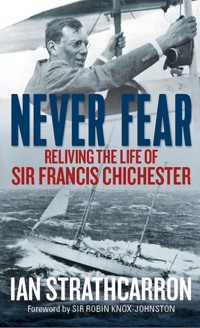
In Never Fear – Reliving the Life of Sir Francis Chichester Ian Strathcarron follows in the footsteps and wakes of Sir Francis's life of adventure, adversity and triumph. Born in 1901 into a troubled childhood in rural Devon, he suffered through the sadism of the English public school system, then in 1918 left for New Zealand where he made his first fortune. There he took up flying and in 1930 became one of the first aviators to fly from London to Sydney. After being the first solo flyer across the Tasman Sea from New Zealand to Australia, he set off to circle the world, only to crash, nearly fatally, in Japan. After serving in the RAF in the Second World War, he took up sailing at the age of fifty-four and in twelve years became the most famous yachtsman in the world. Along the way there are struggles and triumphs, climaxing in being knighted with Sir Francis Drake's sword in Greenwich. Ian Strathcarron, himself an aviator, yachtsman and adventurer, follows him all the way, comparing what Sir Francis found then to what he finds now, meeting the descendants of the people who played important parts in his life and getting under the skin of what made the man, the man.
Das E-Book können Sie in Legimi-Apps oder einer beliebigen App lesen, die das folgende Format unterstützen:
Veröffentlichungsjahr: 2017
Ähnliche



















NEVER FEAR
RELIVING THE LIFE OFSIR FRANCIS CHICHESTER
IAN STRATHCARRON
Dedicated to Evie and Arlo, and Little and Patch
CONTENTS
ACKNOWLEDGMENTS
Thank you to all who helped make the book come true:
Adrian Clark for help with Gipsy Moth V
Alexander and Lucy Rhind from the Old Rectory, Shirwell
Andrew Simpson at the RAF Museum in Hendon.
Anne, Lady Chichester for her memories of Sheila and Sir John
Barry Pickthall at PPL for help with images
Belinda, Lady Montagu for the ‘60s memories
Bob Gibson for Gipsy Moth flying instruction.
Chris Chapman in Wellington, New Zealand
David Gibbons of the National Trust at Arlington Court
David Martin for his family memories
Edward, Lord Montagu for family help
Ewen Southby-Tailyour for his briefing on Blondie Hasler
Giles Chichester for his connections
Gordon Wilson in Peacehaven, New Zealand
Gregor Halsey of the London Model Yacht Club
Ian Hutton and Jessy Lawrence at the Lord Howe Island Museum
Jamie Chichester, Sir, for his family explanations
Janelle Blucher and Gaye Evans at the Norfolk Island Museum
Janet Grosvenor of the Royal Ocean Racing Club
Jeremy Goodwin in Auckland, New Zealand
John Delaney at the Imperial War Museum Duxford
John Roome of the Royal Ocean Racing Yacht Club
Ken Robinson for his Beaulieu recollections
Lance Chapple of the Royal Sydney Yacht Squadron
Lyndsay Tooley from Norfolk Island
Manu and Snah Patel from Devon
Marty Montagu-Scott for help with Buckler’s Hard research
Neil Waterson in Upper Hutt, New Zealand
Neville Cullingford, Squadron Administrator at RAF Hullavington
Nick Blake, Squadron Adjutant Flight Lieutenant at RAF Hullavington
Peter Bradford of the Royal Sydney Yacht Squadron
Peter Bruce for his insights
Peter Bugge of the Guild of Air Pilots and Navigators
Philip Clifford of the Brooklands Museum
Piers and Silvie Le Marchant with Gipsy Moth III in Corfu
Ralph Goodwin in Peacehaven, New Zealand
Ralph, Lord Montagu for help with Beaulieu research
Richard Baggett of the UK Sailing Academy
Rob Thompson and Eileen Skinner of Gipsy Moth Trust
Roy Palmer for the use of his Gipsy Moth
Rt Revd Alan Winstanley at St Peters, Shirwell
Sarah Hustler at the Poole History Society
Sebastian Cox, Head of Air Historical Branch at RAF Northolt
FOREWORD
I am delighted to be writing the foreword to this book as in many ways Francis’s life was like the foreword to my own.
Unlike him I took to the water early in life, already a seaman when joining the Merchant Navy at seventeen. Francis was in his mid-fifties when he first raced a yacht, and that was as crew. Yet, as Ian points out in this excellent account of his triumphs and tribulations, twelve years later he was one of the most famous men on the planet and certainly by far the most famous yachtsman.
In fact it was at his moment of greatest celebration that the first seeds of long distance record breaking stirred in my soul. I was sailing my boat Suhaili back from India when I first heard of Francis’s circumnavigation and thought at the time that it left just one record left unclaimed. Francis had circumnavigated solo, albeit with a one month pit stop in Sydney. Surely the next challenge, the last unadventured adventure, was to circumnavigate solo without a pit stop at all?
Fascinating to me, reading Ian’s Never Fear, is how much long distance sailing has changed in the years between Francis’s and my circumnavigations to those who would attempt to circumnavigate today. The hard skills remain: seamanship of course, plus dealing with fear and loneliness. It is the soft skills that have made racing easier yet more demanding; likewise, safer yet riskier. Whereas we now know to within a few metres where we are all the time, in those days we had to wait for a sun sight, often for several days. Yet this knowing of position itself demands greater performance to reach the next position. And so with safety: satellite technology has made being rescued far more likely than before – it was more or less unthought of in our day – so the sailor’s danger signals that were red are now merely yellow. The higher the bar, the higher the jump. Likewise with the weather: now we can see live on screen what is going to happen where and when; in the 1960s we had a barometer and a weather eye on the clouds and wind direction to judge the portents for what might be approaching.
It follows that Francis’s greatest skill, that of a master navigator, is a redundant skill in today’s world. Like Ian piloting the tanker up the Mississippi, an iPhone with the right app is all you really need if close to land – and offshore, satellites take over where mobile signals fade.
But what are not redundant are his qualities as a man. I recall two Francises. Francis I was the record breaker: a monomaniac on a mission, totally determined, focused to the point of what seemed rudeness, fearless, fatalistic, the mountain mover. Francis II was the Francis ashore: charming, patient, civilised, generous and cultured, the family man, easy with friends and courteous to strangers. What Francis I and Francis II shared was a man happy in his skin, whichever skin was on him at the time.
Francis could only ever have been an Englishman, in fact he was the caricature of a foreigner’s view of the ideal Englishman: understated yet heroic when needed, calm but not to be bossed around, disliking of anything to do with a ‘fuss’, especially a media fuss, even more a medical fuss, amusing in conversation, self-depreciating, loyal to friends, without obvious foes, magnanimous, wry, easily humoured and easily humorous.
Francis was the example I followed, in fact we joked about me finding out what record he would attempt next so that I could prepare to break it later. And he did; and I did. I am so pleased his memory will live on through this excellent biography and I am sure the reader will enjoy reading it as much as the author clearly enjoyed writing it.
ROBIN KNOX-JOHNSTON
It’s extraordinary how you feel the world should be run after being alone for so long.
CHAPTER 1
Arise, Sir Francis
IT WAS, EVERYONE AGREED, a wonderful occasion: mid-morning summer sunny, with Union flags, royal standards and naval ensigns ruffling in a lazy westerly breeze, Old Father Thames resting at high tide, banks brimming with crowds, all anticipation and excitement, waiting for their Queen, surrounded by her pageantry, to knight their hero.
Ashore lay Wren and Vanbrugh’s seventeenth-century baroque masterpiece, Greenwich’s Royal Naval College, emblem of empire, its twin-domed wings haughty over their matching Solomonesque palaces reaching down to the river around the Grand Quadrangle. On the square’s lawn naval cadets sat cross-legged on the grass, behind them junior ratings and officers, a set of blue and white on green, and behind them the Chichester family and friends in suits and tweeds, pearls and summer hats, smiles and laughter.
On the ground floor of King Charles II’s original Greenwich Palace, in the Wren Room overlooking the river, Her Majesty the Queen and the Duke of Edinburgh, attended by their host, Admiral President Vice-Admiral Sir Horace Lyddon and their aide-de-camp, Captain Hedley Kett, were briefed on the morning’s schedule by the Queen’s long-serving Private Secretary, Sir Michael Adeane. It was 9.45 am. As usual the Royal Household’s organisation was impeccable. Gipsy Moth IV would berth in precisely thirty minutes and cast off precisely sixty minutes after that. In the meantime there was a public ceremony to perform and a tour to be made, all finely timed and executed.
In the adjoining Hawksmoor Room Lord Plunket, Equerry to the Queen and godson of Her Majesty Queen Elizabeth the Queen Mother and Buckingham Palace Press Officer Sir Richard Colville unsheathed the ceremonial sword and knelt on the ceremonial stool, double-double-checking the tools of the ceremony. The knighting sword was the very one with which, in 1581, an earlier Elizabeth, Queen Elizabeth I, had knighted an earlier Sir Francis, Sir Francis Drake, for an earlier circumnavigation on board Golden Hind a few cables upstream at Deptford.1 On that occasion, as Sir Horace scarcely needed reminding, the bridge connecting the ship to the shore collapsed ‘and upwards of One Hundred Persons did fall into the River’. On this occasion, Lord Plunket scarcely needed reminding, the ceremony would be held in public, a worldwide televised public too, in a late change from the planned private knighting. About the gold-painted and crimson-cushioned knighting stool Colville could be more relaxed: it had no provenance and, as yet, no mishaps to its name.
At 10 am the Queen’s close friend, letter-writer and lady-in-waiting, the Hon. Mrs Mary Morrison, entered the Wren Room for the Queen’s and Prince Philip’s final look in the full-length mirror that the Royal Household ensures precedes them on all occasions. The Queen was forty-one years old, five feet six inches tall in her raised John Lobb cream shoes. Entitled to wear the full naval uniform of her rank, Lord High Admiral of the Royal Navy, she chose to let the celebration outrank her and wore a Norman Hartnell off-white two-piece suit with royal blue cuffs and collar and matching hat. She looked admirably nautical, just right for the day. Prince Philip, five years older and six inches taller in his Church derby shoes, forswore his rank’s uniform too, that of Admiral of the Fleet, and wore a dark grey double-breasted suit from Gieves & Hawkes of Savile Row. At 10.10 am Colville and Plunket re-joined them in the Wren Room. With five minutes to go the royal party was complete and chit-chatting in practiced serenity.
Serenity was in short supply aboard Gipsy Moth IV. The whole voyage from Plymouth to London, which should have been the triumphant homecoming climax to Francis’s circumnavigation, had been bedevilled from its inception; and now yesterday a new spanner had been chucked into the works, a royal spanner that could hardly be gainsaid.
Francis had first heard of his knighting on his last night in Sydney, five months ago, when he and his wife, Sheila, had been awoken in the early hours by an excited Commissioner, Sir Charles Johnson, with the hot news from the Palace. The next morning, as he was casting off to finish his voyage around the rest of the world, the Governor-General, Lord Casey, handed him a confirming telegram from the Queen. From then onwards the Royal Household and Sheila had been watching his progress home and keeping a number of days from mid-June to mid-July free for the formal knighting ceremony. By the time he was in the Bay of Biscay, firm dates from the Queen’s diary were being floated to Sheila and they settled on 13 June for a private knighting in Greenwich, home of the longitude meridian with which he had reckoned a thousand fixes and symbol of Britannia’s seaborne empire, followed by a public reception and lunch given by the Lord Mayor at Mansion House for a homecoming Londoner.
Working backwards from Greenwich on 13 June, Sheila and the Palace agreed on a week for Francis, their son Giles and her crew to sail Gipsy Moth IV from Plymouth to London, so leaving Drake’s old Devon port no later than 6 June. At that stage Francis was estimated to arrive in Plymouth around 1 June, so leaving the best part of a week for celebrations and recovery there – more than enough time, it would seem. Sheila had no option but to assume that all would be well, which she knew really meant Francis’s frail health would be well, but she must have known deep down what all sailors know from experience: sailing schedules and landlubber timetables seldom rub along too well together.
Francis actually arrived back a few days earlier than anticipated, on 28 May, after a gloriously fast and calm passage up through the Western Approaches. Plymouth was there to greet him: half a million souls thronged the Hoe and shorelines to see him arrive in a beautiful sunset. The world’s media were there to greet him too: photographers and camera crew had hired more or less anything that would float to capture the moment. Francis was overwhelmed but grinned back through clenched teeth. He hated ‘a fuss’ at the best of times but after five months of living at peace with himself, this hysterical floating fandango crowding in on him and Gipsy Moth IV was the very opposite of the quiet reunion with Sheila and Giles for which he had hoped.
On 30 May the Lord Mayor of Plymouth laid on a Thanksgiving Service followed by a fully functioned civic reception and dinner. Next day the Royal Western Yacht Club hosted him. Press conference followed press conference. Everyone wanted a piece of Francis and after five months of sharing himself only with himself, he now had to share himself with the world. Everyone now seemed to have known him for years, everyone was now his old friend from way back, everyone was a well-wisher who had always known he would do it, everyone wanted to slap his back. After a week the constant, unwanted, unnatural adulation was wearing him pale and gaunt. The sea of people and their agendas was proving harder to weather than the sea itself. Sheila urged him to cancel the last great occasion, another formal dinner, this time given in his honour by the naval Commander-in-Chief of Plymouth. She and Giles were ready to sail for Greenwich the next morning. Francis said he couldn’t cancel; during dinner he collapsed and was admitted to the Royal Naval Hospital. They diagnosed a burst duodenal ulcer and exhaustion, nervous and physical. They confined him to his hospital bed so his body might recover.2
Buckingham Palace then suggested a new date: 7 July. Sheila called on their old family – and Royal Family – friend, Commander Erroll Bruce, to be the Sailing Master for the voyage. Francis would have the three weeks’ rest that the hospital demanded and then a week as a passenger on Gipsy Moth IV for the journey to London.
1967 was the summer of sun as well as the summer of love and the good weather shone for their cruise along the south coast. They stopped just once, at Newhaven, and were promptly mobbed by more jubilant well-wishers, who nearly capsized the pontoons. As they passed Dover the Warden of the Cinque Ports greeted them and another flotilla of press launches – or as Francis called them, ‘press hooligans’ – descended on them; aboard Gipsy Moth IV they smiled and waved like royalty and sailed on. Erroll Bruce reported that while Francis was happy to smile and wave, the effort tired him; he was clearly still unwell. On 5 July they found a lovely, peaceful anchorage, as used by the old clipper ships, at the mouth of the Thames under North Foreland and enjoyed their last peaceful evening aboard together; they knew that for the next forty-eight hours they would be swept along by a Force 8 gale of public expectations.
On 6 July the celebrations along the Thames began with gun blasts at Southend and continued with vast cheering crowds lining the narrowing river. From every creek and inlet local boats came out to wave or join the flotilla. While waiting for the tide to change off Gravesend they were entertained to lunch on board the training ship HMS Worcester. Towards the end of lunch they saw an official launch speeding towards them. On board was the same royal press officer, Sir Richard Colville, who was now waiting to greet them ashore.
A Gipsy Moth biplane flies past Gipsy Moth IV en route from Plymouth to Greenwich
On board the Worcester Colville now became the royal spanner in the works. The Queen had changed her mind. Instead of a private ceremony in the Hawksmoor Room at the Admiral President’s Palace, there would now be a public ceremony in the Great Quadrangle. She had been told about the sword; she could sense the public joy; the weather was perfect; the world was watching; she last line, was the Queen; and the Queen had changed her mind.
On board Gipsy Moth IV they protested as best they could: all their clothes for the ceremony had been sent ahead from Plymouth to Greenwich; in the lockers to hand they only had crew kit. Sheila’s least scruffy outfit was a bright red trouser suit; she had no shoes but only sandals; the boys just had reefer jackets. No problem, Sir Richard smoothed, giving Francis his own tie and rustling up some others from the Worcester’s mess room, it’s quite acceptable to step ashore in crew clothes, it adds to the atmosphere. ‘And Lady Chichester too, in crew clothes?’ asked the future Lady Chichester. Colville replied haughtily: ‘It is Her Majesty’s wish that Sir Francis should be honoured as he comes ashore, and what could be more suitable than for you all to be dressed for sailing as you come ashore?’
Now Francis objected: he was not well, and how embarrassing it would be for the Queen if he wobbled or fainted in front of her. Colville replied: ‘Commander Bruce will give you a sip of brandy beforehand.’ Francis replied that he would not breathe brandy on his Queen. All protest seemed in vain. The nonchalant Colville shrugged and left. The crew braced themselves for this new and very public development.
And thus they awoke on board Gipsy Moth IV at first light on 7 July. The setting didn’t help lift their nerves. A special mooring had been prepared for them at Woolwich just three miles, or half an hour, upstream from Greenwich. Situated where the Thames Flood Barrier now lies, the mooring was in a thoroughly industrial setting, just downwind of the droning Woolwich power station with its foul fumes and dust layer, in the days before London’s air and river had been cleaned up.
Arriving in Greenwich (British Pathé)
At 9.40 am, with a loose flotilla of fifty boats jostling behind them, Erroll Bruce asked Giles to slip the mooring lines and off they cast. Gipsy Moth IV looked her very best: garlanded with signal flags and burgees, an Australian Ensign off her jib shroud, her mizzen topped with a Royal Yacht Squadron White Ensign, she was suitably weather-scarred and thoroughly scrubbed. The Thames here is only 400 yards wide and on board they could see and hear the waving and cheering from an East End long since redeveloped and now no longer even particularly British, let alone Cockney.
Sheila in that red trouser suit and those sandals (British Pathé)
By 10 am they had rounded the loop where the Millennium Folly now sits and could see the domes and flags of Greenwich waiting for them a mile ahead. Behind them the pleasure armada whooped their klaxons and blasted their foghorns; some let off rescue flares. Erroll slowed her down; timing was everything. Down below, Gipsy Moth IV only had one mirror, a foot square, pitted affair in the main heads. Sheila and Francis did their best in front of it. Giles was on deck with the mooring lines. At exactly 10.15 am Erroll turned her into tide, throttled back and pulled up alongside: a perfect landing.
From Francis to Sir Francis (British Pathé)
On the pier naval cadets scrambled the mooring lines fast while the silver trumpets of the Royal Marines struck up a nautical fanfare echoing from the roof of the Painted Hall. On this cue, the Royal Standard and the flag of the Lord High Admiral were broken and the Queen’s Bargemaster, the stout and whiskery Albert Barry of the Royal Victorian Order, resplendent in scarlet court coat and waistcoat with gold sash and trimmings, long white socks and black brogues and cap, stepped on to the jetty and offered a welcoming hand to Sheila, then to Francis, Giles and Erroll. As they assembled ashore, legs not too wobbly, a guard of honour of Royal Watermen, more scarlet and gold brocade, garters and shining medals, formed to usher them up the crimson-carpeted ramp.
The silver trumpet fanfare was also the cue for the royal party to leave the Admiral President’s suite and make its way across the lower end of the Grand Quadrangle towards the pontoon. The crowd now took up the fanfare, cheering and clapping the Queen and Prince Philip. Vice-Admiral Lyddon and Sir Richard Colville followed a few paces behind, both in full naval pomp, followed by Mrs Morrison, Captain Kett and Sir Michael Adeane. Off-scene, Lord Plunket escorted two officers with the knighting sword and knighting stool respectively to their positions.
As the Chichester party walked through the Watergate, all black wrought iron and gold tridents, they found the Queen waiting for them. Francis, in his reefer jacket, was first to be received, taking off his cap and shaking her hand in a deep bow. Behind him Sheila, noticeably bigger-boned than her husband, in the bright red trouser suit, dark pink spotted scarf-cap and sandals, curtsied and waved forward Giles and Erroll, looking very much like younger and older versions respectively of Francis.
The royal convoy now walked quickly towards Plunket, who was standing on a plaque announcing the ‘BIRTHPLACE OF KING HENRY VIII IN 1491 AND HIS DAUGHTERS QUEEN MARY IN 1516 AND QUEEN ELIZABETH I IN 1533’. Francis rather uncertainly put his left knee on the stool and bowed his head. Plunket gave the Queen the historic sword and in one movement she dubbed his starboard then his port shoulder, saying: ‘I beg you to bestow the Honour of Knighthood and to be a Knight Commander for individual achievements and sustained endeavour in the navigation and seamanship of small craft.’ Sir Francis stood and bent his head forward so the Queen could place around his neck the pink and grey riband of a Knight Commander of the Order of the British Empire and pinned the star to his reefer jacket. She then moved down the line to shake hands with Lady Sheila, while Sir Francis could be seen looking up and smiling, almost to himself, at the Royal Observatory building on the hill overlooking them, the home of the navigators’ meridian.
The two parties now walked back towards the Watergate, the Queen alongside Sir Francis, Prince Philip alongside Lady Sheila and the others more loosely following behind. ‘Wave to them,’ the Queen told Sir Francis, ‘it’s your day.’ The Royal Watermen bristled to attention as they passed, and the Queen’s Bargemaster led the royal procession down the ramp towards Gipsy Moth IV.
At this stage the scene is lost from all our sources: the BBC, Pathé and Movietone news clips, not to mention my friend, neighbour and eyewitness to the day, Sir Jamie Chichester, the twelfth baronet, on a day’s leave from Eton. So we rely on Erroll Bruce’s account, kindly given to me by another friend and neighbour, his son Peter, an equally distinguished yachtsman:
The ceremony over, every item as precise as the Royal Household always makes such affairs, Sir Francis invited the royal couple to visit Gipsy Moth, and he told me to dig up a bottle of champagne that sailed around the world with him. When I struggled to open it, Prince Philip, who knew me quite well, relaxed the atmosphere by warning me ‘Look out, Erroll you’ll squirt champagne at Her Majesty’ and he duly earned a wifely reprimand. Francis gave the Queen and Duke each a small bale of the finest merino wool from the people of Australia. The whole great occasion over, I took the yacht off from Greenwich Palace Pier, then under Tower Bridge to berth on Tower Pier, where Sir Francis was welcomed by the Lord Mayor of London as the formal ending of a Londoner’s voyage.
If the reception from the Thames had been rather restrained and respectful of the royal moment, once clear of Greenwich all formality was forgotten as Gipsy Moth IV sailed on. The downstream flotilla had now been joined by their upstream sisters and as they passed under the huge raised arms of Tower Bridge, the Port of London fireboats let whoosh giant plumes of spray towards the sky, while the River Thames Police launches couldn’t resist whipping up celebratory doughnuts in the water. Every siren and klaxon and foghorn joined in the cacophony. Surrounded by such tribute, Gipsy Moth IV now looked tiny, almost frail, and on board the Chichesters tinier still, making Francis’s achievement seem all the more extraordinary. Ashore tens of thousands of well-wishers lined the river, waving and cheering in the sunshine from wharves and piers, warehouses and offices, embankments and bridges.
At exactly 12.20 pm Erroll Bruce made his second perfect landing of the day. On Tower Pier the Chichesters were greeted by the Lord Mayor of London, Sir Robert Bellinger, in full mayoral robes and chains, and Lady Bellinger in a brilliant lime-coloured suit and sporty bobble hat in blue, pink and white. It was hardly fair on red trouser suited Lady Sheila – but Lady Bellinger was Belgian and possibly didn’t understand. At least everyone at Greenwich knew that her outfit had been scuppered by the late royal change of plan; here, the press especially thought that Sheila wore a bright red trouser suit, spotty swimming cap and sandals to a banquet through choice. She was never to hear the end of it.
The Chichesters spent ten minutes on the pier, shaking hands with the great and the good of the City of London Corporation, posing for photographs and waving to the crowds. In the footage we can see Lady Sheila looking around for someone; then she waves to a small, elderly figure, a clergyman, on the edge of the pier; she tugs on Sir Francis’s jacket and they walk over to hug the famous and charismatic Revd ‘Tubby’ Clayton, the Chichester family spiritual exemplar and founder of the Toc H Christian charity for the wounded of war.
The procession now left the pier and the Chichesters were shown into a white 1964 Mulliner Park Ward Rolls Royce Silver Cloud III drophead coupé, with Sir Francis sitting high on the cabrio cover and Lady Sheila and Giles in the rear seats below. The Metropolitan Police had laid on two grey horses and four white-faired motorcycles as outriders, and off they all cast, up the hill past the Tower of London, turning left past All Hallows Church, where the ancient bells pealed out in greeting, along Eastcheap and into Cannon Street.
All along the route office workers in shirtsleeves and blouses leaned out of the windows, waving and cheering. Sir Francis looked up left and right and waved back. The pavements too were full of cheering and clapping well-wishers in their lunch hour and by the time they reached St Paul’s Cathedral and doubled back up Cheapside and Poultry to Mansion House, Sir Francis had both port and starboard arms waving back to the crowds, high up to the open windows and low down to the brimming pavements.
Now the Chichesters had to make their last great public appearance of the day. From a specially made balcony between the Corinthian columns of Mansion House, they looked down on a crowd of 5,000 packed into Mansion House Street and Poultry. (In all, according to the Police, 250,000 Londoners turned out that day to pay tribute to Sir Francis.) Raising his hands to stop the cheering, the Lord Mayor said: ‘You personify all that is best in Britain – the spirit of initiative, adventure and determination. In the past eighteen months you commanded not only the attention but also the respect of the world. Your voyage has shown the world that Britons still have something which everyone needs – courage and resolution in the face of seemingly insurmountable odds.’ Then, to renewed cheering, the Lord Mayor gave Sir Francis a silver table decoration as a gift from the people of London. Inspired by a similar gift presented by an earlier Lord Mayor, James Harvye, to the earlier circumnavigating Sir Francis, Chichester’s orb, like Drake’s, had the waypoints of the voyage picked out in glowing rubies.
With a final wave the Chichesters entered Mansion House, descended the magnificent marble staircase and took their places at the top table in the Egyptian Hall. Sheila noted that, ‘The banquet was like a fairy tale; beautiful lifebuoys made of red and white carnations, the Royal Yacht Squadron colours – everything so exciting and so right’. They were clapped in to lunch with ‘Gaily Thro’ the World’ played by the Orchestra of Her Majesty’s Royal Marines. Full silver service luncheon was served.
After lunch the Lord Mayor gave a welcoming home speech, quoting Milton, Tennyson and, inevitably, Masefield:3
Mansion House luncheon invitation cover
I must go down to the seas again, to the lonely sea and the sky,4
And all I ask is a tall ship and a star to steer her by;
And the wheel’s kick and the wind’s song and the white sail’s shaking,
And a grey mist on the sea’s face, and a grey dawn breaking.
Sir Francis, responding after a long-standing ovation, said that he was deeply moved. He gave thanks to the assembled company, and especially to Sheila for her encouragement and flair for understanding him and his quest. He said, inter alia:
‘Being so many months alone, I have seen what is valuable in my own life with brutal clarity, and also what is valuable on the national and international scene. It’s extraordinary how you feel the world should be run after being alone for so long.
I don’t think there is any truth in the rumour that Mr Wilson,5 after seeing Mr Heath6 in a yacht two weeks ago, is presenting Mr Brown7 with a yacht to sail around the world alone. I seem to realise that the terrific welcome I have received is not merely for me. It is a kind of symbol. This voyage of mine represents an independent effort – a private enterprise of the sort that appeals to the British mentality. It is not really suitable for his temperament to have a state or someone else to nurse him financially, physically, morally or anything else from the cradle to the grave.’
After lunch they clapped the family out as the orchestra played ‘Old Father Thames’. Outside, Francis put his sailing cap back on – with some relief, it appears – and waved to the few hundred well-wishers who were still waiting for him.
‘Are you contemplating a career in politics, sir?’, a journalist shouted.
‘Tell me if you hear of a good vacancy’, Sir Francis grinned back.
From the crowd a spontaneous round of ‘For He’s a Jolly Good Fellow’ sprang up, followed by a young ringleader in bright shorts shouting:
‘Three cheers for Sir Francis Chichester. Hip-hip!’
‘Hooray!’
‘Hip-hip!!’
‘Hooray!!’
‘Hip-hip-hip!!!’
‘HOORAY!!!’
With a final wave, the Chichesters settled into the back of a black mayoral Daimler Sovereign for the short ride back home. We don’t know if they were expecting another street celebration but as they turned left off St James’s Street into their own St James’s Place, that is exactly what they found. Francis’s friend and fellow sailor – and owner of the adjacent Duke’s Hotel – Harold Rapp, had teamed up with the Royal Ocean Racing Club, also on St James’s Place, and decked the street out in bunting. Residents and members lined the pavement, clapping and cheering. And there, waiting for them on the doorstep of no. 9, was Erroll Bruce, back from positioning Gipsy Moth IV in St Katherine’s Docks.
For the Chichesters this homecoming was the most emotional part of an intense and overwhelming day. Inside they flopped, drained yet elated. Among the many presents waiting for them were half a dozen bottles of J&B Rare Scotch Whisky from Justerini & Brooks just round the corner in St James’s Street. Erroll did the honours and four crystal clinks were met with four loud ‘Cheers!’ as laughter and relief filled the first-floor drawing room. It had been, everyone agreed, a most wonderful and triumphant day.
NOTES:
1. The sword is now on display in the wardroom at HMNB Devonport.
2. Francis loved the medical officer’s report: if Francis had been in the Navy he would be invalided out straightaway; on the other hand, a civilian doctor would probably prescribe a long sea voyage!
3. John Masefield had been the Poet Laureate of the United Kingdom from 1930 until his death two months before this reading.
4. Francis chose ‘The Lonely Sea and the Sky’ as the title for his 1963 autobiography.
5. British Labour Party prime minister at the time.
6. Conservative Party opposition leader at the time, a middling racing yachtsman, who became the worst prime minister of all time from 1970 to 1974.
7. George Brown, Wilson’s useless, drunkard deputy and rival.
If anything terrifies me, I must try to conquer it.
CHAPTER 2
Frying Pans and Fires
IT WAS NOT ALWAYS THUS. Sixty years earlier, when Francis was seven, his father thought it best to let professional bullies beat him instead; he sent Francis to boarding school. They chose a local Devonshire penal colony, then called Ellerslie House, later renamed Belmont House, about 10 miles away from his home village of Shirwell and just to the west of Barnstaple in the village of Bickington.
It would have been hell anyway but he had the misfortune of having his elder brother, John, there as a Senior Boy. John, five years older at twelve, had seven years of sibling vengeance to unload and now, with a gang behind him and their mother far away, he set about bullying young Francis relentlessly. Almost immediately a bit of prank in the showers backfired on Francis and John arranged for him to be sent to Coventry8 for three weeks. No boy dared, or even wanted, to speak to him. For Francis it was an inexplicable and unforgettable experience: ‘It seems hard to believe that senior boys would do such a thing to a 7-year-old new boy, just because of a stupid joke that went wrong.’
Worse was to come. Ellerslie had started off with good intentions as a parish school built in the grounds of a Bickington church. In 1899 it was enlarged and a very handsome two-storey neo-Georgian mansion built in its extensive grounds. The grounds were made into playing fields and the whole enlarged enterprise handed over to the Exeter diocese, which appointed a particularly nasty piece of work, Revd Douglas Martin Hogg, to be headmaster.
Lesen Sie weiter in der vollständigen Ausgabe!
Lesen Sie weiter in der vollständigen Ausgabe!
Lesen Sie weiter in der vollständigen Ausgabe!
Lesen Sie weiter in der vollständigen Ausgabe!
Lesen Sie weiter in der vollständigen Ausgabe!
Lesen Sie weiter in der vollständigen Ausgabe!
Lesen Sie weiter in der vollständigen Ausgabe!
Lesen Sie weiter in der vollständigen Ausgabe!
Lesen Sie weiter in der vollständigen Ausgabe!
Lesen Sie weiter in der vollständigen Ausgabe!
Lesen Sie weiter in der vollständigen Ausgabe!
Lesen Sie weiter in der vollständigen Ausgabe!
Lesen Sie weiter in der vollständigen Ausgabe!
Lesen Sie weiter in der vollständigen Ausgabe!
Lesen Sie weiter in der vollständigen Ausgabe!
Lesen Sie weiter in der vollständigen Ausgabe!
Lesen Sie weiter in der vollständigen Ausgabe!
Lesen Sie weiter in der vollständigen Ausgabe!
Lesen Sie weiter in der vollständigen Ausgabe!
Lesen Sie weiter in der vollständigen Ausgabe!
Lesen Sie weiter in der vollständigen Ausgabe!
Lesen Sie weiter in der vollständigen Ausgabe!
Lesen Sie weiter in der vollständigen Ausgabe!
Lesen Sie weiter in der vollständigen Ausgabe!
Lesen Sie weiter in der vollständigen Ausgabe!
Lesen Sie weiter in der vollständigen Ausgabe!
Lesen Sie weiter in der vollständigen Ausgabe!
Lesen Sie weiter in der vollständigen Ausgabe!
Lesen Sie weiter in der vollständigen Ausgabe!
Lesen Sie weiter in der vollständigen Ausgabe!
Lesen Sie weiter in der vollständigen Ausgabe!
Lesen Sie weiter in der vollständigen Ausgabe!
Lesen Sie weiter in der vollständigen Ausgabe!
Lesen Sie weiter in der vollständigen Ausgabe!
Lesen Sie weiter in der vollständigen Ausgabe!
Lesen Sie weiter in der vollständigen Ausgabe!
Lesen Sie weiter in der vollständigen Ausgabe!
Lesen Sie weiter in der vollständigen Ausgabe!
Lesen Sie weiter in der vollständigen Ausgabe!
Lesen Sie weiter in der vollständigen Ausgabe!
Lesen Sie weiter in der vollständigen Ausgabe!




