


8,99 €
Mehr erfahren.
- Herausgeber: New Island
- Kategorie: Sachliteratur, Reportagen, Biografien
- Sprache: Englisch
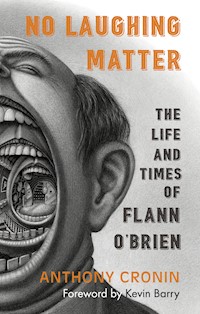
First published in 1989 No Laughing Matter: The Life and Times of Flann O'Brien was the first full-length biography of Flann O'Brien. Rich in background, anecdote and social history, it is an extraordinary portrait of a writer and his times, perceptive, sympathetic and authoritative. Flann O'Brien (aka Brian O'Nolan) was born in Tyrone in 1911 and worked as a civil servant for many years. He also developed an alter ego, Myles na Gopaleen, whose saitrical column in the Irish Times soon acquired legendary status. At Swim-Two-Birds, his first novel, appeared in 1939 and was praised by James Joyce, Graham Greene, Dylan Thomas and others. His second novel, The Third Policeman, failed to find a publisher at the time but has since been acknowledged as one of the most important novels to come out of Ireland in the twentieth century. With a foreword by acclaimed author Kevin Barry and striking redesign, No Laughing Matter is an undisputed classic of Irish literary biography.
Das E-Book können Sie in Legimi-Apps oder einer beliebigen App lesen, die das folgende Format unterstützen:
Veröffentlichungsjahr: 2019
Ähnliche


















NO LAUGHINGMATTER
Also by Anthony Cronin
Poetry
Poems
RMS Titanic
Selected Poems
Reductionist Poem
Relationships
Letter to an Englishman
The Minotaur
Collected Poems
The Fall
Body and Soul
The End of the Modern World
Novels
The Life of Riley
Identity Papers
Memoir
Dead as Doornails
Biography and Criticism
A Question of Modernity
Heritage Now
An Irish Eye
Personal Anthology
The Last Modernist
Play
The Shame of It
NO LAUGHINGMATTER
THE LIFE AND TIMES OFFLANN O’BRIEN
Anthony Cronin
NO LAUGHING MATTER
First published by Grafton Books in 1989
This edition published in 2019 by
New Island Books
16 Priory Hall Office Park
Stillorgan
County Dublin
Republic of Ireland
www.newisland.ie
Copyright © Anthony Cronin, 1989
Foreword © Kevin Barry, 2019
The Author asserts his moral rights in accordance with the provisions of the Copyright and Related Rights Act, 2000.
Print ISBN: 978-1-84840-714-5
Epub ISBN: 978-1-84840-715-2
Mobi ISBN: 978-1-84840-716-9
All rights reserved. The material in this publication is protected by copyright law. Except as may be permitted by law, no part of the material may be reproduced (including by storage in a retrieval system) or transmitted in any form or by any means; adapted; rented or lent without the written permission of the copyright owner.
A CIP catalogue record for this book is available from the British Library.
New Island received financial assistance from The Arts Council (An Chomhairle Ealaíon), 70 Merrion Square, Dublin 2, Ireland.
New Island Books is a member of Publishing Ireland.
Contents
Foreword by Kevin Barry
Preface by Anthony Cronin
1 Origins
2 The Brilliant Beginning
3 The Dubliner
4 The Close
Sources
Bibliographical Note
Index
Foreword
It feels like a different world. In fact, the city of Dublin, as it is presented here – and it is a character or player in the book in its own right – seems to be not just of another era but of another dimension entirely.
As the pages turn, we come to imagine a monochrome place in mean winter light, a place of dank streets, broad-brimmed hats, priestly glances. The wind comes in a cold sweep from the bay and the ceaseless rain that it carries defines the ambience. It’s a city where the attitudes are stiff and the licencing hours are tight. The shabby realities of the newly independent state betray the very dreams that fused it and, as a result, there is a waft of bitterness on the air, and it rises above even the stench of the usual bitternesses. Revolutionary fervour has transmuted into a new conservatism; the city attaches itself to ideas of the conventional and the respectable almost religiously; and thus it is a place where the boredom is so thick on the air that it might almost seem to have mineral properties.
It was just such a city, however, that happened to provide the optimal conditions for the emergence of a great fabulist, of an endlessly fiendish literary prankster, of a Flann O’Brien. It was the sort of place where, if you didn’t make mad stuff up, you’d have gone off your game altogether.
Over the course of this precise, deft and tender book, Anthony Cronin demonstrates the ways in which the place and the time formed the man, and the ways in which the man, in turn, had an era-defining effect on the very tenor of the place.
Flann O’Brien had a belligerent aspect, a savage and inky-black humour, and a default stance of blithe affront to the world, and all of these were massively influential in the Dublin of his time. His poses (if we are unkind enough to call them such) were adopted almost wholesale by a large proportion of the native literati and (if we are charitable enough to call it such) the intelligentsia.
The book is scrupulous and even-handed and it never baulks when it comes to the difficult places. It becomes clear quickly that in tracing from a Strabane cradle to a premature grave the life of O’Brien, the biographer set himself an especially tricky task. O’Brien, or O’Nolan, or O’Nualláin, was a capricious character, a man whose personal music or defining note could change on a shifting of the breeze. If he was sometimes playful and comic and light, he could be thorny and difficult too, and he could flitter from one state to the other inside the beat of a remark. But the book radiates a warming fairness – Cronin is never blind to his subject’s faults and weaknesses, which were legion, but always he provides (or at least he tries to provide) a forgiving context for them.
It should be noted that Cronin is himself a very fine stylist. That style is careful and it reaches always for the contextual overview; it is even, at times, pleasantly mandarin; but the biographer’s own voice emerges clearly in a way that feels off the cuff, and it is full of a kind of wry, sad humour.
Of course he had natural advantages when tackling this project – Cronin was himself an intimate and a confidante of the scene he described. He was a novelist and a poet of high standing, but also he was a classic literary middle-man, that quietly busy archetype whose thankless job it is to make the connections on which a literary culture thrives. He excelled in this role – indeed he can be seen as a kind of orchestrator for the Dublin literary scene of the 1950s and 1960s.
As Cronin traces patiently the life of O’Brien, he reverts always, for telling detail, to the fictions and the newspaper columns. He understands a fundamental truth in documenting the life of a writer: if you look hard enough, and if you dig deep enough, all of the clues and all of the secrets are buried in the work.
Cronin understands, too, that there is nothing mysterious about prose style. A writer’s style is a direct projection of the personality, in fact of the soul, if such a thing can be said to exist. As that style is channelled directly from the subconscious, it contains base and original truths, and it all comes out on the page. A writer cannot hide from himself or herself on the page, most especially in the writing of prose fiction. Thus Cronin uses O’Brien’s work as the sourcing depot for the details of this careful and telling portrait.
He has other and significant resources to draw on. Given the almost hysterically talkative nature of the milieu it depicts, it is natural that this biography should draw much of its energy from verbal sources. Friends, relations, even combatants of O’Brien were enlisted by Cronin to give their views, their sides and their spins, and the narrative comes together as a symphony for these voices.
Let it be said that the book is sometimes very funny. It seems a casual thing to note but in fact it is massively important – a book about Flann O’Brien that didn’t have a decent few laughs in it would be a disaster. Of course, given his quick decline and the endless frustrations of his artistic career, the humour within these pages necessarily leans towards the tragi-comic variety, but as was the life, so must be the biography. As the story of that life develops here, the reader will find herself saying over and again, … ‘Poor Flann’ … ‘Poor Flann’ …, but also, contrarily, it will be difficult not to allow the corners of the mouth fold into the upturn of a smile.
The darkness is as important to the book as the light. The narrative accretes many tiny sadnesses as it goes along. These are mostly made up of the type of setbacks and reverses suffered by every and any artist, but Flann took them so badly, in fact so bitterly, and it is an uncomfortable truth the biography springs when it shows that in effect the writer’s work knocked his life out of whack. He simply wasn’t able for the reverses, for the setbacks.
The trajectory became almost instantly a downward one. O’Brien was a star turn at University College Dublin, especially noted for his razor-blade heckles and indignant interruptions at debates of the Literary & Historical Society. Following the publication of At Swim-Two-Birds, and the subsequently expressed admiration of no less a figure than James Joyce, he became fabled, while still a very young man, around the city’s literary boozing dens. But from there on in, things began to stagnate, and he couldn’t cope with the fact of his early promise so quickly seeming to fade. He fell ever the deeper into the drink and, for public consumption, he even started to perform a kind of stage version of himself. Inevitably, when the mask slipped, there was little enough left behind it.
Cronin is dogged and nerveless in his task as he shows the decline. He recognises the cruel truth that literary ambition is never without victims, that it can destroy lives. But what this book shows also is that the literary past is never stable: it is forever shifting and rearranging back there in the murk. The resurgence of Flann’s reputation – in his stock shares, as he himself might have mocked it – came with the republication of At Swim-Two-Birds in 1960 but already, and here the defining tragedy of the story emerges, it was too late for him to fully capitalise. The drink had done its inevitable work by then, and the talent was tired. You sense from these pages, also, the way the endless column-writing for the Irish Times knocked some of the bluster and life out of him – he may have sometimes considered it throwaway work, a money-maker, but it’s the type of work that can take more out of the writer than he quite realises at the time.
Flann’s story, then, is a sad one if we consider it in its present tense, as it unfolded in the moment, and in the glow of the barside lamps. But what an excellent joke, he would have wryly noted, that his star would somehow endure in our firmament, and that it burns so brightly still.
And what great good luck he posthumously experienced in finding that most elusive of characters – the ideal biographer. This is a fabulously written and an important book, and it honours the vast talent of its subject.
Kevin Barry
December 2018
Preface
When this book was first published (in 1989) Brian O’Nolan had been dead for almost a quarter of a century; but Flann O’Brien, Myles na Gopaleen and the other writers he had contained within himself were just emerging from cult status and becoming established classics. Several selections from Myles’s ‘Cruiskeen Lawn’ column were in print and more were appearing. Its humour and its attitudes had, it seemed, become a shared enthusiasm for a very wide circle of readers, many of whom had never set foot in Dublin or heard a Dubliner speak. And this is surprising, for what had attracted the column’s original readership was what they believed to be its strictly esoteric character. It was meant for the initiated. Only they knew the background to many of its jokes, only they were familiar with the types who were models for its characters, only they could appreciate the subtle accuracies of its dialogue. For several years the column had been almost holy writ to intellectual Dubliners. Its humour became their humour; its mode of response to many sorts of situations, public and private, became their mode of response; even its dialogue fed back into the world about it, so that it became difficult to know whether some people naturally spoke in a particular manner or were only doing so because that was how ‘the Brother’ or some other character in ‘Cruiskeen Lawn’ spoke. But now that same column and even the same writer’s more fugitive journalism were proving to be a heady wine that would travel not only across seas and frontiers but, unlike most journalism, across time as well.
But if the widespread and continuing popularity of ‘Cruiskeen Lawn’ and of some of Brian O’Nolan’s other writings of the same ilk is remarkable in many ways, that of the novels attributed to Flann O’Brien is so as well. The first and still the most celebrated of these, At Swim-Two-Birds, has been described by the Oxford Companion to English Literature as ‘a multi-dimensional exploration of Irish culture and of the nature of fiction’. It is certainly what would have been called at the time of its first publication a ‘highbrow’ book, a series of severely intellectual jokes depending for their full effect on some knowledge of what the phenomenon known as the Irish Literary Revival was all about and even perhaps what part James Joyce played in superseding it or making it ridiculous – matters of concern, one would have thought, only to literary initiates of one kind or another. It is also an anti-novel, deliberately nihilistic in intent as far as the novel-form is concerned, the first (unless one counts James Joyce’s Ulysses) of many anti-novels in various languages and still the most extreme. Of course if it were only these things its appeal would certainly be severely limited. That it is not suggests it has qualities absent from this sort of possible description. So have Flann O’Brien’s subsequent novels, including the one in Irish attributed to Myles na Gopaleen.
The second of these, The Third Policeman, which was rejected and then, he claimed, lost in his own lifetime can be described in equally forbidding terms, involving time, the Theory of Relativity and even the uncertainty principle of modern physics. The one which followed it, An Béal Bocht, now translated as The Poor Mouth, has been regarded as an assault on official and literary attitudes to the Gaeltacht, the Irish-speaking districts of the west of Ireland; while his last, The Dalkey Archive, is certainly full of in-jokes relating to Catholic theology, predestination and James Joyce. Happily, however, the appeal of these books is wider than description of the topics which may underlie, support or, in some sense, inspire the fictions would suggest. There is more to them than that; they have qualities which appeal to readers who are not necessarily interested in predestination, Relativity, Catholic theology or even Irish culture, except in as much as they are part of it. The first among these other qualities is undoubtedly their humour and this is, more than any other, the one which accounts for their author’s relationship with his readers. He is, quite simply, one of the funniest writers to use the English language in the twentieth century. (By a long chalk he is one of the funniest to use the Irish language.) I have not laboured that quality in subsequent discussions of his work; but my belief that everything he wrote was intended to be funny and that most of it succeeded can be taken as a rider to anything else that is said.
Yet, having said that, it is necessary to add something else. He was a humorous writer with an unusually strong, indeed very often a nothing less than fierce, sense of propriety. This frequently dictates his attitude to the very grammar and vocabulary of the language he writes: a master of the colloquial and the idiomatic, he sometimes writes English as if it were a dead language which had to be written with the more correctitude because of that and he is immensely scornful of other peoples’ errors and mistakes. But it also accounts for his ire where the behaviour and pronouncements of politicians and other public figures are concerned; his impatience with the slips and mistakes of the bureaucracy of which he was so long a member; the activities of Dublin Corporation and much else. In these matters he is seldom an idealist or a reformer. He simply believes there is a right way and a wrong way of doing things and he castigates the wrong. I also think, and in discussing The Third Policeman I argue, that this fierce sense of propriety of his applied as well to the moral order of the universe, which he felt to be somehow askew. This was a way of perceiving the world which gave a peculiar twist to his Catholicism and resulted in an attitude that can best be described in terms of the ancient Manichaean belief, which has surfaced at least three times in the history of Christendom as a Christian heresy.
But whether or not this is so, I think the fact that he is a humorous writer with such a strong undertow of belief in rightness and order is one of the things which accounts for the widespread appeal of his work. We live in a peculiar world, one in which everybody’s sense of propriety is deeply and continually offended. Myles, or Flann O’Brien, as humorist or otherwise, gives expression to that belief.
The bold originalities of At Swim-Two-Birds were of a kind that Brian O’Nolan subsequently found it difficult either to consolidate or withdraw from; and this is one of the aspects of his literary career to which I have called attention. Another is his relationship with Ireland. In writing his life I have tried to evoke as fully as possible the background against which he worked, the pietistic, self-isolated, officially nationalist Ireland of the first decades after independence, of the World War and its aftermath. Though his responses were sometimes quite different from those of other members of the literary intelligentsia, O’Nolan engaged with this Ireland in a very intimate way and sometimes on a daily basis. I have tried to describe the reasons for this intimacy as well as the nature of his engagement and to do this I have had to say a good deal about the place and the circumstances that gave rise to it, so this is a ‘life and times’, rather than just a life.
And of course any discussion of his relationship with Ireland has to take account as well of his relationship with literature, particularly with the long shadow cast by James Joyce. Born almost thirty years after Joyce he grew up in an Ireland which in certain fundamentals had not changed. He had, like Joyce, a Catholic middle-class education, attended the same university, walked the same streets. By the time he and his friends at University College Dublin were growing to some sort of literary maturity the high days of the Irish Literary Revival, Yeats’ romantic and backward-looking creation, were over. Joyce, the great modernist, had, as I have said, in a way superseded it; but in any case the nationalist dreams which had informed the Revival and gave it its partly political impetus had been followed by the rather grubby realities of independence.
Tradition-loving Ireland was coming up against the harsh realities of the modern world; and though its minor writers still sought for an easy poetry where Yeats and Synge had taught them to look, in the supposedly heroic lives of peasants and fishermen and the heroic myths and legends of the remote past, in reality it was a time for modernism, for satire, for the stripping away of veils.
To an extent it was a misfortune for O’Nolan that Joyce had been there first. When O’Nolan embarked on the writing of his first novel the great modernist was still alive in Paris, occasionally to be visited there by someone he knew, occasionally even allowing a contemporary of O’Nolan’s like Beckett into some kind of intimacy but maintaining his planetary distance from Ireland and its problems while still being perpetually visible in its skies, or at least perpetually visible to the sort of writer Brian O’Nolan was. And there is no denying that Joyce posed a problem for him; indeed there is a sense in which he admitted this in one way or another over and over again. Writers of supreme genius usually do pose problems for their immediate literary successors, but more especially so if they seem to have used up the very life material which one is destined by birth and upbringing to use oneself. Beckett had a similar problem, but since he was a Protestant from a higher stratum of the Irish middle class than either Joyce or Brian O’Nolan, his life material had not been used up in the same way and in any case he solved it by departing from representational, though not from emotional, realism. But Joyce was only one of the difficulties which O’Nolan had to contend with as a writer; and of course, as is usually the case, his problems as a writer were inseparable from his difficulties as a man. I have dealt with those as fully as I could, I hope with understanding; and I hope too with respect.
Some of those who helped me in the writing of this book and who were thanked in the first edition are no longer with us, but let me record once again my thanks to them all, beginning with Micheál O’Nualláin, who is happily not of their number and who helped me immeasurably; Brian’s wife, Evelyn O’Nolan, his other brothers and sisters, all of whom were unfailingly kind and courteous, that is to say Ciaráin O’Nualláin (to whose memoir in Irish, Óige An Dearthár, I am deeply indebted), Kevin, who sadly died during its progress, Niall, Sister Roisín and Sister Maeve. Nuala and her husband Patrick O’Leary; to Brian’s lifelong friend Niall Sheridan; Timothy O’Keeffe, Des Roche and T. J. Barrington, my former teacher Michael O’Carroll CSSP and Sean P. Farragher CSSP of Blackrock College, Jim Bradley and James O’Kane of Strabane, Douglas Gageby, Bruce Williamson and Brian Fallon of The Irish Times, Angela and Tommy Conolly, Rosemary Coyle, John Wyse Jackson, Anne Clissmann, Benedict Kiely, Francis Stuart, Anne Haverty, Ulick O’Connor, Terence Brown, Sean J. White, Tony O’Riordan, Harry Boylan, Sean Mac Réammoinn, John Kelly, Pádraig O’hUiginn, Caitriona Crowe of the Public Record Office, Paddy O’Brien, Ted Dolan, Colm Tóibín, Denis Hickey, Tess Hurson, Steve Young, the late Justice Thomas Doyle, Hugh Kenner, John Ryan, Patricia Walsh, Catherine Rogan, Cathy Bruton, Kay Rippelmeyer of the Morris Library, Southern Illinois University at Carbondale, the staff of the Special Collections, McFarlin Library, University of Tulsa and the staff of the National Library, Dublin.
Anthony Cronin
July 2003
1
Origins
Strabane today is a town of some 13,000 inhabitants on the border of County Tyrone and County Donegal, which is also the border between the Republic and the six counties of Northern Ireland. It is a pretty town, bisected by a sizeable, full-flowing river, the Mourne, with views of the Donegal hills on one side and the Sperrin mountains on the other; and in normal times it would be a peaceful place.
The times are not normal however, and in the Bowling Green, where the farmers once brought their flax in carts to Reilly’s flax stores, there is an unusually large and strongly fortified police and army barracks, enclosed in wire netting and bristling with the electronic technology which enables the army to maintain surveillance over a considerable area. Beside this is a terrace of pleasant three-storey houses. A plaque on number 15 commemorates the birth of the writer Brian O’Nolan or Brian Ó Nualláin there in 1911. Because nationalists have a majority on Strabane’s Urban District Council the plaque is in both English and Irish, but in the Irish version the word scríbhneoir, which means writer, is misspelled. The Irish form of the writer’s name is also used for a housing development, Ó Nualláin Park, which commemorates him.
Among the working-class housing estates high up on the left bank of the Mourne, the part known locally as ‘The Top of the Town’, support for the Provisional IRA is strong and there are Provisional slogans daubed on the walls. In recent years most of Strabane’s Main Street and many of the familiar buildings of the town centre have been destroyed by bombing, 31 shops, four banks, the town’s two hotels and the Town Hall, a classical edifice of considerable architectural merit, being the most recent tally.
The O’Nolans were not natives of Strabane. Brian’s father, Michael, came there as a Customs and Excise Officer in 1897. He had been born in nearby Omagh, a somewhat larger town with a greater air of bustle and importance befitting the administrative centre of the county Tyrone. He was not born O’Nolan, but Nolan; and he called himself Nolan for some purposes throughout his life.
Names were always a somewhat provisional matter for Michael O’Nolan, as they also would be later on for his son Brian. Born Michael Victor Nolan in July 1875, he was married as Michael V. O’Nolan, but signed the register as Miceál O Nualáin. His superiors in the Customs and Excise service continued to know him as Michael Nolan; and so, somewhat more remarkably, did the Revenue Commissioners of the Irish Free State when he was appointed a Commissioner later in life, though his colleagues in the office referred to him as Micheál Ó Nualláin. On Brian’s birth certificate his father’s name is given as Michael Victor O’Nolan, but five years later, in the census return of 1911, he gave his name as Miceál O Nualláin, though someone added Michael O’Nolan in parentheses underneath. When probate was taken out on his estate his name was given as Michael Nolan.
O’Nolan was unusual. Those Nolans who objected to the English form of their name or wished to be known by what they believed to be the Irish version of it called themselves Ó Nualláin, usually with two l’s and with a sine fada, signifying a long vowel, over the O, in the Irish manner, instead of an apostrophe after it, but on the occasions when law or custom demanded that they should return to the English version they called themselves simply Nolan. To Irish ears O’Nolan has a would-be aristocratic ring, a faint suggestion of chieftainship of the clan.
Michael’s father taught music at the Omagh Model School and he was plain Donal Nolan. Although the profession of music teacher at the end of the 19th century may conjure up a vision of an unworldly person in a threadbare coat giving ill-paid lessons to recalcitrant young ladies, the fact is that Donal Nolan was respectably employed within the school system, but he did nevertheless marry a pupil, Jane Mellon, the 18-year-old daughter of a ‘strong’ farmer from Eiscir Duffey, near Omagh. The couple had eight children, four sons and four daughters.
Michael Victor was the eldest son; and of the others the only ones to play any part in Brian’s life were Gerald, Peter and Fergus. Gerald and Peter both became priests, Peter joining the Carmelite Order and Gerald, or Gearóid as he now called himself, becoming in the course of time Professor of Irish at Maynooth College, the principal training centre for the Irish priesthood.
Unlike Michael, and perhaps Peter, Gearóid and Fergus were convivial spirits, talkative, humorous and fond of a drop. Fergus became a teacher and for a while he assisted Patrick Pearse, the poet who led the 1916 rebellion, at Scoil Éanna, the progressive Irish language school for boys which Pearse had founded. Charitable family legend attributed a certain over-fondness for alcohol in later years to the effect on him of Pearse’s subsequent execution.
While his family was still young Donal Nolan was transferred from Omagh to Belfast, where the boys grew up and attended the new Queen’s University. They were all classicists and were to be distinguished in later life by a good reading knowledge of Latin and Greek; but their deepest personal enthusiasm was for the Irish language.
Since the Parnell divorce case in 1890 and the split in the Irish party at Westminster which followed it, there had been widespread disillusion with politics in Ireland and a fervent revival of cultural nationalism. All over the country young people began to enrol in Irish language classes. The more enthusiastic went to the Gaeltachts, the Irish-speaking districts, to improve their vocabulary and acquire the authentic blas or distinctive pronunciation. Rather constrained late Victorian versions of Irish dancing and singing came back into vogue, the dancing very stiff and rule-bound, the singing much influenced by drawing-room ideas of folk music. Michael, Gearóid, Fergus and Peter all displayed an early enthusiasm for the language. They learned different dialects, Michael’s being Donegal and Gearóid’s, which Michael thought not very good, Munster.
Michael’s attitude to the language was thoroughgoing and systematic, not to say pedantic, as with everything he undertook. On visits to the Donegal Gaeltacht he made notes of pronunciation according to an international system, disagreeing in many cases with the findings of the great Quiggin, a much-respected authority of the time.
With the exception of Peter, the Carmelite, the brothers were also all amateur writers. Michael wrote a detective story later in life which his family believed was accepted for publication by Collins and would have been published were it not for his obstinacy about the terms they offered. Gearóid and Fergus collaborated on a book of short stories which they called Sean agus Nua (Old and New). The stories were written in Irish, but they also made a translation which they called Intrusions and they arranged for the private publication of both versions in one book as an assistance to language enthusiasts.
It is an odd sort of book. The stories are heavily plotted, with surprise dénouements, and they have a featureless urban setting which could be anywhere. Running through them is a marked vein of misogynism. The women characters are frequently wicked intriguers who are discomfited in the end. In 1920, when Brian was nine, his uncle Fergus had a play, A Royal Alliance, produced at the Abbey Theatre in Dublin, a considerable enough achievement in a city where everybody wrote plays for the same theatre. Gerald also wrote an autobiography in Irish, Beatha Duine a Thuil, which has somewhat more literary merit than the stories in Sean Agus Nua.
After graduating from Queen’s, Michael Victor applied for a job in the Customs and Excise Service. He was posted to Strabane in 1897, which must have pleased him, for the little town on the Mourne was only a few miles from where he had been born. His mother had hoped that he would be a priest – Irish mothers of the time were insatiable in their desire for sons in the priesthood – but there is little doubt that, in becoming a civil servant, he chose a method of earning a living suited to his precise, methodical and pedantic temperament.
Michael Nolan was a nationalist. His job as a civil servant under the crown prevented his giving political expression to his views, but in concentrating on the language and all that went with it, he was, in any case, following the tide of the time. He was not long in Strabane before he began to give night classes in Irish and to organise feiseanna, competitions in which the entrants competed for prizes in Irish singing, dancing and recitation.
Like many another young men of the time, he found romance where he had sought merely an expression of his cultural patriotism. Agnes Gormley was the daughter of a newsagent and bookseller who was the principal Catholic shopkeeper in Strabane. She was 18 when they met, 11 years younger than Michael Nolan. Like him, she had been born in Omagh.
The Gormleys had had an extensive business in Omagh, including a bakery, public house and grocery. They lived in some comfort, employing two local girls to look after the children; but in the 1880s, just before Agnes Gormley was born, a failure of the potato crop caused prolonged distress in the area. According to family tradition the Gormleys were ruined by the extended credit John Gormley advanced to local farmers. In any case the business was sold up; John Gormley got a job as foreman in a Derry bakery; and his wife, Agnes’s mother, opened a small newsagency and fancy goods business in Strabane, where he later joined her.
This was in Market Street, known as ‘the back street’ because it runs parallel to the Main Street; but in time John Gormley opened a shop in Main Street as well and was the first Catholic to assert his right to do so. When his daughter Agnes married Michael O’Nolan, John Gormley was one of the best-known and most respected figures in the town, at least as far as the Catholic community was concerned.
Agnes Gormley was one of John Gormley’s seven children, five boys and two girls. It was an immensely talented family; and the boys were all characters of the sort who create the quality of Irish small-town life and contribute to its lore and gossip. Eugene, the eldest, inherited the business in Main Street. Succeeding generations were to know him as a courteous, knowledgeable, impeccably dressed, handsome man, acquainted with the contents of the newspapers and books he sold. Naturally enough, these were not as many as a metropolitan bookshop would have carried, but he stocked a surprising number, ranging from penny dreadfuls to the sort of Irish travel books and books about Ireland that were part of the nationalist ferment of the time. He was himself, by long-standing intention anyway, a writer, whose history of Strabane never in fact materialised, though he published fugitive pieces here and there and belonged to the large section of the population of Ireland which had once had a play rejected by the Abbey. As a young man he was a serious-minded and idealistic nationalist and if not a member of the IRA was a close and active sympathiser. Later he became more moderate in his views and disappointed many Strabane Catholics by his lack of militancy about the Council’s failure to appoint an Irish teacher in the Technical School. A lifelong bachelor with a paternalistic and Olympian manner, dressed always in grey serge and standing usually at the rear of his shop, he had time for converse with young and old; and he is nowadays rightly regarded as having played a significant part in Strabane’s social and cultural history, so much so indeed that, like his nephew, he has been accorded the honour of having a part of one of the new housing estates named after him.
His brother Tom was the inevitable small-town genius who is also a ne’er-do-well. A talented violinist, in later life he would disappear for long periods, frequently returning without even the violin; but, by a paradox not uncommon in Ireland, as his condition worsened his reputation grew, the legend of his wasted talent becoming one of Strabane’s topics and surviving even a disastrous appearance at a concert in the Town Hall. Finally reduced to utter dependence on the rest of the Gormleys for support and on strangers for drink, he once sought to punish the upright Eugene for a refusal to give him money by adopting the role of mendicant musician and playing for coppers in Main Street outside the shop. He usually carried a brown paper parcel under his arm, which supposedly contained musical manuscripts, and he was known to have composed operas. In fact one song of which he wrote both words and music, ‘Ireland Live On’, achieved a certain amount of national popularity and was supposed, in Strabane anyway, to have been considered as a possible national anthem after the Irish Free State came into existence.
If opinion in Strabane was sometimes divided about Tom and his talents, there was more unanimity about his brother Joe. He too was a musician, but whereas Tom wore a tweed cap and looked sometimes in even greater need of a shave than he was of a drink, Joe affected a broad-brimmed black hat and a bow tie and he wore his overcoat slung over his shoulders like a cloak. Like Tom, he also wrote songs and some of them achieved the dignity of performance on the radio and publication in Dublin. He was the impresario and director of many musical productions on the Town Hall stage and coached successive generations of young singers, becoming a very central figure in the town’s activities. At one point he also had ambitions to be a photographer and set up his own studio, where he did the inevitable wedding and first communion studies. This was not a success and since Joe’s musical activities, however great a figure they enabled him to cut in the town, did not bring in a living either, he was ceded the original shop on Market Street. There he carried on a stationery and newsagency business much as Eugene did round the corner, with the addition of a twopenny lending library which stocked the sort of hardback thrillers and westerns designed for that trade. In later life he too was ‘fond of a drop’, but his drinking was not as publicly conducted as Tom’s.
One other Gormley brother had a notable influence on Brian. This was George, who departed early for Dublin where he became a sports reporter on the daily Irish Independent and finally sports editor of the old Evening Mail. Talkative, gregarious, a noted anecdotalist even in Dublin journalistic circles and a frequent visitor to his brother-in-law’s various houses, George Gormley impressed himself deeply on the imagination of his nephew and cast a certain glamour over the trade of journalism which, in Brian’s eyes, it was never quite to lose.
Agnes Gormley was just 20 when she married Michael Victor O’Nolan in 1906. She was an attractive, cheerful girl; and though not as talented as some of the Gormleys – or perhaps, to be more exact, not so accomplished – she had a good singing voice and a more equable disposition. She was not as fond of books as her husband or her brother Eugene were. In later life her favourite reading was hagiographical, though this need not suggest an unusual ambition for sanctity on her part. Like her husband, Agnes Gormley was a devout Catholic, but the lives of the saints, as recorded by Alban Butler, Curtayne and others were favourite reading matter for many Irish mothers in the first half of this century.
In marrying her, Michael Victor married into a family which was certainly warmer, more ebullient and more colourful than the rather serious-minded and ambitious O’Nolans. His son Brian’s character would show both sides in fairly equal measure; and almost everything in it can be exemplified among his parents and his uncles. There was a predisposition towards words and music, the modes and the substance of art; and there was equally the methodical, logical, detail-shredding mind of the civil servant. There was a certain harshness and a strong dash of worldly ambition, but there was also a gentle unworldly part of him which shrank from conflict and was quickly despondent. Related to this was a split between a fierce respectability on the one hand and the erraticisms of the easily exacerbated creative temperament, assisted by drink, on the other. Even the urban, urbane and sophisticated humorist can be exemplified in the figure of his journalist uncle, George Gormley.
In marrying Agnes Gormley Michael O’Nolan also married into Strabane, a town with which all his children, including Brian, would have an almost lifelong relationship. Although Brian would very deliberately and consciously decide to be a Dubliner, Strabane always remained home. Among the many terms of abuse which his persona, Myles na Gopaleen, would deploy so magnificently later on, ‘corner boy’, ‘shop boy’ and even ‘peasant’ would betray something of shopkeeping Strabane and its values.
The marriage took place in the parish of Murlogh, the ceremony being performed by the bridegroom’s priest brothers, Gearóid and Peter, who conducted it in Irish – ‘an interesting departure from the usual custom’, remarked the Derry Journal.
Shortly after his marriage Michael O’Nolan took a house at 15 The Bowling Green, Strabane, then a quiet residential square in one corner of which was a flax store. As was usual with Irish marriages until very recently, children arrived in quick succession. Brian, born on 5 October 1911, was the third child. He was preceded by two brothers Ciarán and Gearóid (Gerald), and followed by a sister, Roisín. Eventually there were to be 12 children in all: seven boys and five girls. Partly because there was a sister in between and partly because there was then a two year gap before the next brother, Fergus, was born, the three eldest boys formed an exclusive coterie within this large family.
The language of the O’Nolan home was Irish. Agnes O’Nolan’s knowledge of the language, though not as extensive as her husband’s, was quite sufficient to ensure that there was no necessity to speak anything else; and since even the maids were imported from the Donegal Gaeltacht no English at all was spoken. The size of the family meant that it could be self-contained and as none of the boys was sent to school for a very long time, Irish was Brian O’Nolan’s first or cradle language. He heard little English spoken for a number of years except from occasional visitors to the house and passers-by in the street.
Not long after Brian’s birth, Michael O’Nolan was transferred to Glasgow. Not much survives in family lore about this interlude, but they lived in what seems to have been a rented house in Athol Gardens, Uddingston, along with their O’Nolan grandmother and Michael Victor’s sister Kathleen, who died of tuberculosis and is buried there.
A transfer to Dublin with its numerous distilleries followed soon after. In order to be near the cluster of distilleries at that end of the city, Michael O’Nolan took a house, by coincidence called St Michael’s, in Inchicore. It was a substantial dwelling, one of a terrace of four set back from the road. Inchicore was a mixed district with a preponderance of working-class people, many of them employed in the railway works, but the O’Nolans’ standard of living was that of the family of a well-to-do permanent official. They had two uniformed maids who took the boys for walks while pushing their sister Roisín in a pram. These walks often took them as far as Kilmainham, with its gaol where so many Irish heroes, including Charles Stewart Parnell, had been imprisoned, or into the open country towards Ballyfermot, a place of tree-lined roads and pleasant meadows. But the three eldest O’Nolan boys also spent a great deal of time watching life go by over the garden wall. There were tramps to be seen making their way into the city; and one of them, a black-bearded young man known as ‘Blackbird Soup’, was often a particular target for the jeers of the working-class children who provoked him until he screamed with rage and chased them along the road. One day a detachment of the Fianna, the nationalist paramilitary boy scout movement founded by Countess Markievicz, marched by in their green shirts and wide-brimmed slouch hats, some of them playing stirring martial music on tin whistles. Describing this later, Ciarán recollected a vague but deep impression of heroism and willingness to do brave deeds for Ireland which moved him strongly.
Although Brian was now of school-going age and Ciarán and Gearóid were older, no move was made to send them to school. The main reason for this seems to have been their father’s objection to their receiving schooling in the English language. Patrick Pearse’s Scoil Éanna was far away on the other side of the city and there was nowhere nearby where the boys could have been educated through what their father regarded as the national language. Concerned about their reading, he decided to teach them to read in Irish, adopting the method of writing the letters of the Irish alphabet on large, cut-out squares of cardboard, which could be arranged in any order.
Thus began the long school-less idyll which was one of the most remarkable features of Brian’s childhood. One effect of it was to increase the O’Nolans’ isolation. Neither in Glasgow nor in Inchicore were they encouraged to seek playmates or companions outside the family circle. This was partly, of course, on linguistic grounds, though, in Inchicore at least, and in some of their subsequent dwelling places as well, it may have had a class dimension. In any case they were one of those self-contained and inventive large families who seem to need nothing from outside. In later years Brian’s shyness was something all his friends were aware of; and they were generally agreed that drink was one of the weapons he used to overcome it. This early isolation within the family circle may have been a cause.
Uncle Peter, the Carmelite, was an occasional visitor to the house in Inchicore. He was blind in one eye and the glass of one lens of his spectacles was opaque. A more frequent visitor was the other priest uncle, Gearóid, who was one of the comparatively small number of people at that time to have a motor car. This was a Ford with a brass radiator, and the boys would immediately climb into it when he parked it outside the house. A breezy character and a chain smoker, he caused a stir in a household where no-one else smoked. He did card and match tricks, which he taught to the eldest boys, and it was from him that Brian, who became quite adept at them, acquired his life-long love of such diversions. Later in life he would often perform simple tricks in pubs and at weddings and other gatherings. This too was a way of overcoming his shyness. In Michael O’Nolan’s household Donegal Irish was spoken and so An t-Athair Gearóid’s more mellifluous Munster Irish caused the boys much amusement, as did his habit of interpolating English phrases into it. ‘Bhfuil sibh all right?’ he would ask, coming out to the car where they were pretending to drive.
One night in April 1916, towards the end of their stay in Inchicore, when Brian was four, the night sky over Dublin was seen to be lurid with flames. On the Monday of that week, Easter Monday, Patrick Pearse, the poet schoolmaster, had proclaimed the Irish Republic from the steps of the General Post Office and the conflagration was the result of the shelling of the rebel positions, which had set fire to a large part of the centre of the city. In the days that followed curt announcements from the military authorities told of the execution of the rebel leaders after secret courts martial. They had been unpopular with the people of Dublin to begin with, but now there was a revulsion of feeling. The effect of the executions, James Stephens was to write, ‘was like watching blood seeping from under a closed door’. In Inchicore, which is about two miles from the city centre, nothing was seen of the actual fighting, though the crunch of artillery shells had been heard. One day a British airship passed over the house. ‘Where is it going?’ the boys asked their father. ‘To hell, I hope,’ was the terse reply.
In 1917, shortly after the Rising, Michael Nolan – to give him the name by which his employers knew him – was promoted, becoming a Surveyor. He now had to travel a great deal and he decided to take a house in Strabane so that his wife could be near her mother and her people while he was away from home.
The house chosen was in Ballycolman Lane, or, as its present-day inhabitants prefer to call it, Ballycolman Avenue. Like the house in Inchicore, the one in Ballycolman Lane was ambiguously situated. It was on the edge of town, near open country, and the nearest neighbours were poor cottagers. While the O’Nolans remained there the isolation from other children continued.
At the back of the pleasant L-shaped house was a steep incline leading through fields and tangled undergrowth to the river. There was a large orchard, but the boys were forbidden to pick the fruit because it belonged to the landlord, a Mr Alexander, a Protestant. Even those apples which grew on a solitary tree in the front garden belonged to him.
Mr Alexander had locked a room in the house, presumably in order to store some things, and, perhaps understandably enough, Mrs O’Nolan and the children soon began to believe that this room was haunted. At night there was a noise as of iron balls rolling across the floor and sometimes a window sash would be heard to crash down, even though no window was open. The window of the locked room was barred, but on one night of great excitement, after the iron balls had been specially mobile, Mrs O’Nolan took out a chair and tried to peer in. Naturally all the children climbed up on it too. Of course they could see nothing likely to cause such a noise inside, but there were other occult phenomena.
Mrs O’Nolan’s sister Teresa used to walk over from Main Street to visit and sometimes her steps could be heard tapping on the path half an hour or more before she arrived. And then there was the curious affair of the hens. There was a commodious henhouse, but the hens would not go into it; nor would they allow themselves to be herded in, summer or winter. They would roost in the apple trees at night, even on the coldest nights of the year, rather than slumber in that henhouse.
There was still no attempt to send the three eldest boys to school. Once again, no Irish schooling was available. Tutors were employed spasmodically, but did not last long. There was a Miss Boyle and a retired schoolmaster called Collins, or Ó Coiléain, who read with them a version of the famous story, The Children of Lir, written in Ulster Irish by J. P. Craig. When Mr Collins’s visits ceased, their father decided to take charge of their schooling once more. He already had a profitable sideline to his job in the form of a correspondence course he had devised for fellow civil servants who had to sit examinations and now he decided to apply the same method to the boys’ education.
He set questions, which he sent by post from wherever he happened to be, graded according to the age and presumed abilities of his three elder sons, of whom Ciarán, the eldest, was now ten and the youngest, Brian, seven. These tests the boys either refused to do at all or did so badly that their well-meaning parent soon gave up. The speed with which he accepted defeat reveals something admirably casual about the otherwise meticulous Michael O’Nolan’s attitude to formal education.
But the refusal to subject his sons to schooling through the medium of English no longer prevented them from coming in contact with that language. The rest of Agnes O’Nolan’s family had less Irish than she had; and her sister Teresa, who came over nightly and slept in the house because of the ghost, had none at all. In the Gormley shop, where the boys now spent a great deal of their time, the customers spoke only English; and the same was true of most of the adults and such few children as they met.
In fact even among the Catholic population of Strabane, nationalist though it showed itself to be whenever it could, there was a prejudice against Irish. Most of the Catholics had been migrants from the Donegal hills and Irish to them was the badge of an impoverished and unsophisticated rural past which they were quite ready to forget. The Irish that they brought with them usually vanished in a generation.
In any case the boys now had an increasing amount of English and they were educating themselves in ways of which their father might not have approved. For one thing, there were the comics in the Gormley shop. These were picture comics – Tiger Tim, Comic Cuts and others – with policemen in tall helmets and burglars in hooped jerseys saying rather obvious things. Ciarán had soon learned to read from these, apparently by the method of recognising whole words, and he was soon reading them aloud to his two brothers as they crouched happily on the floor beneath the counter.
And besides the comics there was the talk, the pithy Tyrone talk that they found the more fascinating precisely because English was unfamiliar to them. They listened to this for hours in the shop. ‘Ba sin an comhrá arbh fhiú a bheith ag éisteacht leis.’ ‘That was talk worth listening to,’ Ciarán was to say over half a century later.1
One drawback of not going to school, however, was that the three eldest O’Nolan boys had still virtually no contact with children outside the family. There was one memorable afternoon when they joined in a football game at the end of Ballycolman Lane, where some neighbour boys were kicking a football made of paper and twine about, but that was almost the only friendly contact in three years. Usually, such encounters were hostile, consisting of an exchange of insults, with the O’Nolans safe behind their own front gate and the other children shouting abuse and even occasionally throwing missiles from a few yards up the road. Once the occasion of battle was the defence of Mr Alexander’s apples against marauders; and, besides the defence of property, there was in these skirmishes an element of class conflict, caused by the difference in social station and the O’Nolans’ presumed standoffishness. If the O’Nolan boys were not positively forbidden to associate with the children of the lane, they were certainly discouraged from doing so.
But though it may have contributed to a certain eccentricity for which they were all, in their various ways, notable later on, the three elder brothers did not feel the lack of other company as any sort of deprivation at the time. Nor had they any difficulty whatever in occupying their school-less days. In the sitting room over the shop in Main Street there was a gramophone – a comparative rarity at that time – a piano and lots of records, many of them of operatic arias and drawing-room ballads sung by John McCormack, the great Irish tenor, about whose singing Brian was to remain enthusiastic for the rest of his life. This sitting room had three windows which looked down on Main Street and here they would perch for long hours, reading comics and gazing down on the scene below. They spent much time also wading in the river, their shoes hanging round their necks. They did not swim or fish – neither then nor later did the O’Nolan boys have much zest for the sports and pastimes of their more orthodox contemporaries – and the wading seems to have been an aimless form of slow walking rather than anything more purposeful. But they did acquire some knowledge of the life of the river, enough to find eels under stones and to know where the trout lurked.
Sometimes they would wade across the river to a place where the mill stream flowed in, forming a pool where the water was deep and dark even on the brightest summer day and there were occasional badgers to be seen. Ciarán was to remember those days by the river as the happiest of his life, particularly the hours spent lying in the long grass of the bank while the sun seemed to stand still in the cloudless summer sky and they could hear the distant clank of mowing machines and the faint hum of the machinery in the linen mill.
These school-free Strabane years were also the first years of ‘the troubles’. The rising of 1916 had been followed by a great revival of nationalist feeling and the various shades of more extreme nationalists had come together under the banner of Sinn Féin – ‘Ourselves Alone’ – to defeat the old Parliamentary Irish Party in successive by-elections.
In 1918, however, Sinn Féiners and parliamentarians formed an alliance to agitate against the conscription measure which the British government was threatening to impose on Ireland. Eugene Gormley was prominent in this anti-conscription drive. He may have been a member of the Irish Volunteers, the paramilitary wing of Sinn Fein which was eventually to be known as the IRA, but in any case he was one of the most identifiable nationalists in Strabane and in 1918 he was arrested and taken under police escort by train to Belfast. From York Street Station he was marched to Victoria military barracks, escorted by a detachment of Northumberland fusiliers with fixed bayonets. He modestly said afterwards that he thought the presence of the fusiliers was an accident – they had simply been on the train and were returning to barracks themselves – but he loved to tell how the people in the streets had stopped to stare and some of them to smile at the man who was important enough to deserve such a large escort.
He was tried by court martial for incitement to sedition. It was the practice among republican prisoners not to recognise the authority or legality of such courts, but when Eugene told the story afterwards, he recounted how before he was taken upstairs a soldier said to him: ‘Don’t let these fucking bastards send you to gaol. Recognise the court.’ He didn’t; and he got six months, which he spent in Crumlin Road gaol, in company with such subsequently well-known nationalists as Ernest Blythe, who became Minister for Finance in the first Free State government and afterwards Managing Director of the Abbey Theatre, and Austin Stack, an intransigent who took the opposite side to Blythe in the Civil War which followed the Anglo-lrish Treaty of 1922.
All the Gormleys were nationalists, indeed all the Catholics in Strabane were nationalists of one shade or another, and the boys’ Aunt Teresa, the elder of the Gormley sisters, was a prominent member of Cumann na mBan, the women’s auxiliary section of the Irish Volunteers. Cumann na mBan organised céilidhes, or Irish dances and concerts, in a hall in Barrack Street, which the boys were sometimes allowed to attend for an hour or so. There was also a céilidhe in the town hall at which some young men went through exercises called a drill display. The boys crouching in the balcony were thrilled not only by the general atmosphere of enthusiasm and martial fervour but also by the mere fact of being allowed to be up so late.
Nevertheless the troubles did not touch the boys’ lives directly. It was not yet the era of ambuscades and reprisals, the cruel and bloody tit for tat which would often involve the civilian population. The games they played in the two storerooms of the Gormley shop, among the chinaware, the delf and the fancy goods which were part of the Gormleys’ stock in trade, were not about nationalist derring-do or British villainy.
Besides the room which Mr Alexander had locked, there was another virtually empty room in the house in Ballycolman Lane known as the washroom. Here there were brown paper parcels containing dozens of copies of such improving works as Tá Na Francaigh Ar An Mir, Drama le Cu Uladh, or The French Are on the Sea, a Play by the Hound of Ulster, Prátai Mhichil Thaidhg, The Potatoes of Michael Ted, Tadg Gahha, Ted the Blacksmith, etc. These had been intended as readers for Gaelic League classes, but had somehow never been distributed. The boys soon discovered that the paper in which they were wrapped made excellent play cigarettes. The paper burned slowly and the smoke had a nice taste and an aroma resembling that of the Turkish cigarettes that Father Gearóid smoked, so they smoked these tobaccoless cigarettes for several months, until the brown paper had all been used up.
Their father came home every two weeks and took them for long walks. He was always a fierce walker; and wherever they were, these silent tramps remained one of his primary methods of communication with his three eldest sons. Brian was six when they settled in Ballycolman Lane. He had learned under his father’s tuition to read Irish and under Ciarán’s, English; and he may also have learned something about the art of story-telling from Ciarán, who told long stories in bed at night; but that was all the schooling he had. One afternoon he went into the cobbler’s shop by the bridge and asked for work. Juveniles of 11 or 12 offering themselves for hire to prosperous farmers was a common sight at the hiring fairs in Abercorn Square, but it is doubtful if the cobbler took the eight-year-old seriously, though he did tell him he could start next day. Naturally his mother put a stop to this proposed employment when she was told of it.
Strabane was to be a second home to all the O’Nolans for many years to come, but in July 1920 Michael O’Nolan was transferred to Tullamore, a town situated in the flat, rather featureless central plain of Ireland. Brian was to use this landscape many years later as the background to




