


8,54 €
Mehr erfahren.
- Herausgeber: Publishdrive
- Kategorie: Sachliteratur, Reportagen, Biografien
- Sprache: Englisch
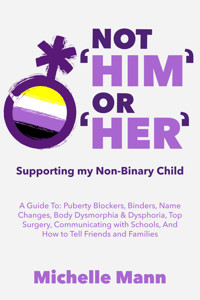
Learn the best ways to support your non-binary child.
Do you have a non-binary child and want to learn about what your child is going through? Are you trying to be supportive but don’t know where to start?
This book is the perfect guide to help you learn every aspect of transitioning, what it means to be a non-binary child, and being a supportive parent. In this book, you will:
Understand what it means to be a non-binary child and how to support your child’s transition.
Learn how to ease yourself into using your child’s new name and pronouns and how to change their name in the legal system.
Discover the adverse effects of body dysphoria and dysmorphia that your child may experience.
Discover how binders are used and how to shop for your non-binary child.
Understand all aspects of puberty blockers and top surgeries and their side effects.
Learn how to tell the world about your non-binary child and explain to them about your child’s journey.
Discover all the non-binary terminologies and how to differentiate between them.
Find out all the information you need to understand your non-binary child’s transition, so get your copy right now to get started.
Das E-Book können Sie in Legimi-Apps oder einer beliebigen App lesen, die das folgende Format unterstützen:
Veröffentlichungsjahr: 2025
Ähnliche



















Book Description
Learn the best ways to support your non-binary child.
Do you have a non-binary child and want to learn about what your child is going through? Are you trying to be supportive but don’t know where to start?
This book is the perfect guide to help you learn every aspect of transitioning, what it means to be a non-binary child, and being a supportive parent. In this book, you will:
Understand what it means to be a non-binary child and how to support your child’s transition.
Learn how to ease yourself into using your child’s new name and pronouns and how to change their name in the legal system.
Discover the adverse effects of body dysphoria and dysmorphia that your child may experience.
Discover how binders are used and how to shop for your non-binary child.
Understand all aspects of puberty blockers and top surgeries and their side effects.
Learn how to tell the world about your non-binary child and explain to them about your child’s journey.
Discover all the non-binary terminologies and how to differentiate between them.
Find out all the information you need to understand your non-binary child’s transition, so get your copy right now to get started.
Not ‘Him’ Or ‘Her’: Supporting My Non-Binary Child
A Guide to Puberty Blockers, Dead Names, Binders, Body Dysmorphia and Dysphoria, Top Surgery, and Telling Friends, Families, and Schools
© Copyright 2021 - All rights reserved.
The content contained within this book may not be reproduced, duplicated, or transmitted without direct written permission from the author or the publisher.
Under no circumstances will any blame or legal responsibility be held against the publisher, or author, for any damages, reparation, or monetary loss due to the information contained within this book, either directly or indirectly.
Legal Notice:
This book is copyright protected. It is only for personal use. You cannot amend, distribute, sell, use, quote or paraphrase any part, or the content within this book, without the consent of the author or publisher.
Disclaimer Notice:
Please note the information contained within this document is for educational and entertainment purposes only. All effort has been executed to present accurate, up to date, reliable, complete information. No warranties of any kind are declared or implied. Readers acknowledge that the author is not engaging in the rendering of legal, financial, medical, or professional advice. The content within this book has been derived from various sources. Please consult a licensed professional before attempting any techniques outlined in this book.
By reading this document, the reader agrees that under no circumstances is the author responsible for any losses, direct or indirect, that are incurred as a result of the use of information contained within this document, including, but not limited to, errors, omissions, or inaccuracies.
Table of Contents
Introduction
Chapter 1: A Parent’s Intro to Non-Binary
What Is Non-Binary?
What It Means for the Child to Define Themselves as Non-Binary
How to Show Your Child Support During the Transition
How to Choose the Right Therapist
What Happens If They Don’t Get the Right Support?
Non-Binary Identity Red Flags for Parents
Chapter 2: Name and Identity
How to Ease into Using New Pronouns
Things to Consider
How to Talk to Others about It
How to Change Your Child’s Name Legally
Chapter 3: Body Dysphoria and Dysmorphia
Body Dysmorphia
Gender Dysphoria
Difference Between Dysphoria and Dysmorphia
What Challenges Affect the Ability to Live Normally?
Chapter 4: Binders and Clothing
Chest Binding and Its Importance
How to Deal as a Parent
Chapter 5: Puberty Blockers
Types of Puberty Blockers
Benefits and Future Additional Treatment
Chapter 6: Top Surgery
The Benefits of Top Surgery
Risks Involved with Top Surgery
Tips for a Faster Recovery
Additional Factors to Consider
Chapter 7: Telling the World
Expressing Their Identity
Importance of Gender Pronouns
Informing Friends and Family
Chapter 8: Non-Binary Terms
Understanding Non-Binary Identity
Conclusion
References
Introduction
Do you have a non-binary child and want to learn how to support them? This book has you covered. We will guide you through the whole process of being there for your non-binary child to be better acquainted with what they are going through. In this book, you will find the ultimate guide to your child’s journey.
Understanding what your child is feeling will help you know how to be there for them. Going through puberty and understanding oneself is something we all go through. On top of all these hardships, your child goes on an additional self-discovery journey as a non-binary child in today’s world. First, we will mention how you can get acquainted with terminologies and what it means to be non-binary. We will show you a few pointers on how to deal with the process so that you make your child feel recognized and seen. A lack of support is detrimental to your child’s mental health and self-esteem. Reading this book will make you feel closer to your child because we will show you how to educate yourself about gender identity and expression.
We have mentioned the best ways to find a suitable therapist to help you and your child better understand all aspects of gender expression and identity. The vital factor is to take the process slowly and not rush into it. You must know that you are bound to make mistakes initially, like referring to your child by the wrong pronoun or name if they choose to change it. This book includes various strategies to tackle each situation without hurting your child’s feelings. We will walk you through introducing your child’s new name and identity to family members and other people in their lives and the legal steps to change their name officially.
After initial introductions, we discuss the negative effects when your child’s bodies or clothes don’t match their feelings. The book mentions the importance of your child’s mental health and what you can do to support your child. You will find all information about the right type of clothing for your child and how to ensure that they use binders safely. It is important to allow your child to express themselves so they are comfortable with their appearance, which should reflect how they feel on the inside.
We proceed to more technical issues from puberty blockers and how they work to top surgery and how it affects the body and the accompanying risks. You will find many tips on how to tell everyone about your non-binary child and explain what it means to be non-binary. The tips in this book will greatly help you as a starting point to family conversations to help them understand how this journey is essential to your child’s life. Lastly, the book discusses different terminologies you need to know so that you can choose the proper terms when referring to your non-binary child.
Chapter 1: A Parent’s Intro to Non-Binary
Parenting is quite a learning curve and to have to deal with gender-related challenges with your child represents an entirely different set of challenges. If your child is still an infant, less than two years old, this might not be much of an issue, nor will it be that apparent. However, as time goes on and your child enters the phase where they are constructing their personality, character, and self-identity, you may come across things that seem inappropriate for your child’s gender, particularly in adolescence between the ages of 4 and 9 when they start to understand the world around them. Understanding how society constructs the concept of genders can become more apparent.
What Is Non-Binary?
In the past, genders were identified as either male or female. These are known as binary genders and you are born one or the other. In recent times the idea of genders has gone through a rather comprehensive range, and today, male and female genders are defined as two extremes in a range of possible genders. On one extreme, some men identify with what society and culture deem appropriate and even necessary for men. On the other end are women who feel similarly with the norms, values, processes, and ideologies that are classified as appropriate for women and females.
Between these two extremes lie several different genders where it is hard to draw a clear line whether gender adheres to the male or female side of the spectrum. More importantly, this doesn’t mean that the individual who lies somewhere in the middle of this scale will have different physical features than a man or woman. Even though the individual may biologically be a man, emotionally, intellectually, and in terms of their traits and characteristics, they may identify more comfortably with a female. Likewise, the same is true for women who feel deep down inside that they belong to a different gender.
It is very common for people who don’t feel comfortable associating themselves with a single gender to hear them say they feel trapped in the body they were born with. There are several examples of men and women who feel like they should have been born with a different gender. In many cases, they will go unnoticed because they dress appropriately for their gender on the outside, but internally, they aren’t comfortable with it.
As things have changed in freedom of expression and more people worldwide are paying more attention to the LGBT community, individuals who clash with their gender feel a bit more comfortable talking about this issue. Many government-run and non-governmental organizations are operating across the globe and trying to help people identify their gender and live a life that suits them.
What It Means for the Child to Define Themselves as Non-Binary
Different genders certainly have physical properties to them since men and women are born different in every regard. However, the concept of being a man or woman is not something that is set in stone. For instance, we have a general concept that little boys should be playing with cars and action figures while little girls should play with dolls, stuffed toys, and other feminine items. In reality, this has nothing to do with the physical gender itself. There is no reason why a girl wouldn’t enjoy playing with a car or a boy wouldn’t want to play with a stuffed toy. It is a strange concept because later on in life, boys grow up to do things considered feminine in the past, and girls might do things considered masculine. For instance, many professional barbers for men are men, though when a small boy wants to brush his doll’s hair or take care of his doll, much like his mother takes care of him, it is considered feminine behavior. Also, most professional chefs are also men. Again, this is something that is usually considered feminine in childhood and something that girls should be doing.
Even if we look at toy stores, we notice entire sections or entire floors are dedicated to specific genders. In the male section, you will notice some typical toys and a very apparent color scheme. On the contrary, in the girl’s section, there is almost nothing that you will find in the boy’s section, and again the color scheme for the toys and space is very different. In both cases, the colors, toys, and general atmosphere are built according to what society deems appropriate for that gender. In reality, a boy might like colors in the girl’s section while girls might enjoy the toys from the boy’s section.
Similarly, so many professions are taught that a specific gender will follow. However, today both genders are often playing a part in that industry. In some cases, the opposite gender is more prominent than the gender pursuing that line of work. So, to say something is inherently masculine or feminine is not entirely correct.




