


Erhalten Sie Zugang zu diesem und mehr als 300000 Büchern ab EUR 5,99 monatlich.
- Herausgeber: The History Press
- Kategorie: Sachliteratur, Reportagen, Biografien
- Sprache: Englisch
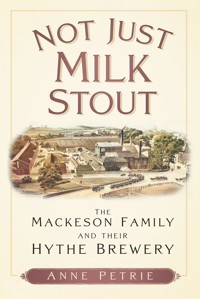
This is the story of how the Mackeson brothers of Deal bought a brewery in the small Kent town of Hythe and transformed it into a producer of one of the biggest brewing success stories of the twentieth century – milk stout. The drink was a favourite in pubs and shops across the country and famously found its way into the snug in Coronation Street's 'Rover's Return'. The family's journey was not a smooth one. From 1801, four generations struggled with economic depression and recession; war; a suicide; bankruptcies; lawsuits; wastrel and importunate relatives; and premature deaths. But there were triumphs along the way, too: transporting the Koh-i-Noor diamond to Queen Victoria, discovering a new dinosaur and finally the reward of a baronetcy.
Sie lesen das E-Book in den Legimi-Apps auf:
Seitenzahl: 171
Veröffentlichungsjahr: 2023
Das E-Book (TTS) können Sie hören im Abo „Legimi Premium” in Legimi-Apps auf:
Ähnliche


















First published 2023
The History Press
97 St George’s Place, Cheltenham,
Gloucestershire, GL50 3QB
www.thehistorypress.co.uk
© Anne Petrie, 2023
The right of Anne Petrie to be identified as the Author of this work has been asserted in accordance with the Copyright, Designs and Patents Act 1988.
All rights reserved. No part of this book may be reprinted or reproduced or utilised in any form or by any electronic, mechanical or other means, now known or hereafter invented, including photocopying and recording, or in any information storage or retrieval system, without the permission in writing from the Publishers.
British Library Cataloguing in Publication Data.
A catalogue record for this book is available from the British Library.
ISBN 978 1 80399 458 1
Typesetting and origination by The History Press.
Printed and bound in Great Britain by TJ Books Limited, Padstow, Cornwall.
eBook converted by Geethik Technologies
CONTENTS
Acknowledgements
Note on Mackeson Names
Prologue
1 A Very Nice Beginning
2 This Sweet Girl’s Property
3 A Most Amiable and Unaffected Young Woman
4 So Iniquitous, So Disgraceful, a Business
5 This Unfortunate Circumstance
6 A Very Fine Young Man
7 Hythe is Half Barracks
8 I Am Really Quite Tired Out
9 Dinodocus Mackesoni
10 Many Songs Were Sung
11 Dae Ye Mind o’ Lang, Lang Syne
12 In Every Sense a Gentleman
13 The Power Was a Horse
14 Make Stout More Nourishing
15 By Golly it Does You Good
Bibliography
Notes
ACKNOWLEDGEMENTS
My thanks are due to my fellow members of Hythe Local History Group, especially Mike de la Mare, Ron Greenwood, Iris Pearce and Paul Naylor for reading the text and helping with the photographs. Kevin Bailey, the curator of Hythe Museum, showed me some lovely breweriana and Peter Henderson, the archivist of the King’s School, Canterbury, went far beyond my original enquiry about admission records. Robert Melrose lent me the diaries of General Frederick Solly-Flood, which helped put Hythe society into perspective.
I also received much-appreciated help and advice from Daniel Korachi-Alaoui at Canterbury Cathedral Archives; from Rachel Lang of University College London Centre for the Study of the Legacies of British Slavery; and from Duncan Sambrook of Sambrook’s Brewery in London and his colleague, brewer John Hatch. Staff at Kent History and Library Centre, at the British Library and at Hythe Library could not have been more helpful.
All these people kindly shared the knowledge and expertise that I lacked and I cannot thank them enough. I must also express my gratitude to those who have allowed me to use their photographs as illustrations: Anne Thompson; the Rev. Michael Darkins of St Leonard’s church, Hythe; and Hythe Civic Society.
NOTE ONMACKESON NAMES
The Mackeson family produced four generations of first sons called Henry. To avoid confusion, I have adopted the following stratagem:
Henry Mackeson of Deal (1737–1800) is just ‘Henry’;
Henry Mackeson, his son (1772–1860), the first brewery owner, is ‘Harry’;
Henry Bean Mackeson, Harry’s son (1813–94), is ‘Henry Bean’;
Henry Mackeson, Henry Bean’s son (1861–1935), is ‘Young Henry’,
All these men were actually known as ‘Harry’ to their families and Young Henry finally christened his first born just that: Harry Ripley Mackeson (1905–64).
PROLOGUE
On an otherwise unremarkable Monday in October 1801, two young men sat down in a room in Hythe with three others, rather older. Two copies of a large document, an indenture on vellum, were produced and carefully read before being signed by three of the men and witnessed by the other two.
The younger pair were Harry and William Mackeson, brothers, originally from Deal, but now living in Hythe and, since the document had been signed, the owners of the town’s brewery and several inns. Of the others, one was their late mother’s great-uncle, John Friend, the erstwhile owner of the brewery, whose Mackeson kinsmen had just agreed to pay him, albeit in instalments, £11,469. To put this in context, the average family income in 1801 was £92 a year.1 The witnesses were brothers, too, members of the Tournay family. Both were attorneys at law. This was a serious matter, worthy of the attention of serious men.
Neither Mackeson brother had planned to become a brewer and both had started out on different career paths, but this simple, if rather expensive, transaction transformed their lives, the lives of their families and the town of Hythe.
In the eighteenth century, nearly every town in the country, large or small, had its brewery. Few survived, as the Mackeson brewery did, into the second half of the twentieth century and few had a product that became a household name. Mackeson Milk Stout was from 1909 the Hythe brewery’s unique selling point, widely advertised as being both healthy and appropriate for women to drink at home or in company. Milk stout even found its way into one of the nation’s favourite soaps, Coronation Street.
The success of their venture made the Mackeson brothers and their descendants well-off by small town standards. They could afford to educate their children and support their careers and vocations away from the brewery, which after all was still ‘trade’ and therefore not quite respectable. The family produced physicians, generals, lawyers, priests and admirals and finally, in the person of Brigadier Sir Harry Ripley Mackeson, a Lord of the Treasury and a baronet. That he was also the MP for Hythe is indicative of the strong links the family had with the town.
Hythe in 1801 was a quiet little place, long past its glory days as an original member of the Cinque Ports confederation, when, with the monarch’s blessing, its citizens made a fortune out of legalised piracy on the high seas. Incorporated by royal charter, it still had the right to return two MPs to Parliament though it now had a population of only a little over 1,000. It was small, even by small town standards in a country with a population of less than 9 million, comprising just 200 householders and their families, offspring, lodgers, apprentices, servants and journeymen2. It was a young town, too: nearly 40 per cent of the population was under 15, a trend reflected in England as a whole. There was a charity school for poor children, an ‘Academy’ run by William Card for the sons of the middling sort, or the King’s School in Canterbury, for those who could afford the fees. The over-60s were less in evidence, but there was some provision for the indigent elderly in the form of two almshouses, St John’s and St Bartholomew’s.
The usual trades were represented in the town: butchers, shoemakers, millers, tailors, drapers, coal merchants, carpenters, bricklayers, grocers, a basket maker, a weaver, a baker and a blacksmith. There was a tannery situated at the east end of the town, allowing its stink to be swept by the prevailing south-westerly winds toward Folkestone. There were also more unusual trades, like that of James Hyam, a peruke maker. Thanks to the Duty on Hair Powder Act of 1795, the golden age of wig-wearing was fading but Hythe was not at the cutting edge of fashion. There was a collar maker, not for men’s shirts, which still had soft necklines, but for horses and given that there were seventy-eight draught horses in the town, Robert Bowen was likely to have been busy. John Raisbeck was a brazier or brass worker producing buttons, buckles, door furniture, fire grates and candlesticks.
Then there were the men who were employed to fight organised crime – smuggling or ‘free trade’ as its practitioners preferred to call it. John Manning and Henry ‘One-Eyed’ Tritton were Customs Riding Officers, paid a pittance to patrol the coast and gather intelligence. They reported to the Customs Supervisor, Isaac Tournay, a brother to the witnesses of the Mackesons’ purchase of the brewery.
Reflecting Hythe’s rural hinterland, there were farmers and graziers, owning between them nearly 700 sheep. The fleeces these produced were dealt with by the appropriately named Thomas Woolley, a wool stapler.
The town also had a few men who did not get their hands dirty, ‘gentry’ as the directories called them, though the term was not definitive. Most ‘gentry’ in Hythe would have been regarded as country bumpkins in London. Perhaps an exception was William Deedes, owner of the Old Manor House in the town, a Deputy Lieutenant of Kent, Lieutenant Colonel commandant of the South Kent Volunteers and relation by marriage of Jane Austen. He, however, was in the process of leaving Hythe for a much grander house up the hill, Sandling Park, designed by Joseph Bonomi the Elder.
At the other end of the social scale, most of the other male residents of the town who were not tradesmen would have been unskilled labourers.
The brewery stood at the western end of the High Street, which was of beaten earth and unlit at night. The houses lining the street were mostly old, with none of the elegant Regency terraces of Brighton or Bath, though some householders had covered their timbered frontages with brick, complete with what we now recognise as typically Georgian windows and doors. Pigs, goats and chickens roamed the streets, despite the town corporation’s endless attempts to compel their owners to keep them penned.
There was a small Thursday stock market and a general market on Saturdays, held under the town hall, which was quite new, built in 1794. John Friend had given some of the land on which it was built.3 It served as a courtroom as well as a meeting place for jurats (town councillors). While they awaited trial, the accused were kept in the town gaol, more or less voluntarily since it was laughably easy to escape from it. There was also an annual fair, held on the town green, each November.
There was only one church, St Leonard’s, up the hill from the town and once the pride of the Cinque Port but now rather shabby, though it had a new tower, built in 1750 to replace one that had collapsed eleven years earlier. St Leonard’s was not a parish church, but a chapel of ease, Hythe forming part of the parish of Saltwood, a mile or so up the hill. Nonconformists and Roman Catholics had to wait a while before they could worship without travelling some distance.
Travel was difficult, as it was throughout the country, although the profits from turnpikes were being used to improve roads. There had been a toll road to Ashford from Hythe since 1762, though the road to Canterbury, Stone Street, was not turnpiked and was described as ‘very rough’.4 For travel further afield, for those who could not afford a carriage or horse hire, there was a thrice-weekly coach service to London, which returned overnight.5
If heavy loads needed to be transported, the easiest method was by sea. Although Hythe was one of the original Cinque Ports, its haven, always subject to silting, had finally succumbed to the longshore drift of the shingle in the late seventeenth century. Now, boats anchored off Hythe and the loads were hauled up the beach by means of a winch turned by wretched ‘sea horses’. Coal was delivered to the town in this way well into the nineteenth century. For less bulky loads, or for passengers who could not face the rigours of a road journey, there were regular hoys plying between Hythe and Griffin’s wharf, almost opposite the Tower of London.6
The shingle that had clogged up Hythe haven was gradually drained – ‘inned’ – and was by the time the Mackesons arrived in town used for grazing land. This flat terrain continued westwards for 25 miles, across the Romney Marsh, sparsely populated except for its small towns, Lydd and New Romney, both also former ports now stranded inland. To the east of Hythe lay hillier land and the towns of Folkestone and Dover, and to the north was the village of Saltwood and the chalk escarpment of the North Downs.
It is fair to say that not a lot happened in Hythe. A glance at the newspapers in the year before the Mackesons’ arrival shows that the only newsworthy events, apart from births, deaths, marriages and a mayor-making, were the disappearance of a brown horse from a field near the turnpike and the illicit slaying of a fat sheep.
THE FAMILY OF HENRY MACKESON
The children of Henry Mackeson of Deal.
1
A VERY NICE BEGINNING
Harry and William (known to the family as Will) were the eldest sons of Henry Mackeson, born just fourteen months apart in 1772 and 1774 respectively. Their childhood was spent in Deal, about 20 miles along the coast from Hythe.
Their father was a mariner who in 1765 had married a widow, Elizabeth Hooper. She had inherited from her first husband a large house in Middle Street, Deal. She gave birth to a son in 1767, but the next year she and the infant died. Though she left the house in trust to her two sons by her first marriage, Henry Mackeson bought it from the estate and continued to live there after his second marriage, in 1771, to Elizabeth Bean of nearby Great Mongeham. She became the mother of Harry and Will and, importantly, as it would turn out, was the great-niece of John Friend, Ashford maltster and Hythe brewer.1
In July 1779, Henry Mackeson was appointed by James Boxer of Folkestone to be first lieutenant on board one of his ships. This was no ordinary assignment: two days earlier, Boxer had been authorised by the king to crew a privateer to sail against the Spanish in ‘a warlike manner’ and to seize ships and prizes.2 England had declared war on Spain in June as a result of its support for the Americans in their War of Independence.
It was probably the profits from this venture that allowed Henry to leave the sea. In 1792 a local directory records him as still living in the Middle Street house, where he had built wine vaults and stables and was trading as a wine merchant.3
By this time, his second wife was dead and he had married for a third time, to Clara Nickoll. Together, they produced three children to add to the six Henry had fathered with Elizabeth Bean.
Harry, the eldest son, joined his father in the wine trade. Henry suffered from gout and by the last years of the century Harry was responsible for most of the business.4 Will, at the age of 14, was apprenticed for seven years to Benjamin Bell, surgeon of Edinburgh.5 He was fortunate to be taken on by such a distinguished practitioner. Bell, Professor of Surgery and Obstetrics at Edinburgh University, was both a surgical pioneer and a man of science whose renown, thanks to his published works, had spread far beyond Scotland.
His time served, Will went home to Deal and set himself up in Lower Street as a ‘Surgeon, Apothecary and Man-midwife’.6 The man-midwife was still a controversial figure in the late eighteenth century and was more fashionable in elite society than among the middle classes of small towns. An anonymous tract, The Danger and Immodesty of the Present Custom of Unnecessarily Employing Men-Midwives, was published only twenty years before Will started practising and the occupation was generally regarded as both unmanly and ungentlemanly. One authority tells us that a man-midwife, to compete with female practitioners, needed highly developed social skills and a professional demeanour. He had to be ‘sober, patient and discreet, polite and easy in his address and manners’.7
George Cruikshank’s 1793 satirical cartoon. The Wellcome Library no. 16968i
Perhaps Deal was not ready for such a novelty or Will, in his early 20s, lacked the necessary social polish. Despite the failure of his venture, he continued to describe himself as a surgeon for some years after he and Harry had acquired the brewery.
Henry Mackeson died in 1800, at lodgings in Canterbury,8 leaving over £11,000.9 Just before he died, he had given Harry and Will an advance on their inheritance of £1,600 between them.10 They and their stepmother Clara were appointed joint executors of Henry’s will.11 Apart from the distribution of cash, £1,000 each for two unmarried daughters had to be invested to provide for their marriage settlements.12 There was a slight difficulty when one of the daughters of Henry’s first wife, Elizabeth Hooper, claimed that the Middle Street house was rightfully hers, but the executors paid her £15 for ‘quieting and extinguishing the claim’.13 The house was eventually sold in 1812, by which time the children were all grown and Clara had gone to live in Lambeth. It had been licensed to sell alcohol when Henry Mackeson ran his wine business there and has continued as licensed premises until the modern day, trading since 1865 under the name the Ship Inn.
Harry and Will put their inheritance to use in buying John Friend’s Hythe brewery. They had agreed to pay Friend £3,130 immediately for the brewery itself, the dwelling house next to it, the brewery equipment, stock in hand and two inns, the White Hart and the Red Lion, both in Hythe. The balance was to be paid after seven years, in instalments of £500.14
The Ship Inn, Deal. Author’s collection
Their involvement in the concern must have started earlier as they were, by the time they signed the indenture, both living in Hythe and were referred to as brewers. Their early correspondence shows that Harry, at least, was conversant with the business and he had another connection with brewing. In 1785, the Hayman brothers of Deal started a brewery in their licensed premises in Lower Street and less than two years later, Harry married Elizabeth Hayman, daughter of Thomas, one of those brothers. Perhaps his interest was sparked by his knowledge of his father-in-law’s business and the decision of John Friend to sell his Hythe brewery was a happy coincidence.
Friend had lived in Hythe with an unmarried cousin, Elizabeth Rammell. He had, as his will shows, intended to leave her the bulk of his considerable estate, but in the event, she died ten months before him, in February 1802. When he died, ‘highly respected’ in December of that year,15 the offspring of Henry Mackeson and Elizabeth Bean got the lot, a few individual legacies aside.16
These subsidiary legacies alone came to over £10,000; although he had lived modestly with only one servant, Friend was wealthy.17 He died possessed of seven barns; eight stables; a water mill; eleven houses with their curtilages (the enclosed areas of land adjacent to dwelling houses); twelve gardens; six orchards; and 260 acres of agricultural land and woods. The lands covered a wide area in east Kent.18 We do not know exactly how much the residue payable to the Mackeson children was, but John (Jack) Mackeson, the third son, wrote gleefully from India, where he was serving with the East India Company:
Mr Friend died worth a good round sum. My share of his property I mean to be the foundation for making a fortune. I shall immediately have £4000 sent out to this country which added to the £1500 I have already will be a very nice beginning.19
Jack’s confidence that he would one day be the possessor of a fortune was sadly misplaced.
Now on a financially secure footing, Harry and Will could turn their attention to developing their brewery, though the records and the accounts and the copy letters were always kept by Harry, who seems to have become the dominant partner from the start, although no formal deed of partnership was ever entered into by the brothers.20 Harry, a methodical man, also kept a reference book explaining legal terms and citing case precedents.21
The brothers decided early on to advertise the business as ‘established in 1669’. The basis of this claim was that Harry had discovered, among the deeds relating to the brewery, a document that detailed a mortgage taken out by James Pashley, its then owner in that year. He believed this to be the earliest record, but there are others extant showing that James Pashley and his father, another James, were brewers in Hythe from at least 1641.22 The year ‘1669’, though, has a nice ring to it and enabled them to claim that the business was founded ‘during the reign of Charles II’ rather than ‘just before the Civil War’.
The Mackesons opened their brewery for business on Monday, 19 October 1801, a week after signing the indenture. Harry started a brand-new ledger and, in a firm, clear hand wrote:




