


1,49 €
Mehr erfahren.
- Herausgeber: Mindanao Books
- Kategorie: Sachliteratur, Reportagen, Biografien
- Sprache: Englisch
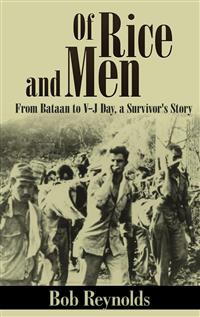
At the fall of Bataan on April 9 1942, over sixty thousand American and Filipino troops were rounded up by the Japanese and forced to march 65 miles from Mariveles, on the southern end of the Bataan Peninsula, to San Fernando, Pampanga, in Central Luzon. Anyone showing a slight weakness to walk was instantly bayoneted in the back. Many marchers committed suicide by leaping from bridges. Others were shot for attempting to eat or drink anything.
Estimates of the number of total deaths from the march range from 5,000 to 8,000. Thousands more later died from malnutrition and disease in the abject conditions of the Japanese POW camps.
One of the fortunate survivors was Sergeant Bob Reynolds who penned his combat memoir
Of Rice and Men in 1947. With a cool, philosophical perspective, he details the harrowing experience, from bitterly defending Bataan on starvation rations, through the many atrocities of the March, and finally his miraculous survival in Cabanatuan POW Camp and, later, in Manila's Bilibid Prison.
*Includes annotations.
Das E-Book können Sie in Legimi-Apps oder einer beliebigen App lesen, die das folgende Format unterstützen:
Veröffentlichungsjahr: 2019
Ähnliche



















Of Rice and Men: From Bataan to V-J Day, A Survivor’s Story
Bob Reynolds
Published by Mindanao Books, 2019.
Copyright
––––––––
Of Rice and Men: From Bataan to V-J Day, a Survivor’s Story by Bob Reynolds. First published in 1947.
Annotated edition published 2019 by Mindanao Publishing. All rights reserved.
First printing: 2019.
ISBN: 978-0-359-58796-4.
Table of Contents
Title Page
Copyright Page
Preface
1 - The Beginning of the End
2 - War in the Philippines
3 - The Battle of Bataan
4 - The Death March
5 - Back to Bataan
6 - Cabanatuan
7 - Lipa, Batangas
8 - Bilibid Prison
9 - Return to Cabanatuan
10 - En Route to Dai Nippon
11 - The Land of the Rising Sun
12 - The Setting of the Sun
Further Reading: The Navy’s Air War: A Mission Completed
Preface
IN THE FOLLOWING PAGES, I have endeavored to delineate that period which, from a viewpoint of national pride, is perhaps one of the darkest periods of humiliation in the history of our United States; the years of Japanese captivity of American troops from the fall of Bataan to V-J Day.
The experiences narrated in the following chapters are mine alone. Encounters of other prisoners not actually witnessed by me have been omitted. Having in mind the interest of readers whose loved ones may have perished on Bataan, or Corregidor, or during the appalling years of Japanese imprisonment, I have avoided using the names of all persons.
The expression “Buddy,” “Friend,” or “Fellow,” represents in respective cases someone’s son, brother, husband or sweetheart from whom I have endeavored to withhold any heartbreaking particularization.
Many of the instances recounted herein may appear gruesome and vulgar; but in the interest of the future of the nation and in memory of the heroic men who did not return I believe the story should be told.
1 - The Beginning of the End
“Because one of your number has escaped, five men must be punished. As I call your names, you will step forward to be executed.”
––––––––
BY THE GRACE OF GOD, it was another narrow escape from death, but let me relate the circumstances...
In the eight months prior to [the attack on] Pearl [Harbor] many of the nation’s youth responded to the call to colors in America’s fast-growing armed forces. In March of 1941, I saw fit to disrupt my educational career as a sophomore in college in compliance with Uncle Sam’s behest, “I WANT YOU!”
After three months of basic ground training at Jefferson Barracks in St. Louis, I was sent to an Air Corps Technical School at Denver, Colorado. There, over a four-month comprehensive course, I studied various phases of Air Corps administration and communications and upon graduation was assigned to the ill-fated Thirty-fourth Pursuit Squadron at Hamilton Field, California. [Almost the entire 34th Squadron was later annihilated].
By this time, I had seven months of service but as yet hadn’t seen any practical work; consequently, I was thrilled at the prospect of having been assigned to a tactical pursuit squadron. If it was action and adventure I was anticipating, I had certainly been delegated to the right organization, for upon reporting to my commanding officer I learned that the squadron was assigned under sealed orders to depart for foreign service within two weeks.
I had time to become acquainted with the nature of my work and most of the pilots and men in the organization when we embarked on board the S.S. President Coolidge for an undisclosed port.
Our mailing address was: “Plum, c/o Postmaster, San Francisco, California.”
The date was November 1, 1941.
The aforementioned S.S. President Coolidge was the flagship of the President Lines and had not been converted from her luxury liner status into a troop transport.
[A few months later, on January 12, 1942, the Coolidge hit two mines in the Philippines’ Espiritu Santo harbor and was forced to run aground. Captain Elwood Joseph Euart’s decision to try and beach his ship saved the lives of five thousand men, but he was court-martialed for the loss of the vessel. Today, the wreckage of the Coolidge, in the accessible shallow waters of Vanuatu, is one of the world’s most popular dive sites.]
We enjoyed the comforts of first-class world travelers en route to the Orient because all the civilian employees of the line had been hired under yearly contract and were a part of the ship when the government requisitioned her. The ship’s orchestra played in the dining salon at meal-time and gymnastics, and swimming instructors were on hand to supervise our recreation. As we sailed from the San Francisco harbor, I stood on deck watching the Golden Gate Bridge fade from view, and wondering just how long it would be before I would see it again.
Often during the intervening years, I wondered too.
Three hours out from the Golden Gate, we were told that our first stop would be Honolulu. From the ship’s crew, we learned that stops were scheduled at Honolulu, Guam, Manila and Hong Kong before returning to an American West Coast port with American refugees from the Orient.
We were certain to disembark at one of these ports, but which one would it be?
On the morning of the fifth day at sea, we sighted [the volcanic crater landmark] Diamond Head [known to the locals as Lēʻahi], the mariner’s guide to [steer into] Honolulu’s harbor. Several hours later, we docked alongside the Aloha Tower and were welcomed in the traditional Hawaiian manner by a string orchestra and a company of lascivious hula dancers who boarded the ship.
Then all hands went ashore to see and taste the magic of Hawaii.
Necklaced with leis, two buddies and I strolled down Honolulu’s famed Avenue of Palms to be greeted subtly by a sign, “DO NOT URINATE ON STREET!” After a three-dollar plate dinner of burned steak at one of the city’s better eating places, we hired a cab to Waikiki Beach where we visited the Hotel Royal Hawaiian and cut our feet on the coral of the beach.
Eight hours later, poorer but wiser men, we once more boarded the ship, which slid gently out of the harbor to the strains of “Aloha" and “Beautiful Hawaii.” Two hours out of Pearl Harbor, we were joined by our naval escort, the cruiser Louisville, that was to be our constant companion throughout the remainder of the voyage.
War was impending even then, as evidenced by our cruiser escort. For additional precaution, the ship was completely blacked out at night. The daily news bulletin was filled with data regarding diplomatic negotiations with Japan.
At a point twelve days out of Hawaii, an unidentified vessel which appeared on the horizon refused to acknowledge the blinker signals dispatched from the cruiser. In less than a minute, our escort had launched two airplanes, and made a ninety-degree turn, heading full speed toward the unidentified craft. All must have proven well, however, as half an hour later she was running again in her usual position.
On November 20, 1941, we disembarked at Manila, and it was then that I was introduced to the smell of the Orient. To describe this odor is difficult but if one can conceive a combination of the aromas of garlic, perfume, sweating horses, and marijuana, he has a general idea. From the pier, we were taken to Nichols Field, where the squadron uncrated its equipment shipped from the California base and proceeded to set up flight operations. After five days at Nichols Field, we received orders from USAFFE [United States Armed Forces in the Far East] to change stations.
Given only rough road maps and compass directions, we spent most of the night reaching our destination, a newly-built airstrip near Del Carmen, Pampanga, about one hundred kilometers north of Manila.
Upon arrival at Del Carmen, we were pleased to find the field inhabited by a company of aviation engineers who had leveled the five-mile runway and were now in the process of surfacing the field.
Since we arrived just before dawn, the engineering unit’s invitation to breakfast with them was indeed welcome.
By noon of that day, everything was in order. Tents were pitched, field equipment was set up and everything was in readiness for our ships, which were to be flown up that afternoon from Manila.
For the following week things progressed in routine. We found a delightful swimming hole in a river that ran parallel with the field and drove trucks to the spot every evening.
While we were busy exploring our new surroundings, the engineers continued their task of surfacing the runways with molasses.
This operation seemed very stupid to me until I learned that molasses encouraged the growth of a certain hearty-rooted tropical grass which would make an excellent surface for our planes’ landing wheels.
At the end of that first week in Del Carmen we received orders once more from our headquarters; this time to dig air raid shelters and revetments for our planes. With this message came an order for our commanding officer to report to nearby Clark Field at once.
When the C.O. returned that evening, we had completed digging shelters to accommodate our two hundred and sixteen men. Even before the propeller of his plane stopped turning, he had summoned every man in the squadron.
With grave expression he informed us that war was practically upon us. G-2 [Military Intelligence] had information of nine hundred heavy Japanese bombers, based on the southern tip of Formosa, a bare three hundred miles from Luzon; theirs could be but one objective: The Philippines!
For thirty seconds complete silence reigned; then the calm authoritative voice of our commanding officer reminded us that we had been thoroughly trained for this eventuality and that he expected us to carry on our work in the same efficient manner we had thus far displayed.
We listened to this speech on the evening of December 7, 1941. In America it was December 6, because of the International Dateline. The following morning our radio section reported that Pearl Harbor had been bombed by Japanese carrier-based planes.
––––––––
Two A-27s of the 17th Pursuit Squadron at Nichols Field
2 - War in the Philippines
ALL OF THAT DAY WE received last-minute radio instructions from Air Force Headquarters; orders for offense and defense, instructions for the issuance of gas masks and combat equipment, and directives to arm our pursuit planes with ammunition and wing bombs. In my department, our work became quite complicated. Daily reports had assumed a nature of vital importance, both to our headquarters and the enemy. Each morning a radio report in code was sent to USAFFE giving them the squadron strength, number of planes fit for combat, the amount of gasoline and ammunition on hand, and other information of primary importance.
At all hours of the day and night messages, often pages long, came pouring in from headquarters. One such dispatch, covering nearly half a typewritten page, when decoded, read: “ALERT ALL PURSUITS.”
It was the notification for which we had been waiting. In five minutes, we had fourteen planes fully armed, manned with props spinning and on the line with noses pointing into the wind. The pilots, checking last minute instrument adjustments, were tense. When their radio headphones gave the order, they took to the air in rapid-fire succession.
The mission was intercepting Japanese bombers over Clark Field, a distance of ten air miles from our base. A range of mountains interfered with our view of the aerial activity and all we could do was to await the return of the fighters.
After fifteen minutes a sputtering drone announced the return of the first homecoming ship. The P-40 is normally flown onto its runway at a landing speed of one hundred and ten miles per hour, but this wounded bird, minus the use of three cylinders, limped in at about eighty miles per hour.
The uninjured pilot had just begun to relate the details of the fight when another ship came into land.
The second plane had been riddled through the fuselage with fifty-caliber machine gun fire, but was still intact. The pilot had come back for ammunition and another set of headphones; the ones he wore had been pierced through the right earpiece by a machine-gun bullet!
For the following hour the planes arrived and departed. When the last pilot returned, he described the fate of the three missing ships.
One had crashed head-on into a Jap bomber, and the other two had been shot down in flames after having accounted for a number of enemy planes.
That evening at dusk, we held a simple memorial service for the heroes who had died that day. Just a few words from the C.O. [Commanding Officer], a moment of silence, and that was all; yet, of the men present that evening, the handful still living will never forget it. I know that I shall not.
The following morning two of our pilots flew on a reconnaissance mission to the northern tip of Luzon.
One returned and told of his partner’s plane having been shot down over wild mountainous terrain by Jap Zero-fighters. The unfortunate pilot was known to the men as “Red” because he had dyed his hair a crimson hue after losing a bet on a West Coast football game shortly before our departure from the States.
The fellow pilot on the mission-related having seen “Red” bail out of his ship, but the mountainous country was known to be inhabited by headhunters, and his chances of survival were slim.
Five days later, a strange looking individual rode onto the airstrip on the back of a water buffalo. The black whiskers were alien to us, but the flaming red hair could be none other than “Red’s!”
He told an exciting story of landing in the treetops near a village of savages. The Philippine Constabulary [chief US law enforcement organization in the Philippines] had warned these primitive natives to be on the alert for descending Japanese airmen, and they approached the falling parachutist with upraised spears. Fortunately, he thought of his red hair and, tearing off his helmet, pointed to the rufous locks and shouted, “Americano!”
After spending the night with the savages, he hired a guide with a water buffalo which cost him his watch, class ring, and automatic pistol but proved to be a good investment as the day following his return to the base he was flying again.
All night, the ground crews worked preparing our remaining ships for combat flight. At 1 A.M. radio orders arrived and directed a strafing and personnel bombing mission at Lingayen Gulf where eighty Japanese troop transports were scheduled to land at dawn that morning.
Just as the first ray of dawn appeared over the mountain range, our remaining eleven planes took off on their deadly mission.
Two hours later, when the air was split by a roar announcing their return, we looked skyward, observing the formation perfect except for one position: the lead plane was not in the flight. Even before the pilots had the opportunity to explain how it had happened, we knew that the Squadron Commander was missing.




