


Erhalten Sie Zugang zu diesem und mehr als 300000 Büchern ab EUR 5,99 monatlich.
- Herausgeber: Parthian Books
- Kategorie: Sachliteratur, Reportagen, Biografien
- Sprache: Englisch
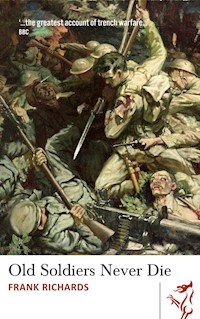
'...the greatest account of trench warfare....' --Phil Carradice, BBC Arguably the greatest of all published memoirs of the Great War, Old Soldiers Never Die is Private Frank Richards' classic account of the war from the standpoint of the regular soldier, and a moving tribute to the army that died on the Western Front in 1914. In this remarkable tale, Richards recounts life in the trenches as a member of the famous Royal Welch Fusiliers, with all its death and camaraderie, in graphic detail, vividly bringing to life the trials and tribulations faced by the ordinary rank and file.
Sie lesen das E-Book in den Legimi-Apps auf:
Seitenzahl: 486
Veröffentlichungsjahr: 2016
Das E-Book (TTS) können Sie hören im Abo „Legimi Premium” in Legimi-Apps auf:
Ähnliche



















Contents
About the AuthorTitle PageFOREWORDI THE STARTII LE CATEAU: THE RETIREMENTIII THE MARNE TO THE AISNEIV FROMELLES: THE FIRST BATTLE OF YPRESV TRENCHES AT HOUPLINESVI CHRISTMAS, 1914VII TRENCHES AT BOIS GRENIERVIII LAVENTIE, GIVENCHY, CUINCHYIX THE BATTLE OF LOOSX WINTER IN THE BETHUNE SECTOR: CAPTURE OF RWF CRATERXI THE BANGALORE TORPEDO AND A DECORATION CEREMONYXII THE CORPS COMMANDER AND QUICK FIRERSXIII THE RED DRAGON MINE AND A RAIDXIV THE SOMME: CAPTURE OF HIGH WOODXV TRENCHES IN HIGH WOODXVI LES BOEUFS AND TRONES WOODXVII SOMME: WINTER 1916–1917XVIII ARRAS: HINDENBURG LINE IXIX ARRAS: HINDENBURG LINE IIXX THIRD BATTLE OF YPRES: POLYGON WOODXXI FIVE WEEKS AT ROUEN BASE CAMPXXII BOIS GRENIER AGAINXXIII THE GERMAN MARCH OFFENSIVEXXIV MINIMUM RESERVEXXV THE FINAL ADVANCEXXVI LE GATEAU AGAINXXVII THE ARMISTICEXXVIII REWARDS FOR WAR SERVICEAboutLibrary of WalesCopyright
Frank Richards was born in 1883 in Monmouthshire. Orphaned at nine years old, he was brought up by his aunt and uncle in the industrial Blaina area, and went on to work as a coal miner throughout the 1890s before joining the Royal Welch Fusiliers in 1901. A veteran soldier who served in British India and many areas of the Western Front, he wrote his seminal account of the Great War from the standpoint of the common soldier,Old Soldiers Never Die, in 1933. This was followed byOld Soldier Sahib, a memoir of his time serving in British India, in 1936. He died in 1961.
OLD SOLDIERS NEVER DIE
Private
FRANK RICHARDS
D.C.M., M.M.
Late Of The Second Battalion, Royal Welch Fusiliers
LIBRARY OF WALES
FOREWORD
Frank Richards opens his astounding yet neglected memoir with a gathering of workmates in a South Wales coalfield pub in August 1914. Aware that his readers may well have expected to be introduced to familiar themes, Richards immediately sets out to establish his own territory and idiom and in so doing provides one of the most striking openings in the literature of twentieth century Wales. It is an opening that, on its own, merits book-length discussion.
In the Wales of 1914 industrial and political tensions were well to the fore, but we have now been introduced to a group of friends who went from the pit to the pub, not to discuss wage-rates and workers’ control but rather to reminisce about years spent in India, Burma, South Africa and China when their individual feats of soldiering had guaranteed famous victories. Basic to the trajectory of their careers was the fact that Wales was an integral part of the United Kingdom and that military service anywhere in their nation’s global Empire was a rewarding and honourable option and one to recall with pride.
On that August day in 1914 at the Castle Hotel in Blaina, Richards and his butties suddenly learn that a new war has been declared and that reservists (as many of them were) had been called up. This news occasioned ‘excitement and language’ and calls for glasses to be filled. The old soldiers, however, knew their duty and fully intended to report for duty on the morrow. Richards, then, has launched his tale but now he has to assure his readers by indicating that there is going to be humour, urbanity and possibly irreverence in what follows. As the drunken old soldiers wend their way home one former artilleryman mimed the firing of shells thereby ‘destroying a mining village in the valley beyond’. Writing very early in the 1930s Richards had perceptively anticipated the actions of countless young picture-goers who in the next generation would walk home from cinemas re-enacting the military heroics they had just witnessed on big screens and imagining the total destruction of neighbouring communities.
From the fourth of August 1914 we are firmly in our author’s hands: he is at his Regimental Depot at Wrexham on the 5thand by the 10thhe is in France. A typical soldier, his main concern is the availability of ‘booze and fillies’ and soon he has reassuring evidence that in that respect ‘we had nothing to grumble about as regards Rouen’. Private Frank Richards’ war has begun and the story he has to tell takes us to his demob in December 1918 and his subsequent shoddy treatment by pension boards back in Wales. We are presented then with that relatively rare thing; a perspective of the Great War in the words of an ordinary soldier and one who saw it all, who quite astonishingly is able to provide first-hand accounts of front line fighting at Bois Grenier, Loos, Bethune, the Somme, Arras, Ypres and Passchendaele. At his demob Richards mused that the chance of his surviving that lot had been twenty-thousand-to-one and yet his seamless story is now told in a voice that is never less than direct and refreshing. It is a remarkable account and one that offers an unusual emphasis for, as the author’s fellow Royal Welsh Fusileer and literary mentor Robert Graves immediately spotted, this book is ‘about the army rather than the war’. It is a vital distinction and one that invites us to judge its overall value in a different context, one both literary and social.
The First World War undoubtedly brought about the birth of modern Wales. It set up an intense interplay between a newly centralised national economy, an enhanced British state and the increasingly democratic institutions and voices of a working people. Wales had been massively involved in the War and now a hundred years on it is essential that we all acquaint ourselves with the major historiographical issues that have lingered. Was it really necessary for Britain to be involved in the War at all? Whose fault was the War? Which rulers and politicians allowed a local dispute to become a World War? It became, as Wales knew to its cost, a remorseless war of attrition: did that betoken a careless disregard of the lives of ordinary people or was it the best available strategic option? These questions, all too often the preserve of academics, need to be more fully debated in Wales. In 2014, as the great Centenary commemoration began, it was soon apparent that across the globe, and not least in Wales, the War was being examined more from the bottom than the top. Local historians and history societies had access to seemingly limitless material depicting a war fought and experienced by hitherto anonymous individuals. We have been left in no doubt that it was the People themselves who actually fought the Great War.
What has been refreshing about this new emphasis on real lives is that we can escape from prevailing stereotypes. In his 1975 book,The Great War in Modern Memory, Paul Fussell argued that it was probably the English class system and the influence of Shakespeare that lent a rather theatrical and somewhat comic feel to the literary treatment of the Great War’s common soldiers. Undeniably Shakespeare’sHenry Vis a great play about soldiers at war, and in many productions Henry’s conversation with a Welsh soldier is often the most amusing and memorable scene. The trouble is that so many subsequent authors have been tempted to write in the same mode. In literary works of considerable distinction one is likely to encounter unconvincing lapses into the colloquial. In Ford Madox Ford’s great novel sequence of the 1920s,Parade’s End, the English officer has to deal with a soldier from Pontardulais who longs to see his ‘bleedi’ little ’ut on the bleedin’ Mumbles’ and a miner ‘from God knows what up-country valley’ with ‘shaggy hair like a Caribbean savage’. InIn Parenthesis, his masterful attempt to both relive and mythologise warfare, David Jones explains how one Welsh soldier, Watcyn, ‘knew everything about the Neath fifteen and could sing Sospan Fach’ but ‘might have been an Englishman when it came to matters near to Aneirin’s heart’.
In discussing what he called the ‘Theatre of War’ Fussell had concentrated his attack on the ‘stagiest’ of Great War memoirs, those of Robert Graves, himself another of the many writers who had served with Welsh regiments. For Fussell,Goodbye to All Thatwas ‘a satire, built out of anecdotes heavily influenced by the techniques of stage comedy’: its author was ‘a joker, a manic illusionist, a fiction writer employing all his tricks’ including a story involving ‘a very dirty act’ at the Wrexham barracks. Graves had published his subsequently acclaimed memoir in 1929, at the very time he became aware of the manuscript by Frank Richards, a soldier who had served under him in the trenches. Graves was to champion Richards and urged him to write a subsequent volume on his pre-1914 military service. For that volume, published in 1936, Graves provided an excellent introduction in which he praised the lucidity, economy and lack of pretension that characterised the writing. He highlighted the qualities of ‘loyalty, openness and moral sureness’, and somewhat ironically explained how Richards ‘never sniggers in the perverted modern fashion’.
Theatricality was never a feature of Richards’ style. Graves’ own memory prompted his observation that it was Richards’ ‘long training as an army signaller’ that gave his prose its succinct authenticity. We might be tempted to assume that, as a signaller, Richards had found a safe wartime niche away from front line action, but we are left in no doubt that signallers performed a skilled and dangerous role at the Front itself (as is confirmed in Llewelyn Wyn Griffith’s 1931 account of his brother’s death inUp To Mametz And Beyond). Richards provides ample evidence of his own sheer professionalism as a signaller, and that quality of professionalism becomes indeed the hallmark of his writing. Richards was first and foremost a storyteller and he had instinctively mastered the technique of providing only the essential background details relevant to any incident that he is recalling. This is especially the case with his use of individual characters, whether they be officers, friends or anonymous soldiers: they enter the story to perform their role or, in the case of one ‘Old Soldier’, possibly an alter ego, to give a cryptic snap judgement or complaint. Certainly we learn little of the country from whence they came, the only qualitative comment on his fellow countrymen being a compliment to soldiers from Birmingham.
The technique he employs, then, is one in which anecdote follows anecdote, and the end result is a masterful picture of how the war of attrition was conducted from an ordinary soldier’s point of view. Throughout one is struck by the author’s sure control of his material, by the absence of rhetoric and by a sense of balance: matters are always held in check. Fundamental to his control is the reporting of disasters, accidents, injuries and carnage (occasionally and incredibly interrupted by short periods of leave in Wales). The reader can only be fascinated by the details but we are always invited to share the author’s own matter of fact reaction to these inevitable by-products of warfare. At every stage we are being educated into a professional soldier’s point of view.
Professionalism is a concept rarely discussed and analysed in our culture and yet it is a quality fundamental to our conduct of public life. Authors have long grasped this fact and popular fiction and cinema accounts of policing, doctors, soldiers and, in an earlier era, cowboys depended for their popularity on the way in which the skills and discipline of heroes amounted to a dependable professionalism. It is soldiers who have always provided the best examples. Their work calls for a variety of complex skills, a high degree of physical fitness and incredible bravery. Inevitably there will be complaints about inadequate weapons, sergeants, officers (especially generals), food, living conditions and the distribution of medals and pensions. Every opportunity for some relief (leave or even a slight ‘Blighty’ wound), entertainment and indulgence was to be welcomed. Death and serious injury just have to be accepted. And in the end the professional soldier always takes pride in what he regards as the privileged role he has been asked to perform. His place alongside valued friends and colleagues is treasured above all else and he pities those who have missed out on the experience of fighting for one’s country.
As Robert Graves reminds us, it was always thus for regular soldiers. He rightly highlights the role of Kipling in giving the ‘Tommy’ his place in our national culture. It was Kipling who gave George MacDonald Fraser the title for his memoir of Burma in World War Two,Quartered Safe Out Here, and a quote that sums up much of the spirit ofOld Soldiers Never Die,
Don’t look or take heed at the man that is struck,
Be thankful your living, and trust to your luck,
And march to your front like a soldier.
Each war adds to our understanding of the mentality of soldiers and conflicts in Viet Nam, Iraq and Afghanistan have led to a flowering of literary memoirs. The circumstances Frank Richards sought to convey is perhaps best summed up in Patrick Hennessey’sThe Junior Officers’ Reading Clubwhen, having described all the horrors of warfare in Afghanistan, he nevertheless admits that ‘deep down we all know there’s something incredibly selfish in what we do, something self-indulgent’. All soldiers know what they have to do and take pride in the way their mighty deeds give them the right to consider themselves a special breed.
In this respect, as in many others, the crafted memoirs of the author who boldly announces himself as Private Frank Richards DCM, MM provides a wonderful introduction to the modern literature of soldiering and helps us to understand why there will always be those who choose to serve their country. In a vivid account he shows how the Great War was fought and won and how common soldiers dealt with enemy fire on one side and social prejudices and eccentricities on the other. Some will find some of his truths distasteful but none will doubt the validity of his testimony. He came home to a Wales where, all too often, pensions, medals and privileges were claimed by ‘lead-swingers and dodgers’ and where the pits were closing. Inevitably the story ends where it started, for in the pub all bitterness could be cast aside as the Old Soldiers retell their tales. Many of us read history, Frank Richards and his butties had lived and shaped it.
Professor Peter Stead
2015
CHAPTER I
THE START
I was a reservist belonging to the Royal Welch Fusiliers whom I had first joined in the year that Queen Victoria died. I had served eight years with the Colours, very nearly seven of them in India and Burmah, and had been back in civil life for another five years and a half, when all this commenced. My job now was coal-mining; I was a timberman’s assistant.
On the fourth of August, 1914, I was at Blaina, Mon., having a drink in the Castle Hotel with a few of my cronies, all old soldiers and the majority of them reservists. One had taken us around South Africa; there wasn’t a Boer left in South Africa by the time he had finished his yarn. Next I had taken them around India and Burmah, and there wasn’t a Pathan or Dacoit left in the world by the time I had finished mine. Now another was taking us through north China in the Boxer Rising of 1900; and he had already got hundreds of Chinks hanging on the gas brackets when someone happened to come in with a piece of news. He said that war had broken out with Germany and that the Sergeant of Police was hanging up a notice by the post office, calling all reservists to the Colours. This caused a bit of excitement and language, but it was too late in the evening for any of us to proceed to our depots so we kept on drinking and yarning until stop-tap. By that time we were getting a little top-heavy, and an old artilleryman wound up the evening by dropping howitzer shells over the mountain and destroying a mining village in the valley beyond.
The next day I proceeded to the Regimental Depot at Wrexham, arriving there about 9 p.m. On my way to barracks I called at a pub which I used to frequent very often when I was a recruit, and found it full of Royal Welch reservists. We hadn’t seen one another for years, and the landlord had a tough job to get rid of us at stop-tap. We arrived at barracks in a jovial state and found that the barrack rooms were full, so about thirty of us had to sleep on the square that night. I was medically examined next morning, and afterwards got my equipment and kit out of stores. On the evening of the 5tha draft of reservists who had arrived early in the day had left the Depot to join the Second Battalion which was stationed at Portland. The Second was the battalionI had served with abroad and had arrived back in England about March 1914, after eighteen years absence. The First Battalion was stationed at Malta, just beginning its tour overseas. On the evening of August 7ththe Depot Sergeant-Major called for ten volunteers to join the Second Battalion. Every man volunteered and I was one of the selected ten. We went by train to Dorchester, where the Battalion, which had left Portland, was now billeted in the Town Hall. Two old chums of mine, Stevens and Billy, who were Section D reservists like myself, were posted to the same platoon in A Company. When I went on reserve there were eight companies in a battalion, and four sections in each company; now there were four companies in the battalion, four platoons in each company, and four sections in each platoon. We reservists were a little muddled at first by all this. A battalion at full strength consisted of twelve hundred, officers and men, which roughly meant about a thousand bayonets. All bandsmen became stretcher-bearers. We sailed from Southampton about 2 a.m. on August 10th, and arrived about 3 p.m. in the afternoon at Rouen, where we were billeted in a convent. I had never visited France before.
I believe we were the first infantry battalion to enter Rouen, and the inhabitants gave us a wonderful reception, and cheered us loudly all the way from the docks to our billets in a convent. On arrival at a new station we pre-War soldiers always made enquiries as to what sort of a place it was for booze and fillies. If both were in abundance it was a glorious place from our point of view. We soon found out that we had nothing to grumble about as regards Rouen. Each man had been issued with a pamphlet signed by Lord Kitchener warning him about the dangers of French wine and women; they may as well have not been issued for all the notice we took of them. Billy and I went out the following evening and called in a cafe. The landlord was very busy, the place being full of our chaps. Billy used to boast that no matter what new country he went to he could always make the natives understand what he required. He ordered a bottle of red wine, speaking in English, Hindustani and Chinese, with one French word to help him out. The landlord did not understand him and Billy cursed him in good Hindustani and told him he did not understand his own language, threatening to knock hell out of him if he did not hurry up with the wine. One of our chaps who spoke a little French told the landlord what Billy required. The wine was brought but we did not care for it very much, so we left for another cafe. I remonstrated with Billy and told him we could not treat the French who were our allies the same as we treated the Eastern races. He said: “Look here, Dick, there is only one way to treat foreigners from Hong Kong to France, and that is to knock hell out of them.” Billy and I spent a very enjoyable evening and the two young ladies who we picked up with proved true daughters of France. Billy said that Rouen was a damned fine place and he hoped that we would be stationed there until the War finished. I went out by myself the following evening, Billy being on guard. Going by the cathedral I struck up an acquaintance with a young English lady who informed me that she was an English governess to a well-to-do French family in Rouen. She took me around Rouen, showing me the places of interest and informed me that the opinion of the upper and middle classes of Rouen was that Great Britain had only come into the War for what she could make out of it, and that if she could see there was nothing to be gained she would soon withdraw her army that she was now sending over.
On the evening of the 13th my company was ordered to Amiens, the other three companies remaining at Rouen. At every railway station on the way the villagers turned up with bottles of wine and flowers. Duffy, a time-serving soldier with six years service, said it was a glorious country. In those early days British soldiers could get anything they wanted and were welcomed everywhere, but as the War progressed they were only welcomed if they had plenty of money to spend, and even then they were made to pay through the nose for everything they bought. We billeted in a school outside Amiens and were allowed out in the afternoon when not on duty. It was no uncommon sight for the first few evenings we were there to see about fifty young ladies lined up outside the school. A man simply had to hitch his arm around one of them and everything was plain sailing. Amiens proved an excellent place and we were sorry to leave it. General French had his Headquarters at the Hotel Moderne and we found a guard for him there. About the 16th August we attended a funeral of two of our airmen who had crashed; all the notabilities of the town were present. We also brought General Grierson’s body from the railway station to the Town Hall. He was Chief-of-Staff to General French. All sorts of stories were going around regarding his death. One was that he had been poisoned when eating his lunch on the train, but I believe now it was just heart failure from the strain and excitement. We took his body back to the railway station where a detachment of Cameron Highlanders took it down-country. Stevens and I visited the cathedral and we were very much taken up with the beautiful oil paintings and other objects of art inside. One old soldier who paid it a visit said it would be a fine place to loot. Nothing had been removed from the cathedral at this time. On the evening of the 22nd August we entrained with the remainder of the Battalion who had come up from Rouen that day, and early next morning detrained at Valenciennes and marched to a little village named Vicq. We, with the 1st Middlesex, 1st Cameronians, and the 2nd Argyle and Sutherland Highlanders formed the 19th Brigade. We did not belong to any division: we were a spare brigade. The majority of men in my battalion had given their cap and collar badges to the French ladies they had been walking out with, as souvenirs, and I expect in some cases had also left other souvenirs which would either be a blessing or curse to the ladies concerned.
CHAPTER II
LE CATEAU: THE RETIREMENT
It was at Vicq that we first realised that there was a war in progress. We advanced out of the village across open country. High shrapnel was exploding in the air some miles in front of us, and an officer and twelve of us were sent out about half a mile in front of the company and took up an outpost position at some crossroads. About midnight orders came for us to rejoin our company which was now lined up on a railway. Rations for the next day were issued out. The bread ration was a two-pound loaf between four men. It was the last bread ration we were to get for many a day, for our service had now begun in earnest. We marched all that night and the greater part of the next day and dug trenches on the evening of the 24th August, outside a little village, the name of which I never heard, or else I have forgotten it. Old men and women from the village gave a hand in the digging. Whilst visiting outposts that evening Major Walwyn was shot through the foot with a spent bullet – the Battalion’s first casualty in the War.
We were only in those trenches a few hours before we were on the march again; we didn’t know where to, or why. We were issued out with an extra fifty rounds of ammunition, making in all two hundred rounds to carry. We marched all night again and all next day, halting a few times to fire at German scouting aeroplanes but not hitting one. At one halt of about twenty minutes we realised that the Germans were still not far away, some field-artillery shells bursting a few yards from my platoon, but nobody was damaged. We reservists fetched straight out of civil life were suffering the worst on this non-stop march, which would have been exhausting enough if we had not been carrying fifty pounds weight or so of stuff on our backs. And yet these two days and nights were only the start of our troubles.
We arrived in Le Cateau about midnight, dead-beat to the world. I don’t believe anyone of us at this time realised that we were retiring, though it was clear that we were not going in the direction of Germany. Of course the officers knew, but they were telling us that we were drawing the enemy into a trap. Le Cateau that night presented a strange sight. Everyone was in a panic, packing up their stuff on carts and barrows to get away south in time. The Royal Welch camped on the square in the centre of the town. We were told to get as much rest as we could. The majority sank down where they were and fell straight asleep. Although deadbeat, Billy, Stevens and I went on the scrounge for food and drink. We entered a cafe, where there were a lot of officers of other battalions, besides a couple of staff-officers, mixed up with ordinary troops, all buying food and drink. For three days officers and men had been on short rations. This was the only time during the whole of the War that I saw officers and men buying food and drink in the same cafe. I slept the sleep of the just that night, for about three hours. I could have done with forty-three, but we were roused up at 4 a.m. and ordered to leave our packs and greatcoats on the square.
Everyone was glad when that order was issued; the only things we had to carry now, besides rifle and ammunition, were an extra pair of socks and our iron rations which consisted of four army biscuits, a pound tin of bully beef, and a small quantity of tea and sugar. Iron rations were carried in case of emergency but were never supposed to be used unless orders came from our superior officers. Haversacks were now strapped on our shoulders and each man was issued with another fifty rounds of ammunition, which made two hundred and fifty rounds to carry. At dawn we marched out of Le Cateau with fixed bayonets. Duffy said: “We’ll have a bang at the bastards to-day.” We all hoped the same. We were all fed up with the marching and would have welcomed a scrap to relieve the monotony. But we were more fed up before the day was over. The Second Argyles who went to the assistance of the East Yorks lost half of their battalion during the day, but we simply marched and countermarched during the whole time that this was going on.
We kept on meeting people who had left their homes and were making their way south with the few belongings they could carry. One little lad about twelve years of age was wheeling his old grandmother in a wheelbarrow. They all seemed to be terror-stricken. In every village we marched through the church had been converted into a field hospital and was generally full of our wounded. At about twilight we lined up in a sunken road. I was the extreme left-hand man of the Battalion, Billy and Stevens being on my right. Our Colonel was speaking to our Company Commander just behind us when up the road came a man wheeling a pram with a baby in it and two women walking alongside. They stopped close by me and the man, speaking in English, told me that the two women were his wife and mother-in-law, and that his only child was in the pram. He was an Englishman, the manager of some works in a small town nearby, but his wife was French. They had been travelling all day. If they had delayed their departure another hour they would have been in the enemy’s hands.
Just at this moment a staff-officer came along and informed our Colonel that all our cavalry patrols were in and that any cavalry or troops who now appeared on our front would be the enemy. He had hardly finished speaking when over a ridge in front of us appeared a body of horsemen galloping towards us. We immediately got out of the sunken road, and standing up opened out with rapid fire at six hundred yards. I had only fired two rounds when a bugle blew the cease-fire. This, I may say, was the only time during the whole of the War with the exception of the German bugle at Bois Grenier, that I heard a bugle in action. The light was very bad, and the majority of the bullets had been falling short because we couldn’t clearly see the sights of our rifles, but several horses fell. The horsemen stopped and waved their arms. We had been firing on our own cavalry who, I was told later, belonged to the 19thHussars: I never heard whether any of them had been killed.
When we got back down in the sunken road the women were crying and the child was bawling, but the man seemed to have vanished. Stevens said: “Where has he got to?” I asked the women but couldn’t get a word out of them, only crying, when out from under the cover of the pram crawled the man. He commenced to storm and rave and wanted to know what we meant by all that firing which had terrified his wife and child. (He didn’t say a word about his mother-in-law.) He said that he would report us. Billy got hold of him and said: “Call yourself an Englishman! What the hell do you reckon you were going to do under that pram? For two pins I’d bayonet you, you bloody swine!”
“Fall in!” came the order, and we were on the march again. It was now dusk and I expect that family fell into the hands of the enemy during the night. We retired all night with fixed bayonets, many sleeping as they were marching along. If any angels were seen on the Retirement, as the newspaper accounts said they were, they were seen that night. March, march, for hour after hour, with no halt: we were now breaking into the fifth day of continuous marching with practically no sleep in between. We were carrying our rifles all shapes and it was only by luck that many a man didn’t receive a severe bayonet wound during the night. Stevens said: “There’s a fine castle there, see?” pointing to one side of the road. But there was nothing there. Very nearly everyone was seeing things, we were all so dead-beat.
At last we were halted and told that we would rest for a couple of hours. Outposts and sentries were posted and we sank down just off the road and were soon fast asleep. Fifteen minutes later we were woke up, and on the march again. We had great difficulty in waking some of the men. About ten yards from the side of the road was a straw rick, and about half a dozen men had got down the other side of it. I slipped over and woke them up. One man we had a job with but we got him going at last. By this time the Company had moved off, so we were stragglers. We came to some crossroads and didn’t know which way to go. Somehow we decided to take the road to the right.
Dawn was now breaking. Along the road we took were broken-down motor lorries, motor cycles, dead horses and broken wagons. In a field were dumped a lot of rations. We had a feed, crammed some biscuits into our haversacks and moved along again. After a few minutes, by picking up more stragglers, we were twenty strong, men of several different battalions. I inquired if anyone had seen the 2nd Royal Welch Fusiliers, but nobody had. By the time that it was full daylight there were thirty-five of us marching along, including two sergeants. We got into a small village – I had long since lost interest in the names of the places we came to, so I don’t know where it was – where we met a staff-officer who took charge of us. He marched us out of the village and up a hill and told us to extend ourselves in skirmishing order at two paces interval and lie down and be prepared to stop an attack at any moment. About five hundred yards in front of us was a wood, and the attack would come from that direction. The enemy commenced shelling our position, but the shells were falling about fifteen yards short. The man on my left was sleeping: he was so dead-beat that the shelling didn’t worry him in the least and the majority of us were not much better. We lay there for about half an hour but saw no signs of the enemy. The staff-officer then lined us up and told us to attach ourselves to the first battalion we came across. I had to shake and thump the man on my left before I could wake him up. We marched off again and came across lots of people who had left their homes. Four ladies in an open carriage insisted on getting out to let some of our crippled and dead-beat men have a ride. We packed as many as we could into the carriage and moved along, the ladies marching with us. Late in the afternoon we took leave of the ladies. The men who had been riding had a good day’s rest and sleep. If the ladies had all our wishes they would be riding in a Rolls-Royce for the rest of their lives.
During the evening when passing through a village I got news that the Battalion had passed through it an hour before. I and a man named Rhodes decided to leave the band and try and catch them up. During the next few days we attached ourselves to three different battalions, but immediately left them when we got news of our own. We wandered on for days, living on anything we could scrounge. It seemed to us that trying to find the Battalion was like trying to chase a will-o’-the wisp. But we were going the right way. All roads seemed to lead to Paris. One day, when we were on our own, not attached to any unit, Rhodes and I came across a band of gypsies in a wood and made them understand that we were very hungry. They invited us to the meal they were about to have, and I think we surprised them by our eating abilities. We thanked them heartily, and with bellies like poisoned pups staggered along again. It was the first square meal we had had since we left Amiens. The following day we came to a railhead. A train was in and an officer inquired if we had lost our unit. We said that we had, so he ordered us to get into the train which was full of troops who were in the same fix as ourselves.
No one knew where we were going to, but we all believed that we were going to Paris. One battalion that we had been with had been told by their officers that they were going to Paris for a rest. Everybody seemed to have Paris on the brain. We had a long train journey and I slept the greater part of the way. We detrained at a place called Le Mans. The only thing I can remember about this place was a large French barracks where we stayed and a street named after one of the Wright brothers of aeroplane fame. I expect I was too dulled with marching to notice anything more. We were there about a week and then got sent up country again. We picked the Battalion up just after they had passed through Coulommiers. I could not find Billy or Stevens; when I asked what had become of them I was told that Stevens had been missing after the Battalion left St Quentin. Then a man named Slavin said that Billy and himself had left the Battalion about fifteen miles from Paris. Billy had a touch of fever. They had got a lift in a motor lorry into Paris where Billy was admitted into hospital. Slavin said that he had stayed in Paris for four days and the last day he was there he saw Billy riding in a grand motor car with two French ladies; the way Billy waved his hand to him, anyone would have thought he was a bloody lord. Billy was lucky enough to be sent home, and I never saw him again.
CHAPTER III
THE MARNE TO THE AISNE
We had finished with our retirement and were facing in the right direction. We marched up some rising ground. Down in the valley in front of us ran the River Marne. On each side of the river was a village. A fine bridge had spanned the river but it was now in a half, the enemy having blown it up. We advanced down the hill in extended order. The enemy were supposed to be holding the two villages, and we had to take them. We were met by a hail of bullets. The men on the right and left of me fell with bullet wounds in the legs, and a sergeant just behind me fell with one through the belly. We were having heavy casualties, but couldn’t see one of the enemy. We lined the edge of a little copse and opened fire on the villages, aiming at the windows of the houses. But the hidden enemy were still keeping up an intense rifle-fire, so we doubled back up the hill and under cover. Some of the men had remarkable escapes, several having their water-bottles pierced. A man named Berry happened to ask me to undo his haversack from his shoulders, saying that he had a spare tin of bully and some biscuits in it. When I did so he found that whilst lying on the slope hill his haversack must have flopped up and a bullet must have just missed his head, gone through his haversack, right through the tin of bully, and through one of his folded socks; because here it was now, reposing in the other sock. No, Berry didn’t know what a narrow squeak he had had until I pulled his haversack off.
When it was dusk we carried on with the attack. We advanced and got into the grounds of a big chateau. Everything was now quiet, and from the chateau my platoon advanced quietly into the village. The first house we came to was locked. We heard some groans in the yard of the house and found an officer of the King’s Own Lancaster Regiment who was badly wounded. He told the Second-in-Command of the Battalion, who was with us, that the enemy was strongly entrenched the other side of the river. He said it was quite possible there were still a lot of them left in the village we were now in. We also came across the dead bodies of three other officers of the same regiment; I expect they had been reconnoitring the village earlier in the day.
Six of us and a young lance-corporal were told to occupy the nearest large house, and if we found any of the enemy inside not to fire but use the bayonet. The doors and the wooden shutters of the windows were securely fastened and we tried to burst a door open, but failed. We then knocked a panel out of the bottom of it, which left a space just big enough for one man to crawl through. The seven of us looked at one another: no doubt each one of us had thought it out that if any of the enemy were still inside the house the first man that crawled in didn’t have a ghost of a chance. We were all old soldiers except the lance-corporal, who had about twelve months service. One old soldier had very nearly persuaded him that it was his duty as a lance-corporal to lead the way, when our officers came on the scene and ordered us to get in the house at once, also warning me to take the lead. It took me a couple of seconds to crawl through, but it seemed like a couple of years. I had every prospect of being shot, bayoneted, stabbed, or clubbed whilst crawling through; but nothing happened and the remainder soon followed. We searched the house. There was not a soul inside, but we found a small back door wide open which a few minutes before had been securely fastened.
I went out to report and going down the street came across one of our majors and half a dozen men knocking at the door of a house which had a Red Cross lamp hanging outside. The major had just given orders to burst the door in when it was opened and a German Red Cross nurse appeared in the doorway. We went in and found twenty-seven wounded Germans, including two officers, inside. Our major, who was an excitable man, was cursing and raving and informing the German officers that if one weapon was found in the house he would order his men to bayonet the bloody lot of them. We searched the house but did not find a weapon of any description. One of the German officers who spoke English told me that we were the first British troops he had seen in action since the War commenced. He had a slight wound in the leg.
I went back to the house I had left, with orders that the seven of us had to stay the night there. We were lucky in that house. In one room we found the remains of a big dinner – roast chickens, ducks, vegetables all nicely cooked, and bottles of wine. By the look of it half a dozen men had just sat down to dine when they were disturbed and had to leave in a hurry. One man said he was going to have a feed and chance whether it was poisoned or not, and that he didn’t believe pukka soldiers would ever poison good food and drink. We all agreed with him. Stories had been going around that the Germans had been poisoning the water in the wells and we had been warned to be very careful not to eat or drink anything where they had been. We never took much notice of the stories or warnings. So now we got down to that feed and ate until we very nearly busted, and washed it down with good wine. We retired upstairs and got into some nice beds just as we were and were soon fast asleep.
We were woke up next morning by one of our own eighteen-pounder shells, which had dropped short, hitting a house a few yards away. The street below was full of our men. Some were drumming up – that is, making tea – others wandering about on the scrounge, when suddenly a machine-gun opened fire from across the river, sweeping the street. Second-Lieutenant Thompson of my battalion was badly wounded; most of the men had taken cover as soon as the gun opened out. Two men named Jackson and Edwards rushed forward, in spite of the machine-gun, and carried him to safety, Jackson getting shot through the wrist. The young lieutenant, who had been shot low down, lived about half an hour. Jackson was awarded the Distinguished Conduct Medal, also the French Medaille Militaire on the recommendation of some French staff-officers who were in the village and happened to be witnesses. Edwards only got the French Medaille Militaire, because his wrists escaped injury. Jackson went home with his wound but came back to France to the First Battalion, and I was told he got killed at Festubert; Edwards was killed at Loos.
The enemy were fighting a rearguard action and the seven of us were told to get up in the tollet of the house and make loopholes in the walls with our entrenching tools. We found a couple of picks in a toolhouse and we soon made the loopholes. We could now see right across the river and the rising ground behind the village the other side. There were a few more bursts of machine-gun fire from the other side of the river and then silence. We spotted some of the enemy making their way up the rising ground and opened out with rapid fire which we kept up until we could see no one to fire at. We had some excellent shooting practice for about five minutes and saw a lot of men fall.
A few hours later the Engineers had constructed a pontoon bridge across the river which we crossed without having a shot fired at us. There were a lot of dead Germans in the village the other side of the river and they were soon relieved of any valuables they had on them. As fast as we retired on our retirement, the Germans were equally as fast on theirs from the Marne to the Aisne. Our rations were very scarce at this time. Bread we never saw; a man’s daily rations were four army biscuits, a pound tin of bully beef and a small portion of tea and sugar. Each man was his own cook and we helped our rations out with anything we could scrounge. We never knew what it was to have our equipment off and even at night when we sometimes got down in a field for an all-night’s rest we were not allowed to take it off. One night just after we had got down to it a man lying beside me was spotted by a sergeant to have slipped his equipment off. He was brought up the next morning before we moved off and was sentenced to twenty-eight days Number One Field punishment. After many days of hard marching, which we did not mind so much now because we were advancing, not running away, we crossed the Aisne and arrived at Venizel Wood. We were there a few days and on the day we left we were shelled with large shells which we called Jack Johnsons, because they burst with a black smoke.
We moved to a little village not far from Soissons where my company was billeted in a linseed-cake factory. Whilst there a General Army Order from the Commander-in-Chief, General Sir Jolm French, was read out, in which he thanked the officers and men for the magnificent spirit they had shown since the twenty-third of August and also said that it was only a question of hours or days before they would be in pursuit of a beaten enemy. Twenty-four hours later another General Army Order from Sir John French was read out, in which he stated that it had been brought to his notice that men did not salute their superior officers, and that the men were probably of the opinion that they did not have to salute their superior officers whilst on active service. But officers must be saluted on active service the same as in peace time, and officers commanding units must see that this is carried out. Ever since we had landed in France we had been under the impression that we did not have to salute officers now; our officers were under the same impression and never pulled us up for not saluting them: we simply stood to attention and answered “Sir” when they were speaking to us. The following day we were on saluting drill, and each one of us tried to outdo the other in our flow of language. There were two parades. The old pre-War soldier heartily disliked saluting parade and church parade. Duffy said we didn’t have a ghost of a chance under these sort of conditions and that we were bound to lose the War. I have often thought since then that our time would have far better been employed if we had been learned something about a machine-gun.
During the time we were on the Aisne our brigade was in reserve and during our leisure hours we played Kitty Nap, Pontoon, Brag, and Crown and Anchor. A pukka old soldier’s Bible was his pack of cards. Corporal Pardoe of my section and I won quite a lot of money. Mine came in handy afterwards for having a good time, but Corporal Pardoe was thrifty with his winnings, and didn’t spend hardly a penny. Duffy told me I was in God’s pocket but that he had no doubt in his own mind that I would get killed during the next action I was in, and that all men who were lucky at gambling very soon had their lights put out. Duffy was a pessimist in his way but a first-class soldier and good all-round chap.
About sixty men who had got separated from the Battalion on the Retirement and had been serving with other units, rejoined us on the Aisne. One man had taken part in a bayonet charge forty-eight hours before. There was an order by Sir John French instructing commanding officers not to punish any men who had left their battalions on the Retirement and had since rejoined. Our Commanding Officer, Colonel Delme-Radcliffe, took no more notice of that order than a crow. We all had to parade in front of him and he wouldn’t listen to explanations. He said that no man should have left the Battalion for five minutes, and punished us by giving us extra route marching in the afternoon to improve our marching. Three or four young officers were in the same boat with us and they had to do the same punishment as we did. In the Royal Welch at this time no good soldier would ever dream of falling out on the line of march unless he was ill with fever. I have seen men hobbling along with blistered feet and skinned heels, chafed between the thighs and backside, cursing and grousing but still with the Battalion after weeks of marching. We thought it very unfair of our Colonel in punishing us, as there were exceptional circumstances in the majority of cases. The man who had taken part in the bayonet charge offered up some beautiful prayers for the Colonel’s soul: they would have been a revelation to any bishop who could have overheard them.
CHAPTER IV
FROMELLES: THE FIRST BATTLE OF YPRES
The first week in October we left the Aisne to march north, and were issued with topcoats but no packs. We folded our topcoats and tied them on our shoulder-straps with string. We marched by night and rested by day. My gambling money came in very handy: we could buy food in the villages where we rested. There were three of us mucking in and we lived like fighting cocks. Our clothes were beginning to show signs of wear, though, and some of the men were wearing civilian trousers which they had scrounged. A lot of us had no caps: I was wearing a handkerchief knotted at the four corners – the only headgear I was to wear for some time. We looked a ragtime lot, but in good spirits and ready for anything that turned up. About eighty per cent of us were Birmingham men: I never saw better soldiers or wished for better pals. Our Colonel was very strict but a good soldier: the Adjutant likewise. We all admired the Adjutant very much: he could give us all chalks on at swearing and beat the lot of us easily.
Our Company Commander had left us on the Retirement, and during the last day’s march from the Aisne a new one took over the company: he was a First Battalion officer and the majority of us had never seen him before. We were loading a train when he first appeared on the scene and he commenced to rave and storm, saying that everything was being loaded up wrong and that we were a lot of ruddy idiots. Company-Sergeant-Major Stanway and Sergeant Fox, who was my platoon sergeant, were directing the loading of the train, and what they didn’t know about loading trains was not worth knowing. Stanway had about fifteen years service and Fox about twelve, the greater part of which they had spent abroad. They were the two best non-commissioned officers I ever soldiered under. In any battalion of men there were always a number of bullies, and it’s natural to expect one or two among the officers: our new Company Commander was agreed to be a first-class bully. Bullies as a rule are bad soldiers, but he was an exception to the rule.
We entrained that evening and arrived at St Orner. We were on the move next morning, and a couple of days later we had a brush-up with some German Uhlans who were fine cavalrymen and excellent raiders; there were bands of them operating around the Bailleul area. One lot had done a good deal of damage to Steenwerk railway station, between Armentières and Bailleul, blowing up the points. We were advancing by platoons in extended order over open country when rifle-fire opened out from somewhere in front; we judged it to come from a fair sized wood about six hundred yards away, and laying down opened out with rapid fire at it. A few more shots were fired at us and then the firing ceased. We advanced again and through the wood but saw no one. No doubt the Uhlans had seen us advancing and opened fire with their carbines from inside the wood, then mounting their horses and using the wood as a screen had galloped safely out of sight. My platoon had no casualties, but Number Two and Number Three platoons had about half a dozen during the day. The men of Number Three told us later in the day that they had killed four Uhlans and their horses as they had galloped out of a small wood on their right front about five hundred yards away.
One of our badly wounded men was taken to a lone farmhouse; McGregor, a stretcher-bearer, volunteered to stay the night with him. The next morning he told us that he had been through a bit of torture: the wounded man had been carried upstairs and during the night six Uhlans had rode up to the farm, tied their horses up outside and entered. They had made the old lady of the farm put them out food and drink. McGregor was wondering whether they would have a scrounge through the house after they had finished their meal. The wounded man was delirious too and might easily have given the show away. The Uhlans left as soon as they had finished their meal but McGregor reckoned that he had lost a stone in weight during that short time they were in the house.




