


9,59 €
Mehr erfahren.
- Herausgeber: Seren
- Kategorie: Sachliteratur, Reportagen, Biografien
- Sprache: Englisch
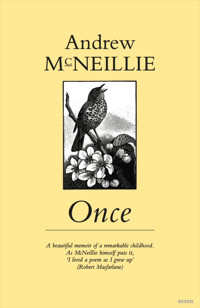
Once is the journey from boyhood to the threshold of manhood of poet Andrew McNeillie. From an aeroplane crossing north Wales the middle-aged writer looks down on the countryside of his childhood and recalls an almost fabulous world now lost to him. Ordinary daily life and education in Llandudno shortly after the war are set against an extraordinary life lived close to nature in some of the wilder parts of Snowdonia. Continually crossing the border between town and country, a fly-fisherman by the age of ten, McNeillie relives his life in nature during a period of increasing urbanisation. Once is a beautifully written eulogy for a retreating countryside now valued more for its leisure potential than as a repository of nature and source of human fullfilment. The narrative is underlain by a way of thinking informed by the natural world and by nature poetry, and is an evocative and memorable book about the nature of experience of memory and writing.
Das E-Book können Sie in Legimi-Apps oder einer beliebigen App lesen, die das folgende Format unterstützen:
Seitenzahl: 300
Veröffentlichungsjahr: 2009
Ähnliche



















forAnna-Mae & Isabelle
Once
Andrew McNeillie
Seren is the book imprint ofPoetry Wales Press Ltd Nolton Street, Bridgend, Wales
www.serenbooks.com
© Andrew McNeillie, 2009
The right of Andrew McNeillie to be identified as the Author of this Work has been asserted in accordance with the Copyright, Designs and Patents Act, 1988.
ISBN 978-1-85411-637-6
A CIP record for this title is available from the British Library
All rights reserved. No part of this publication may be reproduced, stored in a retrieval system, or transmitted at any time or by any means electronic, mechanical, photocopying, recording or otherwise without the prior permission of the copyright holders.
Ebooks conversion by Caleb Woodbridge
The publisher works with the financial assistance of the Welsh Books Council
He that observeth the wind shall not sow; and he that regardeth the clouds shall not reap.
Ecclesiastes
Tu te rappellera la beauté des caresses...
Charles Baudelaire
The Known World
The plane came out at the mouth of the Dee before turning west for Ireland. As soon as I saw the black river, at its dissolution in the Irish Sea, on such a clear winter’s day, I had mentally to blink twice to be sure I could trust my eyes. No, it was not for a minute the murky Mersey, it was the dark-hearted Dee, the black Welsh river far dearer to my heart.
As to my heart, I could only find further warm pleasure in the fact that I flew aboard a plane of the Aer Arann line, my destination Galway. ‘Arann’ here refers to the ‘Aran’ Islands, at the mouth of Galway Bay, where, on Inis Mór, I lived for all but a year in my young manhood, a story to which this is the belated prequel.
The thought made me remember how in my youth I had loved to dream over the map of Britain and Ireland. I relished coastlines and rivers most, estuaries, islands, peninsulas, capes, headlands, bays and inlets. I loved them in outline and I loved the words for them. What is called the littoral, life at the margins, and its lexicon, enchanted me, seduced me. The sight of a harbour with fishing boats and the glimpsed lives of those aboard them chastened me especially. Perhaps I should have gone to sea. Whatever I am, I’m sure I should not have become what I am. Not at least without the great good fortune of having been born and brought up beside the Irish Sea in post-war North Wales, with a writer for a father.
As I flew I remembered a similar flight to Ireland made when I was four. An unusual event in our lives, it was afforded by a book by my father calledNo Resting Place, subsequently filmed in Co. Wicklow, by Paul Rotha, with Abbey and Gate Theatre players. The mental footage of that journey reeled in my mind now. Here I was in its slipstream, physically, ghosting my childish progress in both body and mind. My former embodiment had flown aboard a Dakota, from Speke to Dublin. That was on another bright day in 1951, late July, like this one in February 2006, free of muffling cotton-wool cloud.
There’s nothing like an aerial view for showing how fleeting life is, local and lost. The earth literally slips away before our eyes, after our eyes, into our wake. The earth abides forever says the text. But what remembrance of former things is there between generations? Houses rise and fall. Roads come and go. Families die out. Land is consumed by settlement. Villages grow into towns. Rivers are diverted or dammed. Valleys and worlds are drowned. (Cofiwch Dryweryn reads the famous slogan by the road, the most famous slogan in Wales: Remember Tryweryn, the drowned village.) What do our individual labours and endeavours amount to, and our great passions, sorrows, loves and fears, our brave adventures, our little obscure lives, our moments of courage? Don’t even mention our pettinesses and vices. Even if we seize the day? And who in reality seizes the day but the day seizes first?
What I write here now, if it sees the light of day, being too soon starved of readers will perish on the air like the May-fly under the alder, where the Dee runs dark as the Styx, beneath brooding Welsh clouds. Yet the printed word once hatched has power of survival second only to the stones. I put my faith in it, against all prospect of disaster. I put my faith in the word. The word made gooseflesh, tingling with remembrance, joy and sorrow, the soul made flesh, grounded in the world. We must make a virtue of what we do when it is plainly not a vice. What else? When we can do no other?
The printed words you’re about to read are a relief map of my mind, of the known world, as I knew it once and as I see its lineaments now. I call the sum of them my ideal legendary story. Don’t look here for date and fact and mere sequence of events. This is no curriculum vitae. Nor is it anything approaching such a godforsaken thing, such a travesty of being. (As the poet Les Murray revising theBook of Common Prayerhas put it: ‘In the midst of life, we are in employment’. As I would have added in my youth, in the midst of life we are in education.)
The view from the plane reminded me of co-ordinates that mesmerised me in my boyhood and youth beyond reason: triangulations, between the Red Wood, the Black Lake, the Wooded Hill, and places farther afield. Travel directly west on the same line of latitude as the Wooded Hill, with just a little latitude, and you’ll come to Inis Mór: another limestone territory too. Go no less directly north across the Irish Sea and you’ll reach the Ancient Kingdom of Galloway – Little Ireland – whence McNeillies derive.
How I loved to dream awake along those rectilinear lines. They were lines in a poem. They were my heart’s armature. They defined and structured my legendary and imaginative territory. They entranced me and filled me with longing to adventure, to leave, to go the longest way round to come the shortest way home. Now I recalled, as we flew over Llandudno (which takes its water supply from the Black Lake), how in the old grammar school there (recent rubble rebuilt on now), in the sixth form, I had become infatuated by Charles Baudelaire’s poetry of the voyage. His lines that tell of the child who loves maps and prints, lines that exclaim how big the world is by the sharp light of a reading lamp, could themselves delay me for minutes on end, in a kind of melancholy distraction. Don’t ask me why. Passions can’t be explained. We come into the world as we are. My siblings haven’t lived as I have done, remotely. Nor have they lived like each other.
Now, on this day, how small was the world from the air, how big it loomed in memory, how much detail and incident swarmed around that coast, those toy headlands and seaboard hills and limestone bluffs, woods, rivers and mountains, the territory of the Red Wood and seven tiny miles west of it, the Wooded Hill. My mind zoomed in and out, not just from my literal vantage point, in mid-air, but from another world and being, a world of other knowledges amassed and distances travelled without resting place, by one then nearly a sixty-year stranger: how many times removed? But still, for all that, I was unforgetting and vitally grounded there, though time is unforgiving. My mind’s eye still searched there, compulsive in its quest, and my pulse quickened at sight and thought of that childhood country by the Irish Sea, the plot and ground of my first story. As I looked down on it, I saw it all in detail, in a myriad flashbacks. I saw at once how I’d write it, as a triptych comprising: The Red Wood, The Black Lake, and The Wooded Hill. Just as you may read it now, if you please.
The Red Wood
Lunch-hour was announced to our stretch of coast by a wartime siren sounding the all-clear. Not that it hadn’t all been clear for some time now, along that coast over which you have just flown, surveying the known world.
These were the late forties and early fifties. The war was over. But nothing begins or ends at once. The war still pervaded our lives. We were the fruits of its supposed cessation, we children in our boom year. It left some of our number with mothers only. One or two of us, seeming fatherless, were said to be half American, for our trouble. Here was one, they said, in the language of that era, with a touch of the tar brush. Though we thought nothing of that. Except I remember fascination, as to darker skin that darkened to brown in the summer, not freckled and tinder-quick to scorch red and peel, like my own epidermis.
A great horde of children we were, spawned in careless hope and joy at last, to fill the village with vigorous new life.
* * *
That siren wailing from Laundry Hill, on the outskirts of the Bay, seemed to make your tummy rumble, it was so well timed. The workers at the laundry dispersed home. A mile or so away in Pa D’s Primary we must wait a little longer for a second all-clear, the school bell, a large hand-bell shaken along the corridor. But the siren whetted our appetites and primed us.
Now, when I think back to it, among the many echoes in my mind from wartime news footage, blitz-time movies and so on, the eerie siren-noise feels like the key to Belsen, shutter-gate to a hell of harrowing reels of celluloid... wailing, wailing... to a hell that had been visited on my parents’ generation, all over Europe. But we took the Laundry Hill siren in our childish stride. It was just a normal part of daily life, blaring out, winding itself up and winding itself down, an inhalation and a sigh, to let us know lunch wasn’t far away.
I suppose it was half-a-mile or so, for me, downhill and over Colwyn stream in Llawr Pentre. Then uphill I’d hurry past the terraced houses of Pen-y-Bryn and Edwards-the-blacksmith and horse-dealer’s forge, and round the back of Ratcliffe’s Engineering Works through the Fairy Glen, past Willy Winky the gardener’s shed, across the little stream and through among the trees and shrubs, to ‘Thornfield’ on the Red Wood road. A place of cackling jackdaws and whistling songbirds and whisper and rush of Colwyn stream from the bosky Denbighshire back country.
At ‘Thornfield’, ‘Workers’ Playtime’ would be on the Wireless, or ‘Have a Go’ (‘Give him the money, Mabel’), and the News, read in a patrician voice that spoke from London. What a world it was in which only the lower classes had accents. Know your place. Hence the Elocution Lesson. As my sister knew, being surely one of the last girls in Wales to graduate in received pronunciation, at the end of an era. As I knew, corrected by my parents when, deliberately erring to test them, I’d pronounce ‘lorry’ as ‘lurry’, in the local manner.
Even as a young child I tried them consciously. I resented keeping two worlds between home and the Red Wood road. The idea was, I suppose, for us all to sound like news readers or those women who sold cake-mixes or appliances, the first white goods, on the first television adverts, obscure relations of the queen of England, but sexually charged, as queerly they were. A strange world indeed, and yet it was a shadow of what it had been fifty years before, before both wars. Tug your forelock if you please. Know your betters.
Not that I don’t know mine. How can you put pen to paper and not? How can you read the great writings spawned in our unnameable archipelago and not know your place? You are not on time’s radar. Believe me, but give voice, as the songbird does careless of its doom.
But still, look sharp… it’s 1953. Here comes Captain Miller with his pepper and salt moustache, and all the men on the road, one way or another, touching their hats or caps to my mother. Here’s Mr Edwards the quarryman upright as a sledgehammer shaft, in his Sunday black bowler off to Church (Church in Wales). A nod and gesture with one hand at the rim. Look lively… ‘A peach’ the men at Ratcliffe’s called her.
There must have been a day when the lunchtime siren wailed no more. But I don’t remember it. Nor do I know when, if ever, as a small child, I connected its haunting cry with the war, the war that also marked our lives in other ways: rationing of meat, butter, eggs, sugar, soap... sweets... other essentials, in our ‘Food Control Area’. Covered lorries in convoy trundled through the village. National Service soldiers in the back of them wolf-whistled at my mother, on their way to Kinmel Camp. Snub Meteors and box-like De Havilland jet planes soared greyly across the cold-war sky above. Now and then on a fine day we might see an Atomic cloud, mushroom beyond Pentr’uchaf or above the schoolyard, or out at sea, and pretend the end of the world was coming our way. Take a deep breath. Climb inside a brown paper-bag.... It was no age of innocence, but we at least possessed the innocence of childhood, happily murky with sin though we were, from the day we were born, in Calvinistic Wales.
What else could we be? ‘Give us asws,’ said Gwyneth to me, and I knew why I loved her chestnut hair, her cool white cheek, and something in me stirring, to record that moment in my head for ever. Give her a kiss? We were with our mothers. I didn’t want to, and I did.
We had no television in our house while we lived in the village, all the first thirteen years of my life that is, and we went to the pictures rarely, perhaps once every school holiday, or twice in summer. This made the local picture-houses – The Odeon, The Cosy, The Supreme – all the more places of romance and allure. (Not to forget the pastoral Arcadia where, one season, the new-sprung Teddy Boys ripped up seats and scandalised the citizenry, in a wild Presley frenzy, about ‘Jailhouse Rock’, was it? I think so.) Not having television at home turned watching ‘The Cisco Kid’ and ‘The Lone Ranger’ at my best friend Dick’s house into stolen delight cut short, to be home in time for tea, six doors down the road.
What other trespasses and scrapes too there were to be had with Dick, whose family owned a butcher’s shop: Dick and his mongrel cur Rinty, the most marvellous of mates, nervous as a bird, brave as a lion, and fit as a butcher’s dog. Together we did things ‘Thornfield’ wouldn’t have conscienced for a minute, building and maintaining an underground trench at the top end of their terrace, with a fire, and no smoke without one, and Woodbines to cough over and Player’s Weights, cooking twists of flour and water.
Fearless, we’d drag sheets of corrugated iron, old carpets and linoleum scrounged from the tip at Fairmount, down the Muddy Path (past Captain Miller’s allotment), and on up the Red Wood road, beyond ‘Thornfield’, to Dick’s nameless house, to make our subterranean hide-away. There his mother turned a blind eye. She even dished up custom-made chipolatas to sustain us, out of a black and spitting frying pan, dark and rich sausages, full of meat, of a kind you could never buy over the counter, homemade for the family. Unless we drove her into a fury, as we did when we stole a bag of cement from the coal hole, with a view to making our trench a more robust and permanent fixture. The bag tore before we could lug it a couple of steps up out of the yard and cement powder went everywhere to betray us, blowing onto the washing, cementing our fate.
As to sausages, you never even dreamt of their like, with Daddy’s or HP sauce. And no baked beans, as Dick, being too polite to say he didn’t like them, once secreted into his trouser pocket, during tea at ‘Thornfield’. He did so by a sleight of hand so deft as to remain to this day a marvel of the known world. Yet he never received the credit he was due. Unlike his sister who could eat a cream cracker without making a crumb. As their mother liked to say, by way of reproaching her son. How do you get baked beans-on-toast into your trouser pocket – short trousers, plump legs, tight pockets – while sitting at the table in full sight of everyone, without leaving a trace of sauce anywhere? By dint of genius.
And there’d be jelly-sponge for tea of inimitable flavour, and sloppy blancmange by the bucket. Dick’s mother insisted on bringing blancmange down the road to ‘Thornfield’, in a big bowl covered with a dish-cloth, to shovel into Dick when he came to tea. She brought a tablespoon with her for the job. There Dick would sit being crammed with pink blancmange like apaté de foie-grasgoose fattening for the slaughter.
You might one day expect to see him displayed in the window at the shop, all gooseflesh. ‘Ripe young boy – home-killed. 1s 6d a pound.’ ‘Paté de blancmange. 2s a pot.’ Undaunted by our mother, his mother stood over him, in her wrap-around floral apron (in summer), or her broad-belted brown gaberdine (in winter wind and rain), to the last mouthful. Just so one day she brought an ugly old hedgehog on a shovel to show my mother the new family pet. It was a world, full of eccentricity, of ordinary folk and simpletons and oddities, and community.
There was, for a sublime example, the lady who whistled through her teeth. Every time she spoke, she whistled, like a twittering canary. We were once in the queue behind her at Trelevan Jones the baker. She had a cardboard box on the counter containing a large order of loaves. ‘What’s in the box? What’s in the box?’ I demanded loudly of my mother every time the lady whistled. Each time I asked Mrs Whitworth serving the canary-woman died of trying not to laugh. ‘What’s in the box?’ I was convinced it was a canary. My grandad had a canary called Hamish. I knew what canaries sounded like. ‘Shush! Shush!’ said my mother, bending confidentially, and ‘SHUSH!’ for all to hear.
There was Alan in the terrace just below Ratcliffe’s. He stood in the window all day knitting a scarf from a ball of wool that tumbled slowly as it unwound in a tall glass vase. How longwasthat scarf, where did it wind to in Alan’s head? Up into the attic or the boxroom, like an anaconda, taking over the house. He seemed to have no other sense of time passing than the slow unwinding of a ball of wool.
While Sam Cook has it on his hands, and all the dirt of ages. Sam is Dick’s nextdoor neighbour, and Alan-the-knitting’s chaperone. He gives Alan his daily constitutional, an act of simple kindness. Sam owns houses on Beach Road. Rentier, rent-collector, and great unwashed, he’s a short round man in a peaked cap and national health specs, with a moustache like a tired yard-brush and finger-nails like a badger’s.
Don’t let him give you a sugared almond out of his coat pocket. It’s been there since before the war. Or that apple. Watch your mother snatch it away, with a set smile, before it gets to your lips. But if you are dutiful in pursuit of sixpence, go and sit an hour with Miss Cook, Sam’s bedridden sister, and suffer her to teach you how to knit ‘pan-scrubs’ (pronounced with a strong Northern English accent), out of a wool wound with a fine wire.
What’s the time? Only two minutes older than when you wondered last. Oh the sickly sweet smell of a bedridden body in a white mop cap and a shawl. Oh the race down the road after, clearing your lungs of mothballs and disinfectant, and the smell of fish and chips from Oldham’s to greet you, and a waft of beer from the Ship nextdoor, the salt sea blowing beyond Min-y-Don, and the Emerald Isle Express snorting steam and soot, rattling along, laden with Irishmen, bound for Holyhead or Euston, the fireman in his shiny peaked cap, waving, as if it was all a novelty. For so life seemed.
If not at the pictures, where else might I have heard the siren, whether the air-raid warning or all-clear, except, perhaps, on the radio? Maybe parents explained or older children told us what it was. But I suspect no one told anyone. It was on the air we breathed. Yet I know, to me, it was the all-clear, not the air-raid warning. As who would need warning of lunch, unless they took school dinners? To be clear to go was what I wanted, back into momentary freedom, however fleeting; and fleet-of-foot I’d run to make the most of it, home to ‘Thornfield’, our damp little, narrow little three-bedroom semi with its short backyard and long steep garden terraced high above it, from which you could see the tops of the trees in the Fairy Glen, across the Red Wood road below.
But how keen I’d been to surrender my freedom to the prison-house of Pa-D’s Primary. I suppose I adored my sister, or else envied her, or was merely very foolish and didn’t know myself by heart. At any rate, when she went to school I missed her, and I thought I should go with her too. I began to clamour to go to school. As seems incredible now, to one for whom school days were ever and always the worst days of my life, early and late, kow-towing to petty authority, learning things I never needed to know and not learning things I did, the history of an education for most of the population. But I didn’t want to be left at home. I thought I was missing out. (There’s one born every minute.)
So an arrangement was made and I was allowed to go. I started school in my fourth year, the due age being five. But it was a disaster, even in the shelter of the beginning infants. I could not bear it. It seemed I was a very nervous infant, not cut out for a career in the infantry. What’s more I was an embarrassment to my sister. She had to stand and hold my hand in the playground, waiting for the bell (ask not for whom it tolls: it tolled for me), where the infants ran on the girls’ side of the hall. For boys and girls were otherwise segregated at play. This was not a good start for a boy, a damaging legacy, a telling indicator?
I’d got ‘run down’ as they used to say, in that now distant world of Cod Liver Oil, Radio Malt, Virol, Minidex, and other proprietary medications, intended to put iron in the soul, treatments so numerous that being ‘run down’ must have been a national pastime in those days. In my case it was to do with nerves, the nervous system. I was ‘highly strung’ as they still say of horses and used to say of children. I suppose this would be why Elliman’s Horse Rub or Universal Embrocation was also applied to me, from time to time, and other potions, on bits of greaseproof paper, on my chest, Wych-Hazel another I seem to remember, not to mention the consumption of Hot Toddy, my father’s dire all-purpose concoction that might have put me off whisky for life, had I been less the man I am. So much do I have to thank him for.
In response to the stress of encountering school, I developed a large scab on my bottom, as the polite expression was, necessitating sun-lamp treatment, at Dr Miller’s in the Bay. I remember the pleasant trips there to the West End on the top of the bus with my mother, and lying on the bed, under the big round Sun Lamp, and hearing my mother in another room, talking with Dr Miller, the family doctor, a Scot who drove a red Aston-Martin and between surgeries spent most of his time playing golf. Apart from my condition they’d perhaps be discussing my father’s latest psychosomatic tummy and self-prescribed fish-diet regimen.
I had to be withdrawn. School fell back below the horizon. But I knew it existed now, and what it was, in all its horror, even when I wasn’t looking at it. I was that much less innocent now. Time acquired new meaning, for it would run out. But however shadowed by experience, I had to return to the womb of home and discover myself again, in childhood’s dreamy world, digging for coal on the top terrace beyond the gooseberry patch, among the blackcurrants, driving dinky cars through the mud, flying little silver ‘Meteors’ and ‘Canberras’ at arm’s length across the sky, that manner of diversion, or sailing to and fro on the swing, all the world below me, dreaming along. I liked my own company but I had a convivial sense of fun too and knew a joke when I spotted one. (When I burped at table, ‘just testing my brakes’ I’d declare. Oh the age of the motor car....)
Once, up there at the top of the garden, I heard my father in conversation with Stan Valentine over the hedge. Stan was the black-sheep brother of the great Welsh Nationalist Lewis Valentine. It was said that as an infant he was so wilful his mother threw him to the end of the bed. Whatever that meant. Welsh was his first language. He liked to say in exclamation, ‘Well, I’ll go to the foot of our stairs!’ He was this day sprinkling thick black soot from the chimney round his gooseberry bushes, to deter slugs and snails. My father, playing gooseberry to his neighbour’s peace and quiet, was interested.
‘Let me have some,’ he said, ‘I’ll sprinkle a little on myself.’
At which, as if hand over mouth not to laugh aloud, I tripped rapidly down the steep concrete steps (how many, 39? – dozens and dozens, anyway it always seemed) wellingtons flapping, to tell my mother, about my father, the thought of him sprinkling soot over himself too much to bear. Humorous in my way I was, but also it seems nervous and prone to stresses and anxieties.
Not I think that I was especially sickly, not in any romantic way, you understand, as might have been interesting. But writing about this faltering exposure to schooling reminds me quite strongly of unlocated spells spent ‘ill’ at home at ‘Thornfield’, long afternoons, for some reason in my parents’ bed, presumably for the view that my little back room didn’t have, staring at the bare wintry tree-tops in the Glen, listening to the homely cackling of the jackdaws, on long interminable afternoons, pricking up my ears at hearing Mr James with his pony and trap come down the road at a trot, carrying milk churns to the dairy, from Pentr’uchaf.
I’d shoot out of bed when I heard the hooves and watch him go. He was a man you’d know now as one straight out of R.S. Thomas’s early poems, a Lloyd George thatch of grey hair under his tilted cap, old trench-coat tied at the waist with regulatory binder twine. He was Iago Prytherch. I’d seen him up at the farm when I went to play with the Roberts brothers, red-haired Welsh boys in Red Wood country, and to lean over the sty to see and get a closer whiff of themochyns.
Or it would be Hughie Bach, the casual farmhand, with the emphasis on casual, staggering up from the Ship. Drunk as a lord he’d struggle along, heading for the hills, for whichever farm outbuilding he spent his nights in. You’d hear him singing, or calling out, and he was a sight to watch, trying to snatch his cap up from the reeling road, singing in Welsh, earth of the earth. He made you nervous if you met him on his way but he was harmless they said, with quick but gentle hazel eyes. It always intrigued me what kind of being he was, another one who wore a belt of binder twine. A character they said, a rogue, handing his way up the road by means of the Glen railings, rolling and pitching, slumping, as if still aboard the Ship and the Ship at sea in wild weather.
During the war Hughie once tried to sell my parents a stolen goose from under his coat at the door. ‘Iss a fine goose,’ he said, flashing it out from the skirt of his coat. But they were having none of it. They knew whose goose it was. The story of his crime had run ahead of him and lay in wait to send him ‘down the line’ for a spell in Liverpool’s Walton Jail. Another time he took my father for a ride, up in the back lanes after nightfall, near Llanelian, selling him a sack of black-market mud and stones, with just a foot of so of potatoes on top for good luck. Sometimes on a wet day you’d see him in a hood improvised from a sack, one corner poked into the other, with the rest of the sack hanging behind, keeping his shoulders dry. He always made you think of the earth, smell the earth when you saw him.
I was once brought to a sudden halt running in the Glen when round the corner I came face to face with Hughie Bach’s arse, as he bent double to relieve himself, barely screened by a laurel, trousers round his knees. I doubt you ever saw anyone turn whiter in the face, whiter than Hughie’s grey-pink arse, for sure, or beat a hastier retreat than I did that afternoon.
Or else it was the clopping laundry van, from Laundry Hill. For there were people in our lower middle-class ranks who used the services of the laundry. A sometime Lord Mayor, Mr Dunwell, Royal Welch Fusilier veteran of the Great War, lived two doors down, a Yorkshireman by birth. And there was Captain Miller, risen from the ranks, still further down, with his very pretty wife ‘like an actress’, and the Isherwoods, the McCleans and Miss Burke. These were people of standing, you’d think, but no one thought so, unless themselves. Mr McClean was a retired solicitor. He knew eminent men in London, just a little perhaps. The Isherwoods went into formal mourning, and closed their curtains, when the King died (as the entire road did for any neighbour’s funeral). Yet young Miss Isherwood would collect bets from Walter Price, always at night, in a huddle at the front door, for a book someone kept, perhaps her mother or her dad? Or was she placing them?
‘Have you heard the news?’ What was it? ‘The King is dead!’ she whispered to my mother, in loud reverence, on the Abergele Road, and the man barely cold in his winding sheet.
The horse age had now all but become the race-horse age. But my father knew working horses and had worked with them, had driven a pony and trap, as a matter of course. It was a horse, the red horse Fox, from Bill Davies’s stables in the uplands of the Bay, that nearly brought my story to an early close, at the tender age of nine. Fox bolted with me one Saturday morning, onto a metalled road and after about a quarter of a mile, off I came, knocking myself spark out against the bottom of a lamp post. The people who found me knew me and brought me home concussed and semi-conscious. I remember coming round and being sick into the sink all over the washing-up. Everyone on the Red Wood Road knew about it before I got home, from Dick and from my sister. Was I dead? Would I live?
Perhaps it was the protracted convalescence from this concussive episode and the resulting great span of time off school that makes those afternoons in my parents’ bed seem both numerous and haunting, lying there listening out for the now nightmare tattoo of hoof-beats, gazing into the wintry sky, that was always so buoyant, because of the sea nearby. The sea ran not much more than half a mile away from our door, the white-horse sea. It would flood my mind forever, as a prospect of elsewhere, a restless realm of tides and skies and light, its light always there, in our daily lives, conditioning us, whoever we were, whatever our capacity for dreaming. Neptune tapped a rock and up sprang a horse. I saw the sea and my heart rode away. So it rides now at the drop of a hat, not for escape, but for respite.
Mr Edwards the smith (whose wife once described my father as ‘very athletic’, mystifying us forever) was largely a wrought-iron and an agricultural repair man now. But he shod horses still, and he rounded wild ponies up and held them, at the back end of the year, corralled at the old mill, to what end, I don’t know. (The Belgian meat market they said at Price the Butcher.) One misty morning I remember coming up early from the shore by Pen-y-Bryn and seeing what seemed like hundreds of wild ponies off the moor herded together there. The uncommon mist that shrouded the village must have magnified my sense of their number. They stood shoulder to shoulder, packed, crowding the yard and up the length of the track from the mill to the road.
I would have been twelve, going on thirteen at most the time I saw them. I’d been down fishing in the early morning, attending a nightline, digging bait, one or other, or all three. The ponies all rough and ragged seemed like an apparition, a ghostly vision, neither neighing nor whinnying, in the great, still silence of the mist. Some of them had hooves like hockey sticks, from being on the moor and mountainside, with no hard surface under them to keep their toes in shape. It’s a strange sight to see, a horse with all four hooves that way, like some mad attempt by Leonardo da Vinci to design a rocking horse or a mount for a horseback ball-game.
It might have been the tail-end of the horse age, but still there were very few cars in our world at that time. Only Mr Pierce and Ernie Thomas owned a car on our road at the start, and Mr Meredith (of Meredith & Kirkham garage, so he hardly counted). If I remember right, even by 1956 and Suez there only one or two more; Suez an event I recall, not of course as ‘Suez’ but as something worrying, like Hungary and dark night images on the television news, chez Dick.
I always associate Suez with a grave conversation that passed in the road between Mr Pierce and my father, about petrol rationing. Mr Pierce was peering under the bonnet of his black Ford Prefect, or was it a Poplar? – I don’t think a Pilot – a model on which the bonnet lifted and folded up from the side, as I recall, like a wing. How many horse power did it have? My father peered in with him as if to see. Then the two men stood up and talked, let’s suppose, as would be likely, something about Nasser, and Eden’s fallen world. What I do know is you’d have thought the end of the world was round the corner, running on empty, stuttering to a halt, the way Mr Pierce folded the bonnet down and closed the engine away, as if, it now seems to me, seeing him again in my mind’s eye, consigning the car to the scrapheap for eternity.




