


7,00 €
Mehr erfahren.
- Herausgeber: Garnet Publishing
- Kategorie: Sachliteratur, Reportagen, Biografien
- Sprache: Englisch
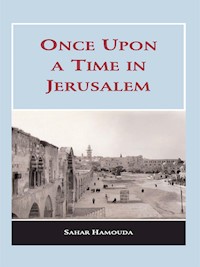
"Once Upon a Time in Jerusalem" tells the saga of a Palestinian family living in Jerusalem during the British mandate, and its fate in the diaspora following the establishment of the state of Israel in 1948. The story is told by two voices: a mother, who was a child in Jerusalem in the 1930s, and her daughter, who comments on her mother's narrative. The real hero of the narrative, however, is the family home in Old Jerusalem, which was built in the 15th century and which still stands today. Within its walls lived the various members of the extended family whose stories the narrative reveals: parents, children, stepmothers, stepsisters, aunts and uncles, nieces and cousins. This is no idealized, nostalgic narrative of perfect characters or an idyllic past, but a truthful rendition of family life under occupation, in a holy city that was conservative to the extreme. Against a backdrop of violence, much social history is revealed as an authoritarian father, a submissive mother, brothers who were resistance fighters, and an imaginative child struggled to lead a normal life among enemies. That became impossible in 1948, when the narrator, by then a young girl studying in Beirut, realized she could not go home. She traveled to Cairo, where she had to start a new life under difficult conditions, and reconcile herself to the idea of exile. Narrated in a terse, matter-of-fact tone, "Once Upon a Time in Jerusalem" is a bildungsroman in which the child is initiated into loss and despair, and a life about which little is known. The book shows a city of the 1930s from a new perspective: a cosmopolitan Jerusalem where people from all nations and faiths worshiped, married and lived together, until such co-existence came to an end and a new order was enforced.
Das E-Book können Sie in Legimi-Apps oder einer beliebigen App lesen, die das folgende Format unterstützen:
Veröffentlichungsjahr: 2012
Ähnliche



















ONCE UPON A TIME IN JERUSALEM
SAHAR HAMOUDA
Garnet
PUBLISHING
ONCE UPON A TIME IN JERUSALEM
Published by Garnet Publishing Limited 8 Southern Court South Street Reading RG1 4QS UK
www.garnetpublishing.co.ukwww.twitter.com/Garnetpubwww.facebook.com/Garnetpubwww.garnetpub.wordpress.com
Copyright © Sahar Hamouda, 2010
All rights reserved. No part of this book may be reproduced in any form or by any electronic or mechanical means, including information storage and retrieval systems, without permission in writing from the publisher, except by a reviewer who may quote brief passages in a review.
First Edition
ISBN-13: 978-1-85964-323-5
British Library Cataloguing-in-Publication Data A catalogue record for this book is available from the British Library
Typeset by Samantha BardenJacket design by David RoseCover photo used courtesy of Mohamed al Fitiani
All pictures used courtesy of the author except p. 31 (bottom) used courtesy of the Library of Congress Prints and Photographs Division, LC-DIG-matpc-05898; and p. 32 (bottom) used courtesy of the Library of Congress Prints and Photographs Division, LC-USZ62-104817
Contents
Preface
Acknowledgements
1 A Jerusalem Home: Dar al Fitiani
2 Family Life
3 Sharing Jerusalem with the British
4 The Nakba
5 Living in the Diaspora
Sources
Glossary
Al Fitiani Genealogy
Al Fitiani Family Tree
Preface
This book was written by many people, just as Dar al Fitiani itself housed many people. They all go into the narrative and the house, for in this case the house is the narrative.
My mother’s tales about her house in Old Jerusalem have always been an integral part of my life. She never told me fairy tales, or any kind of tales, nor is she a good storyteller in the least. But throughout my childhood and well into my adulthood – to this very day, in fact – the stories she told and retold about her family and those stone walls that enclosed them were the only food with which she supplied my imagination. Though I am separated by borders and barbed wire from that land which her soul still inhabits, I have grown to know and love it, for I see it through her eyes and feel it with her passion.
I decided to write this book while I was teaching in Beirut in 1996 to 2000. A number of my students were originally Palestinians, but they didn’t know which villages they came from, or anything about their parents’ or grandparents’ lives in the country they had been forced to leave. They had no Palestinian past, only a Lebanese present. What a contrast to my own case, in which Palestine lived in every corner of our house and minds. I therefore decided to document my mother’s stories, hoping to encourage others to preserve their past, and not let their family history be washed away by the daily business of living, for it is the small stories of our inconsequential lives that make up the larger mosaic of country and history and monumental past.
I spent many hours in libraries and bookshops, trying to collect the material I needed. I knew my book wasn’t a history book on Palestine, or a political book about the loss of Palestine, but a social document of one family living before the nakba of 1948: ordinary people leading extraordinary lives as the forces of history crashed upon their world and brought it to an end forever. I tried to discover names and dates and details with which I could fill the gaps in my mother’s narrative, which was vague and full of explanations such as “I was very young” – touching enough for me, perhaps, but not satisfying for the reader. I tried to find the details that a reader would be looking for: which year an event took place, for instance, or the history of a site. I managed to find only a little. And so I gave up. The book will therefore remain what it set out to be, a recording of my mother’s memory. If I have failed to substantiate it with published evidence and hard facts, I have also succeeded in enriching it with the memories of other members of the family, who inhabited the house or belonged to it in one way or another – Fitianis through either the mother or the father. I am therefore grateful to all of them, for believing in the project, for being as excited about it as I have been over the last ten years, and for being generous with their memories or photos or whatever they could give me. The book belongs to all of us. It is narrated in two voices: my mother is the main narrator, while I comment in italics on her narrative, or provide extra information.
I have been faithful to the stories, whether those I collected from my own reservoir or those I was given by the other members of the family. In only one case did I favour art over reality. After I had written the part about my uncle Abdel Salam’s obsession with clocks and watches, I was told that it was my grandfather who was the one who was constantly tinkering with them, not my uncle. However, the piece read better that way, so I kept it as it was. History will not be altered by that small detail. For I know that my grandfather and my uncle, whom I have never met, will forgive me this small trespass, because my only intention has been to be true to the spirit of the place they loved with such fire, and in which they both spent their last moments on earth.
Should I apologize because the book is so short? But then, my uncle Abdel Salam died young, and nobody apologized for his short life. And my family’s life in their home and country was cut short, and nobody apologized for that either. No, there will be no apologies, for the length of the book reflects the brevity of the time my mother spent in her home and the paucity of memories she had time to collect there: memories I have tried to preserve, so that the wave of amnesia and oblivion that is carrying off our younger generation will pass harmlessly over our ancestral home and leave it standing as proudly as it has done for the last 400 years.
Acknowledgements
For sharing memories and information with me, I am grateful to Abdel Hamid al Fitiani, Adla Fitiani, Ghada Fitiani, Hassan Dajani, Hiyam Dajani and Moftieh Fitiani. For supplying me with photos and permission to publish them, I am grateful to Abdel Hamid al Fitiani, Adla Fitiani, Hassan Dajani, Hiyam Dajani, Khadijeh Hedayeh and Mohamed al Fitiani. I am indebted to Mai Fitiani and Hani al Fitiani for providing me with the Saudi genealogy of the family, and for Wegdan Hussein for translating it into English and commenting on it.
I would also like to thank Dan Nunn and Cathy Costain for believing in the book and giving me the opportunity to publish it.
Finally, I dedicate this book to my mother. She is truly an angel among humans.
1 A Jerusalem Home: Dar al Fitiani
“All happy families are alike but an unhappy family is unhappy after its own fashion.”1 Humbly, I beg to differ. How can happy families be alike or happy in the same fashion? Take my mother for example. She was beaten by various members of her family. There was a twenty year difference between her and her youngest sibling. It was a respectable but not particularly wealthy household. They froze in the winter snow and used pigeon quills for knitting. If she wanted to visit the bathroom at night, she had to walk long, drafty, scary corridors and descend endless stairs in the dark, for light was not wantonly provided. In addition, there were British soldiers to be reckoned with, soldiers who would arrive in the small hours of the morning to look for her rebel brothers, prodding the children and womenfolk of the house with the butts of their guns and filling hearts with fear. Sociologists, anthropologists and psychologists would find in her narratives a veritable orgy of material for the analysis of troubled psychology: an abused childhood, traumatic experiences, family relationships, power relations, oppressed women, primitive practices and lots of isms. Total rubbish as far as my mother is concerned. She thinks of her childhood as having been idyllic. She’d happily lop off twenty years of her life to go back. Not specifically to family life, but to her home.
Lesen Sie weiter in der vollständigen Ausgabe!
Lesen Sie weiter in der vollständigen Ausgabe!
Lesen Sie weiter in der vollständigen Ausgabe!
Lesen Sie weiter in der vollständigen Ausgabe!
Lesen Sie weiter in der vollständigen Ausgabe!
Lesen Sie weiter in der vollständigen Ausgabe!
Lesen Sie weiter in der vollständigen Ausgabe!
Lesen Sie weiter in der vollständigen Ausgabe!




