


Erhalten Sie Zugang zu diesem und mehr als 300000 Büchern ab EUR 5,99 monatlich.
- Herausgeber: Umbria Press
- Kategorie: Sachliteratur, Reportagen, Biografien
- Sprache: Englisch
Giles and Esmond Romilly were the nephews of Winston Churchill and Giles Romilly married Jessica (Decca) Mitford, one of the notorious Mitford girls. They both attended traditional Wellington College, where they rebelled against the military and disciplinary traditions of the time. There was fear that this august school was subject to the corrupting influence of Moscow, as the Romilly brothers produced a left-wing magazine entitled Out of Bounds: Public Schools' Journal Against Fascism, Militarism and Reaction. Several issues appeared and then Esmond ran away from school to work in a Communist bookshop, causing sensational headlines and adverse publicity. Giles, although a rebel, stayed on. This is the story of their schooldays, first at Newlands and then at Wellington, which was first published in 1935 and has been out of print for many years. They recount the story of their early years and their rebellion with skill and panache. Out of Bounds shows the authors political thoughts and beliefs and serves as a moving picture of the struggle against the education, politics and social mores of the 1930s. There will be an foreword by Edmund Romilly, Giles' son and an afterword from Dr Patrick Mileham, the archivist of Wellington College and a distinguished author.
Sie lesen das E-Book in den Legimi-Apps auf:
Seitenzahl: 360
Veröffentlichungsjahr: 2021
Das E-Book (TTS) können Sie hören im Abo „Legimi Premium” in Legimi-Apps auf:
Ähnliche



















OUT OF BOUNDS
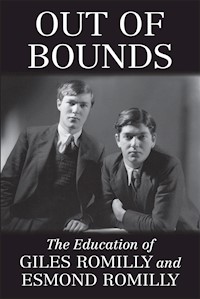
Photo of Esmond and Giles Romillyfor the first edition of Out of Bounds.
OUT OF BOUNDS
The Education ofGILES ROMILLY
and
ESMOND ROMILLY
© Copyright 2015the Estate of Giles Romilly
First published 1935
This edition published 2015 by Umbria Press
London SW15 5DP
www.umbriapress.co.uk
Printed by Ashford Colour Press, Gosport
Paperback ISBN: 978-1-910074-06-0
Ebook ISBN 978-1-910074-07-7
Contents
Acknowledgements
Foreword
PART I
1 Preparing
2 First Introduction
3 Learning
4 Conforming
5 Disgrace
6 Change
7 Defying
8 The Last Round
PART II
1 Tenderfoot
2 Politics
3 Two Worlds
4 Armistice
5 Happy Families
6 French Leave
7 Bloomsbury
8 Co-education
Afterword
Acknowledgements
The publishers would like to thank Edmund Romilly, Giles Romilly’s son, for his foreword and assistance in this new edition of Out Of Bounds; Patrick Mileham, author of Wellington College: The First 150 years, for his afterword, help with photographs and for his work in bringing the book into publication; Louise Millar for her design of the book and the cover; the Chittenden family for the illustrations and information on Newlands; and Wellington College and the archives for illustrations of the College.
Foreword
by Edmund Romilly
It was only comparatively recently that I gave this book my proper attention. Cowritten by my father Giles and his brother Esmond, (whom I never knew), I was struck by the quality of its prose – (as good as Orwell’s, in Giles’ case) – and the apparent maturity of the authors, who were very young at the time of its writing. Out of Bounds was first published by Hamish Hamilton in 1935, so Giles would have been 19 and Esmond 17.
Superstitiously, I was not given the name Esmond, Edmund being a near enough equivalent, because Giles did not want to be reminded too much of Esmond’s tragically early death in the early part of the Second World War. Giles worshipped his younger brother, and it must have been terrible for him to hear of his fate while he himself was interned at Colditz, the German prisoner-of-war camp. He wrote a fine poem about the loss of his brother. It is bitterly ironic to read in a letter Esmond wrote to his wife Jessica Mitford at the time, of his clear certainty that he would survive the war, because he was wrong about that. Nevertheless, for a long time afterwards, Giles told me that Decca – as Jessica was called – refused to believe that he was dead. She was perhaps justified in this refusal by the official report simply stating “missing, believed killed”.
I am not alone in wondering what would have happened to Esmond had he lived. Stephen Spender in his review of Kevin Ingram’s book Rebel: The Short Life of Esmond Romilly, suggests a political leader, general or business tycoon. My own feeling is that he would have become a highly successful, colourful if conscientious entrepreneur, in the Richard Branson mould. The sincerity of Giles’ and Esmond’s communism when they were young men is undoubted, but according to my mother most intelligent people in the 1930s who cared at all about the rife social inequality “in that low, dishonest decade”, were at the very least left wing. I think Esmond’s communism would have faded had he grown older, just as a lot of people’s political ideals do with age. Certainly, my own father Giles continued to vote Labour if he bothered to vote at all, but he made sure that while he was alive he and his family always travelled first class.
Esmond’s early life was checkered, and it is true that the many outstanding qualities that his contemporaries and others saw in him were counterbalanced by a perhaps equal aversion to his perceived shortcomings; Wellington College, as it comes across to me in Out of Bounds was in some senses a startlingly tolerant place, perhaps not inadequate as a breeding ground for an embryonic rebel - startling because, not having been there myself, and certainly not in the 1930s, I had always imagined it to be a fairly Spartan establishment, appropriate as a tutelage for those who would eventually join the army. Yet even when he was making most nuisance of himself, some of the staff at least were sympathetic to him, although perhaps in an ambivalent way. One master was heard to say, “Well, his father was in the Guards, so he should be all right”. As it happened, that turned out to be quite true: for when war came, Esmond immediately enlisted, (although he didn’t have to), and therefore to an extent put on hold his harsh criticisms of the British establishment, and buried them for the sake of a far greater hatred: that of Fascism.
How paradoxical his experiences in the Royal Canadian Air Force must have seemed to him when contrasted with those he endured in the three weeks he spent in a London County Council Remand Home, having been sent there by a beak at the insistence of his mother Nellie, when he was had up in the Magistrates’ Court for an episode of drunken criminal damage. This took place at night, at 15 Pimlico Road, the Romillys’ London home, when he should have been at school. (Philip Toynbee, his co-defendant, was merely fined ten shillings and sixpence, for the very technical reason that unlike Esmond he was classed as an adult). Esmond wrote an interesting, highly empathetic account of his time there, which so far as I know has never been published. Honest enough not to pretend to know the answers, he nevertheless deplored the treatment of other incarcerated teenagers, and deprecated the savagery of the remand home staff, and indeed the melting hypocrisy of visiting priests. He was particularly astute to note the shocking way in which a young prisoner would be taken off to the magistrates’ court to be sentenced, it being a welcome day out and break for him from dreary, pointless routine, only to return utterly crestfallen because he had been given three years. Esmond makes the point that three years is nothing to a fifty year-old beak, but seems more than a lifetime to a very young man. Fortunately however, Esmond fared better: he was allowed out on conditions, one of them being, it seems, that he go to Bedale’s, the progressive, co-educational boarding school. It is amusing to read the faintly damning, condescending assessment of him made by a “leading psycho-analyst”, commissioned and sent to the headmaster more as a warning than anything else. It refers to Esmond’s “normal intelligence with perhaps flashes of brilliances”, his “extraordinary political interests somewhat explosive in character” as being “not very deeply founded”; and in any case, opines the author, “I do not think his particular political ideas are of any interest in themselves”.
As brothers, Giles and Esmond couldn’t have been more different, apparently. Decca told me that Giles was “much more literary”, but that was obvious. It has to be said that my father was by far the more intellectually gifted of the two, a fact I’m sure Esmond would have appreciated but discounted, realising correctly that he had other qualities which Giles did not possess. The poet Stephen Spender was of the opinion that Giles’ talents far exceeded those required for journalism – which is again a statement of the obvious, I would think. But before I deal with Giles, let me mention a similarity between them which arises as a result of what I have said about Esmond: both had youthful criminal streaks. To my surprise, when staying with Bertram Romilly’s niece, Lady Pamela Wakeman for the last time before she died, she showed me a cutting from a newspaper which reported that Giles, too, had been had up in the Magistrates’ Court for possession of a loaded firearm. He pleaded guilty but his mitigation was that the gun was not his but he was merely keeping it for a friend, whose identity he would not disclose. After my surprise, I was amused: as a criminal defence barrister for many years I had often come across defences of that sort, usually in relation to prohibited drugs, but also to firearms and other dangerous items. When I was a child Giles showed me his father Bertram’s service revolver, which he carefully kept well-oiled and in working order, together with a box of ammunition, in an upper cabinet of his study. I don’t think my mother knew about this. As a short man, I think my father had a heightened fear of crowds, and would fantasise about forcing them back by brandishing a gun. Certainly, he was prone to claustrophobia: on one of his many failed attempts to escape from Colditz, (he eventually succeeded), he had hidden himself in a packing case which was to be shipped out of the castle; but when it arrived at the railway station, he thought he couldn’t breathe, panicked and forced his way out of it by means of a pocket knife he was carrying. And so was caught.
Alas, though Stephen Spender’s judgement of his talents was correct, Giles never really achieved the literary prestige which arguably was his due. He did enjoy a certain vogue after the war (in addition to that achieved before it with the publication of Out of Bounds) with his account of life as a member of the prominente at Colditz, entitled The Privileged Nightmare, co-written with the late Michael Alexander; with novels such as Christina Claimed; with journalism, reviews in literary magazines and appearances on The Critics’ Choice, and so on; if you look very carefully, you will find poems of his in anthologies compiled in the 1930s. But the trouble was, when he came back from Germany after the war he was in a state of some shock and was treated with barbituric acid, in those days a new drug whose malign, addictive features were little understood. My sister has told me that he had told her that the medics experimented upon him as if he were a guinea pig. He became addicted and, really, his whole life eventually revolved around the three sorts he was prescribed: drynamil, sodium amytal and nembutal.
He could not work (or sleep) without them, but he could not work properly with them, either. Matters were made worse by the fact that an array of expensive doctors, as it seems to me, were only too eager to provide him with the means of getting more and more of the pernicious things. My father was always an eccentric man, (he was most odd in his choice of gifts, for example: once providing a relative with a raw chicken as a wedding present; this was not during the years of rationing), which was a pity because his eccentricities had the effect of disguising the undoubted mental deterioration he was undergoing in the later years of his life. Had there been a clearer picture, alarm bells might have sounded, people alerted and something been done; as it was he died intestate, of an overdose at fifty years of age, in a hotel bedroom in Berkeley, California. He was in the company of his very recent second wife Coral, my stepmother, but she survived the suicide pact and was eventually certified insane. That was in 1967. I had just turned 16. One of his doctors had the effrontery to present a £40 bill to the administrators of his estate, for services in connection with the provision of the very things which had killed him. My recently published semi-autobiographical novel Victims deals with these and other matters more fully.
On which hopefully not too sombre note I do commend this new edition of Out of Bounds to the reader. It is a remarkable work, both for its time and I think for the future, for I am quite sure it has the qualities to endure. I also think that Alan Gordon Walker and Patrick Mileham are to be congratulated and thanked for facilitating this production on the occasion of the Wellington College anniversary.
EDMUND ROMILLYApril 2015
PART ONE
by
GILES ROMILLY
ONE
Preparing
THE first days of going to school are always memorable; every detail of preparation, departure, arrival, stands out clearly in the mind for years afterwards. I can remember no day so vividly as that on which I first went to Seacliffe School, Seaford, unless perhaps the first day at Wellington College, Berkshire. I can remember what kind of day it was—warm, and stuffy, like the inside of a taxicab—and what time I got up in the morning, and what I had for lunch. I remember the discomfort of my new flannel suit, with its short trousers, its waistcoat, and its Eton collar. I remember the slight sensation of nausea, contingent on clean clothes and trunks in the hall, and incessant running up and down stairs. I remember the napkin tucked into my collar at lunch to prevent me from slopping food over my new coat. I remember my mother checking up lists of clothes and writing out labels. I remember marking my own handkerchiefs in ink. Above all, I remember the hallucinated sense of unreality which prevented me from being absolutely depressed. As though I were having an operation, and things were being done to me which I had no power or will to resist.
We arrived some time in the early afternoon, drawing up in a large taxi before the front door. The Headmaster and his partner and his partner’s wife and sister were in the hall to meet us, and old world courtesy was in the air; my mother said afterwards that, whatever else Mr. Doberell might be, he was at least a “gentleman,” and this counted for a great deal in her eyes. The atmosphere was chintzy, with lots of anaemic watercolours on the walls, the voices of Mr. Doberell and his relations Edwardian and thin. Our conversation dribbled on for a few minutes, and then my mother and Esmond and I went out onto the big playing-field to play “catch” while the authorities stayed behind to entertain a new batch of arrivals.
While we were in the middle of our game (more unreality), an elegant boy in plus-fours stood near with a very rich-looking father; the boy drew from his inner pocket a sumptuous wallet, and immediately several notes changed hands. I think my pocket money amounted to five shillings; I felt very envious.
At last the moment came for my mother and Esmond to go; I felt terribly unhappy, and cried a good deal. As I turned back towards the front door, I wiped my eyes hurriedly. On the step I met a boy whose eyes seemed in a similarly suspicious condition. I asked him very timidly if he was a new boy; he said yes, was I? We told each other our name, and felt considerably happier, and remained together all the evening.
I had a tiny cubicle in what was called the Top Dormitory (the Bottom Dormitory was the senior); as far as I remember, it contained only a bed and a washstand, and I doubt if there would have been room for much else; wooden partitions divided it from identical cubicles on either side; the walls were varnished a bright olive green; there was no difficulty in climbing over from one cubicle to another. At seven o’clock I climbed into my creaky bed, and soon after the matron came round and drew our curtains and opened our windows and said goodnight. I cried in the dark, but as almost everybody else did the same, there was nothing particularly shameful in that. There were no cruel shouts of “Crybaby,” as my imagination had pictured, for everyone was too preoccupied with his own unhappiness, and I could safely indulge mine.
After the first shock of “going to school” I began to find that I did not altogether dislike Seacliffe. I made friends immediately with the other “new boys” and walked with them when one of the masters took us over the Downs or along the sea-front. We were happy in each other’s company, for we boasted incessantly of our parents’ enormous motor cars and vast estates, and of the wonderful times we had in the holidays. Our conversation consisted almost entirely of this imaginative boasting, the fashion for which was started by the elegant boy in plus-fours who had such a lot of pocket money; his father was a brandy merchant, a nouveau riche. The son himself was objectionably purse-proud, but we did not realize this at the time. We thought his descriptions of magnificence wonderful, and were exasperated into attempting more stupendous flights ourselves. But as his stories were at least founded on fact, we were always outdone.
Secondly, I was rather fond of the matron. She was an immense woman. Her face had a comical shapelessness, and her figure was like a sack in which everything has been shaken down to the bottom. The school had no need of an early morning bell, for when she moved the floorboards rang, and her “Good-morning!” was a thunder-clap that not even the heaviest sleeper could ignore. When she laughed she shook all over like a blancmange, and when she was cross she shook also. She called everyone “laddie”; you were either a “good laddie” or a “very naughty laddie.” After lunch she read aloud to the Top Dormitory in her sitting-room; John Buchan, or Percy Westerman, or Rider Haggard was usually the kind of author preferred. I remember arguing with her that I should never become a Boy Scout. “Of course you will, laddie. Everybody loves it,” she said.
But there were a certain number of incidental unpleasantnesses. First of all, the getting up early in the morning. At seven o’clock the matron thundered into the dormitory, and began her round of “Good-mornings” in deafening point-blank discharge. She was followed by a maid with an outsize jug of tepid water, from which our washbasins were filled. Then, after hastily washing our hands and faces, we clattered along to the bathroom with only a towel, and feeling pretty chilly. The headmaster sat on the rim of the bath and put us under the cold shower one by one. While we were waiting he made little hortatory noises through his teeth and superintended our movements with private words of his own.
I was bullied a little. My size and physical incompetence, coupled with a cheeky manner, made me a good subject. On the very day I arrived I managed to put my foot in it. I passed in the corridor a boy with a pronouncedly hooked nose. “Look!” I rashly cried, “there’s a boy with a nose like a beak.” He was a senior boy and he had little sense of humour, and he was very angry. I became from that moment a “cheeky little brat,” and liable to be hunted down and cuffed by him and friends larger than himself; often I was encircled and reduced to tears.
But, apart from these occasional disturbances, my first two terms at Seacliffe were on the whole pleasant and peaceful. I enjoyed my work, and liked or was amused by most of the masters. The star period of the week was a scientific lecture given by a man called Mr. Boil. Benches were placed in a square round the big class-room, and Mr. Boil dominated the scene from a high desk at the far end. With pencil and paper we waited to make notes of the words of knowledge that fell from his mouth; but the only person who really took notes was Mr. Doberell the Headmaster. His example was not followed. We spent the hour in flipping pellets of paper, passing messages and making mass noises of astonishment and interest. Then Mr. Doberell would get to his feet, and with an oratorical gesture and an “I say, you fellows, do try to take a little more interest,” attempt unsuccessfully to quell the din. It was easy to elude him, but occasionally a boy was sent out of the room or made to stand in the comer. Then there would be a moment of hushed awe, in which Mr. Doberell would sit down, flourish his pencil, and commence to take more notes. Afterwards Mr. Boil had lunch at the “Top Table” with Mr. Doberell and Mrs. Hurst, the wife of his partner, and Miss Doberell and such boys as were privileged to be sitting there at the time. There was always currant pudding when Mr. Boil came; and always by the end of the meal a currant or two had got impaled on the sharp bristles of his moustache. With currants on his moustache Mr. Boil was a fascinating sight.
For meals there was a big dining-room with, I think, five tables. Every day at lunch you moved round one place. A master sat at each end of each table, and these were the places you looked forward to most; the Top Table stood highest in estimation however, because it was first served with food. After lunch a few of the sweets that boys had brought back with them were taken out of a cupboard, and handed round by their owners on plates; of course if your own sweets happened to come out, you were allowed more, so this was what you always hoped. Otherwise two or three was the maximum, and they went very quickly.
When all the plates were empty, Mr. Doberell rang a bell, and everyone scrambled to their feet for grace. Then the Top Dormitory went upstairs to be read to by the matron, while the other amused itself as best it could until it was time to change; the commonest way of passing the time was to read an old volume of Punch; there was not usually any private reading.
There were changing-rooms and a locker for each person. In the Christmas term the “change” was usually a game of soccer, or French and English, or simply a kick-about with balls, in which someone stood in goal, and intercepted an endless fire of shots; if you shot from within a certain point, it was called “baby-line” and aroused cries of derision and disgust. On wet afternoons we played Scout games in the gym. Scoring was done by patrols, since the whole school was organized on a scouting basis, and even before you were a Scout you were a member of a patrol, and the patrol unit counted in most of your activities. There were three patrols, Otters, Peewits, and Wolves; I was an ornament of the Wolves.
A patrol was so important that it came to be almost a spiritual unit, and had even a slight, but quite definite personality. When I went to Seacliffe the Wolves seemed rather shabby and intellectual, the Otters rather tough and crude, and the Peewits rather feeble. These characteristics were of course modified as terms wore on; but the homogeneity of the patrol was more or less preserved. All scouting was done by patrol, of course, and since scouting was competitive, it tended greatly to augment patrol consciousness. Friends were generally members of the same patrol; for at tea-times the Wolves, the Otters, and the Peewits sat each at their own table, and it was therefore easier for a Wolf to get to know a Wolf than an Otter or a Peewit. Conversely patrol rivalry—in work, scouting or games—was often a cause of personal dislike. All this was on an incredibly small scale, no doubt, but it prepared the mind for the far more rigid loyalties of a public school.
Once a week we had a dancing lesson. The floor of the gym was cleared and polished, and all the boys went up to their cubicles to change into Eton suits. Then, after roll-call, we sauntered along to the the gym and surprised Mr. Doberell treading in the floor polish with his pumps. We would then slide ecstatically up and down with whoops and shouts until the eagerly awaited “I say, you fellows, stop that, stop that,” restored us to merely momentary order. Suddenly the door would open and in would come a genteel lady in a black frock escorted by a no less genteel, though less substantial accomplice with a music case. “Good afternoon, Miss Sutton”, would rise the well-bred chorus, and “Good afternoon, boys,” the genteel reply. Then, after Mr. Doberell, with much old-world ceremony and flourish, had helped Miss Sutton off with her coat and established her accomplice at the piano, we would pair off for the foxtrot or the waltz; and perhaps, after a hard hour of orthodox foxtrotting and waltzing, we would be allowed to attempt a country dance or perhaps even a Charleston. And Mr. Doberell was, as usual, the readiest pupil of us all. Finally we were formed up in a line, and, after each shaking hands with Miss Sutton, filed out through the corridor to tea, which on those days was, I remember, fish pie.
Every morning before breakfast came the ceremony of prayers. Prayers were personally conducted by Mr. Doberell, and after them he would take us out into the yard for a little healthy early morning exercise. We performed “twirligigs” at the double, and other complex movements of that kind, to the accompaniment of deafening roars and stamping of feet, while Mr. Doberell hovered uncertainly on the fringe, and ready with his “Come, come, you fellows, that won’t do” when the movement became too chaotically out of hand. Yet, though disorderly, his exercises were more stimulating almost than he meant them to be, and we went in to breakfast with excellent appetites.
Breakfast was a substantial English meal (if you could eat the porridge, which some people never could) and after it we were allowed about forty minutes for the performance of our “morning duties.” If you were in the Top Dormitory the performance of these duties was recorded by a cross on a card, and checked by the matron, who also looked to see if you had cleaned your teeth properly; in the Lower Dormitory you were considered man enough to look after “these things” yourself.
There was work in the morning from nine to one, and in the afternoon from four fifteen to six. There were five forms, and the first was the top; I was in the third. This meant that I covered the usual range of subjects—English, French, Latin, History, Geogaphy, Scripture and Mathematic—but I had not quite begun Greek. My favourite hours were Scripture with Mr. Doberell, History with Mr. Browne, and English with Mr. Hurst. Scripture with Mr. Doberell was very lively, for suddenly he would sweep his spectacles off his nose and shout: “l say, you fellows, can’t you attend to what I’m saying? Come up here, So-and-So.” Then So-and-So would get up, knowing what was in store for him, and walk over to Mr. Doberell’s desk. Mr. Doberell would push back his chair, take hold of the boy round the stomach and pull him across his knee; he would then turn up his shorts and give him several terrific smacks on the bare thigh. He had the technique of this so perfect that often the boy would return to his place crying (“blubbing”) in spite of himself; and Mr. Doberell’s hours were always calmer after an incident of this kind. Once he was so angry with a boy that he took him straight out and beat him in his private room upstairs.
English with Mr. Hurst I enjoyed because it was English; one did not rag Mr. Hurst. We read Shakespeare—Julius Caesar mostly, and in the Verity Edition—and Lorna Doone and Ivanhoe and The Cloister on the Hearth. Also we were given exercises in writing English, and sometimes even essays to write ourselves, the subjects being chosen out of old Common Entrance papers. This was what I enjoyed most, and I was warned not “to let my pen run away with me.” Connected with this was an annual spelling competition in which prep schools all over England contested. Sheets were handed round with a few words of advice on the top and a hundred blank spaces below; then Mr. Hurst read out each word several times slowly and distinctly, and we scratched our heads and filled in the blank spaces one by one. A few words recurred so regularly as to become “old favourites”; “meerschaum” especially I remember and “caterpillar” and “brougham.” My best total was ninety-four, but a friend of mine, a boy called Marquis, got, one year, a hundred out of a hundred, and was awarded a ten-shilling prize. He was also given three cheers for the honour he had conferred on the school.
Mr. Browne’s history lessons were the most entertaining of all. Mr. Browne was a junior master at Seacliffe, but he ran most of the school; he organized scouting and swimming, he produced plays from books he had himself dramatized, he was an authority on naval matters and an expert photographer. He was a member of the Royal Naval Reserve, and spent most of his spare time on battleships: he had more than a touch of the “quarterdeck manner.” While we sat waiting, the door would fling open, Mr. Browne charge right across the room with a pile of books up to his chin, and crash them down on his desk. Then “Dates!” he would say, and look fiercely at us; and almost before we could open our notebooks he would begin to run through a list of the principal dates of English history, which was so familiar that we knew it almost by heart; every lesson it was tossed off, and the great facts rammed more securely into our memories. So inwardly did I digest those seventy odd dates, that now, after seven years I still remember about six of them. Once a week also Mr. Browne gave us a lesson in naval history, in which he was expert. This was often the occasion for satirical remarks about my “distinguished” uncle. “Without meaning to be personal, Romilly,” he would begin, taking the cigarette out of his mouth, and managing a sweet smile; and then he would tell the story of Coronel and the Falkland Islands, the implications of which he considered unanswerable. And occasionally he would lecture to the school on warships.
Once or twice a term my mother came down from London to take me out. These were occasions of tremendous anticipation and excitement. Days before, I would begin to count the hours, and cross them off one by one in my mind, or sometimes actually on paper. It tided me gaily over a whole week’s work to know that my mother was coming to take me out at the end of it. Parents arrived usually about the middle of Mr. Boil’s Saturday morning lecture; one of the masters would open the door of the classroom, and call out, “Romilly,” and then I was allowed to get up, and go off at once. I would tear upstairs for a coat and hat, and then rush down to find my mother talking to Mrs. Hurst or Miss Doberell in the hall. And Mrs. Hurst would put her hand on her cheek and smile pleasantly at our fervent embraces. Outside the front door there would be a large, shabby taxi waiting to take us to lunch somewhere in the town. Sometimes we would go to one of the hotels on the esplanade where everything was incredibly dingy and depressing, but more often to a private boarding house called Cliff End, which was run by a woman who was a friend of my mother’s. There we would get a very solid English lunch, and afterwards play chess or pingpong or clock golf. Then we would go for a “stroll” through the dreary streets and along the front, and sit on the beach, or put pennies in the toy gadgets of the Martello tower. We would have tea and a boiled egg in the Scotch tea-rooms, and I would study the poker work on the walls, and my mother would buy me a pound of fudge. And as we trudged back to Seacliffe by the gravelled road that skirted the golf course, I would begin to be very melancholy and cry at having to return to the cold, cheerless classrooms and people with whom I had no real sympathy. As the square, red-brick building came in sight and the field with the rugger posts in front, my state of mind would grow worse; and walking up the drive, the last lap, worse still. And then we would be met by Mrs. Hurst and Miss Doberell, and I would have to pretend that I had not been crying. Mrs. Hurst would telephone for a taxi, and I would say good-bye to my mother, who must not be late for her train, and wander back at last into the classroom full of shouting boys. Feeling pretty desolate I would pull out an old Punch and settle down to read in a corner by myself; not even the knowledge that I had successfully smuggled a pound of fudge could restore me to cheerfulness on one of those evenings.
Sunday was always a depressing day. We got up an hour later than usual, after a stuffy period of reading in bed, and with the sun pouring in at the window. While we were wrestling with clean, unstretched vests and pants, and clean shirts, and clean stiff collars, the matron came in and rubbed some very unpleasant hair oil into our hair. After breakfast (which was a sausage) and the performance of our morning duties, we loitered about in the class-rooms, prayer book in hand, until Mr. Hurst entered with a bag full of pennies, which were distributed to us for the collection. Then we formed up behind and around him, and moved off in orderly cortege towards the church. The congregation consisted mainly of other units like ourselves, both boys and girls; we occupied five pews, and sat in order of seniority. There was a man called Todd who was popular because of his picturesque sermons, which he would illustrate occasionally with some exciting object such as a boomerang; A typical sermon was the one in which he attacked the principle of “Safety First.” After the service we always went for a long roundabout walk; and roundabout in Seaford was not particularly exciting. The Downs or the sea-front—these were the usual alternatives; and once or twice in the term we walked the whole distance to Newhaven—mostly over a very smelly beach—to cheer the departure of the Channel boat. I was never particularly thrilled on these occasions, perhaps because the Channel boats were already old friends (and old enemies) of mine; but it was supposed to be a treat and many of the boys took cameras.
Sunday lunch was as nauseating as school Sunday lunches always are. It consisted of unappetising cold meat, and a peculiar preparation of insipid mashed potato which we called “blotting-paper.” We were, of course, supposed to finish up everything that was on our plates, but if you were clever you could coat the last horror of meat with a thin smear of potato that was hardly a leaving, and wall it up with a few chips of beetroot. Being still very hungry (after our long walk) we would swallow down a helping of the trifle that invariably followed, and rinse out the unpleasant taste with a glass of water and some bread; and that was the end of lunch. And then, after half an·hour of barren loitering, we would get our caps ready for another interminable walk; and if we had been on the sea-front in the morning, we would go to the Downs in the afternoon—over Beachy Head perhaps to Hope Gap, where we would throw stones at a piece of seaweed, and watch other people paddling among the rocks. By that time, unless you knew anything about motor cars (differential gear and that sort of thing), you would have little more to say to your companion, or he to you; motor cars were the only inexhaustible subject, because even after you had discussed them ad nauseam in the abstract, you could turn to discuss the “points” of one that had just passed you on the road; and, failing that, you could, and did, make motor car noises, competing as to who could most realistically “change down” (or “up”). Seacliffe on the march must have sounded sometimes like the letting loose of a hive of bees. But to be without a companion was worse still, for this meant that unless you were a positively unsociable person, you had to walk as close to the master as you could, and listen to his conversation, and the whining “Oh, but sir’s” of other boys whose company you did not enjoy at all. In any case you were glad to get back. Some Sunday afternoons in the summer term, when it was very hot, we were allowed to take out rugs on to a lawn at the back of the school, and read or write letters; this was much more agreeable.
During the two hours or so before tea came an official period for letter writing. When a boy first went to Seacliffe his letters were inspected and touched up, and the spelling mistakes corrected; we sat under the eye of Mr. Hurst, who would get up from time to time, and write on the blackboard: “I am enjoying myself very much this term” or “the weather has been wonderful” or “Last night Mr. Hewitt gave us a very interesting lecture on S. Africa,” as suggestions for filling up the gaps; letters written like this were a series of unrelated statements. Once your writing had become decently legible and orthographical, however, you were allowed to manage your letters yourself, and only the envelopes were examined for tidiness. Generally, letters were only to parents, but I had a friend at a neighbouring prep school, to whom I wrote occasionally. This was considered unorthodox, and I was always being “ragged” by Mr. Browne about it, “Edward again,” he would say, as he dropped the envelope into his box.
The rest of the time before tea we spent in reading (the Autocar perhaps) or occupying ourselves with the latest “craze.” There were always “crazes” at Seacliffe; if they were good “crazes” and caught on they would last a term, perhaps two, if otherwise, a few weeks. A number of people would come back one term with the new discovery—whether plasticine or water pistols or toy tanks—and soon everybody would be buying it. (By buying I mean that innumerable little cheques would be written in our toy cheque books, and handed in to the matron, who had charge of our pocket money). The “craze” then became competitive; the mechanical tanks were christened, and made to race up the sides of desks (a quite realistic battlefield); targets were established for the water pistols; “conkers” rose in value according to the number and importance of their victories over other conkers. If you did not take part in these “crazes” there was nothing, besides reading and stamp-collecting, that you could do. There was something decidedly sheeplike in the way that boy after boy ordered his mechanical tank or his Platignum pen; under the pressure of all that public opinion you could only follow suit.
After tea, which also was very uninteresting on Sundays, I shrink to remember that during the summer term, as often as not, there was a third organized walk. This final trudging of the same stretch of Downs was effected with the utmost weariness of spirit. As soon as it was announced a chorus of protest would arise, and be tyrannically silenced. Cowed and exhausted, we would return home (a euphemism) for prayers; and after prayers a talk on cleanliness or the Scout spirit; and after that bed, with its well-known Sunday night blues, which very few people could resist, and which had a good deal to do with the menacing return of Monday.
But, although I cried on Sunday nights and at the beginning of my second term, I was not too unhappy; that is to say, I was only unhappy at times; otherwise I simply existed from day to day. I put it down to a defect in myself that I was less unhappy the first part of the term than the end; by half-term I had quarrelled with or been put “in Coventry” by most of my “friends”; anyway, half a term was enough of anybody’s company at Seacliffe.
The most humdrum and deadly part of the term was the sixth or seventh week, when you felt you had been there long enough to die of boredom, and the holidays were still miles out of sight. A sort of stagnation settled over all activity, inducing depression and irritation, and that whininess which seems always a characteristic of boys at preparatory schools. The Sunday walks on the Downs became almost unendurable in their monotony; the pointless little roads that were gone over again and again. The endless mathematical hours, the dreary lectures on architecture and rugger. The noisy hours spent in turning over the torn pages of an old Illustrated London News. The irritable squabbles with other people; “Shut up, you little wet”—“Oh, same to you with knobs on.“ “Hold your tongue”—“I can’t, it won’t stay. So there.” The tables we made to make the hours pass more quick1y. Initials despondently hacked into the desk. Revolt before Sunday’s lunch. “Ragging” was the only antidote.
As the term drew to its close, the days seemed to grow longer, but depression gave place to a crotchety excitement. People were apt to pull your hair or to bang your head against a locker because they imagined the approach of the holidays called for some such hearty display. For the settling of old scores there flourished a vicious institution known as “pay day,” on which you were sure to be subjected to a number of acrimonious attacks, prompted by animalism disguised as the righteous repayment of an imaginary debt; then woe betide you if in some forgotten moment you had “answered Shaw back” or “cheeked Grimsworth.” At the moment when excitement began to generate irritable behaviour, the patrol leaders and seconds were informed that it was “up to them” to see that “the others” did not act like babies, or, in Mr. Doberell’s expression, “play the giddy goat”. As a result of this mandate innumerable boys were made to stand in corners and jolly well told not to make little fools of themselves; and “Oh, I say, don’t get baity,” or “Keep your hair on, Campbell” would follow with the reproof, half-cringing, half-defiant, of the victims or this newly authorized zeal.




