


Erhalten Sie Zugang zu diesem und mehr als 300000 Büchern ab EUR 5,99 monatlich.
- Herausgeber: The Lilliput Press
- Kategorie: Sachliteratur, Reportagen, Biografien
- Sprache: Englisch
The only child of a middle-class Methodist couple in suburban Clontarf, Niall Rudd attended High School, Dublin, 1936-9, Methodist College, Belfast, 1939-46 (its ground floor sand-bagged, its windows permanently blacked out), and completed his studies at Trinity College, Dublin, 1946-50. Suspended between several worlds-a Protestant in north Dublin; sole Southerner among Ulster-Scots in wartime Belfast; holiday-maker in Ballymoney, Wexford, where 'the emergency' and petrol-rationing preserves an idyll of repose; and member of a College transformed by the unexpected cosmopolitanism of Allied-forces veterans-the author's astringent eye informs and illuminates throughout this delightful memoir. These worlds provide the background to a number of humorous, affectionate, and satiric, pen-sketches relations, school-masters, rugby-players, academics and others who people a carefully lit canvas. This young Irish scholar and sportman's rite-of-passage from adolescence to maturity is rendered in a work of delicate scrupulosity which recreates the unhurried atmosphere of mid-century Ireland, and reflects the self-interrogation of its citizenry.
Sie lesen das E-Book in den Legimi-Apps auf:
Seitenzahl: 338
Veröffentlichungsjahr: 1993
Das E-Book (TTS) können Sie hören im Abo „Legimi Premium” in Legimi-Apps auf:
Ähnliche



















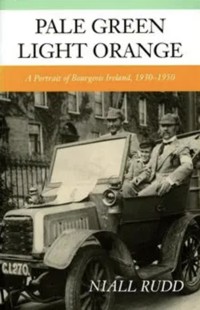
PALE GREEN LIGHT ORANGE
A Portrait of Bourgeois Ireland, 1930–1950
NIALL RUDD
hocestuiuerebis,uitapossepriorefrui
ThinkingofthepastwithpleasureBringsoflifeadoublemeasure
MARTIAL
Contents
Dublin
The sound of heavy engines filled the air until the house seemed to tremble. ‘Ma’am! Ma’am! Will ye come and look at the airship!’ It was Maggie’s voice coming up from outside the back door. My mother hurried down, and I dashed after her, just in time to see the huge cigar shape moving slowly across the houses of Clontarf and out into Dublin Bay. Records show that this was the ill-fated R101 on a trial run over Ireland on the morning of Monday 18 November 1929.1 I was then two years old and five months. The house was ‘Lissadell’, No. 13, Haddon Road, half-way up on the left. Far from having ‘great windows, open to the south’, like the Gore-Booths’ residence in Sligo, our Lissadell was a red-brick semi with a bay window and a small front garden fenced in with black iron railings. The only exotic feature was a tall, sad and rather grimy palm-tree that faced you as you came through the side-passage. Behind that was a greenhouse with the remains of a grape-vine, and then a medium-sized garden with a lilac, an apple-tree and, at the end, a rowan, which I used to climb. Beyond the lane at the back was old Mr Kennedy’s field; and sometimes the owner himself was to be seen, with hat, overcoat and a long staff, walking slowly around the field behind his cows.
‘Maggie’ was Maggie Gannon from Tullamore, some sixty miles west of Dublin. She was probably in her early thirties, but as far as I was concerned she belonged simply to the category of ‘grown-up’. She had a bedroom in the back of the house, reached by a separate staircase with high uncarpeted wooden steps. On one of my rare visits I noticed a gaily coloured jug and basin. On the wall was a picture of the crucified Christ, with a large sacred heart in the bottom left-hand corner. On the dressing-table stood a bottle of holy water that I got into trouble for spilling. Once a week, on her evening off, Maggie’s friend, Greta, would call to collect her; and then they would walk briskly down the road, looking very smart in their hats and gloves and high-heeled shoes. On other evenings I would often sit on the kitchen table while Maggie blacked the range or cleaned the silver. As she worked, she sang
There’s a little brown road winding over the hill,
To a little white cot by the sea,
And a little green gate at whose trellis I’ll wait,
While two eyes of blue come smilin’ through at me …
And if ever I’m left in this world all alone,
I shall wait for my call patientlee;
And if heaven be ki-ind, I shall wake there to fi-ind
Those two eyes of blue still smilin’ through aat mee.
This seemed to fit well enough with what I could gather from the teachings of Irish Methodism; and yet I knew that in some respects Maggie was different. She had that red heart and the holy water, and we didn’t. Moreover, she went to mass and confession. What was mass? And what did you have to confess? From time to time I wondered about such questions, but something told me it would be rude to ask her. Meanwhile Maggie continued to sing, and when I was about seven I began to accompany her on a melodeon which I had been given for Christmas. It was a poor return for all this artistic co-operation when one day I locked her in the pantry and tip-toed away to shrieks of ‘Ma’am!’. Later, much worse, I accidentally discharged a ·22 rifle in the playroom above the kitchen. Luckily the bullet simply went through the carpet and embedded itself in a joist, and no one knew anything about it. If nothing worse, it might easily have brought down a chunk of plaster on Maggie’s head, and then she would have complained vehemently to ‘the Master’.
‘The Master’ was not my father, but my maternal grandfather, Mr James H. Cooke. This old gentleman, now well on in his nineties, rented Lissadell from Mr Gore-Grimes, who used to come at regular intervals, dressed in a bowler hat and decent black, to discuss the maintenance of the property. Grandpa was born in 1841 in Gorey, Co. Wexford, into a family which had lived on the same farm continuously since 1630. Like the Websters, the Foleys, the Fiddlers, and some others, the Cookes had been brought over from Newbury in Berkshire when Bishop Ram acquired land in the area of Gorey and wanted some English yeomen to work it. The original farmhouse at Ballytegan seems to have lasted to the end of the eighteenth century. All that remains of it now is a pile of stones. The present building dates from that time, but was extended and renovated in the 1940s. One piece of family history concerns the rising of 1798, in which Co. Wexford was bitterly involved. A certain Father Stafford, who was being pursued by the authorities, took refuge in Ballytegan. The Cookes hid him and then provided a white horse for his escape. Before long, the situation was reversed. As the rebels closed in, the Cookes had to vacate their home and flee to Arklow. When eventually they returned, nothing had been touched, not even a jug of cream in the dairy. Hence the family tradition that there should always be a white horse at Ballytegan.
While still a boy, James Cooke was apprenticed to a draper’s shop in West Street, Drogheda. To get there he had to walk behind a cart to Greystones, where the railway began, about twenty miles south of Dublin. Over the next ten or twelve years he must have applied himself to other things as well as his trade; for he succeeded in marrying Miss Alice Davis, the boss’s daughter, and thus entering the Victorian commercial middle class. Not all can have gone smoothly. In my time there were stories of how the Hibernian Lace Company had been formed in partnership with the rascally Mr Andrews, who later absconded with the company’s funds. But Grandpa must have recovered reasonably well. When I remember him he had long been a director of Arnotts; he had shares in the railways when they were worth having; and he had sufficient money to give his eldest daughter a house, round the corner in Victoria Road, as a wedding present.
James Cooke in his nineties was a small round jovial man with a fringe of white hair, clear blue eyes, and a set of flashing dentures. Considering that he had to have a weekly injection of insulin, he remained remarkably fit. Every Saturday he would watch rugby in Clontarf; on Sundays he attended the Methodist church at the bottom of St Lawrence Road; and on other days, when he didn’t go into town, he would wander down to a garden seat on the sea front, which had been installed there for him by the flamboyant and energetic mayor, Alfie Byrne (for cartoons, see DublinOpinion for the 1930s and 1940s passim). There he would engage passers-by, telling them stories about Wexford life in the years of the fam-ine, and about ‘Drogheda’, which he always pronounced with three syllables to sound almost like Drockeda. Like many people with an oral rather than a literary education, he had an excellent memory, and he would tell his stories with an almost formulaic accuracy. Some had the timelessness of folk-tales, like the one which concluded, ‘He remembered the fine gold ring he’d seen on her finger as she lay in the coffin. So he said to himself “Wouldn’t it be a shame, now, for a grand bit of gold like that to lie with her in the tomb to the last trumpet, when I could be getting a few good pounds for it from Orgel the jeweller?” So he waited till dusk, and then took a lamp and went down into the vault. He had opened the coffin and was coaxing the ring off, when all of a sudden didn’t the woman herself sit up? He dropped the lamp and ran out into the street, howlin’ like a dog. And he was never seen again.’
Grandpa always wore a grey suit with a short tailcoat; a gold watch-chain hung in a loop across his tummy. In bad weather he would strap on a pair of shiny black leggings – at least when I first knew him. Later he abandoned the leggings, but he never wore shoes – always a pair of black boots, which I would remove, easing them off his swollen feet when he slumped into his armchair before the fire. Not that I was always the dutiful grandson. Once someone gave me a joke knife with a blade which retracted into the handle. Without considering the effect on a nonagenarian, I crawled silently up beside his chair, rose on my knees, and brought it down with a yell on the rounded belly. Then, with a mixture of guilt and excitement, I leaned back to watch as the old man nearly shot out of the chair.
‘Jamesie’, as he was disrespectfully called by his daughters (behind his back), was a gentle, long-suffering character; and (presumably ever since those early days in Drogheda) he had been dominated by his strong-minded wife. Alice, as she was called, died in 1936 at the age of eighty-six. Slim and straight, with her white hair gathered in a bun, she completely ignored the changing fashions, climbing onto tramcars wearing a bonnet and a long brown satin dress with a full skirt, much embroidered. My father, who lived in the house perforce, because my mother accepted the duty of nursing her parents, never much liked his mother-in-law. He once told me sottovoce, ‘The old lady can be damned cantankerous. This morning she turned poor old Jamesie out of the W.C.’ Still, my grandparents stayed together, as of course one did in those days, and in 1938 James H. duly joined his wife in St Fintan’s graveyard on the side of Howth hill, looking south across Dublin Bay. A baptismal font was placed in the church in their memory with the simple inscription, ‘They served their day and generation’.
By the mid-1930s cars were becoming quite numerous. But there was still a fair amount of horse traffic. Every spring at the show grounds in Ballsbridge there was a splendid event in which a score or more of Dublin firms entered a competition; prizes were given to the best-turned-out teams. Merville Dairy, Tedcastle’s Coal, Boland’s Bakery, Johnston, Mooney and O’Brien, the Swastika Laundry, and many more, would come trotting past the stand, the horses with shining coats and brasses, the vehicles freshly painted, and the drivers in their smartest uniforms. Cattle were sometimes to be seen in the streets, especially near the market in the North Circular Road. Occasionally the odd beast would be driven up Haddon Road. Once my mother heard a shout from downstairs, ‘Ma’am! Ma’am! Come quick. There’s a cow in the kitchen!’ ‘Maggie, are you out of your mind?’ But Maggie was right, except that, as mother came down, the cow had left the kitchen and was entering the drawing-room. Eventually it was driven out the door, but not before it had smashed the hall stand and emptied its capacious bowels on the drawing-room carpet. Mother went out to interview the drover, and she was still there, speechless with indignation, when my aunt and I came up the road. ‘Well what did he have to say for himself?’ asked my aunt, when the outlines of the tale had eventually been told. ‘All he said was “Weren’t you the right eejit to leave the door open?”’
At the age of five I was sent to a little school run by Miss Maud McKittrick, MA, and her sister Miss Florence in their bungalow at the end of Belgrove Road less than a mile away. A new road (Kincora Road) had just been built, with beautifully smooth pavements; so one could make fast time on a scooter or a pair of skates. Classes began at 9; there was a break before 11, and the academic rigours ended at lunch-time. The school was quite new; my cousin, Joan Polden, had been amongst the first batch admitted in the previous year. So we got plenty of individual attention. The singing was all right – we learned several songs and carols. But, for me, the handwork classes were a tiresome failure. I wrapped coloured raffia around a cardboard napkin-ring, and the result looked like an experiment designed to test the manual dexterity of a young chimpanzee. In three years I also made about a quarter of a rug, pulling bits of red and brown wool with a special needle through the holes in a square of canvas. Eventually Joan completed it, and the exact row at which bungler gave way to artist was painfully evident. The best part of the syllabus was the reading, but we also learned poetry by heart: ‘“Crom Cruach and his sub-gods twelve”/Said Cormac “are but carven treene./The axe that made them, haft or helve,/Had worthier of our worship been.”’ In other words Samuel Ferguson’s ‘The Burial of King Cormac’. We also learned about Finn MacCumaill and his great band of warriors, the Fiana – which suggests that, unlike our West-Briton families, Miss McKittrick wanted us to know something about Ireland. At home I was given King Arthur and Robin Hood, followed by TheJungleBook. (After nearly sixty years, memories of the White Seal and Rikki Tikki Tavi still awaken excitement.) There were also some books in a big mahogany case in my playroom; but they seemed to belong to a much drearier world. At the age of about ten I got around to Pilgrim’sProgress, and enjoyed it well enough. But I threw down Eric,orLittlebyLittle, and I could never face the heroic story of MarySlessorofCalabar. So I did not acquire much in the way of Victorian piety; and I have done nothing to make up for it since.
Miss McKittrick’s was a cosy, civilized, place – perhaps slightly over-protective. But a few guilty memories suggest that the two ladies would not have been sorry to see me leave. First, there was the time when old Mrs McKittrick found me picking shiny pebbles out of her pebble-dashed wall, and reacted as though I was pulling down the house. More serious was the fact that my friend and contemporary, Peter Comley (an English boy with blond curls) used to suffer periodic nose-bleeds. Since these tended to occur in struggles with me, they were attributed, not always justly, to my savagery. There was also an episode, which calls for no comment in a post-Freudian age, when I pushed a dandelion up classmate Lorna’s nose. At the end of term, that led to a very cool entry in my report: ‘Conduct, fair’, which caused an almighty row at home. In the school itself, every delinquency was punished by a black mark. More than three black marks in any one week meant that the culprit missed ‘story’, last period on Friday. The book being read that term was Anna Sewell’s BlackBeauty, which I liked. But after frequent banishments the narrative became so incoherent that I had to get hold of a copy and read it myself.
The small community in Miss McKittrick’s all came from the Protestant Dublin middle class. There were denominational differences, but we were scarcely aware of them and didn’t know what they meant. Outside school, however, the situation was different. If you turned right at the top of Haddon Road you were still in a late Victorian area; if you turned left, you were in a row of corporation houses. While there was seldom any overt hostility, the two groups of children did not play together. One of the other lot, a seven-year old like myself, once asked what my father earned. When I said I had no idea, he took a drag on his Woodbine, holding it with the lighted end pointing inward towards his palm, and said, ‘Mine gets £360’. But whatever their income, the parents must have brought up their children pretty well; for there was no vandalism, and the stealing never went further than a few apples from the garden.
Clontarf Road ran along the edge of an inner recess of Dublin Bay. When the tide was in, the sea came up to the wall; and on stormy days the waves would hurl sheets of spray across the tramlines. In the mid-30s it was decided to reclaim a strip of land; so a firm of Dutch engineers built a concrete wall just beyond the old stone one, and then another similar wall a hundred yards further out. The intervening space was then filled with sludge pumped in by dredgers. All this took several years, but in the end a layer of topsoil was added, grass was sown, and a pleasant promenade appeared. When the process started, you could climb over the stone wall, down into the valley between it and the first of the two concrete structures. Along the bottom was the slimy edge of the old sea bed, covered with weedy boulders, and water still seeped in with the tide. If you dug your nails into the filthy grey mud and hauled at a stone, it would come away with a damp sucking sound, often revealing a big dirty-green crab crouching underneath. While crab-hunting, I came to know Tom Sweeney. Three years or so older than me, he had dark wavy hair and wore a light blue jersey. Even then he had a certain self-contained strength. I had sometimes seen ‘the kids’ taunting him, and wondered why he didn’t answer back or run away. ‘Oh I just ignore them,’ he said, ‘and after a while they get fed up.’
As our friendship grew, Tom, who lived in a basement flat on the sea front, would come to play cricket in the garden of Lissadell. Most days it was an English county match, with personnel drawn from the cricket reports in the daily paper. I often opted for Gloucester, because of Wally Hammond, or Notts, so that I could be Joe Hardstaff. But I had great difficulty in coping with Tom’s Yorkshire, especially when Bill Bowes joined the attack. On special occasions we held a full-dress test match, usually for the ashes; but sometimes South Africa (with stalwarts like Nourse and Wade) took the place of Australia. Fours were easily had in the smallish garden, but sixes were heavily discouraged. ‘If you sky it into Headons’ you lose a wicket; if it goes into Mulroy’s you’re all out.’ As well as being an excellent playmate, Tom conveyed hints of a larger world. One day he said ‘Last night some of us from school went to see the military tattoo. It was great gas.’ ‘You mean you were in town in the dark?’ ‘Yep. And on our way home we dropped into a café and had fish and chips for supper.’ Fish and chips in town at night! By heaven, that was really living! On another occasion he confided, without arrogance, that his motto was ‘speed and efficiency’. I had never heard of anyone having a motto before; it was clear that Sweeney was going places. (He did indeed; after qualifying as a doctor he spent many years in Kenya and then returned to an important medical post in England.)
The house to which ours was joined was occupied by the black-satin-busted Mrs Mulroy, a wild-haired, wild-eyed woman, liberally rouged. No one ever mentioned Mr Mulroy. Perhaps he had taken the wings of the morning. Or was he perhaps immured somewhere deep in the recesses of the house? At any rate, Mrs M. and her two bizarre lodgers made a menacing trio, with whom my relations were never easy. One day I watched from the front window as a cab drew up. The driver got out and assisted his passenger, a narrow red-faced man with thick glasses, a check cap, and a loosely flapping raincoat, to the gate. He then drove away, leaving the man (whom I knew to be called John O’Donaghue) draped over the gate in a strangely limp posture. In due course O’Donaghue began to move slowly and unsteadily towards the door. But once he had abandoned the support of the gate his knees buckled and he slumped to the ground, flattening a small shrub in the grass border. I watched aghast as he groped around for his glasses and started to crawl up the front steps. At that moment the hall door opened and Mrs Mulroy grabbed him by his coat collar. ‘In witcha now. I’d say you’d had more than wun over the eight!’
That, and a few similar incidents, counted against them. But I, too, had a couple of things to answer for. One day I came across a powerful, stainless-steel catapult belonging to my father. Its black rubber sling was a quarter of an inch thick, and there was a nice leather pouch to hold the missile in place. After some practice with windfall apples, I found the weapon surprisingly accurate. I then turned and looked up at the window of Mrs Mulroy’s back bedroom, whose sash was always about two feet open. With delight and amazement I watched as one rotting apple after another flew through the open space and vanished in the darkness beyond. But then my luck ran out. Choosing a larger and heavier apple, I let fly as before, but failed to allow for the extra weight. And so, with a kind of high-pitched tinkle, it went right through the glass.
That was bad. But worse was the time I saw, standing at the kerb, the Y-model Ford which belonged to the other lodger, Mr Herbie Brennan. As an official of some description, Mr Brennan wore a very dark grey suit, and covered his bald head with a kind of sub-Homburg hat. His faintly smirking mouth was surmounted by a pencil-thin moustache; and one felt that the entire effect could have been removed with the aid of a damp face-cloth. Why these hostile emotions should have surfaced when I had a piece of chalk in my pocket, I cannot tell. But without thinking, I tried to write an inscription on the door of his car. I could feel that the chalk was not adhering properly to the glossy paintwork, so to aid legibility I duplicated the inscription on the pavement beside the running-board. Admittedly part of my purpose was to try out an excremental monosyllable that had recently entered my vocabulary. But it was imprudent to connect the word with one who was certainly Mr Brennan’s landlady, and (for all I knew) his mistress besides. Action followed quickly. Luckily my mother was out; but Maggie innocently called me to the door, where I was seized by Herbie Brennan and bundled into the next house. Twenty minutes later, after a terrific roasting, I was thrown out, convinced that I had narrowly escaped being sent to prison.
The Headons on the other side were totally different. Mr Headon was a former member of the Royal Irish Constabulary. He and his wife had six children, including a priest, a nun, and two doctors. Paddy, the younger of the doctors, was about fifteen years older than me. I can picture him standing in his garden and smiling up at my mother who was at an upstairs window. ‘Great news!’ he called. ‘Mamma has just won a bet. She had a shilling on Golden Miller!’ (Golden Miller won the Grand National in 1934.) Paddy must have joined the army immediately after qualifying, for he was taken prisoner at Tobruk. Tommy, the youngest, was still ten years older than me, but he was full of fun, and quite willing to play with me in the garden. Unusually large and powerful for his age, Tommy became the Dublin Schools’ champion in the field events. In summer, as athletics meetings drew near, the ground would shake under the impact of the shot. His winter sport was rugger, and some years later, in 1939, he played in the front row for Ireland. With all his gaiety and insouciance, Tommy had a keen intelligence. After taking a science degree at University College Dublin, he went into industry, and was managing director of Urney’s Chocolates when he died prematurely in his forties.
To a social historian it would have been obvious that while my family had entered the professional middle class in the generation before mine (my Uncle Ernest was a doctor), they had then remained more or less stationary, whereas the Sweeneys and the Headons had entered the same class in my generation. Hence my Catholic playmates and I were on the same footing. Yet I could dimly sense that things were more complicated than that. Maggie, and other people in her position, always seemed to be Catholics. On the other hand, Dr and Mrs Burke who lived across the road were also Catholics. I once heard mother say that their daughter Mary, who had been to see AsYouLikeIt, was ‘a very cultivated girl’. None of my connections cared about Shakespeare. So here were Catholics with superior tastes to ours. Well well. Again, one afternoon mother and I were invited out to Stillorgan to see the Hacketts – Catholic friends who had previously lived in Clontarf. But Mrs Hackett was a Scot; Mr Hackett was a schools inspector from Ulster, who wrote a book entitled BernardversusShaw; and in the company that afternoon were members of the de Valera family. Finally, the Sloans, Church of Ireland Protestants, who also lived on Haddon Road, were better off than we were. Their son, Stanley, who was about my age, had a magnificent car, which stood to mine as limousine to jalopy; his loft also housed a shiny and complicated system of electric trains, which ran on three-foot-high trestles in an area almost the size of the floor. One day, when he was in our garden, it occurred to me that it would be fun to pour a stream of water onto the gutter of the wash-house roof, and to watch it come rushing out at the bottom of the down-pipe before vanishing into the shore. ‘Stanley, if you stand just there and keep your eye on the bottom of the pipe, I’ll tip this bucket of water into the gutter.’ But the load turned out to be heavier than I thought, and as I tottered down the sloping corrugated-iron roof I found myself gathering momentum; by the time I reached the gutter I could no longer control the bucket, and Stanley, who was gazing at the ground as requested, got the full cascade on the back of his neck.
The Clontarf Methodist Church was (and is) a fine grey-stone building on the corner of Clontarf and St Lawrence Road. My earliest memories are of walking through the door in my Sunday suit, past Uncle Stan (Mr Stanhope Polden), who as Circuit Steward stood at the entrance greeting members of the congregation, handing out hymn-books, and directing visitors to their places. Like grandpa, he had a gold watch-chain across his waistcoat. In the pew one was surrounded by red cushions and varnished wood, and up on the pale green wall was a white marble tablet with black writing. My parents and I were in the second last pew on the right. Behind us were my cousins, the Poldens, no doubt so that Uncle Stan could dodge in and out on his stewardly duties. Now the trouble was that, as Sunday school was in the afternoon, there was no arrangement for children to leave halfway through the service. The result was agonies of boredom. The hymns were all right for about three verses (‘Methodism was born in song’). But the words were meaningless to a six-year-old, and some phrases caused trouble for many years. ‘There is a green hill far away, without a city wall’. But why should a green hill have a city wall? In the noble revivalist hymn ‘Yield not to temptation’ we sang, ‘Fight manfully onwards; dark passions subdue.’ ‘Passions’, naturally, meant nothing. Nor had I heard ‘subdue’ in ordinary speech. I did, however, associate it aurally with those jelly fruits, lightly dusted with sugar, which were known as ‘jube-jubes’. So I vaguely assumed that gluttony was under attack. This guess, perhaps, was in the right general area; but of course in the tradition of Victorian Puritanism ‘passion’ meant, almost exclusively, sex, and sex could not be mentioned at all. (Years later, I learned that even ‘passion’ had become so highly charged that, in the lines of the wedding hymn, ‘love with every passion blending, pleasure than can never cloy’, the word ‘passion’ had been replaced by ‘feeling’ – which, when you come to think of it, pretty well destroys the sense, as love is already a feeling.) Between the hymns came long improvised prayers, during which the congregation would bend forward in their seats. The first time I was taken to a Church of Ireland service I noticed that people actually knelt to pray. No one explained this, and I was left to conclude that it was in some way connected with other superstitious features, like white vestments, stained-glass windows, and the Book of Common Prayer.
Half-way through, the minister would announce ‘the stewards will wait upon you for your offering’ – a formula of such courtesy that it sounded like a relic of the eighteenth century. Uncle Stan then came down the aisle with a silver plate. By the time it reached us, it contained lots of shillings and a few half crowns. I added my mite, after checking whether it was ‘heads or tails’ or ‘hens and harps’. A sweet was smuggled into my hand to stop me fidgeting during Mr Morton’s sermon. This was always the worst part – forty minutes of florid declamation coming from a tall white-haired man in the pulpit. Even Uncle Stan’s attention would wander, and, being a cashier in the Ballast Office, he would mentally tot up the numbers on the hymn-board. Then, becoming more restive, he would take out his gold hunter and spring it open and snap it shut, holding it up so as to catch the preacher’s eye. But it never did any good. I sometimes think that the seeds of unbelief were planted in those early days when my most fervent prayers (‘Oh God, please make Mr Morton stop!’) went unanswered.
The most joyful service was the harvest festival, when the church was lavishly decorated withall kinds of flowers, fruit and vegetables. I sometimes wondered where all the produce came from, since there weren’t any farms in Clontarf; but I happily became a countryman for the day and sang ‘We plough the fields and scatter/The good seed on the land’. What happened to all the stuff afterwards? Somebody said it went to the city hospitals. So one imagined patients smiling gratefully as huge vegetable marrows, stooks of corn, and baskets of potatoes were dumped on their beds. The most sombre occasion was Remembrance Sunday, when we all wore poppies, and ex-servicemen, like Mr Comley, Mr Chambers, and Mr Mercier, wore their medals. My father also wore two medals, but on the other side of his jacket, since they belonged to my uncle Billy, who had been killed at Beaumont Hamel during the battle of the Somme in 1916. He had joined up soon after leaving Wesley College; so he was still barely twenty. In those services we sang ‘For all the saints, who from their labours rest’, to which there are a couple of fine tunes. Well, I don’t suppose any of those lads were exactly saints; but in that battle alone over 400,000 British troops died, in circumstances of unimaginable horror. Looking back even now, when another calamity lies bet-ween, one can only stand in awe of what they did and suffered. So in those remembrance services, only fifteen years or so after the guns had fallen silent, one could still sense the heaviness of people’s thoughts. Years later, when I read AllQuietontheWesternFront, I realized that the Germans had experienced the same horror. But that only made the whole thing seem more appalling.
After the service, visiting preachers would often be entertained to lunch at Lissadell. A very early memory has to do with a hearty young clergyman called Mr Boyd. After eyeing him with some concern as he tucked into the roast beef, I leant forward from my high chair and repeated a maxim heard many times: ‘Chew it well, Mr Boyd!’ Usually, after lunch, as any kind of sport was forbidden (‘Remember the Sabbath day to keep it holy’), there was nothing left to do except to make a nuisance of oneself. My father had the rather primitive idea that the naughtiness resided in my blue suit; for I was always at my most unbearable when wearing it. Another thing that wrecked his Sunday afternoon peace was the sound of ‘Love’s old sweet song’ (‘Just a song at twilight, when the lights are low …’) played rather unsteadily on the cornet by a street musician. This always led to an outburst of bad language, as he threw down the Sunday paper and turned up the volume of the wireless. There was another musician, however, a singer appropriately named Carroll, who used to come round on Tuesday evenings. My mother said he had the remains of a good voice, and when he was heard I would take a penny from her purse in the sideboard, and run out into the dusk and give it to him. He always broke off in mid phrase and said ‘Ah, God bless ye’. Once, when mother was out, I heard Carroll’s voice coming up the road. So I ran to the sideboard. But when I opened the purse there were no pennies, only a silver-coloured coin of about the same size with a horse on it. This was unusual, but clearly Carroll could not be ignored. So I rushed out and handed him the coin. ‘Ah, God bless ye,’ he said. And then ‘Hey now, what’s this? Would she be wanting change?’ ‘No, no thanks!’ I said airily, and dived back indoors.
The Sunday afternoon problem was solved when I was old enough for Sunday school. This fell into three parts: all pupils met together for hymn and prayer; then dispersed into groups for Bible-study; and then returned for a closing hymn. The first hymn was often ‘All things bright and beautiful…’ But I do not remember the bit that said ‘The rich man in his castle, the poor man at the gate, he made them high and lowly; he ordered their estate’. Some democratically minded committee must have cut it out. Bible-study included stories from both the Old and the New Testament, and also ‘Catechism’ (Q. ‘Who made you?’ A. ‘God’. Q. ‘Who is God?’ A. ‘God is a spirit that always was and always will be’. And so on.) Then back to ‘Onward, Christian soldiers’. The piano was played by ‘Juicy’ Hall, aged about thirty, with a blue three-piece suit and black brilliantined hair carefully parted and brushed. As the Sunday school teacher prayed, Juicy would reverently double over on the piano stool, but apparently he didn’t always shut his eyes; for once or twice, when he spotted some of us gazing around the room and grinning, he muttered ‘Get your heads down!’ Seven years or so later, I heard he had just managed to escape from Paris on a push-bike before the Germans arrived. One had a vision of Juicy, keeping his shining head well down as he pedalled furiously for the Channel ports. But what on earth was he doing in Paris?
The Church Hall was the venue of the annual sale of work, which meant scrumptious teas, balloons, and a lot of excited children charging around. I once bought a beautiful necklace for my mother, with big black-and-cream-coloured beads. Twenty years later, when she was near to death and we were sorting out some of her belongings, we came on the necklace. I held it up. ‘Yes,’ she said. ‘Isn’t it hideous?’ And hideous it undoubtedly was. ‘Why on earth didn’t you throw it out?’ I said. ‘Oh no, I couldn’t do that. It was the first present you gave me.’ At the sale, mother always ran the cake stall with Miss Dorrie Daly, a lady whose frail, ultra-feminine persona was rather deceptive. She surprised me one day by showing up at our house at the wheel of a huge maroon Armstrong-Siddeley with a glittering chromium grille. (None of the women in our connection could drive.) She had come to take Grandpa out for the afternoon. Dorrie Daly also made delicious fudge – absolutely stiff with calories – for which the recipe is: 1lb granulated sugar; ¼lb brown cooking sugar; 2oz butter; small half cup of water; a quantity of condensed milk (about two-thirds of a modern tin); bring to the boil, stirring all the time; boil for 15 minutes or so until the mixture becomes bubbly; then pour into greased tins. Dorrie Daly would sometimes add nuts and raisins; but I always regarded that as slightly decadent.
Dome’s sister, Miss Edie, taught piano to Joan and myself and a number of our friends in a small annexe at the back of her house in Haddon Road. She would sit beside us, exhorting and chiding, as we blundered through Czerny’s studies on her battered upright. When it was clear that I had not done my daily half-hour’s practice, she would say ‘Now you must keep at it. Just think how nice it will be to play for people at rugby dinners’, from which I inferred that she did not envisage a career for me on the concert platform. On two or three occasions I was sent in for some kind of exam at the Royal Irish Academy of Music in Westland Row. The first time she said, ‘You’ll have Maestro Viani. He’s very distinguished, you know.’ This caused some apprehension. How could I play in such company, and how could I cope with a grand piano? In the event, Maestro Viani was kind and charming, and issued whatever certificate was necessary. (Did anyone ever fail?) After the first visit, Miss Edie said ‘Well, did you enjoy the piano? Was it a Steinway or a Bechstein?’ ‘Oh no,’ I said, ‘it was a terrible old thing.’ Then, with a gesture, ‘almost as bad as…’ However, she can’t have held it against me, for one evening (probably in 1938) she took me into town as a treat to hear a talk by Mr Ferriss, an Englishman, on the message of the British Israelites. This turned out to be a very fluent performance, drawing on the Old Testament, Revelation, Josephus, and the dimensions of the Great Pyramid. I went to bed trembling at the discovery that the people I had thought of as English, Scottish, Welsh and Irish were actually the lost ten tribes of Israel. More disconcerting still, the Bible showed, when properly interpreted, that Armageddon was not far away; it would all be over by 1957. That gave me less than twenty years to get ready.
Associated with the Methodist church was a troop of scouts, complete with Guides, Cubs and Brownies. But the word which came via my mother from the Poldens was that, although nice people, the Scouts were a slack, undisciplined lot. What was the point of tying knots and lighting fires if you couldn’t stand up straight or march in step? The two Polden boys and their sister were in the Boys’ and Girls’ Brigade, which operated in the Presbyterian church on the corner of Howth Road. So it was decided that I should join the Lifeboys. The uniform (dark blue jersey, large brass badge, and sailors’ hat) implied a link with the navy, which was not made explicit but was nevertheless confirmed by the hymn,
Will your anchor hold
In the storms of life,
When the clouds unfold
Their wings of strife?
When the strong tides lift
And the cables strain,
Will your anchor shift
Or firm remain?
A splendid verse. Once a week I reported to the Presbyterian Church Hall, where the company fell in, marched, and drilled, then changed for gym, and finally sang a hymn before being dismissed. The whole thing was presided over by Miss Muriel Freeman, trim, straight, and strikingly handsome in her long blue coat, three-cornered hat, and white gloves. One didn’t fool around with Miss Freeman. Eventually the Lifeboys would pass into the Boys’ Brigade, which did the same sort of thing, but had in addition a deafening bugle band with drums. In retrospect, the Lifeboys and BB were (and presumably still are) quasi-military organizations. Yet they were entirely innocent. There were no enemies and hence no weapons or fighting. One simply learned to act in unison with others in obeying orders. How useful that is in peacetime is a matter of opinion; but no doubt the exercises on horse and mat did us good. There was no denominational dimension. We never asked or cared who was Methodist, or Presbyterian, or Church of Ireland. Yet in the outside world in regard to Catholics one was vaguely aware of a difference. In the bus or tram, men raised their hats and women crossed themselves when passing St Anthony’s Chapel. That was where Maggie went for mass and confession, where they said ‘Hail Marys’ (whatever they were) and were told to do penance. What were they up to? And why were they allowed to play football on a Sunday? The sad thing was that this slight feeling of constraint discouraged me from asking questions. Similarly, of all the Catholic children that I knew, none ever asked me about religion.




