


Erhalten Sie Zugang zu diesem und mehr als 300000 Büchern ab EUR 5,99 monatlich.
- Herausgeber: Luath Press
- Kategorie: Sachliteratur, Reportagen, Biografien
- Sprache: Englisch
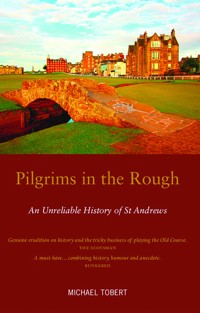
For centuries, people have been travelling to St. Andrews. Whether they were on a holy pilgrimage to see the magnificent Cathedral and the preserved bones of St. Andrew, or devout golfers putting their skills to the test on the Old Course - that holy grail of golf courses - or just students and scholars jostling for a place at one of Scotland's most esteemed centres of learning, St. Andrews has always attracted pilgrims. Michael Tobert leads his readers through St. Andrews' historic highs and lows with a potent combination of the anecdotal and the informative. His writing is both astute and downright funny, and he proves that sometimes, truth really is stranger than fiction.
Sie lesen das E-Book in den Legimi-Apps auf:
Seitenzahl: 259
Veröffentlichungsjahr: 2020
Das E-Book (TTS) können Sie hören im Abo „Legimi Premium” in Legimi-Apps auf:
Ähnliche



















MICHAEL TOBERT grew up in Nottinghamshire, an English county famous for Robin Hood, D.H. Lawrence, coal mines and just about nothing else. He rather liked it. His happiest days were spent communing with nature, a predilection that led him to find employment on a pig farm. The onset of adolescent vegetarianism, however, prompted a change of tack and, after Oxford University, he tried his hand in the City of London (where he hated every moment), at a water company in the West Midlands and at the London Business School. He then headed north where his fragmented career culminated in an attempt to start his own publishing company. This, to his wife’s astonishment, was not a total failure. He has lived in St Andrews for the last 20 years and spends his spare time on the golf course. By dint of constant practice, he is sometimes able to break 80. He is a member of the R&A and has three children. This is his first book.
First published 2000
Reprinted 2001
Reprinted 2004
New edition 2011
Reprinted 2012
Reprinted 2013
New edition 2015
eISBN: 978-1-913025-89-2
The paper used in this book is recyclable. It is made from low chlorine pulps produced in a low energy, low-emissions manner from renewable forests.
Printed and bound by
Bell & Bain Ltd., Glasgow
Typeset in 10.5 point Sabon by
3btype.com
Maps by Jim Lewis
The author’s moral right has been asserted.
A Cataloguing-in-Publication Data record for this book is available from the British Library.
© Michael Tobert
First published 2000
Reprinted 2001
Reprinted 2004
Reprinted 2011
The paper used in this book is recyclable. It is made from low chlorine pulps produced in a low energy, low-emission manner from renewable forests.
Printed and bound by
J W Arrowsmith Ltd., Bristol
Typeset in 10.5 point Sabon by
3btype.com
Maps by Jim Lewis
The author’s moral right has been asserted.
A Cataloguing-in-Publication Data record for this book is available from the British Library.
© Michael Tobert
To Tessa, who, because of this book, has spent toomany days lying dejectedly on the carpet when sheshould have been out playing golf – but has seenfit to forgive me
Contents
Town Plan
The Old Course Plan
Acknowledgements
Preface
INTRODUCTION
An Extremely Brief History
TRAVELS AROUND THE TOWN
1 The Mound behind the R&A
2 The Cathedral
3 The Harbour
4 The Castle
TRAVELS ON THE OLD COURSE
5 The Opening Holes
6 The Loop
7 The Closing Holes
FURTHER TRAVELS AROUND THE TOWN
8 The University: early days
9 The University: fall and rise
10 The Burgh
11 The Links road
THE NECESSITIES OF LIFE
12 Eating
13 Sleeping
14 Booking a Tee Time
SUNDRIES
15 The Weather
16 Dates for the Diary
17 Visitors
POSTSCRIPT
18 St Andrews in 2020
Useful Addresses
Tables
Chronology
The Bishops and Archbishops of St Andrews
Winners of the Open Championship at St Andrews
References
Acknowledgements
TO MY FAMILY, OF COURSE, for putting up with me. To David and Deborah Douglas, whose comments, as the book was in progress, were amusing, encouraging, honest and apposite. To Jurek Pütter for putting me straight on a number of points and sharing with me some wonderful tit-bits about medieval St Andrews. To Dr Peter Lewis of the British Golf Museum, and Dr Barbara Crawford of the Department of Medieval History, St Andrews University, for casting an expert eye over the text. (All errors are, needless to say, the responsibility of the author.) To Duncan McAra, without whose drive this book would still be mouldering in my bottom drawer. And especially to Madeleine, my in-house editor-in-chief, who was always ready to abandon her homework when the need arose.
I am particularly indebted to Jurek Pütter for his original illustrations on pages 26, 32, 60, 8494, 112, 126, 134, 142, 152, 154 and 166, and for permission to extract details from his previously published works on pages 35, 54, 97, 115 as well as on the front cover. Grateful thanks also to Simon Weller for his original drawings on pages 68, 82 and 88. ‘The Man who Missed the Ball on the First Tee at St Andrews’ by H.M. Bateman is reproduced on page 62 by kind permission of the Royal and Ancient Golf Club of St Andrews.
Preface
In this new edition of Pilgrims in the Rough, the Publisher has decided to delete from the title the words St Andrews beyond the 19th Hole and to replace them with an unreliable history. He believes unreliable gives the attentive browser the nod that within the book’s pages he might find something unexpected, perhaps even funny. Who knows what, in this context, the word ‘unreliable’ actually means. Certainly not unreliable.
Well, more or less anything is an improvement on beyond the 19th hole. This came from the Publisher who at the time was looking down unhappily on the cobbled walkway beneath his Edinburgh lodgings. ‘We must sell it,’ he said sniffing ruin round the next corner, ‘as a sort of guide book and hang it on the bootstraps of all those golfers who come to St Andrews. It’s our best hope.’ Or did he say ‘only’ hope, I can’t remember.
I said: ‘But Pilgrims in the Rough is not a guide book and it’s not predominantly about the town’s links, famous though they are. It is a succession of stories that together make up the topsy-turvy history of this ancient town. This includes – how could it not – the golf. But it’s no guide book.’
‘Maybe,’ he replied airily with a wave for a passer-by perhaps known to him or perhaps not. At which point, I believe our meeting concluded.
Now ten years later, it is to be an unreliable history. Good. This is progress. History is a word I like. It fits the bill. As for Unreliable: no. It is 100 per cent reliable. You can put your house, wife and all you hold dear on the accuracy of the history in these pages. My research, as I recall, was painstaking. Still, I have agreed to the inclusion of the word, unreliable. I have accepted it in the spirit in which it was sold to me.
The Publisher declared as follows: ‘It is an unreliable history, Michael, because I want the attentive browser to understand that Pilgrims will take him to places of the imagination that the reliable history cannot reach, to believe that he will laugh, that he will soon be writing to me of train journeys that have passed by in a flash of hilarity, that he will soon be complaining of tears flowing unrestrained in public places. No, Michael, unreliable is just the word we need.’
‘Fair enough,’ I said. ‘Put like that...’
We had one further matter to clear up. Because of the orientation of the first edition, it came to include a lone section that might be accused of belonging in the category, guidebook. This is called ‘The Necessities of Life’ and covers eating, sleeping and booking a tee time.
‘Just bring this up to date,’ said the publisher.
‘Erm, but,’ said I, ‘Pilgrims is not a guidebook, is it? It’s an unreliable history. We are agreed on that.’
‘Yes, that’s as may be, but we can’t have a chapter describing hotels and restaurants in the year 2000 when you wrote it. Some of them will have shut, be under new ownership, burnt down, who knows what.’
To which I replied, ‘Pilgrims is a history. The millennium, when the chapter was written, is modern history. As the years roll by, and the revenues roll in, the chapter will become older history and its interest will increase accordingly. Leave it as it is, Gavin, I implore you.’
When I last saw the proofs, the section hadn’t been tampered with. Not yet.
Introduction
An Extremely Brief History
ST ANDREWS IS WITHIN spitting distance of the Arctic Circle. It is north of Moscow and on the same line of latitude as Hudson’s Bay in Canada. If it weren’t for the fact that we are on an island, and that the Gulf Stream has not yet been entirely obliterated by global warming, St Andrews would be the home of ice hockey rather than the Home of Golf. It is 50 miles north of Edinburgh, in what used to be the Kingdom of Fife, and not on the way to anywhere. The A91 reaches St Andrews and stops, just as the Trans-Siberian Railway reaches Vladivostok and stops. If you are here, the presumption is that you are not just passing through.
St Andrews goes back a long way. Natives have been living in these parts since the days when mankind was still in short trousers, but recorded history didn’t really get going until the Romans reached the river Tay in AD 79.1 I have to say that Romans this far north were a surprise. I had been brought up to believe, quite wrongly, that they never conquered Scotland because they didn’t have socks. You certainly never see pictures of them wearing anything other than a pair of open-toed sandals which (visitors please note) is not recommended footwear for this part of the world. They must have been a hardy lot because they stuck it out until AD 300, by which time the lure of the Tuscan sunshine had clearly become irresistible. The only thing the Romans left behind in St Andrews itself was one worn coin dated AD 268 which was found in the grounds of St Leonards School.2
Next up were the Picts, who painted themselves with a blue dye called woad and hence acquired their name which means ‘the painted people’. On the whole the use of woad has died out in Scotland, except when supporters assemble to watch the national team play football. The Picts were heathens, which meant that they were suitable targets for any Christian missionary who happened along but, this being the Dark Ages, the surrounding gloom makes it hard to know which set of missionaries earned the bonus points – perhaps St Columba’s team on Iona, perhaps St Ninian’s from Whithorn in Dumfries and Galloway, or perhaps St Cuthbert’s from Lindisfarne in Northumbria.3 Also arriving under cover of night was the mysterious St Rule who, as legend has it, landed here bearing the bones of St Andrew, the Apostle. It is after these dry bones that St Andrews is named. By the 10th century, or thereabouts, and thanks in part to Viking preferences for rape and pillage holidays on the west coast,* St Andrews had become the HQ of the Scottish Church.4
Visitors to St Andrews, even those with eyes only for golf, can hardly fail to notice the spectacular ruins at the east end of town. I suppose some might. I do know a Canadian who was so taken with the golf courses that it was years before he realised that the town had an east end, but for most of us, addicts included, the remains are more or less unmissable. They belong to the great Cathedral, founded in 1160. By the time it was consecrated in 1318 (an event which prompted Robert Bruce to ride his horse up the main aisle), it was the largest church in the country, and indeed the largest building erected in Scotland until the Victorians developed a taste for railway stations on the grand scale. It was built in the days when what mattered was religion. It put St Andrews in pole position, it kept the big-spending clergymen in town, and it did wonders for tourism. Yet by 1559, it was in ruins. The town spent 150 years putting the thing up, used it for a further 240 years, and then, egged on by John Knox (of whom more later), laid it to waste. To get a fix on the scale of self-mutilation involved, imagine the townsfolk of today taking a tractor and ploughing up the Old Course.
The old town of St Andrews grew up around the Cathedral, with South Street and North Street sweeping up to the Cathedral gates. Both streets are broad and elegant, in spite of breaking da Vinci’s rule that a street should be as wide as the height of the houses. They are several times wider, which is just as well or where would we all park our cars. The medieval street plan was, and is, delightfully simple. Think of an egg lying on its side. The Cathedral is at the pointy east end and from it South Street and North Street make up the sides of the shell. Down the middle of the egg, through the yolk as it were, runs Market Street. To the north (ie beyond North Street) is a street called The Scores, and then the North Sea. To the south and west are the modern additions to the town. The golf courses begin on the north-west end of the egg. Everything is walkable, and there isn’t anyone, I don’t care how bad his sense of direction, who will find it possible to get lost.
With the Cathedral came the University. Religion and learning are old bedfellows. Founded in 1410, the university is the oldest in Scotland and preceded in Britain only by Oxford and Cambridge. Over the years it has churned out some great names, the movers and shakers in Scottish history, as well as in the wider world, martyrs, scholars, swordsmen, scientists, poets, you name it. Even Marat, the French revolutionary, took an MD in medicine here, but that was in the days when standards were lower and before he had discovered the perils of letting young ladies into his bathroom. If you are in St Andrews on the first Saturday after the students come back in April, you can see many of the great names of St Andrews life walking through the town in the Kate Kennedy procession. St Andrew himself leads the way carrying the X-shaped cross that appears on the Scottish flag (and on extras in Braveheart), whilst John Cleese, a former Rector, brings up the rear.*
There were tourists in St Andrews long before golfers, only in the old days they were called pilgrims. Curious as it may seem, indeed as it was, nowhere else in Northern Europe boasted the relics of an apostle like St Andrew, so those in need of salvation – a sizeable market in any age – risked plague, wars, bandits and our usual weather of ‘winds with gales’ to get here. The Vatican Office for International Pilgrimage, a sort of medieval travel bureau, rated St Andrews the second most important pilgrimage site in North-Western Europe (after Santiago de Compostella in Spain).5 Penitent pilgrims poured in from Italy, Bohemia, Poland, France and Flanders. From the north, Scandinavians filtered down via the Cathedral of St Magnus in Orkney. In response, St Andrews’ second oldest profession (its bed-and-breakfast ladies) put up their prices, thus initiating a tradition which continues today: if you want a room in Open week, start saving early.
It never does to underestimate the speed with which things can turn sour. Take the world economy. One moment we are told that because of free trade and new technology, we will all continue to grow richer and richer until the last trumpet. Then there is a little local difficulty with the Thai Baht and a stumble or two from the Russian President, and alarm bells about world recession start ringing. It is the same on the golf course. One par follows routinely after another, oh what an easy game golf is, and then there is a freakish bounce, the ball lodges against the face of a bunker and you end up taking eight. This is more or less how it was for St Andrews. By the 16th century, things could not have been going better. The tourist trade was booming. Up to 300 ships from the Continent would sail into harbour for the big town fair in April. The Church had more money to spend than the State6 and spent a good proportion of it right here in St Andrews. The town boasted 60 to 70 bakers,7 and a brewer on every street corner to provide the clerics, the pilgrims and the merchants with their evening tipple. A fine old time was being had by all, and then along came the Reformation, John Knox with his vitriol against ‘idolatrie’ and Catholic excesses, and all that nonsense with the Cathedral.
Quite apart from anything else, when your major assets are some ancient bones and the regional HQ of a corporation as wealthy as the Catholic Church, it doesn’t make sense to declare publicly that bone worship is so much mumbo-jumbo and to reduce the Cathedral to a pile of old stones. It is like McDonald’s telling the world that junk food is bad for your health and then bulldozing all their burger joints. It just doesn’t demonstrate much of an eye for business. Anyway, when the tourists had stopped coming, and the Old Church, with its insatiable appetite for the finer things in life, had been kicked out, all the juicy handouts stopped with them. No more queues of people outside the butcher, the baker and the candlestick maker. No more endless streams of pilgrims willing to pay through the nose for a place to lay their troubled and unworthy heads.
The sacking of the Cathedral in 1559 was not quite the end of St Andrews, but almost. The Archbishops, now Protestant, managed to cling on with some interruptions until 1689, at which point bishops of all denominations were deemed unnecessary – but by then St Andrews was staring into the abyss. Trade had collapsed, business was moving to the larger cities, and Union with England and the opening up of the US colonies would drag the centre of gravity southward and westward. St Andrews’ central position in Scottish affairs was at an end and it wasn’t long before the buildings were crumbling and the people were leaving in droves. Dr Johnson, the dictionary man, came to St Andrews in 1773, and muttered about ‘indigence and gloomy depopulation’.8 (Johnson was not the most neutral observer, mind you. One of his other lines was that ‘the noblest prospect which a Scotchman ever sees is the high road that leads to England’.) By 1800, there were no more than two or three ships in the harbour (a 99% decline), a dozen bakers (an 83% decline), and two brewers9 – and when anything falls by that much, it is time for the financiers to climb out onto the window ledge and jump off. By 1876, numbers at the University had evaporated to a mere 13010 which was fine for a drinks party, but a little thin for an enduring place of scholarship. The prospects were looking bad. Worse than bad – terminal. The town was slaloming, accelerando, down the slippery slope, and the only thing that saved it from going splat into its own medieval paving stones was the little white ball.
Golf and St Andrews have been joined at the hip for centuries. Even at its dawn, golf began to dominate waking hours to such an extent that James II of Scotland had to ban it (in 1457) because it interfered with the small matter of defence against the English. Not enough practice hours were being put in on the longbow which, with the auld enemy lurking, showed either commendable sang froid or major league masochism. ‘It’s the English, it’s the English’, came the cry. ‘Aye, weel, A’m twa oop on wee Jamie and A’m nay daunderin hame.’ It wasn’t just the commoners who played. They were all at it, even royalty. Mary Queen of Scots was seen out on the Links* a few days after the tragic loss of her husband, Darnley, giving rise to speculation that she had a tee time booked and didn’t dare cancel it. James VI of Scotland, when he went to London in 1603 to become James I of England, took his clubs with him.11 The precise date that golf came to St Andrews is not known, but it is thought to have been played here by 1400. It was certainly in full swing before 1552, when Archbishop Hamilton agreed – in exchange for being able to keep the rabbits that roamed the course – to confirm the town’s right to play golf (and football) on the Links. The things a man will do for rabbit stew. By 1691, St Andrews was described as ‘the metropolis of golfing’.12
The first stirrings of organisation in the game began in the middle of the 18th century. The Honourable Company of Edinburgh Golfers gathered together in 1744 to play for a silver golf club and drew up golf’s first set of 13 succinct rules, the most delphic of which was rule 2, ‘Your tee must be on the ground’. As opposed to what? On your caddie’s head? Ten years later, in 1754, it was the turn of the Royal and Ancient Golf Club of St Andrews.† Now the R&A had one great advantage over the other emerging golf clubs. At a time when the Honourable Company and others were moving from course to course, the R&A had its own great Links. The early Opens, when not at Prestwick or Musselburgh, were played at St Andrews. The great players of the day, such as Allan Robertson, Tom Morris, or Andra Kirkaldy, worked as caddies or clubmakers in the town, or like Willie and Mungo Park, came here for the big money matches. The R&A was royal, it was ancient and it played on God’s own links in a town where golf had become the only game in town. So it was that when the senior clubs wished in 1897 to create a uniform code of rules, it was decided unanimously to give the job to the R&A.
It was only a short step from there to becoming the ruling body of world golf. OK, the United States has decided to go its own way (the Declaration of Independence has a great deal to answer for), but that still leaves the other ninety-nine countries who look to the R&A to tell them what the rule is if they play an air shot over somebody else’s ball, or whether they can replay without penalty if, as actually happened, an earthquake measuring 7.1 on the Richter scale erupts at the top of their backswing and causes them to drive out of bounds.13 Not that the R&A always gets it right. A journalist telephoned to ask if the stymie* had been abolished. By mistake, he was put through to the lady behind the bar who told him in no uncertain terms that it had not. ‘There is a bottle on the shelf and we still serve it!’14
As for the Old Course itself, which has witnessed the development of the game from its very beginnings, seen all the champions and hosted many great Open Championships, it has become the most renowned piece of golfing turf on the planet. The pilgrims are back and the town is again as vibrant and cosmopolitan as it was all those hundreds of years ago.
* Iona, the original centre of the Scottish church, was persistently raided. In 849, some of St Columba’s relics were moved east to Dunkeld.
* John Cleese, and indeed St Andrew, are impersonated by students.
* This incidentally is the earliest known reference to a woman playing golf. The date was 1568. The Links in question were the fields of Seton (east of Edinburgh).
† The R&A actually started life as the Society of St Andrews Golfers and stayed that way until 1834 when William IV gave it his royal blessing.
* A stymie is where your opponent’s ball lies between you and the hole requiring you to play round (or over) it. The stymie was abolished in 1952. Players now have to lift and mark. For an amusing and informative trot through the rules of golf, John Glover’s Celebration of 100 years of the Rules of Play (whence come the earthquake and stymie incidents) is highly recommended.
Travels Around The Town
CHAPTER 1
The Mound behind the R&A
IT’S YOUR FIRST MORNING in St Andrews. The plane was delayed, British Airways decided that one of your bags should be re-routed via Amsterdam, and you didn’t get to your hotel until late last night. A couple of whiskies, perhaps, to settle the stomach, and then to bed. You tottered down this morning, ate more Scottish breakfast (porridge, kipper or eggs and bacon, toast and tea) than was good for you, and here you are staggering out of your hotel. My advice would be to head for the sea. If you are staying on The Scores or in the B&Bs in Murray Park or North Street, you can probably smell it. Follow your nose. Go to the front across The Scores and take a deep breath. It is wonderful stuff, sea air from St Andrews. If ever air deserved to be bottled, this does. Breathe in a jug-full. When you feel up to it, turn your head gently to the left and there you will see a bandstand below a sloping grassy bank. If the sun is out, lie on the bank, close your eyes and imagine one of our school bands murdering the Radetsky March. A scattering of adoring parents and uncommitted passers-by are sitting where you are, beaming in pleasure or grimacing in pain depending on their blood ties to the participants. Those that are grimacing in pleasure have the mixed emotion that comes from being both related and musical. On a hot Sunday in summer, reclining on the pristine grass as the heady cocktail of melody, cacophony and sea breeze swirls around you, is one of St Andrews’ finer indulgences.
The area around the bandstand is redolent with history. The truncated obelisk behind the bandstand, that looks like Cleopatra’s Needle after my wife has washed it, is the Martyrs Memorial, commemorating the town’s burnt Protestant martyrs (to whom, we will return). Close by is Witch Hill, where the Protestants got their own back by burning the witches, which they continued to do, on and off, for the best part of 150 years. When the Statutes against witchcraft were repealed in 1736, many St Andrews Presbyterians were outraged.15 Witch Lake, in the waters below (to the right), was where witches took their heads-I-win, tails-youlose test. Putative witches splashed down here after being flung from the cliff above. If they swam, they were witches and were burnt. If they drowned, they demonstrated their innocence. Since left thumb was tied to right big toe and right thumb to left toe (to replicate the cross), a lady would have had to be something out of the ordinary to stay afloat. Yet some did – perhaps with a sort of convulsive tortoise-like backstroke – because they were then taken away for firewood.
All this does make you wonder what sort of place St Andrews must have been in those days. The odd aberration may be excusable, but anything that lasts 150 years, which is six generations give or take, shows attachment. My guess is that a town that can wax lyrical about the pleasures of making a bonfire out of some helpless old crone will probably come down quite heavily on the weird and wonderful, and on all those little oddities that make life worth living. But that was then and part of growing up perhaps. Nowadays, the town is a gentle, slightly academic, tolerant sort of place, where people are decent to their kids, oddballs can survive and prosper, and just about everybody, witch or not, can walk around the town secure in the knowledge that they are most unlikely to be burnt, knifed, mugged or otherwise impeded.
Next to Witch Lake, on the R&A side, is what remains of the grand outdoor swimming pool called the Step Rock which was 300 feet long and ran from the beach out to the sea. When it was built in 1903 it was for men only, partly because the tradition was for men to swim naked. Women were allowed in in the 1930s, which either boosted swimwear sales, or the birth rate. Between 1930 and 1960, the ‘Steppie’, as it was generally known, was packed on hot days, with deckchairs, refreshment kiosks doing a roaring trade, and massed ranks of the local population lounging on the concrete platform in front of the diving board and water chute. Old photographs of those days, when the sun shone and the people looked contented, evoke a gentler age. The popularity of the Steppie started to wane in the 1960s and, today, the only things swimming there are a family of seals, courtesy of the Sea Life Centre.
Now that the Steppie is no more, there is always the West Sands, the long beach that runs parallel to the golf courses. Nothing is better for washing away the cares of the day than a plunge into the North Sea on a warm summer’s evening when there is scarcely a ripple on the water or another soul in sight. The water is on the arctic side of bracing, but the sands slope so gently that you have plenty of time to acclimatise. This makes getting in up to the lower thigh relatively easy. It’s the next bit that sorts the men from the boys. A quick allee oop is recommended. Otherwise, the thought of ice water inching over vital parts is too terrifying to contemplate.




