


Erhalten Sie Zugang zu diesem und mehr als 300000 Büchern ab EUR 5,99 monatlich.
- Herausgeber: The History Press
- Kategorie: Sachliteratur, Reportagen, Biografien
- Sprache: Englisch
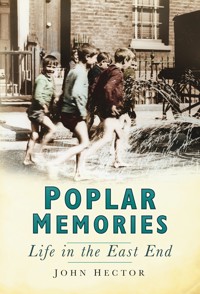
Poplar Memories is a vivid impression of Cockney London before and during the Second World War, set in a teeming, rundown docklands neighbourhood famous for being, well, one end of the Blackwall Tunnel. John Hector's spellbinding account of his early life in the 1920s and '30s conjures up a vanished era when simplicity and happiness went hand-in-hand. Halcyon days of 'talking pictures' and pavement buskers, Saturday night knees-ups round the piano, eel and pie stalls, chimneysweeps, 'boxers', Clarnico's toffees and Lloyd Loom furniture, and a little shop called Woolworth's selling 'nothing over sixpence' – unless it's a shilling. All this was to disappear forever in the horrors of the Blitz. The author was disabled by infantile paralysis – yet he became School Captain and embarked on a successful career at 14, surviving extreme poverty, panel doctors, dockers' riots and Hitler's Luftwaffe with an unshakeable belief in the ordinary people of Poplar.
Sie lesen das E-Book in den Legimi-Apps auf:
Seitenzahl: 187
Veröffentlichungsjahr: 2010
Das E-Book (TTS) können Sie hören im Abo „Legimi Premium” in Legimi-Apps auf:
Ähnliche



















POPLAR
MEMORIES
Life in the East End
POPLAR
MEMORIES
Life in the East End
JOHN HECTOR
Photographs appear by kind permission of Tower Hamlets Local History Library and Archives. Other illustrations are from the author’s collection. Line drawings by Rosemary Whiteman.
First published by Sutton Publishing in 2002
This paperback edition first published in 2010
The History Press
The Mill, Brimscombe Port
Stroud, Gloucestershire, GL5 2QG
www.thehistorypress.co.uk
This ebook edition first published in 2013
All rights reserved
© John Hector, 2010, 2013
The right of John Hector to be identified as the Author of this work has been asserted in accordance with the Copyright, Designs and Patents Act 1988.
This ebook is copyright material and must not be copied, reproduced, transferred, distributed, leased, licensed or publicly performed or used in any way except as specifically permitted in writing by the publishers, as allowed under the terms and conditions under which it was purchased or as strictly permitted by applicable copyright law. Any unauthorised distribution or use of this text may be a direct infringement of the author’s and publisher’s rights, and those responsible may be liable in law accordingly.
EPUB ISBN 978 0 7509 5357 3
Original typesetting by The History Press
Contents
Memories of a Popular Man
Foreword & Acknowledgements
1.
An East End Upbringing
2.
Hospitals, Trams, Shops & Streets
3.
May, my New Career & a Tour of the Market
4.
The General Strike, Pubs & Street Traders
5.
The Blitz
6.
Friends & Neighbours
Poplar Methodist Church, known as Lax’s, in the East India Dock Road, c. 1925. The Revd William Lax was Minister for 35 years from 1902 and Mayor of Poplar in 1918/19. He claimed to be the originator of the ‘street party’, organising the first to commemorate Armistice Day in 1918.
Memories of a Popular Man
JOHN ALFRED HECTOR
(25 December 1917 – 29 January 2010)
My father was a remarkable man. Surviving, as a baby, the difficulties of both infantile paralysis and meningitis (much to the amazement of the doctors, nurses and his own family) he was renowned as a little star for his courage among all the neighbours. As he grew, he met whatever challenges life sent him, and being disabled didn’t stop him from enjoying the many street games the children of those times were so adept at devising. Nor did it hamper his schooling; despite spending many of his early months in various hospitals and being sent to a special school until the age of seven, his determination and hard work led him to become school captain when he joined his older brothers at Culloden Street School.
Throughout my father’s working life, his strength of character, passion for hard work, ready wit and the ability to make people laugh stood him in good stead. He was respected by his bosses and co-workers alike and soon rose to become a manager at Fraser & Fraser and latterly chief buyer at Brown & Tawse of Bromley-by-Bow. He was always ready to lend a helping hand – a character trait of so many East Enders – and he enjoyed being a Rotarian and a Freemason. If it meant delivering coal in icy conditions in the depths of winter, despite his disabilities he would never think twice about the task. He wanted to help others, to be of service – as politicians have it now, ‘to make a difference’, I am sure that my father was doing just that many years beforehand.
As a family man we were lucky to have this strong character as our dad. He was kind, loving, firm but very fair to us girls; Shirley, Barbara and Christine (me), and he adored his beloved Lilian, our dear mother. His enthusiasm for life and all its adventures meant that he always had a tale to tell and we were a willing audience, as too were the grandchildren and great-grandchildren who followed. We all have our special memories of dad. Most of us were taught to fish and recite poetry.
My mother developed Alzheimer’s disease shortly before their diamond wedding anniversary and it upset my father that the acknowledgement from Queen Elizabeth II would be lost to my mother’s memory. Throughout the sad gradual decline in my mother’s health, dad would always talk to her of the past; the ‘good old days’ of their youth, hoping, as if by some miracle, that a link would be remade in mum’s mind and she would be restored to him. With her by his side and with the smallest of typewriters, ream after ream of typescript produced dad’s memories of his early years in Poplar and the surrounding area. Whether he saw in my mum the fear that the loss of memory brings or, as I believe, it gave him the inspiration to record as many as he could of the wonderful times their families shared in those days, he produced a series of booklets about East End life and donated the profits to the Alzheimer’s charity. He had triumphed over the adversity of mum’s condition. He went on local radio to talk about the East End and his fame spread; soon he was giving talks to the WI, Good Companions and many other groups in the region. He assisted the BBC with their Century Speaks series and become involved with Channel 4’s Blitz Spirit programmes. It was a good way for him to cope with the loss of his beloved Lilian, who sadly died in 2000.
Looking at dad’s collection of stories one day, I happened to say that I thought they should be properly collated and published together with all the other memories he spoke of at his talks, perhaps with photographs, as a record of the time. The first edition of Poplar Memories was published in 2002 and my father was immensely proud of the finished book. Through its publication he made so many wonderful friends worldwide – fellow East Enders for whom dad’s reminiscences matched their own personal history.
Helping dad with his work over the years has been an absolute joy for me. I never tired of hearing him telling his tales and just being in his company, as many people know, was an uplifting experience. For the last ten years of his life, despite failing eyesight and poor hearing, he embraced modern technology and learned to use a computer and voice-activated software. He also found a gift for writing, whether for publication or in the form of letters to berate officialdom on one of his many campaigns for the neighbourhood. A tireless worker for good causes, recognition of his work came in the form of his being invited to a Buckingham Palace garden party in 2007, at which he met Her Majesty. It was a marvellous achievement for him, of which we are all so proud.
Poplar Memories is an account of what life was like for my mother and father, their families and so many others like them, sometimes very hard, but always with an enduring spirit of hope. This edition of the book is a tribute to a much-loved and courageous author who passed away in January 2010 at the age of ninety-two. I thought he would be with me forever, but I will have to be content with my treasured memories and the stories of his life contained within these pages. I hope you, too, will really enjoy them.
I am so thankful and proud that I have the good fortune to be his daughter.
Bless you dad.
Christine Stanton (née Hector), 2010
Foreword & Acknowledgements
It is hard to compile a short Foreword from my ten years of writing books, as there is so much to say; however, my first thanks must go to the many readers who have bought and read my other volumes over the past ten years and to the many local celebrities who have kindly endorsed them. The encouragement of my three daughters during that period was enormously helpful, especially while we were nursing my wife Lilian. Having lost our lovely middle daughter, Barbara, three years ago, Christine – the youngest – and Shirley have continued to provide their help and support with the present volume of Poplar Memories. This book is dedicated to senior citizens, to give them a record of the times and events of the borough from the ending of the terrible First World War, through to the Blitz. But I hope it will also be of great value and interest to their children and grandchildren, who sometimes smile in disbelief at the stories we have to tell. My career took me away from Poplar in the early 1930s, but I returned to work in nearby Bow, just two miles away, for the next forty-four years. I saw much of my birthplace laid to waste during the Second World War, and became determined to place on record my memories of what life was like. What Hermann Goering failed to complete, London’s planners have now finished, and a virtual new city has arisen over the streets where we once played as children until the lamplighter came to light our way home to bed.
Hard times? Many years ago, I devoured Henry Mayhew’s accounts of life in Victorian London. I thought, how lucky we were to be living in the time of George and Mary! Now, there are few of us left in our late eighties and early nineties who can still record our memories of those days. Perhaps film researchers, sociologists and people tracing their ancestors on the Internet will use these books as authentic records. Like ‘Mayhew’s London’, perhaps mine will be referred to in future textbooks as ‘Hector’s Poplar’!
Finally, my thanks to Sutton Publishing for producing this book, to Tower Hamlets Local History Society and Library for many of the superb photographs, especially to Chris Lloyd, for his valuable help in identifying many of the locations and dates, and to Poplar folk past and present too numerous to mention.
John Hector, November 2002
The How memorial gateway to St Mary’s Church, Bromley-by-Bow, was built in 1894 and still survives. The church, built in 1843 on St Leonard’s Street, was destroyed during the war. It stood in the grounds of a Benedictine priory that is mentioned in Chaucer’s Canterbury Tales.
1
An East End Upbringing
Contrary to evidence, the children of Poplar, where I was born, were not always playing in the streets. Most of the time they were helping in the home or running errands; if not for the parents, then for neighbours or the local shopkeepers, earning small sums of money to help the household purse. Regular errand-running was an accepted practice, and children grew up reliable and trustworthy in handling money and goods. Some shops employed older children of twelve to thirteen years old, after school, to collect orders from their wholesalers: an early operation of the ‘Cash and Carry’ principle. Children of this age, too, dashed out all over the East End from newsagents shops, burdened with the afternoon and City editions of the evening papers.
One job that was quite laborious was the collecting-up of bottles of Chloride of Lime from one of two depots that distributed this essential disinfectant in the neighbourhood. One, in Poplar High Street, was down a long, cobbled alley where dozens of children would form lines with bags of two or more bottles; the élite might have a two- or four-wheeled wooden cart with a number of bottles or flagons for various neighbours. It would take more than one child to pull the load up the alley to the top of the hill. The Lime water was free, and did in some small way help to keep the drains clean. Many families used it in the washtub too.
In my own family, the three younger brothers had a regular sponsor for our services, being passed on in turn as each of us left school and started ‘real’ work. The next brother would be inducted, and the routine carried on without interruption. Our client was the local dentist, a bachelor; apart from shopping for him, once or twice a week we journeyed to Manor Park with a small attaché case full of denture moulds made from plaster-of-paris – a two-hour journey of two buses and a half-mile walk. This earned us a shilling per trip on top of the half-crown he paid us each week for six days’ worth of shopping.
Some of the girls were honoured to be chosen to take out a new baby from time to time, to wheel them up and down in prams; or perhaps an infant in a pushchair. You would see a congregation of these young nursemaids with their charges. A special girls’ pastime in the spring and summer months, weather permitting, was to build grottoes from sheets of crêpe paper, fixed with bows to a wall, the pavement decorated with coloured paper, shells, postcards and any other oddments to brighten the effect, from where two or three girls would shake a tin at passers-by, calling out ‘penny for the grotto, please’. Any receipts would be shared between them.
Ignoring the ‘health and safety’ warning not to go near the water, a favourite summer pastime of barefoot children in the 1920s was chasing the water cart.
Other girls’ games included pavement skipping, a long rope held at either end by the largest children so that several others could join in the middle. Sometimes, the young mums would come out of their houses to give the girls a hand with turning and to see that fair play was exercised. Hopscotch, and ‘bonce and gobs’ – played sitting on a door mat – could only be played when there was no further work to be done in the home. Cricket, which the boys enjoyed, was played with a ‘wicket’ chalked on someone’s brick wall, and a bat made by a dad from a piece of wood. Test match rules applied, but with only three or four players; more, and some might not get an innings. Football was different, being played between goalposts made from boys’ caps. These would have to be rescued when horsedrawn carts and occasionally cars came by and, when opposition teams became threatening, would be placed closer together with many protests. The smallest and weakest children were usually made to go in goal. The ball, meanwhile, was made from a large bundle of newspaper, compressed and tied with string.
Leapfrog was a game for the taller boys, who could jump. The smaller boys would act as ‘pillows’ when the frog jump took place and anyone collapsing underneath would be called up as ‘weak horses’ and their team would lose. ‘German cricket’ was an all-year game consisting of four wooden staves, placed against a wall to form a wicket. A ball would be thrown and, if the wicket was knocked down, the thrower and his team would run away while the opposition chased them with the ball, aiming at a boy. If he was hit, they tried to eliminate the rest of the team. Meanwhile, the survivors would double back and re-erect the wicket – the ‘score’ was the number of wickets erected. ‘Tin Can Copper’ was a game enjoyed best of all when it was getting dark. An empty condensed milk tin would be thrown from a starting point such as a manhole cover, the thrower and his team would hide until one was discovered by the searchers, who would then station themselves at the manhole and declare, ‘Tin Copper Charlie’ or whatever the name was of the discovered child.
Whips and tops were plentiful at certain times of the year, as were peg tops, deftly wound with a cord and pulled sharply to get a good spin. Small ones made out of boxwood – ‘boxers’ – could be spun on the palm of your hand. Wooden hoops hit with a small stick would accompany children on errands, heavy steel hoops would be propelled with a ‘skimmer’, a short piece of strong wire with a hook at the end, in which the hoop would be kept spinning after a short run. These hoops could cause havoc when they caught in the live rail of the tramlines. Broken ones were mended by the blacksmith in his forge.
‘Tibby cat’ was a dangerous, if enjoyable game for older boys. A small oblong of wood with tapered ends was placed on the pavement and struck with some force to make it rise in the air, then dispatched with a bat along the street, the distance of the hit being paced out. Taller boys with longer strides had the advantage.
As soon as they arrived from school, however, most older boys and girls would have to light or brighten up the fire for the evening meal before their parents came home, if they both worked. Sometimes a chimney would catch fire, blanketing the neighbourhood with thick black smoke. They were rarely swept and some folk deliberately set them alight just to clear the soot and save the cost of a sweep.
Collecting cigarette cards by standing outside tobacco shops and badgering smokers was a regular pastime for the younger boys. The cards were swapped or exchanged for various offers, or used in card games – flicking or ‘skating’ nearest the wall, wins all. Army cap badges and regimental buttons were in good supply after the First World War, and collectable; as were foreign stamps, from which older children learned much of their geography. Fishing for sticklebacks and frogs was possible, if you were prepared to journey outside the area; Victoria Park or Beckton Road Tollgate ditch involved a long walk. You sometimes caught a fish in a net made from an old curtain, by dragging it along the stream. Barrel-organ buskers were popular, touring the pubs. One would dress as a woman and sing in a high voice, much to the amusement of the children sitting next to him on the kerb.
Children also had some devilish adventures. ‘Knock-down Ginger’ involved tying two neighbouring door knobs together and watching the results from hiding. Tying a piece of black thread to an empty cigarette packet or a coin, and placing the object in the path of a suspect, only to snatch it away as they bent down, was usually performed from basement steps in fading light. Police on the afternoon shift at Poplar station would march out with the sergeants in the lead; woe betide any children found up to pranks. Look-outs were posted, ready to call out when the enemy was sighted.
They were all little workers, friendly, gentle children in those days. Most had to grow up too quickly, adult heads on young shoulders. They were the salt of the earth in the next generation.
Poor and orphaned children depended on the Tabernacle, which provided a soup-and-bread kitchen service three times a week.
A group photograph of the children of the Tabernacle and helpers, 1911.
SCHOOLS
The good folk of Poplar owed a great deal to the London County Council, which controlled the running of about eighteen schools within a few square miles and ensured the education of children between the ages of five and fourteen – only a few went on to fifteen years at a couple of central grammar schools. The education was sound, and passed on by first-class teachers who accepted the production of bright pupils as a pleasure and reward for the hours of patience and devotion. Some of us must have been quite difficult to teach.
In my family we were five boys and two girls, all pupils of Culloden Street Elementary school. Each of us achieved a high standard, the youngest three following one another in becoming School Captain, under three different headmasters. Being the youngest, I can still hear the shrill whistle of the summons to the headmaster’s office, wherever I was among the 220 or more pupils spread over seven classes. My eldest sister won a scholarship to the élite George Green Grammar school in the East India Dock Road.
Culloden Street had an infants’ section for the five to seven-year-olds and a Senior Girls’ school separate from the boys. There was a metal workshop and a woodworking section, and a fine housewifery section for the girls, all operated by first-class tutors who had a hard job to pass on to children who would be leaving at fourteen, all the knowledge they could in such a short time. However much or little, it was more than they would get at home. These facilities were shared by neighbouring schools, and a well-planned rota ensured that all worked smoothly across a wide range of abilities. Timewasters were given short shrift.
Children press their pennies on The Okey Pokey Ice Cream Man. His brand was soon superseded by the ‘Stop Me and Buy One’ man from Wall’s.
The imposing Victorian figure of shipbuilder and philanthropist Richard George Green gazes sternly over the local pawnbroker’s shop out of picture. His dog, Hector, looks up from his feet admiringly. In the background is the King George Hall where we used to go for Saturday morning pictures. The grammar school that bore his name is nearby.
Hay Currie school in Bright Street was known for turning out very bright and well-behaved pupils. They were expected to shine under the public gaze, in the shared sections of Culloden Street, at the local swimming baths, and on Sports days. Oban Street and Bromley Hall Road pupils shared our facilities; Ricardo Street, near the Chrisp Street market, was a popular school, known for turning out good young boxers and blessed with several tough teachers of the no-nonsense type. St Leonard’s Street school bordered on the Limehouse Canal; North Street and Woolmore Street schools were on the other side. No pupil in the area had a long walk from home to desk. St Paul’s Road and Dingle Lane schools covered this area, while Millwall and the Isle of Dogs had East Ferry Road, Cahir Street, Glengall Road, Maria Street and Arcadia Street schools, all turning out very bright pupils.
The LCC were to be congratulated too, on their foresight in the 1920s and ’30s in starting evening classes to encourage learning in leisure time. On weekdays, table tennis, dancing, art and drama could be enjoyed; above all, the children of poor families were off the streets and out of mischief.




