


Erhalten Sie Zugang zu diesem und mehr als 300000 Büchern ab EUR 5,99 monatlich.
- Herausgeber: Pitkin
- Kategorie: Sachliteratur, Reportagen, Biografien
- Serie: Pitkin Royal Collection
- Sprache: Englisch
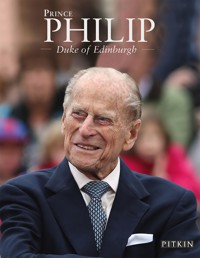
As the longest serving royal consort in British history (1921-2021), this fully-illustrated guide celebrates Prince Philip's remarkable contribution to the monarchy. A strong character full of vigour and verve, he found himself married to the most famous woman in the world, Queen Elizabeth II. They married for love and, although at times this man with strong opinions and enthusiasms of his own has found it hard to play a subordinate role, he has always been the Queen's rock and support. Prince Philip, the Duke of Edinburgh, grew famous for speaking his mind, but as his loyalty to his wife and country and his devotion to duty became apparent, he has become a national treasure and a figure of great respect to the British public. His marriage, fatherhood, early and distinguished career as a 1st Lieutenant in the Royal Navy are all detailed, including the Duke of Edinburgh Awards that have changed the lives of many young people. This commemoration of the Duke of Edinburgh, highlights how Prince Philip, as royal consort, has left an ongoing legacy not only to the sovereignty of Britain but also to his beloved royal family. Her Majesty has never hidden the extent of her reliance on Philip, the man she has called: 'My strength and stay all these years.'
Sie lesen das E-Book in den Legimi-Apps auf:
Seitenzahl: 97
Veröffentlichungsjahr: 2021
Das E-Book (TTS) können Sie hören im Abo „Legimi Premium” in Legimi-Apps auf:
Ähnliche
















Navy ‘whites’ are worn by Prince Philip during the Royal Salute at Kiribati on a tour of Australia and the South Pacific in October 1982.
Prince Philip arrives at Royal Ascot in June 2007.
CONTENTS
A Momentous Meeting
Family Background
A Boy is Born
Early Days – and Exile
School Days and Holidays
Gordonstoun
Into the Royal Navy
An Auspicious War
A Secret Engagement
Permission to Marry
A Royal Wedding
Married Life
A Trip to Paris
Fatherhood
A Happy Time
Carefree Days
Conquering Canada
Becoming Consort
The Coronation
A Life of Duty
Man of Action
Philip at Home
Joy and Sorrow
A Long and Happy Marriage
A Life of Service
Reflections on a Long Career
A MOMENTOUS MEETING
The Royal Yacht Victoria and Albert made stately progress along the Devon coast in late July 1939. On board were King George VI, his wife, Queen Elizabeth, and their two daughters, 13-year-old Princess Elizabeth and her younger sister, Princess Margaret Rose.
The sisters, happy to be reunited with their parents, newly returned from a triumphant tour of North America, were enjoying this excursion to the Royal Naval College at Dartmouth, where the King, who had been a cadet there a quarter of a century earlier, was to undertake an inspection. The weekend weather was warm and sunny, belying the dark clouds of war that were gathering over Europe.
On board too, attending the royal family to whom he was related, was Lord Louis Mountbatten. With him was his nephew, Prince Philip of Greece, a Special Entry recruit into the Royal Navy who was being fast-tracked through Dartmouth on a three-month initial officers’ training course. Philip, just turned 18, tall and handsome with blond hair and bright blue eyes, entertaining and personable, was invited for dinner on Saturday 22 July. The Princesses, looked after by their governess, had their supper in the nursery. But the following day Philip was detailed to entertain his young cousins when it was revealed that mumps and chickenpox in the college prevented the Princesses from attending a planned service in the chapel.
They played with a train set before Philip, becoming bored, encouraged the sisters into the grounds where he impressed the girls by showing his prowess at jumping tennis nets before setting up a game of croquet. Elizabeth, ‘Lilibet’ to her family and friends, was dressed identically to Margaret, both wearing neat double-breasted light coats, knee-length white socks, sensible shoes and berets. Just in her teens, slight and slim, Elizabeth was still childlike. But that meeting was one she did not forget and, when the royal party set sail, the young Princess picked up a pair of field glasses to watch Philip as he valiantly rowed in their wake until they left him far behind.
The Royal Yacht Victoria and Albert, with the young Princess Elizabeth on board, steams towards the Royal Naval College, Dartmouth, on 22 July 1939.
Their first meeting at Dartmouth Royal Naval College: the 13-year-old Princess Elizabeth sits towards the far left of the photograph, while her future husband, Prince Philip of Greece, in a white-topped cap, is seen laughing and chatting at the back.
It is likely that Princess Elizabeth, then heir presumptive to the British throne, knew of her cousin’s turbulent and often sad family background. It is likely that, protected by nannies, her governess and by the rigid protocol that surrounded her family, she found Philip an exciting and romantic figure. It is thought by many that the 13-year-old fell in love that weekend and set her sights unswervingly on the man who was to become her husband and lifelong companion in one of the most remarkable partnerships in the history of the British monarchy.
At 18, Philip, an able and talented young man, had a promising naval career ahead, accelerated by the fast-approaching war. He left Dartmouth with the King’s Dirk, the prize for the best all-round cadet of his intake. Family circumstances meant that he was virtually homeless, living at boarding school or with his grandmother, Princess Victoria of Hesse, Marchioness of Milford Haven, or with one of his English uncles. He was self-reliant, a leader and a man able to deal with whatever life threw his way. But when Princess Elizabeth, who became his wife in 1947, acceded to the British throne early in 1952, he provided the support that she needed, giving up any hopes he might have had of a separate career. In doing so he still remained his own man, acting in his own inimitable way as an ambassador for Britain, a forthright participant in the daily rota of visits, engagements and ritual that is the lot of senior members of the royal family.
Young and handsome: 18-year-old Prince Philip.
FAMILY BACKGROUND
Queen Victoria was great-great-grandmother to both Queen Elizabeth and Prince Philip, each being born after her death in 1901. But although they had an illustrious ancestor in common, their upbringing could not have been more different.
Elizabeth was the beloved elder daughter of the Duke of York who, at the time of her birth, had no idea that he would become King. He was the younger son of King George V. His ‘Lilibet’ became the King’s first granddaughter. Her childhood was secure, comfortable and cosseted.
Philip was born on 10 June 1921 on the dining table of his parents’ villa, Mon Repos, on the island of Corfu. His father, a prince and a soldier, was commanding the Greek army’s 12th division in Asia Minor and did not see his son until three months after his birth. His mother, Princess Alice, and his four older sisters lived in the house which had been left to the family by his paternal grandfather, George I of Greece, who had been assassinated in March 1913. Philip’s uncle, Constantine I, who assumed the Greek crown during the first Balkan War, suffered exile, as did his father, Andrea. Another uncle, Alexander, who briefly took the crown during Constantine’s exile, was bitten by a monkey and died of blood poisoning. His Russian relations had been murdered in 1918. Philip was barely a year old when his father narrowly escaped being sentenced to death by the new republican Greek government. He and his family fled their villa in Corfu into exile.
They settled, eventually, in Paris where they lived at St Cloud in the lodge of the substantial house of Andrea’s elder brother, Prince George (known to the family as ‘Big George’), who was married to the wealthy Marie Bonaparte. By the time Philip was nine, his mother had become ill and had been taken to a Swiss psychiatric sanatorium. Philip had already been sent to Cheam, an English preparatory school, his father had moved to a small flat in Monte Carlo, while his four sisters had married and moved away. The family had broken apart.
Although Prince Philip was, briefly, sixth in line to the Greek throne, he has no Greek blood; in fact he descends from a Danish family. His grandfather, King George I of Greece, was born Prince William of Schleswig-Holstein-Sonderburg-Glücksburg in 1845 in Copenhagen. Suddenly, Prince William’s father became King Christian IX of Denmark and a delegation arrived from Greece to ask William to become their king. William, just 17 and now King George I, arrived in Athens, having given up a naval career to rule a turbulent people in a distant land. He married a Russian noblewoman, Olga, niece of Tsar Alexander II. They had eight children (one of whom, baby Olga, survived just seven months), the last but one being Andrew, known always as Andrea, Prince Philip’s father.
Queen Victoria smiles at baby Alice (later Prince Philip’s mother). Alice is held by Princess Victoria of Hesse, the Queen’s granddaughter. Also in the picture is Princess Beatrice, aunt to the younger Victoria and daughter of the Queen.
Princess Elizabeth was christened at the private chapel at Buckingham Palace in May 1926. Here she is held by her mother, the Duchess of York, who is seated next to Queen Mary. Standing behind them are King George V and the Duke of York.
Philip’s family in 1906, 15 years before his birth. His grandmother, Princess Victoria of Hesse, holds his sisters Margarita and Theodora; seated on the right is Alice, Philip’s mother (Princess Victoria’s daughter); seated on the left is Alice’s sister Louise, at the time Queen of Sweden. Standing on the left is Prince Louis of Battenberg, Victoria’s husband, and next to him is his son-in-law, Prince Andrew of Greece, father to Philip and his sisters. Sitting at the front are Victoria’s two younger children (Philip’s uncles), Louis and George Mountbatten.
Philip’s mother, Alice, was the daughter of Queen Victoria’s granddaughter, Princess Victoria, who married the larger-than-life Prince Louis of Battenberg. He went on to become First Sea Lord and 1st Marquess of Milford Haven and with Victoria, he produced four children. The eldest, Alice, Philip’s mother, despite being born deaf, was noted for her beauty, poise and cleverness. Their youngest son, also Louis but known as ‘Dickie’, became Admiral of the Fleet, Earl Mountbatten of Burma.
Andrea met his future wife in 1902 when both were guests at the coronation of King Edward VII, which had been delayed because of the King’s sudden appendicitis. The young couple fell in love and became engaged.
In May 1903, King Edward VII, now safely crowned and recovered from his appendectomy, agreed that Alice and Andrea should be married. The wedding took place five months later at the Hesse family home, Darmstadt, just south of Frankfurt. It was a magnificent affair lasting two days, with guests from many royal families, including Andrea’s cousin, Tsar Nicholas II, son of his aunt Dagmar. The Tsar’s wife, Alix, was Alice’s aunt.
Alice, not yet out of her teens, was welcomed warmly into her bridegroom’s family home in Athens and the first 10 years of her married life saw the birth of three daughters: Margarita, Theodora and Cecile, Prince Philip’s older sisters. This was a troubled time in Greek politics, culminating in the onset of the Balkan Wars in 1912. Alice, while still enjoying family life at home with her daughters and travelling widely to England, Germany and Russia on family visits and to attend christenings, weddings and funerals, also became deeply involved in serving her new people. She started by organising the mass fabrication of warm clothes for the Greek troops, setting the pupils at the Greek School of Embroidery the task of making thousands of jackets and hoods for the fighting men.
Prince Andrew of Greece, Philip’s father, in 1913.
Her husband, Andrea, a lieutenant-colonel in the Greek army, was posted to Larissa on the former Turkish border. Alice went with him and was appalled by the awful sights of war and the lack of facilities to care for the wounded brought back from the front. She set to commandeering buildings and vehicles, organising doctors and nurses and founding field hospitals, rolling up her sleeves and helping the nursing staff and doctors, doing all she could to tend the wounded and care for the dying. Alice did not falter at the sight of bloody heads and shattered limbs; she assisted at amputations and became adept at bandaging the terrible wounds. Her three young daughters stayed behind in Athens with their grandparents.
Princess Alice of Greece, Philip’s mother, in 1913.
Philip’s four older sisters in about 1915: left to right are the Princesses Theodora, Sophie (the baby), Margarita and Cecile.




