


8,99 €
Mehr erfahren.
- Herausgeber: THP Ireland
- Kategorie: Sachliteratur, Reportagen, Biografien
- Sprache: Englisch
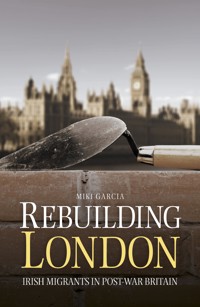
The years immediately after the Second World War were known as the decade of disappearing Irish – the peak period of emigration since the Great Famine. Many of these migrants went to Britain and played a key role in the rebuilding the country after the ravages of war. Their legacy, both in bricks and mortar and also in their cultural and social influences, can still be seen today. Following a brief overview of Ireland and Britain during the post-war years, this book explores the economic and social factors of migration, the work, such as navvies and nurses, that the migrants found in Britain, and the various support systems, such as the Church, pubs, Irish clubs and charities, that were formed as a result, and which created a vibrant legacy that survives to this day.
Das E-Book können Sie in Legimi-Apps oder einer beliebigen App lesen, die das folgende Format unterstützen:
Veröffentlichungsjahr: 2022
Ähnliche

















REBUILDINGLONDON
First published 2015
The History Press Ireland
50 City Quay
Dublin 2
Ireland
www.thehistorypress.ie
© Miki Garcia, 2015
The right of Miki Garcia to be identified as the Author of this work has been asserted in accordance with the Copyright, Designs and Patents Act 1988.
All rights reserved. No part of this book may be reprinted or reproduced or utilised in any form or by any electronic, mechanical or other means, now known or hereafter invented, including photocopying and recording, or in any information storage or retrieval system, without the permission in writing from the Publishers.
British Library Cataloguing in Publication Data.
A catalogue record for this book is available from the British Library.
ISBN 978 0 75096 691 7
eBook converted by Geethik Technologies
Typesetting and origination by The History Press
CONTENTS
Acknowledgements
Introduction
1. Ireland
Making a Living
The Church
Emigration
Social Outcasts
2. BRITAIN
Attractions
Irish Status in Britain
Working in Britain
Harsh Realities
London Life
3. MIGRANTS AT WORK
Navvies
Irish Employers
Public Services
The British Army
Domestic Workers
West End Theatre
White-collar Work
Trade Unions
The Connolly Association
4. SUPPORT SYSTEMS
The Church
Catholic Institutions
Catholic Clubs
Pubs and Clubs
Dancehalls
Independent Charities and Groups
Sporting Groups
Gaelic Cultural Groups
Independent Groups
County Associations
Epilogue
Bibliography
Notes
ACKNOWLEDGEMENTS
Thank you so much to all of the people who answered my questions and inspired me along the way: Peter O’Driscoll, John Jones, James O’Sullivan, Doris Daly, Jim Duggan, Tony Donovan, Maureen Fitzgerald, Michael Doyle, Séamus O’Cionnfhaola, Pat Griffin, John Hurley, Robert Sheehy, Brendan O’Sloan, Steve Martin, William Thompson, Bernard Canavan and Áine Ní Lanagáin.
I would like to thank to all the librarians and workers at the various libraries, archives and research centres for helping me to find documents and photos. I am also grateful to the Irish Embassy in London.
I am also deeply indebted to my editor, Beth Amphlett, for professionally dealing with my persistent demands and helping to make this book happen.
And finally, thank you to all the people who allowed me to share their stories at Arlington House and on the streets of London, as well as at various Irish centres over a cup of tea.
All images are provided courtesy of Brent Council, Brent Archives.
INTRODUCTION
This book considers the role of Irish migrants and, in particular, how they worked and lived – primarily in London – during the peak years for immigration after the Second World War.
The war took away the majority of capable young men – more than 3.5 million served in the British Army. To replace their workforce, women and immigrants took the jobs formerly performed by men. After all, Britain needed to keep the country going before, during and after the war, and to rebuild the bombed and destroyed infrastructure.
The Irish had been the most substantial minority group within the British population from the eighteenth century onwards. For approximately 100 years before the Great Famine in the mid-1850s, the Irish had been a strong and stable workforce in Britain who came in droves to harvest, heave coal and work in all kinds of industries to develop the country. The Great Famine was a decisive historical event as it pushed more than a million Irish people out of Ireland – chiefly to North America, but also to Britain and other countries. The impact of the Irish immigrants was especially significant in politics, in the labour market, trade unions and the Roman Catholic Church on both sides of the Atlantic.
A steady stream of Irish immigrants had been flooding into the US but the direction of the mass migration eventually turned back to Britain due to the aftermath of the Great Depression in the 1930s, as well as the strict immigration laws introduced by the American Government.
The establishment of the Irish Free State in 1921 had failed to pave the way for economic growth. For most people, emigration was vital for survival rather than an opportunity for a better future. The fact that the State was neutral during the Second World War made ordinary people’s lives even harder. After the war ended, the Republic of Ireland’s economy remained dormant, even though other western European countries were enjoying the post-war reconstruction economic boom. The Irish economy simply could not cope with the strains of independence, despite the fact that the country received a substantial amount of post-war aid. During the 1950s, the gross national product, or GNP, continued to decline each year and Ireland officially had the most sluggish economy in Western Europe, typically dubbed as ‘a capitalist country without capital’. In Ireland, times were hard, with no job prospects, bleak rural life, unfair marriage practices and an inflexible Roman Catholic Church, amongst other things.
It is unsurprising, therefore, that Irish emigration in the 1950s was at its highest since the Great Famine. Attracted to the post-war reconstruction boom between 1951 and 1961, more than 400,000 people – or one-sixth of the population – crossed the pond. Within this group, two-thirds of Irish immigrants ended up in London. According to the British Census of 1951, one-third of the people born in the twenty-six counties were living in Greater London. Because the majority of the post-war immigrants from Ireland were Catholic, rural and from the South, the term ‘Ireland’ in this book generally is used for Republic of Ireland, and ‘the Irish’ are the people from the Republic.
Going to British cities was more like a rural-urban internal migration, just like Scottish or Welsh people moving to larger English cities; it was a completely different situation from the transatlantic or long-haul international migration. Irish emigration to Britain has often been done as a result of rather impetuous decisions, and the principal reason has always been economic. A lack of major industries in Ireland resulted in very little opportunity for steady employment. Britain, meanwhile, offered jobs that were not available in Ireland. Close geographical proximity and historical connections made London and other British cities popular as major centres of Irish settlements.
During the post-war years, scores of newcomers who were arriving in British cities on a daily basis had to fit in as quickly as they could amid changing political, economic and social climates. Compared to other immigrants from Commonwealth countries, Irish people’s cultural and characteristic similarities to the British ensured that Irish people remained in ‘a curious middle place’ within the British system. Their de facto British status and invisibility within British society made their lives slightly complicated, as they were called ‘citizens of the Irish middle nation’.1
To cater for Irish immigrants’ specific needs, social clubs, county associations, dancehalls, newspapers, GAA clubs, religious and non-religious charities and Irish businesses quickly sprang up, forming a thriving Irish community. Priests and nuns also played a significant part in Irish immigrants’ lives. As British rule had influenced Ireland for such a long time, Irish people know what it meant to be treated unfairly. To fight against injustice, albeit in a different context, Irish trade unionists had indispensable roles in all industries.
The two most conspicuous Irish occupations during the post-war reconstruction period were nurses – who were the backbone of NHS hospitals from its inception – and navvies, who were involved in building all essential infrastructures. Quite a few construction workers who came to England with little or no money in their pockets eventually became wealthy and successful businessmen, simply by seizing the moment. Some of the most prominent people who have become synonymous with large company names are John Murphy from County Kerry, Pat McNicholas from County Mayo, Michael Clancy from County Clare, Pat Fitzpatrick from County Cork, Michael Joseph Gleeson and Peteen Lowery both from County Galway, to name but a few. Needless to say, these bosses were always partial towards hiring their own countrymen, who were incessantly arriving.
It is not an exaggeration to say that without their hard work and sweat, Britain would never have been rebuilt after the war. As Donall MacAmhlaigh, the author of An Irish Navvy: The Diary of an Exile, put it: ‘Here in Dublin, there are Irish of all kinds – rich, poor, intelligent and ignorant – but in England, for the most part, there is only one kind of Irishman and that is the worker.’
This was especially true during the post-war period.
1
IRELAND
It is a good country to die in.You can always get a good funeral in Ireland.But it is not a good country to live in.It is a country of enormous funerals.Priests, policemen, publicans and politicians.
John Broderick2
You cannot talk about Ireland without addressing its history of emigration. Some of the distinguished characters of the history of Ireland can be explained through British colonisation, oppression and, as a consequence, poverty and emigration. Most famously, Ireland is known for the Great Famine, a key point in the history of the Irish Diaspora. However, Irish people have been populating all corners of the globe for centuries. The vast majority of Irish migrants were involuntary immigrants, who had to leave in large numbers to survive or earn a living, especially when times were bad. The people who left home believed that there was a better life elsewhere.
The establishment of the Irish Free State in 1922, which consisted of twenty-six counties (officially later renamed Éire), didn’t change much for the better. The biggest change was that after the British were gone, Catholic Church authority became clearly visible in all aspects of Irish life and, arguably, more powerful than the Free State government.
Ireland was neutral and didn’t join the Second World War. The wartime neutrality cost Ireland and Irish people politically and economically during the post-war years. Most imports, such as coal and food, were stopped during the ‘Emergency’. In terms of the North-South political relationship, neutrality reinforced partition and strengthened unionist rule in Northern Ireland, which became the serious problem of the post-war isolation of the northern Irish Catholic community. Consequently, a large inflow of post-war Irish immigrants contributed to the Irish Republican Army activities in Britain in the subsequent years of the Troubles.
Referring to a mass exodus from Ireland, the post-war period was famously described as ‘the decade of the vanishing Irish who disappeared in silence’.3 During this decade, one of the most popular Irish songs was called ‘The Boys of Barr na Stáide’, written by Irish poet Sigerson Clifford. It is about his childhood friends in Cahirciveen, Kerry, who fought the Black and Tans, and had a good time with him but are now all scattered: ‘And now they toil on foreign soil, where they have gone their way, deep in the heart of London town or over in Broadway.’
MAKING A LIVING
People migrate for all sorts of different reasons, be they economic, political or social. Their motives and migration routes also vary, depending on their education, gender, age and family background. The general ‘push factors’ that drove Irish people out of the country during the post-war period was mainly economic, due to the lack of steady employment opportunities, particularly in rural areas. But the situation was a vicious circle: underdeveloped areas in Ireland remained the same due to a lack of a workforce as capable people who should have been productive had left in search of work.
The most common reason for Irish citizens to leave their homeland has been always to earn a living. An Anti-Partition League report of 1957 surmised that Irish people lacked national sentiment, particularly in the younger generations. The report shows that the primary concern for the vast bulk of the Irish-born population was to make a living and, if possible, ‘put some money aside’.
When the Irish Free State was established in 1921, everybody expected that the state would soon become industrialised and transform the whole region. Sadly Ireland was unable to recover from the slump and continued to suffer from the debts incurred in the civil war. William T. Cosgrave from the Cumann na nGaedheal government was more focused on improving the agricultural sector rather than industrialisation. As a result, de-industrialisation became a common sight in most parts of Ireland, which remained part of the British market. As a matter of fact, the majority of Irish industries in Ireland were either owned or controlled by the British.
Instead of attempting to improve the situation with new economic policies, the Irish people concentrated on restoring Irish culture such as Gaelic language, music and sport and the rigid values of the Catholic Church. This meant that even creative people, such as writers and artists, joined the migration trend due to the rigid censorship establishment after the Censorship of Publications Act came into force in 1929. In 1950, poet Robert Graves famously described this as ‘the fiercest literary censorship this side of the Iron Curtain’. Cork writer Frank O’Connor was also critical of the government: he saw it as attempting to destroy the character and prospects of Irish writers in their own country. John Broderick, a writer from Athlone who migrated to England, described Ireland as ‘very self-destructive’. His book The Pilgrimage was among countless books that were banned in Ireland. Whether one likes it or not, however, taking a boat was a sensible thing to do. Patrick Kavanagh wrote in his autobiographical novel The Green Fool:
I decided to go to London. Ireland was a fine place to daydream in, but London was a great materialist city where my dreams might crystallize into something more enduring than a winning smile on the face of an Irish colleen – or landscape.4
Because so many people left between 1841 and 1961, the population of Ireland was almost halved. Late marriage and low marriage rates also contributed to the population loss throughout post-war period. The standard of living was getting worse rather than better. The Republic’s total labour force in the 1950s was almost the same as at the foundation of the state.
The post-war period of reconstruction was a time of great progress in some European countries. While these countries began to enjoy a better standard of living, the Republic of Ireland – which came into force and was renamed in 1949 – was stagnant in many ways and suffered from chronic unemployment and emigration throughout the decade. Ireland was the only country in Europe in which the consumption of goods and services fell, and frequent strikes, such as the Dublin Unemployed Association marches in 1953, only highlighted the severity of the problem. Although the Irish Republic became independent and received a substantial number of grants and loans by 1950, Irish unemployment still depended very much on conditions in Britain and Ireland was thus unable to become self-sufficient or build its own industries.
The agricultural sector was not performing well, either. The drudgery of rural life resulting from the lack of power, water and sanitation only encouraged farmers to leave. During the post-war years, many small farmers gave up agriculture as they could not afford new technologies to compete with bigger farmers with land and so were not able to support their families. As few employment opportunities were available in rural areas in Ireland, they were left with no choice but to go elsewhere. Consequently, the country lost a large amount of farmers. Between 1950 and 1959, three government departments – Agriculture, Local Government and Lands (a scheme restricted in the Gaeltacht, or Irish-speaking region) – provided grants for the installation of water in rural homes, but by 1959, only 1,600 households had benefitted from these schemes (as many of them had gone by this time). Subsequently, by 1961, agriculture had declined by nearly 50 per cent, to a level not seen since 1926 and the agricultural industry lost its position as the leading employment sector.
The Irish Government did not completely ignore the issue of population decline, although it was not really keen on preventing its citizens leaving the country. In 1948 it set up the Commission on Emigration and Other Population Problems, acknowledging for the first time that emigration was an integral feature of Irish economy and needed to be considered in the policy-making process. After seven years, the commission finally issued The Report in 1955, which analysed the current situation such as the impact and patterns of emigration and its consequences. The government did not encourage emigration, but The Report did not offer any concrete solutions or remedies to stop it: because ‘going away’ was the country’s real solution. The Leader magazine reported that many politicians were privately more relieved than disturbed by the post-war emigration, because ‘if emigration were to be stopped tomorrow conditions favourable to social revolution might easily arise’.
In a mediocre and rather vague attempt, however, the government did ask its people who had already left to come back. On 2 January 1950, the Cork Examiner printed an article entitled ‘Not enough skilled labour for building programme “Return”, says Taoiseach, or Prime Minister, to emigrants’:
Speaking on the government’s housing programme in a talk broadcast from Radio Éireann last night, An Taoiseach (J.A. Costello) said that during the Second World War, many of Ireland’s skilled workers had emigrated. It was now desirable, as well in the nation’s interest, that they return home. They would find work in Ireland at payment rates at least as good as, if not better than, what they earned abroad, and they would have an assurance that for the foreseeable future, they would have constant work in the building industry. There were over 100,000 homes to be built, said An Taoiseach, and by the time that number was completed, a great many more houses would require reconstruction. We had not enough of skilled men and we needed these urgently if we were to get on with the job…the new state inherited a really formidable and terrible burden of slums hovels and insanity dwellings. Years of neglect and over crowding in cities and towns during the nineteenth century produced shamefully bad housing conditions, particularly in Dublin where the slums were a disgrace to any civilised people…the Government recently announced their decision to undertake a programme costing over the years about £120 millions, which would provide 110,000 new dwelling houses in ten years and within seven years, would adequately equip the country with modern hospitals. That programme was now being put into effect with accelerating speed so as to provide now houses in all parts of the country as well as 33 new hospitals…Christian family life required a decent dwelling for every family…
This evasive and rather controversial article was read by many Irish immigrants in England with interest. The majority of them responded to it with scepticism, annoyance and even anger. One of them, Micheal O’Siochain, wrote a letter to the editor:
It is quite obvious that it applied only to skilled building workers … it doesn’t seem to be a call that is received here with the enthusiasm that a national call of its apparent urgency is entitled to.
Despite the economic depression in the country as a whole, the capital of the republic was undergoing a transformation. In the 1950s, there were plenty of employment opportunities in Dublin. The Bord Failte, or tourist board, was created in 1952. Trams had been phased out, and so tram tracks were removed from the streets. Buses were typically packed at the weekend for those migrant workers from rural areas to go home. Long-awaited development and slum clearance plans were executed. Scores of cottage houses were built rapidly, along with hundreds of balcony block flats and council buildings.
Dublin Airport expanded rapidly; runways were extended and terminals were enhanced in order to deal with foreign airlines such as British European Airways, Sabena and BKS Air Transport. Subsequently, Ireland’s own airline, Aer Lingus, grew swiftly with the help of economist Garret FitzGerald, future Taoiseach. Its first transatlantic flight from Shannon-Dublin to New York was in 1958. Although it was still expensive to fly for the average person, the development of Shannon Airport brought a large number of Americans to Ireland. Used as a refuelling stop, Shannon Airport was the entry point into Europe. American presidents, politicians, film stars and high-profile business people stopped over and, as a result, the first duty-free shop was opened here. This is also the place where Irish coffee was invented and served for the first time.
The post-war period was seen as a complex and tumultuous time for the Irish economy until the Secretary of the Department of Finance, Kenneth Whitaker, called for free trade and an end to protectionism. His White Paper, entitled The First Programme for Economic Expansion and published in November 1958, became a landmark in Irish economic history and Ireland finally underwent structural reforms in the 1960s.
THE CHURCH
Even though the post-Famine years were long gone, the landlord mentality and logic lingered on in society and made ordinary people’s lives intolerable. On top of this, the Church became a dominating figure and represented the ultimate authority in Ireland.
English control, begun in 1171, continued to influence the Irish way of life and helped form national as well as religious identities of Irish people. Since the establishment of the Irish Free State in 1922, the control exerted by the Roman Catholic Church became more conspicuous, particularly in the fields of education, health and welfare services. Catholicism played a critical part in the formation of Irish society and it was overwhelmingly the centre of people’s lives, whether one was religious or not.
After the post-Famine period, the Roman Catholic Church in Ireland embarked on major church-building projects in both rural areas and towns. As a result, churches prospered all across Ireland and they often had six Masses on a Sunday to accommodate a vast number of churchgoers who flocked to fulfil their religious obligations.
Because religious practices were rife, it was not unusual that work was frequently interrupted. Jim Duggan from Waterford, who came to London in the 1950s, recalled his workplace in Ireland: ‘When the bells of church rang at 12 o’clock each day, we had to kneel down on the job and say the angelus prayer. And there was a prayer meeting during the day, too.’5
Local newspapers in Ireland unanimously carried news on the Pope and the Catholic Church catechism and propaganda on a daily basis, as well as all kinds of stories related to Catholicism around the world. Catholicism dominated everyone’s life. The Catholic Church soon became so powerful that it was able to enforce censorship in newspapers, books, advertisements and arts, especially in the areas that were considered against Catholic dogma, such as sexuality.
During this period, Church-run institutions such as industrial schools, homes for unmarried mothers, Magdalene laundries and other institutions gained absolute authority. Some of them existed for many decades prior to the 1950s and grew to be authoritarian institutions, regardless of their original intention. In many cases, those children and grown-ups who had to endure abuse there were left in appalling physical and psychological circumstances.
Although the Church did not assume an obvious political role, its influence in government became increasingly conspicuous. One of the examples was the Mother and Child Scheme, which was proposed by the Minister for Health Noel Browne in 1950. The scheme was intended to provide free maternity care for mothers and healthcare for children, but the then Archbishop of Dublin, John Charles McQuaid, among others, feared that the scheme would pave the way for abortion and birth control.
Direct intervention by the Catholic Church in public life like this was not unusual; the Catholic Church typically encouraged traditional women’s roles such as wives and mothers, and church authorities were adamant that it was the right of parents to provide the care for their children. This healthcare programme was engulfed in crisis from the beginning, simply because it had provoked the hierarchy. Browne’s proposal ended disastrously as he was isolated and did not receive any support from his colleagues at all. The government yielded, as was often the case when the Church and State came into conflict.
During this time, the Irish Department of Health was conscious that Britain was developing the welfare system, but showed only lukewarm interest. Fianna Fáil’s Social Welfare Act in 1952 rationalised and finally extended national health insurance, unemployment insurance, and widows’ and orphans’ schemes. But compared to Britain, which by this time included Northern Ireland, benefits in the Republic were relatively meagre and not for all.
EMIGRATION
Many politicians such as James Dillon, the leader of Fine Gael at that time, were aware that a substantial number of people left not simply due to economic pressure, but also for other reasons; he suggested that these emigrants consisted of ‘some of whom had the temerity to be already above the poverty line, to improve their own condition and even that of their children’. The Report by the Commission on Emigration also suggested that emigration was rife even where land was relatively good. James Dillon concluded that ‘even employed persons are leaving their jobs for more highly paid employment in Britain’.
One of the main social reasons – especially for women – to emigrate was unfair marriage practices. Marriage in Ireland was at one time directly linked to land ownership. But after the Great Famine, rather than the traditional custom of subdividing land between siblings, only one child would inherit the land.
The typical marriage arrangement (which remained in place until the 1950s), especially for medium and large farmers, was the ‘match’: an arranged marriage for the son nominated to succeed to the family farm. The match reflected parental control, as well as that of the husband-to-be: the woman had to bring a dowry, or ‘fortune’ as it was called, with her. The money was typically used to support the other children in the household, and often assisted their emigration.
This marriage practice almost made it impossible for women to even find a husband to get married locally. As a result, many women remained single or emigrated, as they could not afford dowries, while male siblings who could not inherit the land also contributed to the high rate of emigration. There is a strong connection between high emigration and low marriage rates, as they were the products of the same root cause.




