


3,99 €
Mehr erfahren.
- Herausgeber: Ali Ribelli Edizioni
- Kategorie: Sachliteratur, Reportagen, Biografien
- Sprache: Englisch
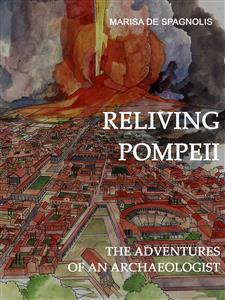
Reliving Pompeii tells the story of a unique archaeological adventure experienced by an archaeologist at the beginning of her career "forced" by circumstances to move from Rome to Pompeii, where she lived and worked for many years. The author lived in the ancient city of Pompeii and worked as an archaeologist in the Pompeian territory, bringing to light a Pandora’s Box of archaeological discoveries in an area afflicted by the presence of the Camorra crime organization.
Das E-Book können Sie in Legimi-Apps oder einer beliebigen App lesen, die das folgende Format unterstützen:
Veröffentlichungsjahr: 2017
Ähnliche



















- MARISA DE SPAGNOLIS -
RELIVING POMPEII
THE ADVENTURES OF AN ARCHAEOLOGIST
English translation by Jason R. Forbus
cover by Giuseppe de Spagnolis
layout by Sara Calmosi
Marisa de Spagnolis - Biosketch
Marisa de Spagnolis - photo by A. Durand
Born in Formia (LT) and originally from Itri Marisa de Spagnolis is a famous archaeologist, an official at the Ministry of Heritage and Culture, the author of over one hundred publications relating to her work in the Campania and Lazio regions. For her exceptional discoveries Marisa de Spagnolis has been invited to give lectures in Italy, Israel, Greece, and the United States.
Ms. de Spagnolis began her career at the Superintendence for Archaeological Heritage of Rome. In 1987 she then moved to Pompeii and began working at the Superintendence for Archaeological Heritage of Salerno, as the Director of the Office of Excavations for Nocera and Sarno.
She remained in the territory of Nocera - Sarno Scafati for ten years during which time there came to light numerous archaeological discoveries. Among which was the discovery of 540 prehistoric tombs in the Valley of the Sarno (comprised chronologically from the second half of the ninth century BC onto the sixth century AD.), In Nocera Superiore tombs from the V BC the V AD (among these Hellenistic tombs documenting the Homeric myth of Dionysos and the Tyrrhenian pirates, the funerary monument of a sutor from 1 AD) Hebrew inscriptions (which document the existence of a synagogue), the monumental Roman necropolis of the first century BC in loc. Pizzone, (with the tombs of Numisii, of Lutatii Cornelii); Nocera Inferiore the archaeological site of Piazza del Corso. At Scafati were unearthed numerous villas constituting the eastern suburb of Pompeii, buried by the eruption of Vesuvius in 79 AD, some of which have been explored (Villa Popidi Narcissi Maioris, Vesuvio Villa, Villa Cascone Sorrentino etc.) Funerary monuments including the monument to Gens Decia and the tomb of the most important Pompeian family at the time of Nero: the Lucrezi Valenti Almost all of the excavations carried out have been the subject of scientific publications. The story of the archaeological discoveries made during ten years of intensive excavations that took place among numerous difficulties is told in the book, “Ten years in Pompeii and the Sarno Valley.”
In 1997 she returned to Rome, where she was entrusted important excavations in the Province of Rome (discovery of the imperial villa of Cesare and Massenzio in San Cesareo) and also that of the province of Latina (where she dated the walls of the Porta Maggiore Norba and discovered the sanctuary of Hercules in Itri). From 2010 to 2012, she is given the direction of one of the most important museums in Italy: the Sperlonga National Archaeological Museum, where she organized numerous events and exhibitions and where, in the summer of 2012, she made the exceptional discovery of the remains of a Neanderthal man.
In 2014 with the book Mefitis and lucus Iunonis, she reveals the mysterious identity of the goddess of the springs of the Sarno.
Summary
Marisa de Spagnolis - Biosketch
Summary
Preface
Chapter I - First time in Pompeii
Chapter II – Arrival in Pompeii
Chapter III - The Sarno River Valley
Chapter IV – The territory of the Sarno River
Chapter V – Discoveries in the Pompeian Territory
Chapter VI - Nocera Inferiore: The Archaeological Area of Piazza del Corso
CHAPTER VII – Excavations and Threats in the Pompeian Territory
CHAPTER VIII – The N(umeri) Popidi Narcissi Maioris Villa
CHAPTER IX - The discovery of the monumental necropolis of Pizzone in Nocera
CHAPTER X - Villa Vesuvio and the Message of Love
CHAPTER XI – Nocera: The Shoemaker’s Tomb
CHAPTER XII - Farewell to Pompeii
APPENDIX – May 5, 1998 – The Sarno flash flood
To Maria, my daughter
There is only one way to live long: that is to fill one’s life.
Lucio Anneo Seneca, de Consolatione, XIX, 5
(uno modo multum est quod vivimus: si satis est)
Preface
This book is the English edition of “Con il Vesuvio sotto i piedi; le avventure di una archeologa vissuta negli scavi di Pompei”, in which I recount the story of my experiences as an archaeologist on the frontlines in a difficult territory rife with Camorra activity and the unique experience and emotions of having lived for ten years in the excavations of Pompeii.
The incentive for the realization of this edition in English I owe to my friend Dr. Helmut Engelhardt, a great lover and expert of archaeology, to whom I express my gratitude.
The greatest fortune for any archaeologist is undoubtedly to live in Pompeii, the city buried by the eruption of Vesuvius in 79 AD, which was so sudden and unexpected that panic seized the inhabitants. In the words of Pliny the Younger he tells us of the event, “The majority had formed the conviction that the gods no longer existed and that night would be eternal and the last one for the world.”
The lapilli, ash and lava have preserved the evidence of daily life, making it possible to recreate the stories and micro-stories, arts and crafts that made the towns affected by the eruption so unique. Pompeii is the most important archaeological heritage of Italy.
Destiny offered me the unique experience that only an archaeologist can imagine, to live inside the archaeological site of Pompeii itself and to work in an area that has unexpectedly revealed a veritable treasure trove of archaeological discoveries.
Structures and finds buried thanks to the eruption of Vesuvius of which they owed their destruction took on new life and told their story. Vesuvius had been responsible for their deaths but also of their revival.
As if from a Pandora’s Box day after day I pulled from the ground thousands of artifacts that allowed me to put together the pieces of a puzzle that changed the history of the area.
With this book, I want to relate what went on behind the scenes of my most important archaeological discoveries in the territory of Pompeii, Nocera, Sarno and to share the emotions of the life of a woman – archaeologist.
Chapter I - First time in Pompeii
My love of archaeology and my interest in the past have accompanied me throughout my life. This passion began to stir in me the first time I saw Pompeii, the legendary city located in the Campania region of southern Italy which was buried by the dramatic eruption of 79 AD. The account of Pliny the Younger details the final moments of Pompeii’s inhabitants, who had ignored the fact that Vesuvius was actually an active volcano.
It was 1964, I was fourteen years old. My father had organized a trip to Pompeii to visit a cousin of mine, an archaeologist who worked and actually lived inside the excavation site and who at the time was unknown to me. His name was Doctor Pietro Soprano; he was a scholar and a man of great moral stature who collaborated with the great archaeologist Amedeo Maiuri.
Lesen Sie weiter in der vollständigen Ausgabe!
Lesen Sie weiter in der vollständigen Ausgabe!
Lesen Sie weiter in der vollständigen Ausgabe!
Lesen Sie weiter in der vollständigen Ausgabe!
Lesen Sie weiter in der vollständigen Ausgabe!
Lesen Sie weiter in der vollständigen Ausgabe!
Lesen Sie weiter in der vollständigen Ausgabe!
Lesen Sie weiter in der vollständigen Ausgabe!
Lesen Sie weiter in der vollständigen Ausgabe!
Lesen Sie weiter in der vollständigen Ausgabe!
Lesen Sie weiter in der vollständigen Ausgabe!
Lesen Sie weiter in der vollständigen Ausgabe!




