


Erhalten Sie Zugang zu diesem und mehr als 300000 Büchern ab EUR 5,99 monatlich.
- Herausgeber: Parthian Books
- Kategorie: Sachliteratur, Reportagen, Biografien
- Sprache: Englisch
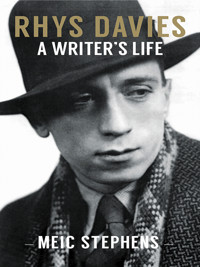
Rhys Davies (1901-78) was among the most dedicated, prolific and accomplished of Welsh prose writers. This is his first full biography, describing the early years of the Blaenclydach grocer's son, his abhorrence of 'chapel culture', his bohemian years in Fitzrovia, his visit to the Lawrences in the south of France, his unremitting work ethic, his patrons, his admiration for the French and Russian writers who were his models, his love-hate relationship with the Rhondda, and above all, the dissembling that went into Print of a Hare's Foot (1969), 'an autobiographical beginning', which proves to be a most unreliable book from start to finish.
Sie lesen das E-Book in den Legimi-Apps auf:
Seitenzahl: 456
Veröffentlichungsjahr: 2013
Das E-Book (TTS) können Sie hören im Abo „Legimi Premium” in Legimi-Apps auf:
Ähnliche


















Contents
Quotes
Title Page
1. The elusive hare
2. The Blaenclydach grocer’s boy
3. London legs
4. A visit to Lorenzo and Frieda
5. Among bohemians
6. Boy with a trumpet
7. The perishable quality
8. No need for compromise
9. Postscript
Acknowledgements
Bibliography
Illustrations
Copyright
Madame Bovary, c’est moi!
Gustave Flaubert,c. 1857
You complain mycharacters are gloomy. Alas, this is not my fault! They come out like that without my necessarily wanting them to, and when I am writing I don’t feel as though I am writing gloomily. In any case, I’m always in a good mood when I’m writing. It is a well-documented fact that pessimists and melancholics always write in a very upbeat way, whereas cheerful writers generally manage to depress their readers.
Anton Chekhov, in a letter to Lidia Avilova (1897)
Never trust the artist. Trust the tale. The proper function of a critic is to save the tale from the artist who created it.
D.H. Lawrence,Studies in Classic American Literature(1923)
Short stories are a luxury which only those writers who fall in love with them can afford to cultivate. To such a writer they yield the purest enjoyment: they become a privately elegant craft allowing, within very strict confines, a wealth of idiosyncrasies . . . Another virtue of the short story is that can be allowed to laugh.
Rhys Davies, in the preface to hisCollected Stories(1955)
Of all the liars the most arrogant are biographers, those who would have us believe, having surveyed a few boxes full of letters, diaries, bank statements and photographs, that they can play the recording angel and tell the truth about another human life.
A.N. Wilson,Incline our Hearts(1988)
That no personality is amenable to a single interpretation is a caveat which should be carried on the dust-jacket of every biography.
David Callard,The Case of Anna Kavan(1992)
Rhys Davies
A Writer’s Life
Meic Stephens
One
The elusive hare
Rhys Davies was among the most dedicated, prolific, and accomplished of Welsh prose-writers in English. With unswerving devotion and scant regard for commercial success, he practised the writer’s craft for some fifty years, in both the short story and the novel form, publishing in his lifetime a substantial body of work on which his literary reputation now firmly rests. He wrote, in all, more than a hundred stories, twenty novels, three novellas, two topographical books about Wales, two plays, and an autobiography in which he set down, obliquely and in code, the little he wanted the world to know about him.
So prodigious an output was made possible largely because he shared his life with no other person, giving it up entirely to his writing. By temperament a loner, and suspicious of the gregarious instinct in writers – a stance he assiduously cultivated in defiance of prevailing fashions and ideologies – he chose to keep himself apart, especially from other expatriate Welsh writers living in England between the two world wars. Except for a few years as a draper’s assistant on first going to London and a short stint of compulsory war-work, he managed to live almost wholly by his pen, his meagre income unsupplemented by any teaching, journalism, broadcasting, or hack-work of any kind. He sat on no committees, signed no manifestos, believed no political nostrums or religious dogma, never read his work in public, attended no foreign conferences, never edited a magazine, engaged in no literary squabbles, spurned all cliques, shunned the company of academics, had no taste or talent for self-promotion, joined no literary societies, never competed for a prize, never sat in judgement on his fellow writers as an adjudicator of literary competitions, and only very rarely as a reviewer of their books. He believed the proper business of a writer was to be writing.
Living in rented or borrowed accommodation from which he invariably soon moved on, he maintained a rigorous work-schedule, writing, eating and sleeping in one small room, and seldom seeking the opinion of other writers. He cultivated detachment as if by not fully belonging to any one place, or by not wholly identifying with any one coterie, he could preserve something of himself, something secret, his inviolable self, which he prized above all else. When immersed in a story, as he often was, he wrote a thousand words a day until it was finished. Domestic comforts, such as a home, a regular partner and some security of income, which make life tolerable for most writers, were not for him. He did not even turn to the anodyne of drink, which has sustained and destroyed so many: it just didn’t work for him, he once said, though he was not averse to the occasional glass in one of his favourite pubs. As for drugs, he had seen what they had done to the only woman he cared for, the heroin addict Anna Kavan.
There was a parsimonious, some said a mean streak to his nature. The virtues he extolled were the puritanical ones he had learned in his youth, namely thrift, a horror of debt, and minding one’s own business, the last of which he also took, rather surprisingly, to be a specifically Welsh characteristic. Although, after his move to London in 1921, he was sometimes to be seen at the Fitzroy Tavern or the Wheatsheaf, or one of Fitzrovia’s other famous pubs, he disliked excessive drinking and always gave the bibulous Dylan Thomas a wide berth. He was, in short, an urbane, mild-mannered, secretive, shy man whose only extravagance was sartorial: he had a taste for fine clothes, almost to the point of dandyism. He owned no furniture and was able to keep all his worldly possessions in a small trunk that went with him with every change of address. Nothing and nobody was allowed to interfere with his writing. This professional single-mindedness, deliberately cultivated, assiduously guarded and reinforced by his equanimity, love of solitude and modest material needs, enabled him to pursue a literary career uninterrupted by any of the emotional or domestic upheavals such as are to be found aplenty in his stories and novels.
There was, moreover, another important fact that needs to be noted at the outset, for it was central both to Davies’s life and to his work. Although he maintained complete discretion and ‘acted straight’, his sexual orientation was expressed as an attraction to other men. Yet most of those who knew him, like his younger brother Lewis, were at a loss to say who his sexual partners were because he never spoke or wrote about them in personal terms. Until the Sexual Offences Act of 1967, homosexuality in Britain was illegal and those who practised it were liable to prosecution and imprisonment. Nonetheless, Davies regularly sought fleeting encounters with strangers, often penurious Guardsmen, about whom he had a homoerotic fixation. He also had romantic crushes on younger, heterosexual men that were not reciprocated and so made him unhappy. But he enjoyed no lasting sexual relationship with another person, and with the women who found him kind, gentle, charming and excellent company, like Anna Kavan, the very type of difficult woman to whom he was drawn, he maintained strictly platonic friendships. Above all, he protected his privacy and independence, fearing intrusion into his inner life by anyone who came too close, man or woman.
Nevertheless, the reader will find many clues in Davies’s books that reveal him as a writer concerned with proclivities he dared not describe directly. Writing about growing up in Glasgow in the 1920s and 1930s, the distinguished poet and critic Edwin Morgan put his predicament as a homosexual like this:
To anyone of my generation, the inhibitions were enormous, and habits of disguise and secrecy, inculcated at an early age, are hard to break…I wanted both to conceal, and not to conceal.1
Every stage of Davies’s life and every aspect of his work was deeply implicated in his sexual identity, so that it is not difficult to read his books from this perspective alone. But reader, beware. The enigmatic title of his ‘autobiographical beginning’,Print of a Hare’s Foot, a most unreliable book from start to finish in that it often fails to tally with the known facts and disguises people and events with adroit use of smoke and mirrors, is in fact a reference to its author’s own ambiguous sexual nature. It conceals much more than it reveals.2
The book’s title was well chosen: the image of the hare, a lunar, richly secretive creature in folklore, said to change its shape while always remaining resolutely itself, sexually active, living by its wits and giving out misleading signals, a symbol of paradox, contradiction and transitoriness, both lucky and unlucky, damned in Deuteronomy and Leviticus as unclean and forbidden, an endangered species, lying low and leaving only the lightest of prints before disappearing into its form in its own mysterious way – this image was central to both Davies’s writing and his life. As M. Wynn Thomas puts it in his chapter inRhys Davies:Decoding the Hare, the fullest study of the writer so far published:
What better image could be found of Davies’s own situation relative to a homophobic culture? He could not just run free; he had to accommodate his movements, as man and writer, to the temper and tempo of his times. As a homosexual – however discreet, and however inactive – he found his identity was inexorably defined, and negatively constructed, by the dominant heterosexual culture.3
This need, and instinct, to dissemble, also explains to some extent the detached, almost clinical way in which Davies observed other people without becoming emotionally involved with them, except in so far as he was fascinated by the play of human emotion and made it the mainstay of his fiction. ‘A creative writer can’t afford to wave a flag’, he wrote in a BBC script in 1950. ‘He mustn’t write social propaganda or political speeches, his task is to look into the secrets of the eternal private heart.’ His detachment also accounted for the evasiveness with which he habitually responded to enquiries about himself. Asked by a publisher in 1954 whether he would write an autobiography, he told friends, ‘It would be too gloomy and the truth (what use is a book without truth?) wouldn’t bear telling.’4A brief autobiographical note he wrote in 1958 made it clear how reluctant he was to say anything that would reveal his true self:
The blankness of a page waiting for notes about myself is much more dismaying than page 1 of a projected new book. Temptations for Exhibitionism! So much to conceal, evade, touch-up!5
Such a man, such a writer, the quintessential misfit and outsider, again in Wynn Thomas’s phrase, ‘a lifelong cryptographer’, presents challenges for the biographer who has to know when the false trails deliberately laid down by Davies are leading nowhere and how to decipher the code in which he habitually wrote about the things that mattered to him. It is, of course, possible to read his work solely for the literary pleasure it affords, but for a fuller appreciation we have to know something about the writer’s personality and career that, thirty-five years after his death, are still recognisably contemporary and relevant. Although Davies was a man very much of his place and time, his achievement as a writer was that, by the mysterious process we call art, he left work that is timeless and universal, and that still speaks to the human condition.
At a time when so much English literary criticism seems to be the fruit of academic theoretical discourse, this book is a biography first and foremost, free of the methodology of fashionable exegesis. But for every biographer a writer’s life is soon inseparable from his or her art, the two going hand in hand, and so an attempt has to be made to throw light on the places, people and events that went to the making of Rhys Davies the man and writer, and to show how his life was indeed writ large in his books. It is left to others to examine his books from critical perspectives that shed more light on his literary achievement.
Notes
1. Edwin Morgan, introduction to the anthologyAnd Thus Will I Freely Sing(ed. Toni Davidson, Polygon, 1989)
2. Print of a Hare’s Foot: An Autobiographical Beginning(Heinemann, 1969; Seren, 1998); all subsequent quotations from the work of RD are from this book, unless otherwise noted.
3. M. Wynn Thomas, ‘“Never Seek to Tell thy Love”: Rhys Davies’s Fiction’,inRhys Davies:Decoding the Hare: critical essays to mark the centenary of the writer’s birth(ed. Meic Stephens, University of Wales Press, 2001); from now on this symposium will be noted asDecoding the Hare.
4. Letter to Redvers and Louise Taylor (22 May 1954)
5. Wales(ed. Keidrych Rhys, September 1958)
Two
The Blaenclydach grocer’s boy
For all his later dissembling and evasion, the plain facts of Rhys Davies’s early life are clear enough. He was born at 6 Clydach Road in Blaenclydach, about a mile from Tonypandy in the Rhondda Valley, on the 9th of November 1901 – not 1903 as he sometimes claimed. He was delivered by a midwife known in the village as Mrs Bowen Small Bag and his parents named him Rees Vivian.
Blaenclydach, with contiguous Cwm Clydach, makes up the continuous Clydach Vale, also named by the writer as his birthplace, and lies in the valley of the Clydach, a tributary of the Rhondda Fawr, which it joins downstream at Tonypandy. For local government purposes, the villages today form what Rhondda Cynon Taf Council designates as Cwm Clydach, and the two are sometimes jointly called Clydach, despite the existence of at least two other places of that name in South Wales. The demarcation between Blaenclydach and Cwm Clydach is not apparent to the visitor’s eye but clear enough to those who live there, one of the many micro-geographies in the Rhondda that are stoutly defended by their proud inhabitants.
As the historian Dai Smith, a native of Tonypandy, makes clear:
The boundaries of somewhere like Tonypandy are indefinable. Those who have lived there will tell you, within a street’s length or span where Tonypandy ‘proper’ began and Llwynypia ended, or where Clydach Vale swoops down to end in the ‘grander precincts’ of De Winton and Dunraven Street or when you have left Tonypandy and entered Penygraig. This intense delineation of territory is nothing to do with council boundaries, political wards or ancient land grants. It is certainly not to do with a separating, physical sense of place since all of mid-Rhondda, and, by extension, large tracts of the coal mining valleys in South Wales blur indistinguishably the one into the other.1
In other words, the Rhondda Fawr (the greater Rhondda) is a built-up area extending from Blaenrhondda at the top of the Cwm, down via Porth, where the river meets the Rhondda Fach (the lesser Rhondda), as far as Trehafod, near Pontypridd, at which point the waters of the Taf (ang.Taff) receive the Rhondda’s tribute before proceeding downstream to Cardiff.
For a description of Tonypandy in 1910 through an outsider’s eyes, this by a reporter sent to the Rhondda in the wake of the Riots of that year conveys something of the topography and living conditions in which the Valley’s people lived:
[Tonypandy lies] in a narrow winding valley confined by squat denuded hills upon whose bleak sides tower huge mounds of rock and rubbish excavated from the numerous coal tips. The river, sometimes almost dry, sometimes rushing down in tempestuous flood, but always pestilential with all manner of garbage and offal, is crossed and recrossed by the railway over which, all day and night, roll the never-ending coal trains on their way to the distant sea-port. The high road, where it may, runs its course alongside the odorous river, but for the greater part of its length it has to hug the steep slopes of the cheerless hills…long rows of steep gardens rise sheer from the roadside to a line of small stone-built four-roomed cottages. A paved alleyway at the rear, the length of the terrace, gives access to the houses, and from this narrow alleyway, another series of gardens continue the ascent to a similar row of cots, and so the terraces rear themselves until the topmost is reached from which the roadway, the pits, the railway and the river are seen in panoramic array. Each alley has one waterspout, common to all the homes in that row. The two tiny back rows are darkened by the overhanging gardens of the higher terrace, and the houses are so low that a man must stoop before entering.2
Rhys Davies, as a child and youth, was absorbed in the life of this place and, ‘born into it’, conveys in his writing like no other writer of his generation the very essence of its teeming life, what Dai Smith calls ‘the synaesthesia of the private’: ‘You do not, either in the end or in the beginning, go to Rhys Davies for the fact-of-the-matter, you go to him for the matter-of-the-thing.’ He is, too, ‘an incomparable guide’ to such sensations as:
its packed spaces of noise, its sudden spilling of light onto darkness when cinemas or variety theatres disgorge their audiences, or the sour mash smell of smoke-fugged saloon bars and the sticky sweetness beneath eiderdown covers as pink face-powder is washed off by the ravenous kisses of the young.3
The community in which Davies grew up suffered its share of fatal accidents caused by the mining industry. Most took place underground and were therefore not witnessed by the boy but, on the 11th of March 1910, there occurred an event, prefiguring the Aber-fan tragedy of 1966, which he saw with his own eyes:
Nobody had taken notice of the old sealed level piercing far into the lower slope of a mountain above rows of houses and a chapel and another school in that high part of the vale. It had been one of the pioneering coal-yielding levels, abandoned after the Cambrian colliery opened, and the thread of water always trickling from a low chink in its walled-up entrance went disregarded. One afternoon a roar was heard from this evil throat of the mountain. The sealed entrance had burst and a gigantic spout of black water hurled out, gathered impetus down the slope, demolished three terraced houses, bombarded the chapel, swept across the main road, flooded the full school, and found partial outlet in a steep gulley leading to the river. It poured for half an hour. Colliers going home from a shift heard the roar and reached the school in time for rescue. A baby, carried down from the smashed terrace houses, was snatched dead out of the swirl, and there were other dead. We were kept back in our school until the waters abated…We saw a stream of acid water coming from the floor of the jagged hole, quietly enough now. In the gaping middle of the terrace below, a brass bedstead hung from a broken room. There was an acrid smell of the mountain’s inside. The nine [sic] who lost life were buried in a great ceremonious funeral, there were benefit concerts for a fund, and for a long time afterwards, memories were dated from before or after The Flood.4
Davies’s parents kept a small grocer’s shop, known ‘for some far-fetched reason’ as Royal Stores, which stood with a few others just across the road from the imposing redbrick Central Hotel, a large public house, one of seven in the village, that features in his books as The Jubilee. The three-bedroomed house at 6 Clydach Road, where the family lived behind and above the shop, is distinguished from others in the row by a commemorative plaque put up by the Rhys Davies Trust in 1995.
Vivian, as he was known in the family, was the fourth child of Thomas Rees Davies and Sarah Ann Davies,néeLewis. His mother, before her marriage, had briefly been an uncertificated pupil-teacher (that is, one who taught younger children and was herself taught) in Ynys-y-bwˆl, near Pontypridd. At the time of the 1891 Census the Lewis family were living at 17 Thompson Street in the village and in 1895, at the time of Sarah Ann’s marriage, at 10 High Street. John Lewis, her father, is described as an underground timberman; there were two other daughters, and a son, who was a collier, that is, one who worked at the coal-face. The address given for Thomas Rees Davies on his marriage certificate was 84 Court Street, Tonypandy.
As so often in early twentieth-century industrial South Wales, when people were, at most, only two or three generations removed from working on the land, the writer subscribed to the mythology found, for example, in some of the poems and stories of Dylan Thomas, and widely disseminated, that presents the people of the coalfield as having lived in a rural paradise before they were plunged into the hell of industrialism. Davies claimed his forefathers ‘had lived in the deeper nooks of the restrainedly beautiful shire [of Carmarthen]; it was “the country” of my childhood ears, everlastingly green in my eyes, sweet-smelling in my broken nose’, though he had no personal experience of living in this lost Arcadia, visited only once or twice, and saw it through rose-tinted spectacles.
There was, it seems, little or no contact between the Davieses of Blaenclydach and their relatives in West Wales. There were no childhood visits and whatever conception the writer had of life there must have come from the lips of his Rhondda-reared mother. That his connection with what he called ‘my West Wales’ was mythic rather than actual accounts to a large extent for the fanciful element some of his critics have detected in his dealing with rural themes, in contrast with his much more authentic depiction of life in the Rhondda; one critic, Stephen Knight, has gone so far as to describe him as ‘a rural fantasist’.5
Rhys Davies once told a student who was writing a dissertation on him at the University of Brest that his father had been raised in an orphanage in Neath.6This may have been designed to put any future enquirer off the scent, something he was apt to do whenever he thought his privacy was being invaded. However, in the 1891 and 1911 Census reports his father’s place of birth was indeed given as Glynneath, although no evidence has come to light to show he was brought up in an orphanage. In fact, Davies’s grandfather, James Davies, a coal haulier in Tonypandy, had been raised in Merthyr Tydfil where his illiterate father, John Davies, born in 1842, had been killed in a pit accident. On the certificate showing details of James Davies’s marriage to Margaret Rees, the daughter of a lampsman, also of Merthyr Tydfil, in 1863, both bride and groom signed with the cross of illiteracy. A generation earlier, the writer’s great grandfather had been a metal wheeler in the Dowlais ironworks and his great great grandfather a carpenter in the same town. In the generation prior to that the Davieses had moved to Merthyr from Boncath in Pembrokeshire and it was this fact which had been preserved in family tradition.
On both the spear and distaff sides Davies’s people had been, for generations, of the labouring poor. But his mother came from a slightly better-off background and had more definite connections with west Wales, though she had been born in Aberdare and brought up in Maerdy in the Rhondda Fach, where she owned a number of houses on which she collected rent. Her father, John Lewis, was a native of Cilrhedyn, a village near the upper reaches of the Cych in Pembrokeshire. She would say three centuries of Lewises were buried in the churchyard at Cilgerran, the parish in which Cilrhedyn is situated. She also claimed they were related to a preacher who had made his name ministering to the spiritual needs of the London Welsh, namely Howell Elvet Lewis,7better known as the hymn-writer Elfed, though it has not been possible to determine precisely what the kinship may have been. Even in the writer’s day, a John Thomas, belonging to a branch of the Lewis family, farmed Fuallt near the village of Cilrhedyn; other Lewises had once been at Blaenpibydd, Ffynnon Las and Cwm Morgan in the same neighbourhood. Thomas andSarah Davies, the writer’s parents, gave the name Lewis to their youngest son in fond remembrance of this connection.
Thomas Davies had been apprenticed, at the age of 12, to a grocer and was working as a shop manager in Tonypandy when he met his future wife. He was 21 and she was 18 when they married on the 19th of February 1895 at the Registry Office in Pontypridd. The reasons for this are unclear but it was not because she was pregnant; both were Congregationalist in religious affiliation and it would have been more usual had they married in a chapel. Almost immediately, and in the last decade of Queen Victoria’s reign, they opened a shop in Clydach Vale, higher up the Cwm and opposite the Bush Inn, but soon moved down to Blaenclydach, nearer Tonypandy, where they spent the rest of their lives and where their three youngest children would be born.
Whatever the facts of his lineage may have been, and beyond the evidence of the Census there is some uncertainty, particularly on his father’s side, it is clear the writer’s male antecedents in the more immediate past had been labourers and craftsmen, first in Merthyr Tydfil and then the Rhondda. They had been brought to South Wales in the middle years of the nineteenth century by the prospect of much higher wages than could be earned on the land. This was the time when South Wales was rapidly being established as one of the great engines of the Industrial Revolution. The earliest extraction of bituminous coal in the Rhondda had been undertaken at Dinas by the lugubriously-named Walter Coffin in 1809. A similar enterprise had been opened at Blaenclydach in 1847 and the first deep pit in the village had been sunk in 1863.
The economic historian Brinley Thomas gave a succinct description of the process by which South Wales had been industrialised to such dynamic effect:
For half-a-century, the keynote in South Wales was growth and expansion. In spite of temporary set-backs in the coal trade and iron industry, the curve of production rose rapidly; and in less than twenty or thirty years remote valleys which used to be inhabited only by a few farmers and shepherds were transformed into congested towns and villages pulsating with life. Coal pits were being sunk in quick succession by enterprising businessmen, and around them arose, almost like mushrooms, houses and institutes, shops and chapels, railways and roads and tramways. Every valley was the scene of bustling activity. Young men from the countryside made their homes in these villages where they earned far more than agriculture could offer them; and they all quickly got used to their new life and gave up all intention of ever moving out.8
The economy, society and topography of the Rhondda were all transformed as the population grew apace from 1,363 in 1841 to 113,735 in 1901, the year of Rhys Davies’s birth. Some two-thirds were Welsh-speaking. The sylvan parish of Ystradyfodwg, in the words of Rhondda’s historian E.D. Lewis, was changed ‘from a secluded pastoral area of sheep walks and small farms into an immense mining conurbation inhabited by a new industrial class, with problems and a character of its own’9; in 1901 the Rhondda Urban District Council, founded in 1897, was the second largest in Wales. By the time Davies was 20 the population had increased again, to 167,000.
The great majority of the Rhondda’s male population were employed in the mining industry and these men, ‘alert, courageous and democratic’, became leaders of British mining unionism in the first three decades of the twentieth century. In 1901 a total of 150,412 men worked in the Valley’s mines, which produced more than 39.2 million tons of coal; by 1923, these figures had increased to 252,617 men and 54.25 million tons, the peak of production. The Davieses and Lewises were among the many thousands of immigrants from the counties of West and North Wales, as well as from the West Country and Ireland, and even further afield, who had flocked to the Klondyke of upland Glamorgan. Rhys Davies was born and brought up at a propitious moment for the Rhondda because, in the first decades of the twentieth century, its steam coal fired not only the boilers of the British Navy but many of the manufacturing industries on which the Empire depended, and so it was in great demand.
In a review ofPrint of a Hare’s Foot, when it appeared in 1969, Goronwy Rees described South Wales in the 1920s:
It was in many ways a savage and violent society, marked by the scars of some of the harshest industrial conflicts this country has ever known. Yet its harshness was tempered by the dignity and warmth, a sense of shared humanity, which the South Wales miner never lost in good times as in bad. Yet it was also, in one of its aspects, an almost claustrophobically closed society; the strange landscape of the South Wales mining valleys, in which the rural and the industrial combine so dramatically, was the background to a peculiarly close and intimate social life in which religion, beer, song, rugby football, socialism and whippets all had their part to play. Yet, in another aspect, it was a society which was open to all the world; the valleys, the grimy streams that ran down them, the coal that came out of their bowels, the tramline following the course of the single village street of the Rhondda, all made their way down to the docks and ships of Cardiff, and through them made their presence felt at the end of the world. The Rhondda was a major factor in the industrialisation of the planet; and in the same way the miner’s struggle for a life which recognised his human dignity made him a participant, and a leader, in a world-wide conflict.10
Into this society Tom and Sal Davies brought five other children, besides Vivian: Gertrude Elizabeth (known as Gertie), born in 1898; her sister Gladys May, born in 1899; John Haydn (known as Jack), born in 1900; Sarah Margaret Lilian (known as Peggie), born in 1910; and Arthur Lewis (known as Arthur and later as Peter), born in 1913. Jack, extrovert and sports-loving, studied to be a mining engineer at the School of Mines in Trefforest but joined the Royal Flying Corps, the precursor of the RAF, shortly after his eighteenth birthday and was killed in action over France during the last months of the First World War; his observer’s log-book, lovingly preserved by his family, shows that in the days before he was shot down he had been dropping bombs on ‘the Hun’ positions along the Somme; his body was never found. Two of his sisters, Gertie and Peggie, became teachers and the other, Gladys, a nurse, while Lewis, who died in December 2011 at the age of 98, read History at the University College of Wales, Aberystwyth, and worked as a librarian at Odhams Press in London. Only Peggie married and none of the siblings had children of their own.
The Davies household was strongly matriarchal. Tom left all domestic and commercial responsibilities to Sal, his capable wife, preferring to spend his free time at the local Liberal Club, which he had helped establish, or at the Penrhys Golf Club or in the local Chamber of Commerce, where he was able to keep up the business contacts on which his social aspirations depended; he was also active with the Freemasons. ‘We hardly ever saw him, except on Sundays,’ Lewis Davies told the present writer.
Rhys Davies was to create many a female character as shrewd, not to say hard-headed, and as dignified, as his mother, while his menfolk tend to be much weaker creatures, bemused, hapless victims of misfortune. From his mother he inherited a strength of will and a knack of cutting his cloth to suit his often straitened circumstances, as well as her puritanical streak, but not her business acumen. His father gave him a calm, unruffled temperament and a phlegmatic acceptance of whatever life would throw at him, as well as an impractical streak in matters financial and administrative. He was also loquacious: ‘My father was such a talker that I stopped listening. His verbosity filled my mother with foot-tapping impatience; she had a constant cry of anguish – “come to thepoint!” It had no lasting effect.’
The Davieses’ status as members of a small shopocracy set them apart from a working-class community on which they relied for custom and which, in turn, was almost wholly dependent on the coal industry. There was a huge gap between the lifestyle of a man in a white apron who cut butter for a living and one in moleskin trousers who, stripped to the waist, hewed coal in the bowels of the earth. The gulf may not have been reflected entirely in terms of income and, when the Rhondda was stricken by industrial strife, Royal Stores was expected to extend credit to its customers while still having to pay its wholesalers, a fact often pointed out by the writer. But even so, the Davieses were altogether better-off. They kept a pony and trap for jaunts into the country and a horse and cart with a part-time driver, for deliveries, and they employed a maid, took holidays in Porthcawl on the South Wales coast, and had their own pew at Gosen, where young Vivian was decked out for chapel attendance like Little Lord Fauntleroy. During the Cambrian Lock-out, when miners’ children were fed from soup kitchens because their parents were struggling to live on strike pay, he was not eligible for the free food handed out at school: ‘We had enough food at home and did not lack cake throughout the strike.’
In short, the Davieses were in the wider community but not quite of it. Some of Rhys Davies’s attitudes in later life, such as the parsimony already noted, were distinctlypetit bourgeoisand in this he was unlike mostof his Welsh literary contemporaries, writers like Jack Jones, Gwyn Thomas and Lewis Jones (another Blaenclydach boy), who were variously but staunchly proletarian in upbringing, sympathies and lifestyles.Davies’s portrait of shop-keepers is generally more sympathetic than that of other Welsh writers of his generation because he sees in them an embattled group who are resented by the people they serve: clearly, Davies felt both part of his community and yet excluded from it by his status as the grocer’s son. His sense of alienation, of a divided self, his bewildered sense of ‘difference’, of being at a tangent to the world, may be traced to this fact. It was to be compounded by sensibilities that slowly grew from his awareness of his own sexual nature.
The settlements of Blaenclydach and Cwm Clydach were dominated by the presence of two collieries, the double-shafted Cambrian (pronounced locally with the stress on the second syllable) and a drift-mine known as the Gorki that was located in Blaenclydach itself, not far from Royal Stores. Both were the focus of bitter and violent industrial strife, most notably during the Cambrian Lock-out that led to the Tonypandy Riots of November 1910, the most famous civil disturbance in the history of South Wales after the Merthyr Rising of 1831.11The boy watched the clashes between miners and police on Clydach Road from the safety of his bedroom window, thus assuming the observer’s position he was to adopt so often in later life.
Davies was well informed about the history of ‘the turbulent valley’, as he called it, reading all he could find about its industrial past and clipping stories from newspapers about the disasters, strikes, lock-outs, economic depression and social deprivation that were such prominent features of Rhondda life. Among the books he later owned were several copies of Idris Davies’sThe Angry Summer(1943), ‘a poem of 1926’, the year of the General Strike when the miners held out against Stanley Baldwin’s government for seven months before bankrupting their communities and being starved back to work. There is no evidence the two Davieses were acquainted but they may very well have met during the 1940s at Foyles bookshop in London, where expatriate Welsh writers gathered, or later at Griff’s Welsh Bookshop in Cecil Court.
The coal mines in Blaenclydach and Cwm Clydach, barely a mile apart, were part of the Cambrian Combine, a group of pits amalgamated and owned by D.A. Thomas, a former Liberal M.P. who was to be raised to the peerage as Viscount Rhondda in 1918 for wartime service as Minister for Food. He was a ruthlessly efficient but relatively progressive owner in that he was prepared to recognize and negotiate with the South Wales Miners’ Federation, which had been founded in 1898. Thomas’s enormous wealth derived from coal mining and his global interests in shipping, patent fuels and newspapers.
The events of 1910-11 were caused by the men’s grievances over payment for work in abnormally difficult conditions at the Ely colliery, one of the pits owned by the Cambrian Combine: they refused to work a new seam at the price per ton offered by management. This dispute led to the dismissal not only of the eighty men directly affected but also the locking out of all 800 men from the Ely. The Cambrian mines were managed for D.A.Thomas by the autocratic Leonard Llewellyn, whose immediate use of blackleg labour at the Glamorgan colliery in Llwynypia, a quarter of a mile to the north of Tonypandy, was a major factor in precipitating in early November 1910 a fierce, close-quarter clash between about seven thousand miners and a hundred policemen brought in to protect the mine. Bands of men went from colliery to colliery preventing officials, engine-men and stokers from working. At the Cambrian Colliery in Clydach Vale officials were stoned out of the electric power-house. Soon about 12,000 mid-Rhondda men were out on strike and the South Wales coalfield had become the arena for a classic clash between labour and capital.
The workers’ anger over the provocative use of blackleg labour in the Engine House at the Glamorgan colliery spilt over into an attack on about sixty of Tonypandy’s shops. The strikers thus registered their disapproval of the links between the coalowners and the town’s shopocracy. Royal Stores was spared, or so Rhys Davies averred, only because his father was known to give credit to unemployed miners, to have helped less literate customers with such matters as correspondence and, during the Riots, had sheltered one of the strikers in his stable. The rioters certainly discriminated in the damage they caused, passing by the chemist’s shop of Willie Llewellyn, a former rugby-player who had played a prominent part in the famous defeat of the All Blacks by the Welsh Rugby XV in 1905.
This was social rebellion as well as industrial strife.The controversial decision by Winston Churchill, then Home Secretary, to despatch detachments of the Lancashire Fusiliers and 18th Hussars, as well as mounted Metropolitan Police, to the townships of mid-Rhondda, where they remained for almost a year, ensured that the name of Tonypandy would become a byword for industrial militancy and that Churchill’s name and image would be booed in the cinemas of South Wales for generations to come.
Rhys Davies was only nine years old at the time of the Tonypandy Riots but the social disturbance they caused is vividly evoked, if not always clearly explained, in several of his books. This much is crystal-clear: the Riots caused intense and widespread suffering among the people of Rhondda and ended in ignominy when the miners were forced to return to work on the owners’ terms. Davies’s account is a mixture of moralizing and annoyance at the violence perpetrated by the ‘slavering and barbaric eyed’ workers on the innocent shop-keepers of Tonypandy. Dai Smith describes it as:
essentially a diorama rather than an analysis. This sense of the relationship of these visceral moments to the longer time sequence which connected them to the successful national strike of 1912 for a minimum wage is as attenuated as his grasp of the progressive movements being incubated, then and there in the Rhondda, for both pragmatic Labourism and quasi-revolutionary forms of syndicalism…But, then, Rhys’s politics, conditioned perhaps by his Liberal father or just withering on the vine of a greater indifference, were never typical of his native ground.12
It is indeed true that, although he claimed his sympathies were broadly with the workers, Davies was never to take their side wholeheartedly, and in the clash between miners and police acting on the owners’ behalf the lad found himself betwixt and between. Above all, and his father’s Liberalism notwithstanding, Davies was careful not to take a party-political stance. He may, as a 20-year-old, have looked in on the local Marxian Club (founded in the 1890s), out of curiosity about the militant Communism beginning to take root during the 1920s in places like Maerdy, a village in the Rhondda Fach known after the General Strike of 1926 as ‘Little Moscow’, but that was largely for the purposes of self-education. He must, too, have been personally acquainted with many members of the Independent Labour Party, with the Syndicalist philosophy of workers’ control and direct action as set out inThe Miners’ Next Step, written in Tonypandy in 1912, which was categorically opposed to the conciliatory ‘Lib-Lab’ attitudes of the older miners’ leaders such as William Abraham (Mabon), Rhondda’s M.P. from 1885 to his death in 1920. As for the Tories, in the Rhondda they were as rare as butterflies on an iceberg.
But largely unconcerned in his writing with political or social questions, and certainly not with abstract ideas or philosophical theories, Davies kept his views pretty much to himself, and never allowed his characters to become mere mouthpieces for propaganda. He was temperamentally detached from the miners’ cause. His commitment was not to the social but the individual, to the imaginative, emotional and sexual liberation of the self. Always the wryly-amused onlooker rather than the involved participant, he was unlike the single-eyed Gwyn Thomas in that he was, in Roland Mathias’s words, ‘a writer of many eyes, most of them bland, a few penetrating, all non-committal’. He witnessed the catastrophic collapse of the coal industry in the inter-war years and the social deprivation it caused but it never seemed to raise his hackles. The only instances on which he clearly expressed a political opinion was when, in 1929, he admitted to Charles Lahr, his first publisher, that he prayed every night for a Labour victory and when, in 1943, he expressed himself in favour of self-government for Wales.13Even so, he had a lifelong horror of ‘engaged’ writing. At times, the callow youth even seemed blissfully, or heartlessly, unaware of the plight of the unemployed, as when he wrote: ‘Groups of Rhondda colliers idling all day on street corners had looked contented enough to me.’ At his worst, he could be quite supercilious, and not only about the working class. He had, moreover, the same inscrutable quality that Alec Guinness had as an actor, so that his opinions are often masked by language that is cold, objective and shorn of personal commitment.
As for his religious beliefs, they were just as muted. The Rhondda, like most of South Wales, had been swept by the Revival of 1904-05 led by Evan Roberts, and hot gospellers had come into Blaenclydach in search of souls to save. But this was an episode of heightened fervour, less vital in reality than the day-to-day influence of the Nonconformist faith on social life. The chapels gave the Welsh people an identity and a moral code for living as well as a focus for their cultural life – choirs, drama groups, debating societies, singing festivals, eisteddfodau and so on – and they served as a cohesive force of deep significance. But after the Cambrian Strike of 1910, some ministers grew wary of the Rhondda workers’ new radicalism and disowned the younger militants, thus sometimes bringing about a schism between those who sang about the bread of heaven and those who wanted bread on earth today: the most progessive elements were driven out of the fold for ever. Even so, it took a greatdeal to challenge what Davies called ‘the tyranny of the chapels’, so pervasive was the influence of Nonconformity, even in places like ‘red Rhondda’, on the everyday lives of the people for a generation or more after 1910.
Although the fervour and sectarianism of evangelical Nonconformity – pulpit oratory, emotional public conversions, rivalry between the chapels and street processions of the ‘saved’ – excited Davies as a boy and were to exercise him as a writer, he did not allow them to touch him deeply as a young man: ‘Sitting flannel-shirted in Gosen chapel, the expert choir-singing crashed disregarded over my head; such heavenly noises were not a taste of mine, perhaps because I couldn’t sing a note.’ A Revivalist preacher, the handsome, Welsh-speaking collier Reuben Daniels, who has the same initials as the author, was to be the hero of his first novel,The Withered Root, but he is portrayed as a sick and disillusioned man destroyed by the conflict between spirit, mind and flesh.14Religious belief and practice get short shrift in Davies’s work. He was not going to be trapped by allegiance to shibboleth and dogma any more than he was willing to settle down, take a job or commit himself to any one person.
His abhorrence of puritanism had its corollary in his joy in the natural world untrammelled by any sense of original sin. ‘There is a primitive shine on Wales,’ he wrote in his travelogueMy Wales.15‘One can smell the old world there still, and it is not a dead aroma.’ He detected the virtues he admired most in the person of his great hero, Dr William Price of Llantrisant – quack, druid, Chartist rebel, exponent of free love, nudism and moon-worship, and pioneer of cremation – whom he described as ‘the seer who sought to bring back to his people the spirit of an ancient, half-forgotten poetry.’ In ‘A Drop of Dew’, his chapter on Dr Price inPrint of a Hare’s Foot, he wrote of him:
The bee in his fox-skin bonnet hummed from a need to give people liberty beyond the prosaic advantages of better wages and pit conditions. He did not lose faith in the old druidic gods.
The free-thinking Dr Price, a man singularly unafraid to live according to his own lights, was for Davies a cipher for the freedom that the future might hold for people like him.
The Davies family, largely as a matter of form and without much conviction, attended Gosen chapel, a short distance from their shop, where Welsh was in regular use as the language of worship. But the parents, both of whom were Welsh-speaking, had made only half-hearted efforts to pass the language on to their children, believing like so many in their day that getting on in the world meant it was best to speak English, or, in the words of the industrialist David Davies of Llandinam, owner of the Ocean Coal Company and Liberal M.P. for Cardigan Boroughs, they thought English was the language to make money in. Yet in the Census report of 1911 Tom and Sal Davies were enumerated as being Welsh-speaking, as were their children, Gertie, Gladys, Jack, Vivian and Peggie. What this means, almost certainly, is that Welsh was the language of the home when the children were small but that the family had turned to English – thelingua francaof the village, its bustling streets, the works, the shops, the schools, the newspapers and the wider world – by the time they were adolescents. Lewis Davies told the present writer he had never once heard Rhys speak a word of Welsh and that their parents used the language only when they wished not to be understood by their children.
As a result, young Vivian grew up with only a few Welsh phrases at his command – and sometimes got the spelling wrong when attempting to put ‘the old language’ into the mouths of his characters. In his copy ofWelsh in a Week(a popular booklet published in Tonypandyc.1930) he ticked the phrases he knew, and they were pitifully few. It was not long before the tedium of sitting through services in a language he did not understand would propel the rebellious youth from the austere Congregationalism of Gosen into the High Anglican rites – ‘bells and smells’ — of St Thomas’s church, just up Clydach Road from Royal Stores, where worship was in English. There he encountered the Reverend Meredith Morris, the remarkably eccentric but gifted vicar, an authority on traditional Welsh music, who caught Davies’s imagination one Sunday with, in lieu of a sermon, a talk on Maeterlink’sThe BlueBird. On another occasion, after roundly attacking the vindictive God of the Old Testament, he flung the Bible to the pulpit floor and riveted his congregation’s attention with the question, ‘Are we to believe that a loving God would want to smearshiton people’s faces?’ The following Sunday, there was not enough room for everyone who wanted to attend the service.
Davies’s motives for attendance at St Thomas’s may have been more aesthetic than spiritual because the dramatic utterances of the Welsh pulpit and thehwyl, or rhetorical frenzy, to which many Nonconformist preachers whipped themselves, was not to his liking; the more impersonal aesthetics and restrained ritual of the Anglican Church were more to his taste. But he was soon followed to church, first by his father, who undoubtedly saw the move as enhancing his social standing, and then by the rest of the family. Davies’s younger brother Lewis told the present writer that he was confirmed by the Bishop of Llandaf and was an acolyte for the Anglican priesthood but changed his mind at the age of17 on realizing that he too was homosexual.
In later life Rhys Davies was to turn against all forms of religious observance and declare himself an atheist. One of the characters inThe Withered Rootis made to say:
You Welsh! A race of mystical poets who have gone awry…To me there seems to be a darkness over your land and futility in your struggles to assert your ancient nationality. Your brilliant children leave you because of the hopeless stagnation of your miserable Nonconformist towns: the religion of your chapels is a blight on the flowering souls of your young…
As for the Welsh language:
To me it is a lovely tongue to be cultivated in the same way as some people cultivate orchids, or keep Persian cats: a hobby yielding much private delight and sometimes a prize at an exhibition.16
In his first novel, he saw Wales as ‘an old woman become lean and sour through worrying over trivialities, though there are the remnants of a tragic beauty about her nevertheless’. This may not have the animus of Joyce’s reference to Ireland as ‘the old sow that eats her farrow’ but it is uncommonly plain speaking. Not even Caradoc Evans, once castigated as ‘the most hated man in Wales’ because of the venom with which he had satirised the countryfolk of West Wales, went quite as far.17These views inevitably proved an impediment to an appreciation of Rhys Davies in some parts of Nonconformist Wales. Only the Welsh-language critic Aneirin Talfan Davies, always a good friend to Welsh writers in English, and a Churchman who knew Davies in London, was willing to put in a good word for him.18
Blaenclydach, a microcosm of the Rhondda and of industrial South Wales in general, racked as it was by political and religious turmoil, was a vital place in which to grow up during the early years of the twentieth century. The detachment with which Rhys Davies observed the life around him seems to have been ingrained in him from an early age and remained the most characteristic trait in his personality. As the knickerbockered lad who helped serve customers from behind the counter of Royal Stores, where there was always some drama unfolding, and who accompanied his father on a daily round up and down the Cwm, he was in a good position to get to know the Valley’s people. But this is the thing: the men of Blaenclydach seldom came into the shop; it was the womenfolk who were the Davieses’ customers and they always had a story to tell or some gossip to impart. Young Viv listened attentively and sympathetically to every tale of woe. It was thus he learnt the courtesy, patience and wry tolerance of other people’s peccadilloes that are among the hallmarks of the grocer’s trade, and of his fiction.
Among the people who bought their groceries at Royal Stores was a man whom Davies called The Gentleman Collier. An Englishman, or perhaps an American, but certainly not a local man, he is described thus:
There was no other like him. His landlady said he owned nine pairs of shoes which he polished as no shoes had ever been polished. He wore smart jackets of maroon or green velvet, fanciful neckwear, kid gloves, and no hat or cap on his long, carefully arranged Botticelli hair…He always chose his own groceries, his landlady cooking for him.
It is clear from the admiring way in which this man was regarded that The Gentleman Collier fascinated young Vivian and was something of a role-model for the growing boy: not for him the ubiquitous cloth cap, or Dai-cap as it was known in the Rhondda, but the stylish trilby or boater in which he was invariably photographed. The grown man paid almost obsessive attention to people’s clothes in what Katie Gramich has called ‘a complex system of vestimentary codes’ that disguise an uneasy gender position such as he had felt since his youth.19
Davies had fond memories of Royal Stores, where he spent a few hours every day:




