


Erhalten Sie Zugang zu diesem und mehr als 300000 Büchern ab EUR 5,99 monatlich.
- Herausgeber: The History Press
- Kategorie: Sachliteratur, Reportagen, Biografien
- Sprache: Englisch
Richard III, the most notorious and most discussed of English kings, was also unusual among his contemporaries in regularly signing his books. This characteristic, among others, has enabled Anne Sutton and Livia Visser-Fuchs to reconstruct his library, and link it to the culture and reading habits of his generation. The books of Richard III are typical of what was available to and popular with the medieval reader – religion, chivalry, history, genealogy, advice on how to govern, romance and prophecy – and allow us to draw an interesting overview of fifteenth-century opinions. Each type of book is examined on its own terms and then related to the known preoccupations of Richard himself, his associates and to the political practices of his time. Containing valuable biographical material, insights into the history and politics of the later fifteenth century, and much detail on late medieval piety and other important aspects of contemporary culture, this fully illustrated survey has wide-ranging significance for all who study the history and literature of the medieval period.
Sie lesen das E-Book in den Legimi-Apps auf:
Seitenzahl: 875
Veröffentlichungsjahr: 2024
Das E-Book (TTS) können Sie hören im Abo „Legimi Premium” in Legimi-Apps auf:
Ähnliche
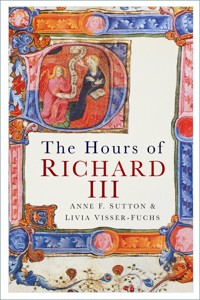


















Front cover: Contrary to normal convention, the main body of this manuscript is foliated in Roman numerals, but preceded by a section in Arabic numerals. Illumination attributed to the Bruges Master of 1483. (© Bodleian Libraries, University of Oxford)
First published 1997
This paperback edition first published 2024
In association with the Yorkist History Trust
The History Press
97 St George’s Place, Cheltenham,
Gloucestershire, GL50 3QB
www.thehistorypress.co.uk
© Livia Visser-Fuchs and the Yorkist History Society, 2005, 2024
The right of Anne F. Sutton and Livia Visser-Fuchs to be identified as the Authors of this work has been asserted in accordance with the Copyright, Designs and Patents Act 1988.
All rights reserved. No part of this book may be reprinted or reproduced or utilised in any form or by any electronic, mechanical or other means, now known or hereafter invented, including photocopying and recording, or in any information storage or retrieval system, without the permission in writing from the Publishers.
British Library Cataloguing in Publication Data.
A catalogue record for this book is available from the British Library.
ISBN 978 1 80399 636 3
Typesetting and origination by The History Press
Printed and bound in Great Britain by TJ Books Limited, Padstow, Cornwall.
eBook converted by Geethik Technologies
Contents
List of Illustrations
Acknowledgements
The Yorkist History Trust
Pedigrees
Abbreviations
Introduction
Why Richard III’s Books?
1. A Chronology of Richard III’s Life and Library
Richard’s Education, His ‘Tutors’, and His Books before 1470
Books Acquired 1471–85
Standard Books in Late Medieval Noble Libraries
Richard III’s Collection
2. The Books of the House of York
Richard, Duke of York, and Cecily Neville
Edward IV and Queen Elizabeth Woodville
Margaret of York, Duchess of Burgundy
3. Devotional Books, Saints and Piety
Books of Scripture
A Book of Revelations: The Booke of Gostlye Grace
Book of Hours and Prayers
Saints and the Life of St Katherine
‘His most simple creature, nakidly borne into this wretched world’
4. Chivalric Ideals and Reality
Chivalric Treatises
Knightly Training: Theory and Exercise
Richard’s Reputation as a Soldier
Richard’s Reputation as a Christian and Courtly Knight
The Display of Chivalry
Conclusion: Richard III and Chivalry
5. Mirrors for Princes: Books with a ‘Handsome Title’
The Model Mirror and the Perfect Prince
Fifteenth-century Readers of Mirrors of Princes: Richard of Gloucester and Others
Social Behaviour: The ‘Well of Gentleness’
The Use of the Imagery of Mirrors of Princes in Richard’s Reign
6. Ancestry and ‘True Nobility’
Pedigrees and Genealogical Chronicles
Richard III’s Roll and Book of Arms
Richard III’s ‘Family Books’
‘Virtue and Ancient Riches’
7. History: Its Reading and Making
Temps Passé: ‘Joyous and playsant hystoryes’
Temps Moyen: ‘So precious and also profitable’
‘A perpetuel conservatryce of thoos thynges that have be doone before this presente time’: Attitudes to Recorded History in Richard III’s Day
Temps Présent: ‘Grete thankynges … unto wryters of hystoryes’: The Writing of History in Richard III’s Day
Richard III’s Own Enthusiasms
8. Prophecy and the House of York
The Prophecy of the Eagle
Edward IV and Prophecy
Prophecy and Richard III
‘Wind of the head’ or the hand of God?
9. Passing the Time: Stories of Love and Example at the Yorkist Court
Romances Owned by Richard III and His Nearest Contemporaries
Fifteenth-century Responses to Fiction
The Duke of Burgundy’s Love Affair with Romances
Romances and Real Life
10. The Reign of Richard III and the Trade in Manuscript and Printed Books, with Special Reference to the Proviso of 1484
Anti-Alien Legislation and the Parliament of 1484
The Anti-Alien Act of 1484
The Proviso and the Book Trade of London in 1484
The Real Supporters of the Proviso
11. Richard III and His Books
Catalogue of Richard III’s Books and Books Associated with Him
A.Richard III’s Books
I. Mechtild of Hackeborn, The Booke of Gostlye Grace, BL, MS Egerton 2006
II. Collection of Romances and Old Testament Stories:
A. John Lydgate, Siege of Thebes, Geoffrey Chaucer, The Knight’s Tale and The Clerk’s Tale, and Ipomedon, with
B. Middle English verse paraphrase of the Old Testament, Longleat House, Library of the Marquess of Bath, MS 257
III. English New Testament (Wycliff translation), New York, Public Library, MS De Ricci 27
IV. Vegetius, De re militari, BL, MS Royal 18 A xii
V. Giles of Rome, De regimine principum, London, Sion College, MS Arc. L 40.2/L 26
VI. The Fitzhugh or Anonymous Chronicle, Cambridge, Corpus Christi College, MS 96
VII. Guido delle Colonne, Historia destructionis Troiae, St Petersburg, Saltykov-Shchedrin State Public Library, MS Lat. F IV 74
VIII. A. Geoffrey of Monmouth, Historia regum Britanniae
B. The Prophecy of the Eagle, St Petersburg, Saltykov-Shchedrin State Public Library, MS Lat. F 76
IX.Grandes chroniques de France, BL, MS Royal 20 C vii
X.Prose Tristan, BL, MS Harley 49
XI. Ramon Lull, Order of Chivalry, translated and printed by William Caxton
XII. A. William Worcester, Boke of Noblesse, BL, MS Royal 18 B xxii, with
B. William Worcester, Collection of Documents on the War in Normandy, London, Lambeth Palace, MS 506
XIII. A. Rolls of Arms, London, College of Arms
B. ‘Thomas Jenyns’ Book’
XIV. Pietro Carmeliano, Vita Sanctae Katherinae
XV. Book of Hours, London, Lambeth Palace, MS 474
B.Books Associated with Richard III
XVI.Epistolae of the Pseudo-Phalaris, edited by Pietro Carmeliano, Dublin, Trinity College Library, MS 326
XVII. William Langland, The Vision of Piers Plowman
XVIII. The Rous Roll, BL, MS Add. 48976
XIX. The Beauchamp Pageant, BL, MS Cotton Julius E iv
XX. The Salisbury Roll, BL, MS Add. 45122
C.Books Wrongly Attributed to Richard III’s Ownership
XXI.The Dicts and Sayings of the Philosophers, London, Lambeth Palace Library, MS 265
XXII. The Ellesmere Chaucer, San Marino, Huntington Library, MS EL 26 C 9
XXIII. A Book of Hours, Sotheby’s Catalogue, 21 June 1994, lot 103
Bibliography
List of Illustrations
Black and White
Fig. 1
Richard’s signature. Lille, Archives départementales, série B, 862/16.161.
Fig. 2
Richard’s signature with the motto tant le desieree. Longleat, MS 257, f. 98v.
Fig. 3
An author or librarian at work. Paris, Bibliothèque de l’Arsenal, MS 5208, f. 1.
Fig. 4
Richard of Gloucester’s signature. Cambridge, Corpus Christi College, MS 96.
Fig. 5
Richard’s signature. BL, MS Royal 20 C vii, f. 134.
Fig. 6
The first page of Richard’s copy of the Bible in English. New York Public Library, MS De Ricci 67.
Fig. 7
Richard’s formal ex libris: Iste liber constat Ricardo duci Gloucestre. BL, MS Harl. 49, f. 155.
Fig. 8
The signatures Anne warrewyk and R Gloucestr’. BL, MS Egerton 2006.
Fig. 9
Richard’s subscription and signature on a letter to Louis XI. BN, MS fr. 2908, f. 13.
Fig. 10
Richard’s motto and signature. BL, MS Cotton Vesp. F xiii, f. 123.
Fig. 11
Calendar page of Richard’s book of hours with his autograph note recording his birthday. London, Lambeth Palace, MS 474, f. 7v.
Fig. 12
Richard’s signature. Danzig, National Archives 300 D/16/135.
Fig. 13
Autograph motto, loyalte me lye, and signature of Elizabeth of York. BL, MS Royal 20 A xix, f. 195.
Fig. 14
The chronicler and poet, Jean Molinet (died 1507) presents his moralised version of the Roman de la rose to Philip of Cleves. The Hague, Royal Library, MS 128 C 5, f. 1.
Fig. 15
Signature of Richard’s father, Richard, Duke of York.
Fig. 16
An English translation of part of Claudian’s Consulship of Stilicho. BL, MS Add. 11814, ff. 18v–19.
Fig. 17
First page of mid-fifteenth-century French copy of Christine de Pizan’s Cité des dames. BL, MS Royal 19 A xix, f. 4.
Fig. 18
Signature of Richard’s brother, George, Duke of Clarence. Lille, Archives départementales, série B, 862/16.161.
Fig. 19
A book of hours belonging to Richard’s sister, Anne, Duchess of Exeter. Cambridge, Sidney Sussex College, MS 37, ff. 116v–117.
Fig. 20
Ex libris of the future Edward IV while he was duke of York. BL, MS Harl. 3352, f. 1v.
Fig. 21
The printer Guillaume Fichet presents Cardinal Bessarion’s Orationes to Edward IV. Rome, Vatican Apostolic Library, MS [sic] 3586, f. 1.
Fig. 22
Signature of Edward IV. Lille, Archives départementales, série B, 862/16.161.
Fig. 23
Autograph note of Richard’s sister, Margaret of York, Duchess of Burgundy. Ghent, Poor Clares, MS 8, f. 163.
Fig. 24
Capital I in the shape of a wyvern. Longleat, MS 257, f. 176.
Fig. 25
An annotated page from the English translation of Mechtild of Hackeborn’s Booke of Gostlye Grace. BL, MS Egerton 2006, f. 94v.
Fig. 26
St Julian and his wife ferrying Christ, dressed as a pilgrim, across the river. The Hague, Royal Library, MS 76 F 2, f. 273v.
Fig. 27
St Ninian shown with a supplicant and an angel. Edinburgh, University Library, MS 42, f. 72v.
Fig. 28
The first remaining page of the long prayer added for Richard in his book of hours. London, Lambeth Palace, MS 474, f. 181.
Fig. 29
St Anne and the Holy Kinship appear to St Coleta and St Francis. Ghent, Poor Clares, MS 8, f. 40v.
Fig. 30
St Margaret emerging from the dragon (the devil) that devoured her. The Hague, Royal Library, MS 76 F 2, f. 276v.
Fig. 31
Sketch of a very worn stone relief of St Anthony with boars resembling the supporters of Richard’s arms. Barnard Castle, St Mary’s church.
Fig. 32 a and b
St Barbara and St Katherine. The Hague, Royal Library, MS 76 F 2, ff. 280 and 276.
Fig. 33
God, the Virgin Mary and the company of saints. The Hague, Royal Library, MS 76 F 2, f. 283.
Fig. 34
The arming of the young Pyrrhus, Achilles’ son.
Fig. 35
The beginning of the English translation of Vegetius’ De re militari. BL, MS Royal 18 A xii, f. 1.
Fig. 36
The hermit-knight instructing the squire in the duties of knighthood. BL, MS Royal 14 E ii, f. 338.
Fig. 37
Two pages from William Worcester’s Boke of Noblesse. BL, MS Royal 18 B xxii, ff. 14v–15.
Fig. 38
A tournament, from the romance of Olivier de Castile. Ghent, University Library, MS 470, f. 66v. Flemish, 1450s.
Fig. 39
Frontinus teaching young knights. The Hague, Royal Library, MS 73 J 22, f. 93.
Fig. 40
Letter from Richard of Gloucester to Louis XI, 16 June [1480]. Paris, BN, MS fr. 2908, f. 13, item 1.
Fig. 41
A typical presentation scene. BL, MS Royal 16 G ix, f. 7.
Fig. 42
Woodcut from Caxton’s translation of James de Cessolis’ Game of Chess.
Fig. 43
The first two pages of the only surviving one of Pietro Carmeliano’s autograph copies of the Latin translation of the Letters of Phalaris. Dublin, Trinity College, MS 429, ff. 3v–4.
Fig. 44
Part of a page from Richard’s copy of Giles of Rome’s De regimine principum. Sion College, MS Arc. L 40.2/ L 26, f. 27v.
Fig. 45
Aristotle instructing King Alexander. Oxford, University College, MS 85, p. 70.
Fig. 46
A Burgundian ‘mirror for princes’, the Instruction d’un jeune prince. Cambridge, Fitzwilliam Museum, MS 1816/165, f. 10v.
Fig. 47
A teacher and his pupils. John Rylands University Library of Manchester, 3469, f. 3.
Fig. 48
The beginning of the family tree showing the descent of Edward IV. Philadelphia, Free Library, MS Lewis E 201.
Fig. 49
The end section of a roll showing the succession of the kings of England. Oxford, Bodleian Library Bodley Roll 5.
Fig. 50
End section of the Clare Roll. London, College of Arms, MS 3/16.
Fig. 51
The last page of the Beauchamp Pageant. BL, MS Cotton Julius B iv.
Fig. 52
The heralds of France and of England debate the merits of their respective countries. Paris, BN, MS fr. 5837, f. 1.
Fig. 53
The first page of Guido delle Colonna’s Historia destructionis Troiae. St Petersburg, Saltykov-Shchedrin State Public Library, MS Lat. F IV 74, f. 1.
Fig. 54
The first page of Geoffrey of Monmouth’s Historia regum Britanniae. St Petersburg, Saltykov-Shchedrin State Public Library, MS Lat. F IV 76, f. 1.
Fig. 55
The first page of the Anonymous or Fitzhugh Chronicle. Cambridge, Corpus Christi College, MS 96, f. 1.
Fig. 56
A page from Richard’s finely illuminated copy of the Grandes chroniques de France. BL, MS Royal 20 C vii, f. 134.
Fig. 57
Fresh Memory (Fresche Memoire) showing the author (lacteur) the tombs of dead kings. Woodcut from Olivier de La Marche’s Chévalier délibéré.
Fig. 58
Historical notes compiled in the household of Sir Thomas Frowyk. BL, MS Harl. 541, ff. 217v and 218.
Fig. 59
Secretaries at work recording events and writing letters ‘in the field’. Baltimore, Walters Art Gallery MS W 201, f. 147.
Fig. 60
An example of recent history illustrated: Edward IV, in bed, is betrayed by George Neville, Archbishop of York. Paris, BN, MS fr. 85, f. 277.
Fig. 61
First page of Caxton’s first edition of the Chronicles of England. John Rylands University Library of Manchester, R26166, f. 8.
Fig. 62
Jean LeFèvre, Toison d’Or King of Arms, at work. Paris, BN, MS fr. 16830, f. 1.
Fig. 63
Merlin watches the red and white dragons fighting. Woodcut from an unidentified printed edition of Geoffrey of Monmouth’s History of the Kings of Britain.
Fig. 64
A roll recording the events leading up to Edward IV’s accession and their biblical precedents. BL, MS Harl. 7353.
Fig. 65
Page from a composite manuscript containing Yorkist material collected by its owner. Cambridge, Trinity College, MS R. 3. 21, f. 245v.
Fig. 66
The culmination of a roll setting out the divinely inspired accession of Edward IV. BL, MS Harl 7353.
Fig. 67
A tapestry depicting a joust hangs behind this animated court scene of 1469. Now Geneva, Collection Bodmer, MS 160, f. 225.
Fig. 68
A scene from Boccaccio’s Teseida. Vienna, Austrian National Library, MS 2617, f. 102.
Fig. 69
The beginning of the story of Ipomedon in Richard’s collection of romances. Longleat, MS 257, f. 90.
Fig. 70
A page from Richard of Gloucester’s elegantly written copy of a part of the Prose Tristan. BL, MS Harl. 49, f. 5v.
Fig. 71
A gentleman reading a romance aloud to two others as passe temps. Paris, BN, MS fr. 11610, f. 1.
Fig. 72
The conclusion of the Earl of Toulouse, with Amen quod Rate and the beginning of Libeaus Desconus (The Fair Unknown). Oxford, Bodleian Library, MS Ashmole 61, ff. 38v–39.
Fig. 73
A princess and a gentleman in conversation. Ghent, University Library, MS 470, f. 15v.
Fig. 74
The romance of the Three Kings’ Sons. BL, MS Harl. 236, f. 117v.
Fig. 75
Dancing during marriage celebrations. Vienna, Austrian National Library, MS 2534, f. 17.
Fig. 76
A copyist at work. Ghent, University Library, MS 470, f. 1.
Fig. 77
Ex libris in a copy of Caxton’s edition of Ralph Higden’s Polycronicon. Private collection.
Fig. 78
Pietro Carmeliano’s recommendation of the Letters of Phalaris to the reader. John Rylands University Library of Manchester printed book 15835.
Fig. 79
Large floriated A at the beginning of Caxton’s edition of the Order of Chivalry. John Rylands University Library of Manchester, 12105, f. 2.
Fig. 80
Standard presentation scene, 1482. BL, MS Royal 15 E ii, f. 7.
Fig. 81
The signatures of Edward V, Richard of Gloucester and Henry, Duke of Buckingham. BL, MS Cotton Vesp. F xiii, f. 123.
Fig. 82
A king and courtiers in ‘a bookshop’, c. 1480–85. Oxford, Bodleian Library, MS Douce 208, f. iv.
Colour Plates
Pl. I
First page of a book of hours of Richard’s father, Richard, Duke of York. Durham, Ushaw College, MS 43, f. 1.
Pl. II
Presentation of a copy of the French translation of Boethius, De consolatione philosophiae to Margaret of York. Jena, University Library, MS EL F. 85, f. 13v.
Pl. III
Top section of the Clare Roll. London, College of Arms, MS 3/16.
Pl. IV
First page of a Burgundian treatise on nobility, the Enseignement de la vraie noblesse. Geneva, Bibliothèque Publique et Universitaire, MS fr. 166, f. 3.
Pl. V
The presentation miniature and the first page of the text of the Hours of the Guardian Angel. Liverpool Cathedral, MS Radcliffe 6, ff. 5v–6.
Pl. VI
Two pages of the autograph copy of his Life of St Katherine which Pietro Carmeliano presented to Chancellor John Russell. Cambridge, Gonville and Caius College, MS 196/102, pp. 4–5.
Pl. VII
Initial D with Annunciation scene at the beginning of the hours of the Virgin in Richard III’s book of hours. London, Lambeth Palace Library, MS 474, f. 15.
Pl. VIIIa
Equestrian portrait of Edward IV at the head of a genealogical roll. Philadelphia, Free Library, MS Lewis E 201.
Pl. VIIIb
The final section of the roll showing Edward IV’s descent from Adam and his right to the thrones of England, France and Spain. Philadelphia, Free Library, MS Lewis E 201.
Pl. IX
An example of contemporary rumour illustrated: Edward of Lancaster is killed by Edward IV’s men after the battle of Tewkesbury. Besançon, Bibliothèque Municipale, MS 1168, f. 4v.
Pl. X
A chapter of the Order of the Golden Fleece presided over by Charles the Bold. The Hague, Royal Library, MS 76 E 10, f. 5v.
Pl. XI
A king of the 1480s, surrounded by his courtiers. BL, MS Royal 15 E i, f. 185.
Acknowledgements
We are very grateful to Julia Boffey and Paul Christianson for kindly reading our text and for their helpful suggestions, comments and additions; to Paul also for allowing us to read and use the typescript copy of his chapter in the forthcoming A History of the Book in Britain, vol. 3 (1400–1557); and to Mary Erler for her interest and support and for looking at the Wycliffe Bible. We also thank Jim Bolton and Elizabeth Watson for kindly reading parts of the text and their helpful suggestions and corrections, and Tony Pollard and Jeremy Potter for their support. We are indebted to Christopher de Hamel for telling us about the spurious ‘hours of Richard III’, and to Lotte Hellinga, Kate Harris, Meg Ford, Nicholas Rogers, Dorothy Clayton, Robert Yorke and Tony Edwards for their help. We would like to thank again all those people who have assisted us over the years in our pursuit of Richard III’s books.
The Yorkist History Trust
The Yorkist History Trust is a charity founded in 1985 to advance and disseminate research and education related to the history of late medieval England (and in particular the reign and life of King Richard III). We fulfil these aims by offering research grants to scholars working on the period, by offering publication grants to titles of relevance, and by publishing critical primary source editions, volumes of collected essays, and academic monographs. Recent publications include Peter Fleming’s Late Medieval Bristol: Time, Space and Power, an edition of The Lordship of Middleham in 1465–66 and 1473–74, edited by Livia Visser-Fuchs, Jonathan Mackman, and Anne F. Sutton, and the late Dr Sutton’s magisterial The King’s Work: The Defence of the North under the Yorkist Kings.
Future projects include editions of the executors’ accounts of Sir Ralph Verney, the probate accounts and inventories of Sir Thomas Charlton, documents relating to the Smithfield Tournament, and London’s Common Council Journal covering the reign of Richard III, as well as a monograph on the chronicler Robert Fabyan. We have recently funded projects on the gentry of the fifteenth century and the Brewers’ Company of London. We welcome applications for editions and monographs to be published by the Trust and to support other publications and research on the fifteenth century. To submit an application, or for more information, please see our website: www.yorkisthistorytrust.org.
THE HOUSE OF BURGUNDY
THE FAMILIES OF LANNOY, CROY AND WAVRIN
THE HOUSE OF YORK
Abbreviations
BIHR
Bulletin of the Institute of Historical Research.
BJRL
Bulletin of the John Rylands Library.
BL
British Library.
BN
Bibliothèque Nationale, Paris.
BR
Bibliothèque Royale Albert I, Brussels.
Charles le Téméraire
P. Cockshaw et al., Charles le Téméraire.
‘Choosing a book’
A.F. Sutton and L. Visser-Fuchs, ‘Choosing a book in late fifteenth-century England and Burgundy’.
Coronation
A.F. Sutton and P.W. Hammond, eds, The Coronation of Richard III.
CPR
Calendar of Patent Rolls.
CS
Camden Society.
EETS
Early English Text Society.
EHR
English Historical Review.
Harl. 433
R. Horrox and P.W. Hammond, eds, British Library Harleian Manuscript 433.
Hours of Richard III
A.F. Sutton and L. Visser-Fuchs, The Hours of Richard III.
HRB
Historia regum Britanniae.
John Vale’s Book
M.L. Kekewich et al., The Politics of Fifteenth-century England: John Vale’s Book.
Manual
A Manual of Writings in Middle English.
Middle English Prose
A.S.G. Edwards, ed., Middle English Prose.
PL
J.P. Migne, Patrologiae cursus completus. Series latina.
‘R III books’
A.F. Sutton and L. Visser-Fuchs, ‘Richard III’s books: I–XIV’ and Hammond, P.W., ‘Richard III’s books: III’.
Richard III
P. Tudor-Craig, Richard III.
RP
Rotuli Parliamentorum.
VCH
Victoria County History.
INTRODUCTION
Why Richard III’s Books?
As in all our dealings with the Middle Ages – or, for that matter, with any period remote from our own – we find that the most important question to ask is not, straightaway, ‘What is this worth to me?’ but ‘What was this worth to them?’.1
In exploring in detail the surviving books which can be associated with Richard III – a man remarkable among his English peers for his habit of signing his books and thereby recording his ownership for us – we wished to discover not only the circumstances of his ownership but also the meaning of the texts themselves in his time, and to attempt to know their owner and understand his contemporaries, who also read these texts, a little better.
As Richard acquired his books gradually, at various stages of his life, and appears to have acquired them consciously, the events of his life must form part of our analysis. The changes in his signature when related to the evidence from datable documents allow us to make conjectures, or occasionally to be certain, about when he obtained various books. Similarly his use and awareness of some of the works can be illustrated by events in his life and his other known interests, and tell us why he had them – this is particularly true for his religious and chivalric texts. The books were part of his life and our knowledge both of his books and of his life benefit from an inter-related study. Too often little or nothing is known about an owner of a surviving medieval text or the precise context in which it was used, but Richard is in this case a happy exception.
As his books are among the few personal possessions that survive for Richard they also demand to be briefly described as objects; some of them are intact and in their original bindings; some, though not many, are decorated, and the quality of their illumination and general workmanship may inform us about Richard’s likes and dislikes and how his taste compared to that of other book owners. Some of the texts are still very well known and have been endlessly studied, such as the two Canterbury Tales which Richard had. There is no need to explore these in the same detail as the lesser known texts – such as the rare Prophecy of the Eagle or the Life of St Katherine – but in each instance an attempt at least must be made to find out what Richard and his contemporaries themselves thought of these texts in their time, and how the works that he chose to own relate to others in the same genre.
It is a curious coincidence that a king about whom so much has already been written for other reasons also turns out to be interesting for research into the social and cultural history of his time, but it is undeniable that there are some remarkable aspects of Richard’s book ownership. For no medieval English prince do we have so many books which were signed by the owner’s hand, or clearly marked as his, and which can also be assumed to have held their owner’s personal interest. It is well known that Humphrey of Gloucester’s ‘library’ earlier in the century was immense and incomparable, but it is difficult to find evidence that he was genuinely interested in the contents of the books. More importantly, it is impossible to use Humphrey’s collection as an indication of what other people of his age and class liked to read, while comparison with the more fragmentary and scattered but, when taken together, ample remains of other ‘libraries’ of Richard’s milieu shows that his was an ‘average’ one, in the sense that his taste was very similar to that of other noble men in the 1470s and ’80s; there is much overlap between the single or few surviving items of lesser known collections and Richard’s more numerous and better documented manuscripts. It is also fortunate that Richard’s surviving titles offer a good, working cross-section of what was available and popular at the time in almost every genre except ‘professional’ books – medical, legal and theological texts – and allow the student and the reader an interesting overview of fifteenth-century attitudes to lay piety, chivalry, history, books of advice or ‘mirrors’ for princes, ancestry and noble lineage, prophetic material, and romances. Studying Richard’s books is to take a crash-course in the literature of his time.
Comparison with the collections of continental princes reveals that there was great similarity between, for example, English and Burgundian courtiers in their areas of interest, though the scale and magnificence of their book ownership differed considerably. There is neither positive nor negative evidence that Richard ever collected any of the illuminated Flemish manuscripts which made the library of his brother, Edward IV, so famous, and it is likely that if he had any such volumes, decorated with his arms, they were coveted by his successors and their marks of ownership have obliterated his. Some splendid manuscripts of the period survive that contain the royal arms but no indication of which king of England commissioned or owned them.
It is a strange fact, no doubt due to the quirks of survival but nonetheless fascinating, that many of Richard’s extant manuscripts represent the unique or one of the very few known copies of a number of texts. He owned one of the two surviving copies of the English translation of Mechtild of Hackeborn’s Liber Specialis Gratiae, the only extant copy of the prose Ipomedon, the only manuscript of Geoffrey of Monmouth’s Historia regum Britanniae known to have belonged to a medieval king of England, one of the two surviving texts of the verse paraphrase of the Old Testament, one of the two surviving texts of the Prophecy of the Eagle with this particular Commentary; and even his ownership of romances makes him disproportionately important in any analysis of owners of romances in English in the fifteenth century.
Finally, we know that Richard and the decision-making members of his only parliament were sufficiently enlightened, at a time when the printed book was beginning to gain a share of the market and when manuscript books were still produced in great numbers, not to allow insular and chauvinist mercantile measures against alien artisans and traders to interfere with the import into England of any kind of book or with the work of any book artisan. Many aspects, therefore, of Richard III’s books deserve our curiosity and the man himself is merely one facet.
1 Stevens, Medieval Romance, pp. 29–30. Professor Stevens continues that: ‘systems of thought … styles in literature … are not invented for their own sake … They come into being because they are needed … primarily for explanation … to impose meanings on life’.
ONE
A Chronology of Richard III’s Life and Library
Whoever … claims to be zealous of truth, of happiness, of wisdom, or knowledge, aye, even of the faith, must needs become a lover of books.
Richard of Bury, Bishop of Durham 1281–1345, wrote this sentiment in his Philobiblon (The Love of Books) and believed it sincerely. His work was still well known among scholars in the fifteenth century, particularly in Germany and England, and printed for the first time in Cologne in 1473. It is possible that Richard III had heard of it: it was after all written by an Englishman and appreciated throughout the Latin-speaking world. In Richard’s own time the text was owned by many religious houses in England; the Bridgettine house of Syon, for example, often visited by the royal family, had as many as three copies.1
Any book lover who reads Richard of Bury’s views inevitably agrees with most of what he says, even if he lacks the bishop’s collector’s obsession; and in the fifteenth century his sentiments were accepted without question. The educated and cultivated aristocrat of Richard III’s day knew that a collection of books was a necessity, an indication of his social status as well as an ever ready source of advice, entertainment, consolation and instruction.
Richard III was born into a family and social class that owned books. He himself had thirteen volumes which survive, containing eighteen separate texts; four other texts which he owned do not survive. This study seeks to bring together all we know about Richard’s books and to put them into the context of the books owned by his immediate family – parents, siblings, their spouses and their children. It also takes into consideration the book trade that supplied them and the contemporary libraries of Richard’s peers in England and abroad, in particular those of the dukes of Burgundy and some members of his court. By using this background, and by comparison and analogy a fairly complete and trustworthy picture emerges.
Richard’s surviving books provide us with a self-selected sample whereby we can assess him, and more important, learn more about the opinions on many subjects available to a man of his background. His books hold the knowledge, the points of view and the accepted ways of thought; they were on his shelves and could be looked at by him at any time. Whether he accepted their stories and opinions, whether he even read them, can be debated, but in some cases it can be assumed that he did. With all possible caveats allowed, these books show some of the prejudices, misinformation, enthusiasms and hopes available to the curious reader of Richard III’s day. Some of his books were ancient and revered texts, others as recent as William Worcester’s exhortations to Edward IV to renew the war with France, others again were hot off Caxton’s press.
Richard’s surviving books included three texts that were straightforwardly religious: his book of hours, his New Testament translation and the Book of Special Grace by Mechtild of Hackeborn. With these should probably be included his verse paraphrase of several Old Testament stories, though this may have been regarded as narrative entertainment, teaching holy writ to a child. When he was king the Italian humanist Pietro Carmeliano presented to him a Latin verse Life of St Katherine, patron of scholars. He owned four romances, stories of entertainment in prose or verse: Palamon and Arcite (The Knight’s Tale) and Patient Griselda (The Clerk’s Tale) by Geoffrey Chaucer, a prose Ipomedon – the career and adventures of a perfect knight – and the beginning of the story of Tristan and Isolde. Lydgate’s Siege of Thebes could also be classified as a romance, but Richard may well have considered it history. His straightforward history books were Guido delle Colonne’s Historia destructionis Troiae, Geoffrey of Monmouth’s Historia regum Britanniae, the Grandes chroniques de France and the Anonymous or Fitzhugh Chronicle of England; between them these covered large swathes of world history from the siege of Troy to nearly 1400. Advice on the conduct of princes, knights and soldiers, as well as practical military advice, was represented by Giles of Rome’s De regimine principum, Caxton’s translation of Ramon Lull’s Order of Chivalry, Vegetius’ De re militari in English, William Worcester’s Boke of Noblesse, and the Letters of Phalaris. Further useful advice for a soldier was contained in his two rolls of arms, but these could also be seen as texts about ancestry and the descent of princes, comparable to the kingly histories of the Historia regum Britanniae. One short text was an oddity by twentieth-century standards, the Prophecy of the Eagle with a commentary, one of the texts that helped to prove the right to rule of the House of York. The subject coverage of Richard’s books is varied and well balanced for such a small collection. The only subjects obviously lacking are theology, the law, astronomy and alchemy, all subjects that he could have left to professionals.
Richard’s Education, His ‘Tutors’, and His Books before 1470
The future Richard III was the eleventh child of Richard, Duke of York, and Cecily, daughter of Ralph Neville, Earl of Westmorland; he was one of four sons who survived infancy. His father was killed at the battle of Wakefield, 30 December 1460, when Richard was eight years old, a moment of such crisis in the family’s fortunes that Richard and his nearest elder brother, George, were sent into safety and exile at the court of the Duke of Burgundy, Philip the Good. Four months later they were recalled to take part in the coronation of their elder brother as Edward IV, and shortly after Richard was created duke of Gloucester.
A partial picture of Richard’s childhood can be gleaned from his books and those of his son. Most people acquire their first book as a child: the first books of members of the best-documented family of book-owners in the fifteenth century, the dukes of Savoy, are known to have been acquired early, for the schoolroom or by gift. The noble child required educational texts like the Donatus, the fourth-century Latin grammar of which versions were still in use in the fifteenth century, or the basic religious text of a psalter; later came collections of moral stories.2 Gifts and inheritance might expand a collection until the owner began to commission or buy on his or her own account.
There are no texts obviously and solely designed for a child among Richard’s books, but if we turn to what we know about the education of his son, Edward of Middleham, we may learn a little about Richard’s ideas on education. The evidence is slight, and there is really only one personal detail but it is of great interest: the presence of Anne Idley as mistress of the nursery of young Edward. She was the widow of Peter Idley, of Drayton, Oxfordshire, a government official and author of a book of moral guidance for his own son. It was a translation in rhyme royal of earlier Latin and English authorities and covered systematically all the moral issues of life, social behaviour, vices and virtues; it taught the child and young man to be restrained in speech and dress, to avoid women and taverns, and to take good advice; it also contained simple religious knowledge, such as the Ten Commandments, the Seven Deadly Sins and the Seven Sacraments.3 Though there is no indication that Anne Idley ever introduced her husband’s book into the Gloucester household, its impeccable contents and the fact that it was popular enough to survive in ten manuscripts, eight from the Yorkist period, make it possible that Edward of Middleham’s early education was aided by Idley’s ‘Instructions to his Son’. Like so many simple fifteenth-century texts the book has been said to make tedious reading, but it is in fact full of small delights:
The most vengeable thing that may be
Of any man, worm, fowl, or beast,
I remember it is the little, small bee
That anon to battle is ready and prest;i [prepared]
For though an armed man come to her nest,
She is not afraid him to assail
And with her little spear proffer him battail.4
Books were given to improve the mind of the growing aristocratic child and to teach him the things relevant to his status and background: the simple, attractive copy of the English translation of Vegetius’ military manual may have been made for Edward of Middleham: the griffin of his earldom of Salisbury is included in the decoration of the first page (see fig. 35). He could have learned his family’s history from the illustrated Rous Roll and Beauchamp Pageant, both made in his father’s reign, as well as from the genealogical rolls that every noble family owned. Richard himself could have learned the ancestry of the House of York from similar texts or from the family tree in verse made by Osbern Bokenham of Clare, now called the Clare Roll.5
Fig. 1 Richard’s signature on a document nominating Charles, Duke of Burgundy, a knight of the Garter, 13 May 1469. Redrawn by Piet Design from Lille, Archives départementales, série B, 862/16.161.
Among Richard’s own books there are some that may have been suitable for a growing boy and adolescent, but it is difficult to establish whether he actually acquired any of these in his youth. Any conclusions about the date of acquisition of his books must be based on his signature, which varies and is sometimes accompanied by a motto. The books he acquired while king are a clearly defined group and present no problems. Of his other books the one that most readily falls into the category of educational texts is his collection of romances and Old Testament stories, possibly signed by him as an adolescent. The romances included Chaucer’s Knight’s Tale and the story of Ipomedon, the best knight in the world; the Bible selection included Joshua, Job, Judith, Tobit and Maccabees. All were chivalric and/or eminently moral tales, their educational message presented as agreeably as Gower or Caxton advised. Gower in his Confessio Amantis had attempted to strike such a happy mean between education and entertainment:
… men sein, and soth it is,
That who that al of wisdom writ
It dulleth ofte a mannes wit
To him that schal it aldai rede,
For thilke cause, if that ye rede,
I wolde go the middel weie
And wryte a bok betwen the tweie,
Somwhat of lust, somewhat of lore, [pleasure]
That of the lasse or of the more
Som man mai lyke of that I wryte … 6
The same idea was voiced by the author known as Caton, translated by Caxton in 1483. He advised that no one read ‘foule sciences’ which are ‘ful of errour as ben foles questyons and scyences seculers, ne also the fictions of poetrye’, but he also knew very well that it was much easier to learn if the lesson was made palatable and pleasant:
Thou oughest to rede and to receyve and to put in thy memorye that that thou shalt rede, and to take to hit dylectacion and plesure, and that thou forgete hit not lightly, as done many one that rede without takyng of hyt ony plesure, for that that entryth in to one of theyr eerys yssueth out ageyn by theyr other eere.7
The details of Richard’s more serious education are largely unknown. Before his exile in 1460 and before the deaths of his father and his second eldest brother, Edmund, Earl of Rutland, at Wakefield, it is possible that he was destined for the Church as the youngest son. Some of the books he owned actually suggest that he had received the sound grammar education a future cleric needed: the highly abbreviated Latin text of De regimine principum and the large, Latin Fitzhugh Chronicle demanded good Latin of their readers, and Richard was obviously pleased to receive Latin copies of the Historia Troiae and the Historia regum Britanniae. These were books only a man with good Latin and a habit of industrious reading – even a scholarly bent – could appreciate. His ownership of one of the earlier English translations of the New Testament and an unusually extensive book of hours and prayers, originally put together for a clergyman, is equally important. The Italian Pietro Carmeliano did not think it odd to dedicate his Latin Life of St Katherine, the patron saint of scholars, to Richard III; he also presented the text to the learned John Russell, Bishop of Lincoln. Lastly, Richard’s handwriting, when he chose, was conspicuously neater than the scrawls of the rest of his family, a fact that may betray a more scholarly education. If Richard did receive such an education it must have faltered after 1461, when he was sent to live in the household of Richard, Earl of Warwick, where he may have stayed for as long as seven years. Here schooling would have emphasised the knightly and social skills that were indispensable to a young nobleman, but a good grounding in grammar would also have been supplied. Among those who could have encouraged a natural inclination and ability to profit from an intellectual education was the earl of Warwick’s brother, George Neville (died 1476), Archbishop of York, whose enthronement feast Richard attended as a boy in 1465. George Neville was a man ‘of blood, virtue and cunning’,8 chancellor of Oxford University at a very early age, a genuine scholar as well as a valuable member of the Neville clan in their struggle for power and impressive enough to stimulate a young man’s ambition. Some of the learned ecclesiastics Neville patronised continued in Richard III’s service and he may have transmitted to Richard an appreciation of learning in others, for example, of a knowledge of Greek.9
It is possible that some of Richard’s teenage education was spent at an inn of court; the inns were increasingly seen as providing a useful secular education for young men who had no intention of pursuing law as a career.10 Certainly Richard as duke and king showed a good understanding of the law. This may, of course, have been a natural consequence of his daily duties as a prince, but it could have derived from some more direct experience. Wherever else he received instruction there is no doubt Richard completed his schooling at his brother’s court. A summary picture of the education provided by the royal household is given by Sir John Fortescue in his De laudibus legum Angliae (c. 1468–70). He praises it as the ‘supreme academy for the nobles of the realm, and a school of vigour, probity and manners’; its education concentrated on military training and produced men who would be able to protect the realm. Elsewhere he expands on the education of the prince himself: he should know the laws of his country and be thereby stimulated to justice, his knowledge to be ‘in general terms’ only. Similarly he should learn holy scripture, but not ‘profoundly’ like a cleric.11 In other words, princes were for fighting and they were to leave religion and the law to professional men like Fortescue. A more varied and balanced picture of the education provided by ‘the schools of urbanity and nurture of England’ at the king’s court is found in the so-called Black Book, the regulations for the royal household (1478). The ‘henchmen’ (the boys in this school) were presided over by the king’s ‘master of horse and henchmen’ and a grammar master, who were
to learn them to ride cleanly and surely, to draw them also to jousts, to learn them wear their harness; to have all courtesy in words, deeds, and degrees, diligently to keep them in rules of goings and sittings, after they be of honour. Moreover to teach them sundry languages and other learnings virtuous, to harping, to pipe, sing, dance, and other honest and temperate behaving and patience … and each of them to be used to that things of virtue that he shall be most apt to learn, with remembrance daily of God’s service accustomed.12
Something of this same variety and balance is reflected in Richard III’s books: both the Old and the New Testament were part of his collection and he had his book of hours and a few other devotional texts; military matters are well represented by the standard texts of De re militari and the Order of Chivalry, by all the history books which were largely one battle or campaign after another, and by the romances of Palamon and Arcite (Knight’s Tale), Ipomedon and the romance/history of the Siege of Thebes. All this is the stuff that virtuous knights were made of and Richard’s collection as a whole matches the instructions given by the wise French courtier Philippe de Mézières in 1386–89, on princely reading for the future Charles VI, in his Songe du Vieil Pelerin.
Fig. 2 Richard’s signature with the motto tant le desieree (I have longed for it so much) on a page of the story of Ipomedon, the ‘best knight of the world’. Redrawn by Piet Design from Longleat, MS 257, f. 98v.
First the prince was to read the scriptures and the service books of the Church, carefully not taking too much pleasure in apocryphal works. He was doubtful concerning romances about such characters as Lancelot, which ‘may excite the reader to knightly deeds, but they excite, too, to fleshly love’ – these books were to be read once only. Of the Bible he recommended especially the historical books of Judges, Kings and Maccabees, and Solomon and Wisdom. He recommended Nicholas Oresme’s renderings of Aristotle, De regimine principum of Giles of Rome, the works of Livy, Valerius Maximus, Seneca and Boethius, and certain histories of later kings such as Charlemagne; the fictions concerning Arthur he considered suspect. Augustine’s City of God and his other works were also on the list. Above all, de Mézières concluded, coming back to where he started, the prince should read the Bible, like his father, Charles V, who read it through every year. It was preferable to read in Latin ‘for one moral or historical book in Latin will give you more pleasure that half a dozen in French … If you read them [the Holy Scriptures] in French you will be drinking from a tributary and not from the main stream’.13
Very similar – perhaps even inspired by de Mézières – and very close to Richard’s surviving collection is the ‘booklist’ for the virtuous knight given by the poet Hoccleve in his Remonstrance against Oldcastle (written 1415):
Rede the storie of Lancelot de Lake
Or Vegece, Of the aart of chivalrie,
The Seege of Troie or Thebes. The applie
To thyng that may to th’ordre of knyght longe …
If thee list thyng rede of auctoritee [like]
To thise stories sit it thee to goon, [befits]
To Iudicum, Regum and Iosue,
To Iudith, and to Paralipomenon,
And Machabe … 14
More autentik shalt thow fynde noon
Ne more pertinent to chivalrie.15
Fig. 3 An author or librarian at work is visited by a nobleman and his dog. Grisaille illustration at the beginning of the romance of Jean d’Avesnes. Flemish, c. 1470. Paris, Bibliothèque de l’Arsenal, MS 5208, f. 1. By permission of the Bibliothèque Nationale.
Books Acquired 1471–85
Richard of Gloucester’s years of formal education ended early. By 1469 he was probably embroiled in the politics that led first to the Earl of Warwick’s desertion of Edward IV for the cause of Lancaster, and then to his invasion of England in September 1470 and Edward’s escape to the lands of his brother-in-law, the Duke of Burgundy. Richard joined him and spent more than four months in Holland and Flanders. Any assessment of whether this second exile affected Richard’s cultural outlook founders on lack of evidence. The commonly repeated assertion that Edward IV became a bibliophile only after he had seen the magnificent library of his host, Louis of Gruuthuse, has no basis in fact when it is critically examined; it would be hazardous to suggest Richard made any cultural discovery in this period that he could not have made outside the territories of the dukes of Burgundy. He did, however, visit his sister Margaret of York, Duchess of Burgundy since 1468, who had become a collector of beautiful manuscripts, and no doubt he also met some of the duke’s influential courtiers, such as Philip of Cleves, Philip of Croy and Anthony of Burgundy, the Grand Bâtard, half-brother to the duke, all of whom patronised authors, illuminators and scribes.
Edward IV regained his throne after a campaign that included the two victories of Barnet and Tewkesbury, with Richard playing an increasingly conspicuous role. In the dozen years that remained of his brother’s reign Richard was given the rule of most of the north of England: he led a series of short campaigns against the Scots in 1480–82, and in 1482–83 his service to his brother was rewarded by what amounted to a palatinate in the western marches of England and Scotland. During this time in the north he put his name in a massive chronicle covering the history of England from the conversion of the Anglo-Saxons to 1199, that became the possession of the Abbey of Jervaulx in Wensleydale not far from his main castle of Middleham. Richard’s participation in the invasion of France in 1475 may have prompted his acquisition of a magnificently (if idiosyncratically) illuminated volume of the Grandes chroniques de France, covering the years 1270–1380, either before the event, in search of advice, or during the campaign, out of curiosity. This he signed about halfway through on folio 134 in a convenient space in the text; his signature, Richard Gloucestre, is mature and is compatible with an acquisition in the 1470s (see also fig. 56). Between 1471 and early 1483 he also put his name, or had it inscribed by others, in three unpretentious reading texts: a New Testament translated into English by Lollard scholars at the end of the previous century; a copy in French of the first sections of what is now called the Prose Tristan, the standard compendium of Tristan stories in their Arthurian setting; and thirdly, Giles of Rome’s De regimine principum, the most famous ‘mirror’ of princes. The New Testament was a plain, working text, made c. 1390, and has the serviceable binding of so many copies produced for early Lollards. The text was unglossed and so free of heresy. Richard may have received an episcopal assurance that the contents were orthodox.16 On the Bible’s first page he put the motto a vous me ly and Gloucestre. The Giles of Rome may have come into Richard’s hands from a northern source, perhaps as a gift from a Percy, as it had probably been made for Henry Percy, 1st Earl of Northumberland, soon after Henry V had regranted him the earldom in 1416. Someone other than Richard seems to have inscribed its first page with the ownership of ‘the prince the Duke of Gloucester’. It may also have been someone else who recorded the duke’s ownership in the Prose Tristan – Iste liber constat Ricardo duci Gloucestre – but the writing is sufficiently like Richard’s to be possibly an early effort by him at a formal ex libris; the phrase does not occur in any of his other manuscripts. The Tristan was acquired no doubt for its stories of chivalry and adventure which would help a young man to pass the time.
Fig. 4 Richard of Gloucester’s signature in the Anonymous or Fitzhugh Chronicle. Redrawn by Piet Design from Cambridge, Corpus Christi College, MS 96.
Fig. 5 Richard’s signature in his copy of the Grandes chroniques de France. Redrawn by Piet Design from BL, MS Royal 20 C vii, f. 134.
In 1472 Richard married Anne Neville, daughter of Richard Neville, the ‘Kingmaker’, killed at Barnet, and of Anne Beauchamp, heir of the Beauchamp Earls of Warwick, and Countess of Warwick in her own right. Richard must have known his wife from the time of his adolescent sojourn in her father’s household. There is only one book that contains any evidence that it may have been Anne Neville’s: the Booke of Gostlye Grace by Mechtild of Hackeborn. It bears the names of both Richard Gloucestr’ and Anne Warrewyk. It is possible that she was also the vous of the a vous me ly motto in the New Testament. It remains arguable, however, that the Anne Warwick in the Booke of Gostlye Grace was Anne, Countess of Warwick, Richard’s mother-in-law, in the role of donor rather than co-owner, and not Anne Neville, her daughter. The inscription in the Booke of Gostlye Grace is almost certainly by Richard himself,17 that in the Tristan is probably also by him, and both, like the signature in the Grandes chroniques, tie in with a 1470s date. The ex libris in the New Testament is damaged almost to illegibility and that in De regimine principum is very rubbed, so these texts cannot be forced into a chronological sequence of acquisition.
The influence of Anne Beauchamp on Richard’s education may have been important, but its details are irrecoverable. The same is true of the bookish and cultural interests of his wife, Anne Neville. She can only be allotted a share (at least) in the ownership of the Booke of Gostlye Grace18 and a share in the parental choice of Anne Idley as the governess of the nursery of her son. As duchess of Gloucester she had every opportunity to ‘collect’ her own manuscripts from Flanders and elsewhere. Some of the mysterious books made in the 1460s–80s that survive in the English royal library suggest that a royal lady of the House of York may have acquired them, obvious candidates being Elizabeth Woodville and her daughters, and Anne Neville.19 It is likely that the duchess of Gloucester had her own selection of stories for entertainment and improvement of the mind, as well as her religious manuals and service books. Her library must have been similar – though not as impressive artistically – to that of her sister-in-law, the duchess of Burgundy and the Booke of Gostlye Grace may be the only survival. Margaret’s surviving library has a heavy bias towards piety and it should be balanced with the inventory of another well-born female contemporary: the impressive collection of books of Gabrielle de la Tour, eldest daughter of the count of Auvergne and Boulogne, acquired apparently during her marriage and before her death in 1474. It ranged over history, religion, verse, romance, books of advice and information and beautiful books of hours, and included many of the titles owned by Richard of Gloucester; it offers persuasive evidence that such rich ladies could obtain books easily and had wide interests.20
Fig. 6 The first page of Richard’s copy of the Bible in English; it has the beginning of the calendar with saints’ days and liturgical instructions. In the bottom margin is written, very small, A vo[us] me ly Gloucestre. New York Public Library, MS De Ricci 67. By permission of the New York Public Library.
Fig. 7 Richard’s formal ex libris: Iste liber constat Ricardo duci Gloucestre (this book belongs to …) in the French prose version of the story of Tristan and Isolde. Redrawn by Piet Design from BL, MS Harl. 49, f. 155.
Fig. 8 The signatures Anne warrewyk and R Gloucestr’ on the first flyleaf of a copy of the English translation of Mechtild of Hackeborn’s Liber Specialis Gratiae, the Booke of Gostlye Grace. Redrawn by Piet Design from BL, MS Egerton 2006.
Fig. 9 Richard’s subscription and signature on a letter to Louis XI of France, thanking the king for his gift of a ‘great bombard’, 16 June [1480]. Redrawn by Piet Design from BN, MS fr. 2908, f. 13.
Fig. 10 Richard’s motto and signature on a document also signed by Edward V and Henry, Duke of Buckingham, April–June 1483. Redrawn by Piet Design from BL, MS Cotton Vesp. F xiii, f. 123.
The story of Richard’s accession to the English throne, displacing his nephew, Edward V, and the rest of his brother’s children as bastards, is too well known to need repetition here. Neither of Edward’s sons were seen again after October 1483. Richard’s ‘active assumption of power’ included the executions of William, Lord Hastings, Anthony, Earl Rivers, his nephew Richard Grey, and Thomas Vaughan. Richard and his queen were crowned on 6 July 1483, the first double coronation since 1308. Richard’s reign lasted little more than two years. He survived a series of rebellions in 1483, and had several diplomatic successes, notably a peace with the Scots, but these were offset by the personal misfortune of losing his only son, Edward, Prince of Wales, in April 1484, and his queen in March 1485, and having to live with the rumours that he had murdered his nephews and even poisoned his wife. Opposition focused on the exiled Henry Tudor and on 22 August Richard was defeated and killed at the battle of Bosworth. His two years as king are hard to judge in cultural terms – he had barely time to stamp any aspect of government with his personality.21 As regards his books, while king he acquired his book of hours in which he wrote his birth-date as Ricardus Rex and had a prayer inserted that includes his name and title. So clean is this book of all references to its original commissioner and previous owners that it was probably selected for the king for that reason. It was also designed to take over from the book of hours that Richard must have used until then: the earlier volume may have contained too many reminders of his early life as duke of Gloucester, of his brother Edward, and of his dead wife and son. Three other books were also acquired while he was king: his Historia Troiae and his Historia regum Britanniae (with its appendix, the Prophecy of the Eagle), both signed Ricardus Rex on their first pages (see figs 53, 54), and the De re militari, decorated with his crowned arms. The first two were second-hand, very ordinary looking books, both valuable for their texts alone. Richard was so glad to have them that he signed both companion volumes, each on its first page. The De re militari, by contrast, is a handsome, well-finished if unlavish book, made and decorated in London in the standard London style. Richard may have commissioned it himself for his son or he may have been given it as a present for himself or his son (see fig. 35).
Fig. 11 Calendar page of Richard’s book of hours with his autograph note recording his birthday on 2 October, written as king; it reads: hac die natus erat Ricardus Rex Anglie iij[us] apud ffodringay anno domini M CCC[Clij] (on this day was born Richard the Third, King of England, at Fotheringhay in the year of our Lord 1452). London, Lambeth Palace, MS 474, f. 7v. By permission of Lambeth Palace Library.
Fig. 12 Richard’s signature on a letter to the city of Danzig, 28 March 1484. Redrawn by Piet Design from Danzig, National Archives 300 D/16/135.
During his reign he also received the dedications of three books: the son of the antiquarian William Worcester presented him with his father’s treatise on the need to reoccupy the lost territories in France and its accompanying collection of supporting texts; Pietro Carmeliano, the wandering scholar from Italy in search of a living, dedicated his verse Life of St Katherine to the king, at the same time presenting copies to two of Richard’s councillors. Lastly Richard received the dedication of his translation of Ramon Lull’s Order of Chivalry




