


9,99 €
Mehr erfahren.
- Herausgeber: The History Press
- Kategorie: Sachliteratur, Reportagen, Biografien
- Sprache: Englisch
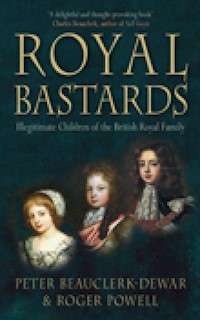
Since 1066 when William the Conqueror (alias William the Bastard) took the throne, English and Scottish kings have sired at least 150 children out of wedlock. Many were acknowledged at court and founded dynasties of their own - several of today's dukedoms are descended from them. Others were only acknowledged grudgingly or not at all. In the twentieth century this trend for royals to father illegitimate children continued, but the parentage, while highly probable, has not been officially recognised. This book - split into four sections: Tudor, Stuart, Hanoverian and, perhaps most fascinating, Royal Loose Ends - is a genuinely fresh approach to British kings and queens, examining their lives and times through the unfamiliar perspective of their illegitimate children.
Das E-Book können Sie in Legimi-Apps oder einer beliebigen App lesen, die das folgende Format unterstützen:
Veröffentlichungsjahr: 2011
Ähnliche



















ROYAL
BASTARDS
About the Authors
Peter Beauclerk-Dewar is a direct decendent of the bastard offspring of Charles II and Nell Gwyn. He is a heraldic consultant to Christies, has previously been an editor for Burke’s Peerage & Gentry, and is a fellow of the Scottish Society of Antiquaries. He also a JP and a trustee of the Institute of Heraldic & Genealogical Studies at the University of Kent. He lives in London.
Roger Powell has been a professional genealogist for over 40 years. He was until his recent retirement a senior editor at Burke’s Peerage and Gentry and Director of Debretts Ancestory Research. He was also a research assistant at the Royal College of Heralds. He is also related to the Duke of Monmouth, another bastard son of Charles II. He lives in Northamptonshire.
ROYAL
BASTARDS
Illegitimate childern of the British Family
PETER BEAUCLERK-DEWAR & ROGER POWELL
This edition first published 2008
The History Press
The Mill, Brimscombe Port
Stroud, Gloucestershire, GL5 2QG
www.thehistorypress.co.uk
This ebook edition first published in 2012
All rights reserved
© Peter Beauclerk-Dewar and Roger Powell, 2006, 2008, 2012
The right of Peter Beauclerk-Dewar and Roger Powell, to be identified as the Author of this work has been asserted in accordance with the Copyrights, Designs and Patents Act 1988.
This ebook is copyright material and must not be copied, reproduced, transferred, distributed, leased, licensed or publicly performed or used in any way except as specifically permitted in writing by the publishers, as allowed under the terms and conditions under which it was purchased or as strictly permitted by applicable copyright law. Any unauthorised distribution or use of this text may be a direct infringement of the author’s and publisher’s rights, and those responsible may be liable in law accordingly.
EPUB ISBN 978 0 7524 7316 1
MOBI ISBN 978 0 7524 7315 4
Original typesetting by The History Press
Contents
Foreword by HRH The Duke of Gloucester, KG, GCVO
Introduction by Peter Beauclerk-Dewar
Section I: Tudor Bastards (1485–1603)
I
The Bastards of Edward IV (1442–83)
II
The Bastards of Richard III (1452–85)
III
The Bastards of Henry VIII (1491–1547)
Section II: Stuart Bastards (1603–1714)
IV
The Bastards of Charles II (1630–1685)
V
The Bastards of James II (1633–1701)
VI
The Bastards of Charles Stuart (1720–88)
Section III: Hanoverian Bastards (1714–1901)
VII
The Bastards of George I (1660–1727)
VIII
The Bastards of George II (1683–1760)
IX
The Bastards of Frederick, Prince of Wales, son of King George II (1707–51)
X
The Bastards of George, Prince of Wales, later King George IV (1762–1830)
XI
The Bastards of William, Duke of Clarence, later King William IV (1765–1837)
Section IV: Royal Loose Ends
XII
Tudor Loose Ends
XIII
Stuart Loose Ends
XIV
Hanoverian Loose Ends
XV
Victorian Loose Ends
XVI
Windsor Loose Ends
Epilogue
Appendix I: Bastardy
Appendix II: The Arms Of Royal Bastards
Bibliography
Foreword
By HRH The Duke of Gloucester, KG, GCVO
Monarchy is by definition a family affair. The principle of heredity prevents conflict in the selection process. Illegitimacy confuses this event and causes uncertainty as occurred in the case of Edward V disqualified by his uncle Richard III.
Monarchs and their families are governed by the same laws of physics and biology as everyone else, but what sets them apart is the notice taken of what they do and what they might do next.
This intense and prolonged scrutiny can be clouded by the human desire to be ‘in the know’ and not to be thought unaware of what is happening. For this reason royal gossip and speculation has always been magnified compared to other gossip. In the distant past bastard children were acknowledged and promoted as an extension of royal power. Queen Victoria, influenced by Prince Albert was determined to change this attitude, leading, some would say, to a more hypocritical age.
It is easy to disapprove of the reckless way that Charles II shamed his barren wife by producing so many illegitimate children by so many different mothers. However it is difficult to regret it if you discover, as I did, that you are descended from several of them!
It was George III, who against all advice, insisted on the passing of the Royal Marriage Act, to give him greater control of his dynasty, and its potential for marriages of foreign policy advantage. He created the successions crisis of 1817, when Princess Charlotte died and in spite of having 14 children there was no eligible grand child to take the throne, for all his male children had chosen brides for themselves and married morganatically. The Duke of Kent rose to the challenge and produced Queen Victoria in time to solve the problem.
Bastard has come to be a term of abuse, as if anyone, who suffered the uncertainties of illegitimacy, was bound to have warped their morals and behaviour.
Peter Beauclerk-Dewar and Roger S. Powell have covered five centuries of alleged bastards, including those acknowledged by the father, as well as those merely speculated, and tried to examine the claims and counter claims dispassionately. Some were ignored by their putative fathers, others supported openly or discretely. If all of them were touched by a sense of importance and destiny, I would like to believe it would encourage them to feel that they should contribute to the nation’s good rather than claim its benefits for themselves.
Introduction To First Edition
The word bastard, described by the Oxford Dictionary as ‘one begotten and born out of wedlock’, is no longer fashionable, now that nearly fifty per cent of all children in this country are born outside marriage. Moreover, it is claimed that the true fathers of many supposedly legitimate children are not in fact so, even though it has always probably been thus, for it is said that it is indeed a wise man who knows his own father. However, the advent of DNA has certainly injected rather more certainty into identifying paternity with all the embarrassments that this might cause.
As part of the research for this book, we have been able to identify the genetic ‘y’ chromosome of the Stuart Kings which is, of course, unique to the male line.
We have been able to do this by identifying the same ‘y’ chromosome in the DNA samples provided by four quite separate lines of male descendants of Stuart kings. This will now provide a benchmark against which other claimants can be measured, for all male line descendants of Stuart kings should all have this unique ‘y’ chromosome. But what it does do is to scotch, once and for all, the assertion that Colonel Robert Sidney was the father of the Duke of Monmouth, rather than King Charles II, as some had claimed.
Until recently, Burke’s Peerage & Baronetage and Burke’s Landed Gentry always drew a veil over illegitimacy and it is only in recent years that natural children have been included, other than, of course, those Royal Bastards who were ennobled and thus qualified for inclusion on those grounds.
Nevertheless the stigma attached to bastardy has always seemed rather unfair whereby the child is blamed for the sins of its parents. Yet in previous generations the stigma was all too real and the accident of birth could have far reaching effects upon the child as the laws of inheritance and succession to titles, names, estates and arms often precluded bastards. Yet conversely in the case of Royal Bastards, they were often given special titles, privileges and positions and the possibility of really lucrative marriage contracts, as we shall see.
It is amusing to find that, even today, the Royal Archives Security scanning system rejected our e-mail attachment of this text ‘because it violates our acceptable use policy on profanity’ following inclusion of the word ‘bastard’ in the title of the book.
Cecil Humphery Smith, the Principal and Founder of the Institute of Heraldic and Genealogical Studies in Canterbury, considers attitudes towards bastards in his thought-provoking article (see page 259). In 1979 he published a number of articles in The Coat of Arms entitled ‘The armorial bearings of the illegitimate issue of the Kings of England’ and he has now consolidated and expanded these thoughts into an article (see page 270). Indeed, we acknowledge his contribution towards the heraldry contained in this volume.
Moreover, in keeping with changing public attitudes, the law relating to illegitimacy has also changed over the years, and from 1926 in England, those parents who subsequently marry, thereby legitimate any children they may have had beforehand, provided that they had been free to marry at the time of their child’s birth. Under the European Human Rights Convention, bastards now enjoy most of the same rights as those children born in wedlock, except in the cases of succession to titles and arms. Indeed the present government has recently enacted leglisation whereby live-in couples and same sex couples will receive most of the same rights as their married counterparts and any illegitimate children involved will be treated the same as their legitimate counterparts. However, this will not affect the laws of arms and titles.
Whilst most of the royal bastards mentioned in this book may well have been conceived in love or lust, the king who was most prolific in fathering bastards was King Henry I, known as King Henry Beauclerk (1070–1135). He realised that by utilising a bevy of mistresses, he would be able to produce twenty or more royal bastards, as he did, who could then be married off to the leading families in Europe, thus promoting and strengthening his foreign policy. So because his wife could only provide one baby per nine months at best, he néeded to resort to outsourcing!
We start this volume with Arthur Plantagenet, Viscount Lisle (1462/4–1542), (see page 18), the son of King Edward IV, but we have not attempted to include earlier Royal Bastards because these have already been covered in The Royal Bastards of Medieval England 1066–1486 by Chris Given Wilson & Alice Curteis and elsewhere.
For many years, Roger Powell, a Deputy Editor of Burke’s Peerage and of Burke’s Landed Gentry of Scotland, has undertaken new research into the various Stuart bastards and as a result has cast new light upon conventional wisdom by disposing of a number of myths. He has also assisted in identifying and assembling many of the illustrations in this book, which has helped to bring this motley collection to life. It is intriguing to see how many of the subjects share that distinct Stuart resemblance. As we have both had many years involvement with Burke’s publications, we are delighted that Burke’s Peerage & Gentry are the publishers of this work and we thank Dr. Gordon Prestoungrange, Baron of Prestoungrange, for having made it possible and John Unwin for its design.
Of these definite Royal Bastards under review over five centuries, a total of forty-four in number, fifteen were sired by Charles II (by seven mothers) and six were by his brother James II (from two mothers), both of whose DNA ‘y’ chromosome has now been established. Moreover William IV (as Duke of Clarence) also had eleven bastards, ten being out of Mrs Jordan. The sheer variety of these forty-four official Royal Bastards, about whose origins there would seem to be little doubt, is impressive. Twenty-three of them are men whereas twenty-one are women. Many of them served in the army, some with much distinction, and a few served in the Royal Navy, whereas others joined the Church as clerics or nuns. In terms of age, the eldest died at the age of 89, whereas the youngest died at a few months, and the average lifespan was forty-five years. Of these many families, there would now seem to be only the four ducal families of Buccleuch, Grafton, St Albans and Richmond that are still represented today in the male line.
Of these forty-four Royal Bastards, ten became Dukes, two became Earls, one a viscount, several became Barons, nine were given the precedence of children of a Marquess and eight were appointed Knights of the Garter. Ten daughters made prestigious marriages with peers, but ten received little or nothing atall. Most were married and together they produced hoards of children which will ensure that there continues to be many thousands of descendants of Royal Bastards. In the St Albans family alone (see page 75), it is claimed that there are some two thousand living descendants of King Charles II and Nell Gwyn which range from dukes to dustmen (and of which both Samantha Cameron, (wife of David, the leader of the Conservative Party) and I are two) and this is probably true of many other families of Royal Bastards too.
Over the centuries, most kings have had one or more mistresses (see page 254) and many begat children by them, most of whom, at least until Queen Victoria’s accession in 1837, were officially recognised. This has extended up to and including the twentieth century, although the details of any illegitimate progeny that Kings Edward VII and VIII are alleged to have had, are still largely shrouded in secrecy and gossip, never having been officially recognised. However, in the final section Royal Loose Ends (see page 167) we examine some of the fables about the alleged progeny of more recent monarchs, numbering twenty-two. But here we have also been able to lay to rest, once and for all, a number of tantalising ghosts and ‘might-have-beens’.
Of course, it has long been suggested that a number of the children born to those Royal mistresses had had Royal fathers, even though officially their fathers were recorded as the husbands of the mistresses concerned, and certainly there have been many precedents for this over the centuries. All the Royal Bastards included in this book in Sections 1 to 3 have either been officially recognised by their Royal fathers or were incontrovertibly theirs. This work draws from much new research and is therefore the most comprehensive book upon the subject ever written.
Although we have also drawn heavily on a number of published reference works such as the Dictionary of National Biography and The Complete Peerage, we have also consulted many biographies and unpublished papers, including the surviving papers of the Benedictine Congregation in France and the Royal Archives at Windsor Castle, all of which are listed in the comprehensive Bibliography.
In the aftermath of the Queen’s Golden Jubilee, we are taking a sympathetic look at these forty-four Royal Bastards, all of whom are the illegitimate offspring of English monarchs or their heirs apparent. Some have distinguished themselves whereas others have contributed little. Among their descendants are their Royal Highnesses Princes William and Harry who have five illegitimate Stuart descents through their mother, Diana, Princess of Wales, – three from Charles II (two through the Richmonds (see page 88), one through the Graftons (see page 60) and one from James II by Arabella Churchill. Moreover, through the late HRH Princess Alice, her son the Duke of Gloucester and his children all descend from Charles II through Lucy Walter and the Buccleuchs (see page 36), as does Sarah Duchess of York and her two daughters, TRH Princesses Beatrice and Eugenie of York, who have five quite separate illegitimate Stuart descents. Camilla Parker Bowles, now HRH The Duchess of Cornwall, also boasts a Stuart descent from Louise de Keroualle and Charles II. Thus much Stuart blood has already been introduced into the House of Windsor.
Of course, it is worth considering that had Lucy Walter married King Charles II, as many claimed she did, then the course of British history would have been very different, and the present King would be the present Duke of Buccleuch. However, we do not believe that this is regarded as a live issue by any of those involved, and in any case whatever proof there is alleged to have been is said to have been destroyed several generations ago. But at least we do now know for certain that the Dukes of Buccleuch do descend paternally from King Charles II, as most of us had always thought.
Even in a short work such as this, there are many people to thank. Firstly we are deeply grateful to Her Majesty The Queen for her gracious permission to carry out researches in the Royal Archives at Windsor Castle and for the use of both written and visual material relating largely to the FitzClarences. We also thank Miss Pamela Clark, the Registrar and Miss Allison Derrett, Assistant Registrar, for all their help and we are also most grateful to HRH The Duke of Gloucester for agreeing to write the Foreword (see page 7).
As with many things, good ideas often grow from very small beginnings and I am also grateful to Peter Pininski for his contribution about Charlotte Stuart, Duchess of Albany; to Thomas Woodcock, Norroy & Ulster King of Arms; Elizabeth Roads, Carrick Pursuivant of Arms and Lyon Clerk at the Court of the Lord Lyon, King of Arms; and to all our correspondants, including The Duke of Richmond and Gordon (with four dukedoms to his name), The Duke of St Albans and his heir Charles Beauclerk (Earl of Burford), Earl of Dalkeith (now Duke of Buccleuch with two dukedoms to his name), Earl of Euston (heir to the Duke of Grafton), Lord Montagu of Beaulieu, the late Stephen Dobson, Gordon Fergusson, Robert Innes-Smith, Mrs. Carol Mitchell, Tim Seely, Major Bruce Shand and Mrs. Michael Worthington and many others besides. We thank them all for their help and encouragement in turning this idea into reality, for it is certainly a colourful footnote to mainstream history.
We also acknowledge with thanks permission to reproduce pages 80-82 from The King of Fools (1988) by John Parker, relating to Tim Seely (see page 247), as well as the many brief extracts from so many books listed in the bibliography; and to The Sunday Times relating to Clarence Guy Gordon Haddon (see page 233). We also acknowledge with thanks permission to reproduce the various illustrations from the owners concerned, all as listed below (see page 287), as well as to Burke’s Peerage and Burke’s Landed Gentry, Burke’s General Armory and Collins’ Peerage for permission to reproduce various armorial bearings.
PB-D March 2006
Introduction To Second Edition
The response to our first edition has been truly heartening and we thank our readers for their interest and our publishers, Burke’s Peerage & Gentry for their help.
However, this second edition is being published in paperback by Tempus Publishing, who will be promoting the book rather more at home and overseas. This follows the success of the book, which has been used recently as a basis for two recent television programmes ‘So You Think You’re Royal’, by Sky TV and Shine Ltd and ‘In Search Of Lost Royals’ by Granada Television and ITV. Sadly, both companies took fright at the prospect of using our title ‘Royal Bastards’ for fear of causing offence! We are also grateful to the BBC for inclusion in several of their Local Radio stations and for the many kind reviews and interviews we have had. Moreover, a lecture tour of South Africa generated much interest and we have now had bookings for some fifty lectures upon the subject. So it does seem to have provoked some interest
Happily, we have been informed of very few mistakes, but the opportunity of a second edition has enabled us to make a few minor corrections and additions. We have also been informed of a number of other possible candidates for inclusion, but the evidence is not strong enough to include them in this edition.
Meanwhile our energies are being directed towards our next book in the series ‘Royal Affairs – Mistresses & Lovers of the English Monarchy’ which should be out next year.
PB-D, March 2008
SECTION I
TUDOR BASTARDS
1485–1603
Chapter I The Bastards of Edward IV (1442-83)
Arthur Plantagenet, KG, Viscount Lisle (1462/4–1542)
King Edward IV reigned from 1461–83 and Arthur was his illegitimate son by Elizabeth Lucie, a widow. She was named by one source (Anstis) as having been the daughter of Thomas Wayte, of Hampshire, but Arthur’s date of birth is still a matter of some conjecture; one source stating it was 1462/64 and another 1480.
The first would seem to be based on the chronicles of Hall and Holinshed who claimed that when Edward IV wanted to marry Elizabeth Woodville, his mother declared that he was already pre-contracted to marry Elizabeth Lucy, on whom he had begot a child before. However, the official version recorded in the Rolls of Parliament, stated that he was pre-contracted to Lady Eleanor Butler, the daughter of John (Talbot), Earl of Shrewsbury and his wife Margaret Beauchamp. Although not a contemporary source, Hall and Holinshed based their version on an earlier manuscript viz: Chronicle of England (Harl. 2408).
Unfortunately we know nothing about the beautiful widow who captured Edward’s heart, but of Edward we are on much safer ground. According to the chronicler Hall, he was
‘a man of goodly personage, of Stature high and exceeding all other in countenance, well-favoured, and comely, of eye quick and pleasant, broad-breasted and well-set; all other members down to his feet kept just proportion with the bulk of his body’.
Sir Thomas More’s description of him was no less flattering: ‘of visage lovely, of body mighty, strong and clean made’ and he stood six feet three inches tall. The similarities between Edward and his grandson Henry VIII were striking not only in build but also in character – for both had close members of their own family executed. We cannot tell if Edward’s bastard son resembled his father in looks but he certainly did not in character.
Although the sex of Elizabeth Lucie’s child is not mentioned, it has been assumed that it was in fact Arthur. However, it is claimed that Elizabeth and Edward also had a daughter and namesake, who married Thomas Lumley, who died 1486/7, son of George Lord Lumley (see page 170). It is possible, therefore, that it is she who is referred to above.
The second date of 1480 is taken from the Dictionary of National Biography (DNB) and is entirely unsupported by any evidence. The Oxford Dictionary of National Biography concludes that he was born before 1470. However if it were true, Arthur would have been born towards the end of his father’s reign, thus perhaps explaining why his father never acknowledged him. However, in support of a possible birth date of 1462/4 is an entry in the Exchequer Records of Edward IV’s reign for a list of garments to be made for ‘My Lord the Bastard’ in 1472, but the identificiation with Arthur is far from certain given that Edward IV might have had other bastards. Nevertheless the reference to Elizabeth Lucie being Edward’s mistress before his marriage to Elizabeth Woodville in 1464, would seem to support 1462/4 as Arthur’s birthdate.
What is known for certain of Arthur’s early life is that he was originally known as Arthur Waite and that he appears for the first time in the pages of history in 1502 as a member of the household of Queen Elizabeth, wife of Henry VII, probably as an esquire of the body; prior to that he may have served in the household of Henry’s mother the Lady Margaret Beaufort. The Wayte family owned the manors of Lee Marks and Segenworth in Titchfield, Hampshire from the fourteenth century but it is unclear when the young Arthur emerged from the shadows and took his place in the world.
Arthur was rescued from obscurity by his half sister Queen Elizabeth and after her death in 1503 he was transferred to the King’s household where he again served as an esquire of the body. His duties demanded that he be ‘attendant upon the King’s person, to array and unray him, and to watch day and night’ and among his fellow squires were Charles Brandon, Richard Weston (born c 1465/6), Edward Guilford and Henry Wyat (born ca 1460). The royal favour continued under Henry VIII.
The years 1509–13 were the honeymoon period of Henry VIII’s love for his first wife Katherine of Aragon and despite the birth and deaths of two infant Princes of Wales, he remained optimistic that she would eventually bear him healthy sons. During this period the King was generous and gracious to his kinsman and on Arthur’s first marriage in 1511 to Elizabeth, subsequently Lady Lisle in her own right, widow of the notorious Edmund Dudley (the well known minister of Henry VII) he received a large grant of lands to sustain him and his wife as landed gentle folk. He also settled into a pattern of service as a Justice of the Peace for Hampshire and Sussex and this was followed in 1513 with a knighthood, just days after the death of the King’s second son. The King also made him Sheriff of Hampshire in which county he had apparently some standing, the Earl of Surrey declaring that ‘the country regards him best of any man hereabouts, and also he is sheriff of the shire, and dwelling within three mile of Portsmouth’.
However, despite his royal blood, it would be another ten years before Henry VIII deemed him fit to be created a peer of the realm. In 1523 the King finally raised him to the peerage by creating him Viscount Lisle and in the next year he appointed him a Knight of the Garter. Further honours followed in 1525 when Lisle was appointed Vice-Admiral of England and acted as deputy for the King’s illegitimate son Henry FitzRoy (see page 60), who was made Lord High Admiral as well as Duke of Richmond and Somerset. Henry’s elevation of two royal bastards, one his own and the other his uncle, was interesting. His subsequent paranoia and suspicion of all his Plantagenet relatives, especially the Pole family, had clearly not yet manifested itself. It would only come with Reginald Pole’s exhortation to Henry VIII not to ruin his own soul over his passion for Anne Boleyn. Lisle retained the position until 1533 when he was succeeded by the Duke of Norfolk, Richmond’s father-in-law.
After the Pilgrimage of Grace and the birth of Prince Edward in 1537, Henry’s thoughts turned increasingly towards securing his only son’s unhindered succession to his kingdoms. The focus of his fears was the Pole and Courtenay families but his particular hatred was reserved for his near kinsman Cardinal Pole, on whom he had originally bestowed many royal favours including the offer of the archbishopric of York. When Henry sought his kinsman’s support in his plan to divorce his wife and marry Anne Boleyn, Pole refused and condemned him for his actions. The king replied ‘I will consider what you have said and you shall have my answer’. The measured tones of his answer hid the anger that Henry felt at such an insult, but as he later confessed ‘There was so much simplicity in his manner that it cheated my indignation, and I could not think he meaned me any ill’. However, the resulting rift between the two was permanent and the discovery of ‘a coat of arms found in the Duchess of Salisbury’s coffer’ which impaled the royal arms of England with those of the Pole family all surrounded by pansies (for Pole) and marigolds (for Princess Mary) only confirmed Henry’s suspicions. According to one contemporary John Worth, it was as if ‘Pole intended to have married my Lady Mary and betwixt them both should again arise the old doctrine of Christ’. When Henry struck it was swiftly and ruthlessly. Within a short period of time both the Marquess of Exeter, Henry’s first cousin, and Lord Montague, Reginald Pole’s brother, were executed. They were followed by Pole’s mother the Countess of Salisbury in 1541.
Despite the past favour shown to him by Henry VIII, Lisle did not escape the dreadful reign of terror that the King launched against his relatives. The reason for Lisle’s sudden arrest was his alleged part in the so called Botolf Plot. According to Holinshed the chronicler:
‘The occasion of his trouble for which he was committed to the Tower rose upon suspicion that he should be privy to a practice which some of his men (as Philpot and Bryndeholme executed the last year as before ye have heard) had consented unto for the betraying of Calais to the French, whilst he was the King’s Lieutenant there.’
The instigator of the plot was Sir Gregory Botolf, one of Lisle’s three domestic chaplains, who entered Lisle’s service in 1538 and within a short time had earned himself the description of ‘Gregory Sweet Lips’. Sir Oliver Browne, another of Lisle’s chaplains thought him ‘the most mischievous knave that ever was born’ and so it proved to be. By his own subsequent declaration Botolf stated that:
‘And know ye for a truth what my enterprise is, with the aid of God and such ways as I shall devise. I shall get the town of Calais into the hands of the Pope and Cardinal Pole. This is the matter that I went to Rome for.’
The author of Lisle’s arrest was none other than the King’s minister, Thomas Cromwell, who was concerned that Lisle’s request for a commission to be set up to implement the King’s religious policy in Calais, would expose his own reluctance to do the job. In doing so Lisle effectively became an opponent of Cromwell, and the latter used the alleged plot to frighten Henry into having his uncle arrested.
Ensconced in Calais, Lisle grew increasingly uneasy, and as his position at Court became more difficult, he became a figure of suspicion. For seven years he had been Governor of Calais and from across the Channel had watched as Henry struck down his relatives one by one. When Lisle was finally arrested, in 1540, he was already a man broken in health and spirit. As he mounted the steps to his prison, he should have remembered the words of his friend Sir Francis Bryan ‘Keep all things secreter than you have been used, there is nothing done or spoken but it is with speed knowen in the Court’. His arrival was noted by the French ambassador:
‘Two days ago, at 10 o’clock at night, lord lisle, deputy of Calais, uncle to this King, was led prisoner to the Tower …It is commonly said he is accused of secret intelligence with Cardinal Pole, who was his near relation, and of certain practices to deliver the town of Calais to Pole’.
For two years the King kept him confined in the Tower but was eventually convinced of his innocence remarking to the French Ambassador that ‘he could not think the Deputy erred through malice, but rather through simplicity and ignorance.’ Lisle was overjoyed when Henry ordered his release and when the King, as proof of his regard, sent him a diamond ring and a ‘most gracious message’ it made such an impression upon the poor man that he died from joy the following night in 1541/2.
Although he had escaped the headsman’s axe, Lisle had become another victim of Henry’s reign of terror on all his surviving male relatives. During his lifetime he had witnessed many momentous events including Henry’s breach with Rome, the Dissolution of the Monasteries, the Pilgrimage of Grace, the executions of Anne Boleyn, Sir Thomas More, Bishop Fisher and, his cousins, Henry Marquess of Exeter and Henry Lord Montague. A stronger man might have survived his confinement in the Tower but this scion of the blood royal ‘The gentlest heart living’, Henry’s description of him, possessed none of the steely character of his cousin the Countess of Salisbury who ‘withstood days of relentless interrogation with the steadfastness of a strong man, and survived the rigours of three years imprisonment in the Tower before she was executed at the age of sixty seven’. Indeed he was lucky to survive the debacle surrounding the trial and execution of Anne Boleyn for two of his more prominent friends Henry Norris and Sir Francis Bryan were accused of committing adultery with that unfortunate woman. The transformation of the King’s character during these years earned him the contempt and disgust of many of his contemporaries including the French Ambassador who described him in 1539 as ‘the most dangerous and cruel man in the world.’
Unlike their kinsfolk none of Lord Lisle’s children married into the higher eschelons of the nobility, but that did not stop them from being proud of their royal blood. Indeed when there seemed to be propects for a disputed succession to the Crown on the death of Elizabeth I, Lord Lisle’s great-grandson Sir Robert Basset made known his pretensions:
‘but not being able to make them good, he was forced to fly into France to save his head. To compound for which, together with his high and generous way of Living, Sir Robert Basset greatly Exhausted his Estate; Selling off etc, no less than thirty Mannors of Land’.
Sir Robert remained in exile from 1603–11 and was but one of fourteen persons who had pretended titles to the crown in 1603. History, however, would be much kinder to George Monck, later 1st Duke of Albemarle, Lord Lisle’s great-great-grandson, who was instrumental in the restoration of Charles II in 1660.
Chapter II The Bastards of Richard III (1452–85)
John De Gloucester, called De Pomfret, (1468?–99)
John of Gloucester, originally known as John of Pomfret, is the only known illegitimate son of King Richard III. He is a shadowy figure about whom very little is known, but during his short life, he posed a very substantial threat to the security of the early Tudor monarchy.
Despite the paucity of information about him, it is possible to piece together some information about his early life and career. Firstly he was almost certainly born no earlier than 1468, when Richard III was only sixteen years old. This would have made John about seventeen years old when his father appointed him to the office of Captain of Calais in 1485. However, it is possible that he was born in the early 1470s thus making him only about twelve years old in 1485. Either way he appears to have been born in Pomfret (Pontefract), Yorkshire or alternatively grew up there until he took up his post in Calais at the end of 1484. As his father was living at Pontefract under the tutelage of the Earl of Warwick from circa 1465–68, the former possibility seems the more likely.
In support of his birth between 1468–72 is a rather obscure reference in the records of the Great Wardrobe of the King in 1472 to a lord bastard. However, it must be said that this could equally have referred to Arthur Plantagenet, later Viscount Lisle, the illegitimate son of King Edward IV (see page 18). But as John was described as ‘the lord bastard’ on two further occasions in 1484 and 1485, the 1472 reference could also have applied to him. Unfortunately his mother’s name is unknown, although at least one historian has speculated that she could have been Katherine Haute, wife of James Haute, son of William Haute and Joan Woodville, cousin to Elizabeth Woodville, wife of King Edward IV.
In addition to his appointment as Captain of Calais, John was made Captain of the fortresses of Rysbank, Guisnes, Hammes and Lieutenant of the Marches of Picardy for life. He was actually out of the country when his father King Richard was defeated and slain at the Battle of Bosworth in 1485, but somewhat generously, Henry Tudor then proceeded to grant him an annual rent of twenty pounds, for life, from the revenues of the lordship of Kingston Lacy in Dorset. If John was born about 1468 he would have reached the age of twenty-one in 1489 or thereabouts, but following the grant of 1486, nothing further is heard of him until his death in prison in 1499.
George Buck, in his book ‘The History of King Richard the Third’ published in 1619, alleges that John had been in prison a number of years before his death and he was referred to in the confession of Perkin Warbeck, another pretender to Henry Tudor’s crown. The date given is 1491, the year in which Perkin Warbeck arrived in Ireland and the future Henry VIII was born. Why Henry decided to imprison John is unknown but it would seem to have a direct link with Warbeck’s appearance in Ireland and later the following year in France at the express invitation of King Charles VIII. Nor is it known if John shared the same prison as the young Earl of Warwick, the only remaining legitimate male Plantagenet.
Henry’s reaction to the threat of Warbeck was to invade France and besiege Boulogne. The French King quickly treated for terms and the resulting Treaty of Etaples stipulated that he pay the English an annual subsidy and banish Warbeck from the realm. Warbeck then appeared at the court of Margaret of Burgundy, sister of Edward IV and then paid a visit to the Holy Roman Emperor, who acknowledged him as Richard, younger son of Edward IV. Whilst Warbeck played out his semi-tragic role as the Yorkist heir to Henry’s crown, John of Gloucester languished in prison. It is not known if he had married but prior to his imprisonment he could have taken a wife. If he did, her fate is unknown. Unlike his cousin Arthur, Edward IV’s bastard, John, did not serve in the King’s or Queen’s household. In view of his age and his parentage he was clearly regarded as a threat to Henry Tudor and is reputed to have been disposed of because some unspecified Irishmen wanted to make him their ruler. The contrast in his fate to that of his cousin Arthur is quite striking and in the author’s mind can only be explained by the character of the two men. John may have been of a more independent and outspoken in his views and unwilling to accept the change in his circumstances, whilst Arthur was the complete opposite. Whilst Arthur flourished under the patronage of the first two Tudors, John paid the ultimate price.
Katherine Plantagenet, Countess of Huntingdon (1468/70–87)
Katherine was the illegitimate daughter of King Richard III but very little indeed is known about her. Even her date of birth and her mother’s name are unknown. All that can be stated with confidence is that she cannot have been born earlier than 1468 as her brother Richard was just 16 years old at the time. Nor is there any evidence to suggest a much later date of birth.
The earliest reference to Katherine is her marriage covenant, dated 29 February 1484, when William Herbert, Earl of Huntingdon agreed ‘to take to wife Dame Katherine Plantagenet, daughter of the King before Michaelmas of that year’. The Earl agreed to make her a jointure in lands of two hundred pounds whilst King Richard undertook to bear the whole cost of the marriage and settle lands and lordships on them to the value of one thousand marks per annum. Lands and lordships to the value of six hundred marks came from the King on the day of their marriage and a reversion of four hundred marks after the death of Lord Stanley. However, during the lifetime of the latter, they would have four hundred marks per annum from the revenues of the lordships of Newport, Brecknock and Hay. Lord Stanley’s involvement was due to his wife’s support of the Duke of Buckingham’s rebellion. Lady Stanley being none other than Margaret Beaufort, mother of Henry Tudor, subsequently Henry VII.
The marriage appears to have taken place between March and May 1484, the former date being when King Richard granted the said annuity and the latter when ‘William Erle of Huntingdon and Kateryn his wif’ received a grant of the proceeds of various manors in Devon, Cornwall and Somerset. The last reference to Katherine was in March 1485 when she and her husband received a further annuity of one hundred and fifty-two pounds ten shillings and ten pence from the King’s possessions in the counties of Carmarthen and Cardigan and his lordship of Haverfordwest
When Katherine died is again unknown, but one contemporary source, a list of the nobility present at the Coronation of Henry VII on 25 November 1487, stated that her husband was then a widower. If this can be supported by additional evidence, Katherine was clearly dead by that date. The cause may have been childbirth, the infant not surviving. Thus she passes from the pages of history.
Chapter III The Bastards of Henry VIII (1491–1547)
Henry FitzRoy, KG, Duke of Richmond & Somerset (1519–36)
This young sprig of the House of Tudor was the illegitimate son of King Henry VIII and Elizabeth Blount, a lady of singular beauty, a maid of honour to his wife Catherine of Aragon.who ‘… in syngyng, daunsyng, and in all goodly pastimes exceded all other, by whiche … she wan the kynges harte’. Indeed her musical skills, physical charms and captivating personality made an indeliable impression on the young king whose own passion for music is well known. In his youth he had been taught to play the organ, lute and harpsichord and he even composed the words to several Court lyrics as well as several Masses.
The King’s interest in Mistress Blount occurred as his belief in Queen Catherine’s ability to produce a living son waned. Her last child, a daughter, was born in November 1518, only to die within a few hours. That he should look for a suitable distraction whilst his wife was with child, might be understandable. However, neither Mistress Blount nor her family seemed to benefit from the association and indeed it is quite possible that they may have disapproved. Nevertheless the possible opportunities that might arise from such an association would not have been lost on this worldly daughter of John Blount, of Knevet, in Shropshire. Indeed she made a very good marriage after the birth of her son to Gilbert, Lord Tailbois of Kyme, the son of Sir George Talboys, of Goltho, Lincolnshire.
Henry FitzRoy, for that is the surname the King gave him, was reputedly born in the summer of 1519 at Blackmore, Essex, an occasional retreat used by the King for his amourous escapades. Prior to the birth, his mother’s last appearance at court was in October 1518 when she participated in the celebrations at York Place, organised by Cardinal Wolsey, to mark the betrothal of the two year old Princess Mary to the Dauphin of France. If her son Henry was created Duke of Richmond and Somerset on his sixth birthday, this suggests that he was conceived at the beginning of September 1518.
Three to four months after Henry’s birth, his mother appears to have conceived again. This next child, a daughter named Elizabeth, was twenty-two years old in June 1542, and therefore was born circa June 1520. Within that three to four month gap, Elizabeth is believed to have married Gilbert Talbois, although no record of the marriage has survived. Why such great haste? Had Henry taken another mistress? Mary Boleyn, perhaps?
All we know for certain, is that there is no record of Henry VIII bestowing on his ex-mistress or her husband any honours worthy of the name in 1519–21 in celebration of their marriage. Indeed what honours Gilbert did receive, were all post-1521 and the earliest date at which she is described as Gilbert’s wife is 1522. Elizabeth’s third child, a son George, was sixteen years old in March 1539, therefore born pre-March 1523, and the earliest reference to his mother being married is in June 1522 when she and her husband were granted the manor of Rokeby/Rugby, co Warwick. Was this in celebration of their recent marriage? If so it raises the possibility of Mistress Blount bearing the King not just one child but two!
The reason for the break-up of this Royal relationship may have been due to the King’s interest in Mary Boleyn, now the wife of William Carey. They had been married in 1520 and Mary bore two children, a daughter Catherine (born 1524) and son Henry (born 1525/6), whose paternity gossip attributed to the King. Although it was often said that Henry named one of his ships after Mary, it now seems that the ship in question originally belonged to her father and was subsequently bought by the king for his navy.
But what of the young Henry FitzRoy? He was according to contemporary accounts, ‘a goodly man child in beauty like to the father and the mother’and ‘well brought up, like a Prince’s child’ and was given his own establishment at Durham Place, Cardinal Wolsey’s mansion in London. As the Cardinal was his godfather, this seemed a suitable solution. In his sixth year he was created Earl of Nottingham and Duke of Richmond and Somerset, with precedence over all other dukes, save for the King’s lawful issue, (the ceremony being described in an heraldic manuscript quoted in the Calendar of State Papers of Henry VIII). He was placed by the King in the care of Master John Palsgrave, Master Parre and Master Page with the words
‘I deliver unto you three my worldly jewel; you twain to have the guiding of his body, and thou Palsgrave, to bring him up in virtue and learning’.
The following month Henry was created Lord High Admiral of England and Warden General of the Marches of Scotland, a clear indication of his intention to promote him to only the highest of offices. He was also made a Knight of the Garter and installed 25 June 1525. Eight years later in 1533 he was promoted to the Lieutenancy of the same Order.
Unfortunately the King’s acknowledgement of his bastard son and his elevation to the peerage was not welcomed by all. Queen Catherine, in particular, resented the honour shown to her husband’s bastard, a fact that was noted by a Venetian observer at the English court:
‘It seems that the Queen resents the Earldom and Dukedom conferred on the King’s natural son and remains dissatisfied, at the instigation it is said of three of her Spanish ladies her chief counsellors, so the King has dismissed them the court, a strong measure, but the Queen was obliged to submit and have patience’.
Her fears were not unreasonable and were fuelled by her own inability to produce a healthy son of her own. Moreover, she feared that the King might make his bastard son and not their daughter, heir to his kingdoms as evidenced by the many other appointments that followed, including that of King’s Lieutenant-General north of the Trent, Lord High Admiral of England, Wales, Ireland, Normandy, Gascony and Aquitaine, Warden-General of the Marches of Scotland, Chamberlain of Chester and North Wales, Receiver of Middleham and Sheriff Hutton, Yorkshire, Lord Lieutenant of Ireland, Constable of Dover Castle and finally Lord Warden of the Cinque Ports. It was often said that the King had in mind to make Henry the King of Ireland, for which all these appointments were a preparation. Indeed the King instructed his Ambassadors to describe the young Duke as one ‘who is near of his blood and of excellent qualities, and is already furnished to keep the state of a great prince, and yet may be easily by the King’s means exalted to higher things’.
Indeed Henry’s impact on his contemporaries was considerable and can best be summed up in the words of William Franklyn, Archdeacon of Durham who thought he was:
‘a child of excellent wisdom and towardness; and, for his good and quick capacity, retentative memory, virtuous inclination to all honour, humanity and goodness, I think hard it would be to find any creature living twice his age, able or worthy to be compared with him’.
His tutor, Richard Croke, agreed declaring that ‘although he is only eight years old, he can translate any passage of Caesar’.
Until the birth of the Prince of Wales in 1537, young Henry was therefore the only son of King Henry to survive childhood. It is only natural, therefore, to expect some degree of speculation at Court on whether the King intended to legitimise him and place him in the direct line of the succession. Indeed in 1536 no less a person than the Earl of Sussex raised this very issue at a meeting of the Privy Council declaring:
‘in the King’s presence, that considering that the Princess (Mary) was a bastard, as well the Duke of Richmond, it was advisable to prefer the male to the female, for the succession to the Crown.’
Certainly, it was believed by many that: ‘In case of there being no sons at all of this last marriage (to Jane Seymour), it is believed the King’s determination was, that the succession should go to his bastard son the Duke of Richmont (sic). His position at Court and in the King’s affections was therefore unique, especially since the 1536 Act of Succession had confirmed Mary and Elizabeth’s bastard status in law and gave Henry the right to choose his own successor. He was also assigned his father’s Royal Arms, although ‘within a bordure and debruised by a silver baton sinister and with a small shield in pretence’.
Despite a certain amount of gossip linking Henry’s name with a niece of Pope Clement VII, a Danish princess, a French princess and a daughter of Eleanor, Dowager Queen of Portugal, the young Duke of Richmond eventually married, in 1533, Mary, daughter of Thomas (Howard), 3rd Duke of Norfolk, but the marriage was never consummated. The match was arranged by the King, and the Duke of Norfolk had to break off a match he had arranged for Mary with Lord Bulbeck, son and heir of the Earl of Oxford. The choice was an interesting one, given that Queen Anne Boleyn was a cousin of the bride, and it is not stretching the imagination too far to suggest that she might have had some hand in the proceedings.




