


Erhalten Sie Zugang zu diesem und mehr als 300000 Büchern ab EUR 5,99 monatlich.
- Herausgeber: Penned in the Margins
- Kategorie: Sachliteratur, Reportagen, Biografien
- Sprache: Englisch
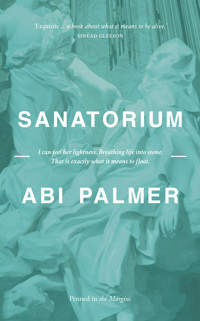
Shortlisted for The Barbellion Prize 2020 A young woman spends a month taking the waters at a thermal water-based rehabilitation facility in Budapest. On her return to London, she attempts to continue her recovery using an £80 inflatable blue bathtub. The tub becomes a metaphor for the intrusion of disability; a trip hazard in the middle of an unsuitable room, slowly deflating and in constant danger of falling apart. Sanatorium moves through contrasting spaces — bathtub to thermal pool, land to water, day to night — interlacing memoir, poetry and meditations on the body to create a mesmerising, mercurial debut. There is a dreamlike quality to Abi Palmer's exquisite Sanatorium. In lucid, gorgeous prose, she tells the story of a body, of illness and of navigating the complicated wellness industry, but ultimately this is a book about what it means to be alive. A striking, experimental debut that will stay with me. Sinéad Gleeson Sanatorium is such an intricately structured book, combining memoir and poetry to hypnotic effect. Palmer creates a space entirely new and oddly familiar – embodied, startlingly direct and, by turns, claustrophobic and expansive. A prayer, a spell, a vision; the book morphs like the chronic pain it meticulously portrays with the clarity and confusion of an hallucination vs the confusion and clarity of life precisely observed with wit and intelligence. An urgent debut, alight with ideas – I loved every page. Luke Kennard I'm blown away... a sharp, original evocation of chronic pain, the strangeness of being in a body, and the incomprehension and sometimes cruelty of the able bodied. Rebecca Tamás
Sie lesen das E-Book in den Legimi-Apps auf:
Seitenzahl: 106
Veröffentlichungsjahr: 2020
Das E-Book (TTS) können Sie hören im Abo „Legimi Premium” in Legimi-Apps auf:
Ähnliche



















SANATORIUM
Abi Palmer is a mixed-media artist and writer. Her work often includes themes of disability, gender and multisensory interaction. Her artworks include: Crip Casino, an interactive gambling arcade parodying the wellness industry and institutionalised spaces, displayed at the Tate Modern and Somerset House; and Alchemy, a multisensory poetry game, which won a Saboteur Award in 2016. She has written for BBC Radio, The Guardian and Poetry London. Sanatorium is her first book.
PUBLISHEDBYPENNEDINTHEMARGINS
Toynbee Studios, 28 Commercial Street, London E1 6AB
www.pennedinthemargins.co.uk
All rights reserved
© Abi Palmer 2020
The right of Abi Palmer to be identified as the author of this work has been asserted by her in accordance with Section 77 of the Copyright, Designs and Patent Act 1988.
This book is in copyright. Subject to statutory exception and to provisions of relevant collective licensing agreements, no reproduction of any part may take place without the written permission of Penned in the Margins.
First published 2020
ISBN 978-1-908058-79-9
This book is sold subject to the condition that it shall not, by way of trade or otherwise, be lent, re-sold, hired out, or otherwise circulated without the publisher’s prior consent in any form of binding or cover other than that in which it is published and without a similar condition including this condition being imposed on the subsequent purchaser.
The author gratefully acknowledges the support of Arts Council England.
LONDON
Have you ever noticed that when we’re near water I want to fuck? Remember Snowdonia? That icy river? Me stripping down and unfolding into oblivion while you shrivelled up and waited for it to be over. I was in so much ecstasy it has taken me years to notice you weren’t right there with me.
The problem is not that I’m constantly in pain, but that pain wakes me constantly. When I have not slept, I am prone to the following: fatigue, brain fog, paralysis, temporary blindness, floating, climbing out of my body, mid-air encounters with a long-deceased and beloved Carmelite saint.
My body is having an opiate crisis. I have been trying so hard to stay tethered to the ground. Each pill is a stone. We keep on piling them up: stones and stones and stones in my stomach, all trying to knock me down for long enough to stop the floating.
LONDON
I purchase an inflatable bathtub from China. It’s small and bucket-shaped, designed for city blocks where everyone is forced to remain upright. When I fill it, the water floods over my shoulders, so hot it could melt its own container.
If I get out alone, I will faint. I surround the tub with different-sized chairs, each topped with a cup of iced water to bring me round. I switch off all the lights and turn on an illuminated plastic pyramid. It plays frog noises and whale song on a loop. I think about sticking glow-in-the-dark stars on the ceiling, but this isn’t a home — it’s all our savings.
I sit, silent and bent-legged, folding my toes until their swollen creases soften. I barely breathe, careful for the skin on my back not to scrape the tub’s plastic seams.
LONDON
In 2008 I moved into a flat with my best friend. We took it in turns to take candlelit baths, accompanied by Radiohead’s OK Computer. This particular combination of warm water, music and light deprivation led to visual hallucinations which I later understood to be a form of synaesthesia: a rose wilts before my eyes; I fall back into a pool of gelatin; we travel along a series of telegraph wires; doves jump up and down in time with the music.
I once repeated this experiment in my inflatable bathtub, but the water was too hot. Instead of falling rose petals, I found myself surrounded by schools of melting sardines.
Oh Teresa Sánchez de Cepeda y Ahumada, drown me with your thick and sacred thighs.
LONDON
Immersing myself in bodies of water is just one of many techniques I have experimented with to ease my chronic pain. I don’t know why floating leads to visions. I think it is something to do with amniotic fluid.
In the early 2000s, an advert for flotation therapy suggested that placing yourself in a room-temperature bath, your weight supported by Epsom salts, is the closest you will get to being in the womb.
Flotation, the ad explained, is like finding yourself in a pre-birth dreamspace. It’s a good way to recover from trauma, because it’s a memory of what it’s like to exist before trauma can hurt you. The argument goes that flotation eases physical pain because you have reminded your body what it is like to live without it.
My birth was particularly traumatic. I was born via C-section but the surgeon did not count on the lumpy scar tissue around my mother’s previous Caesarean wound. They cut the hole too small. When they pulled me out, my head got stuck. An emergency alarm sounded as I began screaming and my body went blue.
When I am instructed to picture a safe space I envisage a deep well, full to the brim with icy water into which I have been thrown. But do not worry: I will survive. I lie back and sink into the water, sucking oxygen through the fat gills at my neck.
LONDON
When I was seven, doctors watched me drag my feet up and down a grey linoleum floor. They decided that getting my head stuck at birth must have triggered a brain haemmorage, which prevented my neural pathways from connecting properly to my legs.
“Her brain is working very hard,” the doctors said to my mother. “No wonder she gets so tired.”
At 17 I became so exhausted that I could not lift my body from its bed.
When I was 21, the doctors decided instead that my mobility problems were due to a genetic connective tissue disorder. This, incidentally, would have also caused my mother’s abnormal scarring (which led to my head getting stuck in the first place).
When I was 27, I was hospitalised with feet and one knee the size of cantaloupe melons. I was diagnosed with an autoimmune disorder, seemingly unrelated to the above conditions.
The doctors said it was lucky the swelling got so bad or they would have continued to attribute the increased pain and stiffness to one of my other conditions, and refuse appropriate treatment.
They told me not to let myself get too stressed about things, or my condition would get worse.
They suggested I take up swimming.
PART ONE
BUDAPEST
In 2017 I received funding to attend a thermal water-based rehabilitation programme in Budapest, Hungary.
The Sanatorium was on an island in the middle of the Danube. By day we bathed in mineral-rich thermal water, in a series of 10-minute increments. Between bathing, we took prescribed therapies. My prescribed treatments were: Medical Massage, Underwater Massage, Magnetic Therapy and Underwater Gymnastics.
Every night I was wheeled through a heated underground tunnel to an interconnected building, The Margaret Island Grand Hotel. It’s an opulent, multi-tiered structure, built not long after Strauss composed his famous waltz, The Blue Danube. Sometimes, when my eyes were tired, I thought I could see the ghost of the hotel’s early guests: pale women in opulent gowns with their hair piled high and pinned with flowers; mustachioed men sipping tea in their elegant tailored hats.
Other times I would move so slowly, I became convinced that the entire building had sunk.
BUDAPEST
Well hi, this is Abi. I’ve just had my first day of rehabilitation. I’ve been at the hotel for a couple of days now, with my partner, Hans. He left last night, so today was my first day alone. I’ve got a carer, Lucy, staying nearby, but yeah, it’s a pretty weird feeling, ha ha ha. I’m suddenly realising I’m going to be mainly on my own for the next month, just focusing on my body. I suppose my body is such a significant part of my life that it’s always somewhere close to the front of my mind. But it’s been five years since the last time I was able to stop and look after it.
LONDON
I first went to rehabilitation five years ago. It was probably the biggest disappointment of my life. They spent so long lowering my expectations, telling me what I couldn’t have. One of the group sessions was about washing a bath. “Imagine you’re trying to do your housework. You can’t wash your whole bath because you’re in too much pain. What do you do?”
I said, “Well, you could talk to social services about whether you need more help to cope with things, couldn’t you?”
“Don’t expect help,” they said. Just wash half the bath.
I was 23. It was my 23rd birthday.
BUDAPEST
The Sanatorium is different to NHS rehab. First of all, I’m in a private hotel room, not a ward of 20. It’s got a giant, king-sized bed, with huge, cushy pillows and blankets. It’s the dead of winter but it’s so warm, I actually have to use air conditioning. There’s a minibar and an unusual number of cupboards. I guess they’re used to having people stay for over a month. I’ve got the Gideon Bible in Hungarian, German and English, in case I feel the need to top myself in any of those languages. That’s a good thing to have in a place like this.
You get three therapies a day, give or take. In between, you go and lie in the sulphurous water, which is meant to be really healing. It’s the thing people come all this way for. It smells like rotten eggs.
Hans was here for the first few days and we tried the sulphurous water together. It really stinks. On the first day he asked me, “Do you think we’ll ever get used to this?”
But by the second day we were in love with it. It’s incredibly soothing, just lying around in water that smells like farts. It really does ease your pain. There’s one little hosepipe that the real smell comes from, but it’s the best part of all. People politely queue at the pipe and take it in turns to hose their aching shoulders. You get used to the smell. You can get used to anything.
The main demographic here is older women. They all get into the thermal baths in full make-up, with beautiful lipstick and manicures, which is the most perplexing thing to me. When you’re steaming the shit out of yourself, why would you do that? They look so perfect and I’m just this little acne-faced kid with a self-trimmed fringe. It turns into a mullet within about three minutes in the steam. My self-esteem isn’t particularly high. Maybe that’s why they do it, for their self-esteem. Maybe they’ve been doing this for longer than me.
BUDAPEST
Today, I had an underwater massage. I sat in a giant blue bath. They told me to grab onto the handrails and trapped my head in a sling. I held on for dear life while a woman silently hosed every inch of my muscles and joints. I don’t know if I liked it. I wanted to be sick.
Then there was the Medical Massage. They told me to take off my top, then my bra. I lay on a massage table, almost naked, with my head in a hole. The masseuse took hold of my knickers and pulled them right down, like I was being punished. Then, out of nowhere, she parted my buttocks.
I don’t know why she did that. Maybe she was just being thorough. If I’m entirely honest, my hips are hurting a lot less than usual at this point. But I’ve never had somebody stare so intimately at my arsehole.
BUDAPEST
And I have really bad gut problems at the moment, ha ha ha. I’m due to be tested for Crohn’s disease when I get home — I struggle with eating at the best of times. But they’ve got loads of healthy food options here and I became so caught up in the beautiful displays of fruit and vegetables that I forgot that I don’t digest healthy options very well. I’ve just basically been shitting the whole weekend. It’s been really painful, all blood and jelly in my shit.




