


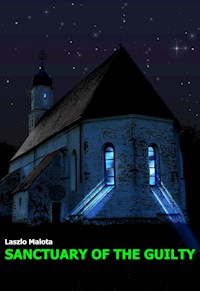
4,99 €
Mehr erfahren.
- Herausgeber: Laszlo Malota
- Kategorie: Sachliteratur, Reportagen, Biografien
- Serie: Malota Books
- Sprache: Englisch
“Nobody has yet written so bravely and honestly about the abuse, the hardship, and the emotional and psychological terror of the catholic seminary as Laszlo Malota. He introduces the world of the seminary, closed to outsiders, with sober objectivity. He depicts the atmosphere of the seminary with such astonishing vividity that you feel that you yourself have become a student of the seminary.”
„Laszlo Malota has written a breathtaking book, Sanctuary of the Guilty that everyone should read for such a book will change perspectives. I hope that one day, we will not only read it but see it as a movie. In the right hands, I am sure the movie would be fantastic.”
David Paul Kirkpatrick
(Former President of the Paramount Pictures, Walt Disney Pictures, Motion Picture Group.)
Malota’s book Sanctuary of the Guilty (A Gyalázatosak Szentélye) topped the Best Seller’s list in Europe, Hungary. The Sanctuary of the Guilty overtook Bridget Jones’s Diary by H. Fielding, The Lord Of The Rings by J. R. R. Tolkien and Imre Kertesz’s novel Fatelessness (Sorstalanság), which won a Nobel Prize. The Sanctuary of the Guilty was so successful that pirated versions of the book were circulated widely in the country, alongside the Nobel prize-winning work.
It received the following review from Miklós Jancsó (awarded Best Director at the Cannes Film Festival for his work on Red Psalm):
“Laszlo Malota you honoured me with a copy of your novel. I read this novel three times. I like it. I like it because of its irony. I like the author’s courage, his incredible bravery. Are you aware of the importance of it? Do you know that you have stirred up a hornet’s nest? It involves persecution, anger. Perhaps involving stakes or not. Or maybe, all things considered, there could also be an auto-da-fe. A truly great film could be made from it. That would cause a huge scandal. It would be an incredible world scandal.”
Das E-Book können Sie in Legimi-Apps oder einer beliebigen App lesen, die das folgende Format unterstützen:
Seitenzahl: 232
Veröffentlichungsjahr: 2018
Ähnliche



















SANCTUARY OF THE GUILTY
by Laszlo Malota
To my old seminarian friends, and the times we spent together in that worn, cold seminary; its walls closing us into one small area of which I have so few good memories.
CHAPTER 1
THE FIRST TERRIBLE DAY
“Glory to the Father, and to the Son, and to the Holy Spirit: as it was in the beginning, is now, and will be for ever,” cried out the parish priest accompanying me as he hastily crossed himself and gawked piously at the seminary.
I felt Christian guilt for not being able to share in his excitement or piety, not to mention the glorification. But I couldn’t do anything about the fact that I doubted the God he praised.
Since I was standing silently next to him, he looked at me with astonishment. Sternness and dissatisfaction crossed his face but were rapidly replaced by an affable expression so very common to priests.
“Amen,” I said coldly.
“Well, we’ve made it. This is it, my son. It’s a magnificent building, isn’t it? This is a kind of priestly sanctuary where, since ancient times, only the chosen have been able to enter ...”
“And what about leaving on the same basis?”
“Well,” he said, a bit annoyed and changing the topic, “this is where the famous priests you so often read about in books start their careers.”
“Yes, Father, I’m reading a book just now,” I started in a quiet voice while trying to act in a way that was worthy of a future seminarian. “It’s about an abbot who almost certainly came from a similar sanctuary way back when. So this abbot, Pierre Froment, travels to Lourdes and, by a divine miracle, is marvelously granted mercy and recovers the faith he had lost. This miracle, which hopefully will happen to Marie, a crippled girl he has loved since childhood and ...”
“What sort of filth are you reading?” the priest howled out in rage. “Who in the name of the Good Lord wrote this abomination?”
“Émile Zola.”
“Give that to me right this moment. Right now, before ...”
“It’s impossible, Father.”
“What?” he said, losing his temper.
“I burned it the other day.”
“You burned it?”
“Yes, my entire Zola collection, starting with all twenty volumes of the Rougon-Macquart and then ...”
“Good. Blessed be the Lord.”
“Truly blessed, since when the flames were almost as high as the sky, the angels quickly began to weep. Maybe they were mourning these masterpieces, because it started to rain, so ...”
“Move!”
We went in. The steps weren’t just any kind of steps. The priest tripped twice and came close to hitting his face on the monument’s foundation stones, but at the last moment, by the grace of Providence, he recovered his balance.
Our fears had barely left us when we received a new shock. The agitated face of a cleric appeared from somewhere out of the dank darkness. He ordered us to stop and blocked the way. We stared at each other in bewilderment. I wanted to put a quick end to this reverent gathering because the priest who had joined our little group brought with him a fairly strong smell of sweat from somewhere deep within the depths of the seminary where, no doubt, ardent prayer had produced this foul perspiration.
“Praise the Lord,” shouted the priest behind me in powerful voice.
“Forever more, amen,” mumbled the newcomer who stood in our way. “How may I be of service to you?”
“We’re here to see the rector, so if it wouldn’t be any trouble, would you be so kind as to help us?”
“What do you need help with?”
“It’s about this young man.”
“Are you a seminarian?” I said, interrupting and causing both of them to look at me in shock.
“I was just wondering,” I muttered.
“So, what do you want here?”
“Well, we really...”
“As I have already said, we’re on our way to see the rector. We have arranged to see him today. I too am a priest,” he confessed, stepping out of the darkness to reveal his cassock and confirm his words.
“I’m sorry, Father. It’s just that so many people come in here, beggars and whatnot, with claims of this and that. They reek to high heaven,” he added, and I realized something.
“We too know this,” the priest responded sympathetically.
“We’ve already managed to drive this scum out of the parish.”
“Begging is a disgusting habit, you know.”
“That it is.”
“I read somewhere,” I said, joining the conversation, “that Saint Francis of Assisi founded the Franciscan order in the early thirteenth century as a mendicant order, and...”
“The air is really cool down here,” the priest said.
“Yes, unfortunately this building is rather damp, but so are all old buildings.”
“Indeed.”
“I’ve heard it said that older buildings are even damper,” I added, trying to keep my own in this all too intriguing conversation.
“How true,” said the seminarian turning to me with a change of expression, “One hears a lot about such things. There was an old house in the town where I come from. It was very old. Before they had refrigerators, old people used to store their food there that ...”
“They wanted to keep it cool.”
“Yes,” exclaimed another would-be seminarian excitedly, “this building was their larder.”
“And whose building was this?” I asked.
“The Church’s, of course,” he answered.
“Oh, how ignorant I am,” I said, and I could almost see those old folks from long ago in front of me, endlessly carrying bags full of food. At the same time, I also tried to imagine them running away with similar types of bags, but I just couldn’t. As I was heading upwards with the two holy clerics, I was plagued by an appalling vision. I saw myself as Jesus being taken before Pontius Pilate by two legionaries that he may pronounce the verdict of the Sanhedrin in the case of Jeshu ha-Nocri.
It was with total surprise that I noticed in the rector’s office that the Superior had an extremely friendly face.
“Welcome, my son,” the procurator said.
“Magnifice domine rector. May God bless you for your kind words,” I shouted excitedly as the two men beside me, who were again priests and no longer legionaries, looked at me in astonishment.
“Don’t thank me for anything yet,” said the rector, interrupting me politely. “Just sit down for now.”
“Oh, we do not want to disturb you,” my parish priest said apologetically.
“I see you’ve made the acquaintance of one of your future fellow seminarians. He is a guide here and holds the position of ductor.”
“I never would have imagined it,” the priest exclaimed excitedly and looked proudly at our guide.
“Ductor?” I repeated to myself.
“He will explain everything to you, my son. Feel free to rely on him.”
“I hope I won’t need to,” I said quietly, but everyone heard it.
“What’s that?”
“I mean I hope I will cause no trouble, that is, I will find my place in easily.”
“Of course, of course.”
Then everyone around me started chatting vigorously about a topic that didn’t interest me in the least. So while they were throwing ideas back and forth, I looked around the place and took in the medieval atmosphere. It served as an office, a reception room and, as it later turned out, a court chamber.
The walls were covered in paintings of priests and archbishops, serious and ripe with knowledge. Old men clothed in all manner of garments, they all held rosaries or crosses.
None of the faces were familiar, and they were all remarkably alike. It was as if each painting had captured different moments in the life of the same man.
The priest and the ductor would have fit in perfectly with this crowd.
The rector, though, seemed different somehow. There was something about him that was unlike the other two and the faces in the paintings.
But I didn’t have time to speculate on these things because my guards were on their feet again, eyes bulging, and gesturing to me it was time to leave.
Somewhat dispirited, I bid farewell to that strange place. As a dutiful seminarian there was nothing else I could do but obey the will of my superiors.
Once outside, the ductor turned to me with a look of censure on his face and in a hushed tone cautioned me to show more discretion.
“That’s not proper behavior here. You have a lot to learn, if I do say so myself.”
“I’m here to learn something of the cunning ways of priests by example,” I said good-naturedly, but neither of them dignified my words with a response. They walked with bowed heads and hands folded beneath their cassocks down the long, dreary, endless, and dimly lit corridor.
The two heavy suitcases were like lead weights on my shoulders. The walk started to become tiring, and it occurred to me that the ductor might be lost and we were walking along the same route over and over again. It’s possible, though, that he had intentionally failed to find the entrance to the seminarians’ cells in order to inflict a little penance on me for my previous behavior.
Then suddenly he stopped, crossed himself, and burst out loudly with “Hail Mary, full of grace.”
“Our Lord is with thee,” the parish priest added emphatically.
“Blessed art thou among women, and blessed is the fruit of thy womb, Jesus,” is what I should have said to take part in this group prayer that we started for Lord knows what reason.
“Amen,” I shouted when I thought they were done.
“Let us look into ourselves now for a few minutes before we step into the sacerdotal part of the seminary, where you will spend the next seven years,” our guide whispered.
I was shaken by his words as if he had just sentenced me to prison.
“Follow me,” the ductor said after the silence that usually follows such things.
We finally entered the seminary, and everything changed instantly. The air was cool and damp; objects were drenched in gloom. The bright light from outside was blinding, but even when my eyes had adapted to the sudden change, the sunrays filtering through here and there fell on me as if it were twilight.
The most surprising change, though, was the one I felt in my soul. This part of the building had something ancient, mystical, and depressing in the air. This disheartened and unsettled me. For a moment I felt like I was in Dante’s Inferno. It must have been to counter this feeling that “Gloria in excelsis Deo” was written above the door.
After going along the corridor we reached a large area, at the end of which, closed off from the world, was a spiral staircase. We silently walked up until we reached a dark door. After having stepped through the door, we found ourselves in a hidden corridor along which the seminarians’ cells were located. This place too was shrouded in gloom, and candles burned along the corridor. We walked in dead silence in front of the crypts before stopping at the entrance to one.
“This is it,” the ductor said.
“Nice,” added the priest without even taking a look.
“It sure is,” I added, because I couldn’t bear staying silent any longer.
“I’ll be back for you in fifteen minutes,” the ductor said and then quickly crossed himself and left.
“Swell. Can’t wait,” I said.
“I’ve had enough of this,” howled the priest, who sped off after the ductor.
I was left alone in the sweltering room. I looked around. The cell had two parts. One looked like a makeshift room with three empty beds and a desk next to them. Behind each bed was a wardrobe. There was no other furniture in the room.
I realized I would probably have to share my solitude with two fellow seminarians. I could only hope, for the time being, that my roommates took hygiene more seriously than the ductor, who wasn’t able to keep anything other than his soul clean.
I sat down on the side of the bed and tried to imagine what the other seminarians might be like. I was particularly interested in the two who I would, unfortunately, have to spend most of my time with.
I felt a little tense, so I paced around the chamber for a while before walking over to the window, which overlooked a courtyard garden. There were carpenters, painters, and electricians all clad in filth and working among the rubble and piles of timber.
These people are free, I realized, and my heart sank. When they finish their work, they’re just going to go through that cold, dark corridor and head back to their lives, while I’ll be left here in this mystic, dreadfully boring place, where I’m locked up with Lord knows what kind of madmen and bigots. I’ll have to live by the rules of this place, rules I would never be able to identify with.
I looked at them for a while, lost in their work, while I was considering my fate. All of a sudden I thought of Esther. I thought of my darling Esther and that terrible morning when we had to go our separate ways.
A door shutting somewhere in the depth of the seminary snapped me back to reality, and, as if guided by sheer malice, the door to the chamber opened and the ductor stepped in.
“You haven’t finished yet, have you?” he asked in astonishment.
“With what?”
“You should be finished unpacking by now. This won’t end well.”
“Neither will this discussion if you show us no humility and patience and don’t wait for us to finish.”
“Us?” he asked me, eyeing me quizzically.
“I was talking to the Lord God.”
“What?” he said and started walking towards me menacingly, his eyes glaring.
“I don’t understand why you find this so unusual.”
“Well, now. How dare you. Only the chosen ...”
“That’s not true. It’s in the Catechism of the Catholic Church. What does point 306 say about prayer? The answer is that when we pray, we are talking to God.”
“Forgive me. I didn’t know that you ...”
“Enough of this. Sit down and wait till I finish my prayer.”
“Please do, and once again I ...”
“Audi, vide, tace, si vis vivere in pace.” (Hear, see, be silent, if you wish to live in peace.) I shouted at him making him flinch. He sat silently till I felt the time had arrived to return again to this world and continue ignoring him.
“Let’s go.”
“Really? Great,” he cheered. “There are people in the chapel who can hardly wait to meet you.”
“Curiosity is a great sin, brother. You must avoid it, and I would suggest the same to those who are waiting for me.”
“Yes, I know, but you have to understand their curiosity. Your arrival here is – how should I say this? – very unusual.”
“How so?”
“What I mean is that we – the other new people, that is – have been here for almost three weeks now. And you’ve only just arrived. Well, everyone’s interested in why ...”
“I am not at liberty to tell you, brother. I made a promise to a pontiff. This is a highly confidential matter. A secret, which if revealed, would bring about my downfall.”
“Good Lord,” said the ductor, dumbfounded. “I had no idea.”
“That’s perfectly all right.”
“But what about ...”
“Please, spare me from foolish gossip.”
We arrived at the chapel. It was in the part of the seminary where the seminarians lived their uncommonly monotonous lives. The chapel couldn’t be accessed from the part of the building where the rector had greeted us, which I later found out was the academic section where we would be attending lectures.
This unique chapel was built underground. At first glance, its stone walls reminded me of a cellar, but as I scanned the room I realized it was more ornate than any cellar. There was a huge altar opposite the entrance, and before it was a sanctuary adorned with gilded paintings. In front of the sanctuary were pews and far off in the back of the chapel was an organ and next to that, confessionals. As far as I was concerned, though, these interrogation booths didn’t exist. The ductor looked like he had divined something, and he began to talk.
“You may confess every day to our spiritual director, our prefect or the vice-rector,” he whispered.
“Is there anyone else we can confess to?”
“Well,” he said, embarrassed, “sometimes the rector ...”
“ … is willing to do things like this?”
“That’s not the way I wanted to put it, but yes.”
The bell rang abruptly and filled the entire area with its sound. Priests came running out from all corners of the chapel at the sound of the bell and diligently genuflected when they reached the pews. The ductor had an officious look on his face as he ran forward.
Before I knew it, they were all being led by the doctor in chanting the Angelus, which is usually chanted at noon.
“The angel of the Lord declared unto Mary. And she conceived by the power of Holy Spirit,” he started, followed by a rattling in unison. “Hail Mary, full of grace ...”
“Behold the handmaid of the Lord. Be it done unto me according to your Word,” shrieked the ductor. The others followed by rattling, “Hail Mary ...”
“And the Word was made flesh. And dwelt among us.”
“Hail Mary ...”
“Pray for us, O Holy Mother of God.”
“That we may be made worthy of the promises of Christ.”
“Let us pray,” I cried aloud. Everyone turned to me in astonishment.
The ductor was the first to come to his senses.
“Pour forth, we beseech thee, O Lord, Thy grace into our hearts, that we to whom the incarnation of Christ Thy Son was made known by the message of an angel, may we by His Passion and Cross be brought to the glory of His resurrection; through the same Christ our Lord. Amen.”
“Amen.”
“Amen,” I said, finishing my own prayer. Now, perfectly relaxed by the great many angelic greetings, I began to walk through the chapel. The ductor immediately appeared next to me.
“What was that? How...,” he stammered nervously.
“By the grace of the Lord, I acted on His divine inspiration,” I replied calmly and crossed myself. “Thy will be done.”
“What grace?”
"Through His sanctifying grace, God enlightens us, strengthens our will, and fills our hearts with joy so that we will know and do good and avoid evil.” (This is the answer given to question 207 of the Catechism of the Catholic Church (What act does God perform in your soul through sanctifyinggrace?))
There was much commotion in the chapel. Everyone knew his place and what he had to do. I spotted the seminarians among the hustle and bustle of the clerics, and they glanced at me in pity mixed with scorn. There was also something expectant in their glances that I hadn’t understood at first.
There was an older, bespectacled seminarian who was paying particular attention to what I was doing. He was on his hands and knees dusting under the altar.
“Who is he?” I asked the ductor, who seemed unwilling to leave my side.
“Anselmus. He used to be a Premonstratensian canon.” After a slight pause, he added, “He’s one of your cellmates.”
I broke out in cold sweat.
“And who’s the other?” I asked quickly.
“Come on, I’ll introduce him,” the ductor said and started off in the direction of the man under the altar.
“Marcus,” I said, holding my hand out, but Anselmus did not reciprocate by showing me this, most fundamental kindness.
“Anselmus was a Pre...”
“Premonstratensian canon. Yes, I know.”
“Who told you?” Anselmus asked, astonished.
“There’s a hermit at the end of our street who is a defrocked Premonstratensian canon, just like you. He told me once, before he was an anchorite but after certain signs of it had already appeared in him, that he was going to join up as soon as possible. He had just had a child, his eighth in fact, which in and of itself was nice enough and a noble thing and without doubt an enviable feat for a Premonstratensian canon. It’s just that this child wasn’t exactly normal.”
“What?”
“How?”
“Something was wrong with his brain. He was a compulsive cleaner and ...”
“Cleaning reminds me,” said Anselmus, with a note of reproach in his voice, “I could use some help.”
“That’s fantastic. I can see Providence at work. Since the ductor is free now, I won’t keep the two of you from your work.”
“Hold on a moment,” the ductor said as he ran after me.
“Yes?” I said, stopping, and then quickly added, “I am at your service.”
“Don’t make me mad,” he said in a threatening tone. I nipped his anger in the bud by saying,
“Non irascatur aliquis, nisi causa sciatur,” (I will not be angry with a person, unless the cause be known.)
“Right, right, but ...”
“I ask for your understanding, my brother. I have very sad memories of that affair. Once, when hopefully we know each other better, I’ll explain it to you. Of course, even then this will be strictly confidential, and I’ll tell you and only you about these things. Maybe then you’ll understand me and forgive me. Maybe then you won’t ask me what I’m not capable of doing. But now, with your permission, I’ll take my leave because I would really like to finish my unfinished prayer, the Lourdes ninth, which I offer up to everyone in our seminary.” And with this I left the stunned ductor to himself. He had no choice but to return to Brother Anselmus, and to do so without me.
I set off from the chapel to look for a secluded, tranquil area in the as yet unknown world of the seminary. I was looking for peace of mind and the opportunity to be left alone with the thoughts that were swirling around in my head. I couldn’t get these thoughts out of my mind.
I went up to the next floor and accidentally bumped into a cleric, who stopped and stared at me simply because I wasn’t wearing a habit. I hadn’t yet been graced with one.
“You?” he started.
“Look, if it’s no problem, could you give me some directions?”
“Who are you looking for? How did you get here? Where are you going?”
“Father, the Lord moves in mysterious ways. Who knows where we come from and where we’re going to? Only God Almighty can answer such questions.”
“Answer me now. Who are you?” he said, losing his Christian temper.
“Homo sum, et nihil humani a me alienum puto,” (I am a human being, I consider nothing that is human alien to me. (Terence)) I answered him calmly. I hoped that hearing Latin words would put him at ease as it does so many priests who achieve ecstasy from a few Latin sentences.
“Seminarian?”
“I can only hope that I live up to everything that the people in this holy building expect of me. I’ll be sure to do my best. I hope I won’t bring shame on this place and that I may live amongst God’s chosen for the rest of my life, that by the end of my life I will have been worthy of the last rites, and that I may stand before our Heavenly Father and be judged by Him.”
“I am the prefect,” he said, and then he reached out his hands and pulled my head toward his. I later found out that this was a priestly greeting.
“Well, well, well. The ways of the Lord. The guide and I were just talking about you.”
“Really?”
“I’ve heard a lot of good things about you.”
“Don’t mention it.”
“I wasn’t going to,” I said, and his face darkened.
“I do not wish to push you into the sin of vanity, Father. No, I wouldn’t want that. We have a responsibility toward one another.”
“Have you made yourself at home here?”
“Actually, I haven’t had a chance to do that yet. I felt that inspecting the chapel was more important than unpacking some old bags. And now I would like to familiarize myself with my new home if you do not object, Father.”
“But get back to the chapel by one o’clock. Do you know why?” he inquired.
“Of course I know,” I answered firmly, though I honestly had no idea why I had to return.
“One o’clock, then,” he said and quickly left. I was alone, closed in by the cold walls of the seminary. They looked like the walls of a dungeon, walls that had witnessed much suffering.
I walked down the empty corridor and was suddenly overcome by a need to escape. The lack of air was choking me. I felt the walls closing in as if they wanted to crush me. All the windows were closed. None of them would so much as budge, no matter how hard I tried to open them. Even the doors were closed. I felt lost in this stone wasteland. I started running. I had no idea where to go, but I had to run away, to anywhere. Even so, I knew I really had no choice in the matter. I knew escape was impossible.
The fear was welling up inside of me, and I eventually managed to force open a window overlooking the garden. The air of freedom gushed in through the window, allaying my fears and bringing back my courage.
“Don’t you know it’s not allowed to open the windows?” snapped an unknown voice.
“Pardon?” I said as if in a stupor. I turned around and saw a cleric standing in front of me. Judging by his age, he must have been a seminarian.
“Close it this instant,” he said in a voice that would brook no disagreement.
“Why? I wasn’t feeling well.”
“So you want us to clean up all the dust coming in from the outside? Can’t you see all the dirt getting kicked up by those workers? Of course, this surely wouldn’t interest you since you don’t live on this floor. Right?”
He stared at me in silence. My composure quickly returned. My indifference enraged him.
“What insolence! How dare you talk like that to a fourth year deacon?” he shouted, shutting the window. He slammed it shut with such sudden rage that the glass shattered, scattering pieces of broken glass everywhere.
“Oh, Lord,” he roared, dropping to his knees.
“Brother,” I said leaning down to him and gently placing my hand on his shoulder, “stultum est timere quod vitare non potes.” (It is foolish to fear what you cannot avoid.)
“You must believe me, this was a mistake. All my pent up anger must have burst forth. The entire thing was the devil’s doing. It wasn’t me.”
“No, you are mistaken, dear brother. This isn’t the work of the devil. It’s divine guidance.”
“Do you think so?” he asked frightened.
“I’m certain. God is warning you through these broken pieces of glass. He’s telling you that it is not enough to warn others or, for that matter, to order them around. You must look into yourself. It is not enough to preserve the cleanliness of the seminary; you must also help to clean it.”
“But I’ve already done everything ...”
“That is a misconception, Brother.”
“No, believe me, it’s not,” he shouted, trying to convince me otherwise, but failing completely.
“According to the prefect, you haven’t helped to clean the chapel. And the word of the prefect is holy and infallible.”
“Oh, Lord, your might is great. I have a sinful soul,” he shouted as he hopped back up and started bowing before the broken window. He then stopped abruptly and adopted a completely different tone of voice.
“What’ll happen if someone finds out? What should we do now, if you know what I mean?”
“I shall pray for you, Brother,” I said, trying unsuccessfully to calm him down.
“That won’t be enough,” he blurted out and immediately turned white.
“Enough?” I asked, shocked by his words. “You’re a deacon, and you’ve never heard of Saint John of Damascus?”
“But ... just ... but why?” he stammered, unsure of what to think.
“Saint John writes, ‘Prayer is an uprising of the mind to God or a petitioning of God for what is fitting.’ (Saint John of Damascus, De Fide Orthodoxa, Book 3, Chapter 24.) What more can a man do?”
“No, of course, nothing. I feel the same way,” he said slavishly.
“Now, take me to the chapel. It’s one o’clock. Or don’t you even know what happens at one o’clock?”
“Of course I do,” he shouted proudly. “Psalms. Yep, psalms,” he added jovially.
We took a shorter way back to the chapel. By the time we arrived, the others were already in the midst of the psalms. I was amazed at the number of clerics gathered there.
“Are they all seminarians?” I asked my companion.
“They are indeed,” he whispered complacently. His words shook me more than the piercing glance one of the priests shot at me.
“Come forward,” suggested my companion.
“No,” I protested. “We’re just as close to God here.”
“Well, that’s not the point,” he said thoughtlessly. Flustered, he quickly added, “Um, I’d like to introduce you to the others.”
“I won’t have anything to do with it,” I protested.
“But you will,” he said, pulling me towards the chancel.
“Stop it,” I said louder than I should have. A few people glanced back, including my parish priest. Even Anselmus was among the onlookers. He furled his brow, a look suggesting that he would deal with me later.
“I’m going to the front. The deacons are there,” I heard him say.
I was alone, surrounded by the ancient walls of the chapel. I watched the others signing psalms and felt that depressing sense of loneliness press down on me again. I felt a sense of detachment cut through me. The empty, monotonous world of the seminary made me think of Esther and that cruel night.
We lay side by side in the room without making a sound. The shutters were only half drawn, letting in the shadows cast by the light outside. I could feel her hand shaking in mine. I could hear her breathing unsteadily.
I didn’t want to break the silence because I knew it would hurt the one person I love.
“Why are you being so quiet?” asked Esther suddenly. I was unable to answer her right away. I finally mustered the courage.
“I have to leave.”
“But it’s still nighttime. My parents won’t be back till lunch tomorrow.”
“That’s not what I meant. It’s not ...” I stammered, and she nestled against me. She hugged me tightly and despairingly.
“Don’t cry,” I whispered nervously.
“Don’t you love me anymore?” she asked in a voice that was both accusing and forlorn.
“I ... I do love you.”
“Then I don’t understand you.”
“I have to do it,” I said decidedly. What I was about to say made me feel unsure of myself. “I have to leave you.”
“Leave?”
“Yes. Because I have to leave, for a long time. A very long time. And we won’t be able to meet. I’m not going because I want to. I’ve been forced into it because of a vow and because of desperation. I won’t ask you to love a person you can only see a few times a year.”
“Where are you going? Where will you be?” she asked, bewildered.
“I can’t tell you.”
“I have a right to know,” she shouted.
“To prison,” I blurted out.
“Prison?” She sat bolt upright, and then she fainted.
It was like some nightmare. It was in that moment that I realized I had lost her. She lay there before me, listening unmercifully. I kept calling her name, but she didn’t respond.
“Esther,” I shouted. “Wake up, Esther! You can’t leave me here.”




