


5,99 €
Mehr erfahren.
- Herausgeber: Sabine Raschhofer
- Kategorie: Sachliteratur, Reportagen, Biografien
- Sprache: Englisch
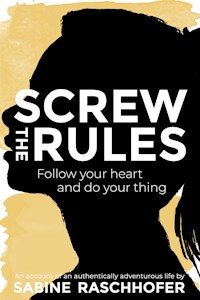
What if the life you're meant to live begins the moment you walk away from the one everyone expects?
Raised in a ski resort town in the Austrian Alps, Sabine longs for more. Guided by curiosity and a restless spirit, she sets off on a shoestring journey around the world - choosing the road less travelled.
Her appetite for adventure eventually brings her to a turning point she never expected. After narrowly escaping death and enduring a lengthy recovery, she refuses to let her spirit dim, embracing whatever opportunities come her way.
At thirty-two, with no IT experience, she starts a tech company in Australia and lands the deal of a lifetime. What follows is her greatest challenge yet - one that, instead of breaking her, leads her across five continents and into some of the most joyful years of her life.
Raw, funny, and deeply human, Screw the Rules is for anyone who knows there must be more than a life played safe.
Das E-Book können Sie in Legimi-Apps oder einer beliebigen App lesen, die das folgende Format unterstützen:
Veröffentlichungsjahr: 2019
Ähnliche

















About Screw the Rules
A candid and courageous journey across continents and into the soul.
Part travel memoir, part David versus Goliath tale, part personal manifesto, Sabine Raschhofer’s autobiography takes us across continents and into the soul, daring us to live life fully and authentically.
Raised in the idyllic Austrian Alps, Sabine is driven by an innate sense of adventure that propels her to every corner of the globe, from the islands of Indonesia to the mountains of Venezuela, from the South African coastline to the Canadian wilderness.
Fulfilling a childhood dream, she settles in Australia – where her entrepreneurial spirit and trail-blazing attitude leads to her greatest challenge of all …
Written with candour and courage, Screw the Rules is a book about truth and integrity, faith and love, bravery and resilience. It is about believing in yourself (and the universe), even when the odds are stacked against you – and the healing power of a beautiful sunset.
Contents
Acknowledgements
Writing a book about your life is a surreal process, confronting at times but highly rewarding – more than I could have ever imagined. None of this would have been possible without the amazing support of my family. Mum, Dad, Heiner, Evelyn and Bettina, thank you so much for having always been so caring and encouraging in letting me walk my path and be who I am. Thank you for your unconditional support (in every respect) during tough times when you kept believing in me, rather than showering me with advice on what you thought was best for me or how I should be living my life. Above all, thank you for always being there for me. I couldn’t have wished for a better family.
Inge Scheck, Doris Scheck and Christoph Scheck, Elfi Schmelzle, Andrew Piggott and family (including my very special goddaughter Stella) and Otto Wiesenthal from the Altstadt Vienna Hotel; thank you for sponsoring the publishing process of my book. I’m forever grateful for your support and your help in bringing my story to life.
To my editors, Ann Bolch, Jo Scanlan and Ariane Durkin (who each came onboard at various stages of the writing process); a heartfelt thank you for your efforts, inspiring insights and, above all, for taking ‘my little project’ so seriously.
And, finally, to Joel Naoum of Critical Mass Publishing; thank you for your patience and professionalism; it’s a big world out there and it was very comforting to know that my years of work were in the best hands.
‘Sometimes people don’t understand the path you take. They don’t have to. It’s not theirs’
– Unknown
PART I
‘I don’t know where I’m going but I’m on my way’
– Carl Sagan
Chapter 1
An all-too-familiar bliss
It seems like madness to some that although I grew up in the spectacular beauty of the Austrian Alps, I was longing for more. I loved them – absolutely – but I was always aware of the world outside my ski-resort town of Bad Gastein, where, even though each season offered a different aspect of natural bliss, it was all too familiar. I was actually born in Salzburg, Austria, on 1 April 1970, the third of four children, all born within four years of each other. My parents had bought a hotel in the mountains a year and a half prior to my arrival, and that's where our family lived, in a congenial section of the hotel that provided us with plenty of private space (while at the same time we kids had access to various ‘hide-outs’ over six floors). I loved living in the hotel and, from when we were little, my siblings and I always made sure we did our part to contribute to the operations, be it by picking fresh flowers for the guest rooms in exchange for a scoop of ice cream, playing the flute for the guests in front of the Christmas tree on Christmas Eve, performing ballet (with my brother stepping in as the announcer) or acting as the head waiter’s little helpers.
We learned to ski almost before we learned to walk, having the luxury of the perfect beginners’ hill right on the doorstep. We spent most of our time outdoors, if not in the snow, then in trees, playing around the waterfall in town or making our first few schillings (the Austrian currency at the time) by selling bunches of fresh flowers to passersby on the promenade in front of the hotel. We only ever went home when we were hungry or when it got dark. As we grew older, the helping-out-in-the-hotel-part naturally grew less and less attractive and, by our mid-teens, during school holidays we had to decide between morning or afternoon shifts in reception, the restaurant, the kitchen or the laundry. We had to choose carefully as some shifts meant less or no time on the mountain skiing or missing out on the après-ski – dancing to live music with a beer in the hand and ski boots still on.
Testing times with Mrs G
In Austria, after primary school one either attends secondary school for four years, followed by an apprenticeship or another form of higher education, or moves on to high school, graduating with a High School Certificate (HSC). With no high school in Bad Gastein, once we each turned 13 we changed to a Catholic boarding school in Salzburg, 100 kilometres away. While one would usually enter high school at the age of ten, our parents were against sending us to boarding school at such young age so they decided to hold off until third grade when the subjects between secondary school and high school began to be markedly different.
During secondary schooling in my hometown, I never had to study much, always finishing the year among the top three. In high school, however, I was in for a surprise. I failed my first English test and I cried my eyes out on my mum’s lap when she came to visit. Failing a test was completely new to me and, although my grades started to improve quickly, other than in mathematics the days of excelling were gone. This was most noticeable in German class where I seemed to have the rare talent of misinterpreting every poem or prose. And my essays, too, never quite managed to match the expectations of my German teacher, Mrs G, who quickly proceeded to postmark me dumb, a seal that she never removed.
Once I had reached the final year of high school and it was time to choose subjects for the HSC, I selected German as one of my three required oral exams. (If one failed a written exam, one would automatically have to take it orally. Considering I was bound to misinterpret what was going to be put in front of me for my written exam, I had to be smart enough to make German one of my three oral exams from the onset to avoid ending up with a fourth subject.) Mrs G was not pleased. She wanted only her brightest students to take the oral exam, as their performance would reflect well on her teaching. As expected, I failed the written exam. Mrs G had made it clear she wanted me to fall at the next step. When it was time for the orals, I faced the challenge extremely well prepared, having studied German literature back to front for weeks, barely bothering with the other subjects that I had to pass at the HSC. Considering that the oral examination was going to take place in front of an internal committee as well as other students, I felt pretty confident that I would pass.
Mrs G, however, was a step ahead of me and had decided to test me on a subject that we had never touched on during class. I was rather confused when I was presented with the questions but figured it must have been covered on one of my days off. Thankfully, a couple of my classmates were present during my exam and, once I had been told that I had failed, approached me, confirming that they also didn’t know what Mrs G had been talking about and that we had never gone over that specific subject matter in class. What followed was a meeting with the school’s principal, my year’s head teacher and the school’s psychology teacher. I was given the option to either re-take the exam in front of an external committee or to report back after summer – in three months’ time along with all the other students who had failed the first time round – after which I would be guaranteed a pass. (Obviously option two was the preferred option for the school considering the effect on the school’s reputation if an external committee had to get involved.) I chose option two.
My German teacher’s attitude towards my abilities left a significant emotional scar in regards to my confidence and self-esteem. Her degrading comments instilled over time ensured that – in certain areas in my life – I would feel inadequate for years to come. It was only in my mid-thirties that I started to look at it all from a different perspective, when someone for whom I had the utmost respect expressed his admiration of my communication skills.
The odd one out
Overall, my mid-teens were a challenge in the sense that I often felt like the odd one out, that I didn’t quite fit in. Two years my senior, my brother Heiner was this naturally cool guy who, from a young age, had the ability to gather a squad of people around him; he was forever the leader of the pack and someone I invariably looked up to. My sister Evelyn, less than a year older than me, was also extremely popular and always part of the in-group. She was very pretty with a great sense of style and it seemed like every boy in town was after her. The number of letters, flowers and other presents that were delivered to her in boarding school was simply ridiculous. And Bettina, my younger sister by a year and a half, was this gorgeous girl everyone loved, the cute ‘little one’. She had a lively and charming personality as well as a sense for fashion that was always ahead of her time. And then there was me – the one with the odd haircut, who always tried to copy her sisters but never quite succeeded. I remember that when Evelyn got a cool green pair of pants, I too wanted green pants; but my pants turned out to be a very uncool version – wrong material, wrong cut, wrong green. I was trying so hard, but I simply didn’t have the style. I was also quite envious of my sisters’ friends. They seemed to have a much more exciting and trendier group of girls in their year; they were always on the go and in general appeared to have a good deal more fun than me and my classmates.
When I was about 15, after a day of skiing with a few friends during Christmas break, I overheard one of my brother’s cool friends say to another male friend ‘… Evelyn and Bettina are so pretty and so much fun, but Sabine doesn’t really have anything to pride herself on’. I had always been rather shy and insecure and I was very much aware that I wasn’t as popular as my sisters (not that I was ugly, I was just trying too hard to be someone I wasn’t) but that comment stabbed me in the chest. The situation then got even worse when my brother’s friend turned around and saw me standing right behind him.
Following that incident my sisters kept trying to push me to have more fun and join them on their nights out, but for quite a while I convinced myself more often than not that I would be better off staying at home, rather than having to change clothes, face the cold and not get much sleep. Although my brother’s friend’s comment at the time was a tough one to take, it was certainly character building. It taught me to fend for myself early on, igniting a ‘just you wait!’kind of attitude. In school I gradually turned into a rebel, going against the rules when they didn’t make sense and standing up for myself when I didn’t believe in the status quo.
Envisioning my future
What I had always wanted from my mid-teens on was to travel and by the time I reached my final year of high school my main focus was on finding a way to live overseas for a while. The solution seemed to be a program through Rotary International that would give me the opportunity to study in the United States for a year. To qualify, I had to go to quite some effort, which included completing a set of forms, acquiring doctors’ certificates and writing essays to prove a certain standard of the English language. It took me weeks to get it all done. When I proudly presented the completed file to my dad to get his seal of approval before submitting it, he readily put his signature on the first couple of pages that had to be signed off by a parent. But when it came to the final autograph, he paused, looked up at me and eventually stated, rather firmly, that I ought to have a higher education certificate before going overseas. I tried to argue my way out of it but to no avail. All those weeks of excitement and focus on gathering the information to qualify for my year abroad turned out to have been a waste of time and energy.
Although I had always known – or these days I prefer to say I believed I knew – that my future wasn’t going to be in the hospitality industry, once I had passed my HSC at the end of the summer holidays, I ended up getting a Diploma in Hotel and Tourism Management. I had come to the conclusion that this would be the quickest and easiest way to get me travelling, rather than moving on to university and being stuck in one place for years to come. (Not to mention that I had never been the studious type to begin with. I had liked the idea of being a scientist but with the emphasis on being, rather than becoming.)
By the age of 18 I had found my own style and was starting to feel more confident in my skin. My two years at college turned out to be a time that I would cherish forever. My brother as well as my sisters had attended the same school. At the age of 14, my younger sister had started the trend with enrolling in the hotel school, which was located on the same grounds, then my brother and older sister followed suit by gaining the equivalent education at college. Over four years, each year there was an intake of yet another Raschhofer. By the time it was my turn, it appeared that every teacher had already put me into the ‘love’ or ‘hate’ basket – there didn’t seem to be much in between – without having met me. Most of the students in my year were several years older than I and had come from all walks of life and all corners of the world, making for an interesting mix. With a certain reputation preceding my arrival, I quickly managed to join the cool gang, which was a very welcome change.
Within my family it was agreed that once we finished college, my siblings and I would take turns working at home – a year at a time each. Considering that I had envisioned my future elsewhere and certainly not in hospitality (not that I had a clue about the specifics of this ‘elsewhere’), I couldn’t quite call myself the originator of that idea; yet it seemed like a fair deal to start off with. My brother Heiner and my younger sister Bettina were going to be placed at the Hotel Auersperg in Salzburg, my maternal grandma’s hotel that my parents had taken over years earlier. My older sister Evelyn and I were to rotate at Haus Hirt, the hotel in the mountains.
Dad was a ‘born’ old-school hotelier (although he was actually from an age-old beer-brewing family) who lived his profession with a heart and passion rarely seen these days. While Dad had always held the fort on the frontline, Mum was mostly behind the scenes, at least during the day. At night Mum would join Dad behind the bar to entertain the guests, while at the same time bringing up four children and trying to instil in us the high values that they both exemplified. And while Evelyn was the creative type and all about innovation and the comfort of the guests, I felt most at ease behind the desk, putting my efficiency and organisational skills to work. To my surprise, I ended up rather enjoying my full-time position at the hotel, but once I had served my first year working at home, I could hardly wait for Evelyn to return from overseas to take over my spot and open the gate for me.
Chapter 2
On the road
So here I was, finally on the road. My first stop was Sardinia, a stunning island off the coast of Italy where I was going to work as a receptionist at a hotel on the Costa Smeralda for the summer season. Having been given my grandma’s old car, I drove off to Zucchero, one of my favourite Italian singers, blasting from the speakers and over the next nine hours only stopped for petrol and ‘lap-food’.
At 3am and still rather awake, I arrived in Livorno, the port from which I was to take the ferry to Sardinia in the morning. After parking in a public car park in town, I wound back the seat and went to sleep. Shortly after I was woken by a knock on my window from the police. I told them I would be catching the ferry in a few hours’ time, but they wouldn’t have it. Instead they gave me a firm talk about the dangers of a young girl sleeping in a car and suggested I follow them in my car to find a hotel. As kind a gesture as this was, on no account was I prepared to spend any money on a hotel room, especially considering there were only a few hours left. The first hotel the poliziotti stopped at was fully booked. And when they got out of their car to knock on the second door, I quickly drove off. Once I was sure I had lost them I parked the car at a hidden car park in front of a large hotel close to the harbour. Proud of my successful escape, I couldn’t wait for the real adventure to begin.
What a fabulous summer it was. There were days when I lay on the beach but couldn’t relax due to the immense feeling of happiness that made my heart race. This was the first time I’d been away on my own and I loved every bit of it. I loved the island, the Italian way of life, the crystal clear ocean and the beautiful beaches; I loved working at the hotel and dealing with the mostly Italian clientele. Above all I loved the feeling of freedom.
Yet, it hadn’t been easy to start off with. During a couple of months of a previous summer I had studied the Italian language at the Universita per gli Stranieri in Perugia, Italy, and although I was doing pretty well when it came to structuring sentences, I was lacking experience in communication. When I had first arrived at the hotel in Sardinia that I was going to work at for the season and Stephano, the hotel’s director, flooded me with questions, I barely understood a word. This was embarrassing enough, but not as bad as the time when the maintenance guy – I think his name was Giovanni – who was based at the partner hotel Abi d’Oruat nearby Golfo di Marinella, stormed in one day and asked who the idiot was who couldn’t understand Italian. Well,that would be me, I responded, with a bright red face. He had called several times over the previous couple of days and I always had to ask him at least three times to please repeat what he had just said. I simply couldn’t understand him; mind you, he never considered adjusting his dialect or slowing down his speech. Being forced to speak and listen to the Italian language full-time, I didn’t take long to get the hang of it. When Giovanni came by just a few weeks later, he looked at me and announced, ‘Cazzo come parli bene adesso!’ (F…, you speak well now!). I couldn’t have been more excited to hear these words.
My boyfriend at the time, Stephan, came to visit one day and ended up getting a job as a night auditor/bar-man/pool attendant. On our days off we drove around the island, slept on the beach or in the car and sneaked into the pool areas of exclusive five-star hotels for our morning showers. Having grown up in a hotel I was a bit more inhibited than Stephan when it came to certain behaviours that our lifestyle forced us into. We weren’t quite in backpacker territory but rather the Costa Smeralda, one of the most expensive locations in Europe, well known for drawing the rich and famous. So when, one day, Stephan stripped down to his boxer shorts at a petrol station, took the water hose that he had spotted not far from the petrol pumps, hosed himself down and brushed his teeth right there in front of everyone, it hit my limit of bearable embarrassment. However, it wasn’t long before I found myself at home in such situations.
My dad thought alternating between working at home and going overseas would be great for gaining work experience in various corners of the world. This was based on his own very successful career, which had started with the graduation from hotel school at the age of 18 and took him on a journey that, over 13 years, had seen him work in top positions at some of the most exclusive hotels around the world. I always loved listening to my dad’s stories. In 1962 he drove a VW Beetle from Berlin in Germany to Jordan in the Middle East (and later on to Baghdad in Iraq) to be part of the pre-opening team of the Al Urdon Hotel in Amman. While Dad held the position of assistant manager, the hotel was later officially opened by His Majesty, King Hussein. Twenty-five years later, on a trip to Jordan with my mum in 1987, Dad returned to the Al-Urdon Hotel where he was excitedly greeted by a former employee still working there. With a huge smile on his face the employee pulled out his wallet and proudly presented a business card that Dad had given him all those years ago. He humbly told Dad that he was the best manager he had ever had.
So Dad’s were big shoes to fill. But at that stage in my life, I had other priorities, especially considering that I was yet to find my realcalling. And what better way to do that than to go backpacking around the world for a year – a plan that Stephan and I had forged while in Italy. Nervous about how to break the news to my parents, I thought it best to tell them while they were visiting in Sardinia for a week. In order to ease my parents into the idea of our backpacking trip, I told them that we would be gone for half a year. I figured that six months down the track, when we had only covered half the itinerary, they would get the idea that the whole trip might take a little longer. Expecting to be faced with having to defend and justify my plans, I was stunned – to say the least – to be met with not much of a reaction from either of my parents. Dad didn’t show the slightest bit of disappointment in me. It couldn’t have been easy to hold back words of worry and to not hand out well-meant advice as to what was best for me and my future. With the one 'hurdle' jumped, all that was now left to do was to strike a deal with my older sister to extend my absence from the family hotel by half a year, giving me a year and a half all up (including my summer in Italy). I would then do the same for her upon my return.
From when I was a young girl I had proclaimed that one day I was going to emigrate to Australia. I still don’t have a clue where that idea came from, considering that, at the time, I didn’t even know where Australia was. I can only assume that I heard someone talk about it or had seen a documentary on TV at some stage. When I told Stephan that I wanted to go to Australia and asked if he would be interested in joining me, he suggested we spend time in Asia along the way. This is how our idea of the round-the-world trip was born. Among my friends there had always been a sentiment that growing up in a nice hotel would be a free pass to a spoilt life and that every step I was going to take would be funded by my parents. Yet this couldn’t have been further from the truth. From when we were little, Mum and Dad had always been careful not to ‘spoil’ us. For example, desserts, soft drinks and the like were out of the question. Only on Sunday were we allowed the occasional piece of cake and orange juice; any additional treat had to be earned. And an around-the-world airline ticket now certainly wouldn’t be subsidised either. Working at home – followed by a season in a resort town – had the added benefit of saving money. With food and accommodation provided, I had been doing rather well in filling up the piggy bank over the previous year. While our trip was going to require significant investment, with the help of the occasional job along the way, we were positive we would manage.
As soon as we returned to Austria from our summer in Italy we organised our visas, got the required vaccinations and off we went. I can still see my parents waving me good-bye at the train station in Salzburg. I was 21 and, having grown up in a privileged and protected environment, this was going to be a very different experience. It was hard to imagine that I would be gone for a year, living a very exciting but comparably unpredictable and – considering our budget – most likely quite rough life. Stephan was a cool, fun guy, but from when I had first met him, he’d had the tendency to be rather hard – on me, and in general. There was never much room for being unwell, let alone for any moaning or groaning. He had travelled to Asia with his family twice before over the previous couple of years and, based on his experience and prior to getting onto the plane in Vienna, my backpack now had to go through his meticulous inspection. I wasn’t ‘allowed’ much more than a rain jacket, jeans and shorts – a pair each – one jumper, a few t-shirts, a cap and a hand towel (we were going to get a thin and light sarong in Thailand, in lieu of a larger towel) and very basic toiletries. The rest of the backpack had to be filled with books and practical things like a torch and first aid kit.
Upon arrival in Bangkok, our first stop, Stephan assured me that in view of our plans and the fact that we were going to rough it over the following 12 months, I would be much better off with short hair. I agreed, letting him cut my rather long mane into a wobbly bob. The following day we left the city lights behind and off we went on our adventure. As excited as I was, it undoubtedly required some adjusting to fully embrace the whole ‘backpacking on a shoestring’ experience. From the get-go our travels turned out to be far more strenuous than I had expected and it wasn’t long before I started doubting what had originally sounded like a dream-adventure. Always choosing the roads less travelled, I was generally the only girl around, trying to keep up with the boys until only a couple of weeks into our trip, while trekking somewhere in the middle of nowhere close to the border with Myanmar, I found myself wondering how I was going to hold up for yet another eleven and a half months. I loved the adventure, the jungle and the amazing scenery as much as experiencing new cultures and meeting the local people, but I wasn’t used to the heat, the very different diet and the little sleep; and before long I got rather sick, with my body emptying at either end every half hour or so until I was throwing up bile. Yet the sorrier I felt for myself, the tougher Stephan turned, telling me to pull myself together. After another couple of weeks, however, I started to wholeheartedly adapt to the experience, changing my ‘counting down’ to ‘Oh my gosh, the first month is over – there are only eleven more to go!’
In 1991 the whole backpacking scene in Asia was very different to what it is today. One would always meet a few fellow travellers along the way, but it was still a bit of a novelty for backpackers and locals alike, especially as soon as one found oneself even just slightly off the beaten track. We had agreed with our parents that we would try to contact them every second Friday. Mail took a long time and we wanted to make sure that our family and friends knew we were well and safe. Whenever we anticipated finding ourselves in a remote area on ‘phone day’ we would let our parents know in advance. There was no such thing as a public phone booth (let alone mobile phones), so making a call to Austria always turned into a half-day adventure, trying to find a ‘call-centre’ where an operator, using an antiquated phone, would attempt to place the call for us. At times it took hours for the operator to get through to either of our parents and then it was usually not much more than ‘Everything’s great, how about you? Good, thanks. Bye.’It wasan exercise that would cost us about a day’s budget.
The exciting thing was snail mail. Every few weeks we would give our family and friends an approximate schedule of when we would be at a major city so that they could write to us ‘poste restante’. The anticipation of getting to a post office in a far-away place to see if there was mail waiting was immense. I still remember when we got to Singapore in late December and I even had a Christmas parcel waiting for me. There’s nothing better than handwritten letters from family and friends when you are on a different continent and always on the move, not able to communicate much.
From the north of Thailand we slowly made our way south, travelling ‘third class’ on the cheapest train and bus fares, often seated among chickens and screaming roosters. By the beginning of December we had reached the far south and decided to take a ferry across to the Ko Tarutao National Park. The night we arrived we went for a walk along the beach. It was a beautiful beach set in a national park, but somehow had a weird feel to it. There were no food stalls, no locals trying to sell coconuts or pineapples or none of the hustle and bustle that we had become so used to. What we got in exchange were oodles of mosquitoes and sand flies. We had an early night that night. The following morning I awoke to an alarmingly high fever, chills and sweats. I could hardly move my head and my whole body ached. Stephan went and consulted a fellow traveller who we had met the night before and was a doctor by profession. Judging from my symptoms, the Swiss doctor believed I had contracted malaria. As a first-aid measure and to hopefully kill the virus, he suggested that I take six of each of the two types of malaria pills we had been taking on a weekly basis since leaving Austria. I did as I was told and, with no further resources on the island and feeling extremely weak, Stephan and I made our way back to the mainland, heading straight to the first hospital that we came across. As lovely as the resident doctors and nurses were, I was unable to properly communicate my symptoms and soon it became obvious that they didn’t understand us the slightest bit. After several attempts of trying to explain to them – with hands and feet – that I was feeling very sick, one of the doctors handed me five different sachets of pills, as if hoping that one of these would sort me out.
With both Stephan and I starting to get worried, we decided to head to Malaysia (among travellers Malaysia was known as the place to go in a medical emergency). By the time we left the hospital it was already late afternoon and we found ourselves stuck for the night in Had Yai, a small town just north of the border. The following morning, we rose early and by 7am were piled into a so-called ‘shared cab’ and on our way to Malaysia. The trip soon came to an abrupt end when the cab broke down half way and we were left on the side of the highway, desperately trying to hitch a ride.
Our journey started to turn into a real ordeal. I was barely able to stand up, with a woollen sarong wrapped around my head and neck, shivering in the humid heat and feeling weaker by the minute. We eventually got picked up by a large flower delivery truck, which, once we had left the highway, seemed to stop at every corner. At long last we made it to Butterworth by early evening, from where we took a ferry across to Penang, an island off the coast of Malaysia that we had been told would be our best and closest option for medical treatment. Upon arrival at our final destination, we flagged down a rickshaw (a three-wheeled, human-powered passenger cart) and while I just sat there, all curled up and hoping for nothing more than a bed, Stephan directed our driver from guesthouse to guesthouse trying to find a free room.
After touring half of Georgetown, we eventually found a small Chinese hotel where we were given our own, clean room with real beds. This was pure bliss. But the best thing about that place was the lady doctor next door to the hotel who had studied in England for several years and spoke perfect English. She, too, suggested I had contracted malaria and that taking an overdose of Lariam and Fansidar, the malaria pills that we had been carrying on us, had been the right course of action. Apparently, nothing else could be done at that stage. Both Lariam and Fansidar were among the strongest malaria prophylaxis available at the time. And while ‘feeding’ my body with six pills each in one go – after having already taken them on a weekly basis for several weeks – might have killed the malaria, it also left me extremely weak. I felt like I had been put on a form of chemotherapy; everything I ate and drank tasted like chemicals. Each sip of water made me feel sick. I had such a strong chemical taste in my mouth that I could no longer handle drinking plain water, resorting to sugared soft drinks to try and overpower the taste. This was the first and only time I saw Stephan cry. We were both scared, and worried whether I’d recover enough to continue travelling.
If you told anyone today that the Tropical Institute in Vienna that we consulted in regards to vaccinations and malaria prophylaxis before we left Austria had recommended taking both Lariam and Fansidar for several months, they would shake their head in disbelief. To my knowledge, both medications have been prohibited in various countries, at least in the form available at the time. It took many months to regain my energy, but the effects of the malaria pills showed long after we had returned to Europe. By the end of our trip I had lost about half my hair and it continued to fall out in small strands for several months. I began to have nightmares about waking up bald but thankfully my hair started to grow back eventually.
Although I was still fragile, it wasn’t too long before we were able to continue on our trip, moving on to the Cameron Highlands, in inland Malaysia, to get away from the heat. What followed was a nice, quiet Christmas in the mountains, New Year’s Eve in Singapore – which, with all its restrictions, turned out to not have been a very good choice – and a couple of months in Hong Kong, where we made a temporary home of the infamous Traveller’s Hostel on the 16th floor of the equally infamous Chunking Mansions block in Kowloon. It was time to supplement our budget. Among backpackers Hong Kong was rated as a pretty good place to find short-term work, a notion that proved itself right when within 20 minutes of scouting the area, I scored a job as a waitress at Mad Dog’s, an English pub right next door to the hostel and Stephan was offered a position as a barman at the German Beer Café around the corner. While I commenced work literally a couple of days after we had arrived in Hong Kong, Stephan’s job wasn’t to start for another two weeks, which prompted him to travel to China in the meantime. Full of Stephan’s interesting stories upon his return to Hong Kong – and his longstanding sentiment that I supposedly wasn’t able to do anything by myself in the back of my mind – I decided to follow suit. I left work a couple of weeks before Stephan finished and embarked on a trip to China – on my own.
Travelling in China was a whole new experience. Upon arriving in Guangzhou, the town right across the border from Hong Kong, I faced my first challenge – getting to the hostel without being able to communicate on any level. I pushed myself into a bus crammed with locals and tried to follow the course of the road, comparing it with the map in my guidebook, in the hope of eventually identifying the right stop. This wasn’t an easy task considering that the bus was so packed I could hardly see out of the window, let alone read any Chinese street signs. Stephan had already warned me that, once I crossed the border, nobody would speak or understand even a word of English. In the end I had no choice but to get off the bus without a clue where the hell I was. As it turned out, my instincts were still in good shape and, with the use of sign language, my map and the limited dictionary in the back of my guidebook (pointing out each word to a passerby), I eventually discovered that my destination was only a few minutes down the road.
Determined to prove myself and put together my own itinerary, the following day I embarked on a trip to remember. The first leg of my journey was a 17-hour boat ride to Wuzhou, which – as the only tourist on board – proved a good introduction to the Chinese culture, especially when it came to staring and spitting. The male passengers were assigned one side of the boat. Women took over the opposite side. We had two storeys each with a small aisle in between. Each passenger was allocated a wooden plank as a sitting and sleeping area, with a 10-centimetre-high division separating one from his or her neighbour. The 'beds' hadn’t quite been designed for Western frames though, forcing me to roll up my shoulders to avoid squashing the Chinese ladies on either side of me. For the whole trip it seemed like at least 20 pairs of eyes were on me, staring me down without even the slightest attempt at subtlety. Especially the men right across from me, who kept gazing at me as if they had been freeze-dried. Not knowing where to look – staring back at them wasn’t a comfortable option – I decided to lie down and cover myself, including my head, with a sarong and try to sleep. Whenever I woke up and looked around, none of those eyes seemed to have moved. Not that I was sleeping much anyway with all that throat clearing and spitting going on around me. Not to talk about my excursions to the toilet, where trying to navigate my way through the mucus and the rubbish that was building up on the aisle en-route was a challenge in itself. Once I arrived in Wuzhou my journey continued with an eight-and-a-half-hour bus ride to Yangzhou. It was February and freezing cold and the glass was missing from several windows. I emptied all the clothes from my backpack and perfected the art of layering, putting on every single t-shirt, my only sweatshirt, and my rain jacket, finishing off with my sarong wrapped tightly around me. Although still freezing, the scenery was stunning and I very much enjoyed the trip.
My time in China was, without doubt, a great experience; it was challenging at times, but I loved it. I hardly spoke a word over the two weeks that I was there. There were no heaters other than the odd little black container filled with hot coals that was placed next to one's feet at selected cafés and restaurants, nor was there any hot water. But the times that take you out of your comfort zone are the ones you end up cherishing the most.
From Hong Kong, Stephan and I went back to Singapore, up the east coast of Malaysia, and across the country to Penang from where we crossed the Strait of Malacca to reach one of my favourite places that we visited in Asia, the Indonesian island of Sumatra. From Nias, a small island off the west coast of Sumatra, we managed to get onto a cargo ship that was heading south and was scheduled to anchor in Padang, the capital of West Sumatra, a few days later. The ship wasn’t designed to host passengers and while we would have been more than happy to sleep on deck, this was not an option. Instead we were offered the beds of two crew members in exchange for extra money. Our cabin was a tiny one that we shared with other crew. It was extremely hot and humid with next to no air and an obvious breeding ground for cockroaches. I had never seen so many in the one spot; they were of the smallest kind, but you could feel them crawling all over you during the night. Due to the heat, we were each provided with an additional large cuddle-pillow to wipe off the constant flow of sweat during the night. The ‘bathroom’ was a small dark room in the hallway shared by the whole crew. The water in the mandi (a large tub filled with water that one pours over oneself using a plastic pan) must have been sitting in the tub for days and my first attempt at a refreshing ‘shower’ resulted in a rash all over my body, after which I decided to opt out of any wash routine for the remaining three days and chose to bathe in my sweat instead.
What was so special about this trip was the purpose of it. The ship had a big market in its hull carrying all kinds of consumables for the people who lived on the remote surrounding islands. Along the way to Padang it stopped at several different locations in the middle of the ocean, with natives from the islands approaching from every direction in their log-boats – some of them with plastic sails – filled with coconuts, bananas, wood or whatever else they had to offer in exchange for goods from the ship’s market, like toothpaste, shampoo and cookies. It was such an awe-inspiring sight. The picture still remains clear in my head as much as the picture of our room when we arrived in Padang. Bed sheets had never looked that white, a bed had never seemed that big and a shower had never felt that good.
The following three months we spent exploring other Indonesian islands. From Sumatra we returned to Singapore, boarding a ship down to Java, from where we made our way to Bali and on to Sulawesi, Lombok, Sumbawa, Flores – with a side-trip to Komodo Island – and West-Timor.
I was very lucky to have had recovered from malaria as well as I had but, having grown up in the mountains and having always been very fit, it was a frustrating experience when at times the slightest bit of exercise, especially climbing the various volcanoes that we passed along the way, turned into a fighting game between my mind and my body. My mind was always more than willing but my body, more often than not weak and shaky, wasn’t. For some reason it never seemed to occur to either Stephan or I to attribute the weakness to the after-effect of the malaria. Stephan kept pushing me and asking me to pull myself together when at times all I wanted was to lie down, cry and feel sorry for myself, not knowing what the hell was wrong with me.
After eight most amazing months in Southeast Asia, it was eventually time to move on to Australia and from Kupang, the main port on the island of Timor, we now boarded a short flight across to Darwin in the far north of the country. I was incredibly excited. I was about to set foot on the continent that, for years, I had been claiming to one day make my home.
As is often the case, however, expectations didn’t quite match reality and my first impression of Down Under left me feeling rather irritated and, walking down the streets of Darwin, lost and lonely in a weird kind of way. I wished myself back to Indonesia, or Thailand, or Hong Kong – anywhere there was more life, more chaos, more people. I missed the hustle and bustle. We had become so used to crowded streets, to the noise, the hubbub and the colours – and not forgetting the many food stalls – that we weren’t quite ready for the polar opposite. When we got off the plane at the airport, our first sight was a tall, rather white Australian lady with a cowboy hat who had come to greet the passengers on the tarmac, a large open space with no one else around. Downtown was marked by wide, empty, perfectly ‘groomed’ streets. Everything appeared way too organised to the point of feeling sterile.
My initial view of Australia clearly reflected my perception based on everything we had become used to over the previous eight months and it didn’t take long for us to again fully immerse ourselves into the adventure, wishing we had more time to spend in that spellbinding country. Due to time constraints, we decided to first explore the outback and to then follow the typical backpackers’ route along the east coast of the country. Sharing a car with an English couple, we drove from Darwin to Alice Springs and Ayers Rock (Uluru) in the so-called red centre of Australia, passing through the various national parks along the way. Next we took a flight to Cairns on the Great Barrier Reef. From Cairns we slowly made our way south to Sydney, hitchhiking all the way. This was in 1992, the year of the infamous ‘backpacker murders’ (a spate of serial killings with its seven victims being backpackers aged between 19 and 22), a horror story we only found out about on our final leg, when our ride, an ocker Aussie in a huge truck – one of the most warmhearted people we had come across – warned us to be careful because hitchhiking was no longer the way to go, at least not in New South Wales.
My original idea of ‘a year in Australia’ turned into a six-week stint. Once we reached Sydney – and with the final months of our trip rapidly approaching – we were left with no choice but to move on. Our next destination was New Zealand – best described, in its entirety, as a natural spectacle. With the country’s extremely friendly and laid-back people and a hitchhiking culture that was still intact, it turned out to be yet another highlight on our itinerary. The least that people picking us up on the side of the road would do was drop us directly at our chosen backpackers (the new-age hostels, generally much smaller with more of a ‘homely’ feel than your usual hostel). The more likely scenario was that they would first invite us into their home for coffee and cake, or take us to their remote farm and offer accommodation for a night or two.
Continuing to make our way east, we were hit with yet another shock to our systems when we arrived on the island of Oahu, Hawaii, another six weeks later. I’d been very much looking forward to Hawaii, expecting everyone to run around in grass skirts (not literally, but kind of) and flowers in their hair. Instead, we were confronted by the sight of girls strutting along in high heels and red Ferraris zooming past. At least that was our first impression based on Waikiki, the touristy part of the island framed by five-star hotels, and following a very relaxed New Zealand that was dominated by checkered fleece shirts and utes (very small trucks). Life in Hawaii felt way too fast and trendy for us, so once we had given it the obligatory couple of days, we happily left for mainland USA.
Upon arrival in LA and eager to leave the city lights behind, we rented a cheap station wagon with a box of camping gear fitted to its rooftop and embarked on a tour of Arizona, Utah and Nevada, returning to LA via San Francisco and the famed Highway No 1. Last but not least and to ease us back into ‘real life’ we decided to spend a couple of days in Chicago, before flying to the Dutch city of Amsterdam, where Evelyn, my older sister, came to meet us – to hand me the baton while she set out on her year and a half away. It was the end to a most amazing year filled with experiences and impressions that were ours to keep; and that, without doubt, shaped me in various ways.
Chapter 3
Taking flight
Over the course of our year away and to stay true to his mission to rough it, Stephan had grown his hair and a beard and by the time we arrived back in Austria he looked rather rugged and ‘suspicious’, to the extent where at our final few border crossings – starting with our entry into the USA – my luggage was searched every single time simply, I suspect, because I was his girlfriend. As for my own appearance, after 12 months’ travelling, apart from my jeans that were now ripped in more places than not and my boots that looked like they had seen a few jungle trails, I still looked as innocent and ‘normal’ as before we had left. Evelyn seemed a bit disappointed when she first saw me. I’m not sure what she had expected but there was really not much I could do about it then – it was too late for dreadlocks or whatever else she was hoping to see. My only option to spice up my looks for the rest of the family was a fake tattoo that I managed to get in Amsterdam and that I was hoping would do the trick to give my parents a bit of an initial shock when they came to meet me at the airport.




