


13,99 €
Mehr erfahren.
- Herausgeber: Parkstone International
- Kategorie: Geisteswissenschaft
- Sprache: Englisch
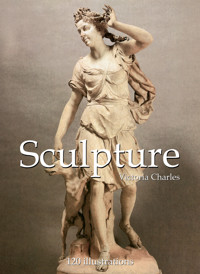
Mega Square Sculpture spans over 23,000 years and over 120 examples of the most beautiful sculptures in the world: from prehistoric art and Egyptian statues to the works of Michelangelo, Henry Moore and Niki de Saint-Phalle. It illuminates the wide variety of materials used and the evolution of styles over centuries, as well as the peculiarities of the most important sculptors.
Das E-Book können Sie in Legimi-Apps oder einer beliebigen App lesen, die das folgende Format unterstützen:
Seitenzahl: 41
Veröffentlichungsjahr: 2023
Ähnliche

Victoria Charles
© 2023, Confidential Concepts, Worldwide, USA
© 2023, Parkstone Press USA, New York
© Image-Barwww.image-bar.com
© 2023, Richmond Barthé, copyrights reserved
© 2023, Constantin Brancusi Estate, Artists Rights Society (ARS), New York, USA/ ADAGP, Paris
© 2023, César Estate, Artists Rights Society (ARS), New York, USA/ ADAGP, Paris
© 2023, Camille Claudel Estate, Artists Rights Society (ARS), New York, USA/ ADAGP, Paris
© 2023, Jean Dubuffet Estate, Artists Rights Society (ARS), New York, USA/ ADAGP, Paris
© 2023, Giacometti Estate/ Artists Rights Society (ARS), New York, USA/ ADAGP, Paris
© 2023, Ernst Kirchner, by Indeborg and Dr Wolfgang Henz-Ketter, Wichtrach/Bern
© 2023, Henri Matisse, Les Héritiers Matisse, Artists Rights Society, New York, USA/ ADAGP, Paris
© 2023, Succession H. Matisse, Paris/ Artists Rights Society (ARS), New York, USA
© 2023, The Henry Moore Foundation
© 2023, Meret Oppenheim Estate, Artists Rights Society (ARS), New York, USA/ Pro Litteris, Zurich
© 2023, Nauman Estate/ Artists Rights Society (ARS), New York, USA
© 2023, Picasso Estate/ Artists Rights Society (ARS), New York, USA/PICASSO
© 2023, Robert Rauschenberg Estate, Artists Rights Society (ARS), New York, USA/ ADAGP, Paris
© 2023, Niki de Saint-Phalle Estate, Artists Rights Society (ARS), New York, USA/ ADAGP, Paris
All rights reserved. No part of this may be reproduced or adapted without the permission of the copyright holder, throughout the world.
Unless otherwise specified, copyright on the works reproduced lies with the respective photographers. Despite intensive research, it has not always been possible to establish copyright ownership. Where this is the case, we would appreciate notification.
ISBN: 978-1-78160-947-7
Contents
Greek sculpture
Roman sculpture
Italian sculpture
Spanish sculpture
German sculpture
Flemish sculpture
English sculpture
French sculpture
The 20th century
The Artists
Cesar Baldaccini (1921-1998)
Richmond Barthé (1901-1989)
Constantin Brancusi (1876-1957)
Antonio Canova (1757-1822)
Jean-Baptiste Carpeaux (1827-1875)
Benvenuto Cellini (1500-1571)
Charles-Antoine Coysevox (1640-1720)
Donatello (1383-1466)
Jean Dubuffet (1901-1985)
Henri Matisse (1869-1954)
Henry Moore (1898-1986)
Bruce Naumann (1941)
Pierre Puget (1620-1694)
Robert Rauschenberg (1925)
Luca della Robbia (1399/1400-1482)
Auguste Rodin (1840-1917)
Niki de Saint-Phalle (1930-2002)
List of Illustrations
Foreword
Sculpture, although it preceded painted art, was long considered to be merely the accessory and complement of the eldest of the three arts: architecture. Executed using the same materials as in architecture – wood, stone and marble – sculpture was initially seen as ornament for architecture.
However, little by little, sculpture soon established itself as an independent and dignified art. After having admired the universe, man started to contemplate himself. He recognised that the human body is among all forms the only one able to fully manifest the spirit and aspirations of man.
Ruled by proportion and symmetry, superior in beauty, sculptors would work hard to reinvent the perfect body. Likewise, in the slow path of progress that led painting to produce what we call a work of art, it was a long process for sculpture to detach itself from architecture and produce what we call low-relief and sculpture in the round.
It is in the depths of antique and primitive civilisation in the Nile Basin that one must search for the origins of the arts. Around the same time that the Nile settlers constructed temples and pyramids, they engraved headstones and tombstones and lined the avenues leading up to their temples with sphinxes mounted on pedestals.
Rivals to the Egyptians, the Assyrians certainly had more influence over the Greek and the Etruscan civilisations. The oldest monuments from Greece and Etruria show evidence that they somewhat imitated ancient Assyrian art. We can witness this from Cyprus to Rhodes, from Crete to Sicily, from Athens to Corinthia.
Etruria can be proud of an ancient primitive civilisation which was close to our own. Originated with Asian influences, it modified the Greek civilisation, then the Roman, by bringing to them the first rudiments of all arts and industries.
Greek sculpture
What Pliny said about painting, “de picturae imitis inserta,” can also be said about sculpture. One can be certain that Greek art started out by imitating Oriental art. However, contrary to other ancient civilisations, the Greeks only followed lessons as a means to react against their masters.
If they did not invent art, they did invent beauty. Aphrodite of Melos (The Louvre Museum, 2nd century BC) may be the most magnificent specimen of Greek art. She is marvelously composed — the curves of her torso, the fineness of her skin — and she is the perfect equation between the subject and the style.




