


Erhalten Sie Zugang zu diesem und mehr als 300000 Büchern ab EUR 5,99 monatlich.
- Herausgeber: Birlinn
- Kategorie: Sachliteratur, Reportagen, Biografien
- Sprache: Englisch
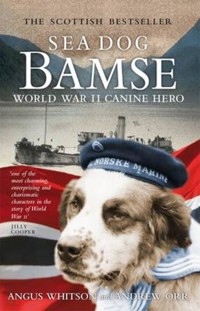
This is the remarkable story of one of the Second World War's most unusual animal heroes. Sea Dog Bamse tells the story of a 14-stone St Bernard dog who became global mascot for the Royal Norwegian Forces and a symbol of freedom and inspiration for Allied troops throughout Europe. From a happy and carefree puppyhood spent as a family pet in the Norwegian fishing town of Honningsvag, the gentle giant Bamse followed his master at the outbreak of the war to become a registered crew member of the mine-sweeper Thorodd. Often donning his own steel helmet as he took his place in the Thorodd's bow gun turret, Bamse cut an impressive figure and made a huge contribution to the morale of the crew, and he gallantly saved the lives of two of them. After Norway fell to the Germans in 1940, the Thorodd operated from Dundee and Montrose, where Bamse became a well-known and much-loved figure, shepherding the Thorodd's crew-members back to the boat at pub closing time, travelling on the local buses, breaking up fights and even taking part in football matches. Mourned both by locals and Norwegians when he died in 1944, Bamse's memory has been kept alive both in Norway, where he is still regarded as a national hero, and in Montrose, where a larger-than-life statue of him was unveiled in 2006 by HRH Prince Andrew. Written from extensive source material and eyewitness accounts, Sea Dog Bamse is a fitting tribute to the extraordinary life of an extraordinary dog.
Sie lesen das E-Book in den Legimi-Apps auf:
Seitenzahl: 293
Veröffentlichungsjahr: 2011
Das E-Book (TTS) können Sie hören im Abo „Legimi Premium” in Legimi-Apps auf:
Ähnliche



















Praise for Sea Dog Bamse
‘tells not just the story of a remarkable dog – it also gives an insight into life during the war’Dundee Courier
‘a stirring memorial to a pet who inspired two war-torn nations’The Mail on Sunday
‘this story should have been told ages ago … a magnificent book about one of the most unusual war heroes to come from Norway’Maritim Logg Norway
‘a lively and affectionate account of Bamse’s life … a highly readable book, a useful piece of living local history … the best possible memorial’Montrose Review
‘great story’The Naval Review
‘Angus Whitson and Andrew Orr have succeeded in piecing together fact and folklore to give as full an account as possible of the life of a singular animal … a well researched, carefully crafted and hugely enjoyable account of one of the most remarkable animals to play a part in World War II’Press & Journal
‘a fitting tribute to the extraordinary life of an extraordinary dog’SCOTS, The Journal of the Scots Heritage Society
‘an entertaining … touching story’ The Scots Magazine
‘the British love a heroic dog, none more so than Bamse … charming’Scottish Legion News
‘be prepared to read this fantastic story in one sitting … a worthy book about a marvellous canine hero’Sea Breezes Worldwide
‘it tells the tale of how he raised the morale of the Norwegian Navy and recounts his extraordinary interactions with the sailors and civilians who knew him’The Times
‘part Marley and Me and part Lassie, this true story of an amazing dog during World War II will appeal to military buffs and animal lovers alike’Waterstones Book of the Month
Sea Dog Bamse
World War II Canine Hero
Angus Whitson and Andrew Orr
To Henny King,without whose vision and application a statue would nothave been created, and this story may not have been told
All knowledge, the totality of all questionsand answers, is contained in the dog.
Franz Kafka
Contents
Title Page
Dedication
Epigraph
A Message from Jilly Cooper
Maps
Introduction
1 Norway’s Nose
2 Family Matters
3 Rumbles of War7
4 Clearing the Decks
5 Tides of War
6 Gallant Efforts1
7 Bamse’s Manor
8 Dog Days1
9 Failing Health27
10 The Sands of Time48
11 The Lady in the Hat66
Postscript78
Sources80
Acknowledgements82
Index85
About the Author
Copyright
A Message from Jilly Cooper
When I wrote my book, Animals in War, Bamse, the glorious Norwegian St Bernard dog, was easily one of the most charming, courageous, enterprising and charismatic characters in the story of World War II.
I am enchanted that he is honoured by his own wonderful biography. Andrew Orr and Angus Whitson have unearthed a wealth of new material, including fascinating interviews with people who really knew Bamse. I am sure that if you hear a rumble of thunder and see the clouds move on the day this book is published it will be Bamse barking with joy and wagging his tail in heaven.
Jilly Cooper
Northern Waters 1939−45
East Scotland Mine Clearance Sector 1941−5
Dundee Docks Area 1939–45
Montrose Docks Area 1939–45
1
Norway’s Nose
The clatter of a handcart’s iron-rimmed wheels on the uneven surface of the cobbled streets drew sympathetic glances from passers-by in the far-northern fishing town. On the handcart lay a little girl, just two years old and desperately ill. She was being taken home from the doctor’s tiny infirmary to die. There was nothing more that Dr Harald Borgeresen could do, and he had broken the news to the frightened parents as gently as possible. The child’s pinched, white face peeped out from blankets piled deep to cushion her from the jolts and bumps of the rough journey. Despite the near sub-zero temperature, her small hand stretched out from beneath the blankets, clutching the hand of her mother, who walked alongside.
It was a short journey from the infirmary to the family home, up the hill past traditional three-storey wooden houses painted dark blue, magenta and cream. In the tight-knit fishing community everyone knew each other; happy events were celebrated and misfortunes were shared by all. Everyone was touched by the little girl’s sickness, from which there seemed small hope of recovery. No one passed the cart without words of encouragement and support, and some came out of their houses to ask after her. The father strained at the cart’s shafts, struggling to ease the rigid wheels over the worst of the ruts. A warm bed heated with earthenware hot-water bottles had been prepared for the small patient, and the mother urged her husband to hurry home out of the bitter weather. The father, no less concerned for their beloved daughter, did his best to calm his distraught wife, pointing out that to go any faster could worsen little Vigdis’ condition. At home, the patient’s older sisters and brother waited apprehensively for their parents’ return, watched over by Bamse, the family’s two-year-old St Bernard dog, who was already showing the reliability and the steadiness of temperament which were to characterise the rest of his life.
Near the top of the hill, where the houses thinned and familiar views over the harbour and the fjord opened out, the makeshift conveyance reached the patient’s home. Bamse’s broad face, staring intently from a front window, disappeared abruptly, and the dog joined the family’s older children as they flung open the front door and trooped out quietly to welcome their little sister home. Bamse seemed to sense the sadness and gravity of the situation, and his normal ecstatic greeting, capering and frisking round the family was subdued. The tawny head pushed over the blankets, and after a couple of confirmatory sniffs his pink tongue licked the little girl’s hand. It was no burden for the father to carry his daughter’s feather-light body to the warm bed, where her mother undressed her. Her siblings went with their father to the kitchen, where he explained the doctor’s prognosis and prepared them for Vigdis’ almost certain death.
In this most northern part of Norway, with its sense of being at the extreme end of the known world, everyone was familiar with death – it is said that at one time every fourth adult male died at sea. These were the days before the wonders of available antibiotics – unlike today, when doctors have a pharmacopoeia of proprietary drugs and remedies with which to attack every illness and ailment. Before World War II, epidemic illnesses were expected and commonplace, not just in Norway, but worldwide. Childhood epidemics, especially, were frequently fatal as doctors had so few means of combating them. The fisher folk of the village were no strangers to adversity, and such deaths were accepted with fortitude and stoicism.
No one had time to give much thought to the dog, who had come into the bedroom with the family and lain down beside the bed. When the girl’s mother had done all she could to ensure her daughter’s comfort, she called Bamse to follow her through to the kitchen and join the rest of the family. But the dog remained where he was, and nothing anyone – not even his master – said or did could persuade him to leave the patient’s side.
From that moment Bamse took charge. Only the mother and the doctor could enter the little girl’s bedroom. As if by some incredible instinct, he seemed to understand that these were the two people best able to care for his smallest charge. All others, including her father, the dog physically debarred from entering. Thus began Bamse’s remarkable vigil, and he did not move from the bedside except to feed and attend the calls of nature. At such times her father and siblings surely snatched a few moments to visit the patient, but made sure they were out of the bedroom by the time the great nanny dog returned.
For 12 days and nights the dog kept his watch. There is only hearsay about the patient’s progress, because the sole person still alive to tell the story is Vigdis herself. As she was so young, she has no memory of coming so close to death, and indeed has never known what she was suffering from. At that age, children sleep much of the day, and the recuperative power of sleep is well acknowledged. To the wonder of the waiting and watching family, the frail child passed through a period of crisis and then gradually began to show signs of recovery, sleeping round the clock and waking only to be fed and changed by her mother.
The prayers of the family had been answered. News of Vigdis’ merciful recovery rapidly spread to neighbours and soon to the rest of the community. The dog’s 12-day vigil, which had begun so hopelessly, ended joyfully with the complete recovery of the little girl who had been sent home to die. Everyone marvelled at Bamse’s intervention, and there was much debate about his contribution to Vigdis’ restoration to full health. Most agreed that it was nothing short of a miracle, and it was an early indication of the dog’s insight and comprehension of human conditions, that developed in such an astounding way in later years.
It seems probable that it was at this point that Bamse began to establish his reputation as a dog far beyond the ordinary. It says something about Bamse that he had the innate confidence to impose his will on his master, and it says something about the father, Erling Hafto, a former naval officer, and presumably not greatly used to being opposed, that he accepted the domestic regime imposed by the family pet. However, something profound must have connected between the two, because in due course they sailed off together to fight a war.
The little girl, Vigdis Hafto, at the time of writing in 2008, is a grandmother in her seventies and a picture of good health. She shows no sign of how close to death she was all those years ago.
If the incidental details of this story have been embellished, in general the events happened as they are told. It all took place in 1938 in Honningsvåg, a fishing and whaling centre and the principal town on the south coast of the island of Magerøya at the extreme north of Norway. It was here that Vigdis grew up with Bamse as her constant companion. Captain Hafto was Honningsvåg’s harbour-master, a job central to the life of the community, and consequently he was one of the town’s leading men. The title ‘captain’ was not a reference to naval rank, but one accorded him as a courtesy in his capacity as harbour-master. It seems strange now that a man of his authority and standing should have had only an ordinary handcart to transport his dying daughter home, but in 1938 Honningsvåg was about as remote a spot in Europe as it was possible to be.
Magerøya Island lies 525 kilometres north of the Arctic Circle − at a similar latitude to Point Barrow in the very north of Alaska − at the very northernmost tip of Europe. There is no landmass between it and the North Pole over 2,000 kilometres away. Almost everything about Magerøya and Honningsvåg – the church, the school, the harbour – always has been, and still is, ‘the world’s most northernmost’. Russian sailors, on their way from the Atlantic Ocean to the Russian port of Murmansk on the Barents Sea, sailed past the steep cliffs of Nordkapp (North Cape) on Magerøya’s north coast, and nicknamed it ‘Norway’s Nose’. In 1938 the only link with the mainland was by boat across the one-kilometre-wide Magerøya Sound, and fishing and agriculture were practically the only commercial activities on the island. Roads were cobbled, and only tracks linked the main town with the outlying villages. Apart from a few commercial vehicles at the harbour, there were no cars. The old town had grown up long before the invention of the internal combustion engine, and its narrow streets were not suited to motor traffic; in any case, Honningsvåg’s whole raison d’ être at that time was fishing and whaling, so boats were the principal means of transportation. Erling Hafto, therefore, could not call for an ambulance to speed his daughter’s journey home from hospital.
Today the island is linked to the mainland by the sub-sea Nordkapp (North Cape) Tunnel. While fishing still forms a core business activity, the island has become increasingly dependent on tourism, and the port of Honningsvåg is a popular cruise-ship destination. It is a land of contrasts: in summer the constant daylight from the never-setting sun brings a surge of energy and activity, while from November until January the sun sinks below the horizon, with the semi-darkness lightened by dazzling displays of the dancing Aurora Borealis, the breathtaking Northern Lights. Mythical bedtime stories of supernatural trolls who steal naughty children’s minds and enslave them contrast with the hard reality of daily life within the Arctic Circle.
Honningsvåg is situated at the foot of the east arc of a horseshoe-shaped fjord at the south end of the island, overlooking Magerøya Sound and the steep cliff faces and dramatic mountains of the mainland beyond. To the south lies the mouth and dark waters of the Porsangen fjord, an inlet of the Barents Sea. The harbour provides a deepwater anchorage, safe in almost all weathers, which explains why the whale catchers and fishermen built their community in such a lonely spot. It would be natural to think that so close to the Arctic ice cap Norway’s northern coast would be ice-bound, at least for some months of the year; but it is not so.
The Gulf Stream system of warm ocean currents keeps the coasts of this part of northern Europe free of ice all year round. The currents originate off the tip of Florida and travel north up America’s eastern seaboard and across the North Atlantic to become the North Atlantic Drift, which splits. One branch heads south past the Canary Islands, skirting the coasts of southwest Europe and western Africa. The other continues northwards, warming Scotland’s west coast on its way, to feed the Norwegian Current. It swirls past Norway’s Nose as it journeys east along Russia’s north coast and peters out, eventually, somewhere in the Barents Sea. All along the northeast aspect of Norway’s fjord-pitted coastline, and then eastwards past the Russian port of Murmansk, the warm currents keep the Arctic ice at bay and the seaways open.
Thanks to the Gulf Stream, in winter the temperature at Honningsvåg is some 20ºC higher than other areas at this latitude. The warm currents carry nutrients that fish feed on, which in turn attract the sea birds that follow the fish. It is small wonder that for generations fishing has been a way of life and culture for these northern people. Cod, haddock, pollack, salmon, halibut and shellfish support a large fishing industry, and the waters abound with seals, dolphins, and killer and minke whales, which traditionally provided food and a source of profit for their hunters.
The combination of an open seaway, a sheltered deepwater harbour and an abundance of sea harvest allowed about 4,000 people to subsist on Magerøya, with just over half of them living in Honningsvåg. The number seems to defy the landscape they clung to – wind-torn, rocky, treeless and barren. Not surprisingly, they were outnumbered by the reindeer, which are far more suited to such a remote place.
It was in this stark landscape that Bamse’s story unfolded. With the mountain ancestry of the St Bernard, a breed that originated in the Himalayas and evolved in the Italian Alps, Bamse was well suited to these Arctic conditions and his subsequent life at sea. He may have seemed just a great bundle of cosy fur, but he represented his breed well as a muscular, northern-climate working dog, and he would not have felt out of his element in the remote region to which his master Erling Hafto brought him.
2
Family Matters
Erling Hafto was born in 1900 in Nedre Eiker, near Oslo, into an entirely different world from the one where he was to spend most of his life, 1,600 kilometres north in Honningsvåg. Not only are there geographical differences, but there is also a distinctness of culture and language. Northern Scandinavia, where Honningsvåg lies, is the home of the indigenous Sami people, who inhabit a vast expanse of territory lying across four nations. The area includes Finnmark and North Troms in Norway, the northern counties of Sweden, Lapland in Finland and the adjacent Kola Peninsula in Russia; it is the land of trolls, reindeer and Santa Claus. The Sami homelands are as alien to the people of Oslo as the Outer Hebrides off Scotland’s west coast, with their Gaelic-speaking inhabitants, are to residents of London. For Erling Hafto, Honningsvåg was a remote place far from his family and his upbringing. It was the sea that brought him to Honningsvåg, and it was the sea took him away to war, before returning him there for the rest of his working life.
From childhood, Erling wanted only to go to sea, and at fifteen he successfully applied for a naval cadetship aboard a sail training ship, the traditional way of entering the Royal Norwegian Navy. He never regretted this early choice and thrived in his new element. Family papers indicate that he was the top cadet of his intake, showing outstanding leadership qualities. He went on to graduate as an officer from the Royal Norwegian Naval Academy.
Given this promising start, it is surprising that Erling decided to leave the navy in 1925, when he was only 25. There are no obvious reasons for this. He plainly did not want to abandon a seagoing life as he was soon engaged by a shipping company as captain of a coastal vessel, plying trade up and down the length of Norway. Pay and conditions may have been better with his new employers, or his decision to leave the navy may have been influenced by meeting his future wife, Halldis, who came from the coastal town of Bodø, the second-largest town of northern Norway. The couple may have fallen in love when Erling’s ship called into the port, which is a centre for shipbuilding and repair. It is notoriously difficult for a sailor to keep romance alive when he is away from shore for extended periods, and Halldis may have made it clear that the life of a sailor’s wife was not for her.
Their marriage in 1927 was to last for nearly fifty years. In 1928, their first child, Kjersti, was born in Bodø. She was followed in 1932 by another daughter, Torbjør. For as long as Erling continued to work at sea, he endured the separations of each voyage. His daughter Vigdis remembers how his family meant everything to her father, and how he hated being away from his wife and children. A desire to settle his family in a stable environment led him to seek a position on land that would make use of his marine experience. In such a seafaring environment there was no shortage of sailors like him who were ready to sling their anchor on shore, and competition was strong whenever suitable posts became available, so it is testimony to his abilities that at the age of only 31 he was appointed assistant harbour-masterat Honningsvåg. Erling and his young family then moved to the port, and it was there that a son, Gunnar-Helge, was born in 1933. In 1935, their youngest child Vigdis arrived.
In the year of Vigdis’ birth, Erling was promoted to harbour-master of Honningsvåg. This was an important post because of the volume of fishing boats and commercial ships that used the port. He was now in a secure government position which allowed him to settle down, establish a family home and plan for a future. His office was on the main quay in the centre of the town’s commercial activities, and the house they lived in was at the top of the hill overlooking the fjord. When not in the office, Erling was seen riding his horse to and from work and around the island when he visited the small outlying fishing harbours. As harbour-master he was central to the commercial life of the port, but Erling was also an outgoing and friendly man and the Hafto family soon played a leading role in Honningsvåg’s social life, and an international sprinkling of sea captains from all over Europe, especially Britain, regularly called at the Hafto house on the hill. The children learned to speak excellent English, hearing it spoken from an early age.
After Vigdis’ birth, Halldis may have thought that the family was complete, but Erling produced a surprise. Twice a year he travelled to Oslo to present his reports to the authorities on the past half-year’s activities at Honningsvåg port. It was a long and slow journey, and he was usually away from home for several weeks, but it gave him the opportunity to visit his family at Nedre Eiker. Like any fond husband and father he returned home from these trips laden with special gifts for his family from the distant capital city of Oslo.
On one of his trips in 1937 he visited a dog breeder near his old family home, and bought a pedigree St Bernard puppy. It is not known whether he had long planned to own such a large family pet, or whether he was captivated by what he saw and bought the puppy on impulse, but he was certainly the first of many who fell under the spell of this particular dog. Whatever his motivation, the puppy accompanied him home as a pet for his children. What Halldis said when her husband presented her with the newest addition to the family can only be guessed at, but with four active children, the youngest only one year old, she might at the very least have suggested his timing was misplaced. Most likely the whole family was involved in choosing a name for their pet and after much discussion, especially amongst the children, everyone agreed upon Bamse.
St Bernards, or Saints, as they are also affectionately known, are one of the most readily recognisable breeds of dog, and one of the largest. Although they are gentle-natured dogs and make ideal pets, it takes a particular type of person and family to take on responsibility for a Saint, as they must be prepared to make room in their lives and home for a very bulky addition. On his arrival in Honningsvåg, Bamse became the most northerly St Bernard in the world, for there is no suggestion that there were any others of his breed on the island. He settled into his new family and surroundings much like any puppy, although he needed more space than the average family pet. At this time, houses on treeless Magerøya were built almost entirely of wood, every piece of which had to be imported from the extensive forests on the mainland. As a result, wood was not to be used extravagantly in house construction, and although the rooms were adequate in size, they were not spacious. A growing St Bernard dog took up more space and posed a bigger problem than a growing child in the Haftos’ relatively small home.
A puppy the size of a Labrador needs feeding on a grand scale, and, as he matured, Bamse’s appetite grew with him. Little can be told about his diet, but he seems to have been influenced by his environment because he acquired a taste for raw fish, possibly out of desperation to satisfy his hunger pangs. It was a taste that would stand him in good stead in later years.
The St Bernard breed we know today was established in the Great St Bernard hospice and monastery founded c.1050 by an Augustinian monk, Saint Bernard of Menthon, at the wild alpine pass that bears his name. The Great St Bernard Pass marks the border between Switzerland and Italy, and, at 2,469 metres, is the highest point on what was once a busy trading and pilgrimage route between the two countries. There are no accurate records of the breed’s true origins and development but it seems generally agreed that St Bernards were descended from Tibetan mastiffs, possibly left behind at the monastery by travellers and kept by the monks, initially, as guard dogs.
Tibetan mastiffs are mountain dogs and their sturdy bone structure and large, broad heads are replicated in the St Bernard. Like their ancestors, Saints have a thick coat to repel the worst weathers and have developed their own colouration, typically red-brown or tawny with white markings. Tibetan mastiffs were originally flock-and guard-dogs, and Bamse was proficient in both roles, learning first to look after and safely shepherd the Hafto children when they visited their father at his office, and later, in Scotland, rounding up Thorodd’s crew after nights out drinking and guarding the ship against unwelcome visitors.
The three youngest children became Bamse’s special charges and companions, although Vigdis says that while he was the family pet and shared by all, it was generally acknowledged that he showed his greatest allegiance to her. The eldest daughter Kjersti, aged nine when Bamse arrived, was at school and too independent to admit to needing a four-footed minder. The four youngest members of the family – including Bamse now – were thrown together, and as the puppy grew, inevitably faster than his human companions, the children looked to him for friendship and comfort. They perhaps even regarded him as gang leader. From early on, Bamse began to display common sense, dependability and all of the other positive traits of his breed, responding well to the trust that the children and their parents put in him.
It took pressure off Halldis, despite her initial reservations, to know that the big nanny dog was so protective towards the children. As the friendship between dog and children developed and their reliance on him grew his influence spread beyond the immediate Hafto family. Vigdis remembers when he grew big enough to give the smaller children rides on his back, and it was not long before he was a favourite amongst all the neighbouring families. As his coat thickened, the young children used him as they might an electric blanket, snuggling up to him for warmth. Scarcely out of puppyhood, he already displayed a patience with the demands of children that would normally be exceptional in an adult dog, and he became the children’s constant playmate.
As he grew stronger and his usefulness became apparent, a harness with two large panniers for carrying food and shopping was made for him. In the winter, he was harnessed to a sledge and delighted the children with his willingness to provide sleigh rides. He accepted all of these tasks with equanimity and clear enjoyment, as though they were his contribution to his adoptive family’s well-being. As he matured, a pattern of behaviour emerged which marked him out as a dog with an outstanding affinity for human beings. The defining incident early on in his life, which cemented the esteem held for him not only within the Hafto family, but by all the people of Honningsvåg, was his long vigil over Vigdis and her incredible recovery.
Thereafter, the Hafto parents were confident that they could leave their younger children alone in Bamse’s safekeeping and that he would ensure that they came to no harm. The children were regular visitors to their father’s office at the harbour and they clung tightly onto Bamse’s fur as he guided them safely there and home again. Island life in pre-World War II Norway was pretty safe for young children, slower and more tranquil than on the mainland – closer to nature and lacking many of mainland living amenities. There were no motor vehicles to avoid, but the sea could be dangerous, and although everyone knew everybody else and kept an eye on youngsters wandering where they shouldn’t, it was impossible to be alert constantly to what children were up to. Bamse had proved he could anticipate danger and divert the children from it.
Regardless of the affection she and the whole family felt for him, however, Halldis found Bamse’s increasingly hefty physical presence very intrusive as he took up more and more space in the family home. Even though he contributed much to the Hafto family life, Halldis found it increasingly difficult to cope with him, especially on her own when her husband was away. St Bernards are generally not fully grown until they are at least two years old, and Bamse grew to be very large, even by the breed standards of the time. Despite the maturity he had displayed while he was growing up, as he approached his second birthday he still behaved like a puppy from time to time, displaying a bouncy, jolly temperament and knocking over children, and even adults, in his enthusiasm for life and people. One sweep of his tail could clear a table of everything upon it. Although her mother may have wished that her husband had not come home with such an unsuitable pet for her small house, Vigdis makes it clear that a deep, durable bond grew up between herself and her nanny dog, and this bond was never severed by distance or by time.




